Zone 8: Warm temperate

The average annual extreme minimum falls within 10°F to 20°F. Use that limit for perennial winter survival, then add local heat, frost timing, wind, soil, and moisture.

Winter band
10°F to 20°F
Regional overlap
4 climate regions
Best use
Screen returning plants

Use Zone 8 as a winter limit

USDA Zone 8 has an average annual extreme minimum temperature of 10°F to 20°F. Use it to screen winter survival, then check heat, frost dates, and soil.

Good decision

Use the zone to remove trees, shrubs, and perennials that cannot survive the expected winter low.

Incomplete decision

Do not use the number alone for annual planting dates, summer heat, irrigation, soil drainage, or disease pressure.

The same zone behaves differently across the country

Southeast

Zones 7–10

Long, hot, humid summers meet mild winters. Plant choice depends as much on disease resistance and heat tolerance as winter survival.

Rainfall
45–65 inches annually
Growing season
240–365 days
Frost window
Mar 1 – Apr 15 to Oct 15 – Nov 30

Southwest

Zones 8–10

Heat, low rainfall, alkaline soil, and intense sun drive plant choice. Water strategy matters more than a mild zone number suggests.

Rainfall
8–15 inches annually
Growing season
270–365 days
Frost window
Feb 15 – Mar 30 to Nov 1 – Dec 15

Pacific Northwest

Zones 7–9

Mild wet winters and dry summers support conifers and shade plants, but summer irrigation and winter drainage need separate plans.

Rainfall
35–150 inches annually
Growing season
220–280 days
Frost window
Mar 15 – May 1 to Oct 1 – Nov 15

California

Zones 8–11

Mediterranean rainfall patterns and strong local microclimates make summer water, elevation, coast exposure, and fire conditions decisive.

Rainfall
10–40 inches annually
Growing season
300–365 days
Frost window
Jan 15 – Apr 1 to Nov 1 – Dec 31

Regional cautions

  • Fungal disease in humidity
  • Tropical storm damage
  • Heat stress on cool-season plants
  • Heavy clay soils
  • Extreme heat and drought
  • Alkaline soils

Check four conditions after winter hardiness

Season plan

  1. Last spring frostSets the earliest practical timing for tender plants.
  2. Summer heat and humidityCan stress plants that survive the winter easily.
  3. Root-zone drainageWet winter soil and dry summer soil create different failures.
  4. Yard microclimatesWalls, slopes, wind, and low pockets can shift exposure inside one property.

Zone 8 next steps

Half zones and temperature bands

USDA splits each 10°F zone into two 5°F half zones. The 1991-2020 map averages the coldest night of each year at 13,412 weather stations; it is not the coldest temperature ever recorded.

Zone 8 at a glance

Half zoneAverage annual extreme minimum (°F)Same range (°C)
8a10°F to 15°F-12.2°C to -9.4°C
8b15°F to 20°F-9.4°C to -6.7°C

Frost dates are not part of the zone. Find them for the weather station nearest you with our frost date calculator guide, then count your season with the frost date calculator.

Sources: USDA Plant Hardiness Zone Map, USDA ARS 2023 map release, NOAA NCEI U.S. Climate Normals.

Plants whose published range includes Zone 8

Grouped by plant type. Each note repeats the hardiness, light, and water lines from the plant's own profile. Confirm the exact cultivar before buying.

Plant shortlist

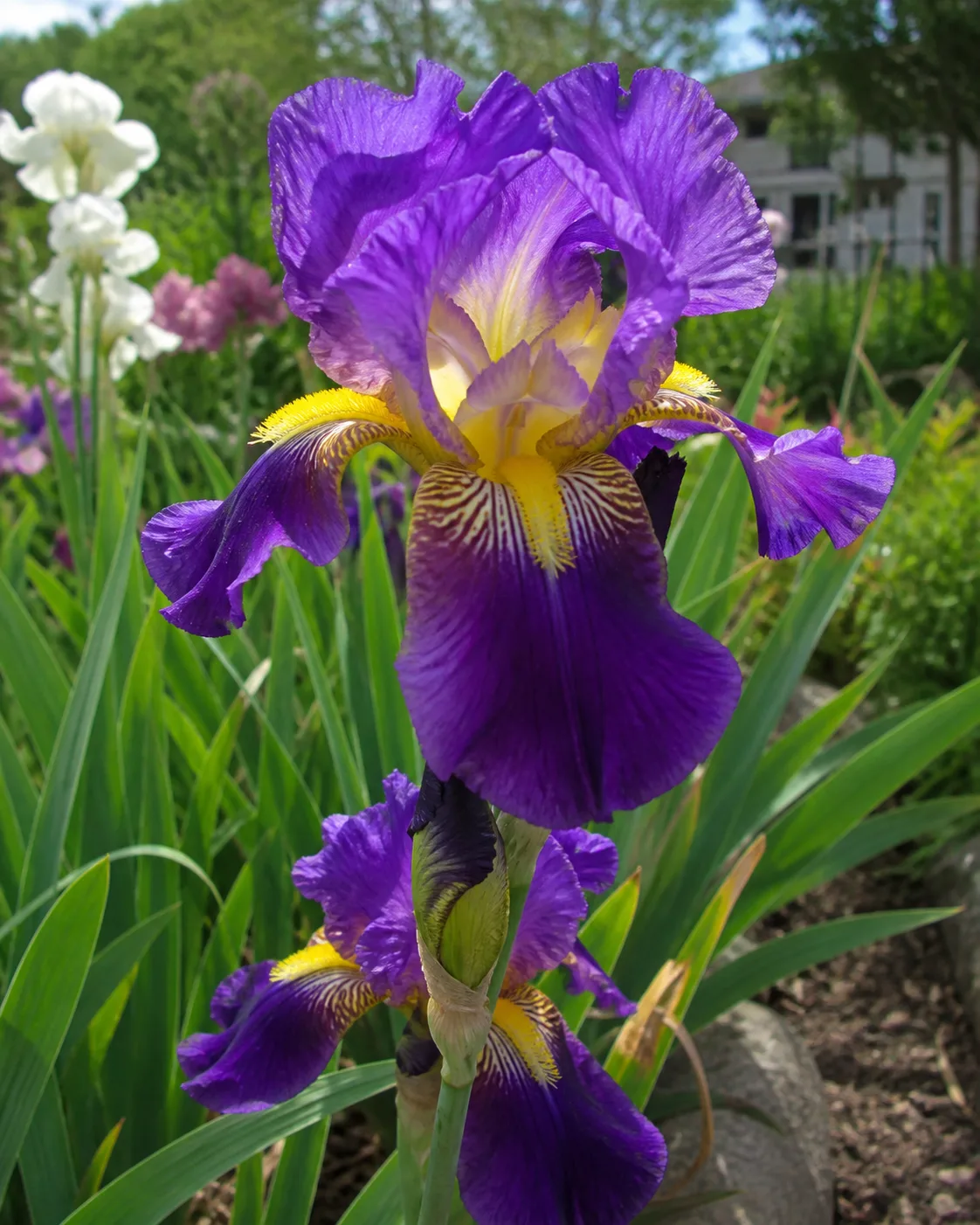
Bearded Iris plant in bloom in a garden setting

Flowers 10

  • Bearded Iris: USDA Zones 3-9 · Full sun, afternoon shade in heat · Moderate while establishing, low once settled
  • Chrysanthemum: Typically hardy in Zones 5-9, cultivar dependent · Full sun, at least 6 hours of direct sun · Consistent moisture in well-drained soil
  • Daffodil: Hardy in USDA Zones 3-8 · Full sun to light shade in spring · Moist after planting, never waterlogged
  • English Lavender: Zones 5-9, protect near cold edge · Full sun, 6 or more hours daily · Low once established; avoid wet crowns

All 10 flowers for Zone 8

Fruits 4

  • Peach Tree: Zones 5-9 (NC State) · Full sun, 6+ hours · Moist, well-drained soil (NC State)
  • Pear Tree: USDA Zones 4-8 · Full sun, 6+ hours · Deep watering while young and during dry spells
  • Plum Tree: Zones 4-9 · Full sun, 6+ hours · Deep watering while young and during fruit sizing
  • Pomegranate: USDA Zones 8-10, and 7b with protection (Clemson) · Full sun, 6+ hours · Drought tolerant once established; even moisture while fruit develops

Herbs 2

  • Rosemary: USDA Zones 8-10; hardier cultivars to zone 7 or 6b with protection · Full sun, 6 or more hours · Low; let the soil dry between waterings
  • Sage: USDA Zones 4-8 · Full sun to partial shade · Low, and never in wet soil

Houseplants 2

  • Aloe Vera: Outdoors year-round in zones 8–11 (UF/IFAS, Florida); a houseplant elsewhere · Full sun or very bright indirect light, at least 6 hours of sun · Water deeply once soil is dry 3–4 in down (1–2 in for young plants)
  • Cast Iron Plant: Zones 7-11 outdoors, any zone indoors · Dappled to full shade; avoids direct sun · Low, let the soil dry 2 to 3 in down

Lawn Grasses 4

  • Bahia Grass: USDA Zones 8-10 · Full sun, 6+ hours · Rainfall alone may be enough in a normal year (LSU)
  • Buffalo Grass: USDA Zones 4-8 · Full sun, 6–8 hours · Deep soak about every 2 weeks in hot dry weather (K-State)
  • Centipede Grass: Zones 7-10, Southeast · Full sun to moderate shade · About 1 in. per week in active growth, rain included
  • Perennial Ryegrass: Zones 3-8 (NC State) · Full sun (6+ hours) or partial shade (2-6 hours), per NC State · 1-1.5 in. per week (Iowa State); up to 2.25 in. in hot, dry, windy weather (Colorado State)

Perennials 12

  • Amsonia (Bluestar): Zones 3-9 eastern, 5-8 threadleaf (NC State) · Full sun (6+ hours) to part shade (2-6 hours) · Drought tolerant once established
  • Black-Eyed Susan: USDA Zones 3-8 · Full sun, 6 or more hours · Evenly moist; drought tolerant once established
  • Coneflower: Zones 3-8 (Illinois), 3-9 (Clemson) · Full sun to part shade · Drought tolerant once established, in well-drained soil
  • Coral Bells: Zones 4-9, some varieties to Zone 3 (UVM) · Part sun to part shade for best color; check the plant tag · Moist, well-drained soil; water until established

All 12 perennials for Zone 8

Shrubs 19

  • Aucuba: USDA Zones 7-10 · Partial to full shade, avoid afternoon sun · Moderate, drought tolerant once established
  • Barberry: USDA Zones 4-8 · Full sun to partial shade · Dry to average soil once established
  • Beautyberry: USDA Zones 6-10 (NC State) · Full sun to part shade · Tolerates drought and wet soil
  • Boxwood: USDA Zones 5-8 · Part shade with afternoon shelter; full sun is tolerated · A thorough weekly soak when rain is under 1 inch; needs drainage

All 19 shrubs for Zone 8

Trees 16

  • Cherry Blossom Tree: USDA Zones 5-8 (‘Okame’ Zones 6-9) · Full sun with open airflow · Even moisture while young; poorly drained soil is not tolerated
  • Eastern Redbud: USDA Zones 4-9 · Full sun to partial shade · Moist, well-drained soil
  • Flowering Dogwood: USDA Zones 5-9 · Sun with some afternoon shade · Moist, well-drained soil, watered deeply in dry spells
  • Ginkgo Tree: USDA Zones 4-8 · Full sun to partial shade · Water new trees until established, drought tolerant after

All 16 trees for Zone 8

Vegetables 3

  • Corn: Warm-season annual (NC State lists zones 2-11) · Full sun, 6+ hours · At least 1 in a week, soil moist 6 in deep
  • Cucumber: Warm-season annual (NC State lists zones 2-11) · Full sun · About 1 in a week, soil moist 6 in deep
  • Garlic: Zones 4-9, planted in fall · Full sun (6+ hours) · About 1 in. a week, stopped before harvest

Zone 8 questions

What temperatures define USDA Zone 8?

Zone 8 covers an average annual extreme minimum of 10°F to 20°F. Half zone 8a runs from 10°F to 15°F and 8b from 15°F to 20°F. The 2023 USDA map uses 1991-2020 data from 13,412 weather stations.

Does Zone 8 tell me my frost dates?

No. A hardiness zone describes winter lows only. Frost dates come from local weather station records, such as the NOAA 1991-2020 U.S. Climate Normals, so look them up for the station nearest you before you plan planting dates.

How many KnowTheYard plant profiles include Zone 8?

72 published profiles state a hardiness range that includes Zone 8, across 9 plant categories. Hardiness is the first filter; check light, water, heat, and mature size on each profile.