
Best Ornamental Grasses for Landscape Texture
Compare ornamental grasses by mature size and season, prevent flopping, set plant spacing, time cutback, and check invasive status first.
At a glance
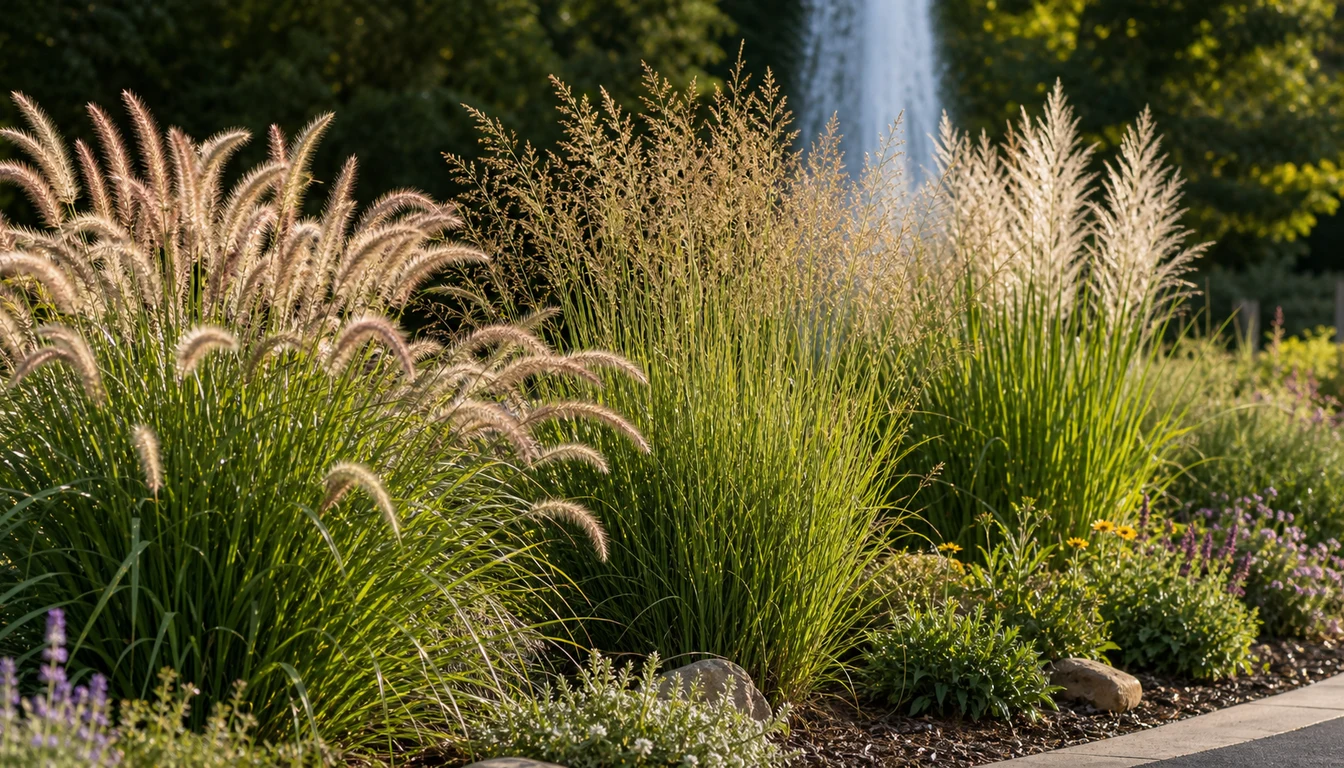
Ornamental grasses are the plants people buy for movement, and the ones they most often plant at the wrong spacing.
This page covers the clump-forming perennial grasses grown in beds and borders, which are a different group from the turf species mown as a lawn. Size, the season each grass earns its place, and four planting decisions are what keep an ornamental grass bed looking deliberate by its third year.
What Counts as an Ornamental Grass
An ornamental grass is grown as an individual clump and left standing. It is never mown as a surface, which is the whole difference between this group and the turf species that make a lawn.
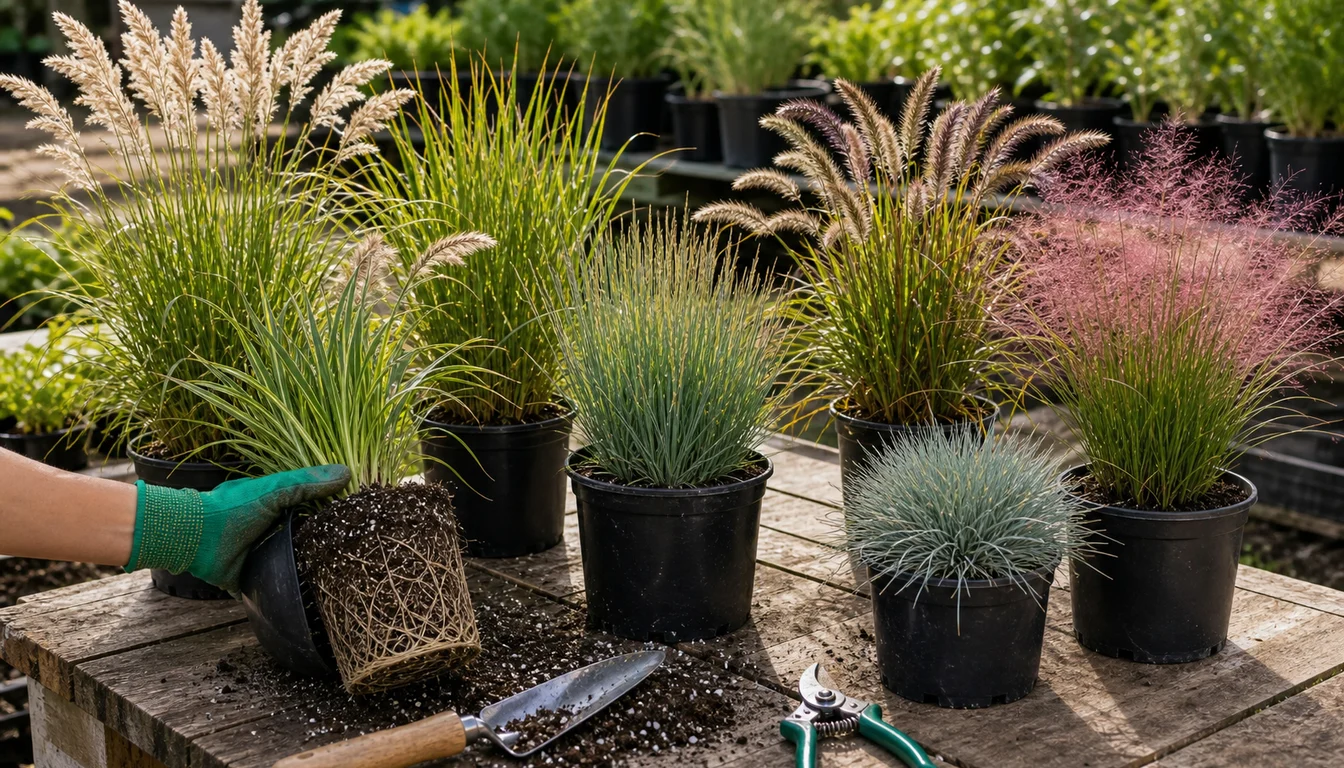
That distinction matters at the point of purchase more than anywhere else. These plants are sold in one or two gallon pots at a small fraction of their mature size, so the thing on the bench tells you almost nothing about the thing you are actually buying.
A grass that fits comfortably in a one gallon pot can be five feet across in three seasons.
Look up the mature height and width before you look at anything else, because the label photograph and the pot both understate it. Everything about growing them follows from that one number.
The Grasses Worth Planting, by Size
Size is the first filter for this group because the range inside it is extreme. The same shelf holds a plant that stays an eight inch mound and one that will block a window.
The low mounds edge paths and front borders, the mid-height uprights do the structural work in a bed, and the tall ones are screens that happen to be grasses.
Four of the seven below are North American natives, which changes more than appearance. Native switchgrass, little bluestem and muhly support local insects the way a pollinator planting does, and none of them carry the seeding problem covered further down.
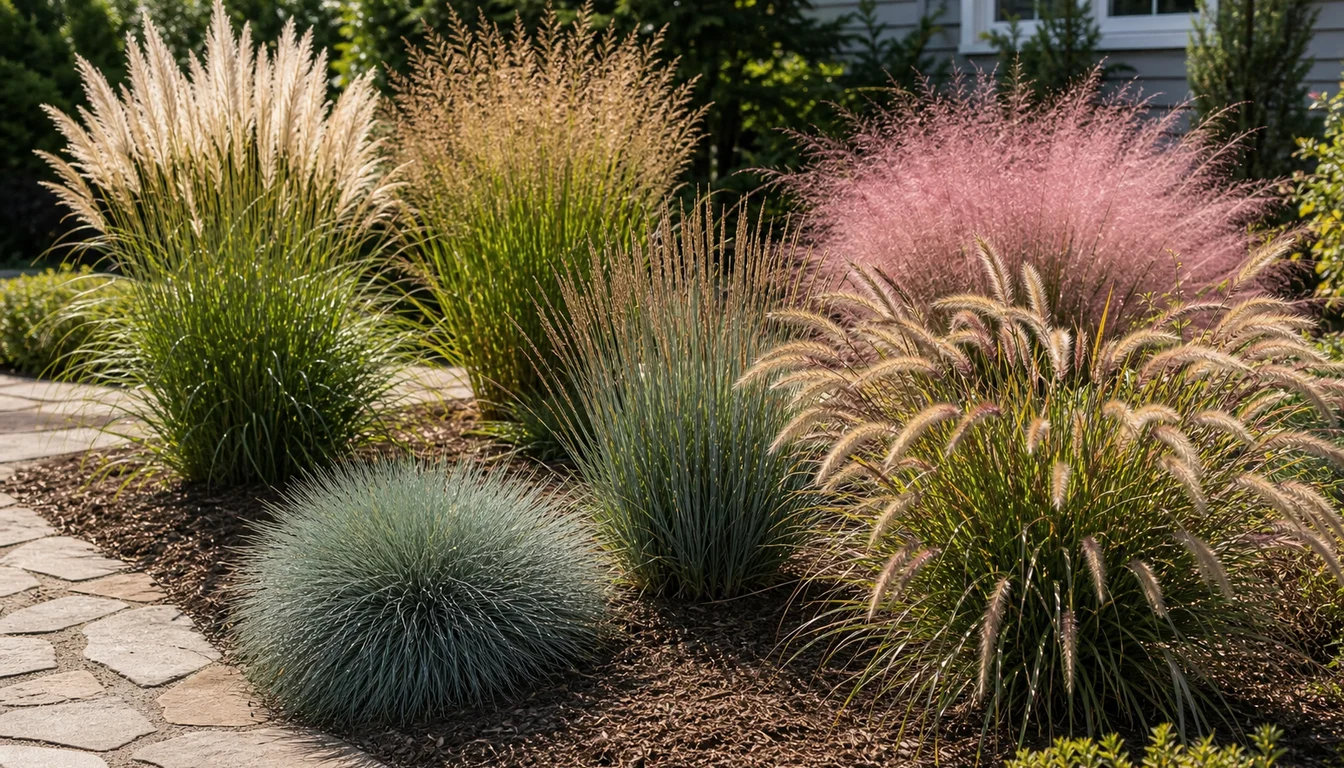
| Grass | Mature size | When it peaks | What it is for |
|---|---|---|---|
| Blue fescue | 8-12 in mound | Spring into early summer | Front edge, short-lived, replace every few years |
| Little bluestem | 2-4 ft, Zones 3-9 | Late summer into winter | Native, copper winter color |
| Fountain grass | 2-4 ft | Late summer | Soft plumes; the purple form is an annual below Zone 9 |
| Pink muhly | About 3 ft, Zones 6-10 | Autumn | Native, a pink haze for a few weeks |
| Switchgrass | 3-6 ft | Late summer into winter | Native, upright and wind-firm |
| Feather reed grass | 4-5 ft in flower | Early summer, stands all winter | Sterile, the most vertical of the group |
| Maiden grass and miscanthus | 5-8 ft | Autumn | Screening; check the invasiveness note below |
Warm-Season and Cool-Season Grasses Live on Different Clocks
These plants split into two groups that run on completely different calendars, and knowing which one you own settles most of the worrying. Warm-season grasses stay dormant until late spring and then build toward a late summer and autumn peak.
Cool-season grasses do the opposite, greening up early and often going quiet through midsummer heat. Feather reed grass and blue fescue are the cool-season entries on the list above, and everything else on it is warm-season.
The practical consequence is that a bed built only on warm-season grasses is bare from frost until around June.
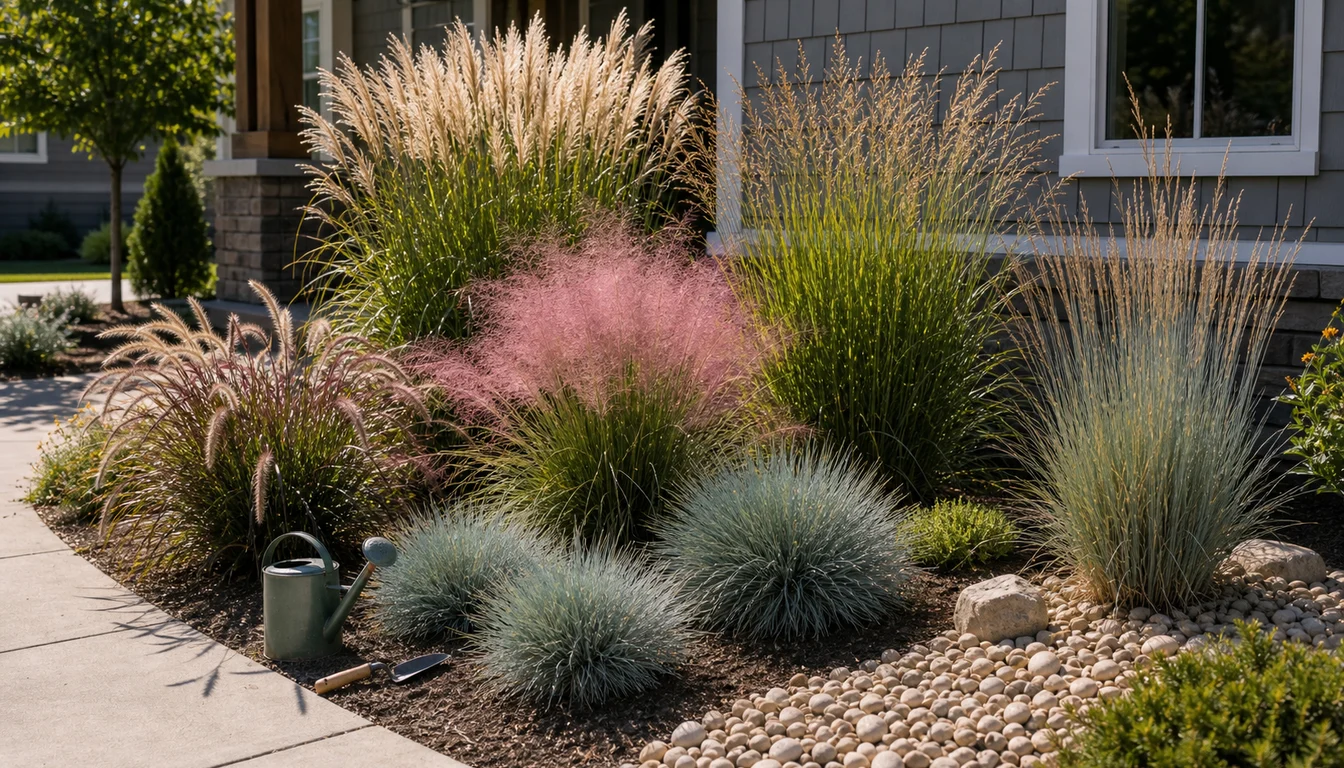
- Early spring: cool-season grasses are already growing while the warm-season clumps look dead
- Midsummer: cool-season types can go dull, and this is when a full-sun perennial alongside them carries the bed
- Late summer and autumn: the warm-season grasses peak, which is when to judge the planting
- Winter: standing stems and seed heads are the whole point, so leave them
Check Miscanthus Against Your State Before Buying
The largest and most widely sold grass on the list is the one carrying a caveat. Miscanthus sinensis self-seeds into natural areas and is listed as invasive in a number of US states, with how much seed it sets varying by cultivar and by how long the local growing season runs.
There are straightforward swaps that do the same visual job. Feather reed grass 'Karl Foerster' is a sterile hybrid that sets no viable seed at all, and switchgrass gives similar height with native credentials, while a Russian sage covers the airy gray-blue role from a different direction entirely.
Search your state's invasive plant list for Miscanthus sinensis before buying one, and if it appears there, buy feather reed grass or switchgrass instead. Both reach screening height without the seed.
Why an Ornamental Grass Flops Open
Flopping is not the same as leaning in wind, and the difference is where the collapse starts.
A flopped clump splays outward from its own middle so the center opens up like a hoop, while a healthy clump leans as one piece and springs back. Four things cause the first kind, and staking fixes none of them.
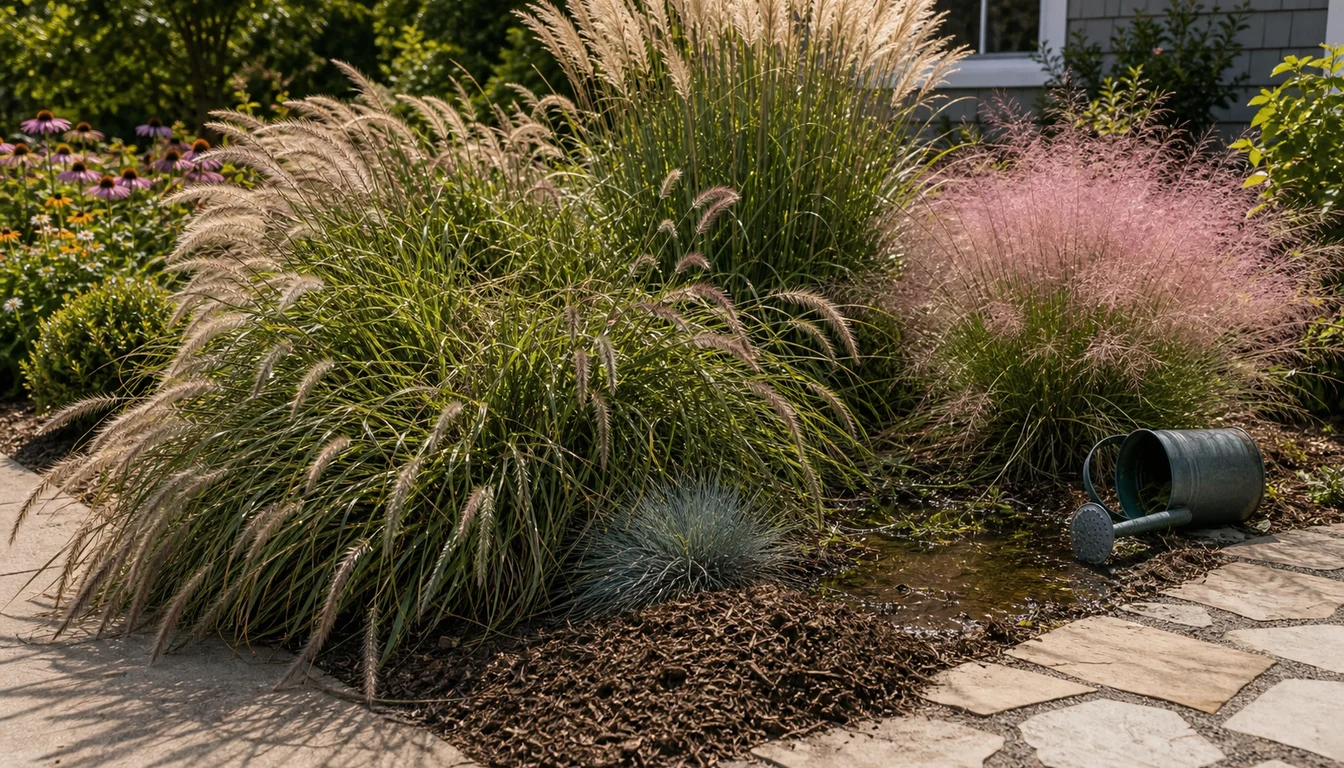
- Lush, soft, leaning by midsummer: too much nitrogen, so stop feeding it entirely
- Floppy in a bed watered with everything else: too much water, and most of these are drought tolerant once established
- Stretched and thin-stemmed: under six hours of sun, so move it rather than treat it
- Dead or hollow center, growth only around the rim: the clump is three or four years old and needs dividing
Cut Back in Late Winter, Not in Autumn
Cut in late winter or early spring, before new growth pushes up through the crown. Once green shoots are already several inches up, shearing leaves cut tips that stay visible for the rest of the season.
Waiting is not laziness, because the standing stems are doing two jobs all winter. They carry the structure that is most of the reason to grow these plants, and they shelter insects that overwinter in hollow stems.
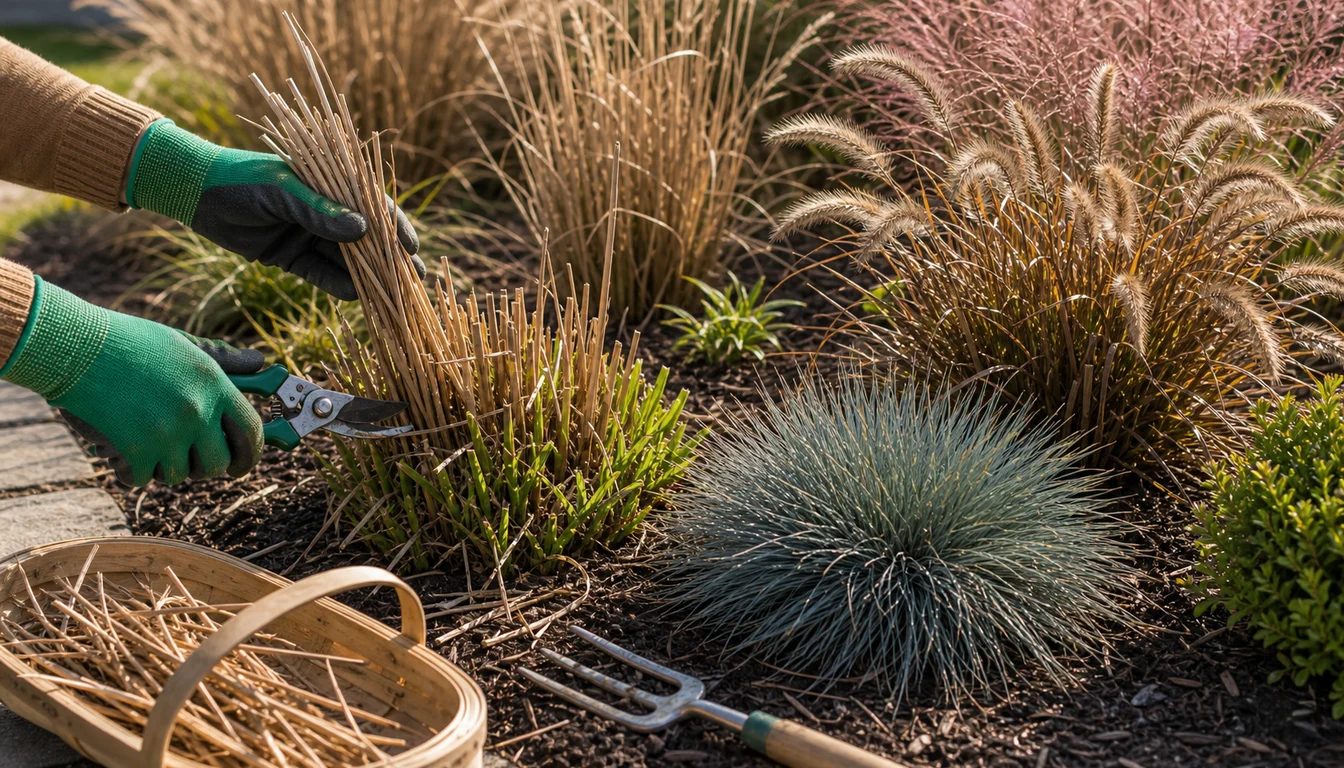
- Warm-season clumps: shear to roughly 4 to 6 inches once you see new shoots at the base
- Feather reed grass: cut low in late winter, since it starts moving earlier than the rest
- Blue fescue and evergreen types: comb the dead blades out by hand rather than shearing hard
- Any clump already 6 inches into growth: cut above the new shoots and accept the tips this year
Space Them for Their Mature Width, and Divide on Time
Space each plant at its mature width, so a grass that reaches four feet across goes four feet from its neighbor. That produces a planting that looks sparse and slightly wrong for its first season, which is the correct appearance and not a mistake to fix by buying more plants.
Fill the gaps meanwhile with perennials that share the same sun and drainage and will not be swamped once the clumps close in. Coneflower and black-eyed Susan hold their own beside a mature grass, aster extends the season past it, and low sedum or an upright liatris stays visible in front of one rather than disappearing behind it.
Then plan on lifting them.
Most clumps need dividing every three or four years, and the signal is a dead center with growth only around the rim. Divide warm-season grasses in spring as growth starts, never in autumn, using the same lift-and-split approach as dividing any clumping perennial.
Quick Tips
- Look up mature width before buying, since the pot understates it badly.
- Space at mature width and accept a gappy first season.
- Judge a warm-season planting in September, not in May.
- Leave the stems standing through winter for structure and insect shelter.
- Shear warm-season clumps to 4 to 6 inches in late winter, before shoots rise.
- Comb blue fescue out by hand instead of shearing it hard.
- Check Miscanthus sinensis against your state list, and buy feather reed grass if it appears.
Frequently Asked Questions
What is the difference between ornamental grass and lawn grass?
Ornamental grasses grow as individual clumps that are left standing and never mown, while lawn turf is a continuous surface cut to a set height. They are different species groups doing different jobs, so mowing heights and turf care advice do not apply here.
How far apart should ornamental grasses be planted?
At their mature width, so a grass reaching four feet across is planted four feet from its neighbor. The bed will look sparse the first season and close up in the second or third, and planting tighter to fix the early gap is what produces a collapsed bed later.
When should I cut back ornamental grasses?
Late winter or early spring, before new growth pushes through the crown, cutting warm-season clumps to roughly 4 to 6 inches. Leaving them through winter is deliberate, since the standing stems carry the structure and shelter overwintering insects.
Why is my ornamental grass flopping over?
Look at where the collapse starts, because a clump splaying open from its middle is different from one leaning in wind. Too much nitrogen, too much water and under six hours of sun all soften the stems, and a hollow center after three or four years means it needs dividing rather than staking.
Are ornamental grasses invasive?
Most are not, but Miscanthus sinensis self-seeds into natural areas and is listed as invasive in a number of US states. Check your state list before buying one, and choose sterile feather reed grass or native switchgrass, little bluestem or muhly instead.
Which ornamental grasses stay small?
Blue fescue holds an 8 to 12 inch mound and suits a front edge, though it is short-lived and usually wants replacing every few years. Little bluestem at 2 to 4 feet and fountain grass at a similar height are the next step up before the screening grasses begin.
Sources & References
- University of Minnesota Extension, Ornamental Grasses for Cold Climates
- USDA National Invasive Species Information Center, Chinese Silvergrass
- Missouri Botanical Garden Plant Finder, Ornamental Grasses
- North Carolina Extension Gardener Plant Toolbox
- Penn State Extension, Ornamental Grasses in the Landscape