
A Drought Tolerant Plant Is Not Drought Tolerant Yet
Colorado State puts it in one sentence. Drought tolerant plants are not drought tolerant until their roots are established in the soil.
The label on the pot describes a state the plant will reach, not the plant you are carrying to the car. Between those two things sits a period of regular watering that almost nobody plans for and most people abandon halfway through.
For a tree the figure is a minimum of one year per inch of trunk diameter, so a three inch tree is a three year commitment before the word on the label applies at all.
That reframes this from a shopping list into a schedule with an end date. Most of the plants that died in low water gardens were the right plants.
At a glance
When Does a Drought Tolerant Plant Become Drought Tolerant?
Not on the day it goes in the ground, and not for a long time afterwards.
Colorado State states the rule directly. Drought tolerant plants are not drought tolerant until their roots are established in the soil, which means the label describes a condition the plant has to reach rather than a property it arrives with.
The plant in the pot has a root ball the size of the pot. Until those roots have grown out into the surrounding soil, it can only draw on the small volume it came with, which is the same predicament as a plant in a container with no watering can.
Establishment for a newly transplanted tree takes a minimum of one year per inch of trunk diameter. A two inch tree needs two years, a three inch tree needs three, and the clock starts at planting rather than at purchase.
Shrubs and perennials need regular irrigation for the first couple of years for the same reason, on a shorter timetable.
That gap explains most of the failures.
A gardener buys the right plants, puts them in, waters for a month, and stops because the label said they would not need it.
The plants that died were the correct choices, abandoned one or two years early.
How Much Water Does a New Planting Need, and for How Long?
There is a rate, and it is bigger than a watering can.
A tree without lawn irrigation over it takes 10 gallons of water each week per inch of trunk diameter. A two inch tree therefore takes 20 gallons a week, which is a hose running slowly rather than a passing splash.
The frequency changes with the season. From May to September trees are watered weekly to twice a month, and from October to April one to two times a month, and only when the air temperature is above 40 degrees Fahrenheit.
Time of day matters for how much of it arrives. All plantings are watered between 6pm and 10am, when less of it evaporates on the way in.
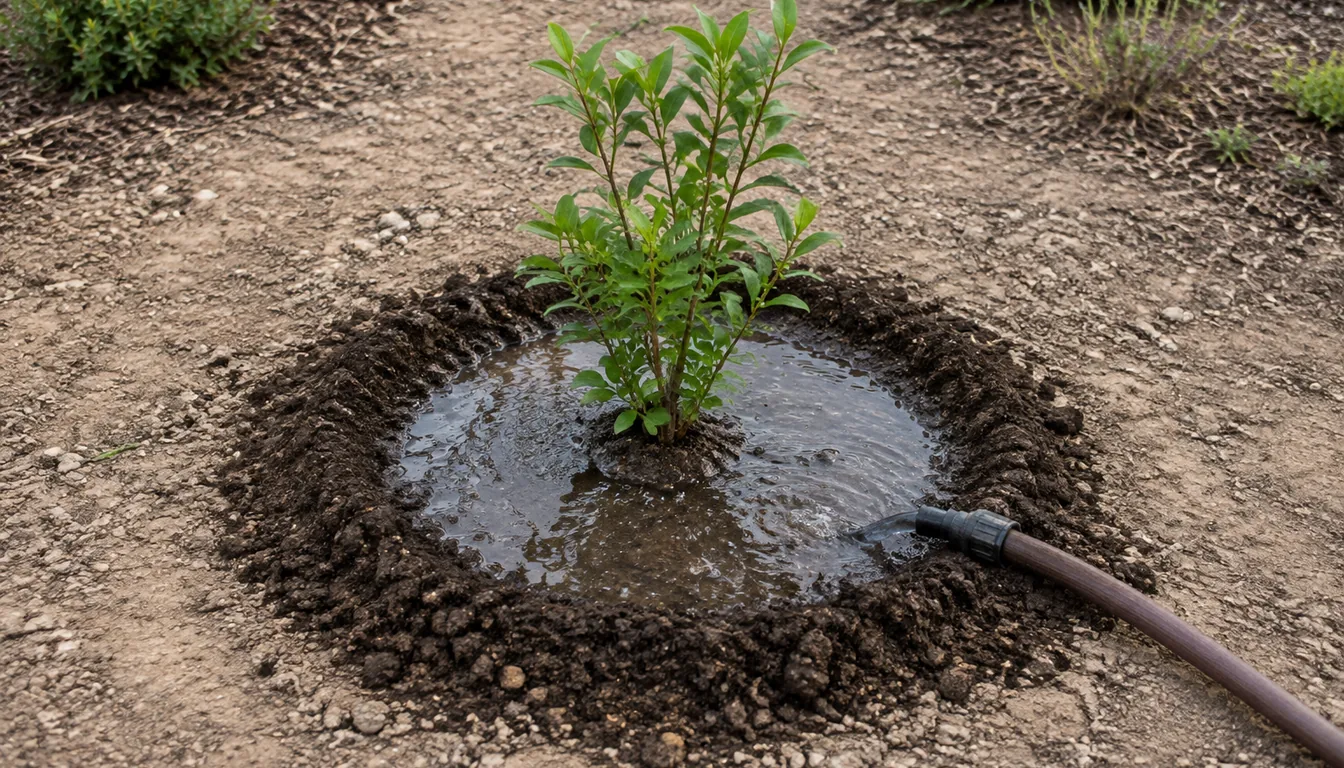
Where it goes matters more than most people realize. Water is directed to the surrounding soil as well as the original root ball, since roots grow toward moisture and watering only the root ball teaches them to stay in the hole they came in.
Depth is the target. A tree's absorbing roots sit in the top 12 inches of soil, so the water has to soak in rather than run across the surface, which is what a low ring of soil mounded around the plant is for.
- Rate for a tree
- 10 gallons a week per inch of trunk diameter
- May to September
- Weekly to twice a month
- October to April
- Once or twice a month, only above 40F
- Time of day
- Between 6pm and 10am
How Do You Group Plants So the Water Goes Where It Is Needed?
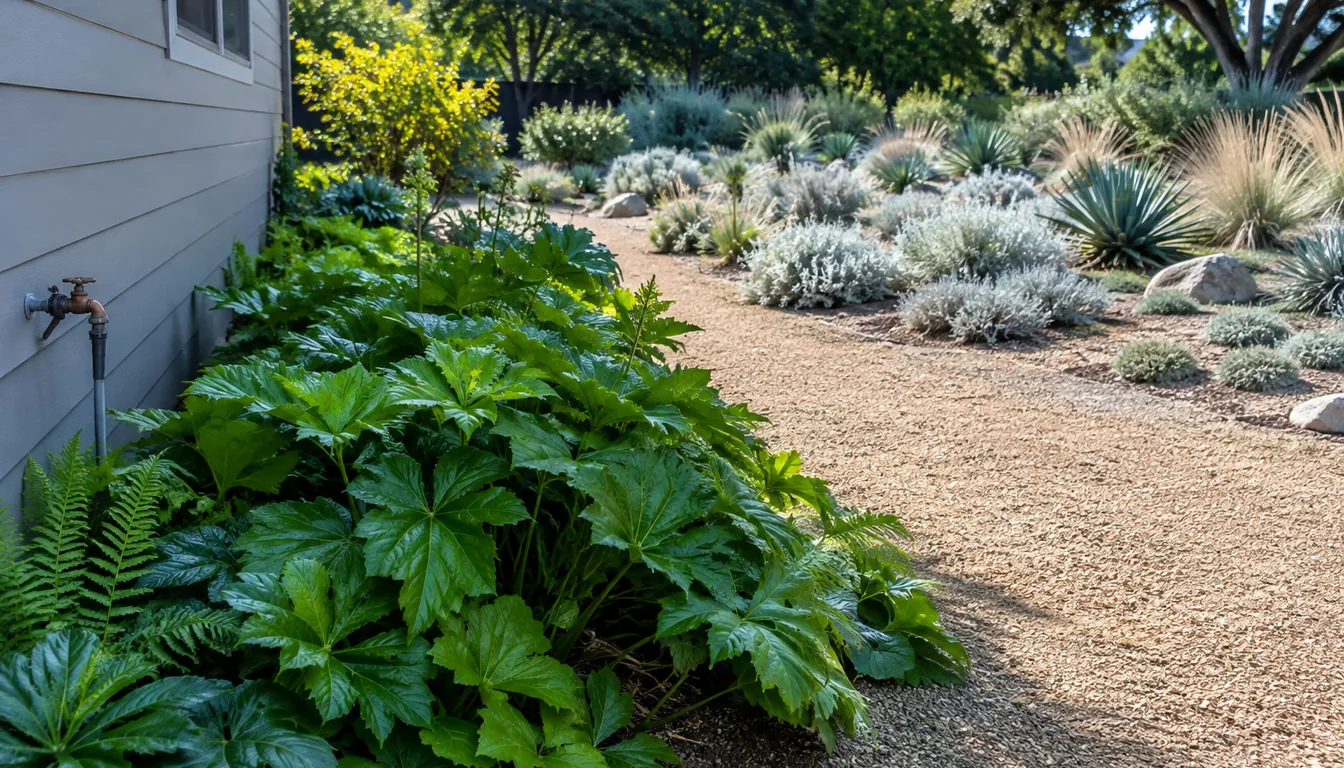
Plants with similar water needs go together, in what is called a hydrozone.
The point is that each group can then be watered effectively for the health of everything in it, rather than every plant in the bed getting whatever suits the average.
Mixing is what defeats a low water garden. One thirsty plant among drought adapted neighbors puts the whole bed on the thirsty plant's schedule, and the dry-adapted plants around it start dying of drainage rather than drought.
Layout follows convenience, and convenience follows honesty about what you will actually do. The high water group stays small and goes near the house and the tap, where it is easy to reach and impossible to forget.
The low water group takes the large areas furthest from the tap, which is where nobody wants to drag a hose anyway. Those two facts happen to agree, which is the useful part.
Do it before planting. Grouping is a design decision, and it is very difficult to retrofit once everything is in the ground and rooted.
| Zone | Where it goes | What belongs in it |
|---|---|---|
| High water | Small, near the house and the tap | Containers, vegetables, anything that wilts fast and is worth the effort |
| Moderate water | Between the two, along paths and seating | Plants that take a soak in a dry spell but do not need a schedule |
| Low water | The large areas furthest from the tap | Established drought adapted planting, on rainfall alone once settled |
How Deep Should the Mulch Be, and Where?
One depth does not cover a garden, which is where most mulching goes wrong.
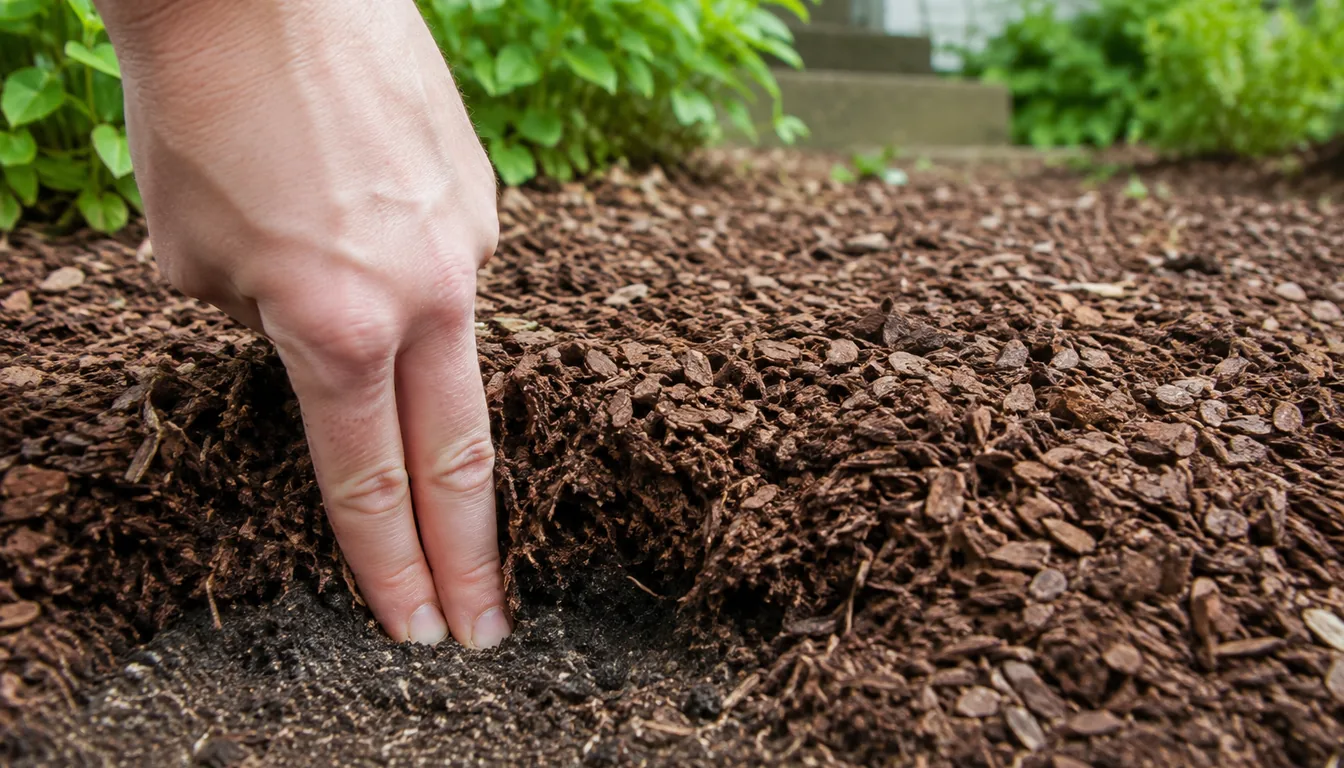
Around trees the layer goes on at 3 to 4 inches, spread over an area extending 2 to 4 feet out from the base of the trunk, so it is covering root zone rather than decorating a circle.
Flower beds take much less. A layer of 1 to 2 inches is enough there, and a deeper layer over crowns and low growth keeps them damp all winter.
Vegetable beds sit at 3 inches or less, which keeps the soil moist without slowing the warming a vegetable garden needs in spring.
The reason the numbers differ is what sits underneath them. Too little dries out and stops doing its job, and too much holds moisture against crowns and stems that need to breathe.
One rule crosses all of them. Mulch never touches a trunk or a stem, whatever depth it is at over the rest of the bed.
| Where | Depth | Watch for |
|---|---|---|
| Around trees | 3 to 4 in, extending 2 to 4 ft from the trunk | Never heaped against the bark |
| Flower beds | 1 to 2 in | Deeper keeps crowns damp through winter |
| Vegetable beds | 3 in or less | Deeper slows the soil warming in spring |
| Against any stem | None | Keep a clear gap all the way round |
Which Plants Actually Suit a Low Water Garden?
A list is a starting point, and the plant itself tells you more.
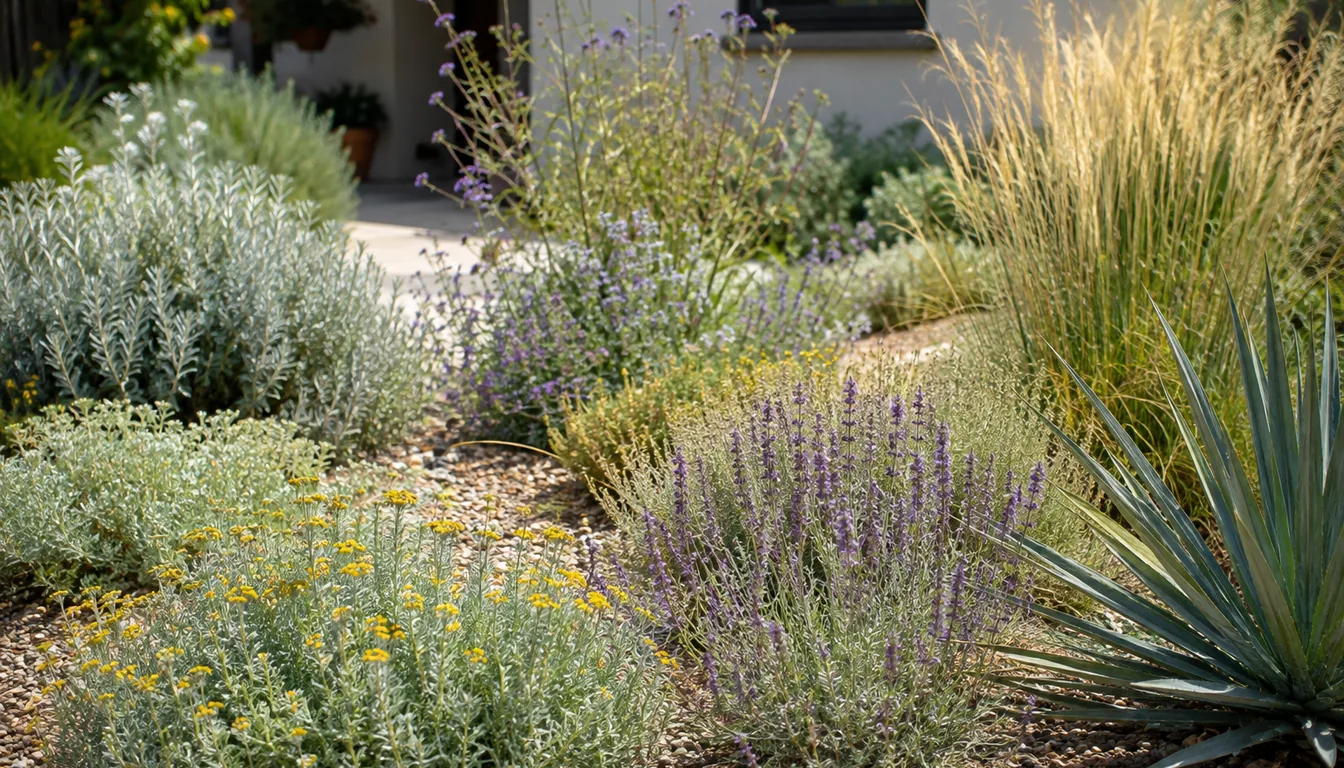
Drought adapted plants converge on a few visible traits, because there are only so many ways to lose less water. Narrow or small leaves present less surface to the sun, silver and gray foliage reflects it, and hairy or waxy surfaces slow evaporation off the leaf.
Underground the same logic runs. Deep roots reach moisture that shallow ones cannot, and fleshy roots and leaves store it for the gaps between rains.
Those traits are a reasonable filter in a garden center when the label says nothing useful, which is most labels. A broad thin soft green leaf is built for a wet climate, whatever is printed on the tag.
Climate still decides. A plant that is drought tolerant in one region can fail in another, because heat, humidity, winter wet and soil all differ, and many dry-country plants die of a wet winter rather than a dry summer.
Dry shade is its own problem. Most published lists quietly assume full sun, and a north facing bed under a tree is dry for a different reason and needs a different plant.
The best test is local and free. Whatever is thriving unirrigated in gardens near you has already passed the only trial that counts.
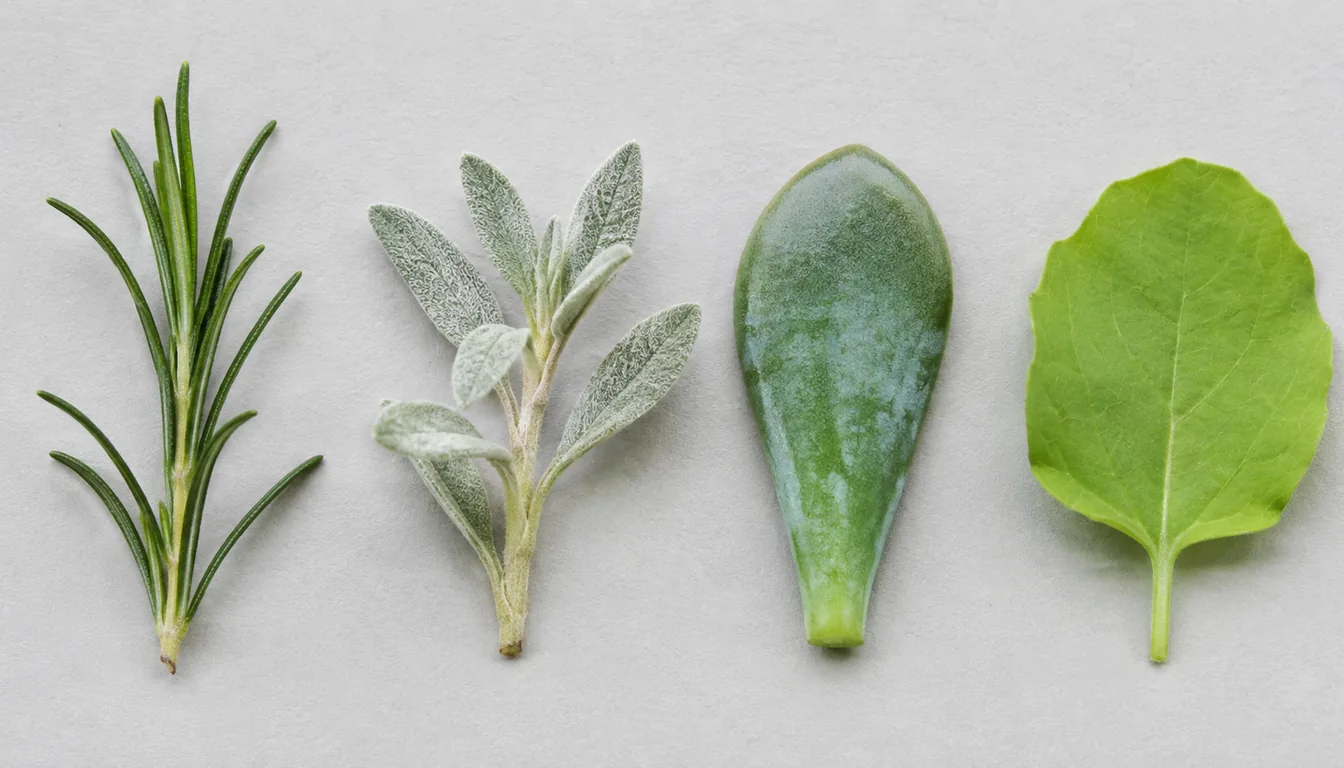
Read the leaves
Narrow, small, silver, hairy or waxy leaves all reduce water loss. A broad, thin, soft green leaf is built for a climate with regular rain, and no amount of mulch changes that.
Read the roots
Deep roots reach water shallow ones cannot, and fleshy roots and leaves store it. A plant sold in a small pot with a dense mat of fine surface roots is not the one for the driest corner.
Read the origin
Plants adapted to your own rainfall pattern handle it best, including the wet part of it. A Mediterranean plant in a wet winter climate usually dies of drainage rather than drought.
What Goes Wrong in a Low Water Garden?
Four failures cover most losses, and only one of them is drought.
The commonest is the plant abandoned before its roots reached the surrounding soil. That is not a plant failing in drought, it is a plant that never got the chance to become drought tolerant in the first place.
The second is winter wet. A great many drought adapted plants come from places with dry winters, and they die of drainage in a cold wet one while the gardener concludes they were not tough enough.
The third is a watering habit that undermines the plant. Light frequent watering keeps roots shallow, which leaves the plant less able to handle the first dry spell rather than more, so the well-meaning daily sprinkle is doing the damage.
The fourth is the irrigation program nobody turned off. A drought garden left on the same schedule as a lawn is being drowned, and the symptoms look exactly like drought from above ground.
Turning the water off at the end of establishment is a decision, not an event. It has to be made deliberately, because nothing about the garden announces that the period is over.
- Check how long the plant has been in the ground before blaming the plant
- Check the drainage in winter, since dry-country plants often die wet rather than dry
- Check whether the watering has been light and frequent rather than deep and rare
- Check whether an irrigation program is still running on a garden that finished establishing
Pro Tips
- Count one year per inch of trunk diameter and write the end date down, since nothing about the garden will tell you when establishment is over.
- Give a new tree 10 gallons a week per inch of trunk diameter rather than a passing splash.
- Water between 6pm and 10am so less of it evaporates before it soaks in.
- Mound a low ring of soil around a new planting so the water pools over the root ball instead of running off.
- Group the thirsty plants near the tap and give the far end of the garden to the dry ones.
Frequently Asked Questions
Do drought tolerant plants need watering?
Yes, until they are established. Colorado State says drought tolerant plants are not drought tolerant until their roots are established in the soil, and that takes a minimum of one year per inch of trunk diameter on a tree.
How long does establishment take?
For a tree, a minimum of one year per inch of trunk diameter, so a three inch tree takes three years. Shrubs and perennials need regular irrigation for the first couple of years.
How much water does a new tree need?
Ten gallons a week per inch of trunk diameter where there is no lawn irrigation, so a two inch tree takes 20 gallons a week. Weekly to twice monthly from May to September, once or twice a month from October to April and only above 40F.
What is hydrozoning?
Grouping plants with similar water needs together so each group can be watered effectively. In practice the small thirsty group goes near the house and the tap, and the large low water planting takes the far end of the garden.
How deep should mulch be?
Three to four inches around trees, over an area extending two to four feet from the trunk.
One to two inches in flower beds and three inches or less in vegetable beds.
Never against a trunk or stem.
Why did my drought tolerant plant die?
Most often because it was left to fend for itself before its roots reached the surrounding soil. After that, winter drainage, light frequent watering that kept the roots shallow, and an irrigation program nobody turned off.
Sources & References
- Watering a Home Landscape During Drought, Colorado State University Extension
- Healthy Roots and Healthy Trees, Colorado State University Extension
- Fall and Winter Watering of Plants and Trees, Colorado State University Extension
- Watering Established Trees and Shrubs, University of Minnesota Extension
- Xeriscaping, Creating Water Efficient Landscapes, University of Georgia Extension
Related Guides
An Overwatered Tree Hides It for a Year, Then Thins
A tree gives you almost no warning. Colorado State says the symptoms of root problems may appear…
12 min read
Best Time to Water Flowers for Stronger Blooms
Watering flowers at the wrong time does more damage than skipping a day.
10 min read
Best Time to Water Indoor Plants: Morning or Evening?
Morning is the better default for watering indoor plants.
6 min read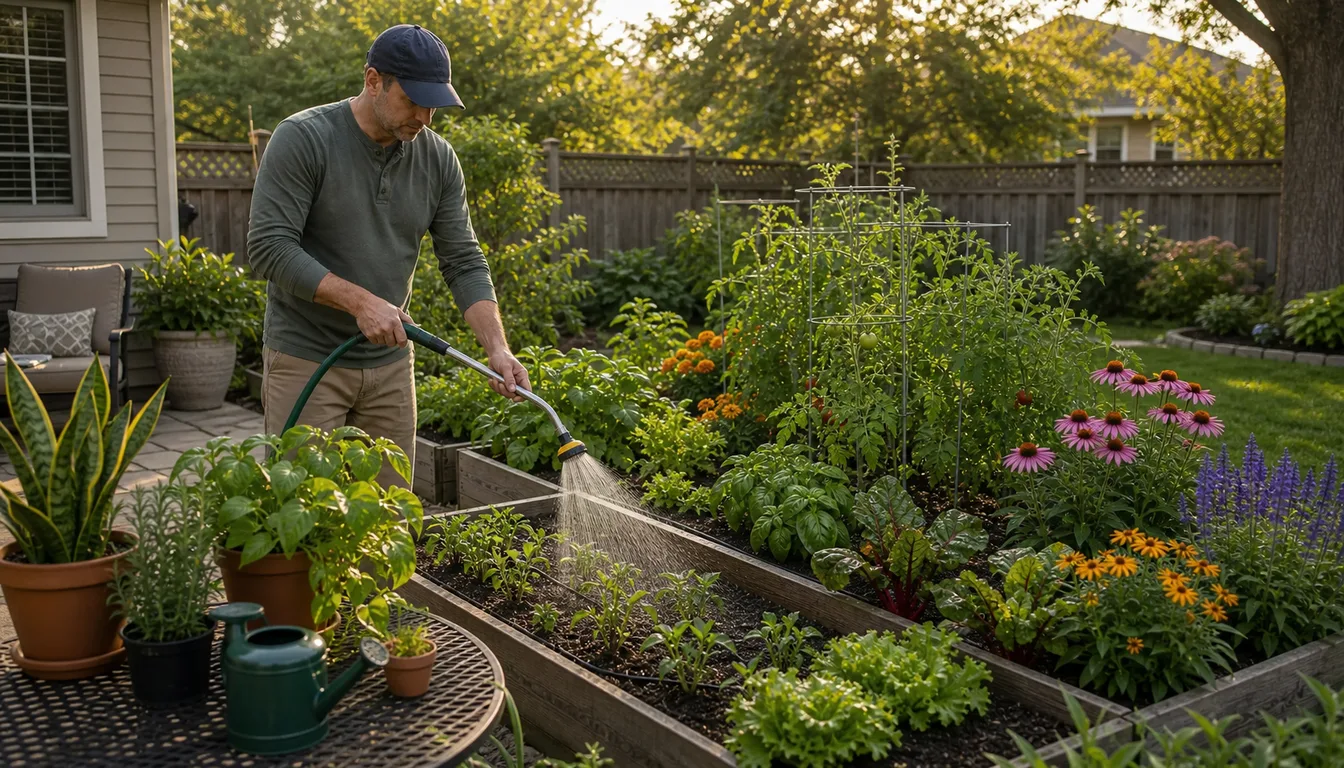
Best Time to Water Plants for Healthier Roots
Watering at the wrong time wastes water and stresses plants, even if you are generous with the…
11 min read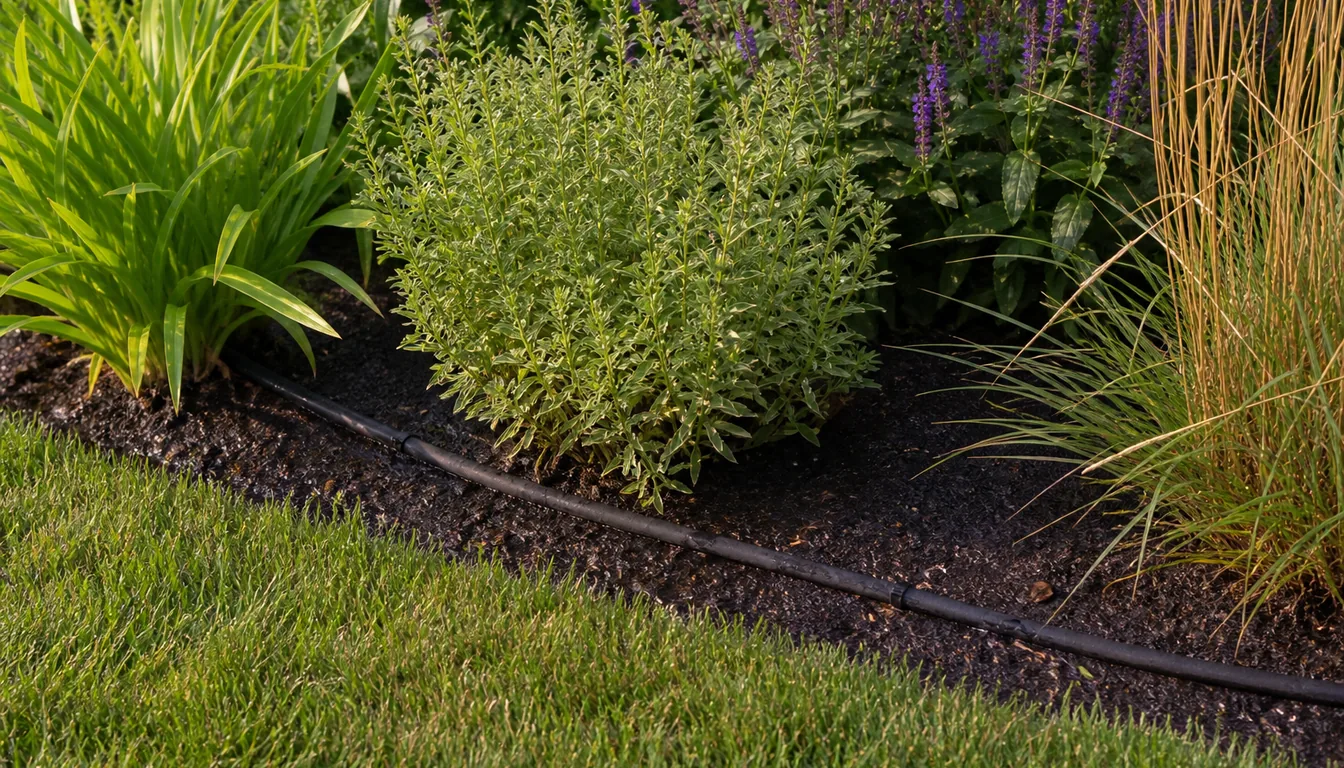
Deep Watering vs Frequent Watering: What Roots Need
Deep watering usually serves established lawns, vegetables, trees, and shrubs better than repeated…
17 min read
How Much Water Do Plants Need? Wet the Root Zone, Then Wait
Plants need enough water to moisten the soil where their roots take it up, and then no more until…
8 min read