
Low-Maintenance Plants for Yards That Need Less Water, Pruning, and Fuss
A plant is low maintenance in your yard when it suits the light, soil, winter, and rainfall it gets, and when its full-grown size fits the space without regular cutting back. Most yard work comes from mismatches, such as a sun plant in shade, a thirsty plant in a dry corner, or a shrub that wants to be twice the size of its bed.
Within that rule, Iowa State University Extension names ten perennials that perform reliably with basic care, namely hosta, daylily, perennial salvia, purple coneflower, stonecrop sedum, catmint, yarrow, thread-leaf coreopsis, Shasta daisy, and iris. Even these still need something, whether a shearing, a cutback after bloom, or protection from deer, and knowing that need ahead of time is what keeps them easy.
The plants here are for outdoor beds, borders, and shrub plantings. Houseplants follow different rules, summarized at the end.
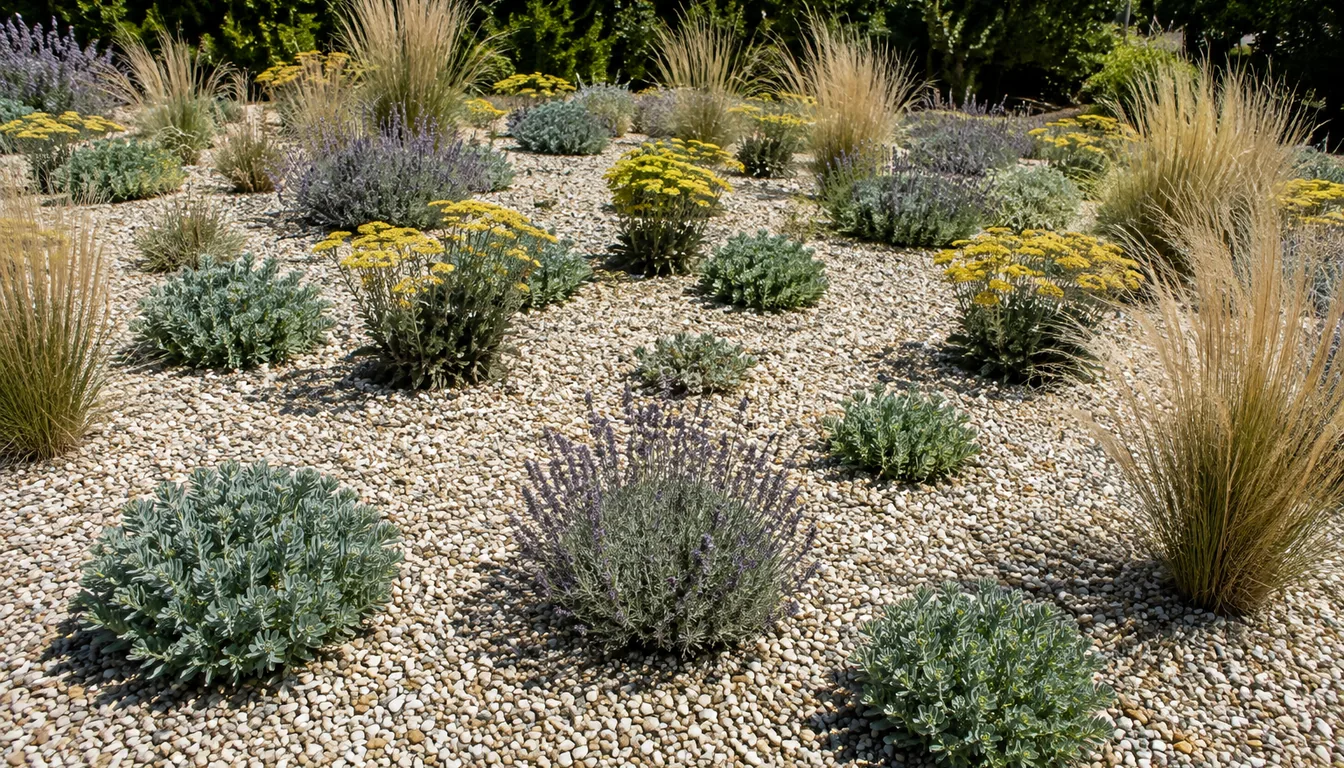
At a glance
Why Site Fit Matters More Than the Plant Tag
Colorado State University's Master Gardener notes put a number on it. Landscape maintenance professionals estimate that 90% of landscape maintenance problems come from issues that could have been addressed in the site analysis, before anything was planted. Utah State University Extension makes the same point from the plant side, advising species adapted to the soil, water, temperature, light, and pest conditions of the site to minimize both maintenance and water.
In practice, a plant counts as low maintenance when it avoids the chores that eat a weekend. It does not need watering beyond the rest of its bed, it does not need cutting back to fit its space, it does not need regular spraying, and it does not spread into its neighbors. A plant that is drought tolerant but spreads by runners can still mean hours of weeding, which is why Iowa State warns against the orange ditch daylily while recommending named daylily cultivars.
That also explains why the same plant can be easy in one yard and hard in another. Utah State notes that natives are not automatically the low-water answer, since some, like aspen, are adapted to conditions most gardens do not have.
Easy Perennials and What Each One Still Needs
The ten perennials Iowa State University Extension lists as easy to grow are a sound starting point because they tolerate a wide range of soils and weather once established. Their remaining work is small but different for each, and the table includes it.
| Perennial | Best site | Typical size | What it still needs |
|---|---|---|---|
| Hosta | Part to full shade, moist organic soil | 6 to 36 inches, by cultivar | Protection from slugs, deer, and rabbits |
| Daylily | Sun to light shade, any well-drained soil | 18 to 36 inches | A named cultivar, since the orange ditch daylily spreads aggressively |
| Perennial salvia | Full sun, well-drained soil | 18 to 30 inches | A cutback after the first bloom for a second flush, and a hardiness check |
| Purple coneflower | Full sun, average to dry soil | 24 to 36 inches tall | Little beyond sun and drainage |
| Stonecrop sedum | Full sun, dry to average soil | Under 6 inches to 24 inches | Little, since it is highly drought tolerant |
| Catmint | Full sun, well-drained soil | 18 to 24 inches tall, 24 to 36 inches wide | A shearing after bloom for rebloom |
| Yarrow | Full sun, dry to average soil | 18 to 30 inches | Lean soil, since it grows poorly in rich ground and spreads readily |
| Thread-leaf coreopsis | Full sun, average to dry soil | 12 to 24 inches | Minimal care, according to Iowa State |
| Shasta daisy | Full sun, moderate moisture | 24 to 36 inches tall | A cultivar bred for vigor and disease resistance |
| Iris | Full sun, well-drained soil | 24 to 36 inches | Sharp drainage for bearded types, while Siberian iris tolerates moist soil |
Most of these are full-sun perennials. Hosta is the shade option on the list, and NC State Extension notes that deer and rabbits enjoy its tender foliage and that slugs and snails need watching, so in a yard with heavy deer pressure it is not a no-work choice.
Iowa State also flags hardiness on salvia. Several salvia species and cultivars are hardy in cold climates and many are not, so the tag needs checking against your zone before a salvia is counted as a perennial.
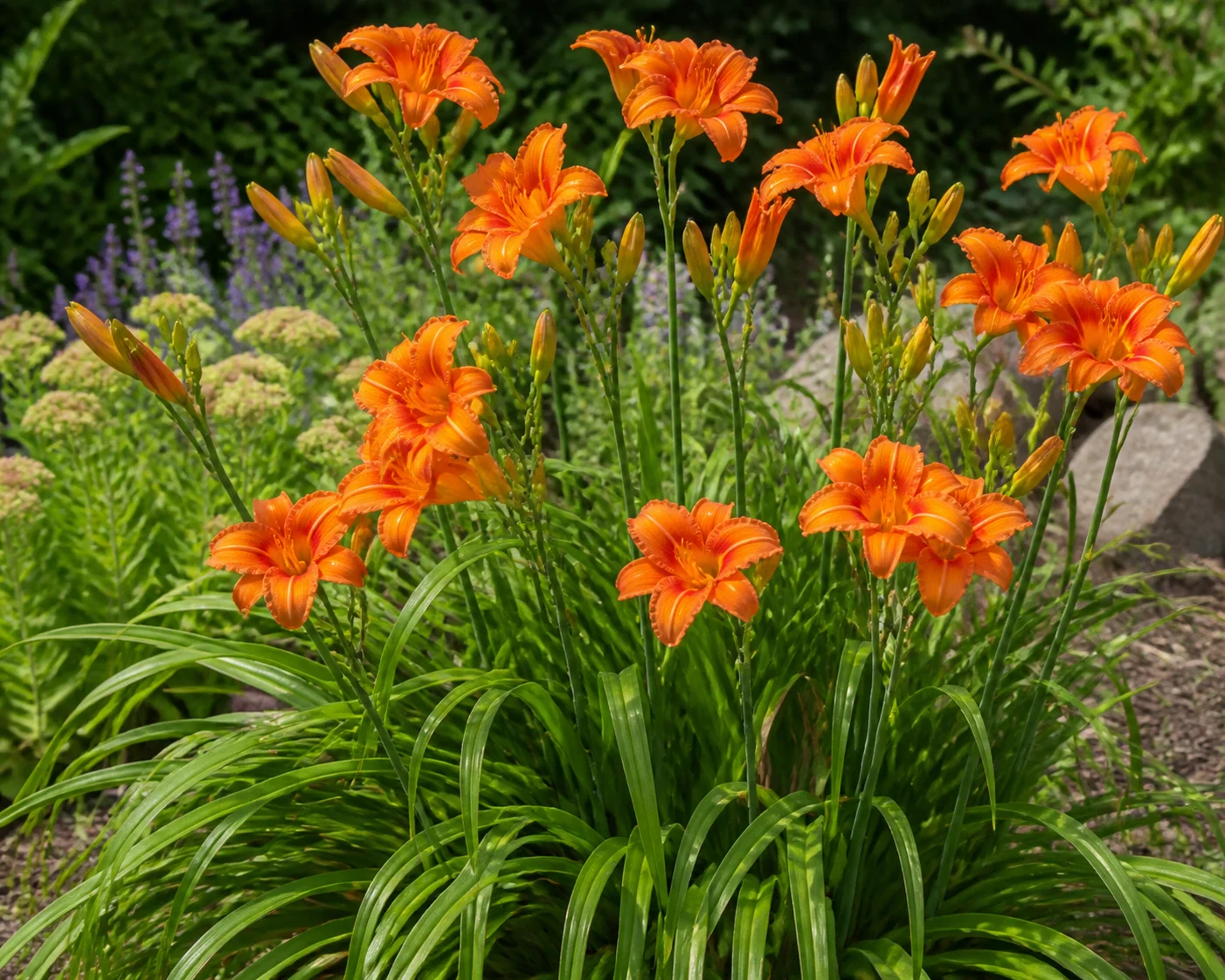
Daylily
Long-lived clumps for sun or light shade in nearly any drained soil
- Mature fit
- Clumps 18 to 36 inches tall and wide
- Main tradeoff
- The orange ditch daylily spreads aggressively, so named cultivars are the easy choice
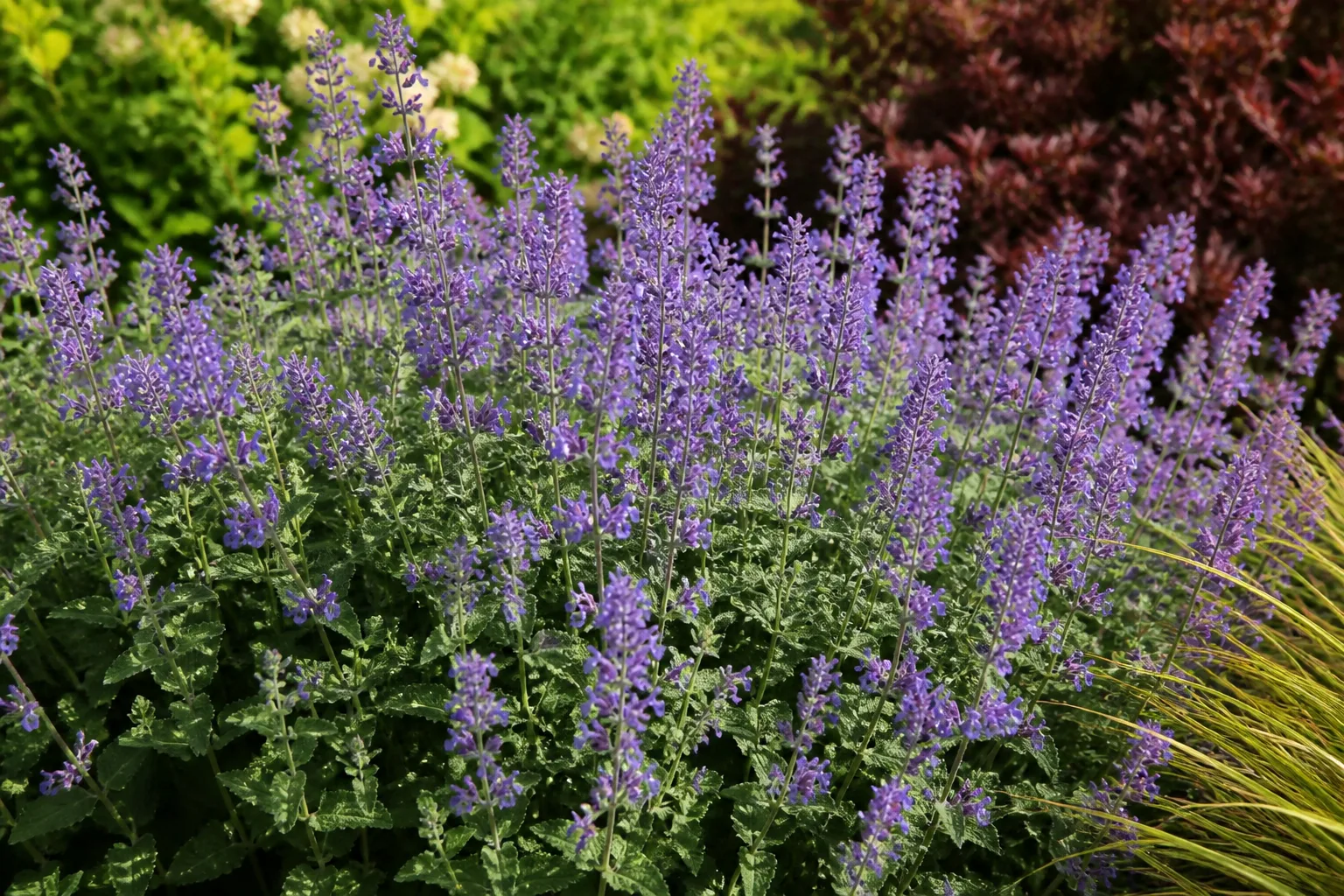
Catmint
Long-blooming edging for hot, sunny, well-drained beds
- Mature fit
- About 18 to 24 inches tall and wider than it is tall
- Main tradeoff
- Shearing after the first bloom is what brings the second flush
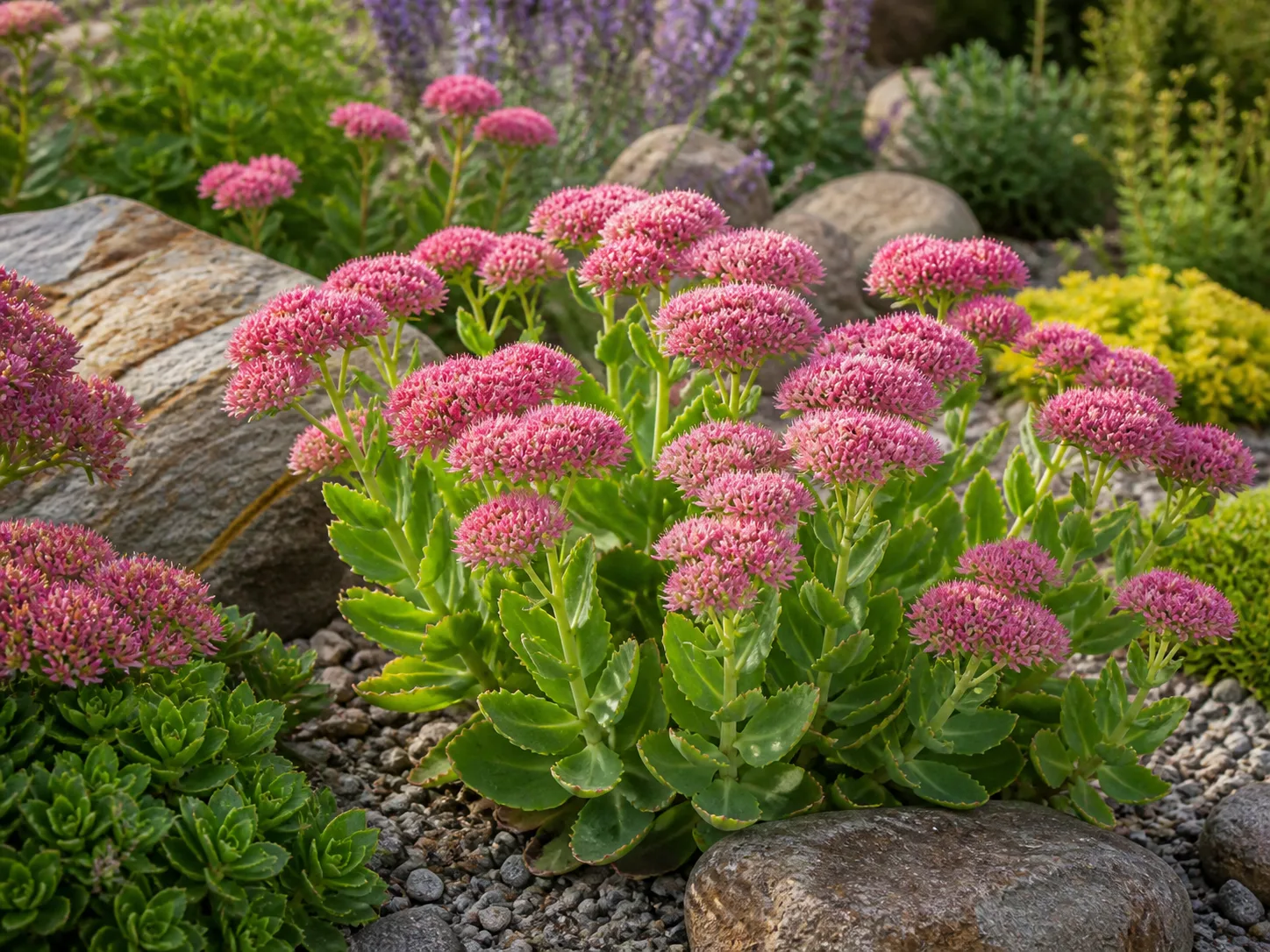
Sedum
Drought-tolerant cover for the driest, sunniest spots
- Mature fit
- Groundcovers under 6 inches to upright clumps near 2 feet
- Main tradeoff
- Needs full sun and dry to average, well-drained soil
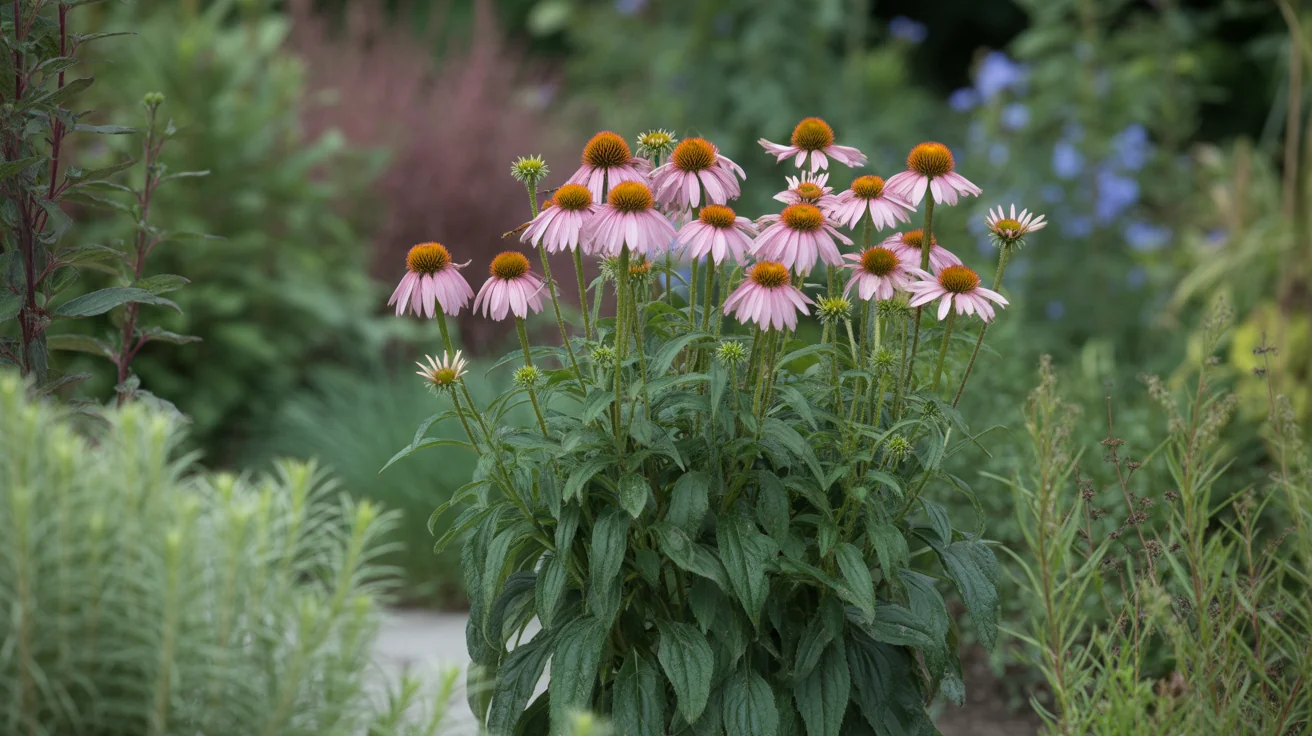
Coneflower
Summer flowers for sun and average to dry soil
- Mature fit
- About 2 to 3 feet tall and 18 to 24 inches wide
- Main tradeoff
- Wants full sun and drainage more than extra care
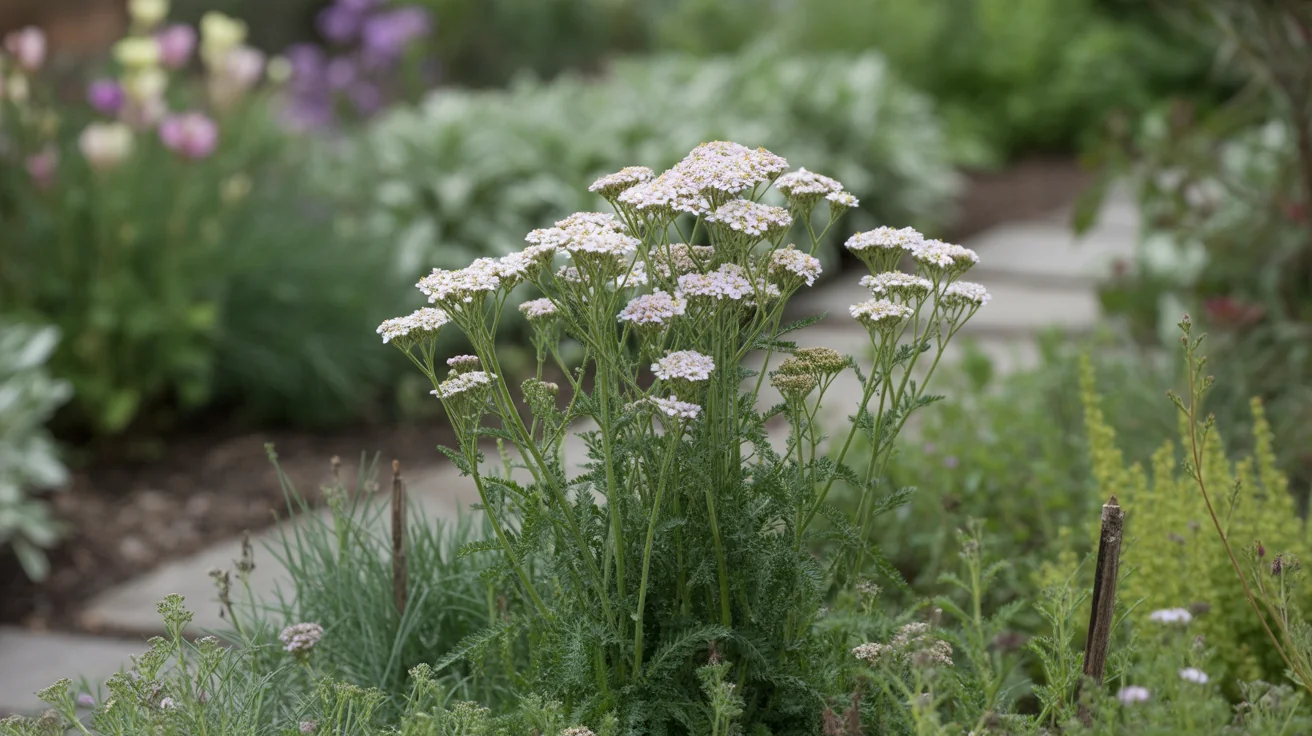
Yarrow
Flat flower clusters for dry, lean, sunny ground
- Mature fit
- Usually 18 to 30 inches tall
- Main tradeoff
- Grows poorly in rich soil and spreads readily
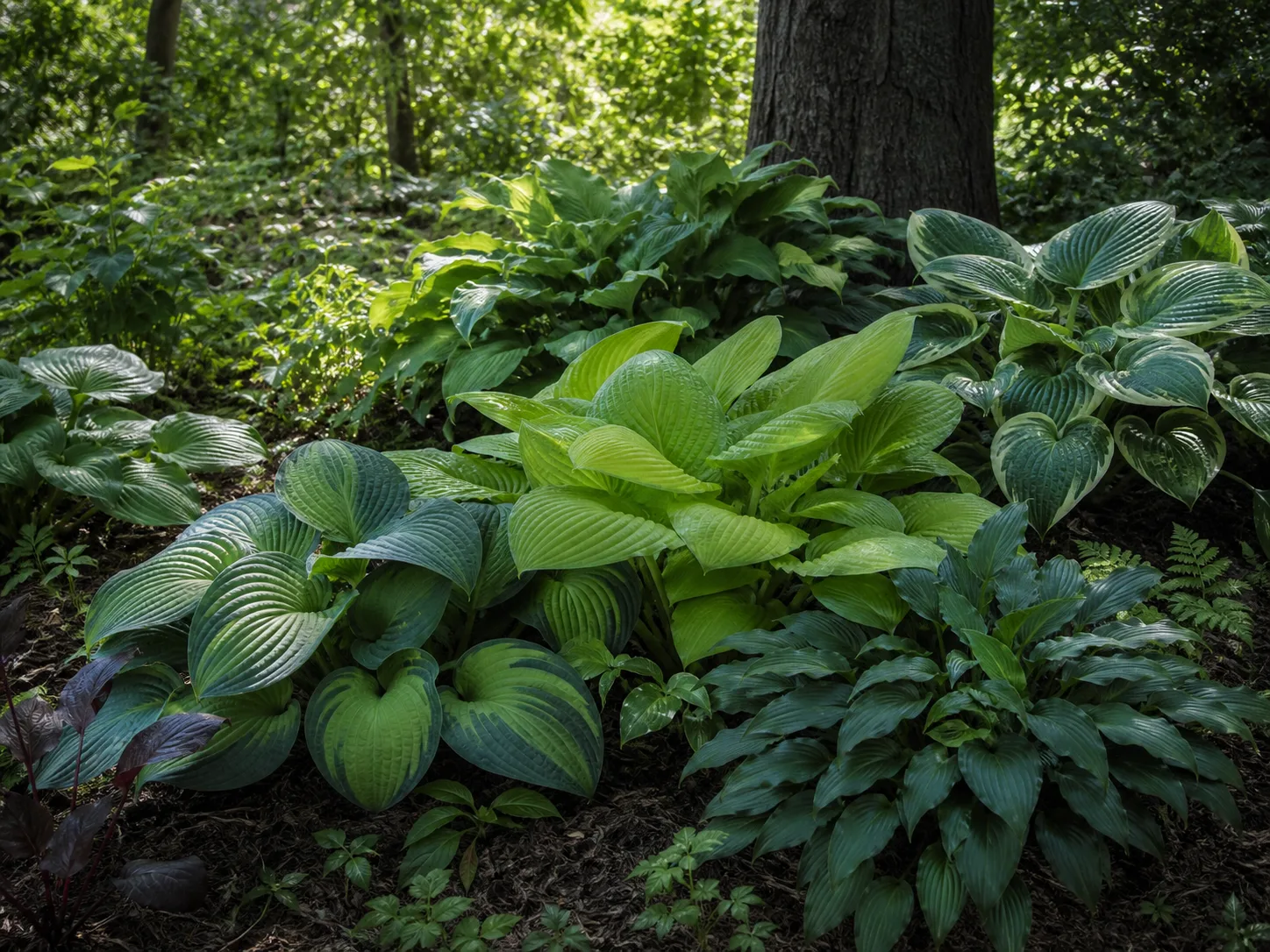
Hosta
Durable foliage for part to full shade
- Mature fit
- From small edgers to large clumps, by cultivar
- Main tradeoff
- Deer, rabbits, and slugs all feed on the leaves
Shrubs That Stay Easy Because They Fit
With shrubs, the chore that adds up most is pruning to size, and it is avoidable at the nursery. University of Maryland Extension's warning is that cutting a shrub back does not hold it at a smaller size, because pruning stimulates new growth. A shrub chosen for its mature size needs a light trim or none, while one chosen too large needs cutting every year. The evergreen shrub comparison lists mature sizes for common hedge and foundation shrubs.
Shearing adds work of its own. Maryland advises shearing no more than once a year and alternating it with thinning, since shearing stimulates more new growth and can reduce flowering.
Some popular shrubs show up on easy-care lists but carry real work.
- Boxwood is easy to shape, but University of Maryland Extension lists leafminer, Volutella blight, and winter injury as its most common problems, and boxwood blight is a further risk. Regular shearing makes the foliage so dense that it encourages leaf spot and canker.
- Bigleaf hydrangea needs protection from afternoon sun, pruning before August 1 to keep next year's flowers, and protection from deer, according to NC State Extension.
- Japanese holly is the opposite case in NC State's database, with no serious insect pests or diseases, though its leaves yellow in alkaline soil.
The point is not that boxwood or hydrangea are bad shrubs. It is that their care belongs in the plan, and a yard meant to need little work is better served by shrubs whose known problems do not apply to that site.
Group Plants by Water So the Hose Waters Areas, Not Plants
Watering is where mixed plantings create the most work. Utah State University Extension recommends grouping plants with similar water needs into the same area or irrigation zone, which it calls a hydrozone, so each group gets the water it needs and no more.
| Hydrozone | How often it is watered | Example fit |
|---|---|---|
| Zone 0 | No irrigation once established | Plants adapted to local rainfall |
| Zone 1 | About monthly | Very drought-tolerant plants such as stonecrop |
| Zone 2 | About twice a month | Drought-tolerant perennials such as yarrow, catmint, and coneflower |
| Zone 3 | About weekly | Plants that want steady moisture, such as hosta |
| Zone 4 | About twice a week | Plants that need constantly moist soil |
The frequencies are Utah State's, from a dry climate, and the plant examples follow the water needs Iowa State gives for each. A yard in a wetter region shifts every zone toward less watering, but the grouping is what saves the work.
Colorado State's notes explain why grouping matters. Irrigation is done by area, not plant by plant, so one thirsty plant in a dry bed forces the whole bed onto its schedule. The same notes estimate that the average homeowner uses twice the water the lawn and gardens actually need.
Drip or a soaker hose on a timer handles the wetter zones with little effort, and Colorado State estimates that mulch combined with drip irrigation can cut water use by 50%. The run time is not a fixed number. It depends on the hose, the pressure, and the soil, and the soaker hose setup explains how to find it by running the hose and digging to see how deep the water reached.
Mulch and Spacing That Keep Weeds Down
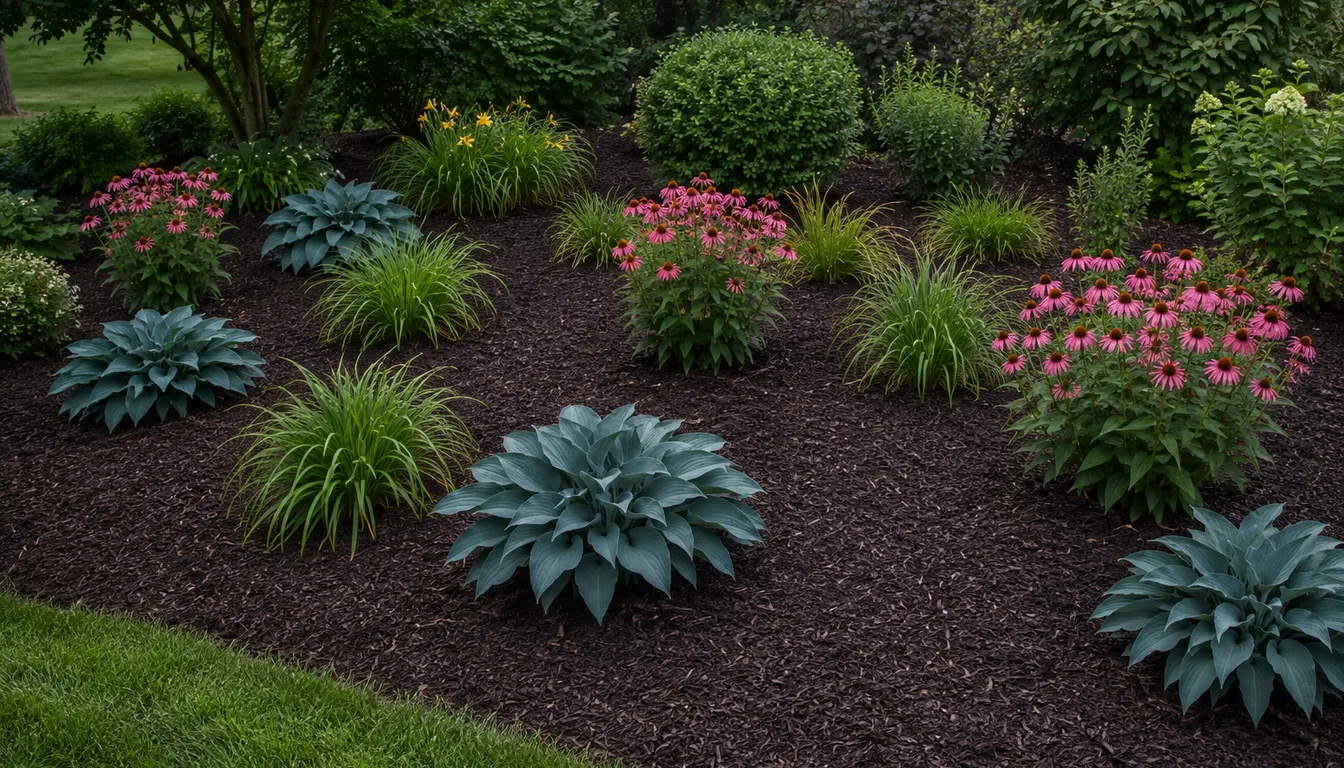
Weeding is the other chore that never ends in a bare bed. NC State Extension's handbook notes that mulch helps keep soil moist, evens out soil temperature, inhibits weeds, and improves the soil as it breaks down. Illinois Extension recommends a layer of 2 to 4 inches of bark or wood chips around trees and shrubs, kept away from the base of the trunk rather than piled against it.
Spacing decides how long the mulch has to do that job alone. Plants set at their mature width, using the sizes in the table above, leave gaps at first and then close them as the clumps fill in, so foliage takes over the shading the mulch was doing. Plants crowded closer than that fill in sooner but then need dividing or cutting back to stay apart.
Lawn is worth the same scrutiny. Utah State University Extension suggests keeping turf where it is used for play, traffic, or cooling, and notes that if the only time a lawn area gets traffic is when it is mowed, a lower-maintenance planting may serve better there. A strip of lawn along a fence that only sees the mower can be a good first place for a mulched bed of the perennials above.
The First Season Is the Exception
Low maintenance describes an established plant. Iowa State's descriptions of drought tolerance for catmint, salvia, and the other easy perennials all apply once the plant is established, and new plantings need regular water until their roots spread.
Shrubs take longer. Illinois Extension recommends watering newly planted trees and shrubs through their first two summers whenever rainfall is short, with a heavy weekly soak that wets the soil 8 to 12 inches deep rather than frequent light watering. It also notes that potted shrubs can stay in transplant shock for up to three years while roots grow beyond the planting hole.
A low-maintenance yard is therefore built over one or two seasons of extra attention. Planting a section at a time keeps that early watering manageable.
Low-Maintenance Houseplants Are a Separate Choice
Indoors, the plants that need the least care are the ones suited to the light the room actually gets, and that decision works differently from choosing yard plants. Snake plant, ZZ plant, pothos, and Chinese evergreen are common choices for dimmer rooms, and the low-light houseplant guide compares them for dim rooms.
Cleaner air is not a reason to pick one of them over another. The evidence on houseplants and indoor air shows that a reasonable number of plants does not measurably clean the air in a home, so the light in the room is the better guide.
Pro Tips
- Check a plant's mature width before buying, since a shrub that outgrows its spot needs cutting back every year.
- Plant one bed or one watering zone at a time so the first season of extra watering stays manageable.
- Choose named daylily cultivars over the orange ditch daylily, which spreads aggressively.
Frequently Asked Questions
What are the easiest perennials for beginners?
Iowa State University Extension lists hosta, daylily, perennial salvia, purple coneflower, stonecrop sedum, catmint, yarrow, thread-leaf coreopsis, Shasta daisy, and iris. All but hosta want sun, and hosta needs protection where deer, rabbits, or slugs are common.
Are native plants always the lowest-maintenance choice?
Not automatically. Utah State University Extension notes that some natives are adapted to conditions most gardens lack, such as aspen in high, wet meadows. A plant adapted to your yard's soil, water, and light is the low-maintenance choice, native or not.
Is boxwood a low-maintenance shrub?
It is easy to shape but not trouble free. University of Maryland Extension lists leafminer, Volutella blight, and winter injury as common boxwood problems, and frequent shearing makes those disease problems worse.
How long before a new planting becomes low maintenance?
Perennials usually need regular water through their first season. Illinois Extension advises watering new trees and shrubs through their first two summers when rain is short.
How do I cut down on watering?
Group plants with similar water needs in the same area, mulch the soil, and water each area on its own schedule with drip or a soaker hose. Colorado State estimates that mulch combined with drip irrigation can cut water use by half.
Sources & References
- Easy to Grow Perennials, Iowa State University Extension and Outreach
- Principles of Water Wise Landscaping, Utah State University Extension
- CMG GardenNotes #410 and #411, Water Wise Landscape Design, Colorado State University Extension
- Pruning Shrubs and Hedges in the Home Garden, University of Maryland Extension
- Boxwood: Identify and Manage Common Problems, University of Maryland Extension
- Hydrangea macrophylla, North Carolina Extension Gardener Plant Toolbox
- Ilex crenata, North Carolina Extension Gardener Plant Toolbox
- Hosta, North Carolina Extension Gardener Plant Toolbox
- Extension Gardener Handbook, Chapter 11: Woody Ornamentals, NC State Extension
- Tree and Shrub Planting Guide, Illinois Extension
Related Guides
Best Butterfly Garden Plants for a Complete Habitat
The best butterfly garden plants do two different jobs. Host plants feed caterpillars, while nectar…
15 min read
Best Fall-Blooming Flowers for Color Near Frost
A bed that still carries flowers in October usually was planned before temperatures fell.
9 min read
Best Fast-Growing Trees for Shade and Privacy
The best fast-growing tree is the one whose mature crown, roots, climate range, and maintenance…
16 min read
Best Fragrant Flowers for Every Yard and Season
The best fragrant flowers depend on climate, light, space, and the hours you use the yard.
15 min read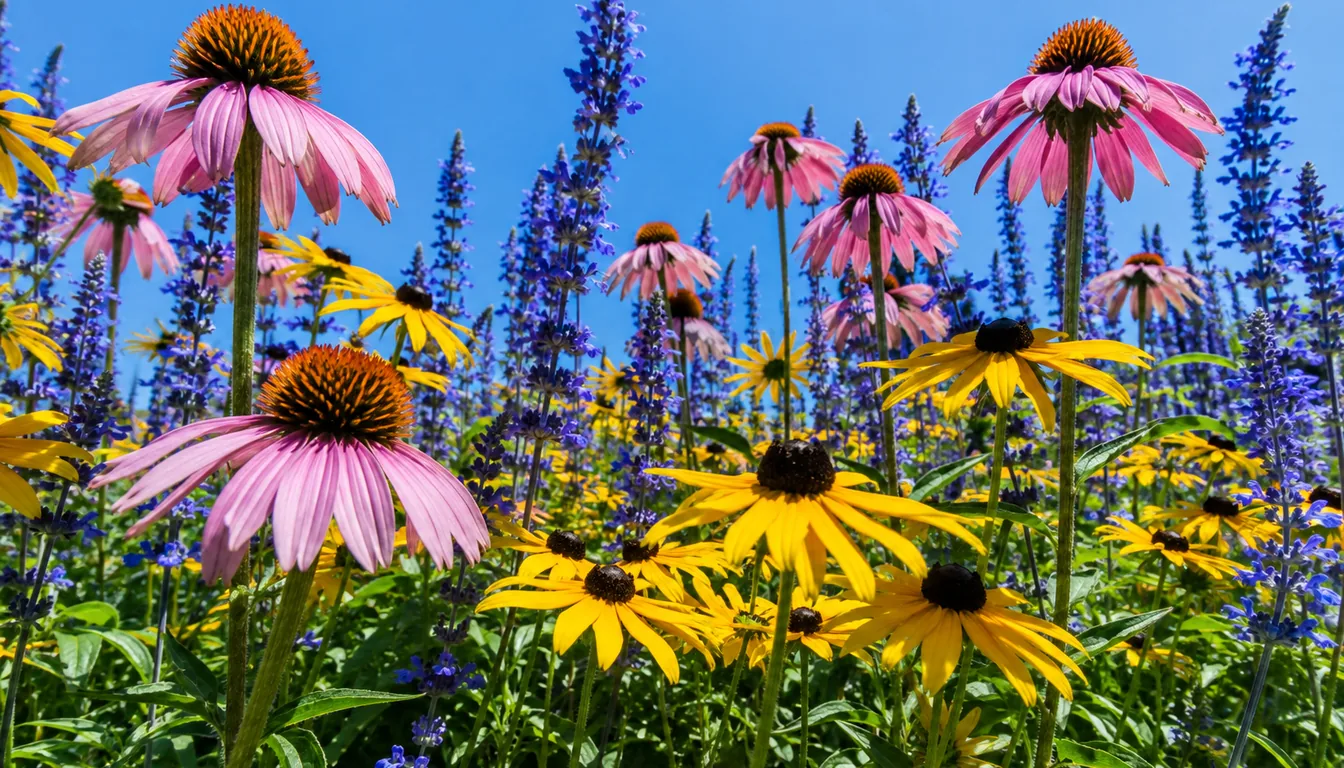
Best Full-Sun Perennials for Hot, Bright Beds
The best full-sun perennials are the ones that match the bed's soil moisture and drainage, local…
14 min read
Best Ground Cover Plants for Sun, Shade, and Slopes
The best ground cover is a plant that survives the site and performs the job without escaping into…
18 min read