
What's Catmint? How to Shear It for a Second Bloom
Nepeta spp. Lamiaceae
Catmint carries months of blue over a tough gray-green mound, then splits wide open the moment its first flush is done.
A hard shear resets it, and lean ground keeps the stems firm enough to hold the shape in the first place.
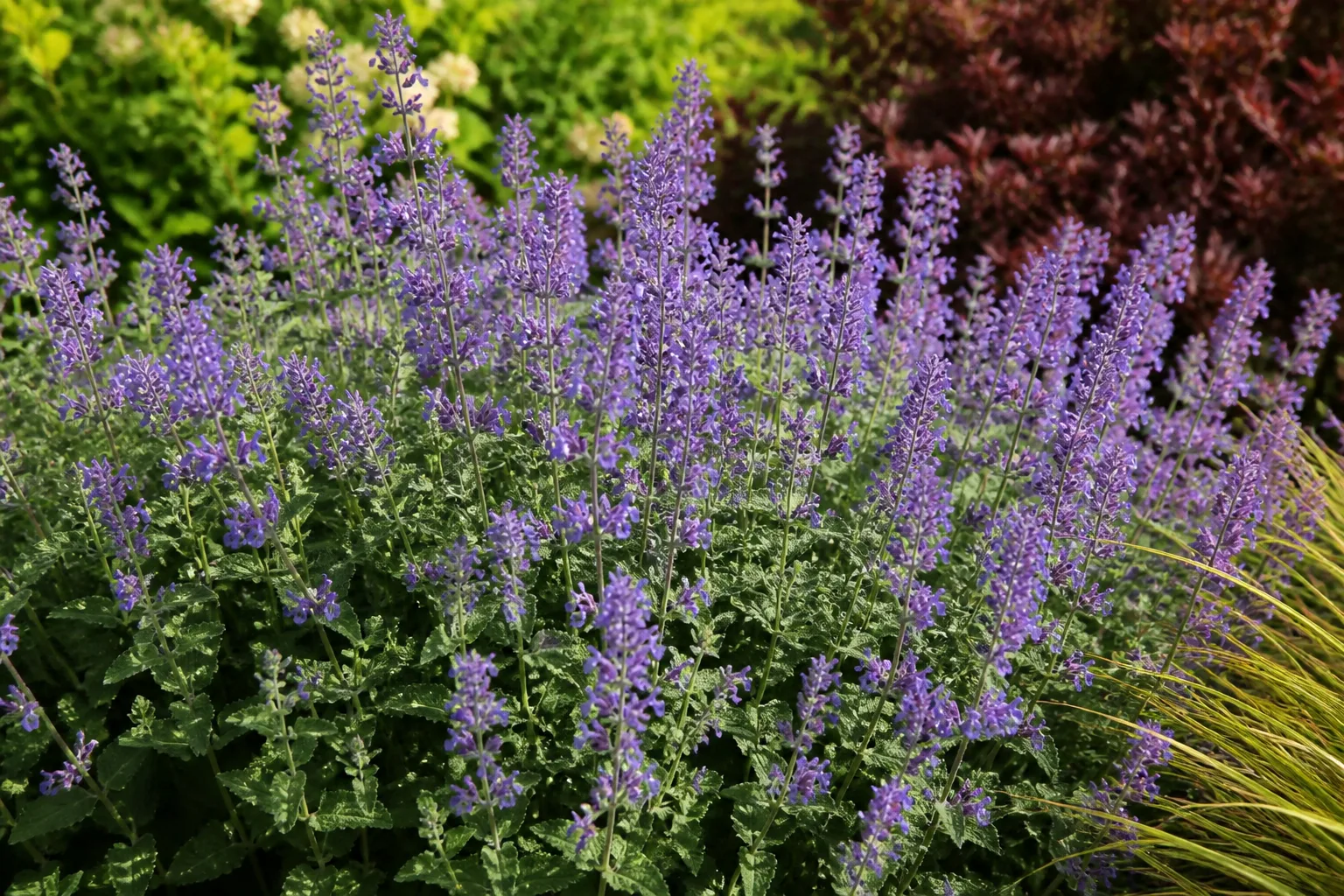
Care snapshot
Is Catmint the Same Plant as Catnip?
No, though they are close relatives and the confusion is fair. True catnip is Nepeta cataria, while the plant sold for borders is almost always a Nepeta x faassenii hybrid.
What you are buying is essentially a small aromatic shrub that behaves like one. Catmint builds a dense gray-green mound of small scalloped leaves, covers itself in slender blue-violet spikes for months, and holds that shape through heat and wind that would flatten a softer perennial.
It also stays where you put it, forming clumps rather than running underground, so nothing about its mint-family membership means it will take over a bed.
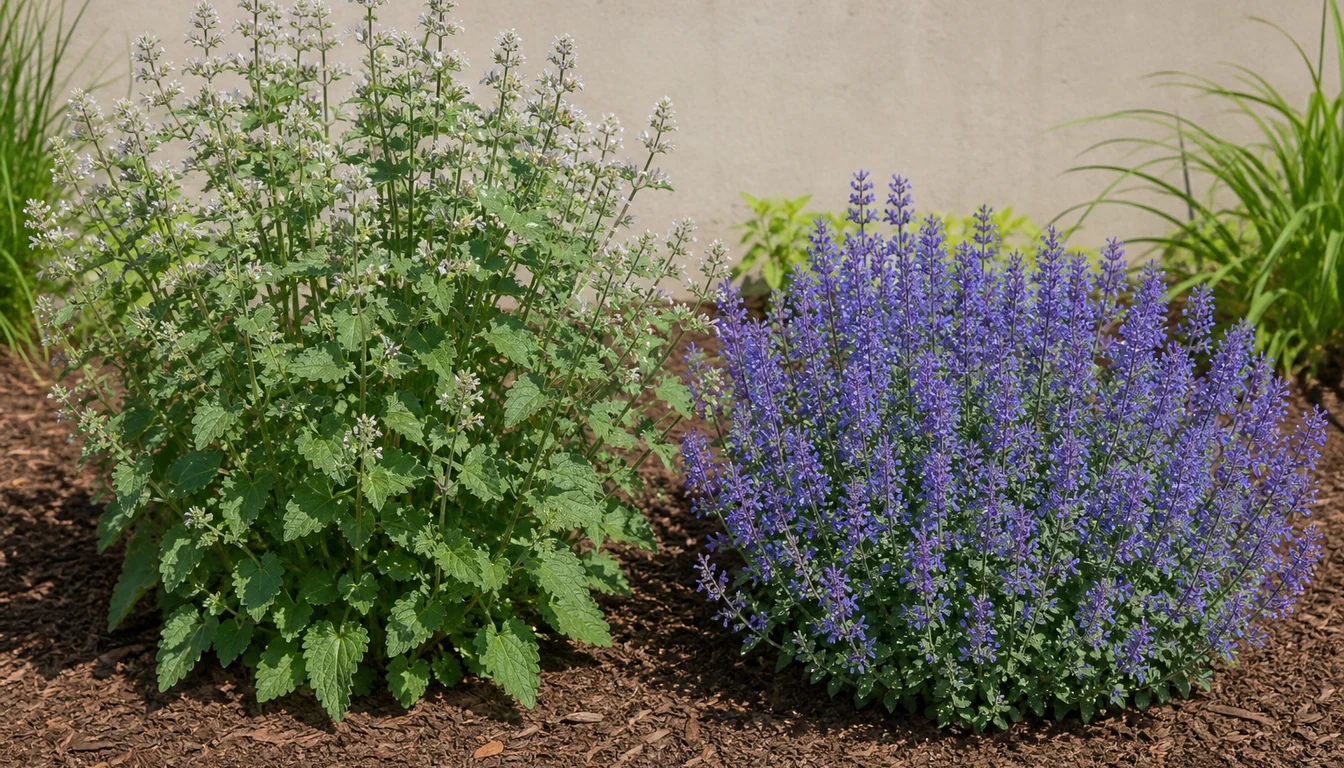
On a nursery bench the two are easy to separate once you know what to look at. Catnip is coarse and upright with large soft toothed leaves and dull whitish flowers, and next to a garden catmint in full blue it looks like the weed it half is.
Which Catmint Should You Plant?
Choose on mature spread rather than on flower color, because sprawl is what people regret. A one-gallon pot gives no hint that the plant in it will cover a yard of ground by August.
The named selections split fairly cleanly into two groups.
Compact types hold near 12 to 18 inches and stay tight enough to edge a path without spilling across it. The big billowy ones like 'Six Hills Giant' run 2 to 3 ft and want mid-border company that can hide a base which loosens after the first flush.
Color is the easy part once space is settled. The standard lavender-blue now has deeper violet and even soft pink alternatives, though the blues still read best at a distance and still pull the most bees.
- 'Walker's Low'
- 18 to 24 inches, mounding, very long bloom. The reliable default, despite a name that suggests otherwise.
- 'Purrsian Blue'
- 14 to 18 inches, compact and heavy-flowering. Holds a crisp edge along a path or a wall.
- 'Six Hills Giant'
- 2 to 3 ft and billowy. Needs mid-border neighbors, not a front edge.
- Dwarf selections
- 12 to 16 inches. For tight borders and containers where anything larger blocks the way.
Why Does Rich Soil Make Catmint Flop?
Rich ground grows soft stems, and soft stems cannot hold a mound up once it carries the weight of flowers.
This is a dry-hillside plant by ancestry, so a bed improved for roses gives it more water and more nitrogen than its structure was built for. The result is fast lush growth that splits open at the center by midsummer and a crown that sits wet through winter.
Sun is the other half of the same story. Six to eight hours keeps growth short and firm, and light reaching the plant from more than one side, as along a path or a drive, is what stops it leaning toward the brightest gap.
Water it like the dry-border plant it is, which after the first year means a deep soak every ten to fourteen days and nothing in between.
Let the top 2 inches dry, then water hard enough to reach 6 to 8 inches down so the roots keep chasing moisture downward.
- Drainage
- Fast. Reject any site still wet 24 hours after rain.
- Soil texture
- Sandy loam or loam. Open heavy clay with grit or fine gravel, or raise the bed.
- Organic matter
- Modest. Roughly 50% native soil, 30% coarse grit, 20% compost in an average bed.
- Soil pH
- Tolerant from about 6.0 to 7.5, so pH is rarely the problem.
When Should You Shear Catmint, and How Hard?
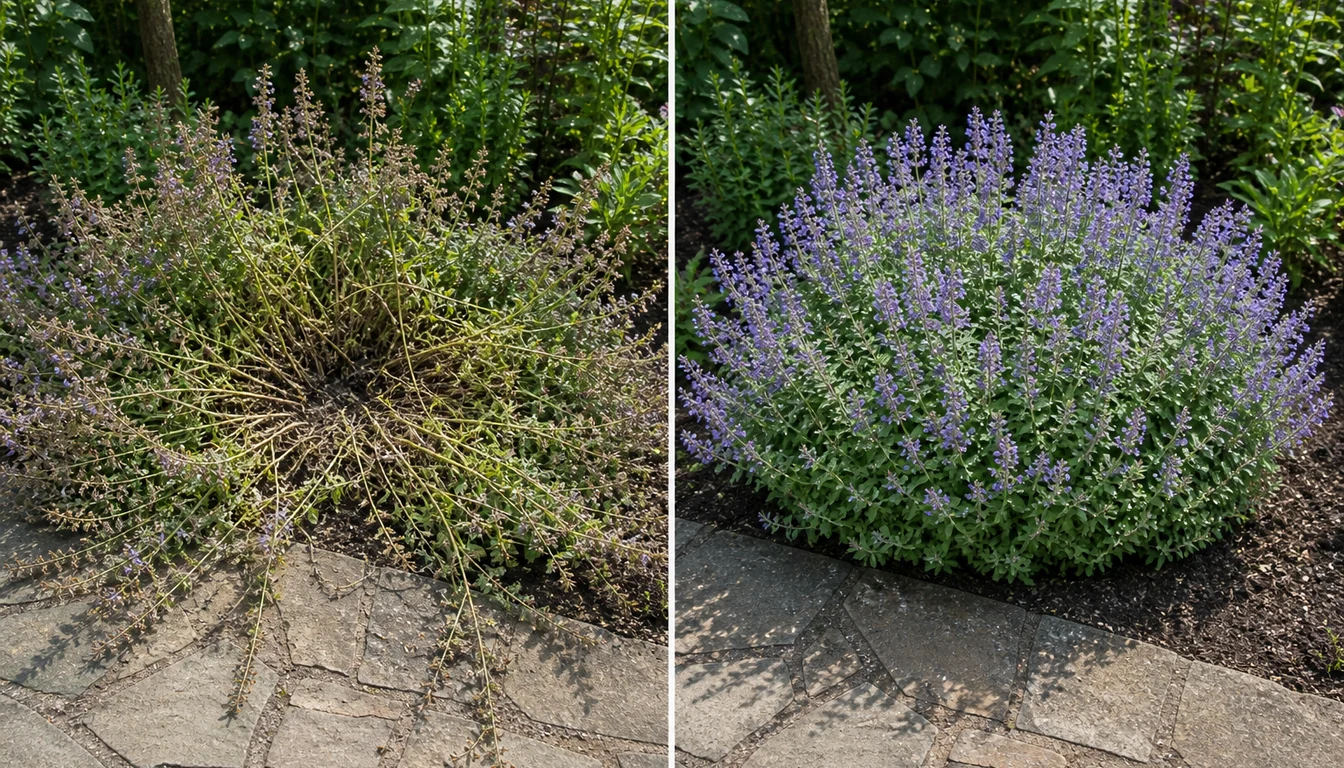
After the first heavy flush a Catmint goes over all at once, splitting at the center and dropping its stems flat across whatever is beside it. Picking off spent spikes one by one will not close that gap, because the stems themselves have finished.
The fix is a haircut, taken with hedge shears and taken across the whole plant at roughly half its height. Do it as soon as the first flush fades rather than waiting to see whether it recovers on its own.
It will look drastic, and that is the point.
Timidity is what makes this job fail, since a light trim leaves the collapsed stems in place and the plant stays shabby. Cut into firm growth and fresh basal foliage pushes within a week or two, followed by a second flush of flower that carries the plant into fall.
A late-season plant can simply be left alone once that second flush fades. In cold zones the top growth dies back anyway, and stems left standing give the crown a little extra shelter through winter.
- Wait for the fadeShear as soon as the bulk of the first flush has browned, not while the plant is still carrying good color.
- Use hedge shearsTake the whole mound at once. Snips invite you to be selective, which is exactly the wrong instinct here.
- Cut to about halfCome down to roughly half the plant's height, into firm leafy growth rather than into bare woody stem.
- Clear the debrisRake the cuttings off the crown so the fresh shoots underneath get light and air.
- Water once, then stopA single soak after cutting helps the regrowth start. Return to the lean watering habit after that.
When Does It Need Dividing, and Where Does It Go in Winter?
A clump asks to be divided by going woody and bare in the middle while the outer ring carries on flowering.
Early spring in cold zones is the cleanest window, while warmer gardens can also work in early fall. Either way, do the job in the cool of the morning and keep a bucket of water beside you so the pieces never sit dry in the sun.
Winter looks completely different depending on where you garden, which catches people out. In Zone 3 and Zone 4 the plant vanishes to nothing above ground and comes back later than the spring bulbs around it, so an empty patch in April is not a dead plant.
- Shear it down firstCut the mound back to a few inches before you dig. A full-size catmint is mostly loose stem, and you cannot see the crown through it.
- Work in the coolLift the clump early in the morning and keep the pieces shaded, because these fine roots dry out within minutes in the sun the plant otherwise thrives in.
- Find the living rimThe outer ring holds all the shoots and the middle is spent wood, so plan every cut to take a piece off that rim.
- Throw the woody heart awayThe bare center will not re-shoot and it is what split the clump open in the first place. Replanting it just recreates the problem.
- Set the pieces slightly highReplant into gritty ground with the crown a touch proud of the surface and water once, since a freshly cut crown sitting wet is the usual way these are lost.
Will Cats Wreck It, and What Else Bothers It?
Some cats ignore garden catmint entirely and some roll in it until it is flat. The hybrids carry less of the compound that drives the response than true catnip does, but that is a weaker reaction rather than a reliable absence of one.
A rolling cat flattens the stems, and eating the plant can matter too. ASPCA lists catnip, Nepeta cataria, as toxic to cats, with vomiting and diarrhea, and no record covers garden Catmint hybrids, so if a cat eats a lot of it, contact a veterinarian or ASPCA Animal Poison Control. What you lose is the shape of a border edge, so put a young plant somewhere a rolling animal will not crush it and give it a season to build a base that can take the traffic.
Insects mostly leave it alone, because the aromatic foliage does the work a spray would otherwise do.
Two get through in stressed conditions. Aphids cluster on soft tips in late spring, especially on plants growing too rich, and spider mites stipple the leaves in a hot dry spell, but neither is usually more than cosmetic on an established mound.
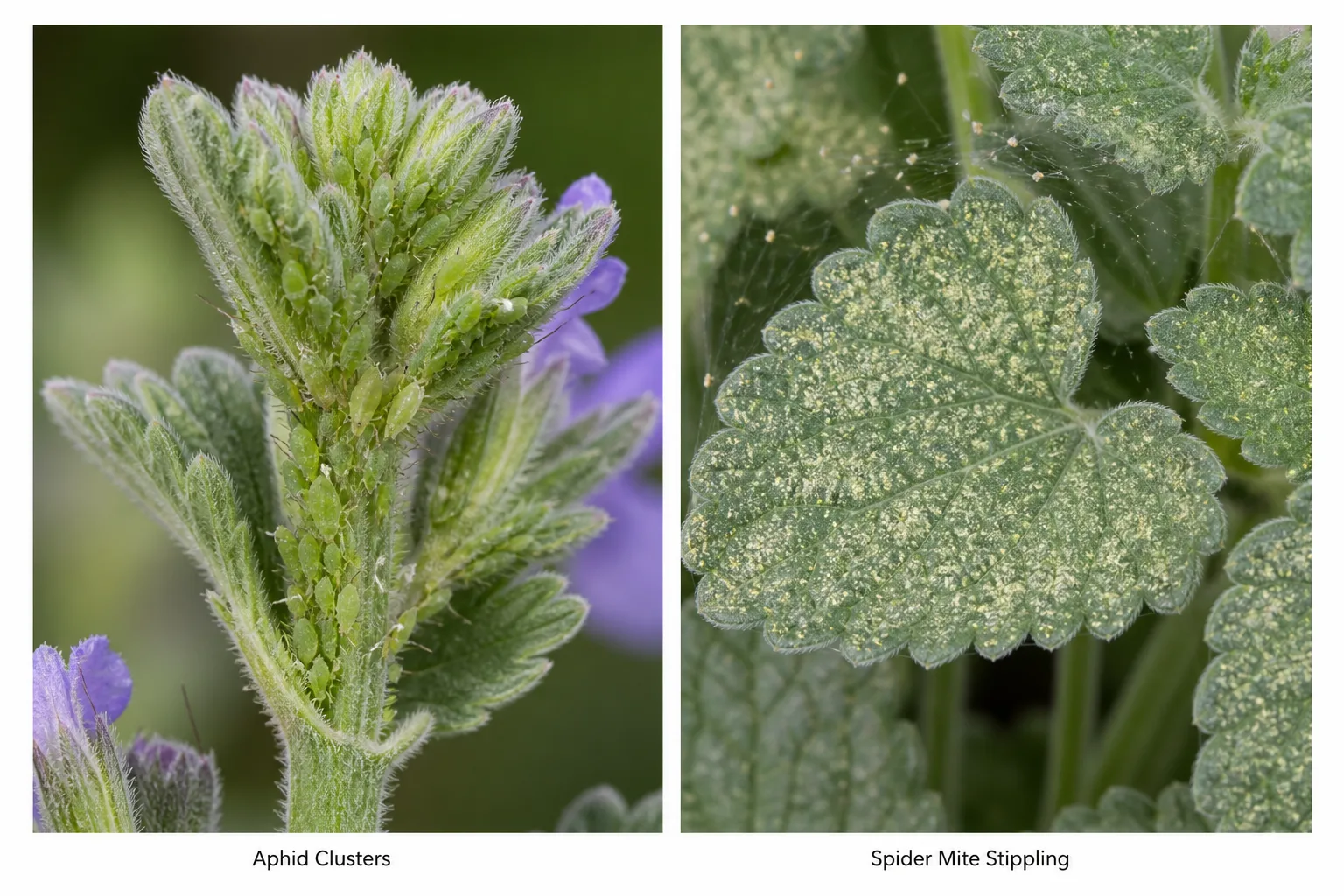
Dense clusters on tender shoot tips, worst on plants in rich ground. A hose blast or a pinch back of the affected tips usually settles it.
Fine pale stippling with dusty webbing in hot dry weather. Rinse the foliage and check whether the plant is also drought-stressed.
A clump collapsing from the center in ground that stays wet. This is the one that kills, so lift healthy outer pieces and improve the drainage rather than watering less.
Flattened stems and a hollowed-out center with no insect present. Protect young plants with low wire hoops until the base is woody enough to take it.
Frequently Asked Questions
How long does catmint bloom?
The first flush runs for several weeks from late spring, and a hard shear afterward usually buys a second flush that carries into early fall. Left unsheared, the plant tends to finish in midsummer and look tired for the rest of the season.
Does catmint spread and become invasive?
It forms a widening clump rather than running underground, so it does not behave like true mint. Some selections drop seed in open ground, which is easily managed by shearing before the spikes ripen.
Can I grow catmint in a container?
It does well in a pot as long as the mix drains sharply and the container is wide enough for the mound to spill without tipping. Container plants dry faster than bedded ones, so check them in summer rather than applying the ten-to-fourteen-day rule directly.
Is catmint good for bees?
It is one of the better long-season nectar plants for bees, largely because the bloom window is so wide. Shearing briefly interrupts that supply, which is a reason to keep other flowering plants nearby rather than a reason to skip the cut.
Why is my catmint dying in the middle?
An open, woody center on an older clump is normal aging and calls for division. If the middle is soft and collapsing rather than woody and bare, the problem is crown rot and the ground is holding too much water.
Do deer eat catmint?
Deer and rabbits generally pass it over, because the aromatic foliage is unpleasant to them. That makes it useful as a border planted in front of things they do want to eat.
Sources & References
- North Carolina State Extension – Nepeta species plant profile
- Cornell Cooperative Extension, Perennials for Pollinator Gardens
- University of Minnesota Extension, Perennials for Pollinators
- Missouri Botanical Garden Plant Finder – Nepeta x faassenii 'Walker's Low'
- Royal Horticultural Society – Nepeta (catmint) growing guide
- Missouri Botanical Garden Plant Finder, Nepeta species profile
- Royal Horticultural Society, Nepeta growing guide
- Toxic and Non-toxic Plants: Catnip | ASPCA
Related Plants
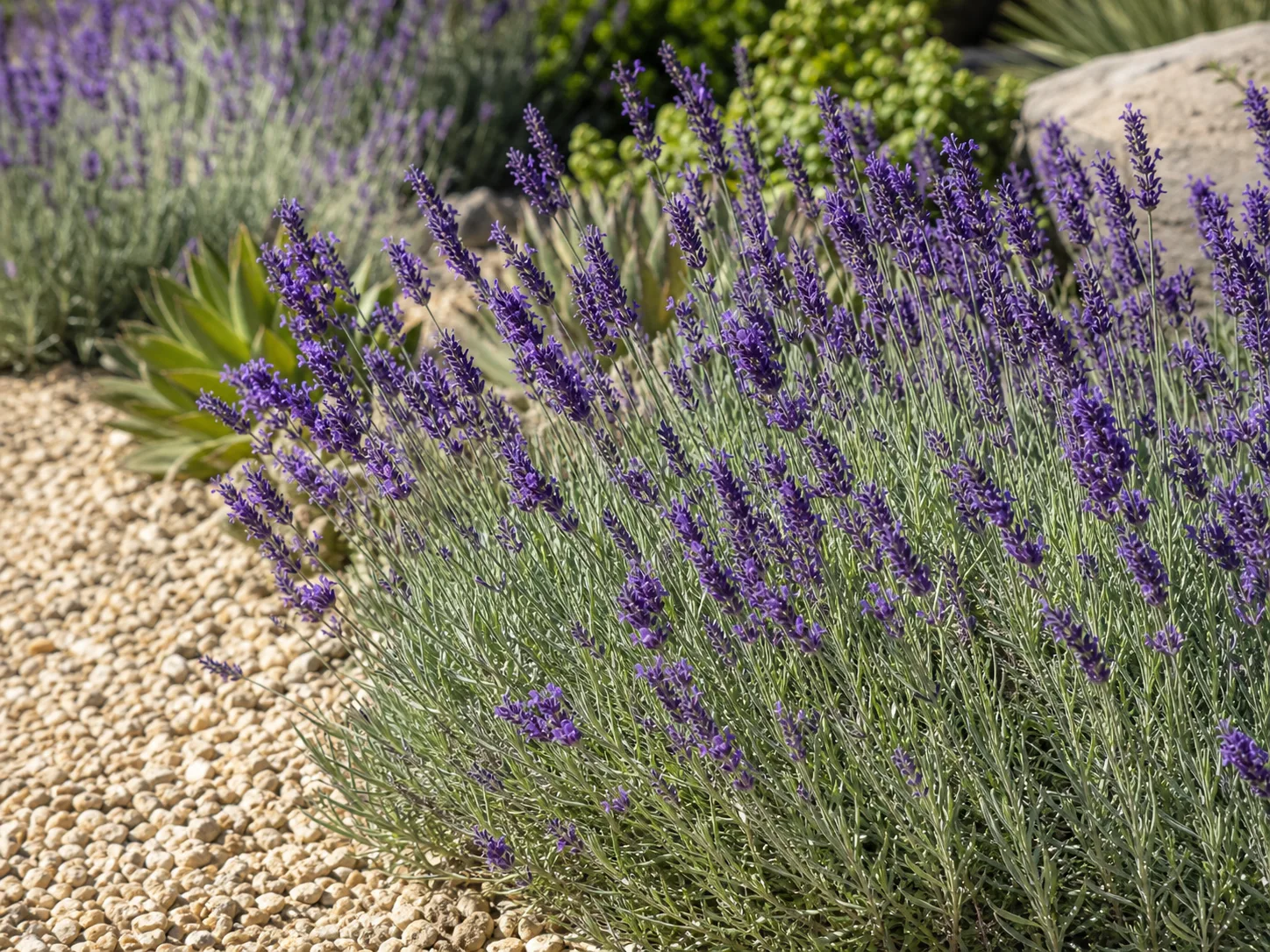
English Lavender
Another fragrant, drought-tolerant perennial that pairs well with catmint in sunny borders.
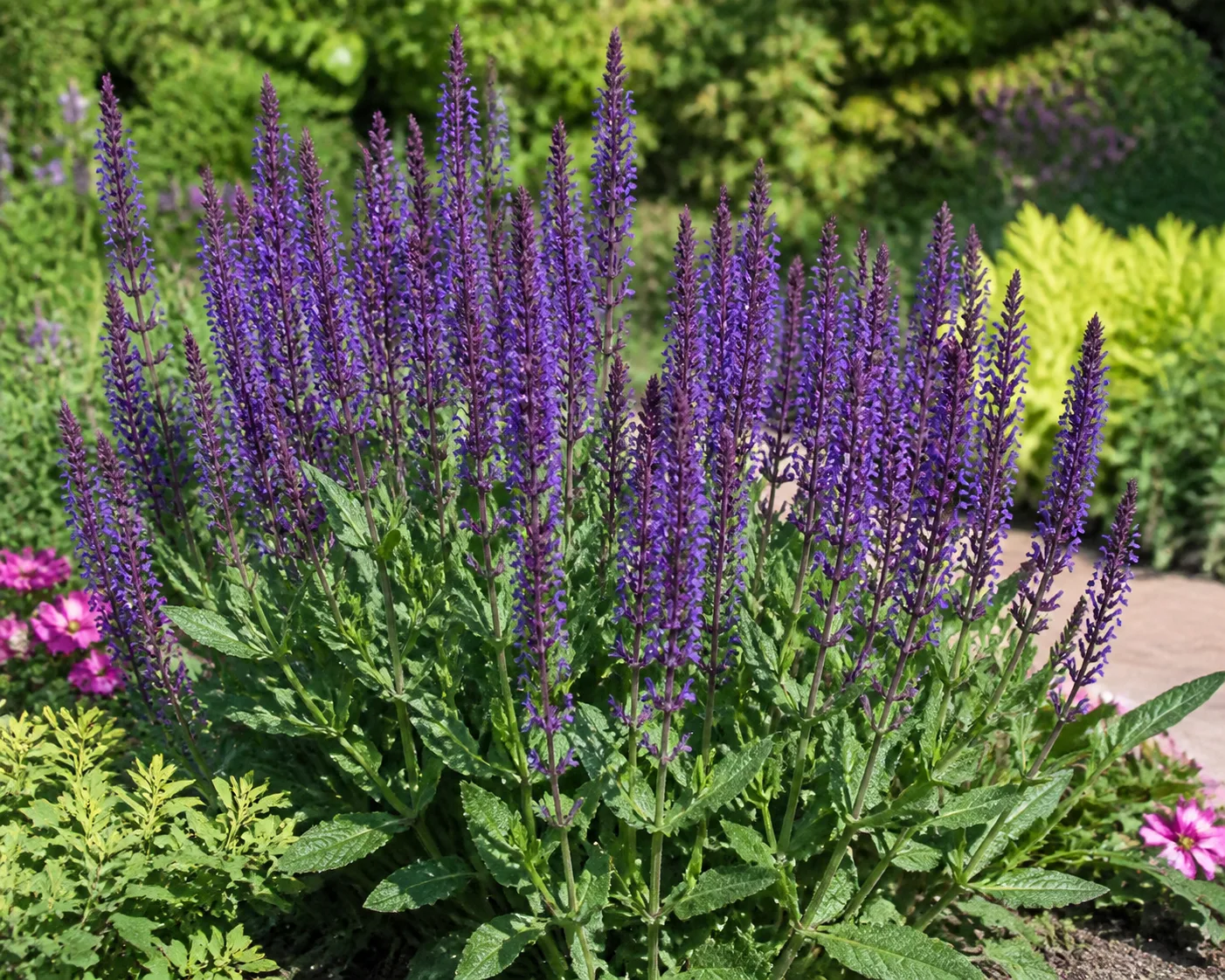
Salvia
Upright blue and purple spires that bloom with catmint and attract pollinators.
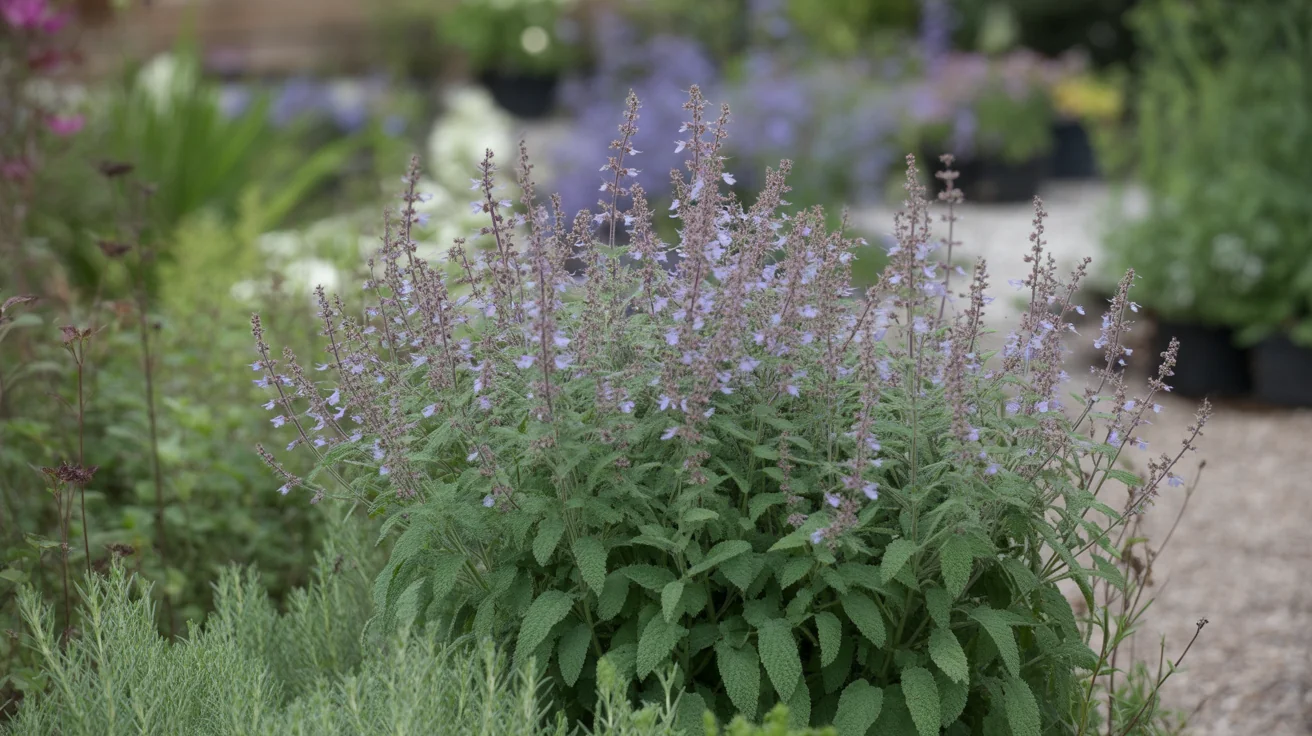
Russian Sage
Tall, airy blue perennial that offers a similar look for larger spaces.
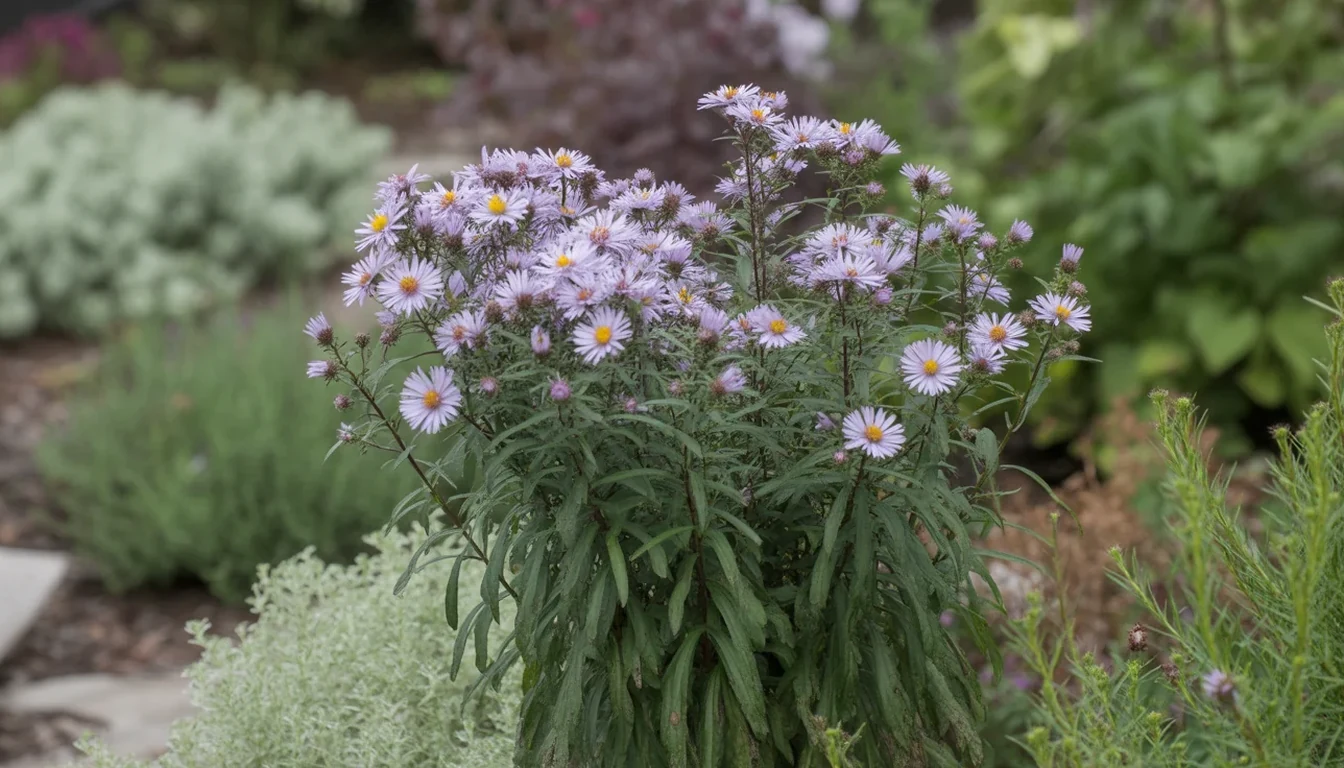
Aster
Gardeners blame the weather when an Aster splits open in September, but the shape was decided in early summer.
Astilbe
An Astilbe puts real color into a shade bed that would otherwise be green on green, but its shallow roots hold no…
Bigleaf Hydrangea
Bigleaf hydrangea (Hydrangea macrophylla) produces mophead or lacecap flowers, but winter survival and reliable…