
Boxwood Blight Signs and What to Do Before It Spreads
Boxwood blight becomes likely when brown leaf spots are followed by rapid leaf drop and narrow black streaks on young green stems. Stop working around the shrub, contain loose leaves, and arrange a laboratory diagnosis before making an irreversible removal or treatment decision.
Quick diagnosis
Leaf spots plus black stem streaks and fast leaf drop
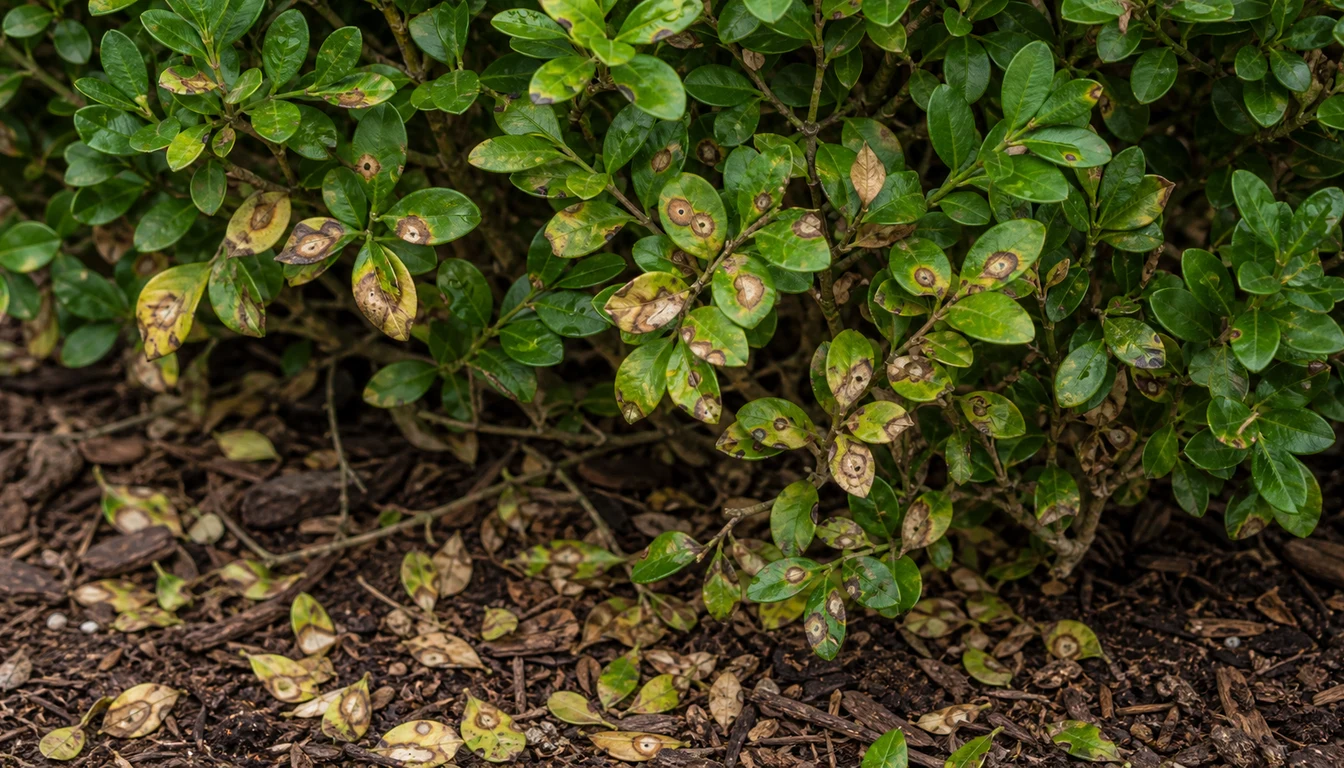
Begin at the bottom of the shrub. Boxwood blight often starts with round brown spots on lower leaves, then those leaves turn brown and drop while numerous narrow black streaks appear lengthwise on young green stems.
One spotted leaf is not enough to confirm this disease.
Uniform bronze foliage after winter, straw-colored leaves that stay attached, blistered leaves, or yellow decline above wet soil each point toward a different problem. Treat the shrub as a suspect only when the signs form the blight sequence, then ask a plant diagnostic laboratory or local Extension service how to submit a sealed sample.
Open the full diagnosisWhat You Are Seeing
Do not prune through the hedge to see how far the damage goes. The fungus that causes boxwood blight can travel on infected leaves, tools, gloves, clothing, equipment, animals, and splashing water, so an inspection can spread the problem when loose debris moves from shrub to shrub.
Mark the suspect plant and stop overhead irrigation nearby. Keep people, pets, mowers, and shared tools out of the affected area until the foliage is dry and you know how your diagnostic service wants the sample packaged.
Photograph attached leaf spots, bare lower branches, fallen leaves, and black streaks before collecting anything. If a sample is requested, include a stem that carries both affected and healthy tissue, seal it as directed, and prevent leaves from escaping during transport.
Wait for confirmation before treating every brown boxwood as contagious blight. Winter injury, root rot, Volutella canker, Macrophoma leaf spot, and boxwood leafminer require different actions, and several of those plants can be saved without removing the hedge.
Common Causes
01 High likelihood when all three signs occur together
The three-sign pattern supports boxwood blight
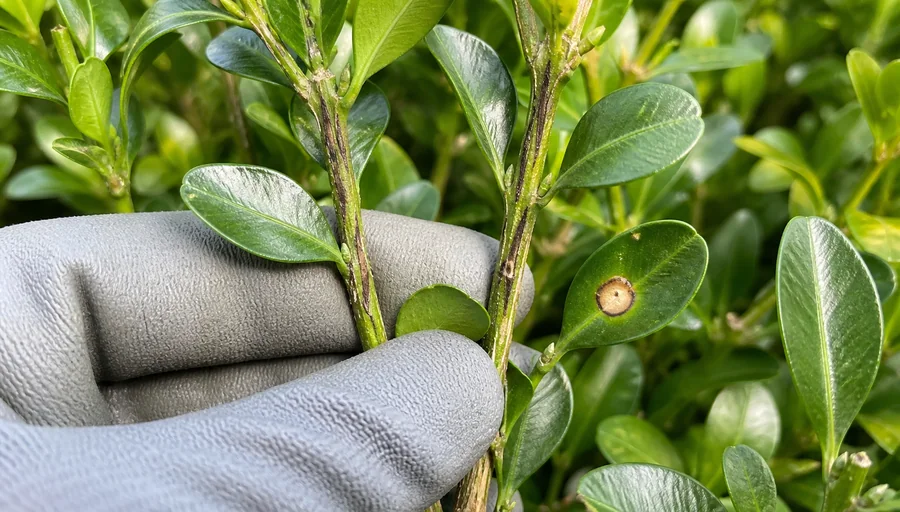
Boxwood blight is caused by the fungus Calonectria pseudonaviculata. Susceptible plants develop circular brown leaf spots, rapid defoliation that often begins low in the canopy, and narrow black lesions along green stems.
The pathogen does not attack the roots. A large plant may push new leaves after an episode, but repeated leaf loss and stem cankers weaken it, spoil the hedge, and keep producing infected debris that threatens nearby plants.
How to identify it
- Round tan or brown leaf spots enlarge and develop dark brown borders.
- Leaves brown and fall quickly, often from the lower canopy upward.
- Numerous narrow black streaks run lengthwise on young green stems.
- Outbreaks accelerate during extended wet weather or where overhead water keeps foliage wet.
- A diagnostic laboratory detects the pathogen in a properly collected sample.
What to do
- Stop pruning, mowing, overhead watering, and foot traffic around the suspect shrub.
- Arrange confirmatory diagnosis because winter injury and other boxwood diseases can look similar from a distance.
- After confirmation, follow local Extension guidance for prompt removal of susceptible infected plants and loose leaf litter.
- Keep removed material contained and use a disposal method allowed by local rules, never a home compost pile.
- Clean clothing and footwear, then decontaminate tools before they enter another boxwood planting.
02 Common lookalike
Volutella leaves straw-colored foliage attached
Volutella stem blight or canker usually affects stressed branches rather than racing upward through the whole shrub. Leaves at branch tips fade to straw color before spring growth, yet most stay attached for months instead of dropping rapidly.
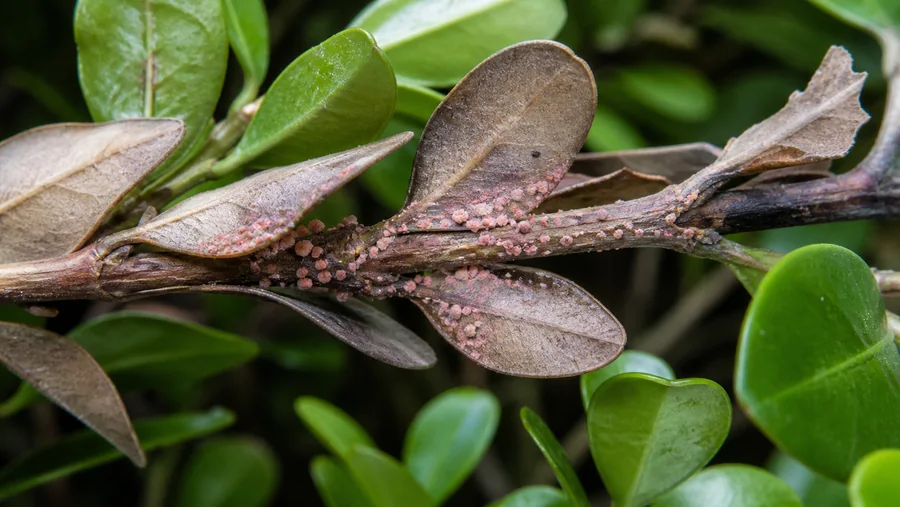
Moist conditions can reveal salmon-pink fruiting bodies on leaves and stems. Loose bark, a girdled branch, and discolored wood below the bark support Volutella, while narrow black streaks on green stems support boxwood blight.
How to identify it
- Straw-colored leaves remain attached to affected branch tips.
- Salmon-pink structures appear on leaves or stems during moist weather.
- Bark is loose or girdled at varying distances from the branch tip.
- Damage follows drought, poor pruning, crowding, or another source of plant stress.
- Rapid lower-canopy leaf drop and numerous black stem streaks are absent.
What to do
- Prune confirmed Volutella branches when the foliage is dry rather than using the blight removal response.
- Remove diseased leaves trapped inside branch crotches and collect fallen debris.
- Thin selected stems at their point of attachment to admit light and air without shearing the exterior into a dense shell.
- Correct drought stress, deep planting, excess mulch, or root damage that weakened the branch.
- Decontaminate pruning tools before moving to another shrub.
03 Possible on stressed foliage
Macrophoma covers dying leaves with tiny raised dots
Macrophoma is a weak leaf-spot fungus that is most obvious on straw-colored leaves already declining from another stress. The leaf surface carries many tiny raised black fruiting bodies rather than a few enlarging brown lesions with dark borders.
This disease lacks the narrow black stem streaks of boxwood blight and responds to selective pruning and better airflow instead of the containment response used for confirmed blight.
How to identify it
- Numerous pinhead-sized black raised dots cover dying or straw-colored leaves.
- The affected foliage was already weak or damaged before the dots became obvious.
- Leaves do not drop rapidly from the lower canopy in a moving wave.
- Young green stems lack narrow lengthwise black streaks.
What to do
- Prune affected branches and remove the diseased leaves from the planting.
- Thin congested growth so the inner canopy dries faster after rain.
- Water at the soil surface rather than wetting the foliage.
- Check for the drought, root injury, deep planting, or crowding that allowed a weak pathogen to colonize dying tissue.
04 Likely after cold sun and wind
Winter injury bronzes the exposed face
Winter bronzing produces copper, orange-brown, or straw foliage where cold sun and drying wind pull water from evergreen leaves faster than frozen soil can replace it. The exposed south, west, or windward face is usually worse while protected inner foliage stays greener.
The leaves change color more uniformly than a blight-spotted leaf and may remain attached until spring. Black stem streaks are absent, and live buds can open normally once the soil warms.
How to identify it
- Color changed during winter or became obvious as winter ended.
- The exposed outer face is bronze while sheltered foliage remains greener.
- Leaves lack expanding brown spots with dark borders.
- Green tissue is visible when a small stem surface is lightly scratched.
- Buds remain firm and begin to swell at spring budbreak.
What to do
- Wait until spring growth reveals which stems remain alive before pruning.
- Water during dry fall weather and during winter thaws when the soil is workable.
- Use a wind screen with space around the shrub rather than wrapping wet material tightly against the foliage.
- Choose a more sheltered site or a cultivar suited to the local winter exposure when damage repeats.
05 Likely in a saturated bed
Root rot starts below wet soil, not on spotted leaves
Phytophthora root rot causes a gradual loss of color and vigor because damaged roots cannot supply the canopy. Leaves progress from green to yellow-green, purplish brown, or straw, and their margins may roll inward as branches decline.
The evidence sits at the soil line and below it. Dark roots, reduced fine roots, discolored lower stem wood, and a low bed that stays wet support root rot, while round leaf spots and black lesions on young upper stems support boxwood blight.
How to identify it
- The entire plant loses color and vigor gradually rather than dropping spotted leaves within days.
- Leaf margins turn upward or roll inward.
- Soil stays wet after rain or receives water from a downspout or low grade.
- Fine roots are missing and larger roots are dark brown.
- Lower stem tissue is discolored near the soil line.
What to do
- Inspect roots and site drainage before applying a disease treatment to the foliage.
- Stop excess irrigation and redirect water that collects around the root zone.
- Improve grade or move replacement shrubs to a raised, well-drained site.
- Remove a severely damaged plant when too little healthy root system remains to support recovery.
- Keep wet soil from the affected bed out of other planting areas.
06 Possible where leaves look blistered
Leafminer makes blistered mines inside the leaf
Boxwood leafminer larvae feed between the upper and lower leaf surfaces. Infested leaves develop blotch-shaped mines and look blistered from late summer through the following spring, and a heavy population can cause premature leaf drop.
Hold a damaged leaf to light or split it open. A hollowed mine or small larvae inside confirms an insect problem, while solid brown lesions plus black streaked stems point back toward blight.
How to identify it
- Leaves have raised or blistered areas rather than flat circular spots.
- Blotch-shaped translucent mines are visible when a leaf is held to light.
- Larvae or an empty mine can be found between the two leaf surfaces.
- Damage becomes obvious from late summer through spring.
- Young green stems do not carry narrow black streaks.
What to do
- Confirm that the damage is inside the leaf before choosing insect control.
- Prune heavily infested shoots at the locally recommended time and dispose of the clippings.
- Choose resistant boxwood cultivars when replacing plants in a site with recurring leafminer pressure.
- Use an insecticide only when damage warrants it and follow the current label and local pollinator restrictions.
Why Confirmation Changes the Boxwood Blight Response
A laboratory diagnosis separates contagious Calonectria from winter injury and other lookalikes, preventing both removal of a salvageable hedge and pruning that spreads infected debris.
Once confirmed, prompt containment and removal are the usual recommendation for a susceptible infected shrub. Fallen leaves matter as much as the standing plant because the fungus survives in infected debris and can produce new spores when wet conditions return.
Fungicides protect uninfected tissue but do not cure spotted leaves, stem cankers, or an established infection. Repeated applications can also hide symptoms, so a valued planting that will be managed rather than removed needs a diagnosis-led plan from local Extension staff or a qualified plant health professional.
Removal does not make the site immediately clean. Survival structures can persist with contaminated debris and soil for years, which is why planting another susceptible boxwood in the same spot can restart the problem.
A resistant cultivar can reduce disease severity but is not the same as an immune plant. Clean nursery sourcing, temporary isolation, regular inspection, and control of contaminated movement still matter when resistant boxwood remains part of the landscape.
How Boxwood Blight Arrives in a Clean Garden
Almost every new infection is carried in rather than appearing on its own.
The spores are sticky and do not ride the wind for long distances. They travel on things that touched infected foliage, which is why the arrival routes are short and physical.
New plants are the first route. A nursery shrub can carry the fungus with no visible spot and show symptoms weeks after it goes in the ground.
Holiday decoration is the route almost nobody suspects. A boxwood wreath can carry the pathogen, so one hung by the door and later thrown on the compost puts spores where they can start.
Tools, gloves, boots and tarps are the third route, and they explain why one infected shrub so often becomes a whole row.
Wildlife and pets move spores the same way. A deer working along a hedge line does what a contaminated glove does, only more slowly.
- Hold new boxwood away from the hedge for a season and inspect it before planting.
- Buy from a nursery that follows a recognized boxwood blight cleanliness program.
- Keep boxwood wreaths and garlands off a porch that sits beside a boxwood planting.
- Work through healthy shrubs first and touch the suspect plant last.
- Disinfect tools between shrubs rather than once at the end of the day.
Removing an Infected Shrub Without Spreading It
Removal is a containment job, and the order of operations matters more than the speed.
Work in dry weather. Wet foliage releases and carries spores, so a removal done in the rain spreads exactly what it was meant to stop.
Cut the shrub down in pieces and bag as you go, rather than dragging a whole plant across the lawn.
Fallen leaves are the part people leave behind. Infected leaf litter keeps producing spores, so rake, sweep or vacuum the soil under the plant until the surface is bare.
- Bag everything
- Double-bag foliage, prunings and leaf litter in sealed plastic. Send it to the landfill, or bury it two feet deep well away from any boxwood.
- Never compost it
- A garden pile does not reach or hold a killing temperature, so the debris comes back to the bed as mulch the following year.
- Disinfect tools
- One part household bleach to nine parts water, mixed fresh each time, or a labeled o-benzyl-p-chlorophenol concentrate at about 1.25 ounces per gallon.
- Disinfect yourself
- Gloves, boots, tarps and the wheelbarrow all count. Change clothes when the job is done and wash them separately.
- Cover the bare soil
- A fresh mulch layer over the cleared ground reduces the splash that lifts surviving spores back onto foliage.
American boxwood is the one exception worth knowing about.
Researchers have suggested that a large American boxwood may push healthy new growth during dry spells, so pruning out diseased branches is offered as an alternative to felling a mature specimen.
That path is not settled, and the plant remains a spore source either way. Treat it as a decision to make with local Extension staff rather than a general rule.
What Can Go Back in the Hole
A cleared spot is not a clean spot.
Survival structures persist in soil and debris for years, so putting another susceptible boxwood in the same hole often restarts the same season of leaf drop.
Only one plant family is at risk, which narrows the question usefully. Boxwood, pachysandra and sweetbox are the landscape plants reported susceptible, and anything outside that family is off the hook.
Resistant boxwood
- No boxwood is immune to it
- Resistant cultivars show little or no symptom
- Clean sourcing and inspection still apply
Small-leaved holly
- Japanese holly reads closest to a clipped box
- Inkberry holly suits damper ground
- Neither sits in the box family
Other clipped evergreens
- Yaupon holly in warm regions
- Dwarf yew where deer pressure is low
- Check mature size before buying
Keep out of the bed
- Pachysandra as a groundcover under the hedge
- Sweetbox as a shade filler
- Both are susceptible box relatives
The pachysandra point catches people out. It is a common underplanting for a boxwood hedge, and it can hold the disease in the bed after the shrubs themselves are gone.
Give the ground a full season before replanting where the design allows it. Time and thorough debris removal do most of the work, and nothing you spray shortens the wait.
Recovery Plan
Freeze movement around the suspect plant
Stop pruning and overhead watering, mark the shrub, photograph the pattern, and keep loose leaves in place until you know how to collect them safely. Check adjacent lower canopies without touching them.
Contain the sample and wait for the result
Follow the receiving laboratory's packaging and delivery instructions. Do not spray first because a fungicide can suppress symptoms and make the history harder to interpret.
Remove or begin a specialist management plan
Carry out the disposal, cleanup, and equipment decontamination recommended for your location. Inspect nearby boxwood regularly through wet periods because new leaf spots and lower leaf drop reveal spread earlier than a bare branch does.
Watch the site before choosing a replacement
Keep susceptible boxwood out of a contaminated planting spot unless local disease guidance supports a specific management approach. When you replace the hedge, compare holly with boxwood and keep new plants separate for several weeks before planting.
Buy boxwood from a reputable nursery that follows a recognized boxwood blight cleanliness program, inspect leaves and green stems before purchase, and keep new plants separate from established boxwood for several weeks.
Avoid placing boxwood holiday greenery, shared tools, or nursery debris near the planting.
Space shrubs so mature branches do not overlap, water at the base, and avoid working in wet foliage.
Clean tools, gloves, shoes, and equipment after work in any suspect planting, since prevention depends on stopping movement rather than waiting for visible disease.
Never compost confirmed infected boxwood or its fallen leaves. Follow local disposal guidance, and choose a resistant cultivar or a non-host replacement only after accounting for the contaminated site and the long survival of the pathogen in debris.