
Best Ground Cover Plants for Sun, Shade, and Slopes
The best ground cover is a plant that survives the site and performs the job without escaping into places where it is unwanted. Creeping thyme and low sedums suit sunny, fast-draining ground, while wild ginger, foamflower, sedges, and some hardy geraniums cover shaded soil more reliably.
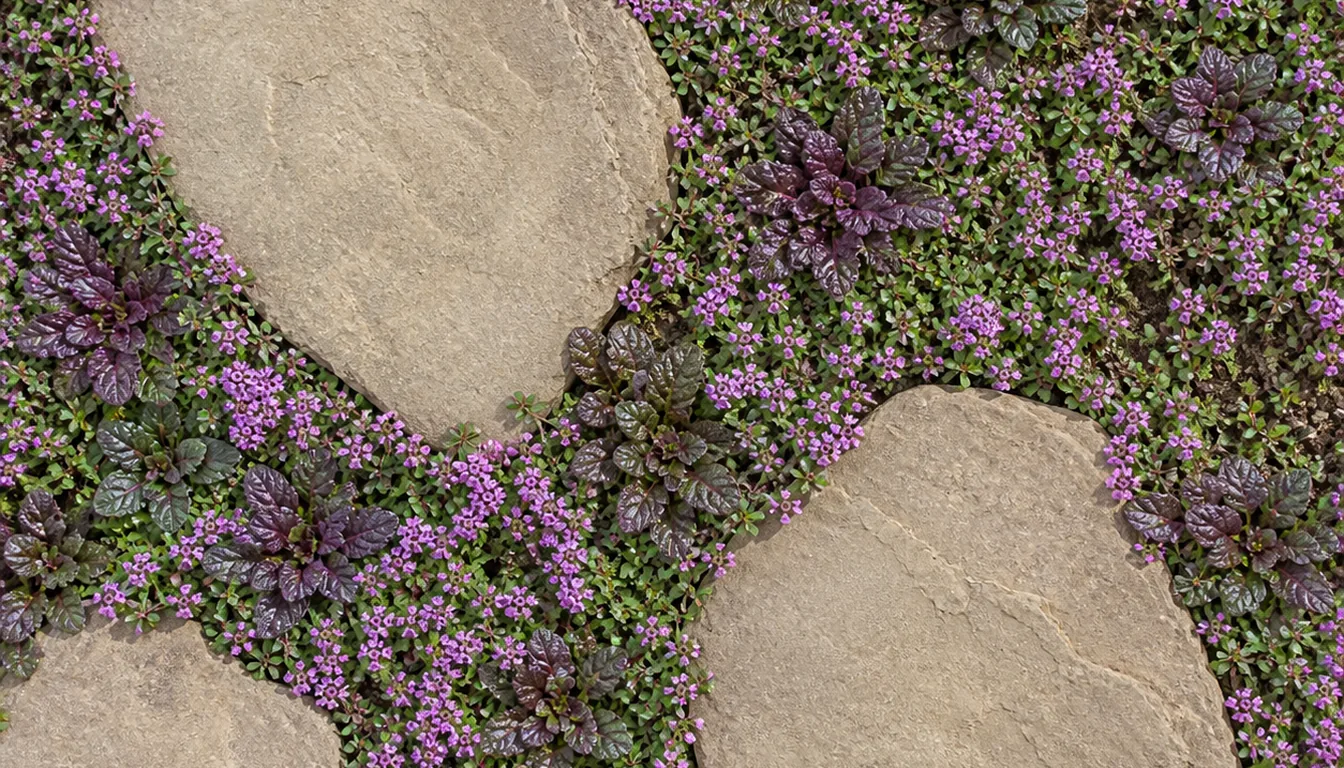
Use a path for repeated footsteps and plants for the space around it. Most ground covers tolerate occasional steps at best, so a living carpet is rarely a direct replacement for turf where children, dogs, or a wheelbarrow travel every day.
At a glance
What Should a Ground Cover Do in This Spot?
Ground cover describes a job, not one botanical group.
A low perennial, shrub, grasslike sedge, fern, or spreading succulent can all cover soil, but each builds a different height, root system, seasonal look, and level of competition.
Begin with the pressure the planting must handle.
Six hours of direct sun, dry tree roots, road salt, periodic flooding, deer browsing, and a steep bank are separate filters, and one plant rarely handles all of them.
Then decide what success means. You may need year-round foliage by a front walk, roots that slow surface erosion, flowers for pollinators, a soft edge around stepping stones, or simply fewer weeds beneath shrubs.
- Light
- Record direct sun in midsummer, including hot afternoon exposure
- Water
- Notice whether soil dries within a day or stays wet after rain
- Traffic
- Separate occasional steps from a daily route
- Spread
- Check mature width, rooting habit, and local invasive status
- Season
- Decide whether winter coverage or summer flowers matter more
A plant tag supplies a range, not a verdict.
A species listed for sun to shade may flower in sun but merely persist in shade, and a drought-tolerant plant still needs regular water while new roots establish.
Which Ground Cover Plants Fit Sun, Shade, or Moist Soil?
Use the table as a shortlist, then confirm hardiness and invasive status with a local Extension office or state plant list.
Common names can cover several species, so buy by botanical name and check that name against a current local invasive list.
| Site and job | Plants worth checking locally | What makes them useful | Important limit |
|---|---|---|---|
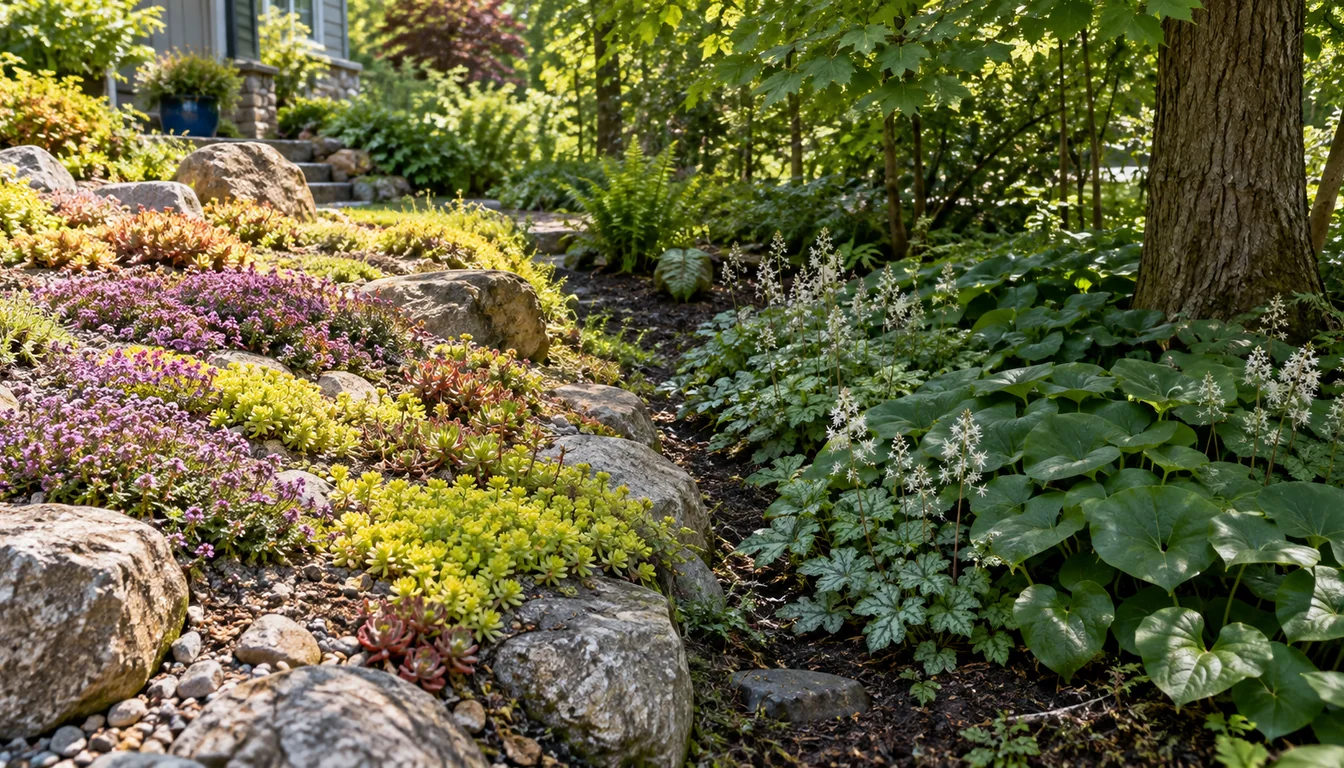
| Sunny, dry, well-drained edge | Creeping thyme, low sedum, pussytoes | Low mats, modest water after establishment, flowers | Poor fit for wet clay; thyme takes only light steps |
| Sunny slope | Creeping phlox, barren strawberry, prairie alumroot | Spreading growth covers exposed soil | Plants do not repair active gullies or unstable soil |
| Part shade under open trees | Pennsylvania sedge, foamflower, wild geranium | Handles filtered light and gives layered texture | Establishment water competes with tree roots |
| Moist shade | Wild ginger, foamflower, Christmas fern in masses | Covers soil where many sun plants thin | None wants permanent standing water |
| Hot-region sun | Regionally native frogfruit or sunshine mimosa | Fast coverage and pollinator flowers in suitable climates | Can spread strongly and is not hardy everywhere |
| Between occasional stepping stones | Creeping thyme, self-heal, region-suitable low sedges | Low enough to soften hard edges | Daily traffic still needs stone or gravel |
For a broader palette in dim beds, compare the site against shade plants selected for low-light gardens. That page owns shade-bed choices beyond the low, spreading layer covered here.
Can Ground Cover Replace Grass?
Ground cover can replace turf on a slope, beneath trees, in a narrow side yard, or around stepping stones where mowing is awkward. It performs poorly as a sports surface because most stems and crowns cannot recover from repeated twisting feet, running dogs, or mower-like compaction.
Map how people actually move before removing grass. A faint shortcut across the lawn will become a bare channel through a new planting unless you place pavers, gravel, or another firm surface on that line.
Good conversion
A low-traffic slope, tree edge, foundation bed, curb strip, or island around shrubs
Keep turf or hardscape
Play area, dog run, cart route, gate entrance, or the only path to a utility
Mixed solution
Pavers carry each step while low plants fill the wider joints and shoulders
Drainage warning
Plants can shield soil from rain impact, but they cannot make compacted subsoil drain
Ground covers reduce mowing after establishment, yet they do not erase maintenance. Expect weeding while gaps remain, edging where stems escape, leaf cleanup, irrigation during drought, and occasional division or renewal.
A diverse planting can support more insects and produce a longer season than one species planted wall to wall. Keep the mix simple enough that you can identify seedlings, runners, and weeds before they merge.
Will Ground Cover Stop Erosion on a Slope?
Dense foliage can slow runoff and protect the soil surface from pounding rain.
Roots also bind the upper layer, which makes a planted slope more stable than bare, freshly cultivated ground.
Plants are not structural repair. Water emerging from the bank, widening gullies, a leaning retaining wall, exposed utilities, or soil moving after storms calls for drainage or engineering help before planting.
On a stable bank, disturb as little soil as possible. Clear weeds in small areas, keep existing roots where practical, set plants in staggered rows across the contour, and water each pocket slowly so runoff does not wash the backfill downhill.

- Watch one stormMark where water enters, speeds up, pools, or leaves the slope.
- Correct the sourceRedirect a downspout or concentrated discharge before adding plants.
- Choose several root formsCombine low spreaders with clumping grasses, sedges, or small shrubs suited to the site.
- Plant across the contourStagger holes instead of creating straight downhill channels.
- Protect open soilUse a thin weed-free mulch or an approved biodegradable erosion blanket until foliage closes.
Closer initial spacing gives faster surface coverage, but packing plants tightly can increase cost, competition, and disease where air stays damp.
Balance erosion risk against each plant's mature spread rather than using one spacing for every species.
How Many Ground Cover Plants Do You Need?
Measure the plantable area, subtract pavers and other permanent objects, and use the spacing recommended for the exact plant. Spacing is measured on center, from the middle of one crown to the middle of the next.
For square spacing, divide the bed's square footage by the square of spacing in feet.
At 12 inches on center, one plant covers roughly one square foot. At 18 inches, each plant occupies about 2.25 square feet.

| On-center spacing | Approximate plants per 100 sq. ft. | Tradeoff |
|---|---|---|
| 6 inches | 400 | Very fast closure, high purchase cost, strong early competition |
| 8 inches | 225 | Fast closure for small plugs |
| 12 inches | 100 | Moderate cost and closure speed |
| 18 inches | 45 | Lower cost, longer weed-management period |
| 24 inches | 25 | Suitable only for plants with a wide mature spread |
These figures are planning estimates. Add a small allowance for an irregular edge, but do not buy extra plants merely to force instant coverage around crowns that need air.
Coverage speed also depends on growth habit. A slow clumping sedge at 12 inches behaves differently from a runner that roots wherever its stems touch soil.
How Do You Prepare and Plant a Ground Cover Bed?
Remove perennial weeds before planting because bindweed, nutsedge, bermudagrass, and similar plants become difficult to extract through a woven carpet. Digging, repeated removal, solarization, or another locally appropriate method may take a season, but planting into active perennial weeds usually transfers the work to a tighter space.
Test drainage and identify the soil rather than applying the same amendment everywhere. Compost can improve low-organic-matter mineral soil, but a rich blanket will not correct a compacted layer or a site that receives runoff from a roof.
If you need to decide whether an organic material belongs on top or in the soil, use the mulch versus compost comparison. Keep mulch away from crowns and woody trunks.
- Perennial weeds and turf removed with their roots or exhausted before planting
- Soil surface graded so water does not collect against a building
- Plant labels checked for mature width and correct botanical name
- Crowns set level with surrounding soil rather than buried
- Circling roots loosened without tearing the whole root ball apart
- Plants watered immediately and mulch kept thin around small crowns
Plant when mild weather gives roots time to grow before heat or frozen soil. Spring works across many cold-winter regions, while fall can be excellent where the selected plant is hardy and several weeks of workable soil remain.
Under mature trees, avoid tilling the whole root zone or piling new soil over roots. Use small pockets between major roots, choose plants that accept root competition, and expect to water those pockets longer than an open bed.
How Often Should New Ground Cover Be Watered?
Water immediately after planting, then check moisture inside a root ball rather than judging the surrounding surface. Nursery mix can dry faster than native soil, especially when a plug sits beneath an overhang or beside thirsty tree roots.
There is no honest universal schedule.
Temperature, wind, soil, plant size, rainfall, slope, and shade change how quickly water leaves, so water when the root zone is beginning to dry and apply enough to moisten it fully.
During the first weeks, inspect often enough to catch one plant drying before the entire bed wilts. Gradually lengthen the interval as roots move into the surrounding soil, while continuing deeper irrigation during dry weather through the first growing season.
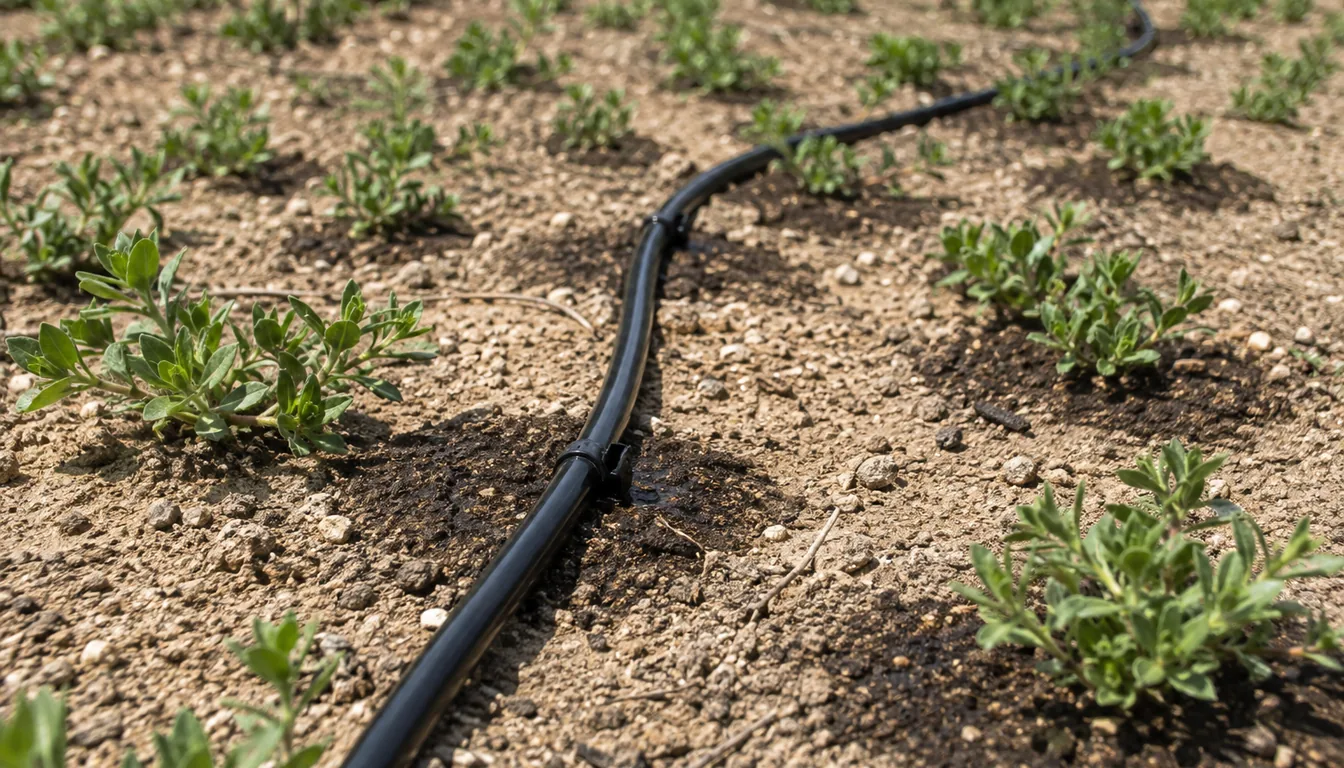
Dense foliage changes the watering problem later. Water at soil level when practical and early enough for splashed leaves to dry, because prolonged leaf wetness and poor air movement favor several foliar diseases.
Established drought-tolerant low sedums need less frequent water than moisture-loving woodland plants.
The word established matters. Drought tolerance describes a rooted plant, not a plug installed yesterday.
How Do You Keep Ground Cover From Taking Over?
Containment begins with plant choice. A vigorous species beside a lawn or woodland boundary creates more work than the same plant inside a paved courtyard, and an invasive species remains a poor choice even when edging seems strong.
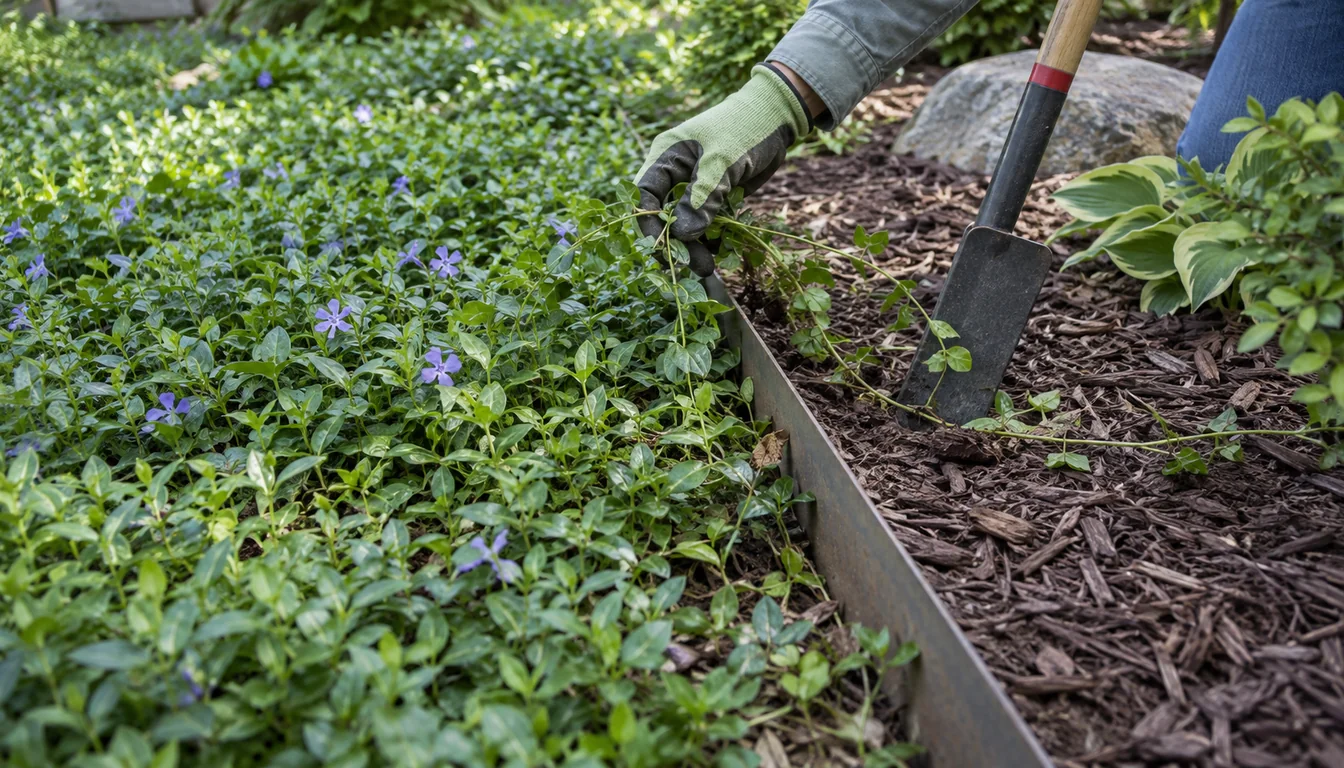
Use a visible boundary that you can inspect. Metal edging, a mow strip, paving, or a narrow gravel band makes crossing stems easy to see, but rhizomes may travel below or seed may travel above it.
Walk the edge during active growth and cut runners before they root beyond the line. Bag reproductive pieces from invasive or regulated plants according to local guidance rather than adding them to a home compost pile.
Stolons above soil
Lift and cut runners before nodes root across the boundary
Rhizomes below soil
Dig a narrow inspection trench and remove outward-growing pieces
Seed spread
Deadhead before seed matures when volunteer plants are a problem
Clumping growth
Divide crowded crowns and reset healthy outer pieces into gaps
Weed control changes once the ground cover closes. Pull seedlings while they are small, work from stepping boards to avoid crushing stems, and avoid deep hoeing that severs shallow roots.
Do not assume a dense carpet blocks every weed. Windblown seeds can germinate in trapped leaf litter, while perennial weeds can emerge through the foliage from roots below.
Why Is Ground Cover Dying or Refusing to Spread?
Read the pattern before replacing plants.
One dead circle suggests a local cause such as a dry irrigation gap, pet urine, buried construction debris, foot traffic, or a low wet pocket. Decline across the entire bed points more strongly to a site mismatch or weather event.
Lift one failing plant and inspect the roots. Dry, firm roots and soil pulling from the pot-shaped root ball indicate missed water, while dark soft roots, sour-smelling soil, or a buried crown point toward excess moisture and poor aeration.

| Symptom | Likely question to test | Useful next move |
|---|---|---|
| Long open stems and few flowers | Is the plant receiving enough light? | Move or replace it with a shade-suited species |
| Crispy edge beside pavement | Does reflected heat dry this strip first? | Adjust irrigation or use a heat-tolerant edge plant |
| Soft crown in a low spot | Does water remain after rain? | Correct grade or drainage before replanting |
| Narrow bare route | Are people or animals following one line? | Add a durable path on the route |
| Healthy edge with an empty center | Has an older clump crowded itself? | Divide vigorous outer growth and renew the center |
| Random holes and exposed roots | Is runoff moving mulch and soil? | Slow concentrated water and protect the surface |
A fertilizer response should follow evidence of a nutrient need, not slow spreading alone.
Excess nitrogen can make some ground covers loose, disease-prone, and easier to damage.
Replace a repeated failure with a plant that fits the measured condition. If every living plant loses to daily feet or moving water, change the surface or drainage job instead of buying a third batch.
Pro Tips
- Record midsummer sun and drainage before shopping because a low-growing habit does not reveal a plant's site needs.
- Put pavers on the route people already use, then plant ground cover around them.
- Check botanical names against a current state invasive list before buying a fast spreader.
- Measure spacing from crown center to crown center and use the exact plant's mature width.
- Inspect each root ball during establishment because surrounding soil can look moist while the nursery mix is dry.
- Keep one visible edge where runners, rhizomes, and seedlings can be found early.
Frequently Asked Questions
What is the lowest-maintenance ground cover?
The lowest-maintenance choice is a locally hardy plant matched to the site's light, soil moisture, traffic, and available space. A drought-tolerant sun plant becomes high maintenance in wet shade, while a vigorous spreader becomes work when it reaches a lawn or natural area.
What ground cover chokes out weeds?
A healthy, dense planting shades many new weed seedlings after it closes, but no ground cover eliminates established perennial weeds. Clear difficult weeds first and continue pulling seedlings while gaps remain.
How long does ground cover take to fill in?
The answer depends on species, starting plant size, spacing, climate, and care. Close spacing closes gaps sooner but costs more and can create competition or poor airflow, so use the mature spread and growth habit on the exact plant label.
Can you walk on ground cover plants?
Some low plants tolerate occasional steps, especially around pavers, but most cannot handle a daily route or active play. Put stone, gravel, or another durable surface wherever traffic repeats.
Should landscape fabric go under ground cover?
Fabric can obstruct rooting stems, complicate division, and collect soil where weeds germinate above it. Remove existing weeds, use a thin temporary mulch, and let the plants contact soil unless a project-specific erosion product is recommended.
Do ground covers attract pests?
Dense foliage creates shelter for insects and other small animals, but a well-matched planting is not automatically a pest problem. Keep foliage away from siding where local pest guidance calls for clearance, remove trapped debris, and diagnose actual damage before treating.
Sources & References
- Groundcovers, University of Maryland Extension
- Groundcovers for Sun, Iowa State University Extension
- Alternatives to Lawn: Groundcovers, University of Wisconsin Extension
- Selecting Landscape Plants: Groundcovers, Virginia Cooperative Extension
- Ground Cover Plants, Colorado State University Extension
- Ground Cover Plants, University of Minnesota Extension
- Perennial Groundcovers, Cornell Cooperative Extension
- Groundcover Plant Finder, Missouri Botanical Garden
Related Guides

Best Butterfly Garden Plants for a Complete Habitat
The best butterfly garden plants do two different jobs. Host plants feed caterpillars, while nectar…
15 min read
Best Fall-Blooming Flowers for Color Near Frost
A bed that still carries flowers in October usually was planned before temperatures fell.
9 min read
Best Fast-Growing Trees for Shade and Privacy
The best fast-growing tree is the one whose mature crown, roots, climate range, and maintenance…
16 min read
Best Fragrant Flowers for Every Yard and Season
The best fragrant flowers depend on climate, light, space, and the hours you use the yard.
15 min read
Best Full-Sun Perennials for Hot, Bright Beds
The best full-sun perennials are the ones that match the bed's soil moisture and drainage, local…
14 min read
Best Indoor Plants for Every Room and Light Level
The best indoor plant is one that fits the light in its exact location and the care you will…
16 min read