
Vegetable Garden Fertilizer Chart With Amounts by Crop and Bed Size
A vegetable fertilizer chart has to answer two questions. One is how much of a nutrient a crop needs, usually given as pounds of nitrogen per 1,000 or 100 square feet. The other is how much of an actual bag that means for a bed of a given size.
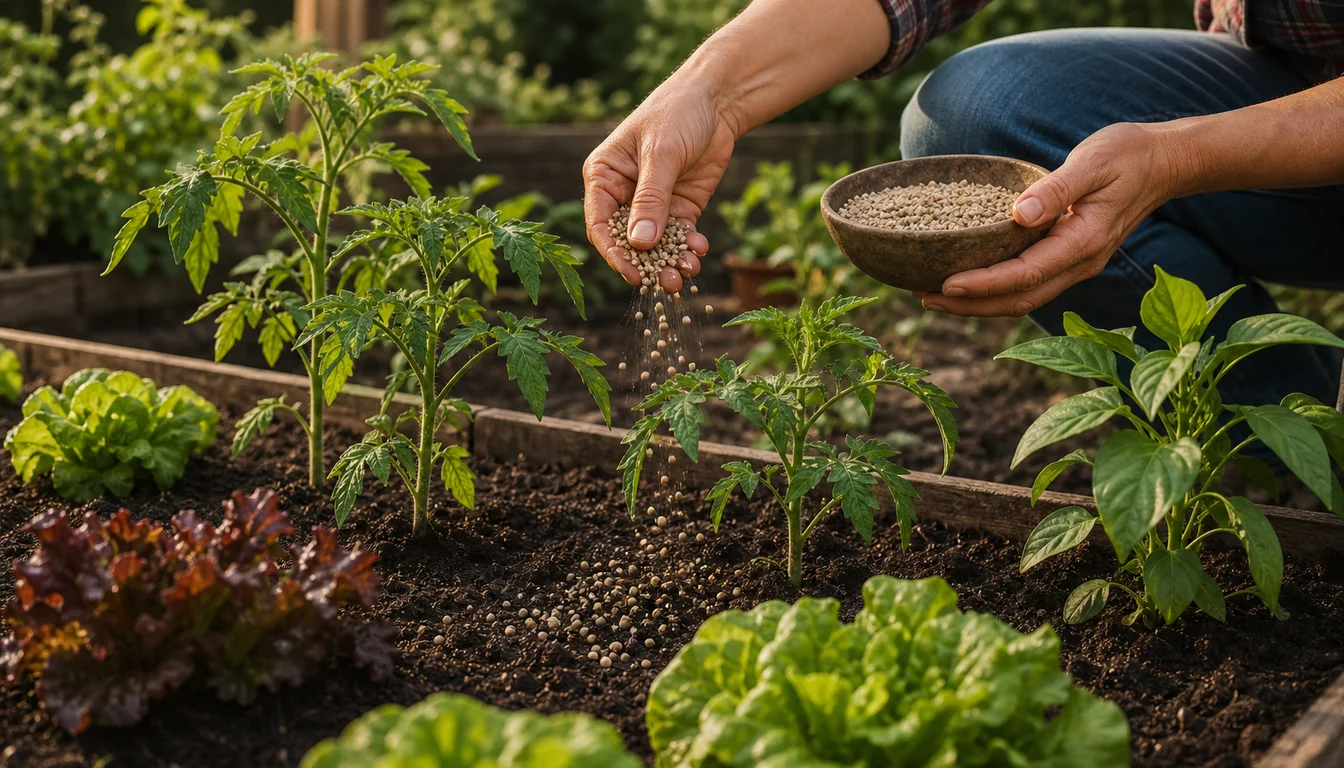
Without a soil test, Penn State's general rate is 1.75 pounds of 10-10-10 per 100 square feet for the season. That works out to a little over half a pound, roughly a generous cup, for a 4 by 8 foot raised bed. A soil test replaces that general number with one fitted to the bed, and the tables below convert either kind of rate into pounds and cups.
The timing for each feeding is covered separately, in when to apply vegetable fertilizer.
At a glance
How Much Nitrogen Does Each Vegetable Group Need?
Crops differ most in how much nitrogen they use over a season. Utah State Extension sorts common vegetables into three groups.
| Demand | Crops | Nitrogen per 1,000 sq ft | Nitrogen per 100 sq ft |
|---|---|---|---|
| Low | Peas, beans | 1 to 2 lb | 0.1 to 0.2 lb |
| Intermediate | Tomato, pepper, squash, pumpkin, melon, broccoli, cauliflower, Brussels sprouts, lettuce, spinach, carrot, beet, radish, turnip, celery, asparagus | 2 to 3 lb | 0.2 to 0.3 lb |
| High | Onion, sweet corn, potato | 4 to 6 lb | 0.4 to 0.6 lb |
Most of a mixed garden sits in the middle row. The high group is where the extra nitrogen goes, and Utah State does not put it all on at once. Its guidance for high-demand vegetables is to apply the intermediate rate before planting, then band or broadcast the additional nitrogen once plants are well established. Sweet corn, onions and potatoes therefore get their extra share as side-dresses.
Legumes are where sources part ways. Utah State lists 1 to 2 pounds of nitrogen per 1,000 square feet for peas and beans, while Colorado State advises avoiding nitrogen where legumes are planted, because it can reduce their yield. Both agree that peas and beans need the least, and in a bed with a history of good bean crops the Colorado answer of little or none is the safer starting point.
Soil organic matter lowers the number for every group. Colorado State's standard for home vegetable gardens is 0.2 pound of actual nitrogen per 100 square feet when organic matter is below 2 percent, half that at 2 to 3 percent, and none at 4 percent or more. A soil test report that lists organic matter is therefore already telling the gardener which row of that scale applies.
How Do You Turn a Nutrient Rate Into Pounds of Fertilizer?
The three numbers on a bag are percentages by weight. Clemson Extension explains that a 100-pound bag of 18-4-10 holds 18 pounds of nitrogen, 4 pounds of phosphate and 10 pounds of potash, and the rest of the weight is carrier material that helps spread it.
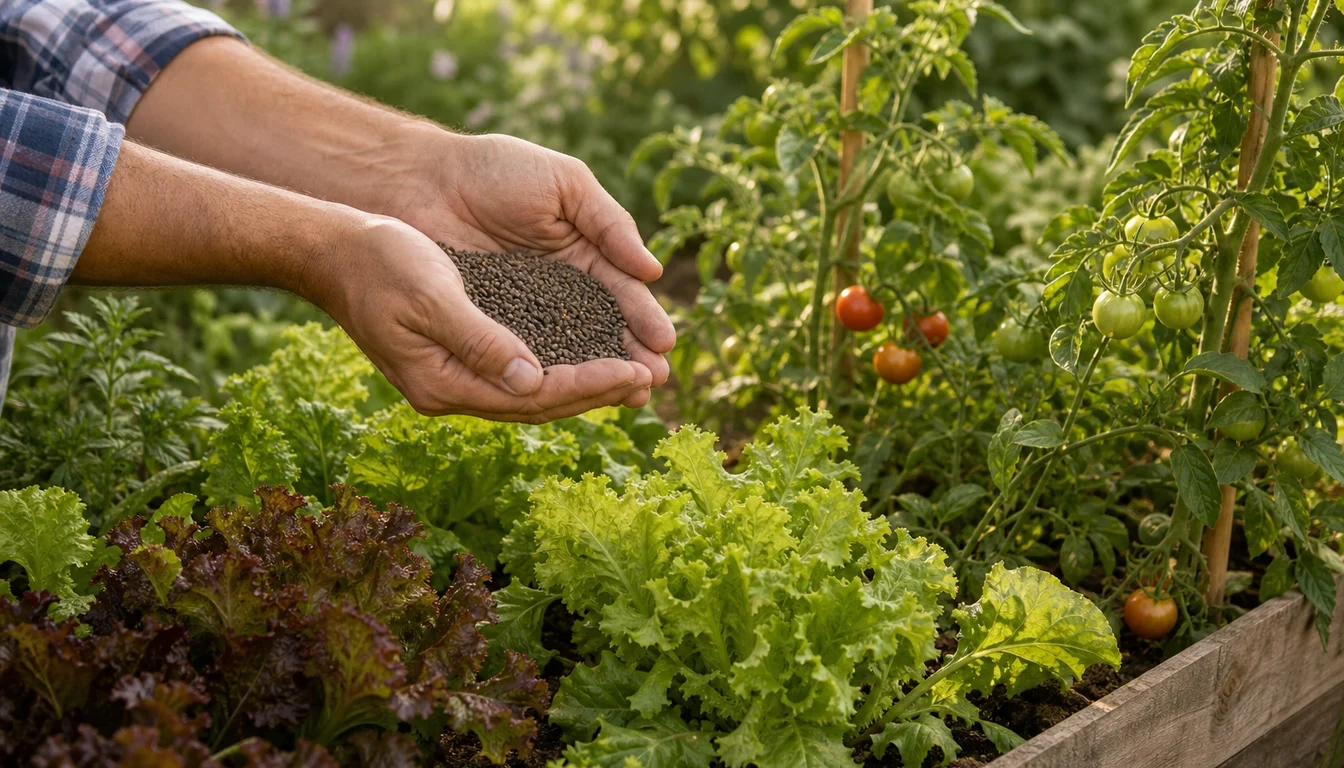
Penn State's conversion follows from that. The recommended amount of a nutrient is divided by its percentage written as a decimal, and the answer is the weight of product to apply. Iowa State makes the same point from the other direction, noting that the amount of nutrient to apply does not equal the amount of fertilizer to apply.
- Formula
- Pounds of nutrient divided by the label percentage as a decimal
- 0.2 lb N from 10-10-10
- 0.2 / 0.10 = 2 lb of product
- 0.2 lb N from 21-0-0
- 0.2 / 0.21 = about 1 lb of product
- Volume rule of thumb
- A pint of most granular fertilizers weighs about a pound
- Per 1,000 to per 100 sq ft
- Divide by 10
Penn State bases the calculation on nitrogen first and phosphate second, because an excess of either one causes environmental problems. When a bag supplies more phosphorus or potassium than the test asked for, matching the nitrogen and accepting the extra is the safer error than matching the phosphorus and overshooting the nitrogen.
Organic products follow the same arithmetic with lower percentages, so the weight of product goes up. Utah State lists blood meal at about 12 percent nitrogen and composts at 1 to 3 percent, so meeting a bed's nitrogen need from compost alone takes a large volume of it. Organic materials and their numbers are covered in the homemade vegetable fertilizer guide, and the fertilizer calculator runs the division for any label.
What Rate Fits a Garden With No Soil Test?
A garden with no soil test can still use a measured rate. Penn State's general recommendation is 1.75 pounds of 10-10-10 per 100 square feet for the season, and University of Minnesota's lettuce guidance is 2 pounds of 10-10-10 per 100 square feet. Either one supplies close to 0.2 pound of nitrogen per 100 square feet, which matches Colorado State's standard for soil low in organic matter.
The weakness of a balanced bag is the phosphorus and potassium that come with the nitrogen. Minnesota notes that many of its soils already have enough phosphorus and advises a low- or no-phosphorus fertilizer unless a soil test specifically calls for more. Utah State's version of the no-test approach is to apply only the phosphorus and potassium amounts listed for soils already testing adequate, which it calls less accurate but conservative.
How Much Fertilizer Does a Bed of Your Size Take?
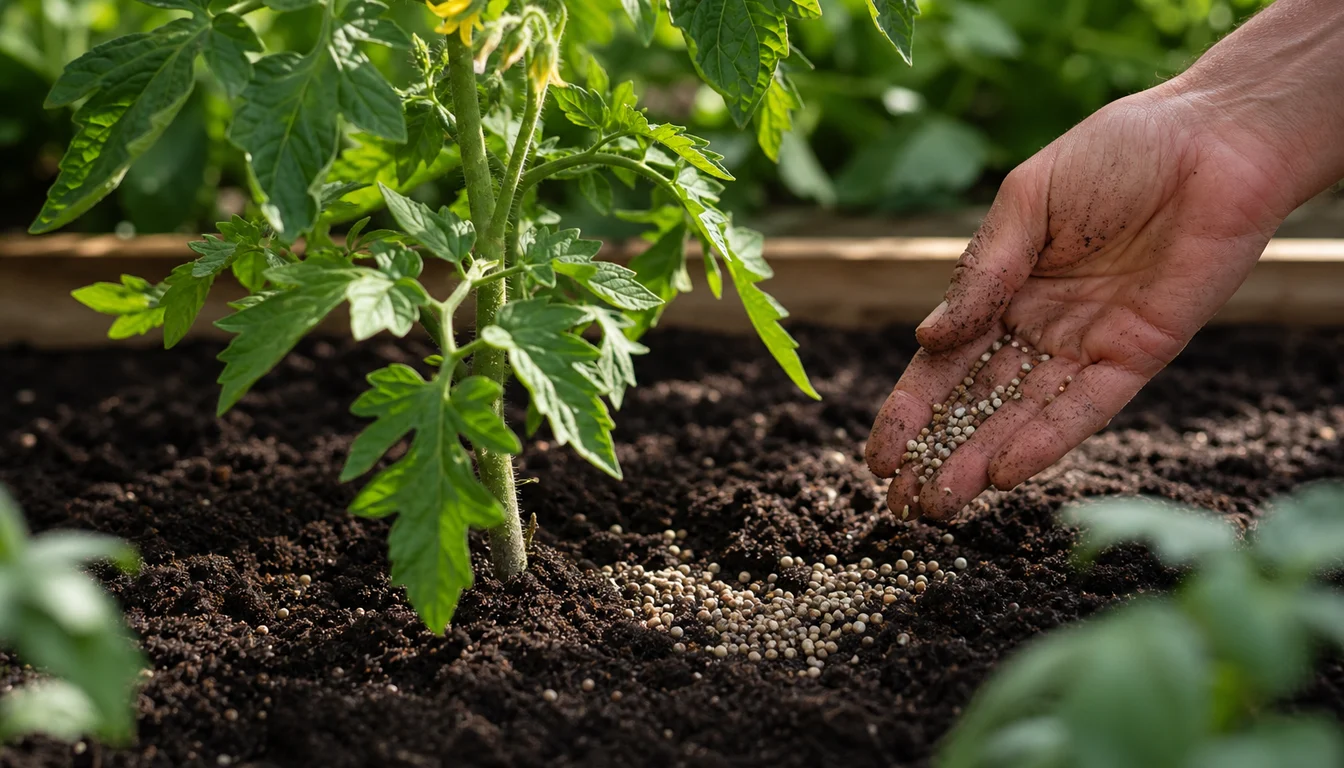
Rates per 100 square feet only become useful once they are scaled to a real bed. The bed's area divided by 100 gives the share of the rate it takes, so a 4 by 8 foot bed of 32 square feet takes 0.32 of it.
| Bed size | Area | 10-10-10 at 1.75 lb per 100 sq ft | 21-0-0 for 0.2 lb N per 100 sq ft |
|---|---|---|---|
| 4 x 4 ft | 16 sq ft | 0.28 lb, about 1/2 cup | 0.16 lb, about 1/3 cup |
| 3 x 6 ft | 18 sq ft | 0.32 lb, about 2/3 cup | 0.18 lb, about 1/3 cup |
| 4 x 8 ft | 32 sq ft | 0.56 lb, about 1 cup plus 2 tablespoons | 0.32 lb, about 2/3 cup |
| 4 x 12 ft | 48 sq ft | 0.84 lb, about 1 2/3 cups | 0.48 lb, about 1 cup |
| 10 x 10 ft | 100 sq ft | 1.75 lb, about 3 1/2 cups | 1 lb, about 2 cups |
| 20 x 25 ft | 500 sq ft | 8.75 lb | 5 lb |
The cup figures use Clemson's rule that a pint of most fertilizers weighs about a pound, and Colorado State's note that a pound of 21-0-0 is about 2 cups. Granule sizes differ between products, so a kitchen scale gives a closer answer for a small bed than a measuring cup does.
The two columns are not added together. The first is a season's balanced feed for a bed without a test. The second is a nitrogen-only amount for a bed whose test shows phosphorus and potassium are already adequate. Either one is split between the pre-plant feed and the side-dresses rather than applied in a single pass.
How Much Goes On in Each Side-Dress?
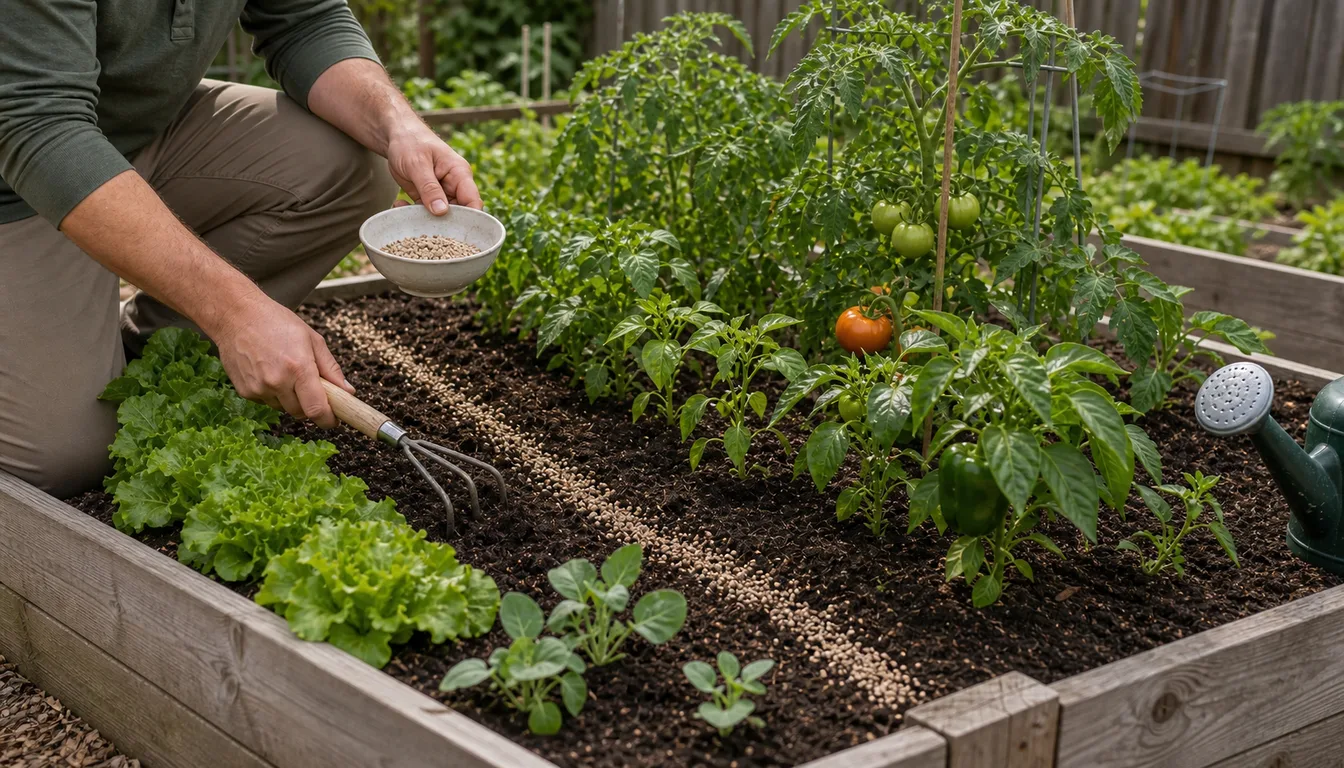
Side-dress rates are usually written per length of row, because the fertilizer goes in a band beside the plants. The last column scales each published rate to 10 feet of row, which suits a raised bed better than 100 feet does.
| Crop | When | Published rate | About per 10 ft of row |
|---|---|---|---|
| Tomatoes | First fruits start to enlarge | 1 cup of 27-3-3 per 100 ft (Minnesota) | 1 1/2 tablespoons of 27-3-3 |
| Sweet corn | About 1 foot tall | 1 cup of 27-3-3 per 100 ft (Minnesota) | 1 1/2 tablespoons of 27-3-3 |
| Summer squash, zucchini | Vines begin to spread | 1 cup of 27-3-3 per 100 ft (Minnesota) | 1 1/2 tablespoons of 27-3-3 |
| Lettuce | About 4 inches tall | 1 lb of 10-10-10 per 25 ft (Minnesota) | 0.4 lb, about 3/4 cup of 10-10-10 |
| Onions | Roots well developed, once or twice | 0.25 to 0.5 lb of urea per 25 ft (Minnesota) | 0.1 to 0.2 lb of urea |
| Potatoes | About 4 weeks after planting, then 2 weeks later | 0.15 lb of nitrogen per 50 ft (Minnesota) | 0.03 lb of nitrogen, about 1/4 cup of 21-0-0 |
| Carrots, beets | 4 to 6 weeks after planting | 4 oz of nitrogen per 250 ft (Colorado State) | about 1 1/2 tablespoons of 21-0-0 |
| Peppers | After the first flush of fruit sets | 4 oz of nitrogen per 250 ft (Colorado State) | about 1 1/2 tablespoons of 21-0-0 |
| Beans | None | Colorado State advises no nitrogen side-dress | None |
The table shows how far apart crops sit. An onion row takes several times the nitrogen of a carrot row the same length, which matches Utah State placing onions in its high-demand group and carrots in the middle one.
Tomatoes and corn share a rate in Minnesota's guidance, but Colorado State does not recommend urea or ammonium nitrate as nitrogen sources for tomatoes, so a tomato side-dress is better drawn from another product. Clemson places side-dress fertilizer 4 to 6 inches from the plants, and Minnesota scratches it into the soil surface before watering.
Why Is More Than the Chart Not Safer?
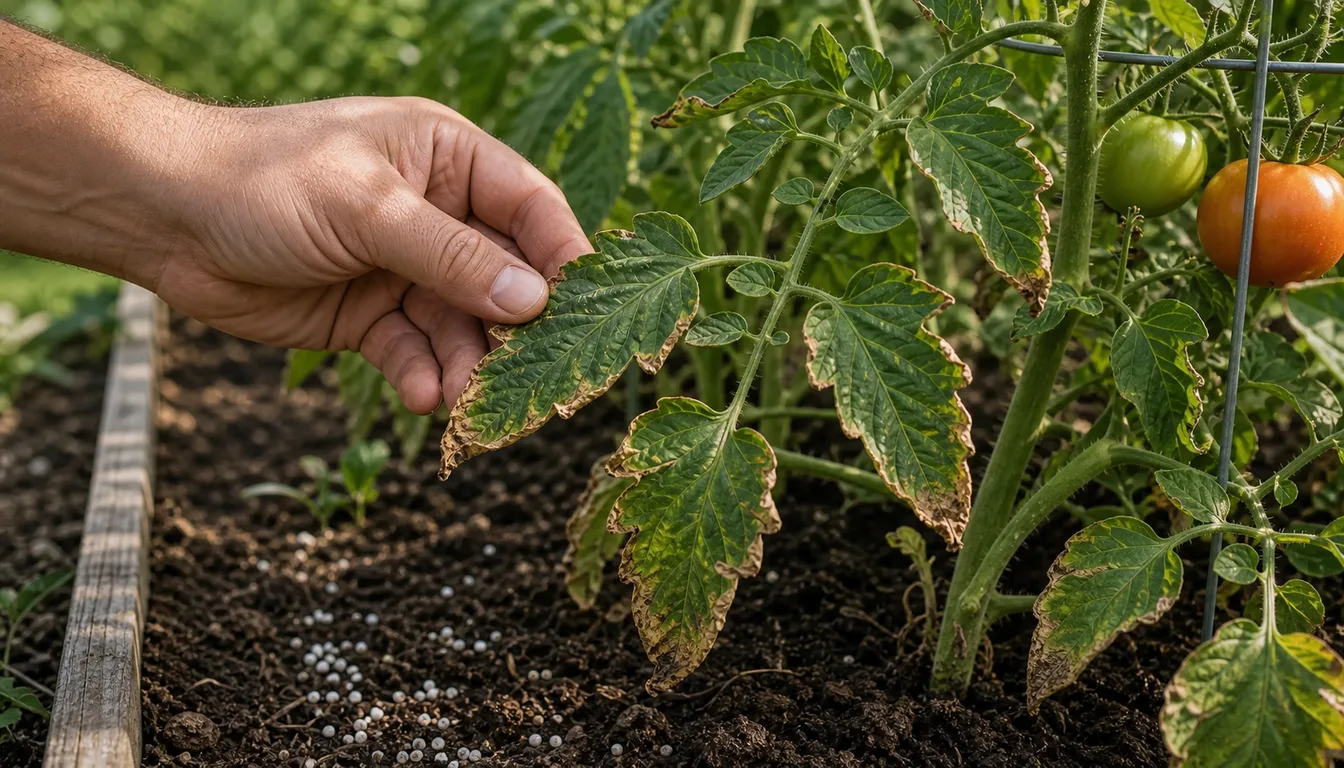
Every number above is a ceiling for that crop, not a floor to exceed for a bigger harvest. Minnesota Extension warns that too much nitrogen gives bushy, leafy tomatoes and peppers that are slow to bear fruit, and that in carrots it produces leaves at the expense of roots.
Salt is the other cost. Maryland Extension notes that too much fertilizer can burn plants and build excess salt in the soil.
Compost can overshoot too. Utah State cautions that repeated compost applications sized to meet nitrogen needs alone can build up excess phosphorus and salt in the soil over time. A bed fed generous compost every year is the bed most likely to test high in phosphorus, and the one where a nitrogen-only side-dress makes the most sense.
How Does the Chart Change Across a Season of Plantings?
A bed that grows more than one crop in a year does not get one season total. University of Minnesota's guidance is to apply nitrogen immediately before or after planting each annual crop, so a fall planting of broccoli after spring lettuce gets its own nitrogen at its own planting.
Phosphorus and potassium follow the soil test, not the planting count. Clemson suggests a new soil sample each year, and a bed that grows two or three crops a year is the one where that yearly test earns its cost.
| Planting | What the chart gives it |
|---|---|
| Spring bed prep | The season's phosphorus and potassium, plus part of the first crop's nitrogen |
| Cool-season crop | Its group's nitrogen, split between planting and a side-dress |
| Warm-season crop following it | Fresh nitrogen at planting, then its own side-dress stage |
| Fall crop | Nitrogen at planting again, phosphorus and potassium only if the test calls for them |
| Asparagus and other perennials | Early spring and again at the end of the harvest season |
Containers use their own schedule rather than any of these rows. Penn State pairs a slow-release fertilizer at planting with a soluble fertilizer every two to four weeks, and Iowa State notes that slow-release products seldom last the whole season in a pot.
Pro Tips
- Divide any per-1,000-square-foot rate by 10 before scaling it to a bed.
- Weigh a small bed's fertilizer on a kitchen scale rather than estimating by the handful.
- Base the amount on nitrogen when a bag's other two numbers do not match the soil test.
- Give onions, sweet corn and potatoes their extra nitrogen as side-dresses, not all at planting.
- Leave nitrogen off bean and pea rows unless a test shows a real shortage.
- Retest a bed that gets compost every year, since phosphorus builds up there first.
Frequently Asked Questions
How much fertilizer does a 4 by 8 raised bed need?
Without a soil test, about 0.56 pound of 10-10-10 for the season, which is a little over a cup. That comes from Penn State's general rate of 1.75 pounds per 100 square feet, scaled to the bed's 32 square feet and split between bed prep and later side-dresses.
Is 10-10-10 a good vegetable garden fertilizer?
It is a workable choice for a first season without a soil test. Its weakness is the phosphorus and potassium it adds every year, and University of Minnesota advises a low- or no-phosphorus product unless a soil test calls for phosphorus.
Why do charts list pounds of nitrogen instead of pounds of fertilizer?
Because the same nitrogen need is met by very different weights of product. Dividing the nitrogen amount by the label's nitrogen percentage as a decimal gives the weight of a particular fertilizer, so 0.2 pound of nitrogen is 2 pounds of 10-10-10 but about 1 pound of 21-0-0.
Do heavy feeders like corn get more fertilizer at planting?
Not much more. Utah State gives high-demand crops the intermediate rate before planting and adds the rest after the plants are established, so sweet corn, onions and potatoes get their extra nitrogen as side-dresses.
How do I convert a rate per 1,000 square feet to per 100 square feet?
Divide it by 10. Two pounds of nitrogen per 1,000 square feet is 0.2 pound per 100 square feet, and that figure can then be scaled to any bed by its area.
Sources & References
- Tips for Growing Garden Vegetables in Utah: Soil Fertilization, Utah State University Extension
- Selecting and Using Organic Fertilizers, Utah State University Extension
- Vegetable Gardens: Soil Management and Fertilization (CMG GardenNotes #711), Colorado State University Extension
- Vegetable Gardening: Nitrogen Recommendations, Colorado State University Extension
- How to Tailor Fertilizer Recommendations to the Fertilizers You Have, Penn State Extension
- Reading a Fertilizer Label, Clemson Cooperative Extension
- Recommendations for Liming and Fertilizing Vegetables, Clemson Cooperative Extension
- Fertilizer Rates and Requirements for the Home Garden, Iowa State University Extension
- Growing Lettuce, Endive and Radicchio in Home Gardens, University of Minnesota Extension
- Growing Tomatoes in Home Gardens, University of Minnesota Extension
- Growing Sweet Corn in Home Gardens, University of Minnesota Extension
- Growing Summer Squash and Zucchini in Home Gardens, University of Minnesota Extension
- Growing Onions in Home Gardens, University of Minnesota Extension
- Growing Potatoes in Home Gardens, University of Minnesota Extension
- Growing Carrots and Parsnips in Home Gardens, University of Minnesota Extension
- Quick Guide to Fertilizing Plants, University of Minnesota Extension
- Maintaining Container Grown Vegetables, University of Maryland Extension
- Container Vegetable Gardening: Four Keys to Success, Penn State Extension
Related Guides
Best Fertilizer for Indoor Plants: How to Choose
The best fertilizer for most indoor plants is a complete fertilizer labeled for houseplants, with…
15 min read
Best Fertilizer for Vegetables by Garden Type
Fertilizer only helps vegetables if it matches what your soil and crops need.
11 min read
Can You Fertilize Wet Grass Safely?
A wet lawn right when you planned to fertilize creates second thoughts fast.
11 min read
How Long Does Compost Take to Be Ready?
Compost does not follow a calendar, it follows conditions.
11 min read
How to Fertilize Tomatoes Without Overfeeding
Fertilize tomatoes according to a soil test and product label, not a fixed weekly calendar.
15 min read
How to Fertilize a Vegetable Garden for Maximum Yield
Fertilizer is not magic dust. It is plant food in a specific ratio.
14 min read