
Best Fertilizer for Indoor Plants: How to Choose
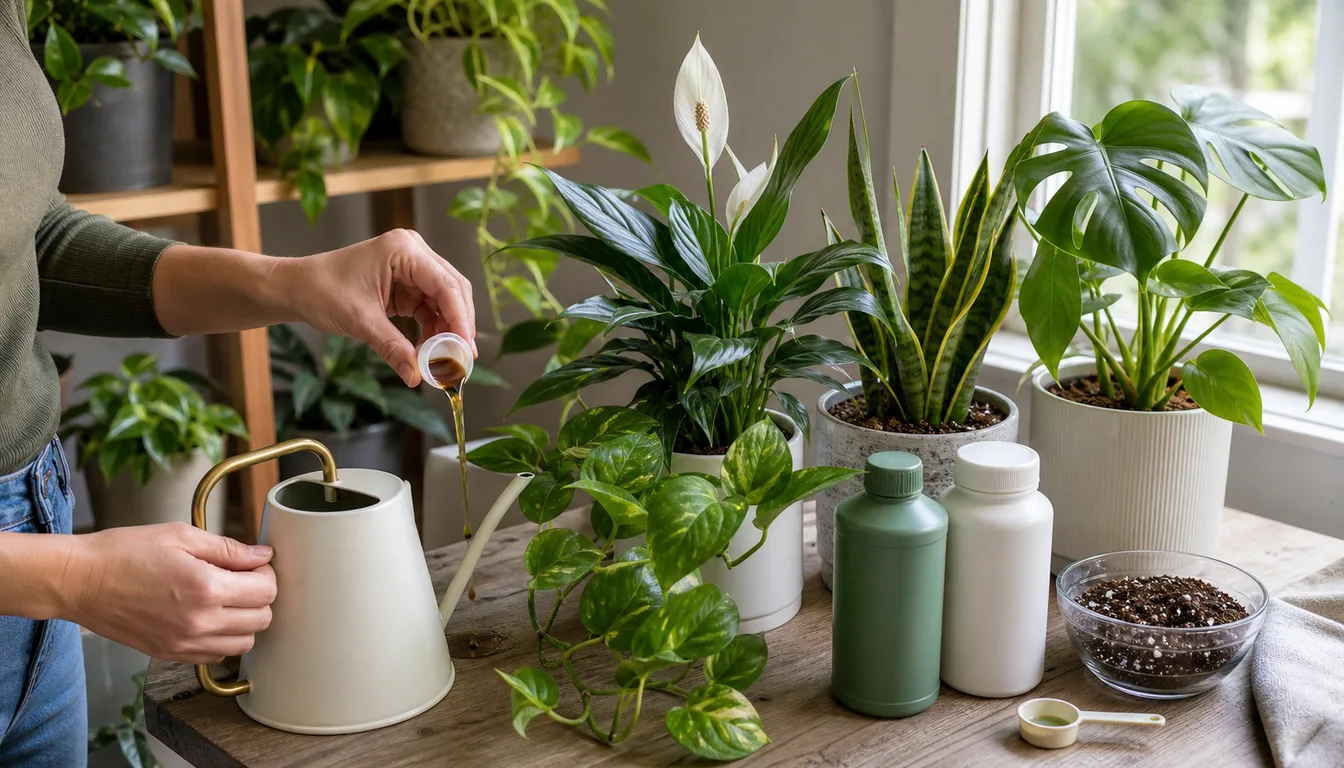
The best fertilizer for most indoor plants is a complete fertilizer labeled for houseplants, with nitrogen, phosphate, potash, and listed micronutrients. A liquid product gives you the most control over dose, while a labeled slow-release product is useful when you want fewer applications.
The product is only half the decision. Feed when the plant is making healthy new growth under useful light, follow the product's indoor rate, and reduce or pause feeding when growth slows.
A stronger N-P-K number does not make a fertilizer better. It means the concentrate contains a higher percentage of nutrients, so the label rate becomes even more important.
Fertilizer supplies mineral nutrients.
It cannot correct dim light, damaged roots, chronic overwatering, or a pot with no drainage.
At a glance
What Is the Best Default Fertilizer for Houseplants?
Start with a complete liquid or water-soluble houseplant fertilizer whose label includes an indoor application rate. Choose one that lists micronutrients as well as the three familiar N-P-K numbers.
A balanced product can work, but the three numbers do not have to match. Houseplant fertilizers are sold in several useful ratios, and the application rate determines how much nutrient actually reaches the pot.
- Product
- Complete fertilizer labeled for indoor plants
- Format
- Liquid or water-soluble for easy dose control
- Analysis
- N-P-K plus a micronutrient list
- Dose
- The indoor label rate, or the lower end of a labeled range
- Timing
- Only while the plant is actively growing
Brand is less important than a clear guaranteed analysis, usable directions, and a format you can measure consistently.
Avoid lawn and landscape products because their concentration and application instructions are not designed for small indoor containers.
One suitable product can feed most common foliage houseplants. You may need a separate labeled product for orchids, cacti, succulents, or edible indoor crops when their care instructions call for one.
Does Your Indoor Plant Need Fertilizer Now?
Look for active growth before reaching for fertilizer. A new leaf, extending vine, fresh shoot, or developing flower stalk shows that the plant has enough light and healthy roots to use added nutrients.
Low light changes the calculation.
A plant that produces little new growth in a dim room uses nutrients slowly, so frequent feeding increases the chance that unused fertilizer salts will remain in the potting mix.
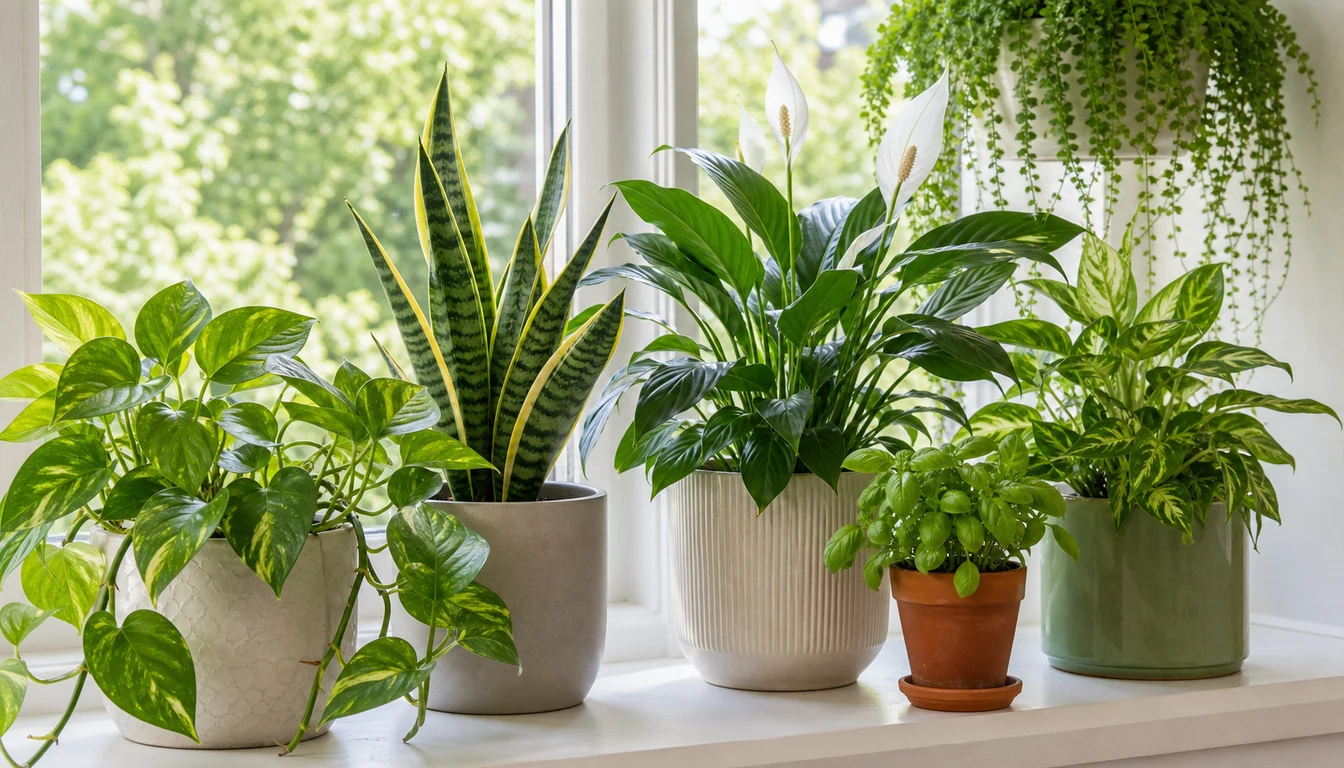
- The plant is producing healthy new growth
- Its light level supports that growth
- The root ball drains and is not staying waterlogged
- The plant is not wilted from dry soil
- The potting mix is not newly charged with fertilizer
- No recent pest, disease, or root problem is driving the symptoms
Recently purchased plants often contain enough fertilizer from the grower for the first few months. Check the tag and potting mix before adding more.
Pale leaves do not prove a nutrient shortage. Overwatering, damaged roots, low light, pests, normal aging, and unsuitable pH can all limit color or growth, and extra fertilizer may worsen a root problem.
Healthy new growth is a better feeding signal than the month on the calendar. A plant under strong grow lights may remain active in winter, while one several feet from a window may slow during summer too.
How Do You Read an Indoor Fertilizer Label?
The three prominent numbers are the fertilizer grade. They state the percentage by weight of nitrogen, phosphate, and potash in that order.
A 10-10-10 product contains ten percent of each listed component by weight. A 2-2-2 product contains a lower percentage, but either product can deliver an appropriate dose when it is measured and diluted according to its own label.
| Label field | What it tells you | How to use it |
|---|---|---|
| N-P-K grade | Nutrient percentages by weight | Compare concentration, not product quality |
| Indoor directions | Amount and interval for houseplants | Treat this as the starting authority |
| Guaranteed analysis | Included macro- and micronutrients | Prefer a complete list over vague marketing claims |
| Application method | Liquid, water-soluble, slow-release, spike, or ready-to-use | Choose a method you can apply accurately |
| Warnings | Mixing, storage, and contact precautions | Follow them exactly |
The N-P-K grade is not the amount you pour into one pot. A high-analysis concentrate may be perfectly usable indoors at a small label dose, while a mild product can still cause injury if it is applied too often.
Do not assume a bloom product with a very high middle number will force flowers. Light, plant maturity, temperature, watering, and species-specific growth cycles still control whether a houseplant can bloom.
Choose a complete formulation before chasing a special ratio.
A product that lists iron, manganese, zinc, and other micronutrients can be useful in soilless potting mixes, but extra supplements are unnecessary unless the plant, water, or growing medium creates a known need.
Liquid, Slow-Release, Spikes, or Organic: Which Format Fits?
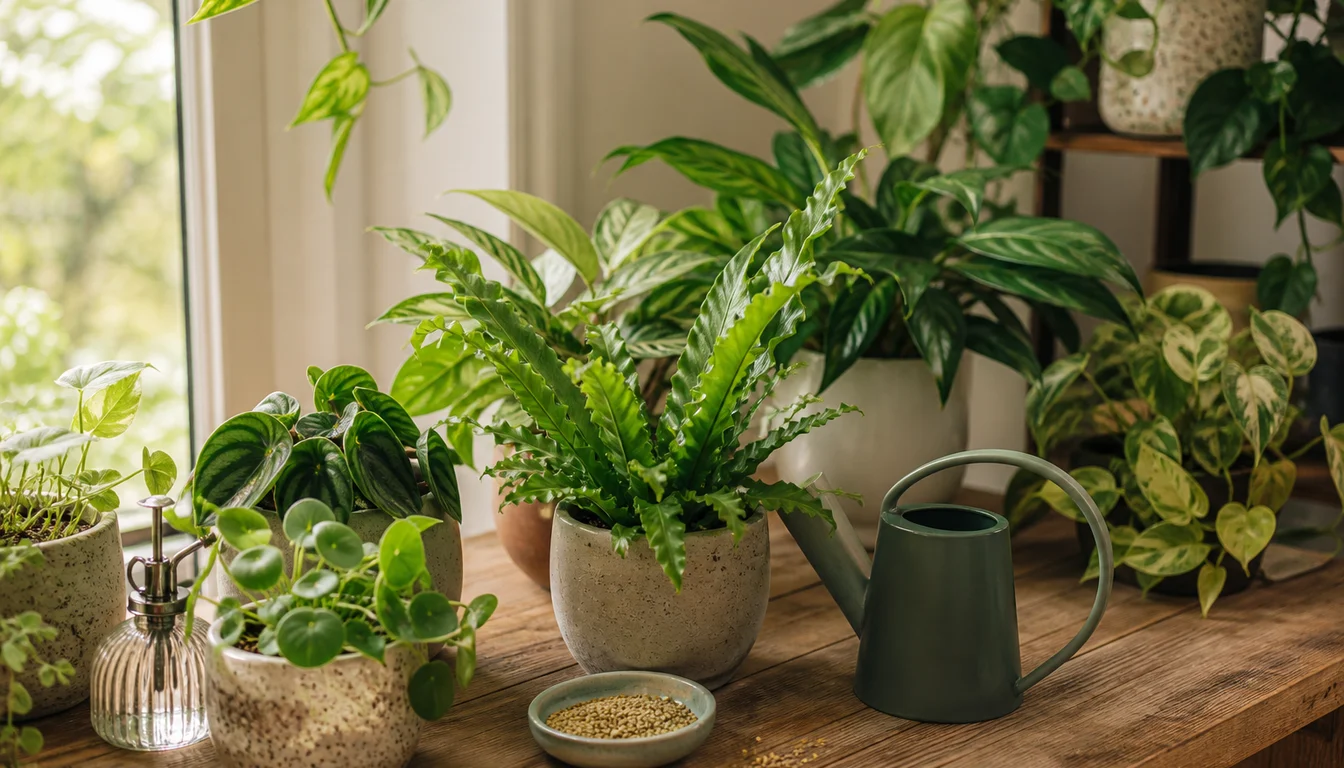
Liquid and water-soluble fertilizers give you the easiest control. You can mix only what you need, use the lower label rate for a slow-growing plant, and stop immediately when conditions change.
Slow-release granules release nutrients over a period stated on the package.
They suit established plants in draining pots, but you must check whether the potting mix already contains a controlled-release charge.
| Format | Best fit | Main limitation |
|---|---|---|
| Liquid concentrate | Mixed collections and readers who want dose control | Requires measuring and repeat applications |
| Water-soluble powder | Many pots fed from one watering can | Must dissolve completely and be measured accurately |
| Slow-release granules | Established plants and simpler routines | Harder to remove after overapplication |
| Fertilizer spikes | A correctly sized pot when the label gives a clear rate | Nutrients are concentrated in a small part of the root zone |
| Organic fertilizer | Readers who prefer plant- or animal-derived inputs | Release can be slower, and some products smell or attract indoor pests |
Organic and synthetic products can both supply usable nutrients. The meaningful differences indoors are concentration, release speed, odor, storage, measurement, and whether the directions fit your container.
Spikes are convenient, but they are not automatically safer. A liquid solution spreads through the watered root ball, while a spike releases nutrients near one location and gives you less control after insertion.
Choose the format you can measure and repeat correctly. A modest routine followed consistently is more useful than switching among several specialty bottles.
How Should the Plant, Light, Pot, and Mix Change Your Choice?
Plant type matters, but light and growth rate often matter more than the name on the pot. A fast-growing ficus in bright light can use nutrients more quickly than a slow succulent or a snake plant held in a darker room.
Container volume affects the total amount applied. A large plant does not justify a large dose when it is root-bound in a small amount of mix, and a tiny pot should never receive the same spoonful used for a floor container.
| Situation | Safer starting decision | What to watch |
|---|---|---|
| Common foliage plant in bright indirect light | Complete houseplant fertilizer at the lower labeled rate | Steady new leaves without soft, stretched growth |
| Low-light or naturally slow-growing plant | Feed less often or wait for visible growth | Long wet periods and little new growth |
| Cactus or succulent | Use a product labeled for that group at its stated rate | Soft growth, poor drainage, or feeding during rest |
| Orchid or other bark-grown epiphyte | Follow species and media-specific directions | Fast drainage and the fertilizer already in the care program |
| Flowering houseplant | Use its labeled houseplant feed before considering a bloom formula | Adequate light and normal bud cycle |
| Indoor herb or edible crop | Use a fertilizer labeled for edible container plants | Harvest rate, strong light, and label restrictions |
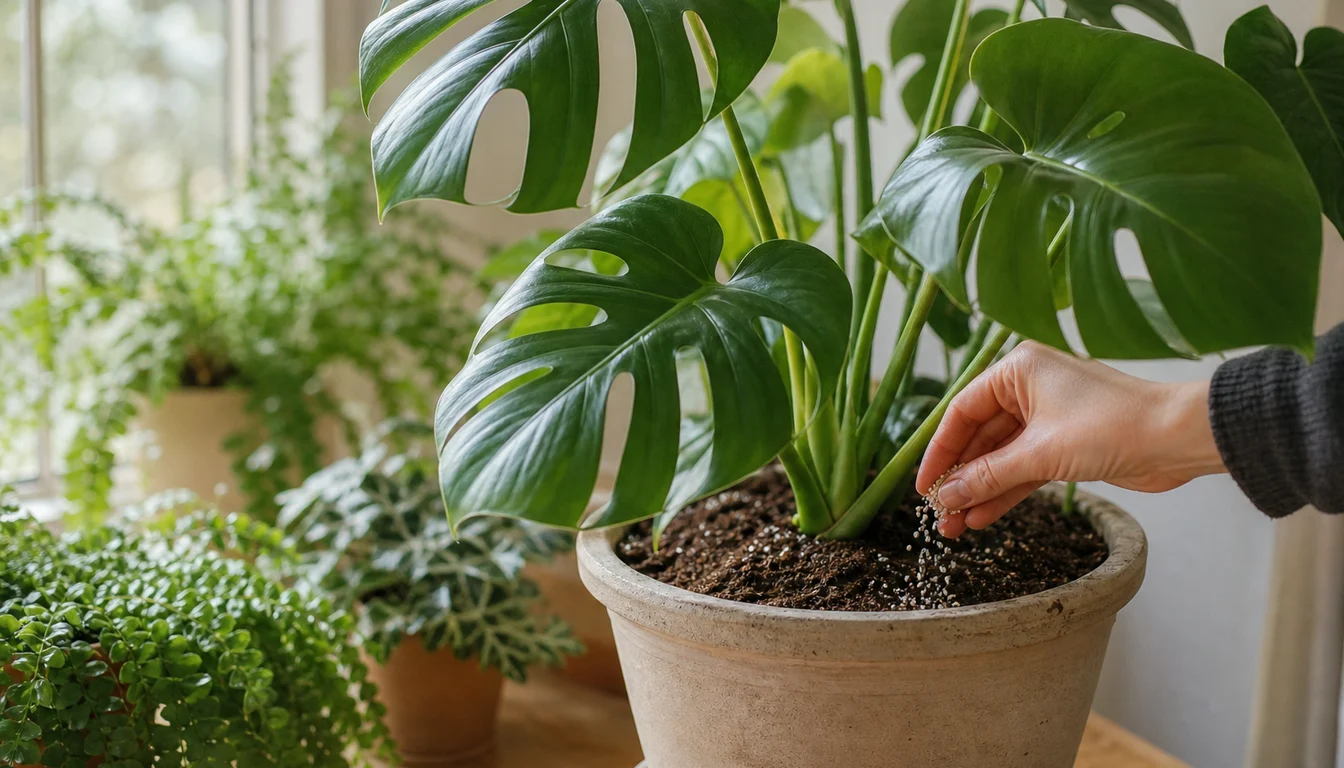
A fresh commercial potting mix may already contain slow-release fertilizer that lasts for months. Read the bag, note the potting date, and avoid stacking liquid feed on top of an unknown charge.
Specialty products make sense when the plant and growing medium are genuinely different. Orchid bark, succulent mix, semi-hydro media, and edible crops are better reasons to change products than a marketing label promising larger leaves.
Do not add calcium, magnesium, or a separate micronutrient product by default.
First check the guaranteed analysis of the main fertilizer and learn whether your water and potting medium already supply those elements.
How Much Fertilizer Should You Use, and How Often?
Use the product's indoor directions as the upper boundary. When the label offers a range, begin at the lower rate and adjust only after you observe continued active growth without salt symptoms.
University guidance varies from a reduced monthly dose to half-strength feeding every few weeks because indoor conditions vary. This is why one universal schedule cannot fit a sunny plant room, a dim office, and a shelf under strong grow lights.
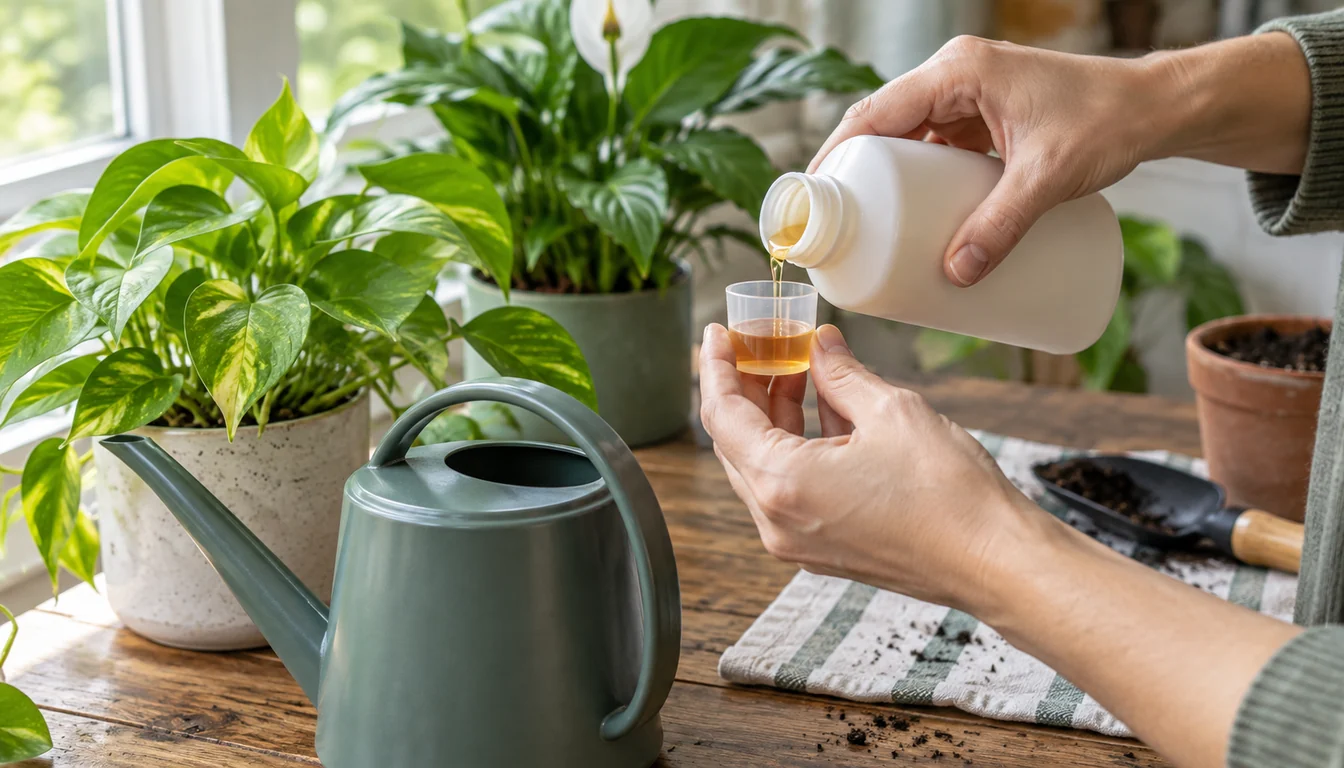
- Read this product's labelConfirm the indoor dose, mixing order, reapplication interval, and safety instructions.
- Check the plant and mixFeed only an actively growing plant with healthy roots, and wait if the root ball is extremely dry or waterlogged.
- Measure the full water volumeFill the watering can to the amount used in the label calculation before adding concentrate or dissolved powder.
- Mix one productMeasure accurately and avoid combining supplements unless their labels explicitly permit it.
- Apply through the root ballWater evenly until a little solution drains from a pot with drainage holes, then empty the saucer.
- Record the dateWait through the stated interval and judge the newest growth before changing the rate.
Do not copy a capful or scoop measurement from another brand.
Two products with different analyses can use very different amounts of concentrate per gallon.
Moist, normally hydrated potting mix is safer than a severely dry root ball because fertilizer salts become concentrated in a small amount of water. If the plant is wilted from drought, water it normally and wait for recovery before feeding.
Increase only one variable at a time. If growth remains healthy but slow, change either the rate or the interval, then observe the next leaves before making another adjustment.
When Should You Pause or Restart Fertilizing?
Pause when the plant stops producing healthy growth, when light falls sharply, or when roots are stressed. Fertilizer cannot make a dormant or damaged root system use nutrients faster.
A new nursery plant may carry enough fertilizer for two or three months.
Let it acclimate, inspect the tag and potting mix, and wait for healthy new growth before adding a second program.
After repotting, the bag label is more useful than a fixed waiting period. A mix with a starter charge or slow-release granules may feed the plant for months, while an uncharged bark or coir mix may need a species-appropriate program sooner.
Winter is a light decision, not a mandatory date. Most plants in naturally dim winter rooms need little or no fertilizer, but a plant growing steadily under strong supplemental light may continue on a reduced, label-compliant routine.
Pruning alone does not always require a long pause. If the roots are healthy and the plant quickly resumes growth, continue cautiously, but do not use extra fertilizer to force shoots after a severe cut.
Restart from current growth, not from the old calendar schedule. The first normal new leaf or shoot shows more than the month printed on a care chart.
What Does Fertilizer Burn Look Like, and How Do You Fix It?
Fertilizer dissolves into salts in the water around roots. When the concentration becomes too high, roots have difficulty taking up water and may be injured.
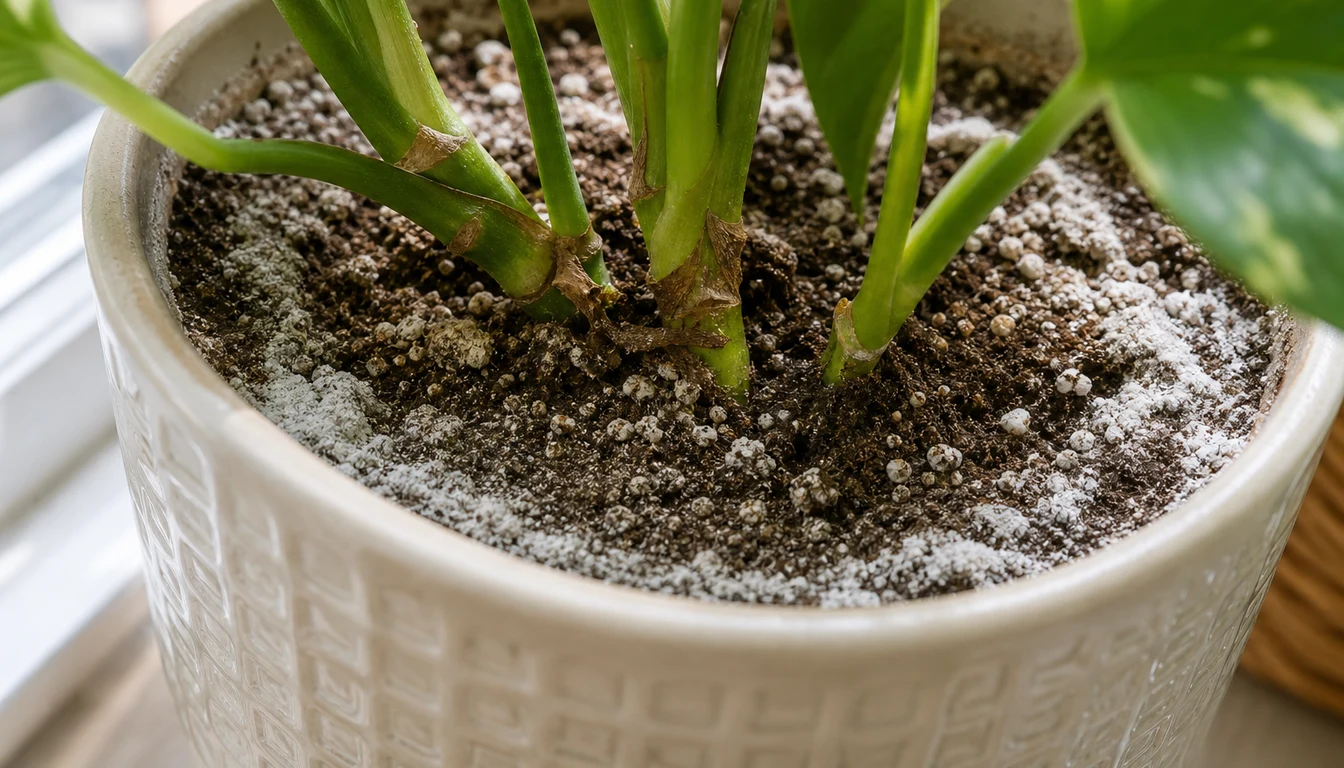
Visible clues include a white crust on the potting mix or rim, brown leaf tips and margins, slowed growth, leaf drop, and damaged brown roots. These signs overlap with hard-water minerals, dry air, poor watering, and root disease, so inspect the whole plant before blaming fertilizer.
| What you see | Possible explanation | First response |
|---|---|---|
| White crust on mix or pot rim | Fertilizer salts, hard-water minerals, or both | Stop feeding and remove loose surface crust |
| Brown tips with otherwise firm growth | Salt buildup, dry air, inconsistent watering, or water quality | Review water and feeding history before adding anything |
| Wilt in wet mix | Root damage, rot, or excess salts | Unpot and inspect roots if the condition persists |
| Soft stretched new growth | Too much nitrogen relative to available light | Reduce feeding and improve light gradually |
| Pale plant with no active growth | Often light or root trouble rather than a simple shortage | Diagnose growing conditions before fertilizing |
For a draining pot with healthy structure, run a generous volume of plain water through the mix and let it drain completely. Empty the saucer and repeat only as needed rather than leaving the pot standing in the flushed water.
Illinois Extension recommends leaching houseplant pots periodically to limit salt buildup.
If a container has no drainage hole, do not flood it in place because trapped water can create a second root problem.
Severe root damage may require repotting into fresh mix after dead roots are removed. Resume feeding only when new growth shows that the remaining roots are functioning.
Do not treat fertilizer burn with more fertilizer. Stop the source, restore drainage and normal moisture, then give the plant time to produce healthy new tissue.
Pro Tips
- Keep the product label with the bottle so the measuring cap never becomes an unlabeled guess.
- Write the feeding date and dose in a phone note before moving to the next plant.
- Use one complete fertilizer consistently before deciding that a second supplement is necessary.
- Empty drainage saucers after watering or feeding so the root ball does not sit in concentrated solution.
- Judge the routine by healthy new growth, not by old leaves that cannot repair their damaged tissue.
Frequently Asked Questions
Can I use one fertilizer for all my indoor plants?
One complete houseplant fertilizer can cover many common foliage plants when you adjust the dose and interval to growth. Use a species-specific or crop-labeled product when an orchid, cactus, succulent, or edible plant has different directions.
Is liquid fertilizer better than slow-release fertilizer?
Liquid fertilizer gives you more control and can be stopped immediately when growth slows. Slow-release fertilizer reduces application frequency, but you need to know whether the potting mix already contains it and follow the rate for the container size.
Should I fertilize an indoor plant with yellow leaves?
Not until you check light, soil moisture, drainage, roots, pests, and the pattern of yellowing. Yellow leaves can result from a nutrient shortage, but overwatering and root damage are common causes that fertilizer will not fix.
Can I fertilize indoor plants in winter?
Feed only if the plant is producing healthy new growth under enough natural or supplemental light. Most plants in dim winter rooms need little or no fertilizer until light and growth increase.
Are coffee grounds or kitchen scraps good indoor plant fertilizer?
Do not add undecomposed coffee grounds or kitchen scraps directly to indoor pots. They make dose and nutrient balance unpredictable and can encourage mold or pests, while a labeled fertilizer provides a measurable analysis.
Sources & References
Related Guides
Best Fertilizer for Vegetables by Garden Type
Fertilizer only helps vegetables if it matches what your soil and crops need.
11 min read
Can You Fertilize Wet Grass Safely?
A wet lawn right when you planned to fertilize creates second thoughts fast.
11 min read
Homemade Liquid Fertilizer for Healthier Plants
Store-bought fertilizer works, but most of us already own everything needed to brew homemade liquid…
11 min read
How Long Does Compost Take to Be Ready?
Compost does not follow a calendar, it follows conditions.
11 min read
How to Fertilize Tomatoes Without Overfeeding
Fertilize tomatoes according to a soil test and product label, not a fixed weekly calendar.
15 min read
How to Fertilize a Vegetable Garden for Maximum Yield
Fertilizer is not magic dust. It is plant food in a specific ratio.
14 min read