
How to Choose and Grow St. Augustine Grass for Your Yard
Stenotaphrum secundatum Poaceae
St. Augustinegrass forms a broad-bladed warm-season lawn from sod, plugs or sprigs. Some cultivars suit partial shade, but cold, concentrated wear and lawn pests remain important limits.
Care snapshot
Shade tolerance belongs to the cultivar as well as the species
St. Augustinegrass, Stenotaphrum secundatum, is a warm-season turfgrass with broad leaves and aboveground runners called stolons. Nodes along those runners can produce roots and new shoots, allowing the lawn to spread across the soil.
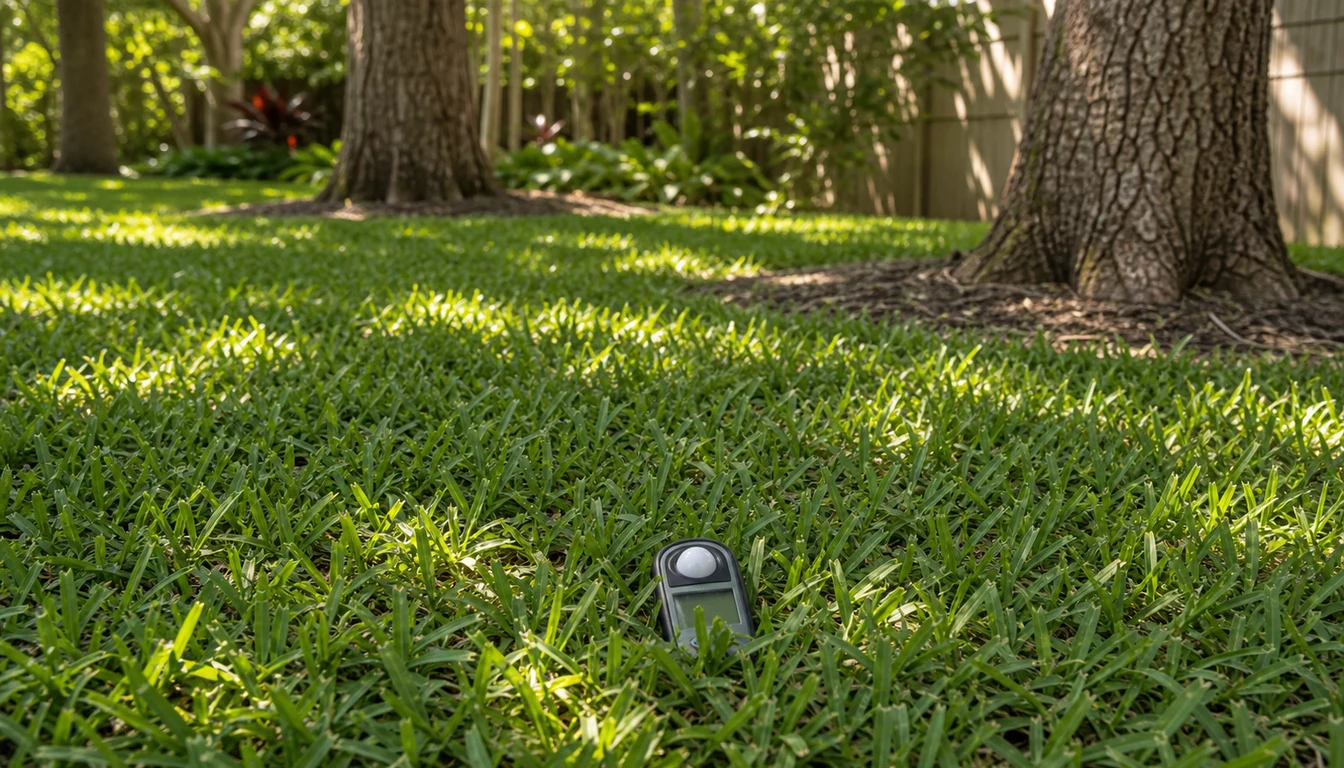
Its relative shade tolerance is one reason it is used in southern home lawns. That does not make every St. Augustine cultivar suitable for every shaded yard. UF/IFAS describes Floratam as less shade-tolerant than several other cultivars, while Palmetto can grow in partial shade but not dense shade.
- Floratam
- UF/IFAS describes weaker shade and cold tolerance than several other cultivars. Its conventional mowing recommendation is 3.5–4 inches.
- Raleigh
- A more cold-tolerant selection used in northern Florida. Disease and chinch-bug susceptibility still matter.
- Seville
- A dwarf cultivar described as suitable for shade, but cold-sensitive. UF/IFAS recommends mowing at 2–2.5 inches.
A lawn shaded by trees also faces root competition and changing light through the season. Buying a grass described as shade-tolerant does not remove those conditions. The actual cultivar and the light reaching the weakest part of the lawn matter more than a blanket four-hour promise.
Texas A&M lists traffic tolerance among the species’ weaknesses. St. Augustine can spread into gaps during active growth, but fast recovery is different from resisting repeated wear. A heavily used path or dog run can remain bare even where the rest of the lawn grows well.
Winter dormancy and cold injury are different
St. Augustine can lose green color during winter dormancy and resume growth when conditions warm. Cold injury is different because damaged plants may fail to regrow. Brown color alone cannot tell which has happened.
Cultivars differ in cold tolerance. UF/IFAS describes Raleigh as a more cold-tolerant selection used in northern Florida, while Floratam has comparatively poor cold tolerance. That is a real difference, although it does not make either cultivar immune to a severe freeze.
Local performance and the site’s exposure help determine whether St. Augustine is a reasonable investment. A broad zone label does not identify the best cultivar, predict a particular winter or show whether roots and growing points in a brown patch are alive.
As active growth returns, living runners and new shoots provide better evidence of recovery than a winter color comparison. Areas that remain dead may need vegetative repair after the cause and the site’s suitability have been assessed.
Sod, plugs and sprigs establish the lawn
St. Augustine lawns are established with living planting material rather than a practical commercial lawn-seed option. Sod supplies a continuous surface, plugs supply small rooted pieces, and sprigs supply portions capable of producing new growth.
New sod looks like a lawn immediately, but it is not immediately ready for normal traffic. Roots still need to grow into the prepared soil. UF/IFAS emphasizes that newly laid sod remains vulnerable until that connection develops.
Plugs and sprigs leave open ground while runners spread. Weed management and establishment watering continue during that period. Fill time varies with the cultivar, growing conditions and planting density, so one spacing cannot promise a finished lawn by a fixed date.
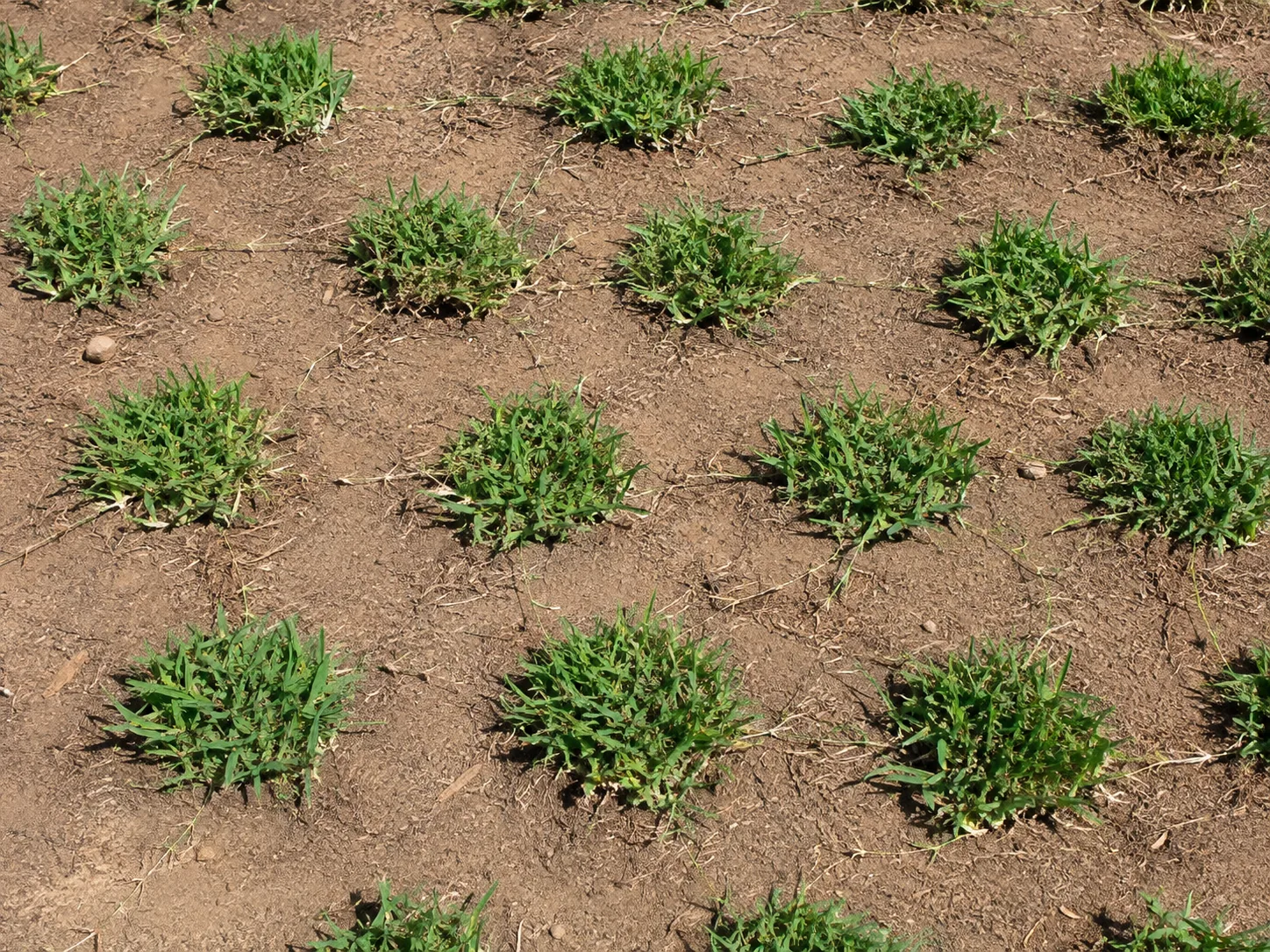
Planting during a suitable period of active growth gives the grass time to establish. UF/IFAS describes different planting windows within Florida, which is a reminder that a date suitable for one region may expose a new lawn elsewhere to heat, drought or freezing.
Fresh planting needs moisture close to its developing roots. Watering can become less frequent as roots establish, while each application reaches farther into the soil. Sod or plugs that resist a gentle tug have made a stronger connection than pieces that still lift easily.
Using identified planting material also keeps cultivar choice meaningful. A plug from an unknown lawn may differ in appearance, mowing needs or disease response. The important purchase is the actual grass and its condition, not just a square foot of green cover.
Mowing height changes with cultivar
UF/IFAS recommends 3.5–4 inches for many standard cultivars with conventional rotary mowing, while dwarf cultivars have lower height recommendations. A standard lawn and a dwarf lawn therefore should not automatically share a mower setting.
Repeatedly mowing too low can discourage rooting and increase the chance of scalping. Keeping enough leaf area matters especially where light or moisture already limits growth. The correct setting follows the named cultivar and mowing method.
UF/IFAS advises removing no more than a third of the leaf blade at one mowing. Growth determines how often that is necessary. A fast-growing summer lawn may need more frequent cutting than the same lawn during a cooler period.
A sharp blade cuts rather than tears leaf tips. Ragged cuts can give the lawn a brownish cast without establishing a disease diagnosis. Mowing history belongs in the assessment of a lawn that suddenly looks less green.
Measure irrigation instead of assuming an inch every week
Established St. Augustine may need irrigation during extended dry weather. Folded or wilted blades, a blue-gray cast and footprints that persist can signal moisture stress, but soil conditions and sprinkler coverage help explain why a particular area is affected.
UF/IFAS uses one-half to three-quarters of an inch per irrigation as guidance for established Florida lawns, with frequency adjusted to need. That is an amount per application, not a universal weekly allowance or a fixed number of sprinkler minutes.
Straight-sided containers placed around an irrigation zone show how much water actually arrives. They also reveal uneven distribution. Increasing runtime to rescue one dry corner can overwater another corner if coverage is poor.
Newly planted sod or plugs need a different establishment schedule until roots reach surrounding soil. A mature-lawn watering rule should not be copied onto pieces that can still dry out near the surface.
More water is not a general treatment for brown patches. Wet conditions and excess nitrogen can contribute to disease problems, while drought and insect damage can occur together. Soil moisture and observations of the plant need to guide the next step.
Soil preparation and feeding support the roots
Sod or plugs need contact with prepared soil so new roots can enter it. Persistent drainage or compaction problems remain beneath a green surface unless they are addressed. Adding more fertilizer does not repair those physical conditions.
St. Augustine is grown on a range of soils. A soil test gives useful information about pH and available nutrients. A universal organic-matter percentage or compost depth cannot describe every installation.
UF/IFAS varies its fertilizer guidance by region, soil, shade and management. The nutrient amount is measured as nitrogen per unit area, which is different from the weight of a fertilizer product. More growth is not always desirable if it increases thatch or disease pressure.
Yellowing may involve nitrogen deficiency, but high-pH conditions can also limit micronutrient availability. Iron and nitrogen are not interchangeable treatments. The pattern of symptoms and soil information matter before a product is chosen.
Fertilizing before suitable active growth can put new growth at risk from cold and supply nutrients before roots can use them well. Timing follows local conditions and current product or local restrictions, not a national calendar date.
A brown patch does not diagnose chinch bugs
The southern chinch bug, Blissus insularis, is an important St. Augustine pest. It feeds on plant fluids and can cause yellow-to-brown patches, often beginning in sunny or water-stressed areas. Those conditions also produce other lawn problems.
UF/IFAS explicitly warns that not all brown grass has chinch bugs. The border between affected and green turf is a useful place to inspect for insects. Tiny orange nymphs and black-and-white adults may be present, but beneficial big-eyed bugs can be mistaken for them.
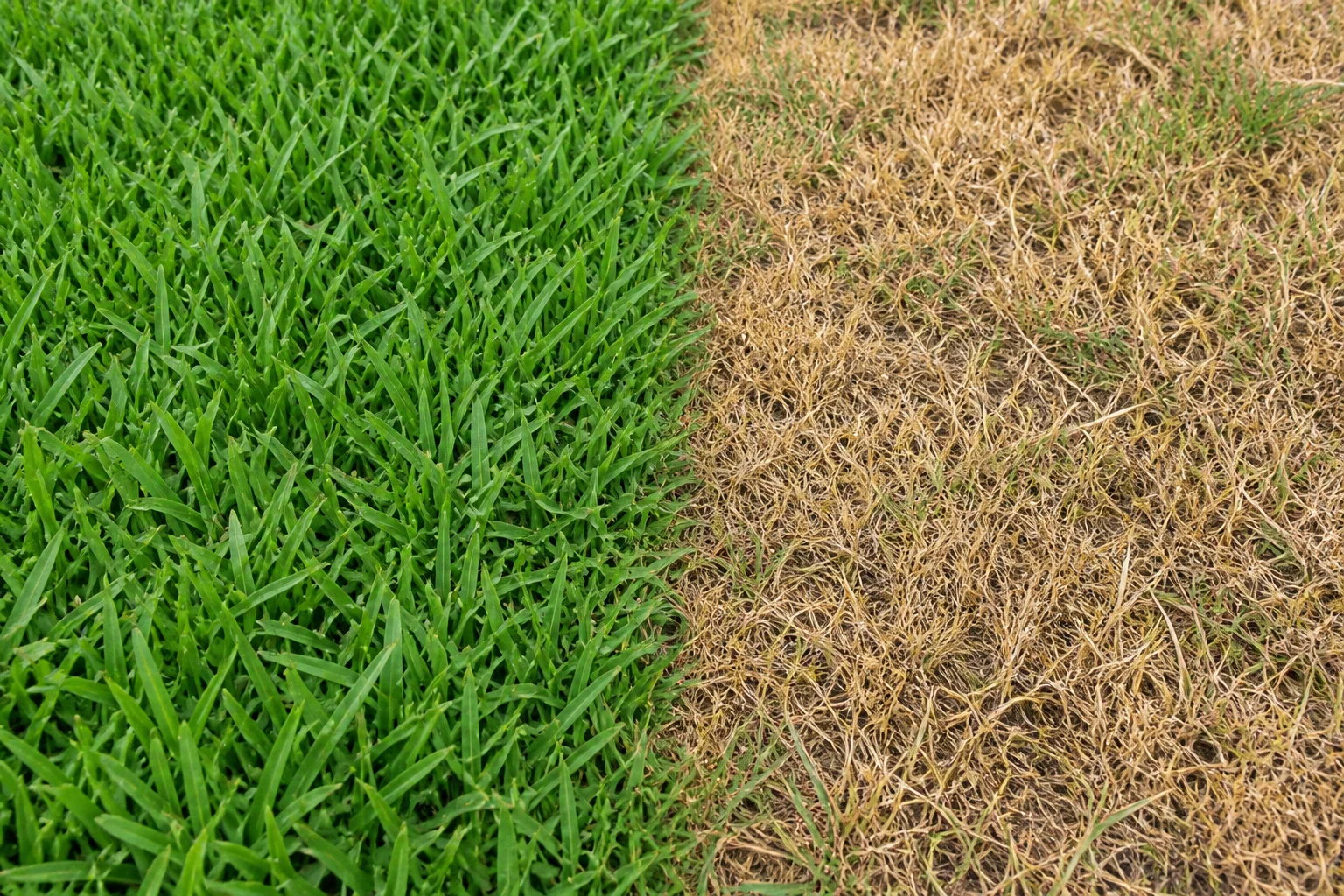
For a closer look, UF/IFAS describes collecting insects with a handheld vacuum from a small area spanning living and damaged grass, then inspecting the debris on a light-colored surface. A specimen or clear close-up can help an extension adviser distinguish a pest from a beneficial insect.
The UF/IFAS lawn publication also describes a water-filled cylinder method at the edge of suspected damage, where insects float to the surface. That is a sampling method for finding insects. Soaking a patch and waiting for it to turn green is not a reliable test that separates drought from chinch bugs.
A damaged area may contain both moisture stress and insects, and dead tissue from other causes will not recover after watering either. Lack of recovery therefore does not identify a pest. Gray leaf spot, large patch, take-all root rot, wear and other problems also belong in the assessment.
Thatch, lawn use and treated areas
St. Augustine can accumulate thatch, especially under excessive fertilization or irrigation. This material lies near the soil surface and can provide shelter for insects. A soft lawn deserves a closer look, but softness alone does not measure thatch depth or identify a pest.
UF/IFAS discusses vertical mowing for sufficiently thick thatch during active growth and warns that it can damage turf that then needs to recover. Measured buildup, the lawn’s condition and its ability to recover help determine whether removal is appropriate.
Aeration and thatch removal do different jobs. Compacted soil limits the root environment, while a mat of thatch is material at the surface. Identifying which condition is present helps avoid using disruptive equipment for the wrong problem.
The sources cited here do not establish that St. Augustinegrass is safe for pets to eat. Grass identity also does not establish the safety of recently treated turf. Label-specific restrictions govern when people and animals can return after an application.
For a suitable acidic site with light use, centipedegrass offers a lower-fertility alternative. Zoysia and St. Augustine have different wear and cold-tolerance tradeoffs, with cultivar and local conditions still affecting the choice.
Frequently Asked Questions
Is St. Augustine sod ready to use as soon as it is laid?
No. Sod supplies immediate cover, but roots still need to establish in the soil below. Traffic before that connection develops can damage the new lawn.
Does a brown patch that stays brown after watering prove chinch bugs?
No. Insects, root or disease problems and other injury can overlap with drought. Identifying insects and examining conditions at the patch are more useful than judging recovery from a soak.
Can all St. Augustine cultivars be mowed at the same height?
No. Standard and dwarf cultivars have different recommendations. Mowing method, light and growing conditions also matter, so the named cultivar is the starting point.
Sources & References
Related Plants
Bermuda Grass
Fine-textured warm-season grass that loves full sun and heavy use.
Zoysia Grass
Dense, slow-growing warm-season grass with good drought tolerance.
Centipede Grass
Low-input warm-season grass that stays short and needs less fertilizer.
Bahia Grass
Bahia grass is a warm-season utility lawn built for sandy, hungry ground where fussier grasses give up.
Buffalo Grass
Many people treat buffalo grass like a regular high-input lawn, then wonder why it looks thin and weedy.
Fescue
Fescue is not a grass, it is a genus. More than 450 species carry the name and about ten make turf, split into a coarse…