
How to Grow Calathea Orbifolia and Care for Its Broad Leaves
Goeppertia orbifolia Marantaceae
Calathea Orbifolia is grown for huge round silver-green leaves that make dry air, hard water, and direct sun easy to see. It is pet-safe and beautiful, but it needs steady warmth, high humidity, gentle light, and careful watering to keep new leaves clean.
Care snapshot
Know the Big Round Leaf Before You Buy
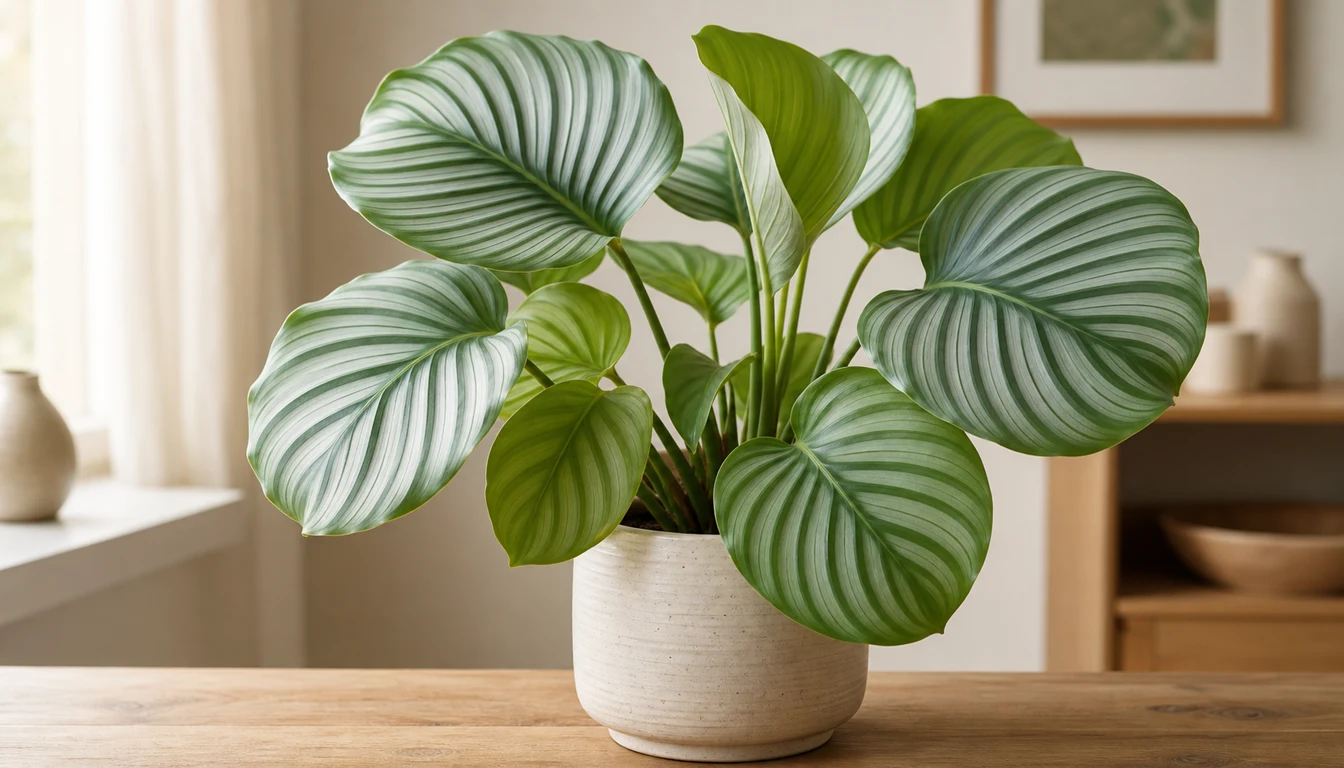
Calathea Orbifolia is the houseplant name most growers still use for Goeppertia orbifolia, a clumping foliage plant in the prayer plant family. It grows from upright crowns and makes broad round leaves with pale silver striping.
Those leaves are the reason to buy it and also the reason the plant feels demanding.
A narrow brown rim, a curled edge, or a pale washed-out panel shows quickly because each leaf is so large and smooth.
NC State notes that orbifolia leaves can reach about 12 inches wide, which makes one damaged leaf noticeable for months while the plant slowly grows a cleaner replacement.
That slow replacement pace changes how you should judge the plant. A small scuff on a pothos vine disappears into new growth, but a scarred orbifolia leaf stays in the main display until the crown has enough energy to push another full-sized blade.
The plant also moves differently from many upright foliage houseplants. Leaves lift and settle through the day because the plant is related to prayer plants, so a slight evening change is normal while tight curling, limp petioles, or edges that keep crisping are care signals.
Buy Calathea Orbifolia when you can give it a warm bright room with filtered light and steady humidity. Skip it when you need a set-and-forget plant for a dry shelf, a cold entry, or a sunny window.
- Plant identity
- Clumping prayer plant relative grown for broad silver-striped foliage
- Display trait
- Large round leaves that show edge damage clearly
- Care consequence
- Needs stable humidity, gentle light, and clean water
- Poor fit
- Dry rooms, cold drafts, direct sun, or irregular watering
Choose Orbifolia Only if the Room Can Support It
The right buyer wants the orbifolia leaf more than the easiest possible care routine. If you mainly want patterned foliage that tolerates ordinary room air, a smaller Calathea or Prayer Plant is usually easier to keep looking clean.
Look at the plant before you look at the pot cover. Good stock has firm leaves, clean undersides, no sticky residue near the petioles, and no pattern of fresh brown rims on every new leaf.
A perfect older leaf is rare in stores, but the newest leaf should look stronger than the oldest leaf. If new leaves already open with crisp rims, torn folds, or faded panels, the plant has probably been moved through dry air, poor water, or rough light before you get it home.
Check the room too. A plant stand beside a radiator, a sunny south window, or a dark corner may look good for a week, then the broad leaves reveal that the display spot and the care spot are not the same place.
Peace Lily is often easier when you want a broad leafy houseplant that tells you clearly when it is thirsty, while Alocasia Polly gives a more dramatic leaf shape but is not a pet-safe alternative.
- Calathea Orbifolia
- Best for big round silver leaves in a humid warm room
- Calathea
- Better when you want smaller patterned leaves with similar care
- Prayer Plant
- Better for lower growth that is easier to keep humid
- Peace Lily
- Better for a broad leafy plant with clearer thirst signals
- Alocasia Polly
- Better for sharper drama, but not for pet-safe rooms
Give Bright Filtered Light and Steady Warmth
Calathea Orbifolia wants bright filtered light, not direct sun. NC State recommends bright indirect light or partial shade and warns that direct sun can scorch the leaves.
A spot near an east window, a few feet back from a bright window, or behind a sheer curtain is usually safer than a hot sill because a soft hand shadow usually means the light is bright but filtered.
Warmth needs to be steady. NC State gives 65 to 75 F as a good indoor range and notes that drafts should be avoided, so keep the pot away from winter doors, air conditioners, and cold glass.
Weak light does not always burn the plant, but it slows replacement growth and can make new leaves smaller or less defined.
Direct light damages faster because pale leaf panels can scorch before you notice the pot drying.
If you move the plant for better light, change only one variable and wait for the next leaf. Moving it closer to the window, changing water, and repotting in the same week makes it hard to know which action helped or hurt.
Read light by the newest growth, not only by whether the plant survives. If the leaves stay upright but each new blade is smaller, paler, or slower to unfurl, move the pot closer to a bright wall before you add fertilizer.
Glass can create two opposite problems in the same week. Morning light through an east window may be gentle, while cold glass at night chills the leaf edge and slows root activity.
Rotate the pot a quarter turn every week or two if the plant leans toward the window. Do it gently, because the broad leaves bruise and bend more easily than stiff-leaved houseplants.
Keep the Mix Moist With Water the Leaves Tolerate
Watering Calathea Orbifolia is a balance between steady moisture and root oxygen. NC State says the soil should stay consistently moist but not soggy, which means the pot should never sit in standing water.
Water quality matters because the leaf edge reports it. NC State prefers distilled or rain water for this plant and notes that fluoride can lead to brown leaf tips.
Use surface feel and pot weight together. The top can start to lose its wet shine while the rootball is still moist enough, and a heavy pot with yellowing leaves should make you pause before watering again.
For a mature plant in a breathable pot, the next watering often comes when the upper mix is just beginning to feel less damp but the pot has not gone light. That is a different habit from soaking only after a hard dry-down.
A small nursery pot dries faster at the edge than in the center, while a decorative cachepot can hide runoff and keep the lower mix wet. Lift the inner pot after watering so you know whether water is draining or collecting below the roots.
If you need a broader timing check, use a houseplant watering rhythm as a starting point, then let orbifolia's pot weight and leaf edge overrule the calendar.
If your tap water leaves white crust on pots, switch to filtered, rain, or distilled water for several watering cycles and judge the fix by new leaves because old brown edges will not turn green again.
Do not flush a stressed plant every day to remove salts. A careful full watering followed by real drainage is safer than repeated small rinses that leave the rootball constantly wet.
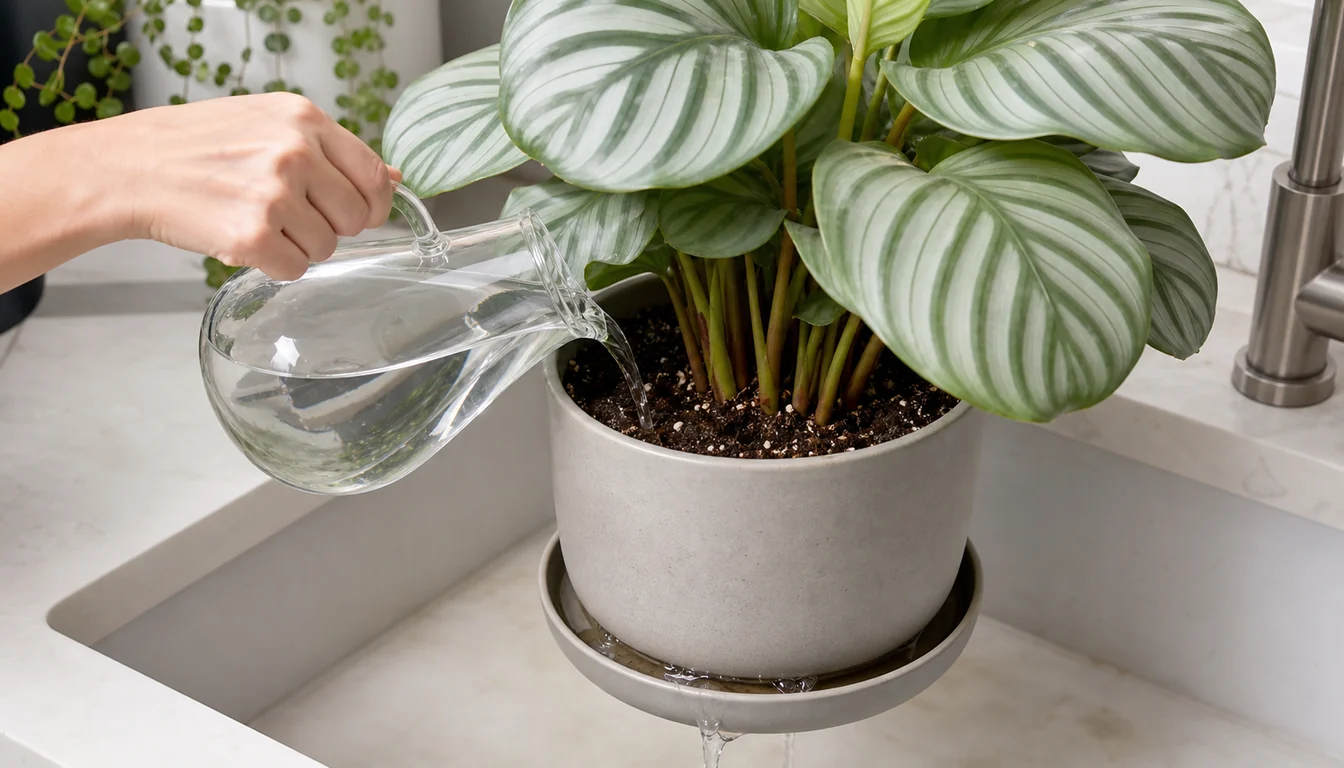
- Feel the top inch and lift the pot before watering.
- Use filtered, rain, or distilled water if tap water leaves residue.
- Water evenly around the rootball instead of one corner.
- Let extra water drain through the pot holes.
- Empty the saucer before the base sits wet.
Make Humidity Reach the Leaf Surface
Humidity has to reach the leaves, not just the space under the pot. NC State says Calathea Orbifolia needs high humidity of at least 60 percent, and the broad leaf edge is where dry air announces itself.
A pebble tray may catch runoff, but a small humidifier, a plant group, or a naturally humid bright bathroom usually changes the air around the broad leaves more reliably.
Misting can help with dusting, but it gives only a short wet moment. If droplets sit too long on a crowded plant, they can also make leaf spot problems easier.
Airflow should be gentle, not cold or drying. Give leaves space so humidity does not become stagnant wetness around folded foliage.
A humidity meter helps most when it sits near the leaves, not across the room. Read the lowest daily number, because the plant reacts to dry afternoons and heated nights even if the room feels comfortable when you check it.
If only one side browns, compare nearby heat vents, window drafts, and sun patches before changing the whole care routine. Uneven damage often means one leaf edge is getting a different room than the rest of the plant.
Bathrooms work only when they have real light and stable warmth. A humid but dim bathroom can keep leaves from crisping while starving the plant of enough energy to replace old damage.
- Small humidifier
- Best steady help when room air is dry
- Grouped plants
- Useful when several humidity lovers share good light
- Bright bathroom
- Good only if light and warmth are still adequate
- Pebble tray
- Helps catch water, but rarely fixes dry leaf edges alone
- Misting
- Useful for cleaning support, not a humidity plan
Repot and Divide Only When the Clump Earns It
Calathea Orbifolia grows as a clump, so repotting is the right time to consider division, but a plant with one strong crown should stay intact.
Use a moist, airy, well-drained potting mix and move up only when roots have filled the pot. A larger pot with unused wet mix can keep the lower root zone stale and turn leaf decline into root decline.
Choose the next pot by root mass, not by leaf width. A large plant can still have a compact rootball, and jumping several pot sizes makes watering harder because the outer mix stays wet after the roots have used what they can reach.
A good mix should hold moisture without sealing the roots away from air. If the old mix smells sour, stays cold and wet, or collapses into a dense plug, remove loose bad mix gently instead of ripping through healthy roots.
Division works best in spring on a mature clump with more than one rooted crown.
If the plant has one strong crown, leaving it intact is usually better than making two weak pieces.
Each division needs a real growing point and enough roots to support several leaves. A leaf with a petiole but no crown is not a cutting, so it will fade even if the leaf stays green for a while.
After repotting, give warmth, humidity, and moderate filtered light while roots settle. Do not use heavy fertilizer as a recovery shortcut.
Expect a short pause after repotting. The useful sign is not instant growth, but leaves that stay firm while the plant resumes opening new rolled leaves from the crown.
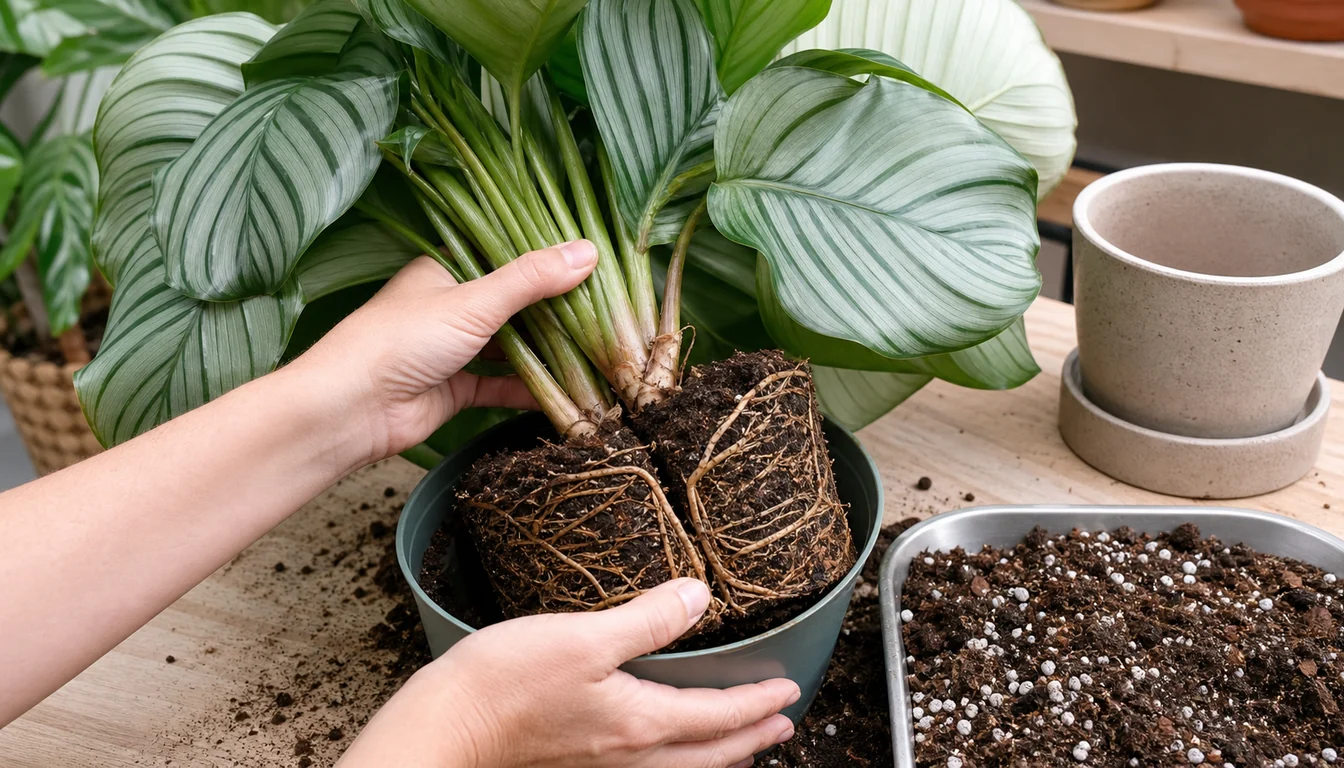
- Repot when roots fill the pot or water runs through too quickly.
- Keep the crown at the same depth in the new mix.
- Choose a pot with drainage holes.
- Divide only when each piece has roots and a growing crown.
- Keep divisions warm and humid while they recover.
- Wait for new growth before feeding strongly.
Read the Leaf Edge Before Changing Everything
The edge of a Calathea Orbifolia leaf is the first place to read trouble. A thin tan rim usually points toward dry air, hard water, or repeated drying, while a soft yellowing leaf with a heavy pot points toward wet roots.
Do not change light, water, fertilizer, and pot size at the same time. Pick the strongest clue, correct that cause, and judge progress by the next leaf that opens.
Start with the newest symptom. Brown edges on only the oldest leaves may be history, while the same mark on the newest leaf says the current room or water routine is still causing stress.
Spider mites and thrips matter because broad leaves make damage easy to see but folded new growth can hide the insects. Wipe the undersides with a damp cloth and inspect where the leaf meets the petiole before treating the whole plant.
Old damaged leaves can stay marked for months even after care improves. Cut a leaf only when it is mostly dead, diseased, or in the way, because every green leaf still helps the plant make energy.
When two symptoms overlap, let the root zone decide first. A curled plant in a light pot may need water, but a curled plant in a heavy pot needs air around the roots and a slower watering rhythm.
If the next leaf opens clean, keep the corrected routine instead of chasing every old mark on the plant.
- Narrow brown rim
- Raise humidity and improve water quality
- Curled leaves with light pot
- Water evenly and check room humidity
- Yellow soft leaves
- Pause watering and check root oxygen
- Bleached panel
- Move away from direct sun
- Dusty or stippled surface
- Inspect for mites or thrips and rinse gently
- Smaller pale new leaves
- Improve filtered light before feeding
Adjust Feeding and Humidity Through the Year
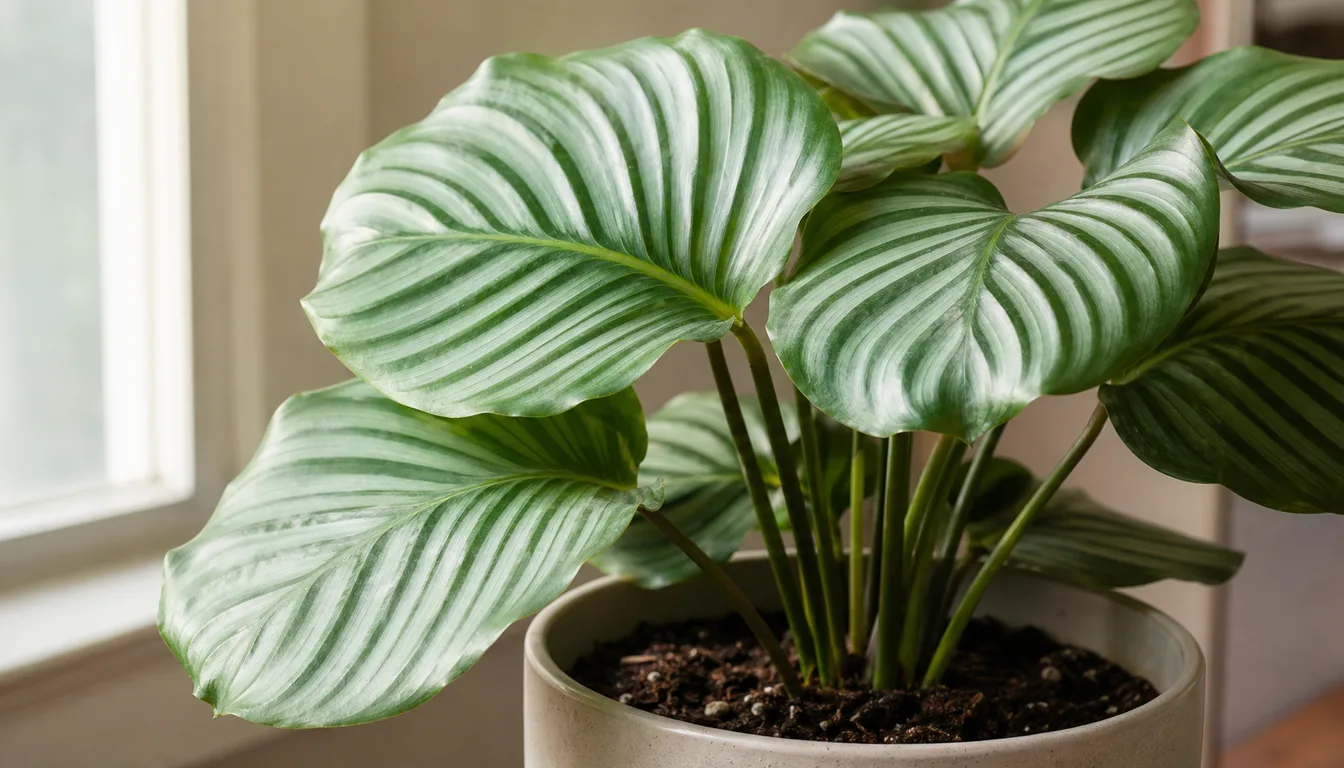
Feed Calathea Orbifolia only while it is actively growing. NC State recommends monthly fertilizer during the growing season, which means feeding should slow when growth slows.
Winter often brings lower light and drier heated air at the same time, so the plant may need less fertilizer and slightly slower watering but more help from humidity.
In spring, restart feeding lightly only after you see active growth.
A half-strength balanced houseplant fertilizer is easier to correct than a strong dose that leaves salts behind in already sensitive mix.
Summer is when the plant can replace damaged leaves fastest, but heat near glass can also dry the broad surface quickly. Watch the afternoon leaf edge before assuming summer growth means more sun is safe.
A pale new leaf should not send you straight to fertilizer. Check light, roots, humidity, and pests first, because feeding a stressed plant can add salts when the leaves already show edge burn.
Flush the pot only as part of normal thorough watering, then let it drain. The goal is to prevent salt buildup while keeping the rootball evenly moist, not to wash the plant so often that oxygen disappears from the mix.
Pet-Safe Does Not Mean Low Maintenance
Calathea Orbifolia is a good choice when you want a pet-safe foliage plant with serious visual impact. ASPCA lists prayer plant relatives as non-toxic to dogs and cats.
Pet-safe does not mean chew-proof. Torn broad leaves stay visible, and a plant that keeps losing display leaves may never look like the reason you bought it.
This matters more with orbifolia than with many small-leaved plants because one bite can ruin a full leaf surface. Put the pot on a stable stand or plant table where the leaves have room to spread without becoming a toy.
Place it where pets cannot shred the leaves, where humidity is realistic, and where the plant is not brushed every time someone walks by, because a pet-safe plant still needs a spot that protects the plant as well as the pet.
Cleaning matters too. Large leaves collect dust, and gentle wiping keeps light reaching the surface while giving you a weekly chance to spot pests, dry edges, or water marks early.
For small apartments, measure the plant's future width before you buy the largest pot on the shelf. Orbifolia looks best when the leaves can spread without rubbing walls, curtains, or nearby furniture every day.
If the only safe pet spot is dark, choose a smaller pet-safe plant instead. A safe plant still fails as a display plant when the room cannot support clean new leaves.
Frequently Asked Questions
Why are my Calathea Orbifolia edges brown?
Brown edges usually point to dry air, hard or salty water, or repeated hard drying. Fix the current cause and judge progress by the next new leaf.
How much light does Calathea Orbifolia need?
Give bright filtered light with no direct sun. A soft hand shadow on the leaf is safer than a sharp hot shadow.
Should I mist Calathea Orbifolia?
Misting is not enough by itself. A humidifier, grouped plants, or a naturally humid bright room helps the leaf surface more than a quick spray.
What water is best for Calathea Orbifolia?
Filtered, rain, or distilled water is safer if your tap water leaves white residue. NC State notes that fluoride can cause brown leaf tips.
Can I divide Calathea Orbifolia?
Divide only a mature plant with several rooted crowns during repotting. A single-crown plant should be left intact.
Is Calathea Orbifolia safe for cats and dogs?
Yes. Calathea and prayer plant relatives are generally treated as non-toxic to cats and dogs, but chewing can still ruin the broad leaves.
Sources & References
Related Plants
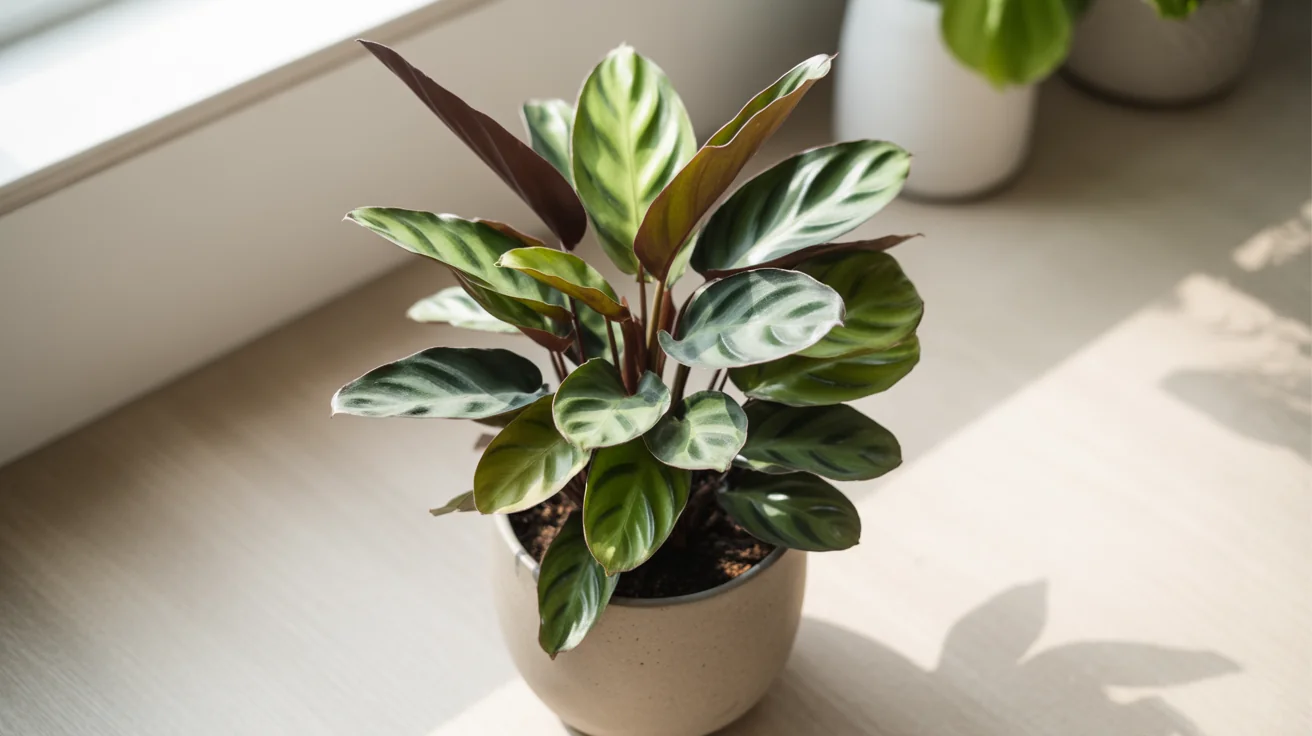
Calathea
Smaller-leaved calathea species with more pattern variety and similar humidity needs.
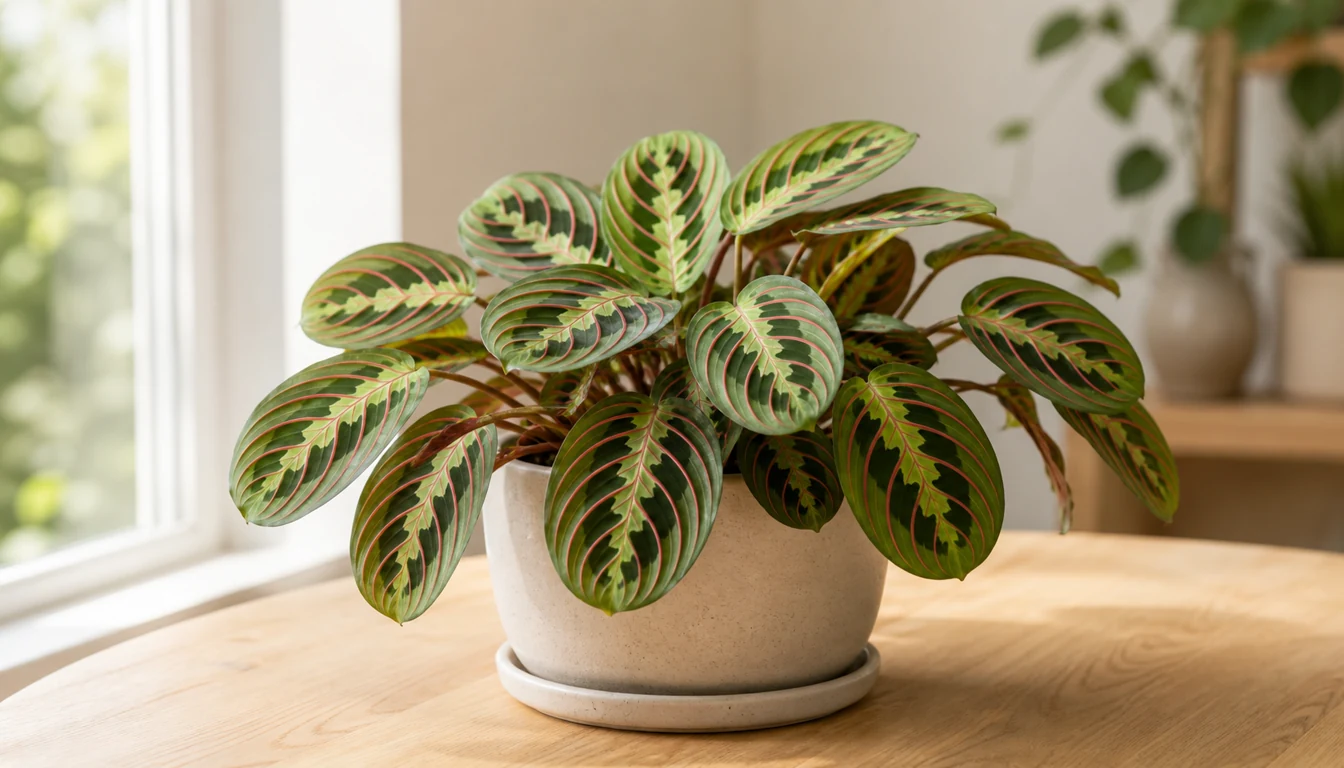
Prayer Plant
Lower-growing prayer plant with striped leaves that is easier to keep close to humidity.
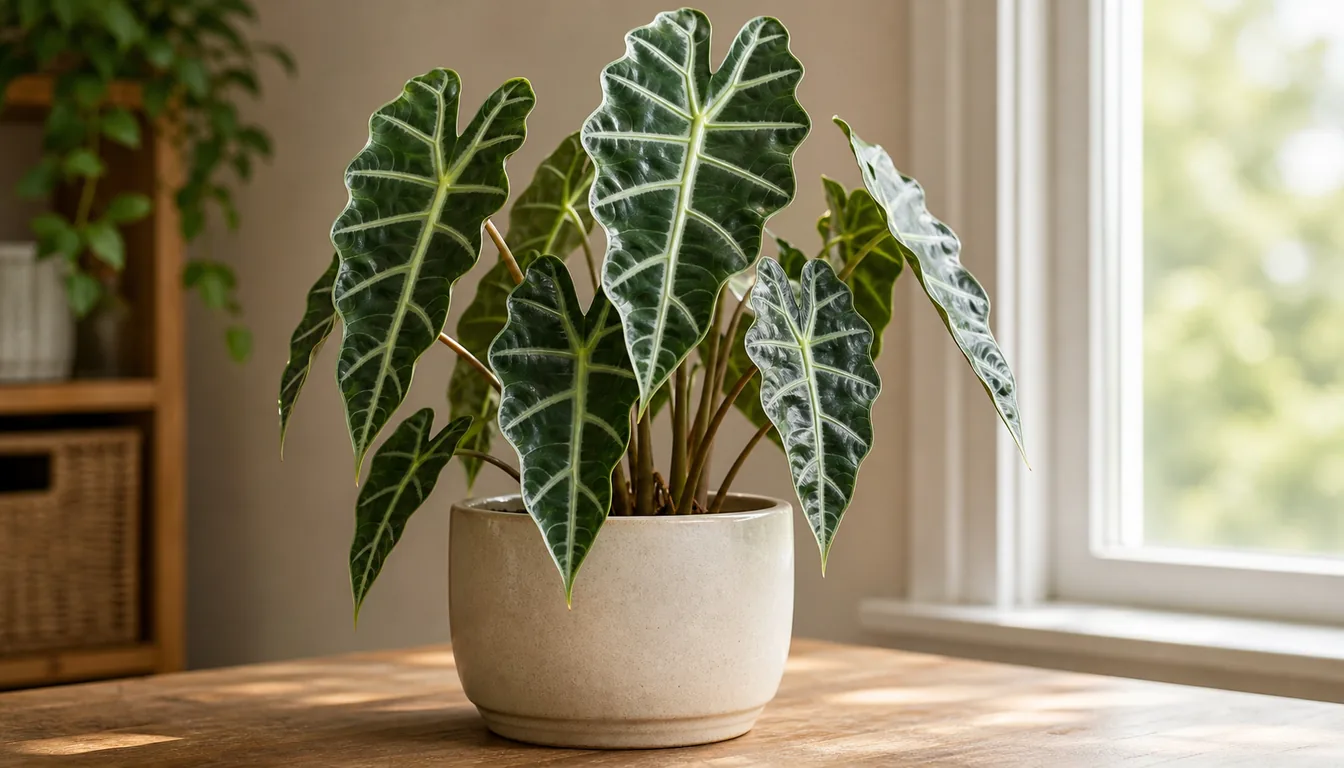
Alocasia Polly
Dramatic foliage with similar humidity needs, but pet toxic and more dormancy prone.
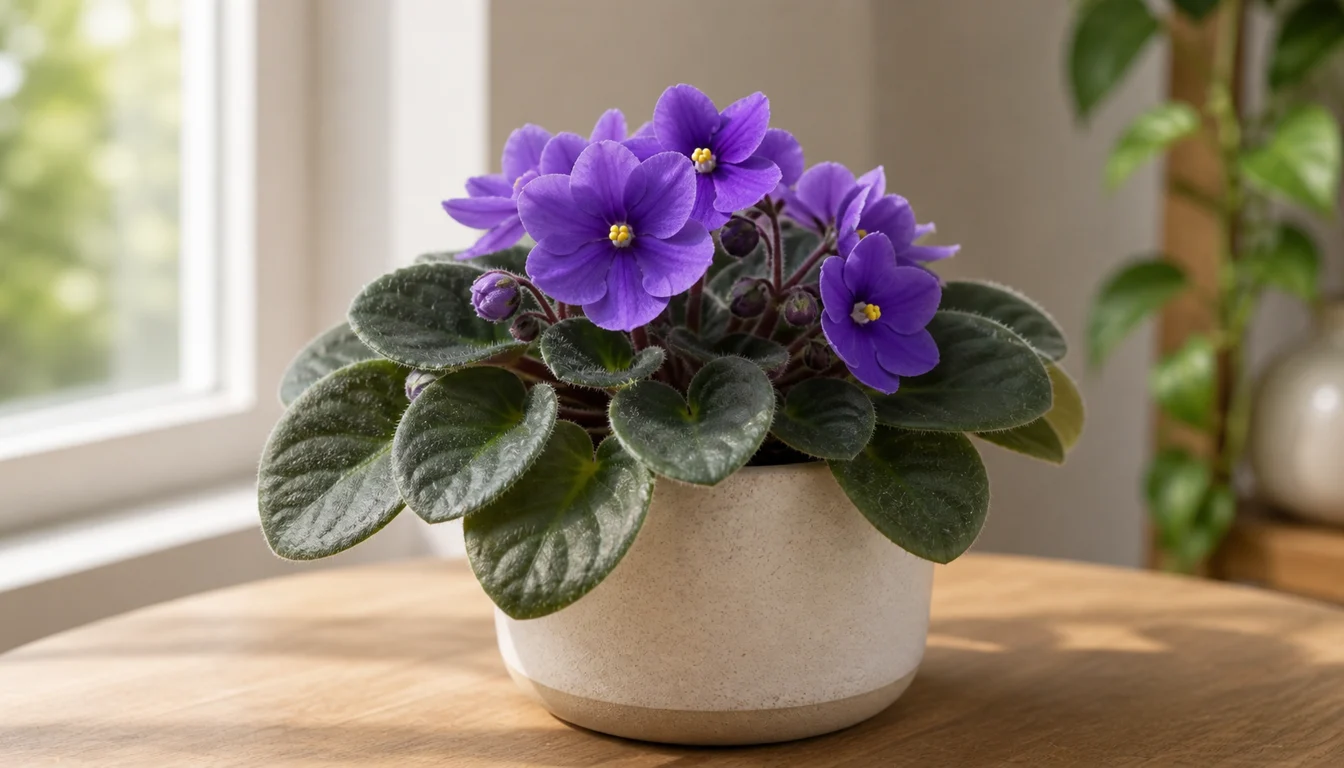
African Violet
African Violet is a windowsill bloomer that rewards steady, small-pot care.
Air Plant
Air plants are living sculptures that thrive without soil, anchoring to driftwood, rocks, or shells while drawing…
Alocasia
Alocasias include compact, textured houseplants and large elephant ears that need substantial floor space.