
Which Potting Mix Do Your Houseplants Need?
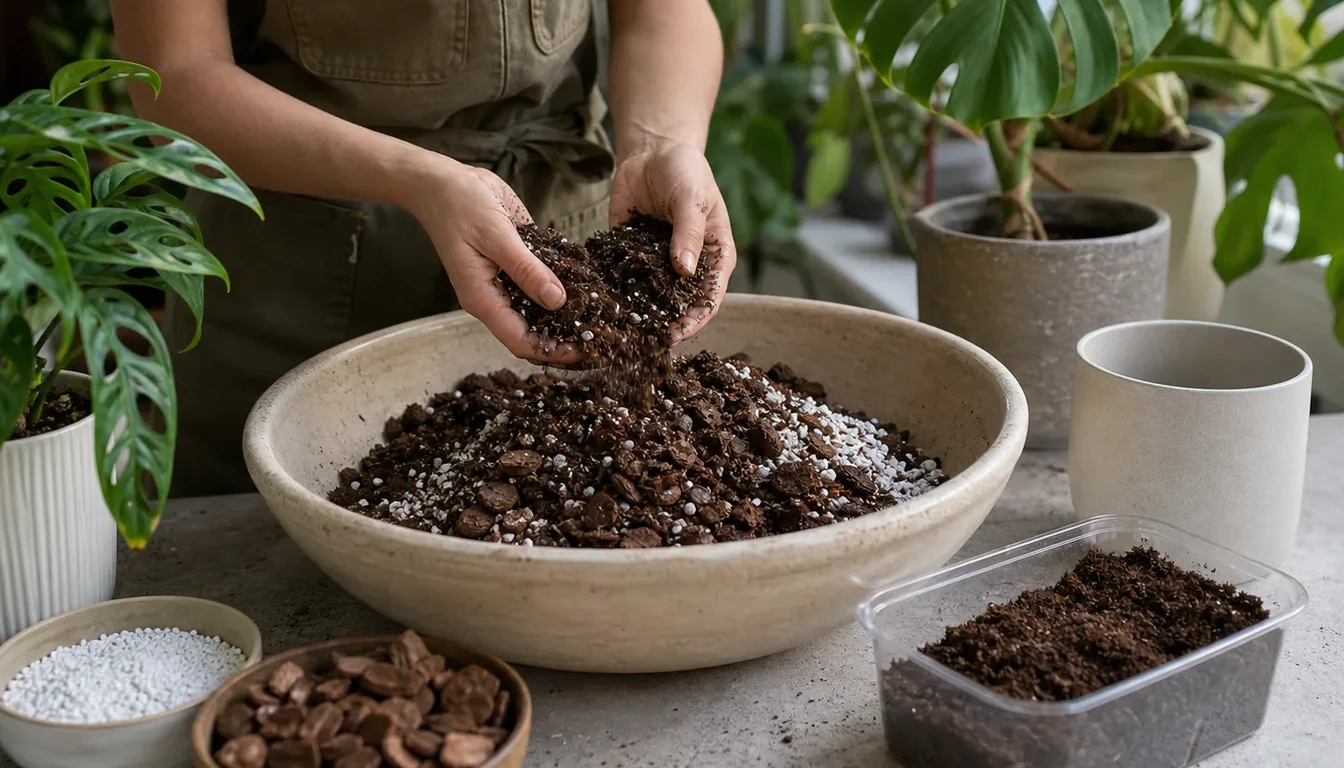
A good-quality soilless potting mix suited to the plant is the simplest starting point for most houseplants. It needs to retain usable water and nutrients while leaving room for air after drainage. A bagged mix can already do that without extra bark or perlite.
The right choice also depends on the container and growing conditions. A mix that works in a bright room can remain wet much longer in a cool, dim spot, and the same material behaves differently in a shallow pot. Those differences matter more than a recipe described as perfect for every indoor plant.
At a glance
What makes a suitable houseplant mix?
Roots need both water and oxygen. Potting mix provides spaces that can hold either, along with support for the plant and a place for nutrients to remain available. Maximizing empty space alone can leave a moisture-loving plant drying out too quickly.
After watering, some water drains under gravity and some remains held in smaller spaces and around particles. Free drainage does not mean dry mix. The useful question is whether the roots have a suitable balance as the pot moves from wet to drier conditions.
Particle size, proportions and handling affect that balance. Fine material can occupy gaps between larger pieces, so adding a little chunky material does not guarantee an airy mixture. Packing it firmly also changes the result.
A squeezed handful is only a rough handling check. Iowa State describes suitably moistened media that forms a ball but breaks apart easily, which contradicts the idea that holding any shape proves a mix is unsuitable. Neither that test nor a photograph measures oxygen availability around a living root system.
Why container height changes the water balance
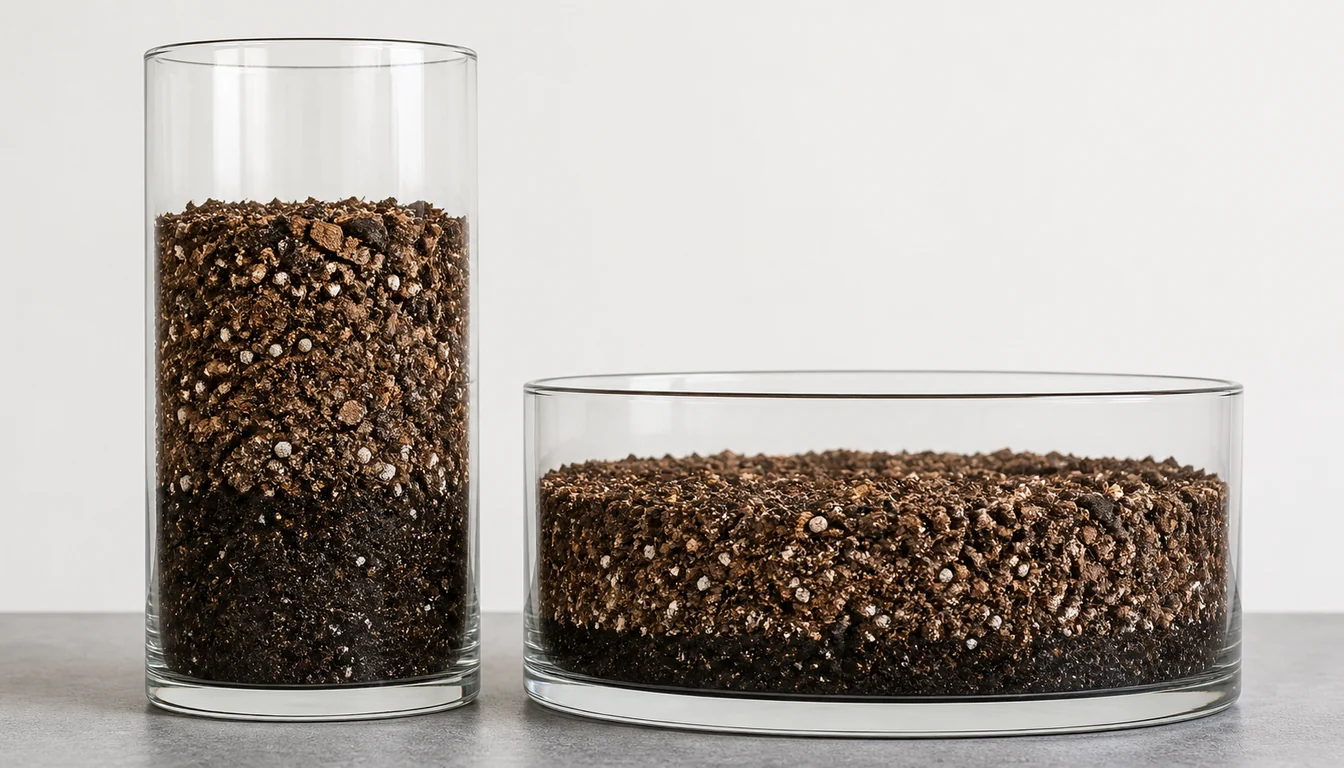
With the same mix and comparable filling, a shorter column holds a higher proportion of water after free drainage. A taller column has more material above the wetter lower zone and a greater average share of air-filled pores. The shorter container does not avoid that zone by spreading it out sideways.
UC container-media examples show why this matters when a mix moves from a normal pot into a shallow bowl. A mix that provides adequate aeration in the taller container may stay too wet around roots in the shallow one.
This is a comparison of water and air proportions after drainage, not a stopwatch for the next watering. Total mix volume, the plant's water use, exposed surface, container material and room conditions still affect how quickly a pot dries. A very large, tall pot is not automatically a good home for a small root ball.
Drainage holes allow excess water to leave, but they cannot remove all water held by the mix. Gravel beneath the mix does not replace those holes or reliably correct an unsuitable blend. A continuous suitable mix leaves the available depth for roots instead of filling it with a separate gravel layer.
Reading the bag before you buy
The front label describes an intended use, while the ingredient list and product instructions explain more about the blend. “Potting soil” and “potting mix” are not consistent guarantees across brands. A product called soil may be soilless, so the name alone cannot settle the choice.
Grade matters as well as ingredient name. Fine composted bark and large orchid-bark pieces do different jobs, just as fine, decomposed peat differs from coarser horticultural peat. A bag listing bark is not necessarily a chunky orchid mix.
| Ingredient or additive | Useful role | What to check |
|---|---|---|
| Peat or coir | Retains moisture as part of a blend | Texture, wetting instructions and how the finished product is intended to be used |
| Processed bark | Changes structure and water retention | Fine composted material versus coarse pieces, and suitability for the plant |
| Perlite | Adds lightweight, durable pore space | Grade and proportion, rather than a few visible white flecks |
| Vermiculite | Holds water and some nutrients | Whether that retention suits the plant and the rest of the mix |
| Compost | Can contribute organic matter and nutrients | Maturity, consistency and salt levels can vary |
| Fertilizer, lime or wetting agent | Changes nutrition, acidity or wetting | Existing additions and the package's feeding and handling instructions |
Organic ingredients eventually decompose, while mineral components such as perlite persist. That does not establish a two-year expiry for peat or coir, or make bark longer-lasting than perlite.
Matching the mix to the plant
Plant requirements are a better starting point than the thickness of a root seen during repotting. Fleshy roots do not identify one universal recipe, and wilting does not automatically mean a plant needs a more moisture-retentive mix.
| Growing situation | Sensible starting point | Important limit |
|---|---|---|
| Ordinary foliage houseplants in draining pots | A commercial indoor mix intended for the species or group | Observe moisture through the root zone rather than adding coarse ingredients automatically |
| Plants needing more consistent moisture | A blend that retains useful water while remaining aerated | Water retention cannot compensate for damaged roots or a sealed container |
| Desert cacti and many dry-habitat succulents | A suitable freely draining cactus/succulent blend | Tropical forest cacti have different moisture needs, despite also being succulents |
| Bark-grown epiphytic orchids | A mix suited to that orchid's root habit and container | Terrestrial orchids are not interchangeable with epiphytic kinds |
RHS guidance distinguishes forest cacti such as Christmas cactus from desert types. That is why “succulent” on a plant label does not justify putting every member of the group into the driest available blend.
For an unidentified plant, identification is more useful than selecting the middle row of a recipe table. A shop label or botanical name gives you a starting point for the plant's requirements, then its growing conditions help refine the choice.
When does a homemade adjustment help?
A ready-made mix is often the practical choice because it may already include adjusted acidity, a wetting agent and fertilizer. Adding raw peat, bark or compost changes more than the appearance, and adding extra fertilizer or lime can duplicate what is already present.
A home adjustment works best when it answers a specific problem. More durable coarse material may improve aeration in an overly retentive blend, but an already open mix may instead need more usable water storage. More perlite is not a universal correction.
- Define the reasonIdentify the plant, container and observed moisture problem before changing ingredients.
- Start smallUse a product or plant-specific recipe with stated ingredients. Measure by volume and record the proportions so the result can be repeated.
- Handle appropriatelyFollow packaging precautions for dust. Mix components evenly without crushing them or packing the pot hard.
- Observe the planted resultNote how the root zone wets and dries under normal conditions. A small trial is more informative than changing the entire collection at once.
A hand-mixed blend does not need every popular amendment. Charcoal, compost and water-retaining products each have particular uses and limitations, and none is proof of quality. Garden mulch and arbitrary sand additions are also poor substitutes for ingredients specified in a potting recipe.
Is the mix actually causing the problem?
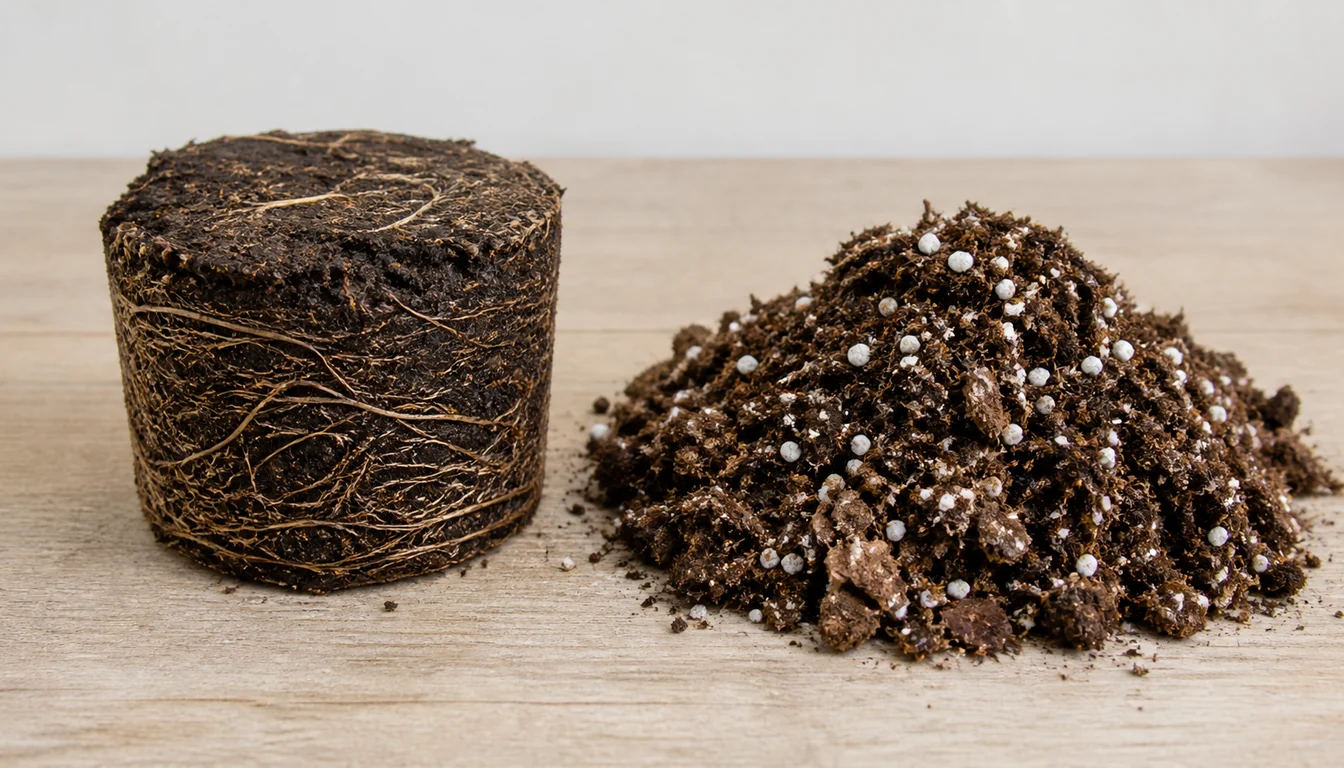
An old mix can lose structure, but calendar age is not enough to diagnose failure. A root ball can hold its pot shape because roots bind it together, while a newly bought mixture can perform poorly if the container or watering does not suit it.
| Observation | Possible explanation | What separates the possibilities |
|---|---|---|
| Water runs out quickly but the center stays dry | A shrunken, water-repellent root ball may be bypassed | Check moisture inside the ball, not just the runoff |
| Mix stays wet much longer than before | Lower plant water use, blocked drainage, root loss or changed structure | Compare location and growth, inspect the outlet, then assess roots if needed |
| Pot dries rapidly and roots are densely crowded | Little space remains for water-holding mix | Examine the root ball before choosing a larger container |
| Roots and old mix form a firm cylinder | Root binding or compaction may be involved | Shape and dark color alone do not prove the mix has collapsed |
| White deposits appear | Mineral or fertilizer residues may have accumulated | Consider the water and feeding history rather than adding more fertilizer |
UC guidance explains that very dry media can repel water. Gradual rewetting can restore contact with the root ball, so immediate runoff is not by itself a reason to discard the mix.
If roots are soft or deteriorating, the problem needs prompt assessment. New mix cannot restore dead roots, and moving a reduced root system into a much larger wet volume can make recovery harder. Repotting choices follow the condition of the plant, not a claim that every old pot needs replacing.
Choosing a ready-made mix
For a healthy foliage plant in an ordinary draining pot, a reputable premixed product intended for that use is a reasonable purchase. A separate bag of bark or perlite is optional. A specialty mix can be useful when its ingredients and intended conditions match the plant, and price alone does not establish whether it is worthwhile.
- The package describes a use appropriate to the plant and container.
- The ingredient grade and water-retention description fit the intended conditions.
- Existing fertilizer and other additives are accounted for before anything is added.
- The mix can be stored covered and protected from contamination according to its instructions.
The next useful comparison is with the mix that already works for you. If the new product behaves differently, the watering interval may need to change. Keeping the old interval while changing the mix, pot and location at once makes it difficult to tell which change caused a problem.
Frequently Asked Questions
Can I use ordinary garden soil in a houseplant pot?
A formulated potting medium is usually the simpler choice. Unamended garden soil behaves differently in a restricted container and may provide poor aeration or introduce pests and weeds. Some tested mixtures include treated soil, but that does not make soil dug from the yard an equivalent substitute.
Sources & References
- UC Agriculture and Natural Resources: Soil Mixes Part 2, Water and Air Porosity
- UMass Extension: Effects of Growing Media on Water and Nutrient Management
- Iowa State University Extension: Potting Media, Components and Handling
- Penn State Extension: Repotting Houseplants
- University of Maryland Extension: Potting and Repotting Indoor Plants
- Royal Horticultural Society: How to Grow Cacti and Succulents
- Illinois Extension: Container Drainage Options
- UC Master Gardeners of Santa Clara County: Watering Hydrophobic Soil
Related Guides

Best Butterfly Garden Plants for a Complete Habitat
The best butterfly garden plants do two different jobs. Host plants feed caterpillars, while nectar…
15 min read
Best Fall-Blooming Flowers for Color Near Frost
A bed that still carries flowers in October usually was planned before temperatures fell.
9 min read
Best Fast-Growing Trees for Shade and Privacy
The best fast-growing tree is the one whose mature crown, roots, climate range, and maintenance…
16 min read
Best Fragrant Flowers for Every Yard and Season
The best fragrant flowers depend on climate, light, space, and the hours you use the yard.
15 min read
Best Full-Sun Perennials for Hot, Bright Beds
The best full-sun perennials are the ones that match the bed's soil moisture and drainage, local…
14 min read
Best Ground Cover Plants for Sun, Shade, and Slopes
The best ground cover is a plant that survives the site and performs the job without escaping into…
18 min read