
How to Grow Bird of Paradise Indoors and What to Expect
Strelitzia reginae Strelitziaceae
Bird of paradise (Strelitzia reginae) needs a sunny indoor position and a well-drained root zone. Bright light supports its paddle-shaped leaves, but an attractive leafy plant is not a promise of flowers.
The orange-flowered species forms a rhizomatous clump. Its identity, maturity and growing conditions matter more than a tight pot or a fixed fertilizer schedule when you are hoping for blooms.
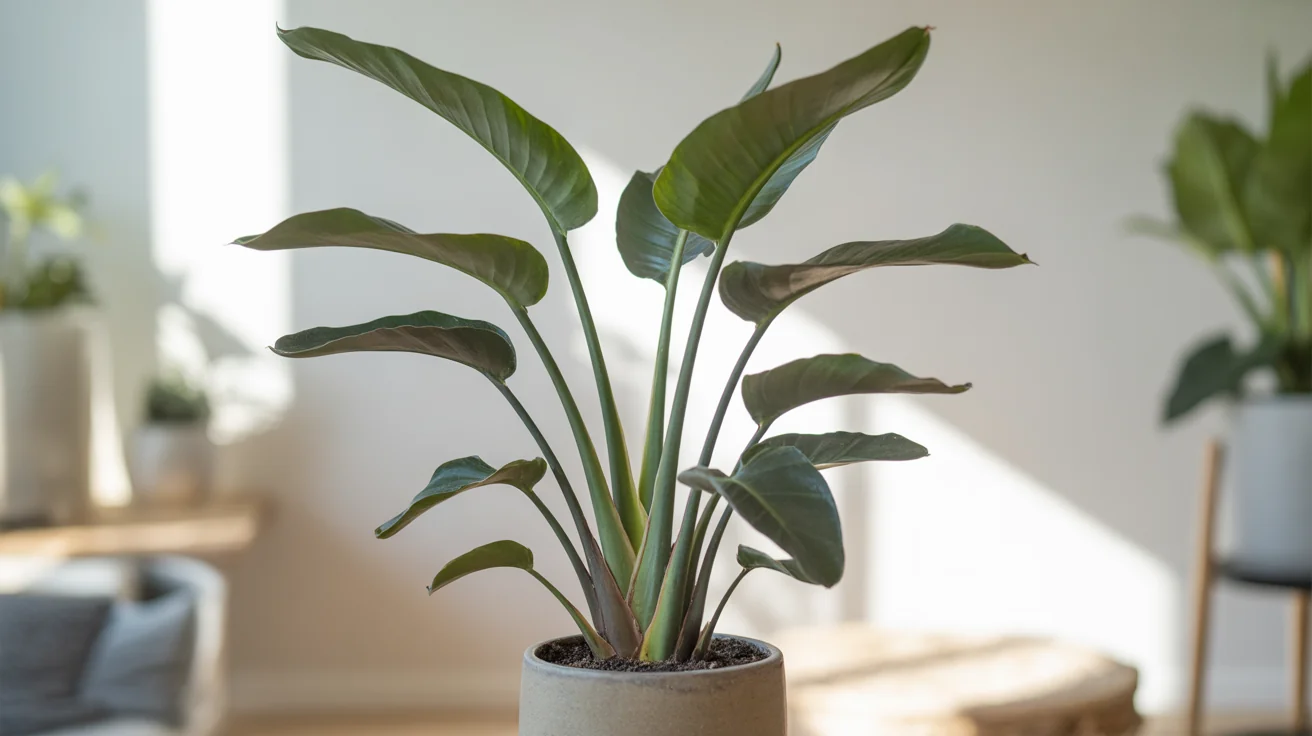
Care snapshot
A Clumping Plant With Broad Leaves
Strelitzia reginae is a South African perennial with leaves rising in fans from underground rhizomes. Orange sepals and blue petals emerge from a pointed, boat-shaped bract, giving the flower its familiar birdlike outline.
UF/IFAS describes landscape clumps around 3–5 feet tall. Indoor size depends on the plant, container and conditions, so that range is a space-planning reference rather than a promise about a nursery specimen. The leaves also need lateral clearance from doors, walkways and neighboring plants.
An established clump can have several fans without becoming a woody tree. That matters when it outgrows a pot because repotting retains the clump, while division separates parts of its rhizome and root system. Cutting off an individual leaf does not produce the same kind of new plant.
Large leaves can tear along their veins through wind or handling. The nearby close view shows marginal splits, not a confirmed pest or disease. New spotting, progressive browning, webbing or declining growth needs its own inspection rather than being dismissed as normal splitting.
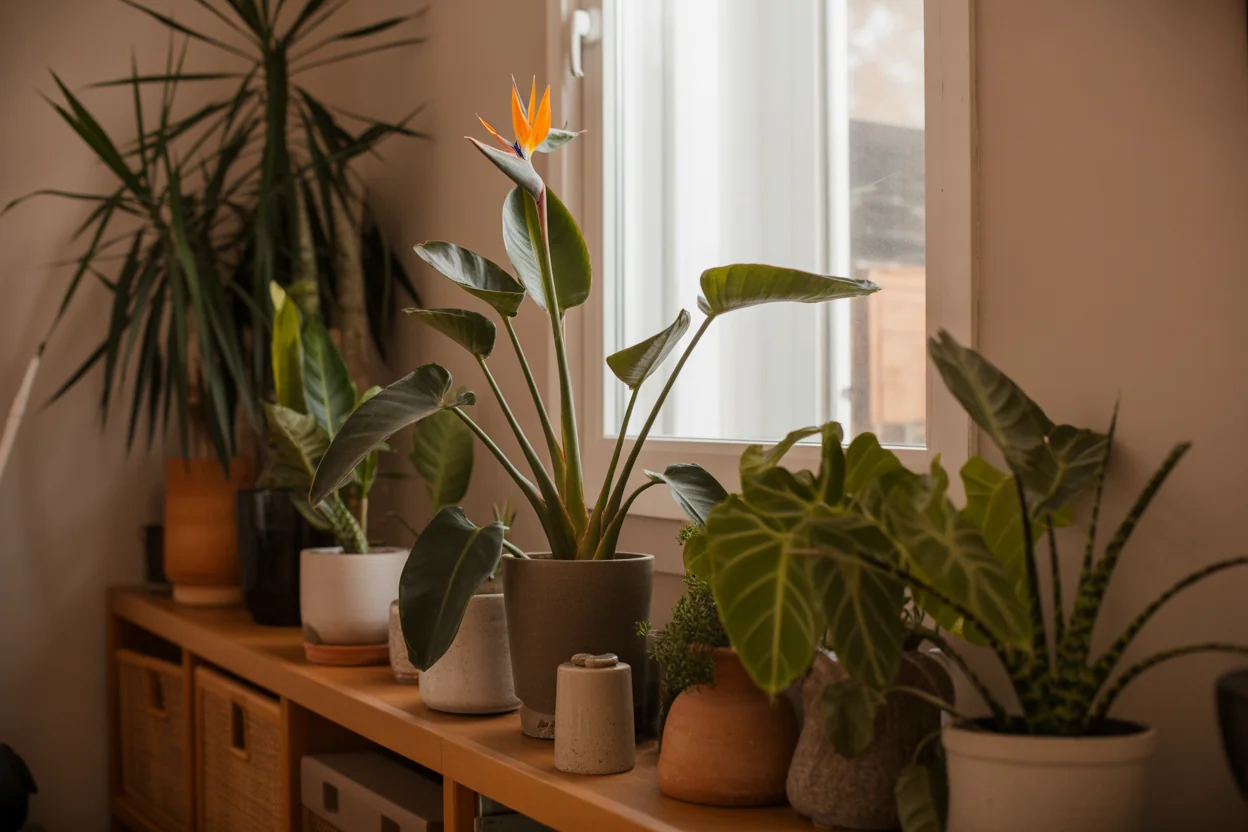
Which Bird of Paradise Fits the Space?
A species name is more useful than a small pot when judging eventual size. Strelitzia nicolai is a different, much larger white-flowered species that can become tree-sized outdoors. A young plant sold for a room does not stay small simply because it started in a compact container.
- Strelitzia reginae
- Clumping orange-and-blue-flowered species covered here; suited to a sunny indoor position with room around its leaves
- Strelitzia nicolai
- Large white-flowered relative; UF describes landscape heights of roughly 15–30 feet, not a predicted indoor height
- Mandela’s Gold
- A yellow-flowered selection of S. reginae listed by NC State; flower color does not establish a dwarf size
A compact or dwarf sales description needs information about that specific selection. It cannot establish a universal mature height for every bird of paradise. Leaf length, the spread of the existing fans, pot weight and access for moving it all affect whether the plant fits your home.
Fiddle Leaf Fig offers a woody branching form instead of a rhizomatous fan. Choosing between them involves the growth habit and available light, not just which plant looks smaller on a sales bench.
Strong Light Supports Growth, Not Guaranteed Flowers
NC State recommends a sunny indoor position for S. reginae. A bright unobstructed window is a useful starting point, but orientation alone does not measure what reaches the leaves. Trees, neighboring buildings, glazing and distance from the window change the exposure.
A plant accustomed to a dimmer room needs a gradual transition to stronger sun. Sudden exposure can injure leaves even on a species that grows in sun outdoors. New pale or brown patches after a move warrant checking both exposure and watering, rather than applying a fixed distance-from-glass rule.
Maturity and growing conditions both affect flowering. UF/IFAS reports a longer wait from seed than from division in its growing context. Those observations do not guarantee an indoor bloom date, and more fertilizer cannot substitute for adequate light.
UF describes flowering as intermittent through the year in suitable conditions. An indoor plant may never reproduce that pattern. Healthy foliage without flowers is therefore a different situation from a plant losing leaves, sitting in wet soil or producing little growth.
A grow light may supplement an unsuitable window, but fixture output, coverage and distance determine its usefulness. A universal bulb wattage or daily timer setting would not describe every plant and room.
Water the Root Ball, Then Let It Lose Moisture
Bird of paradise uses more water while actively growing in strong light than during a cool, dim period. NC State advises generous watering during spring and summer growth and drier conditions in winter. That describes changing demand, not a weekly schedule or permission to leave the roots completely dry for the season.
The surface of a large pot can dry while its center remains wet. A moisture check below the surface, the recent drying pattern and pot weight where it can be lifted safely give a better picture together. Repeated deep probing through thick roots adds damage without necessarily resolving the question.
When the upper mix has dried and checks show the root zone is losing moisture, water thoroughly so the root ball is wetted and excess leaves the drainage holes. Empty collected water from the saucer or outer pot. If the mix is still wet below the surface, adding another drink can prolong poor aeration.
Yellow leaves, curling and brown edges overlap among several stresses. They do not identify overwatering or underwatering by themselves. Persistently wet mix with decline raises concern about root problems, while a light pot with dry mix supports a different watering decision.
Rapid worsening, a loose plant or soft decaying roots merits closer examination and, when the cause remains unclear, a plant diagnostic service. Changing water use is necessary when conditions are wrong, but it does not identify or cure every root disease.
A Stable Pot With Working Drainage
A tall clump needs both a stable container and a root zone that drains. A heavy decorative outer pot can provide stability, but water trapped inside it still needs somewhere to go. A draining inner pot makes that water easier to remove.
A commercial indoor potting mix that retains moisture while leaving air spaces is a practical starting point. Its condition and the pot size matter more than a universal percentage of bark or perlite. Compacted old mix and a large volume of persistently wet unused soil can both make watering harder to judge.
Roots filling the container, water failing to wet the root ball evenly, or a pot becoming unstable are reasons to assess repotting. A modest increase matched to the actual root mass avoids surrounding a small root system with an unnecessarily large wet volume.
Keeping a plant severely root-bound is not a dependable flowering method. Repotting and division also serve different purposes. A larger container preserves a healthy clump, while division reduces its size and creates separate plants at the cost of root disturbance.
Surface crust can reflect dissolved salts, but color alone does not identify the cause. Fertilizer use, irrigation water and drainage all deserve attention before adding more feed to a struggling plant.
Division and Seed Are Different Routes
Division separates an established rhizomatous clump into plants with growing points and roots. UF/IFAS recommends late spring or early summer for its outdoor growing context. Indoors, active growth and suitable recovery conditions are more useful than choosing a month without considering the room.
UF describes dividing older clumps into single-stem divisions. Each viable portion retains a growing point and roots, and a larger division may preserve more of the established plant. A detached leaf or a piece with no growing point is a different kind of material.
- Remove the clump from its container and expose enough of the root and rhizome structure to see where fans connect.
- Use a clean sharp tool to separate viable portions while retaining roots and growing points. Avoid tearing apart healthy roots simply to maximize the number of pieces.
- Replant at the previous depth in a draining mix, with a container suited to each division.
- Keep the mix moist while new roots establish, allowing excess water to drain. Adjust from observations rather than withholding water for a fixed number of days.
Fresh divisions need moisture while roots establish. A draining mix can stay moist without remaining saturated. Routine dusting with cinnamon or sulfur is not part of the division method described by UF/IFAS, and cannot compensate for unsuitable root conditions.
Seed propagation is also valid, but germination can be slow and uneven and seedlings take longer to flower. UF reports about 1–2 years to flowering after division and 3–5 years from seed in its context. These ranges explain the tradeoff between methods, not an indoor guarantee.
Inspect the Pest Before Choosing a Treatment
Broad leaves make damage conspicuous, but a dusty or yellow leaf is not enough to identify an insect. The undersides, leaf bases and stems often provide more useful evidence. Separating an infested plant from neighboring houseplants helps limit movement while the problem is assessed.
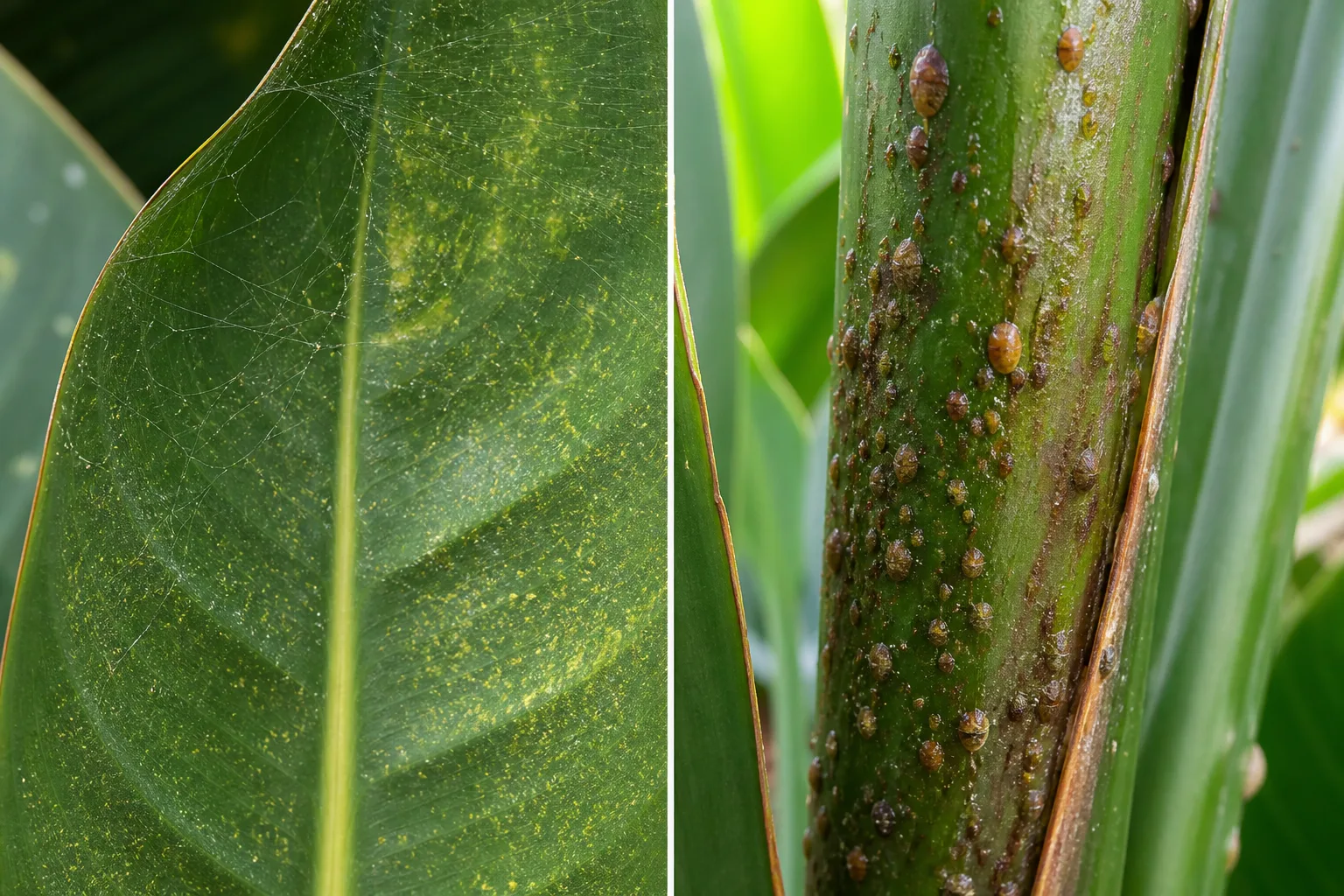
- Fine stippling and webbing
- Inspect closely for spider mites, especially on leaf undersides; an ordinary spider web alone is insufficient
- Attached brown bumps
- Inspect for scale insects; natural scars and other marks can resemble them
- White cottony clusters
- Inspect leaf joints and bases for mealybugs
- Sticky residue
- Can accompany soft scale or mealybugs; not every scale insect produces honeydew
Washing or wiping can remove some pests, where the leaf surface and plant size allow it. A pesticide decision depends on the identified pest, plant sensitivity and a product label permitting that indoor use. Insecticidal soap is not interchangeable with household detergent, and a sequence of soap, neem and systemic products is not a universal treatment plan.
Some products work best on particular pest stages, so follow-up depends on that biology and the label. Inspecting after treatment is more informative than declaring success because the old speckles remain or disappear. Damaged tissue does not necessarily recover even when pests are controlled.
Seasonal Changes Follow the Plant’s Conditions
Indoor growth responds to available light and warmth, not the calendar alone. As growth slows, the mix often dries more slowly and fertilizer demand falls. Continuing the same watering and feeding routine can leave a cool root ball wet for longer.
Fertilizer supports active growth when nutrients are needed. A houseplant product used according to its label is a more defensible starting point than importing a landscape fertilizer rate into a pot. Feeding a stressed plant to force flowers leaves the underlying light or root problem unresolved.
NC State gives indoor nighttime temperatures around 55–65°F with warmer days. This is care guidance, not a precise temperature at which every plant is injured. Outdoor hardiness zones describe winter climate and cannot determine a room’s temperature, humidity or window exposure.
A summer move outdoors changes light, wind and moisture use together. Gradual acclimation protects leaves accustomed to indoor conditions, and the return indoors calls for a pest inspection. Forecast cold, exposed containers and flowers all need consideration rather than relying on a landscape survival limit.
Old damaged leaves and spent flower stalks can be removed with clean tools without repeatedly cutting healthy fans apart. New growth, pest observations and root-zone drying provide a useful record of how the current position is working.
Animal Safety Depends on the Correct Plant
ASPCA lists Strelitzia reginae as toxic to dogs, cats and horses. Its entry identifies gastrointestinal irritants, chiefly in fruit and seeds. Reported effects include nausea, vomiting and drowsiness, but vomiting does not apply to horses and the list does not predict an individual animal’s outcome.
The same common name can also refer to unrelated plants. ASPCA explicitly distinguishes this species from the plant listed as Poinciana gilliesii, also known as bird of paradise. A photograph and the scientific name are useful when seeking advice after an exposure.
Keep the plant and shed material away from animals that chew plants. Contact a veterinarian promptly after suspected ingestion rather than waiting for a large amount to be eaten or symptoms to worsen. A general low-severity plant rating cannot clear a particular exposure.
This ornamental is not an edible crop, and its pet classification does not establish human food safety. Placement also needs to account for children, heavy pots and access to fallen fruit or seeds.
Sources & References
Related Plants
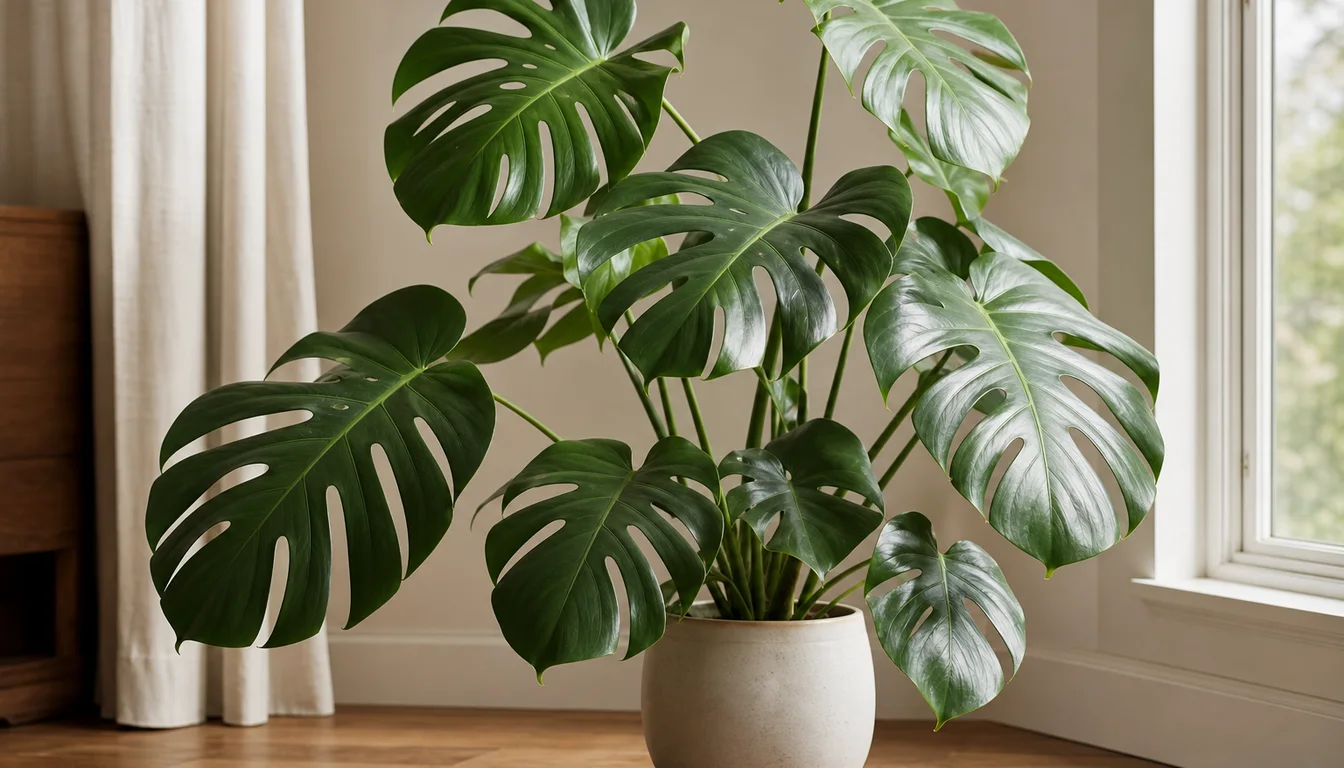
Monstera
A climbing foliage plant with a different support and growth habit from a rhizomatous Strelitzia clump.
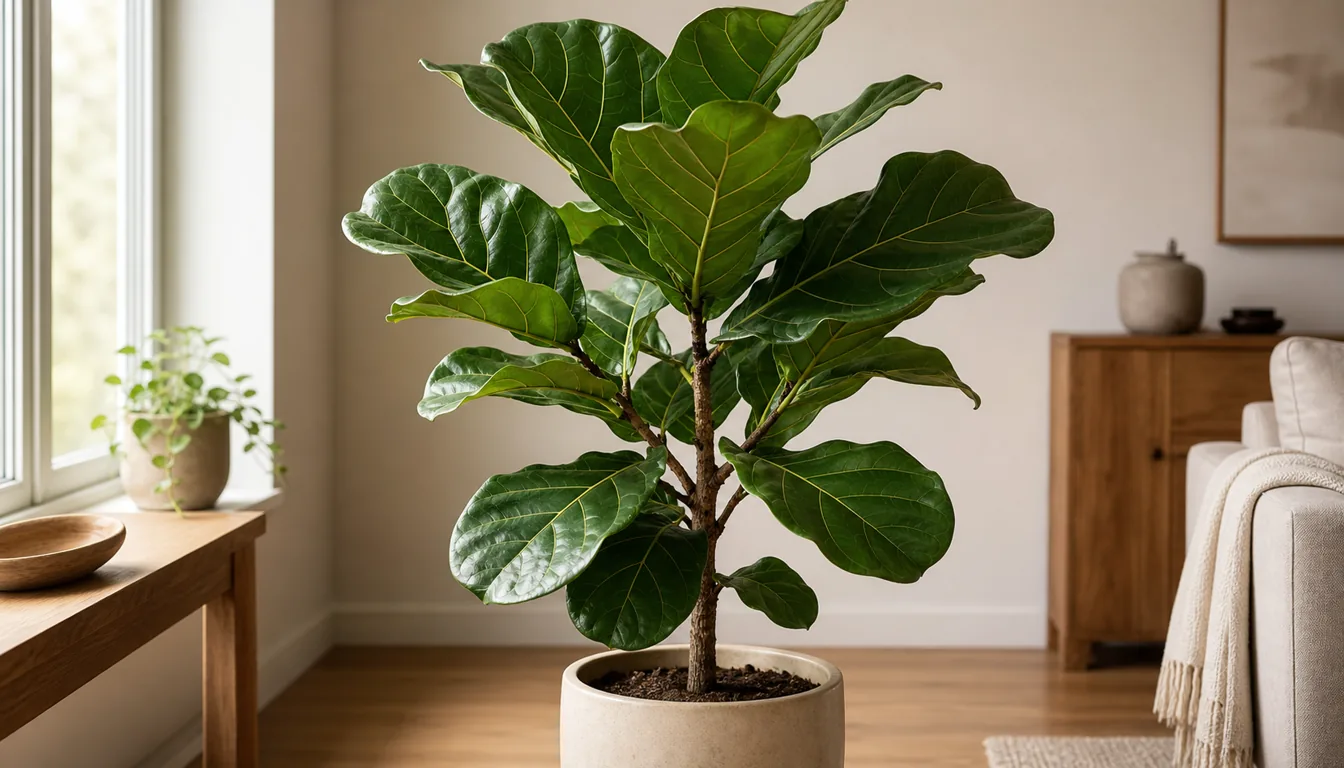
Fiddle Leaf Fig
A woody indoor tree for readers comparing branching form with upright leaf fans.
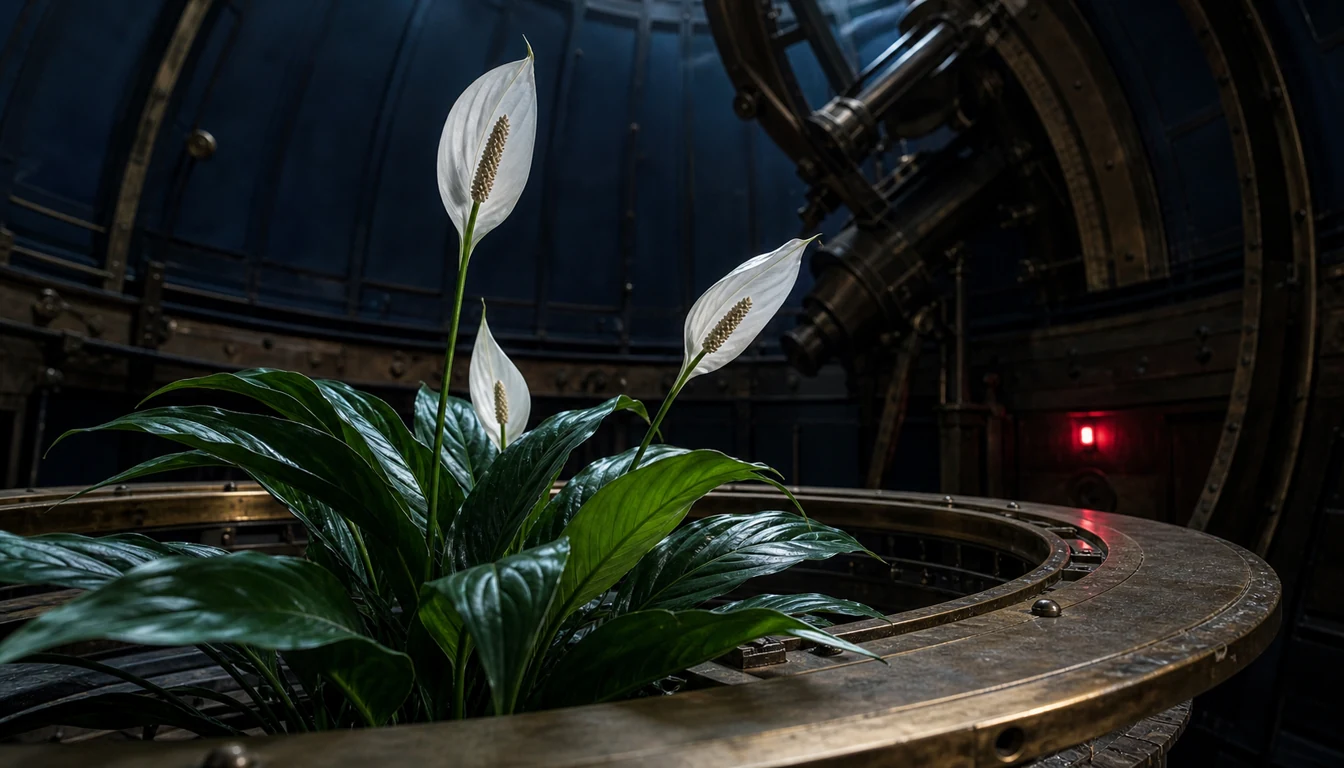
Peace Lily
A different flowering houseplant; its lower-light tolerance does not guarantee blooms in a dark room.
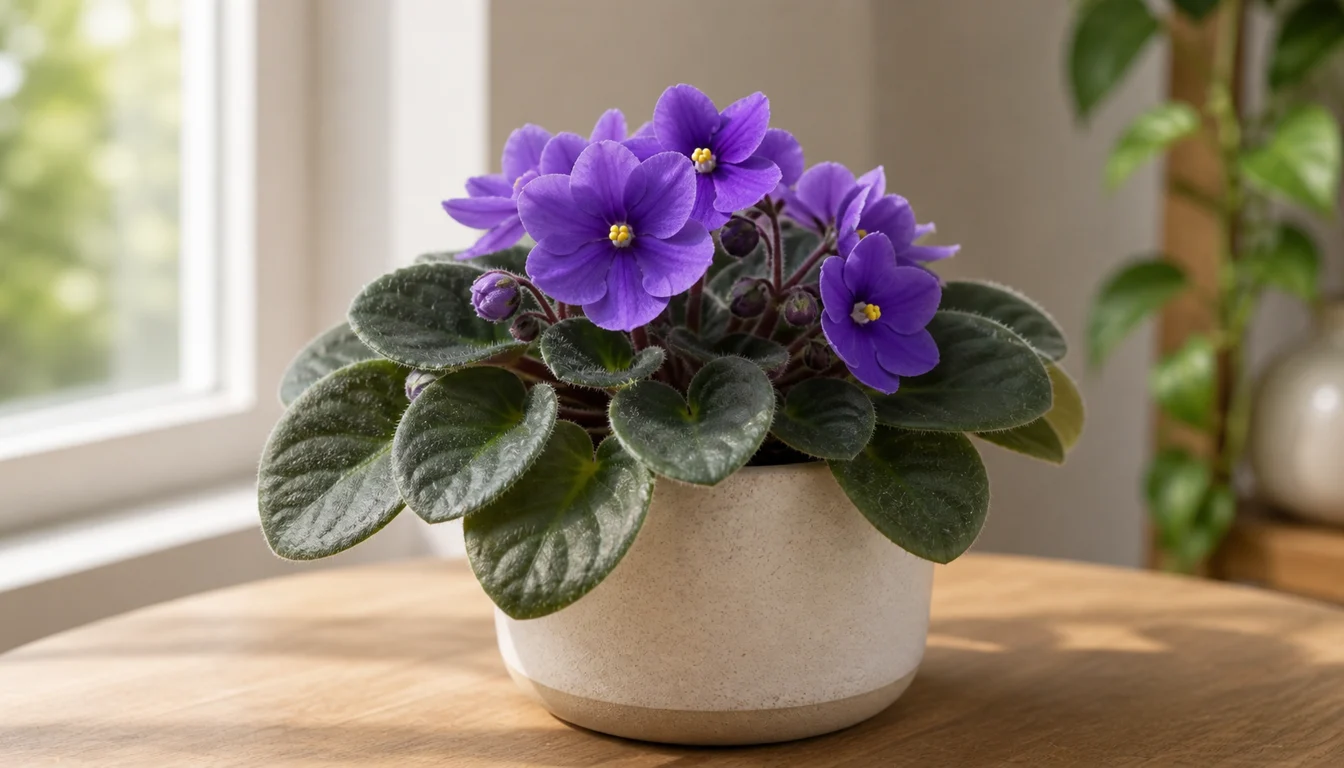
African Violet
African Violet is a windowsill bloomer that rewards steady, small-pot care.
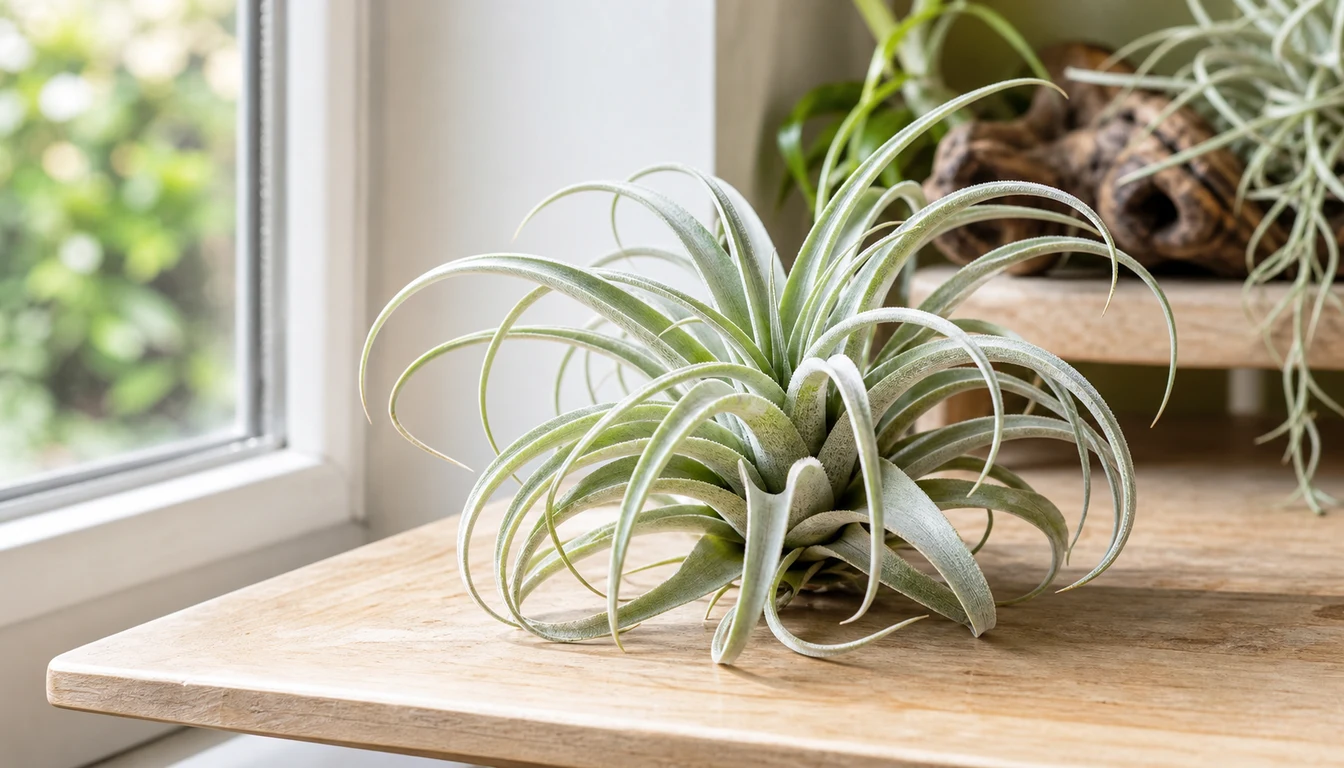
Air Plant
Air plants are living sculptures that thrive without soil, anchoring to driftwood, rocks, or shells while drawing…
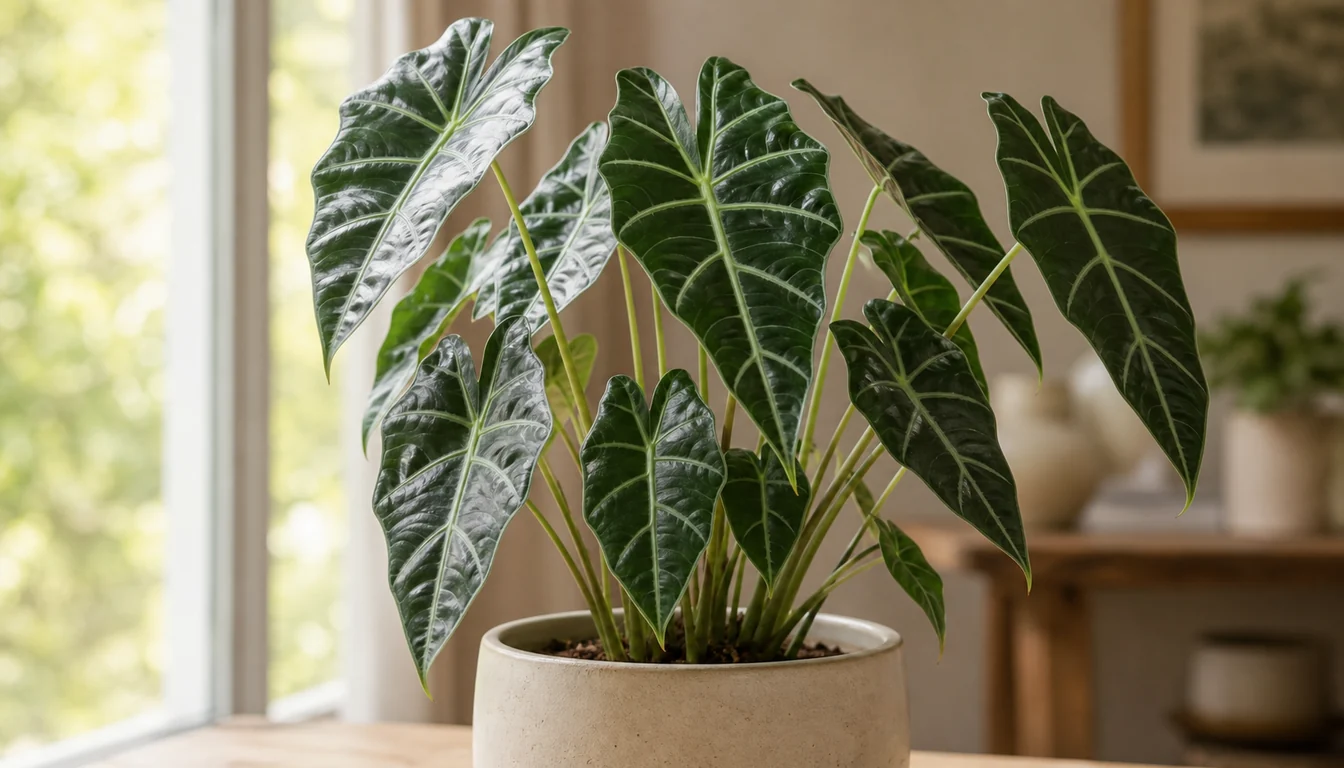
Alocasia
Alocasias include compact, textured houseplants and large elephant ears that need substantial floor space.