
How to Grow Arrowhead Plant as a Compact Pot or Climbing Vine
Syngonium podophyllum Araceae
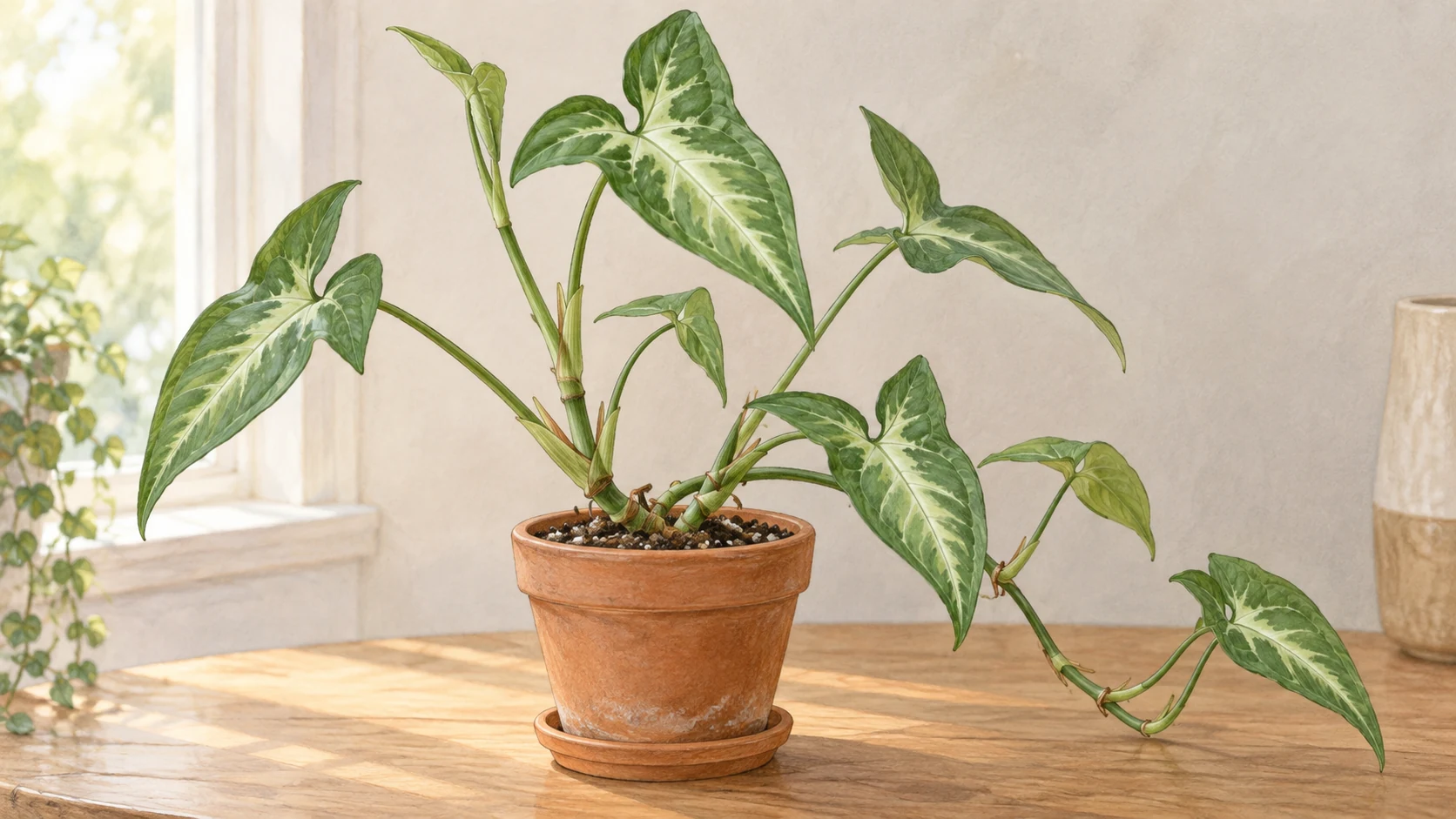
Arrowhead Plant starts with a compact habit and arrow-shaped leaves, then develops longer climbing stems and more divided foliage as it matures. Pruning can maintain a smaller display, while a support allows the vine to develop. Bright indirect light and moisture in a draining mix support either form.
Care snapshot
The Leaves Change as the Vine Matures
The neat arrowhead leaves sold in nursery pots are juvenile growth. As Syngonium podophyllum matures, stems can climb or trail, and later leaves can become lobed and more deeply divided. That change is part of its development rather than evidence that the original plant has turned into a different species.
NC State describes the transition from a young, shrubby habit to a vine. Long petioles hold the blades away from the stem, while adventitious roots help a climbing stem attach to support. A leaf stalk and the vine itself are different structures, which becomes especially important when taking cuttings.
A compact display and a climbing display require different handling. Pruning back elongating stems can retain a smaller, juvenile-looking plant. A stable support gives a growing vine somewhere to attach and room to develop its later foliage.
A hanging basket allows stems to trail, but their length also changes how easily leaves can be reached by people and animals. A pot that was safely out of reach when young may eventually send a vine down within chewing distance.
The botanical illustrations on this page show the plant’s form and a stem cutting. They are AI-generated educational illustrations, not photographs of a growing trial or proof of a particular cultivar.
Bright Light for the Display You Want
Arrowhead Plant favors a bright position with indirect or filtered light. NC State warns that full sun can burn or bleach its foliage. A protected indoor plant moved abruptly into strong outdoor sun can be injured even in a climate warm enough for growth.
The light reaching the leaves depends on more than window direction. Buildings, trees, curtains, and distance can turn apparently similar windows into very different growing positions. A trailing stem may also leave the bright area occupied by the rest of the plant.
Slow growth and longer gaps between leaves can accompany inadequate light, but long stems are also part of the plant’s normal maturation. The useful distinction is whether the whole plant has begun to weaken or whether vigorous stems are simply developing their vining habit.
A grow light can help where natural light is insufficient. Its placement depends on the fixture’s output and coverage rather than a universal distance from the leaves. The response of new growth is more useful than expecting old scorched tissue to repair itself.
Color, Leaf Shape, and Cultivar Names
Syngonium selections can have green, pale, or pink markings. NC State lists cultivars including 'Bold Allusion', 'Milk Confetti', 'Painted Arrow', and 'Three Kings'. Those names identify selections, but a sales label or a single photograph cannot establish every detail of their care or future size.
Color and mature habit are separate buying decisions. A plant chosen for pale markings can still develop vining stems, and a small pot does not guarantee a permanently compact plant. The nursery’s description of the named selection is more useful than assuming that every pink plant grows alike.
Changes in appearance also need context. Juvenile and adult leaves can differ substantially even on a healthy plant. New damage, fading across the canopy, or distorted growth deserves a conditions and pest check rather than being assigned to normal maturation automatically.
Pruning can maintain the display you prefer, while training preserves the vine. That choice does not require withholding water or confining damaged roots to keep the plant small.
Mix and Pot Size Support the Roots
A suitable houseplant mix holds moisture while allowing excess water to drain. Its structure matters more than a fixed proportion of bark or perlite. Different commercial mixes start with different ingredients and do not behave identically in the same pot.
An oversized pot adds a volume of wet medium beyond the area occupied by the roots. A compact plant can then remain wet for longer than expected. Conversely, a crowded root ball may need more room even when the visible foliage still fits the display.
Repotting is justified by those conditions and by the state of the medium. Water running quickly down a gap at the side does not prove the center was wetted, and a mix that has deteriorated can retain water unevenly. An automatic yearly replacement does not resolve which of those problems is present.
A support belongs in a stable arrangement that does not crush the roots or leave the pot top-heavy. Pruning and training control the visible form more directly than treating pot size as a guarantee of bushiness.
Moisture and the Meaning of a Limp Leaf
Arrowhead Plant benefits from moisture available around its roots without being left in saturated media. Water fills spaces in the mix, while drainage and drying allow air to return. Water trapped inside a decorative pot can keep the lower roots wet long after the surface changes.
A limp leaf does not identify one watering problem. Dry roots may lack available water, while damaged roots may be unable to take up water from a wet mix. The same outward posture can accompany those opposite conditions.
Surface moisture, pot weight, and moisture below the surface help distinguish the situations. No one check is conclusive. A dry crust can conceal wetter material, and a light pot may contain dry mix that sheds water through channels.
Watering becomes appropriate as the upper layer begins to dry and the pot is losing moisture, before the entire root ball becomes severely dry. A pot that is still wet below the surface needs more time or an assessment of why it remains wet. Slow wetting followed by drainage replenishes moisture around the roots, and excess water needs a route out of both the nursery pot and any outer container.
Continued collapse in wet media warrants examination of drainage and roots. A firm stem does not establish that fine roots are healthy, and a temporary improvement in leaf posture does not prove that every underlying problem is resolved.
Pruning and Making a Node Cutting
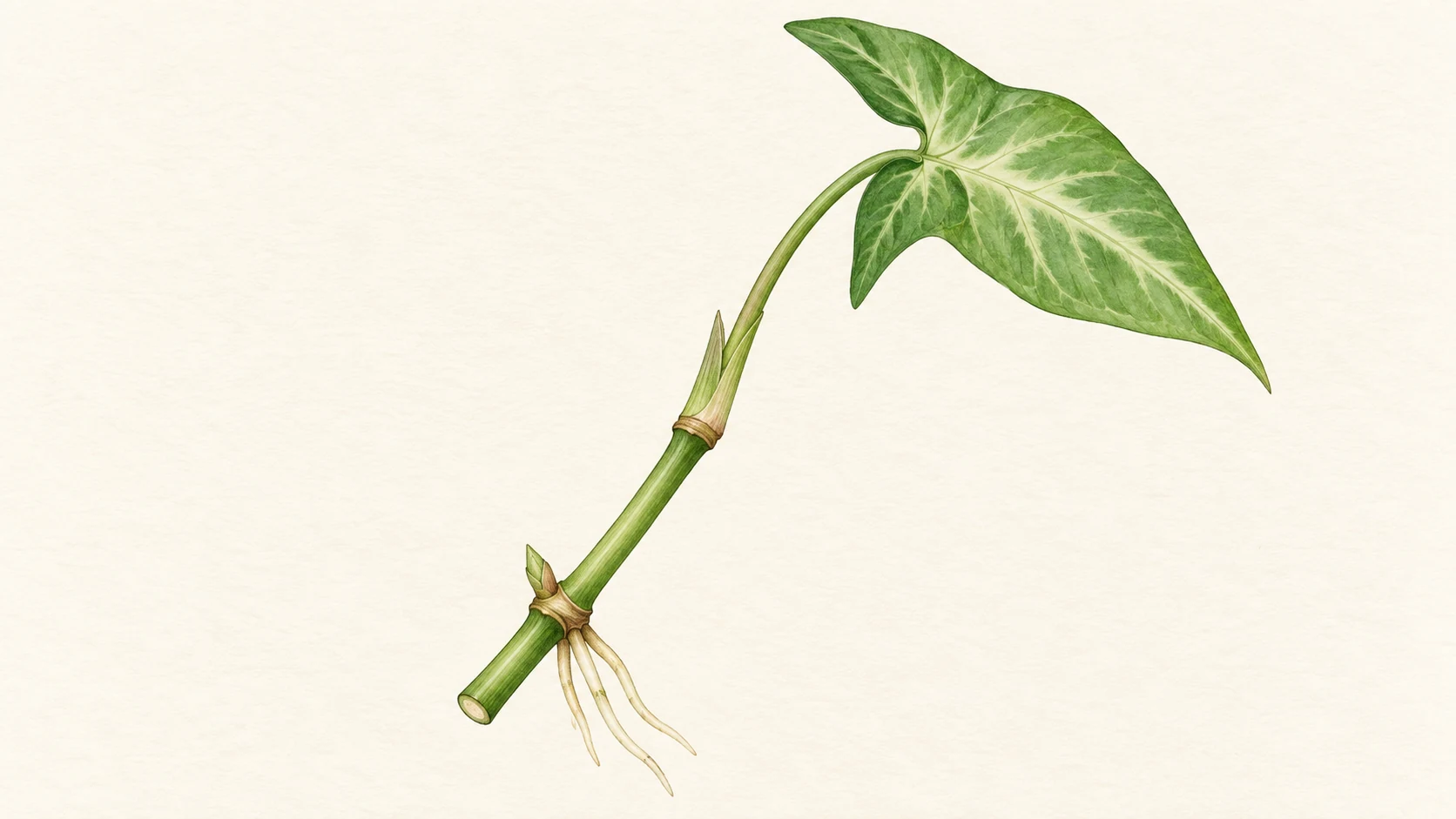
A node is the part of the vine where a leaf attaches and a bud can produce further growth. The petiole connects the blade to that node. Cutting off a leaf and its petiole does not preserve the same structures as taking a section of vine containing a node.
For a compact plant, pruning just above a node leaves that node on the parent. A cutting taken from the removed stem needs its own node and viable bud. The two cuts serve different purposes even though both are described casually as trimming the plant.
NC State lists stem cuttings, division, and layering as propagation methods. Layering keeps a stem attached while a node roots in contact with suitable medium. That can be useful when the aim is to establish a new root system before separating the vine.
For a stem cutting, sound material and suitable conditions matter more than a prescribed leaf count. A heavily damaged or rotting stem is not made suitable by cutting it to a standard length. Gloves also help prevent contact with irritating sap.
- Identify a sound section of vine with a node and viable bud. Use clean tools to cut below the node retained on the cutting.
- Remove foliage that would be buried or submerged while leaving useful leaves above the rooting area. Keep the node intact.
- Place the node in moist, open rooting medium with the foliage above it. A stable position reduces repeated movement while roots develop.
- Keep the cutting in warm, bright indirect conditions and follow moisture without saturating the medium. Rooting and new shoot development vary, so neither a calendar deadline nor one white root proves establishment.
Water can also be used to observe rooting in suitable houseplant cuttings, but a jar is not automatically a complete long-term growing system. Plants grown in water still need oxygen and an appropriate nutrient supply. The diagram below identifies the node and bud rather than prescribing a root length at which every cutting must be potted.
Growth Changes with the Room
A plant in a bright, warm room can remain active longer than one in a dim winter position. Indoor heating, air conditioning, drafts, and changing sun angles all affect its conditions. USDA outdoor hardiness zones do not describe those room conditions.
Slower growth usually reduces demand for water and nutrients. That is a reason to reassess the root zone and feeding, rather than remove a fixed percentage of water at the start of winter. Fertilizer follows actual growth and the product label, accounting for nutrients already present in the potting mix.
Pruning while conditions support regrowth can help the remaining nodes resume growth. A hard cut in poor light may leave a bare stem for longer, so the timing decision includes the light available after pruning. Necessary removal of damaged tissue is a different question from routine shaping.
Warm, humid conditions suit the plant, but misting does not maintain humidity for long. Purdue explains that the droplets evaporate quickly. Grouping plants or using a humidifier can affect their surroundings, while the pot still needs free drainage.
A sudden decline is not automatically a seasonal rest. The sequence of changes, moisture conditions, and direct pest observations help separate a gradual slowdown from an active problem.
Mites, Mealybugs, and Other Pest Clues
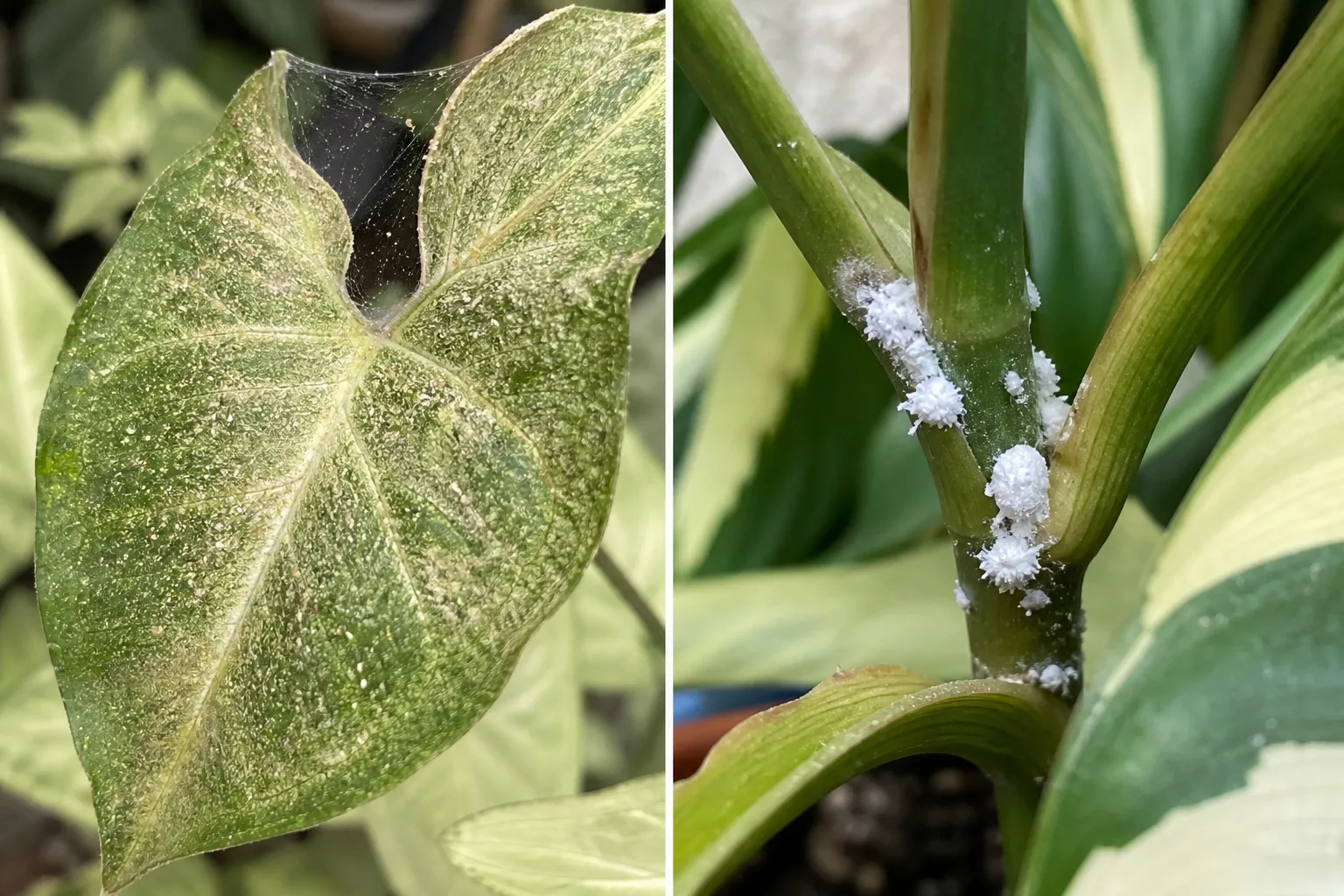
Spider mites and mealybugs look different when inspected closely. Mites can leave fine webbing and stippling, while mealybugs often have a white, waxy appearance around joints. A pale mark on its own does not establish either pest.
Magnification and inspection of leaf undersides help reveal mites. Mealybugs may hide where petioles join stems. Checking those areas is more informative than treating the most visible leaf without identifying what caused its damage.
Scale insects can resemble attached bumps. Soft scales may produce sticky honeydew, while armored scales do not. Fungus gnat adults around moist media are another observation, but they do not prove that larvae caused a mature plant’s decline.
Minnesota recommends physical cleaning with plain water where appropriate and warns that homemade soap mixtures can injure plants. A pesticide needs to be labeled for the plant, pest, and indoor setting. Repeat applications follow that label and observed activity rather than an automatic weekly course.
Separating newly acquired or infested plants reduces opportunities for spread. Inspection still matters because a fixed isolation period does not prove that all hidden pests have disappeared.
Pet Exposure and Outdoor Spread
The ASPCA lists Syngonium podophyllum as toxic to dogs, cats, and horses because of insoluble calcium oxalates. Listed signs include oral pain and irritation, swelling, drooling, and difficulty swallowing. Vomiting applies to dogs and cats, not horses.
Suspected ingestion calls for prompt veterinary or animal poison-service advice. The listing does not establish a harmless nibble or a predictable outcome. A high shelf or hanging basket only reduces access while animals cannot reach the foliage or fallen pieces.
Sap can cause contact irritation, so gloves are useful during pruning and propagation. Discarded cuttings also contain plant material that pets or children may reach. Keeping a cutting jar accessible creates a different exposure point from the original pot.
Outdoor planting needs a separate decision. UF/IFAS classifies Syngonium podophyllum as invasive with no recommended uses in Florida’s north, central, and south regions. A warm climate suitable for growth does not therefore make it a suitable landscape choice.
Pruning waste and rooted fragments belong in appropriate disposal rather than being dumped outdoors. Elsewhere, local invasive-plant guidance should inform outdoor use. A container alone does not prove that a trailing or discarded stem cannot reach the ground and establish.
Sources & References
- NC State Extension: Syngonium podophyllum
- ASPCA: Arrow-Head Vine
- UF/IFAS Assessment: Syngonium podophyllum
- Purdue Extension HO-39: Indoor Plant Care
- University of Maryland Extension: Diagnose Indoor Plant Problems
- University of Maryland Extension: Root Rots of Indoor Plants
- University of Minnesota Extension: Managing Insects on Indoor Plants
Related Plants
Golden Pothos
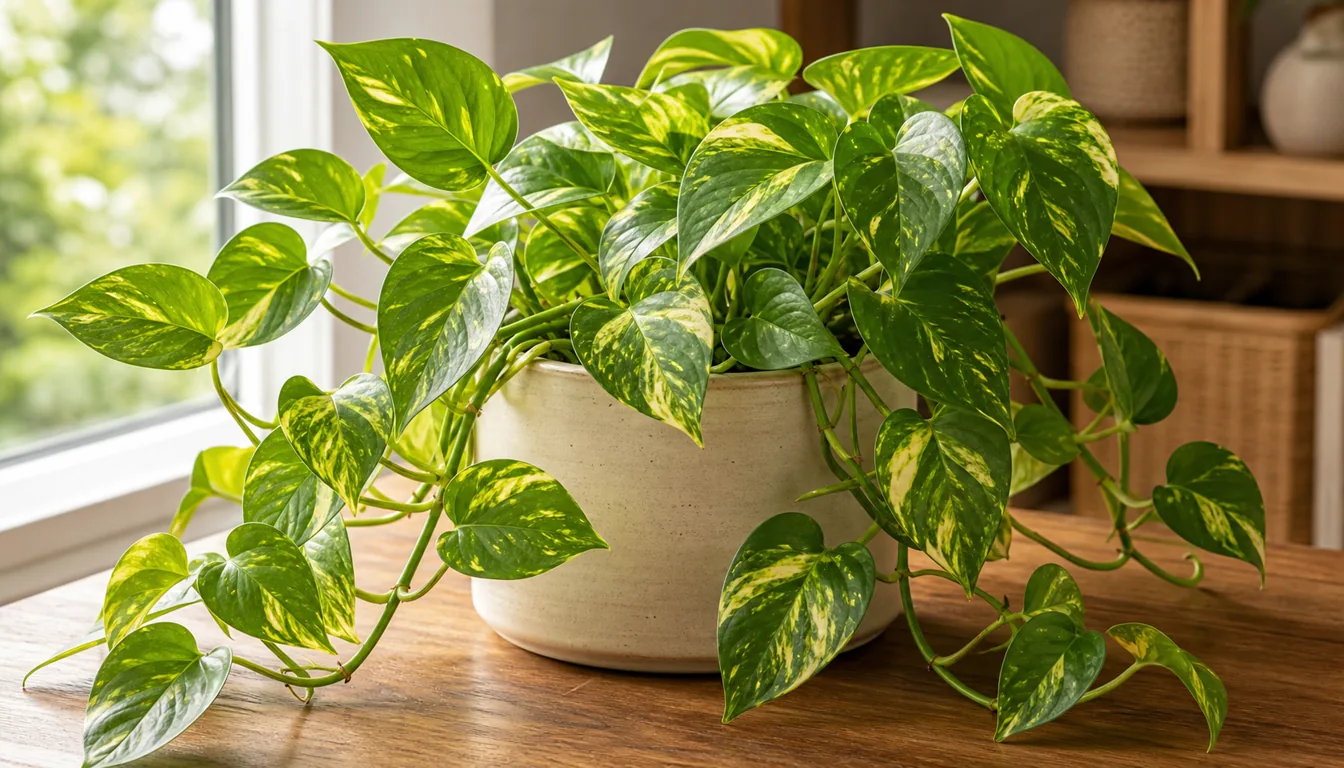
A separate climbing aroid with heart-shaped foliage and its own care and pet guidance.
Heartleaf Philodendron
Compare the form and support needs of another group of indoor aroids.
African Violet
African Violet is a windowsill bloomer that rewards steady, small-pot care.
Air Plant
Air plants are living sculptures that thrive without soil, anchoring to driftwood, rocks, or shells while drawing…
Alocasia
Alocasias include compact, textured houseplants and large elephant ears that need substantial floor space.
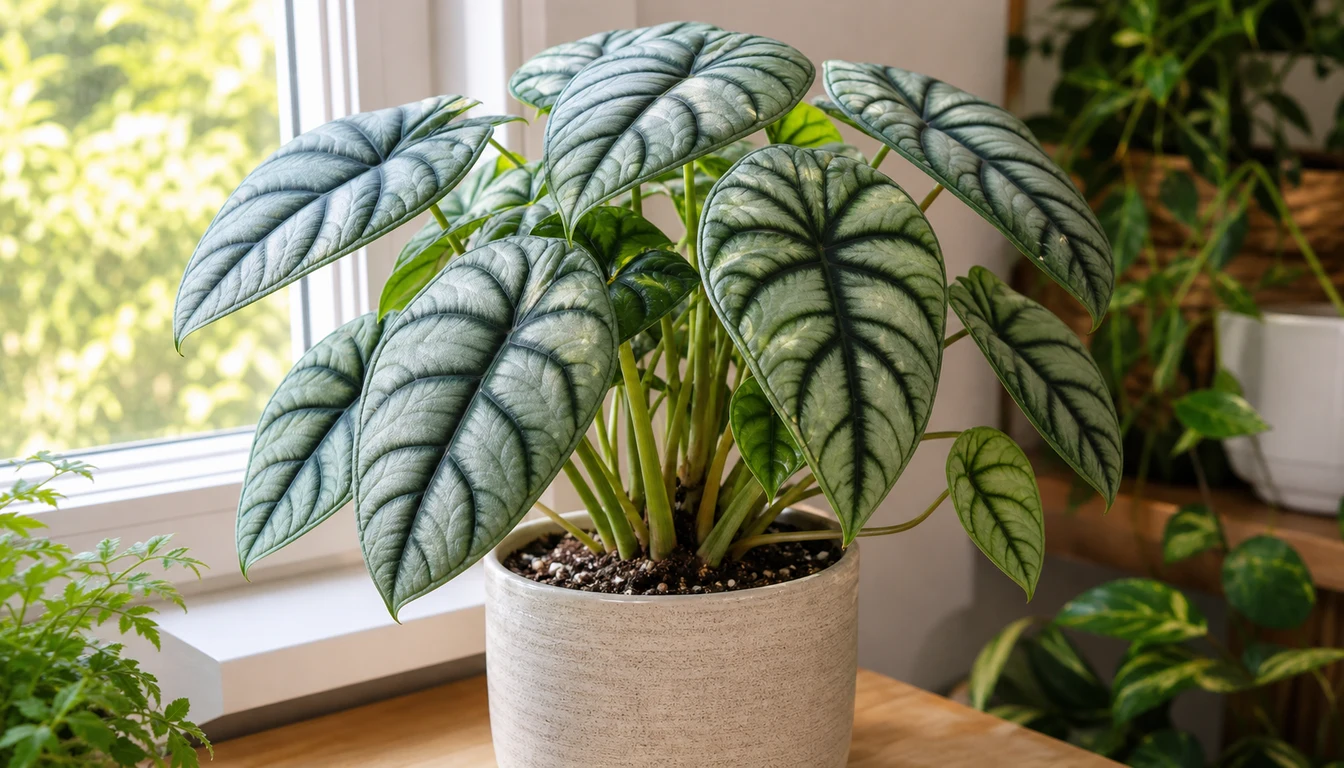
Alocasia Dragon Scale
Alocasia Dragon Scale has thick, quilted-looking leaves with dark veins.