
Cutting Back a Leggy Houseplant Does Not Fix It
Most people cut a houseplant back because it has gone long and bare. That plant is telling you about the light, and scissors do not add light.
A plant short of light stretches, goes pale greenish yellow and drops leaves. Put it back in the same corner after cutting and it stretches again from the new growth, because nothing about the cause changed.
Where a cut does work, it works through one mechanism. The bud at the tip of a stem makes a hormone that travels down and holds the buds below it dormant, so removing the tip releases them.
That single idea explains pinching, cutting above a node, and why a rubber plant behaves nothing like a pothos. This page starts with whether to cut, then covers where.
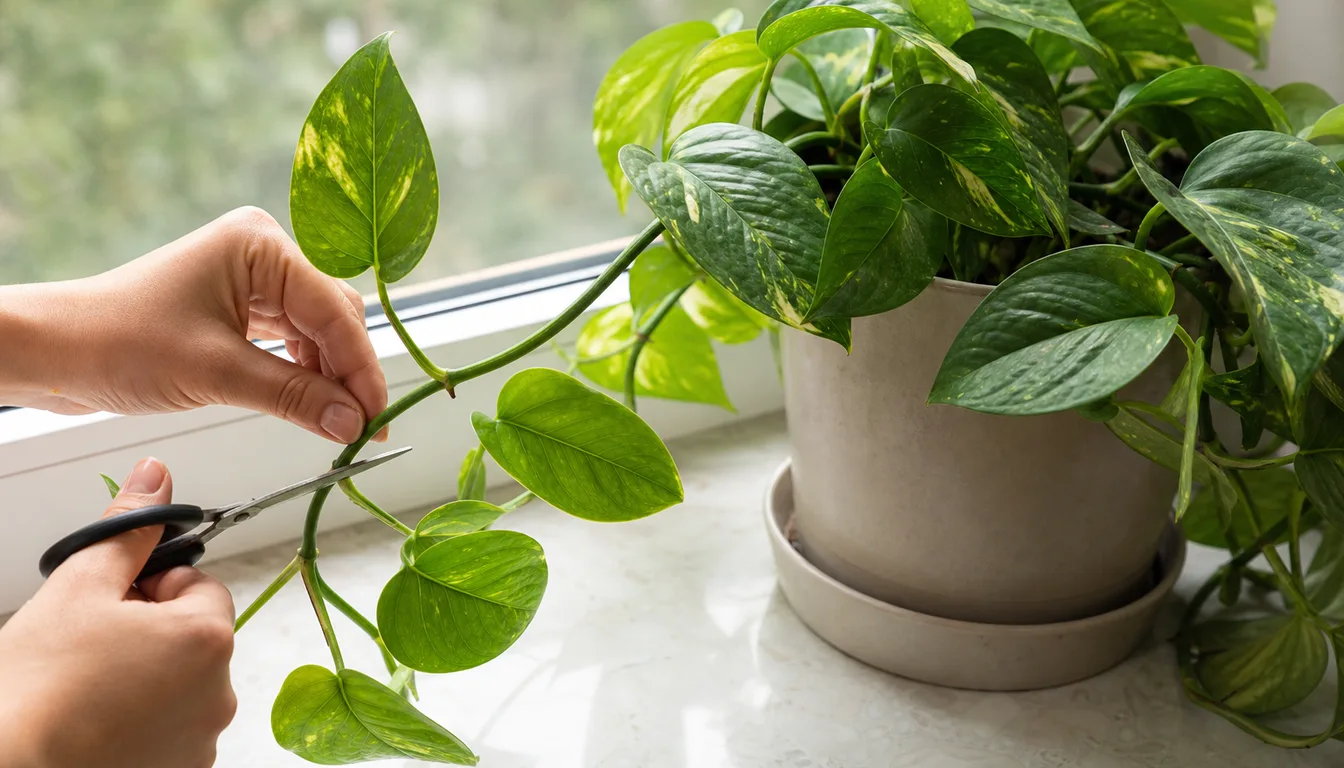
At a glance
Is Your Plant Leggy, or Just Short of Light?
Legginess is a measurement rather than an aesthetic complaint.
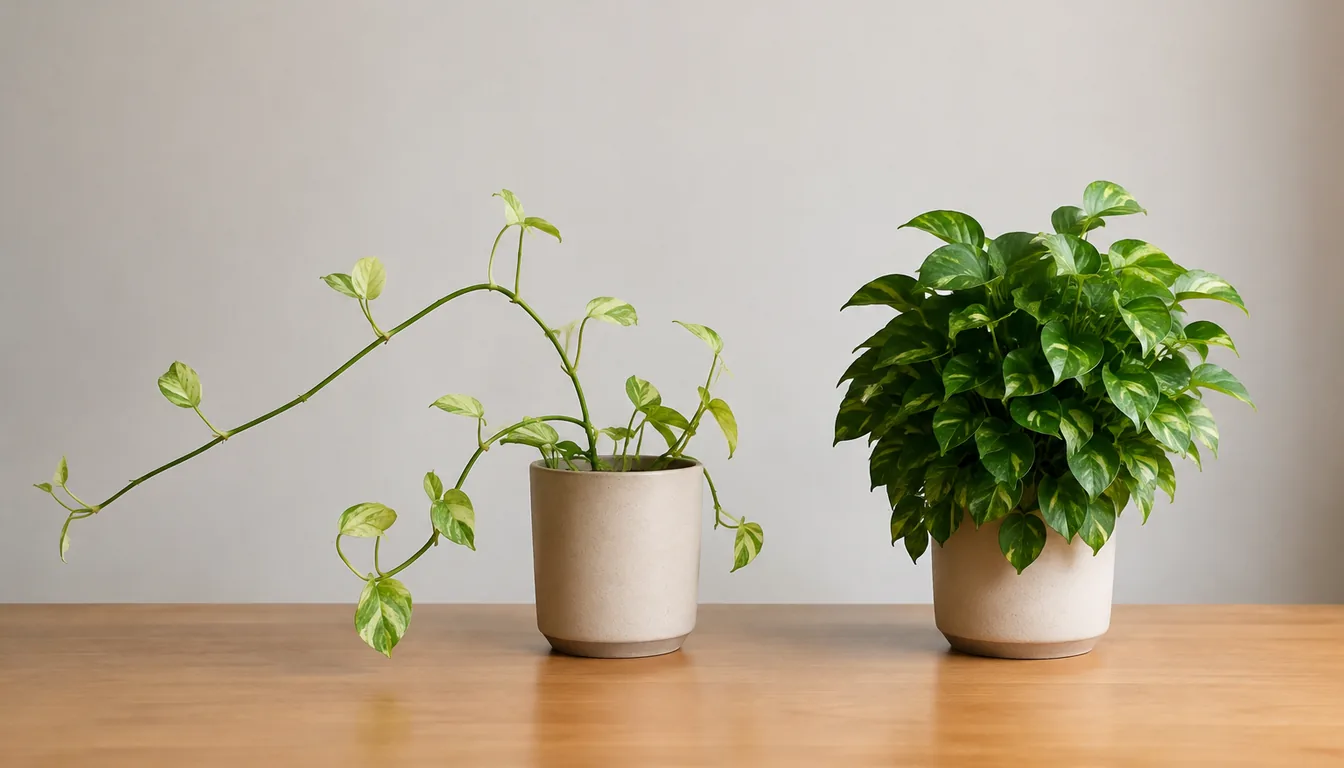
The distance between one leaf and the next along a stem is the plant's response to how much light it is getting. Short gaps and dense foliage mean it has enough, and long bare stretches between widely spaced pale leaves mean it does not.
A plant that needs more light stretches, turns a pale greenish yellow and may start dropping leaves. Those three arrive together and they are one message rather than three problems, which is worth knowing before you start treating any of them separately.
There are numbers behind it. Low light plants want between 50 and 250 foot-candles and medium light plants want 250 to 1,000, while a north window supplies roughly 75 and an east or west window about 150.
Ordinary lamps do not close that gap.
Plants grown under incandescent lighting stretch anyway, so a table lamp beside a plant is company rather than light.
Cutting back a stretched plant and returning it to the same position gives you a shorter stretched plant. Move it first, then cut for shape once the new growth is coming in tight.
| Position | Roughly | What it supports |
|---|---|---|
| North window | 75 foot-candles | Survival for low light plants, no dense growth |
| East or west window | 150 foot-candles | Low light plants properly, medium light plants marginally |
| Bright room, several feet back from a window | Under 250 foot-candles | The low light range only |
| Beside a bright south or west window | 250 foot-candles and up | Medium light plants, dense compact growth |
Why Does Cutting the Tip Make a Plant Fuller?
One hormone runs the whole thing.
The bud at the tip of a stem produces auxin, which moves downward through the shoot. That auxin inhibits the buds lower down, which is why a long stem can carry a dormant bud at every leaf without any of them ever growing.
The effect has a name, apical dominance, and it is why a plant left alone gets longer rather than fuller. The tip keeps the rest of the stem quiet, and it goes on doing that for as long as it is there, which on a houseplant can be years.
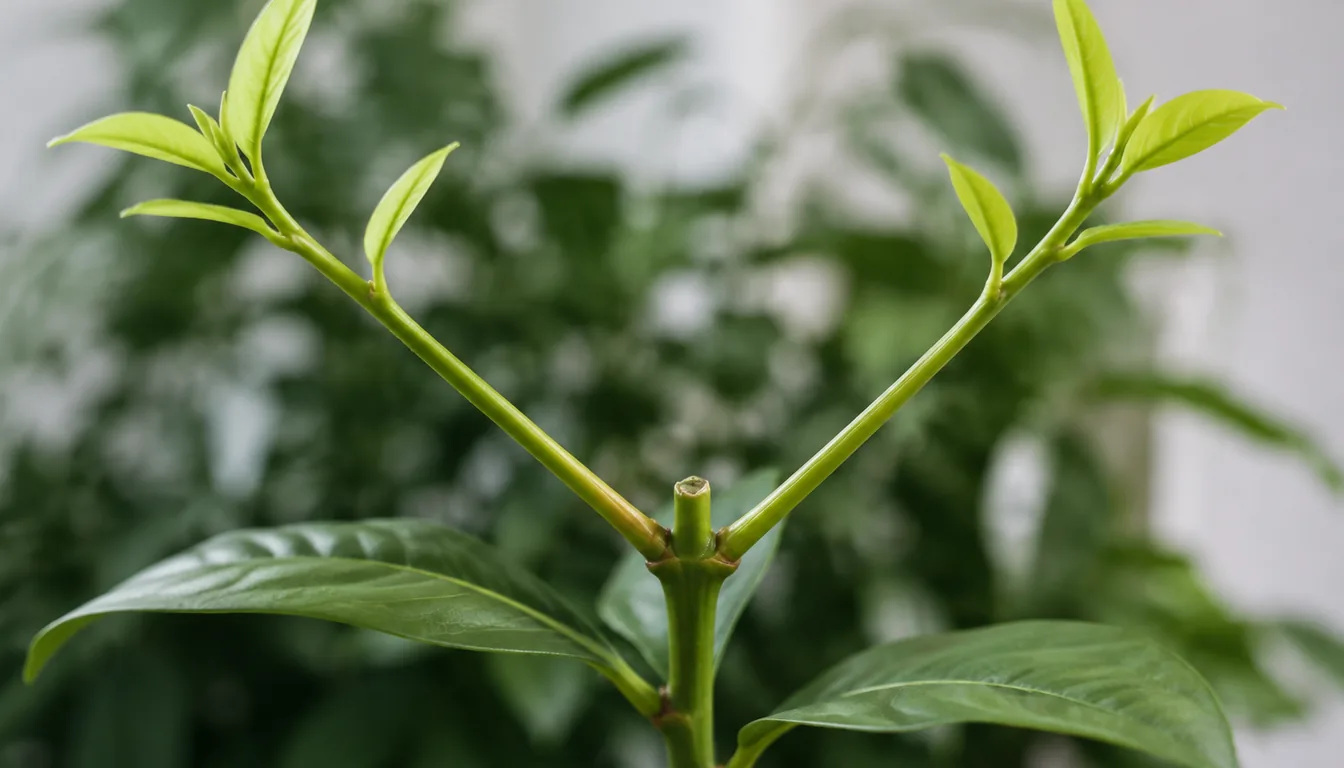
Removing the apex temporarily destroys that dominance and stimulates the lower buds into shoots. Take one tip and you usually get two.
It does not last. Whichever new shoot takes the lead starts producing auxin of its own and reimposes the same suppression, which is why pinching is something done repeatedly rather than once.
Where Exactly Does the Cut Go?
Everything is measured from the node.
A node is the joint where a leaf stalk meets the stem, usually visible as a slight swelling. It holds the dormant buds that the cut is meant to release, and on many trailing plants it carries a small aerial root as well.
The cut goes just beyond a node, on the side away from the base of the plant. That leaves the node and its buds on the plant, which is the whole point of the exercise.
Cutting in the bare stretch between two nodes leaves a stub with nothing in it. There is no bud in that section, so the stub dies back to the node below and looks untidy for weeks while it does.
Pinching is the same cut without tools. Removing the growing tip and about 2 to 3 inches of soft growth with a fingernail works while the tissue is still fleshy.
Anything firmer than that wants clean scissors. A crushed stem end takes longer to seal and gives rot a better way in, so the difference between a cut and a tear is worth the trip to the drawer.
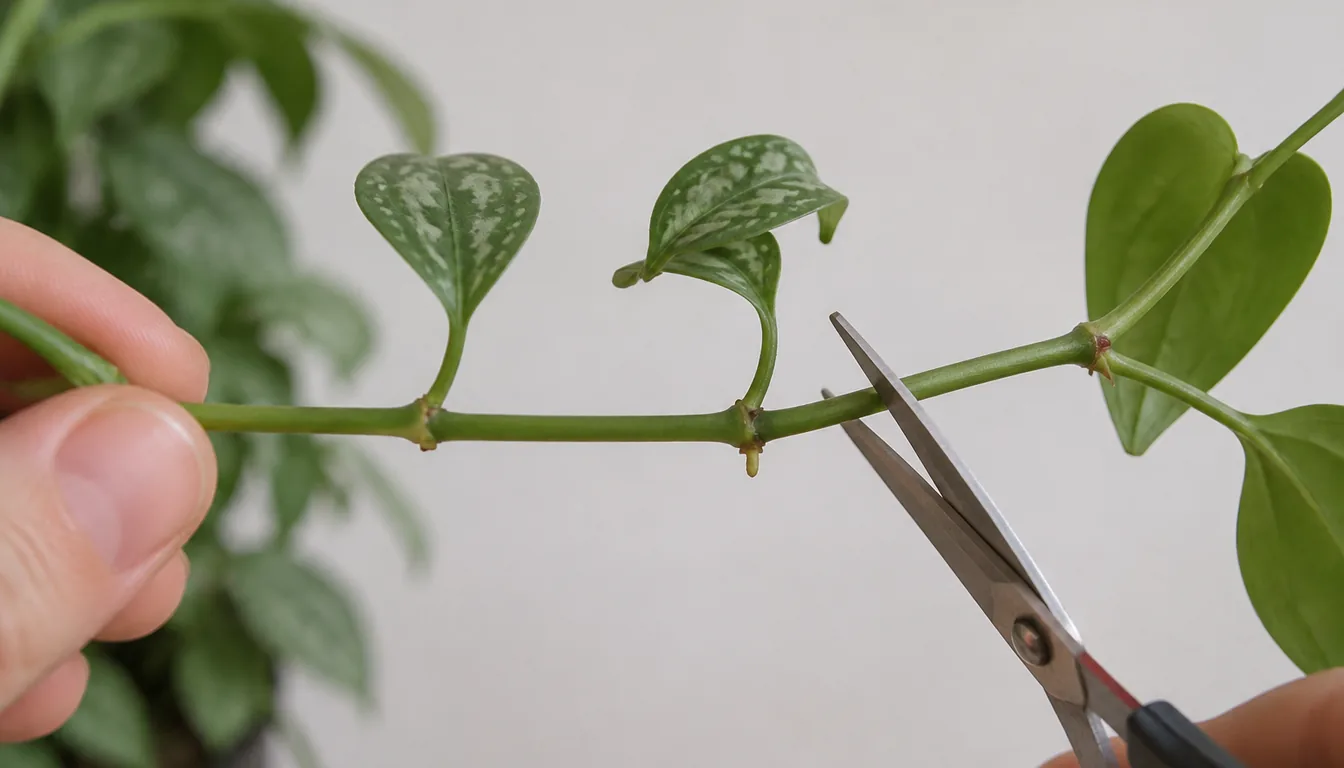
- Find a nodeRun your fingers along the stem to the joint where a leaf comes off, which is slightly swollen and often carries a small root bump.
- Decide the lengthChoose the node you want the new growth to come from, not the length of stem you want to remove.
- Cut just past itPlace the blades a short distance beyond that node, on the far side from the pot, and cut cleanly.
- Keep the pieceSet the offcut aside rather than binning it, since it has nodes on it and will root.
How Do You Cut a Vine, a Clump and a Single-Stem Plant?
Habit decides where the buds are, and the buds decide where the cut belongs.
A trailing vine such as a pothos carries a node at every leaf, so it can branch anywhere along its length. Cutting a long bare runner back to a node near the pot fills the crown, while trimming the tip only makes the end of that one runner bushier.
Clump-forming plants and rosettes have no stem to cut into.
The work there is removing whole leaves or whole stems right at the base. There is no branching response to be had, since all the growth comes from the crown rather than from buds along a stem.
Single-stem plants are the ones to think about before cutting. A rubber plant or a dracaena branches only where the stem is cut, and it will not put out a shoot lower down on its own.
That makes the cut on a single-stem plant a decision about its final shape rather than a tidy-up. Cut it at chest height and it branches at chest height, permanently, so the height is worth thinking about for a day before the blades come out.
Trailing vines
Nodes all along the stem, so the plant can branch anywhere. Cut long bare runners back to a node near the pot to thicken the crown, and pinch the tips of the shorter ones to keep them branching.
Clumps and rosettes
No stem to cut into and no branching response. Remove whole leaves or whole stems right at the base, and use division rather than pruning when the plant outgrows its space.
Single-stem plants
They branch only at the cut and never below it. Choose the height you want the head to start at, cut there once, and accept that the decision is permanent.
When Should You Prune Indoors, and How Much?
The plant has to be able to answer the cut.
Pruning belongs in the active growing season, when there is enough light and warmth for the plant to put out the replacement growth the cut is asking for.
Winter indoors is the wrong half of the year.
Light drops, growth slows to almost nothing, and a hard cut in December sits on a plant that will not respond to it until March. The wound is open for that whole period and the gap in the plant stays a gap.
About a quarter of the foliage is a sensible ceiling in one session on a healthy plant. Beyond that you are removing more of the plant's ability to feed itself than it can spare while regrowing.
Take less from a plant already under pressure. Anything recently repotted, recovering from root loss or fighting a pest problem has nothing spare.
Dead, damaged and diseased material is outside all of this. It comes off whenever you see it, in any season, and it does not count against the quarter.
- Best season
- Spring and summer, while the plant is growing
- Ceiling in one session
- About a quarter of the foliage
- Weak or recovering plants
- Less, or nothing until they have rebuilt
- Dead and damaged growth
- Any time, and it does not count toward the quarter
Can You Root What You Cut Off?
Most of what comes off a houseplant is a plant.
A cutting roots from a node, which is the same joint the cut was measured from. That is why the node matters twice, once for where the parent branches and once for where the offcut roots.
Strip the lowest leaves so that at least one bare node sits below the water line or under the mix. Leaves left below that line rot, and the rot spreads up into the stem before anything has had time to root.
Vines and soft-stemmed plants are easy. Many will root in a glass of water on a windowsill within a few weeks, and the roots are visible while it happens, which is half the appeal.
Water roots are not soil roots, though. They are structurally different, so a cutting rooted in water sulks for a while after potting and sometimes has to grow a second set before it moves again.
Rooting straight into damp mix skips that step entirely.
Some plants cannot be done this way at all. Anything growing from a single crown or a rosette has no stem with nodes on it, so those are divided rather than propagated from cuttings.
- Choose the pieceTake a healthy offcut with at least two or three nodes on it and no flowers or buds.
- Strip the bottomRemove the leaves from the lowest node or two, so at least one bare node will sit below the surface.
- Set it goingStand it in clean water changed weekly, or push it into damp mix and keep the mix from drying out.
- Pot it onMove it into mix once roots are an inch or two long, and expect a slow few weeks while it adjusts.
When Is Cutting the Wrong Answer?
Four situations where the scissors make things worse or make no difference.
Legginess is the big one, and it is the reason most people arrive here. A stretched plant in a dim room cut back in a dim room gives you a shorter stretched plant, and the light has to change first for anything else to.
Yellowing lower leaves over wet soil is a root problem. Removing them tidies the plant and does nothing about the cause, which the overwatering guide takes up.
A pest infestation travels on hands and blades.
Pruning through one carries it from stem to stem and onto the next plant you touch. Deal with the pest first, then prune once the plant is clean, and wash the blades in between.
A plant with damaged roots has nothing spare. Anything recently repotted or recovering from root loss needs its leaves to rebuild with, and cutting them off removes the tool it is using.
- If the plant is stretched, move it into better light before cutting anything
- If the lower leaves are yellowing over wet soil, check the roots rather than trimming
- If there are pests on it, treat them first so pruning does not spread them
- If it has just been repotted or lost roots, wait until it is growing again
Pro Tips
- Measure legginess by the gap between one leaf and the next, since that gap is the plant's light reading.
- Cut just beyond a node, because the bare stretch between nodes has no bud in it and dies back.
- Expect two shoots where you removed one tip, and repeat the pinch when the new leader takes over.
- Stop at about a quarter of the foliage in one session on a healthy plant.
- Keep the offcuts, since anything with two or three nodes on it is a new plant.
Frequently Asked Questions
Will pruning fix a leggy houseplant?
No, not on its own.
Legginess means the plant needs more light, so cutting it back and leaving it in the same place produces a shorter plant that stretches again.
Move it first, then cut for shape.
Why does pinching the tip make a plant bushier?
The bud at the tip produces auxin, which travels down the stem and keeps the buds below it dormant. Removing the tip temporarily ends that suppression and the lower buds grow out as shoots.
Where exactly should I cut a houseplant stem?
Just beyond a node, on the side away from the base, so the node and its buds stay on the plant. Cutting in the bare stretch between nodes leaves a stub with no bud in it, and it dies back.
How much can I take off at once?
About a quarter of the foliage on a healthy plant in the growing season. Take less from anything recently repotted or recovering, and remove dead or damaged growth whenever you see it.
When is the best time to prune houseplants?
Spring and summer, while the plant is actively growing and has the light to replace what came off. A hard cut in midwinter sits on a plant that cannot respond to it.
Can I root the pieces I cut off?
Usually.
Take a piece with two or three nodes, strip the lowest leaves so a bare node sits below the surface, and root it in water or damp mix.
Plants growing from a single crown or rosette have no nodes to root from and are divided instead.
Sources & References
- Basic Principles of Pruning Woody Plants, University of Georgia Extension
- Lighting Indoor Houseplants, University of Missouri Extension
- Lighting, Houseplants, University of Illinois Extension
- Lighting for indoor plants and starting seeds, University of Minnesota Extension
- Pruning Herbaceous Plants, Penn State Extension
Related Guides
Deadheading Daffodils Matters Less Than the Six Weeks After
Almost every page about spent daffodils tells you to remove the seed pod so the bulb is not…
11 min read
French Lavender Pruning Depends on the Plant and Season
French lavender needs light trimming within its leafy growth, rather than a hard cut into bare…
6 min read
Fruit Tree Pruning Starts With Where the Crop Forms
A fruit tree that gives small, crowded, scabby fruit is usually not underfed.
11 min read
How Deep Can You Cut a Spent Lavender Spike?
Deadheading lavender is the lightest cut you will ever make on the plant, and the one place people…
7 min read
How Do You Prune Spanish Lavender for a Second Flush?
Spanish lavender is the one that flowers first and the one that keeps going.
7 min read
How to Deadhead Daisies for More Blooms
To deadhead a daisy, wait until the petals have faded or collapsed, then follow the flower stem…
12 min read