
What's Oregano? How to Get One With Real Flavor
Origanum vulgare Lamiaceae
Two oregano plants of the same species can taste completely different, because seed-grown plants do not come true and a cutting copies a parent chosen for flavor. Beyond that the plant wants lean, sharply drained ground in full sun, a harvest cut counted in leaf pairs, and a winter mulch applied after the soil has frozen rather than before.
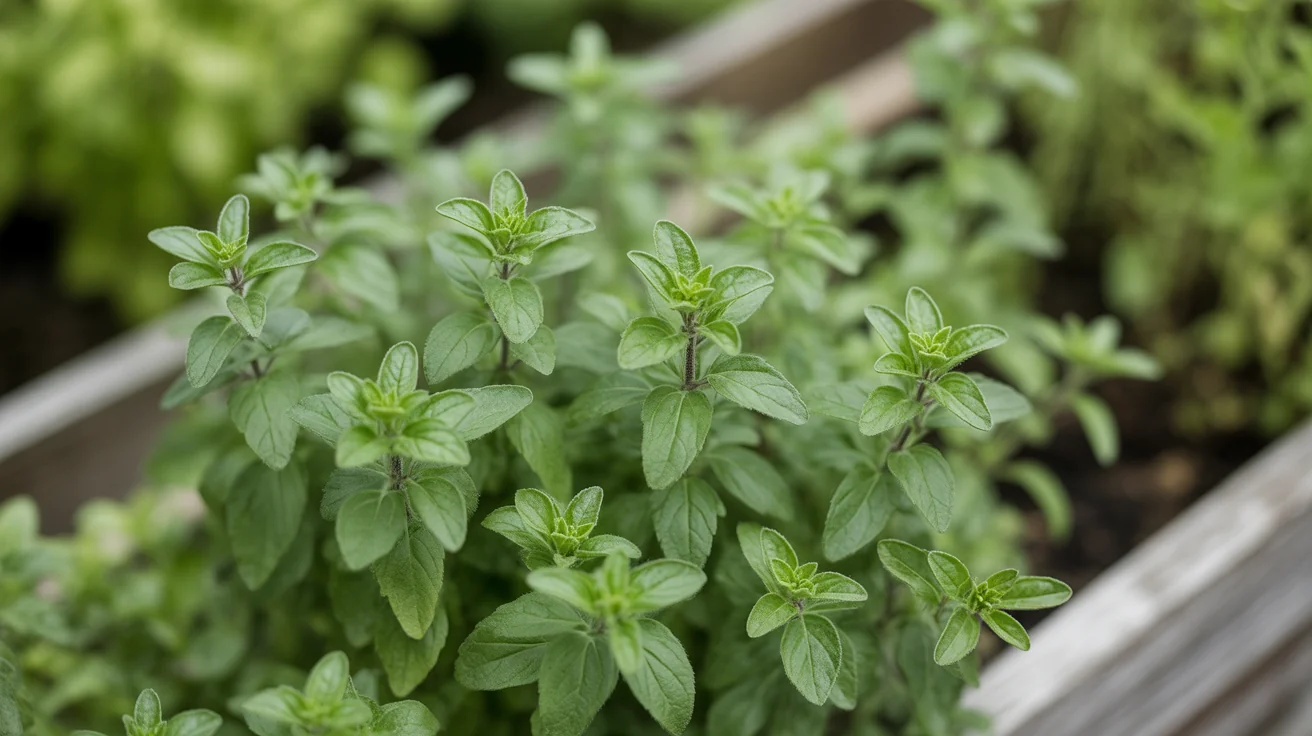
Care snapshot
Why Does Some Oregano Taste of Nothing?
Two oregano plants of the same species can taste completely different.
One fills a kitchen with scent from a single crushed leaf, and the other tastes of almost nothing.
The difference is decided long before the plant reaches the shop.
Illinois Extension gives the reason plainly.
Seed-propagated plants often do not come true from seed, which makes a tray of oregano seedlings a lottery. Its advice is to obtain plants grown from cuttings, and those cuttings are taken from plants with high flavor quality.
The plant a cook means has two published names.
Illinois calls true Greek oregano Origanum vulgare var. hirtum.
Clemson gives what is effectively the same plant as Origanum heracleoticum and describes it as highly prized for its sharp, biting oregano taste. Either name on a label is a good sign.
Marjoram is the near miss. Illinois calls common marjoram inferior for use as a culinary herb, and it sits on the same bench under labels that do not always make the difference obvious.
Maryland Extension gives the sensory version of that comparison, calling oregano coarser than sweet marjoram and saying it smells more like thyme. That is a useful thing to carry to a nursery bench, because it says what the right plant should smell of rather than only what the wrong one is called.
- Crush a leaf and smell it before buying, because that is the only reliable test available on a nursery bench.
- Look for a label naming Greek oregano, Origanum vulgare var. hirtum, or Origanum heracleoticum.
- Prefer a plant grown from cuttings over one raised from a seed tray, since a cutting copies a parent that was chosen for its flavor.
- Treat a plant labeled only oregano as unknown until you have smelled it.
None of this shows in a photograph, which is why those checks use your nose rather than your eyes. Thyme and sage are more forgiving, because a plant of the right species there is reliably the right plant.
That is worth knowing before a first herb bed goes in. Among the essential kitchen herbs this is the one where buying the right species is not enough on its own.
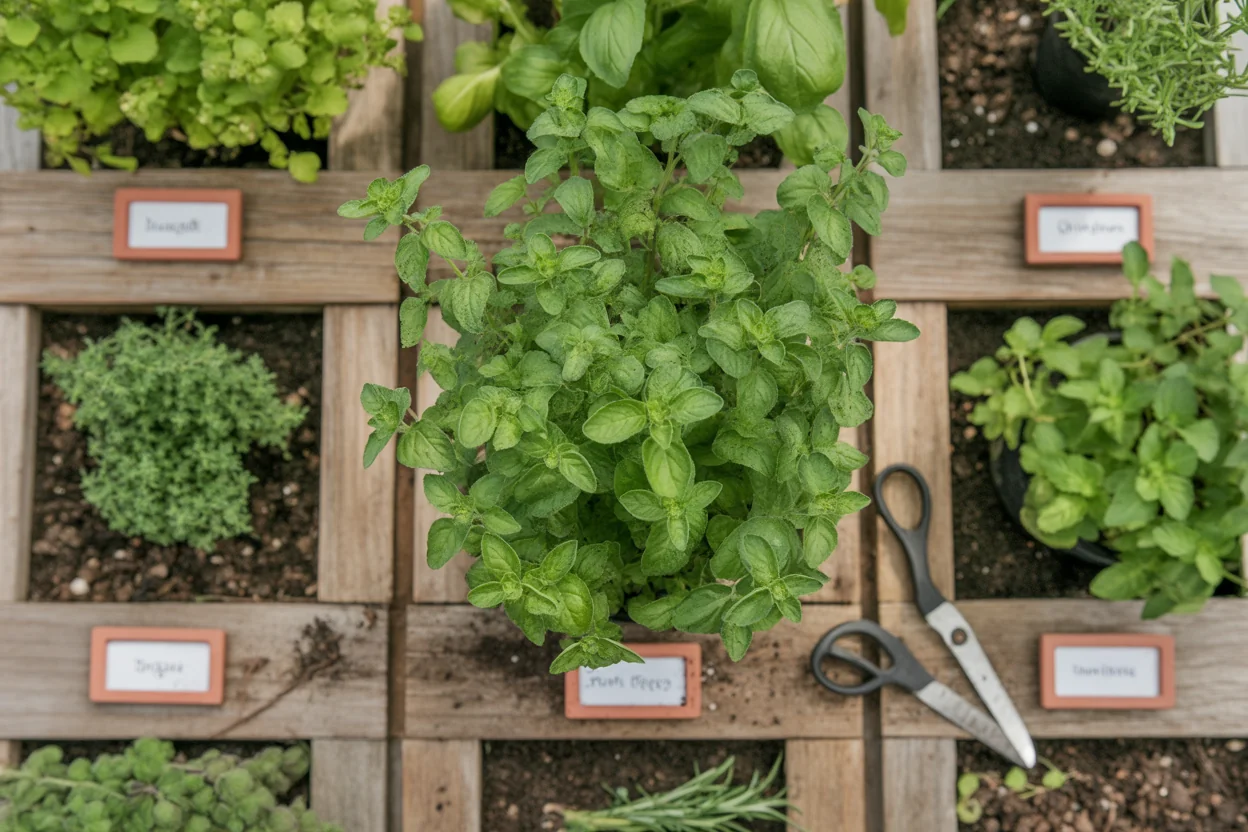
Where Should Oregano Be Planted?
Illinois Extension is direct about the light.
Oregano must be planted in a full sun location, and good drainage is required for best growth and overwintering.
NC State adds one exception, which is that golden and variegated forms benefit from partial shade during peak heat.
The soil runs against instinct.
NC State lists clay, loam or sand as all workable, with good drainage and dry to medium moisture, and Maryland says plainly that oregano grows well in poor soil.
Enriching the ground works against this plant instead of for it.
- Light
- Full sun, with golden and variegated forms taking some shade in peak heat
- Soil
- Clay, loam or sand, lean rather than enriched
- Moisture
- Dry to medium, with good drainage throughout
- Mature size
- 1 to 3 feet tall and 1 to 2 feet wide, up to 2 feet by Maryland's figure
- Spacing
- Thinned to 10 to 12 inches apart
- Hardiness
- USDA Zones 4a to 8b
The site that kills oregano is the one that stays wet.
NC State names root rot as occurring in wet, poorly drained soils, and nothing done afterwards undoes a bad choice of spot.
Raising the planting area or moving to a slope has to happen before the plant goes in.
Maryland puts the spacing at 10 to 12 inches between plants, which is closer than the 1 to 2 foot spread in the specification suggests. The two figures answer different questions, since one is how far apart to thin a row and the other is how much ground a mature plant eventually covers.
Give it that width if the plant is meant to stay. One plant covers 1 to 2 feet across, which is more ground than the pot it comes home in suggests.
How Dry Can Oregano Be Kept?
Oregano is a dry-ground plant.
NC State rates it as suited to occasionally dry conditions and puts its moisture preference at dry to medium.
The failure it names is root rot in wet, poorly drained soils.
Watering it the way a leafy herb is watered produces exactly that.
The right interval changes with the weather, so a check beats a schedule.
An established plant in well-drained ground rarely needs watering at all.
Oregano belongs with the drought-tolerant plants that repay a hot, poor corner nothing else wants.
How Do You Get Oregano Through Winter?
NC State gives oregano USDA Zones 4a to 8b, which covers most of the country. That number is only half the answer.
Illinois ties overwintering to drainage rather than to cold, saying good drainage is required for best growth and overwintering.
A plant that sails through January in gritty ground can still die in February in a bed that holds meltwater.
Fixing that is an autumn job rather than a spring one.
- Plant on a slope or a raised bed, because Illinois ties overwintering to drainage as much as to cold.
- Wait until the soil has frozen before mulching, which Illinois puts at November or December.
- Use evergreen boughs or straw rather than a dense material that holds moisture against the crown.
- Check that the spot drains before winter rather than after, since root rot in wet ground is the failure NC State names.
The mulch timing is the part people get wrong. Illinois says to apply a winter mulch of evergreen boughs or straw in November or December, after the soil has frozen, which is later than it sounds.
How Much Oregano Can You Cut at Once?
Illinois gives the harvest cut as a count rather than a length.
Remove the stem tips, leaving 4 to 6 pairs of leaves on the plant. Those remaining pairs are what the plant regrows from.
Iowa State gives the same limit as a proportion, taking no more than about one-third of the top growth of a perennial at a time. Two sources measuring the same restraint differently is a good sign that the restraint is the point.
That makes harvesting and pruning the same job. Taking tips is what keeps an oregano plant dense, instead of letting it stretch and open out in the middle.
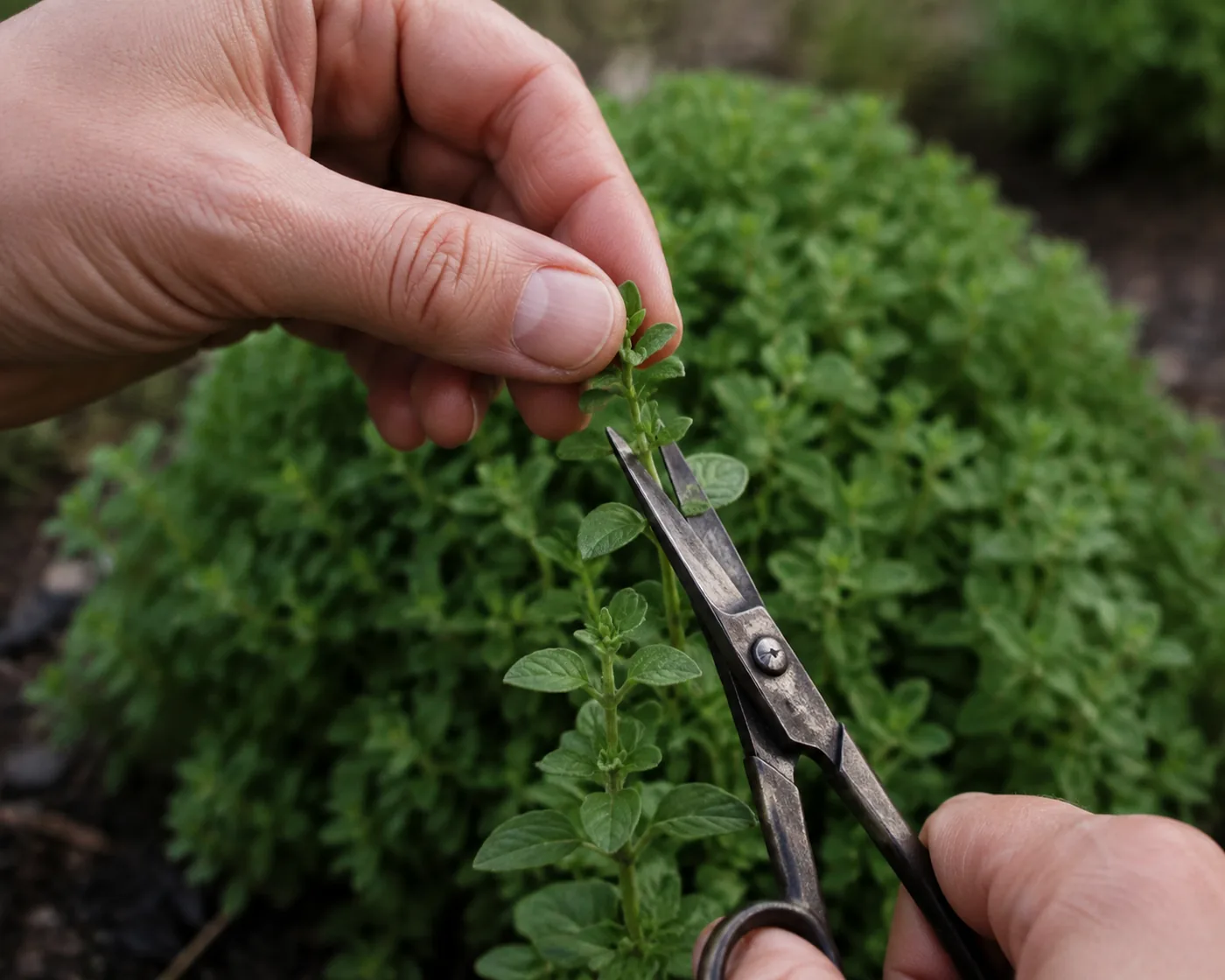
When you cut decides how much flavor comes with it. Iowa State harvests just as flower buds appear but before they open, which is when volatile oil levels are highest, and cuts in the early morning after the dew has dried and before temperatures rise.
That gives a season with two peaks rather than a running trickle. Iowa State puts the main oregano harvest in early July, with a second harvest often possible in September once the plant has rebuilt.
Cutting the flowers is not a loss either way. Maryland says cutting back the flowers stimulates foliage, so the harvest that takes the most flavor is also the one that keeps the plant producing leaves.
There is one reason to let some of it bloom. Oregano flowers are worked heavily by bees and small wasps, so a plant left in flower at the back of a bed does the job pollinator plantings are grown for, while the plants in front stay cut.
The herb pruning guide covers how this cut compares with the ones the woody herbs need.
How Should Oregano Be Dried?
Drying matters more for oregano than for most herbs. Clemson notes that, unlike most herbs, the leaves are best used dried, which turns preserving from an overflow measure into part of growing the plant at all.
The slow method is the one Illinois gives. Hang the cut stems in a cool, dry, dark, well-ventilated location, and Iowa State supplies the numbers behind it, drying at 70 to 80 degrees over 2 to 4 weeks.
- Air drying at 70 to 80 degrees, taking 2 to 4 weeks depending on humidity.
- Oven drying at no more than 180 degrees for 3 to 4 hours, with the oven door slightly open.
- Microwave drying for 1 to 3 minutes, turning stems or stirring leaves every 30 seconds.
The two fast methods trade something for the time they save. Volatile oils are what the leaf is being kept for, and heat drives them off, which is why the oven figure is a ceiling of 180 degrees rather than a target.
The open oven door is not a detail to skip. It lets moisture leave instead of sitting around the leaves, and a closed oven at the same setting steams them.
Once dry the leaves come off the stems easily. Whole leaves keep their flavor longer than crushed ones, so the crumbling is best left until the moment the oregano is used.
How Do You Make More Oregano, and When Do You Have To?
A cutting copies the plant it came from, and seed does not. That is the whole argument for propagating oregano rather than sowing it.
Illinois says cuttings are taken from plants with high flavor quality, which is a choice no seed packet lets you make.
- A cutting taken from a plant you have already smelled gives the same flavor, and is usable the season after it roots.
- Division splits an established clump, and copies the parent the same way a cutting does.
- Seed gives an unpredictable flavor and, Illinois notes, may take several years to produce a harvestable plant.
The time cost points the same way as the flavor does. Several years against one season is not a close comparison for anyone who wants oregano to cook with.
Anyone sowing anyway needs one detail.
Illinois says to place seeds on top of the growing media and press them into the surface, because light is needed for germination.
Covering them is the usual way a tray comes to nothing.
The reason this section matters even to someone happy with their plant is that the plant will not last. Maryland says to replant when plants become woody in 3 to 4 years, which makes propagation a maintenance job rather than an expansion one.
Rooted cuttings also solve the problem the first section set out, since a plant with good flavor can be multiplied instead of hunted for again. It is the same argument that makes rosemary cuttings worth the trouble.
What Goes Wrong With Oregano, and Is It Safe Around Pets?
Most oregano failures trace to the soil rather than to anything living.
NC State names root rot as occurring in wet, poorly drained soils, and that is the first thing to rule out on a plant that is thinning, yellowing or slowly giving up.
From above, the causes look alike.
The way to tell is to lift the plant. Healthy oregano roots are pale and densely fibrous, while rotted ones are dark, soft and collapsed, with the darkening running up into the base of the stems.
That check takes a minute and settles the question. A plant with a clean root ball has a different problem, and the list below covers the rest.
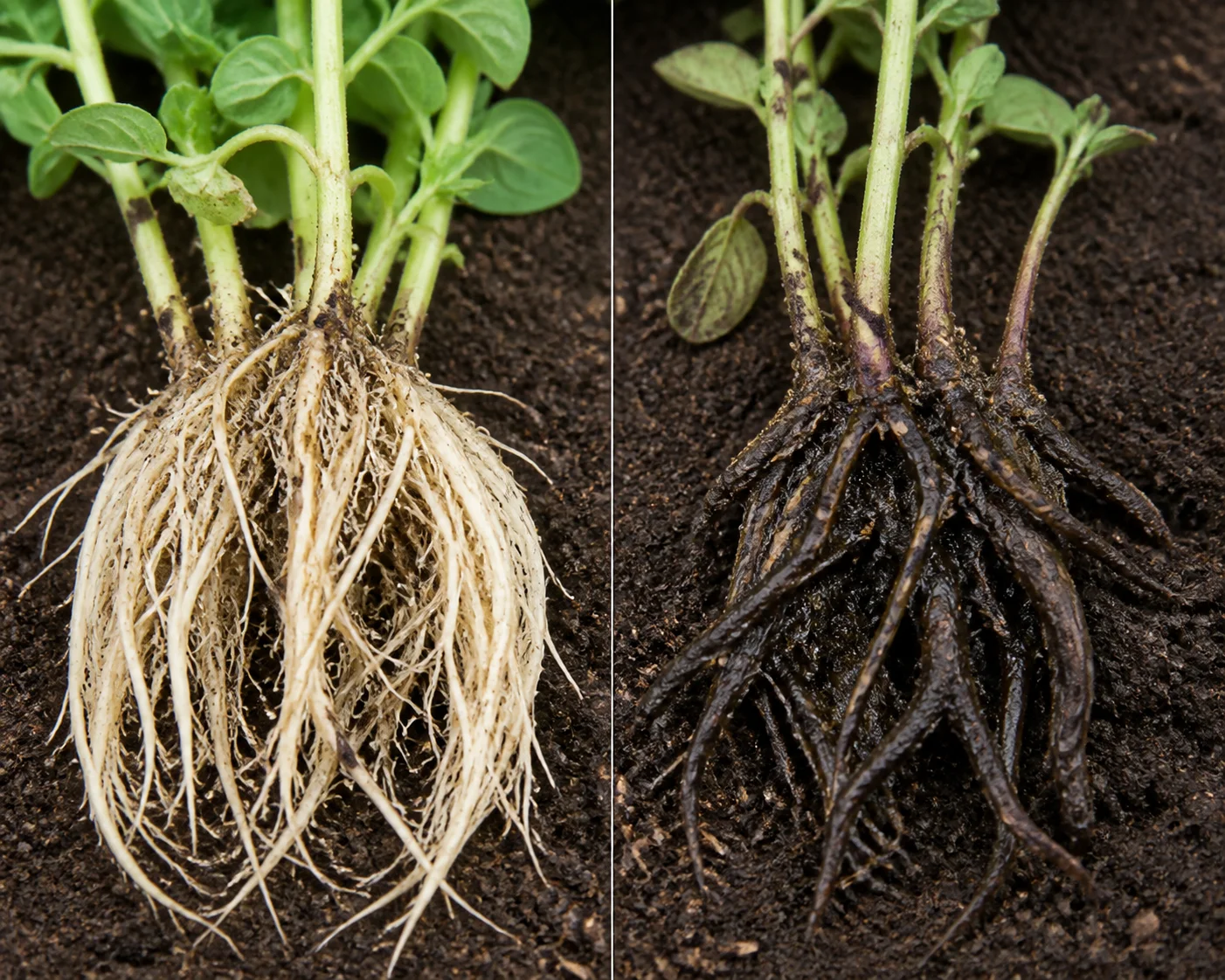
- Root rot follows soil that stays wet, and the answer is drainage rather than any treatment.
- Fungal disease builds where air sits still around a crowded plant, which spacing and cutting both help.
- Aphids cluster visibly on soft new growth, and leaf miners leave pale winding trails inside the leaf.
- Spider mites leave fine stippling and webbing, and build up in hot, dry, still air.
The pests NC State lists are the ordinary ones. Aphids, leaf miners and spider mites all turn up on oregano, and each leaves a mark distinctive enough to name.
What does not eat it is worth as much as what does. Oregano turns up on the rabbit-resistant lists and the deer-resistant ones alike, on the strength of the same oils the kitchen wants it for.
The pet question has a clear answer, and it is not the comfortable one. Oregano is a culinary herb, which readers reasonably read as safe around animals, and the ASPCA does not agree.
Frequently Asked Questions
Why does my oregano have no flavor?
Most likely it was grown from seed.
Illinois Extension says seed-propagated plants often do not come true from seed, so flavor varies plant to plant.
Replacing it with a cutting-grown plant you have smelled is the reliable fix.
What is the difference between oregano and Greek oregano?
Greek oregano is the one a cook means. Illinois names it Origanum vulgare var. hirtum and calls it true oregano with excellent flavor, and Clemson gives the same plant as Origanum heracleoticum, prized for a sharp, biting taste.
How much oregano can I cut at once?
Illinois gives the limit as leaving 4 to 6 pairs of leaves on the plant after removing a stem tip. That is what the plant regrows from, so cutting past it slows the recovery.
Is oregano safe for cats and dogs?
No.
The ASPCA classes Origanum vulgare hirtum as toxic to dogs, cats and horses.
The toxic principles are gastrointestinal irritants and the signs listed are mild vomiting and diarrhea.
Should oregano be used fresh or dried?
Dried.
Clemson notes that, unlike most herbs, oregano leaves are best used dried.
Illinois gives the method as hanging cut stems in a cool, dry, dark, well-ventilated place, then stripping the leaves and storing them sealed.
When should I mulch oregano for winter?
Later than most people expect. Illinois says to apply a winter mulch of evergreen boughs or straw in November or December, after the soil has frozen, and ties overwintering to good drainage as much as to cold.
Sources & References
Related Plants
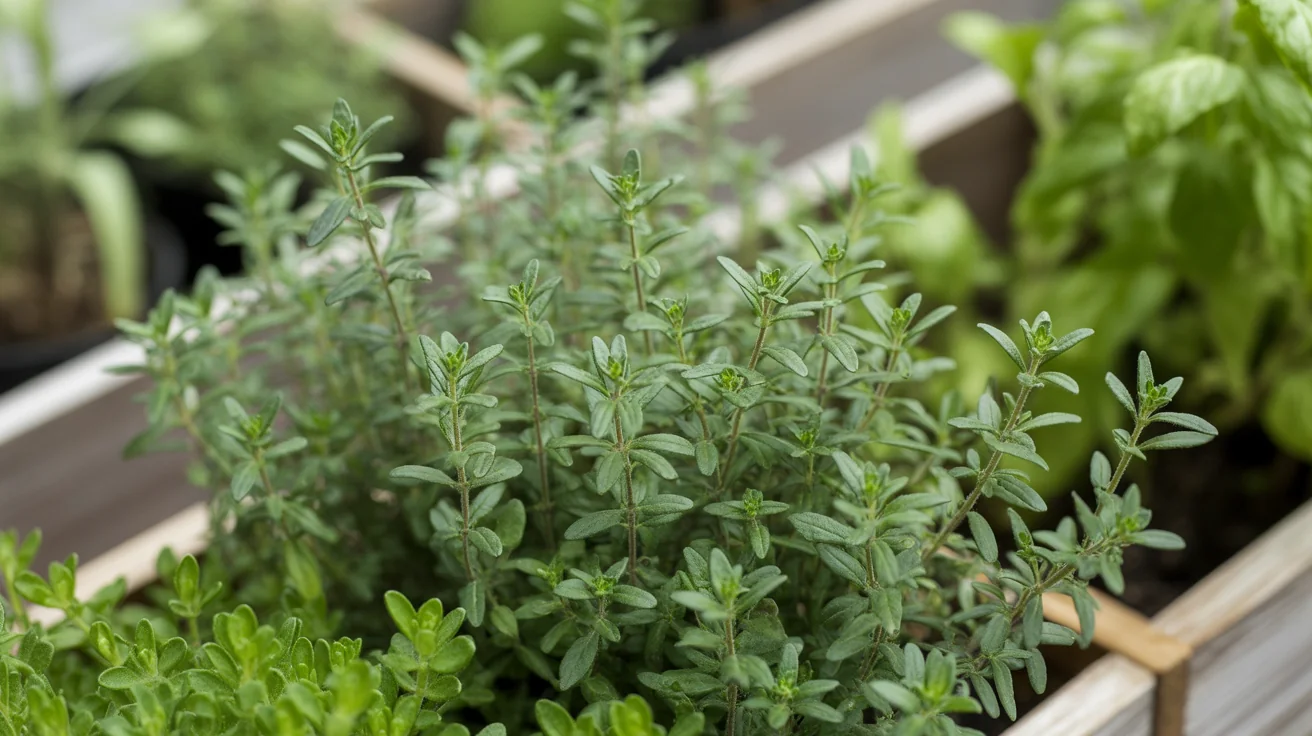
Thyme
Low, woody herb that likes the same sunny, dry conditions as oregano.
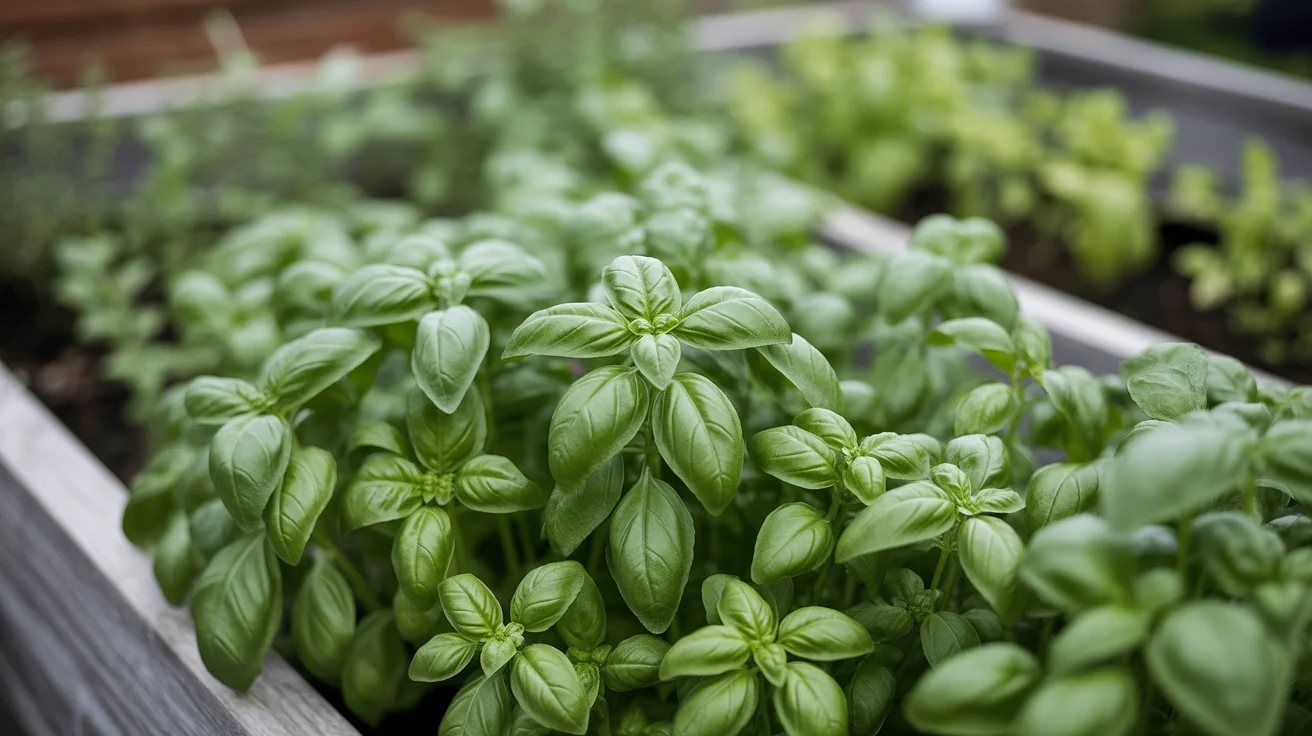
Basil
Tender annual herb for warmer soils, pairs with oregano in many dishes.
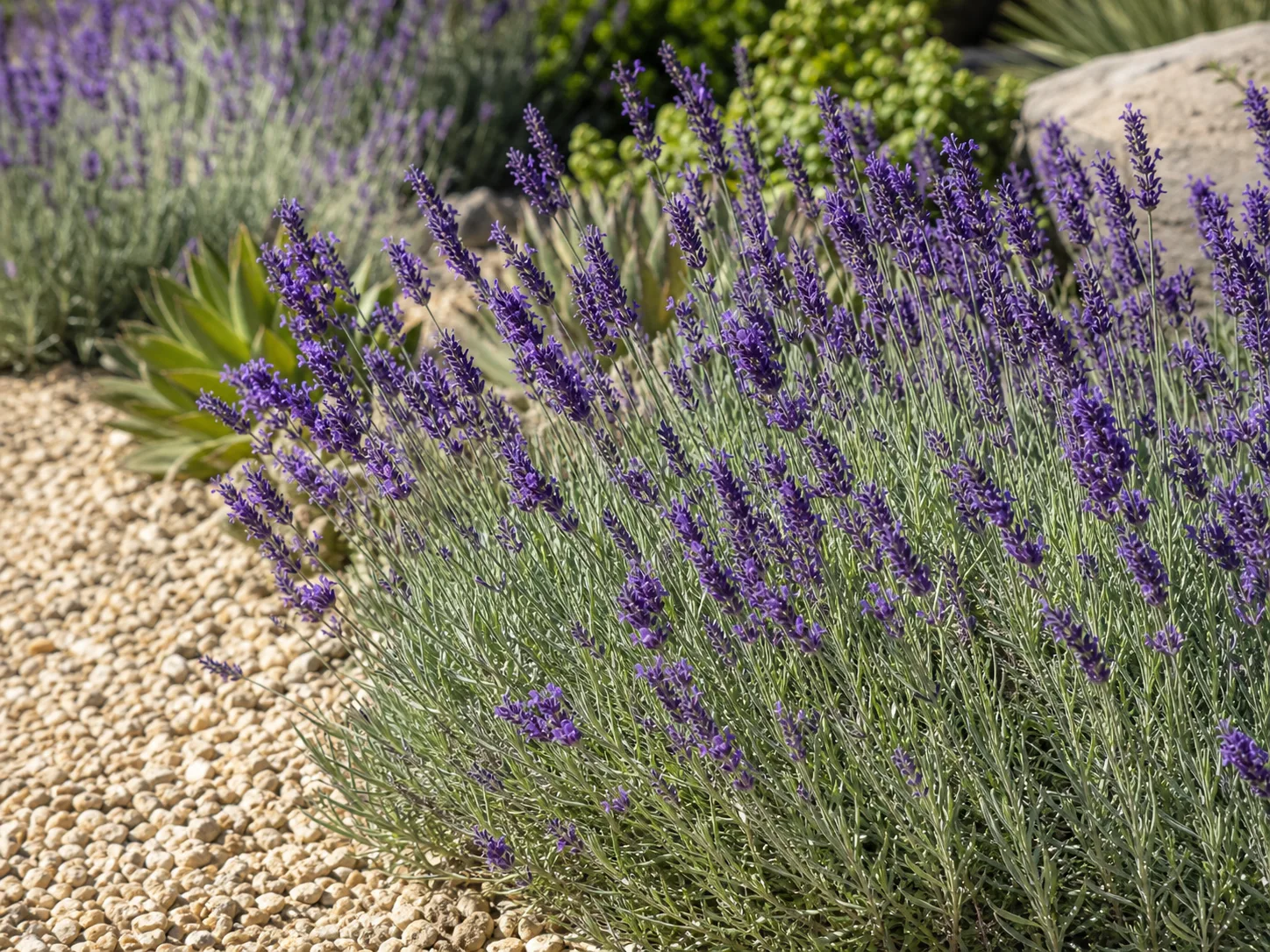
English Lavender
Woody Mediterranean perennial that thrives beside oregano in dry, sunny beds.
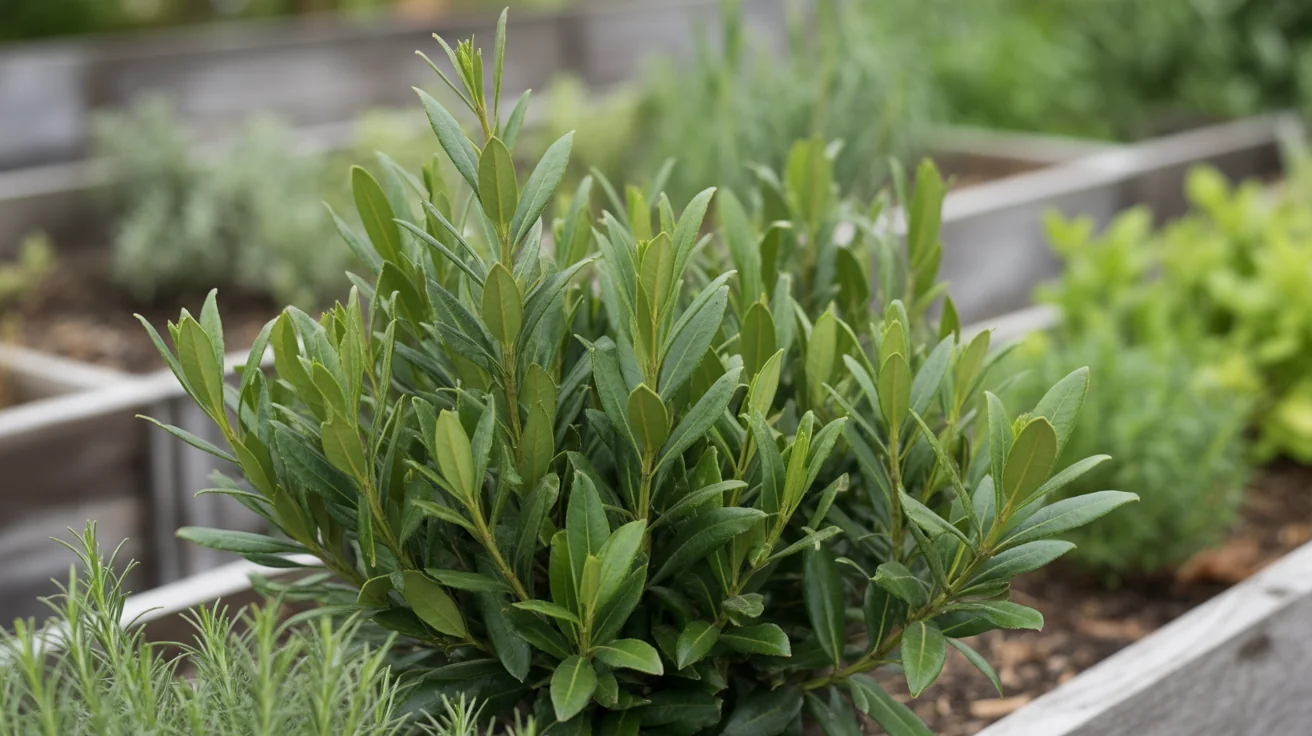
Bay Laurel
Bay laurel is a tree grown as a container plant, which is why every decision about it looks the way it does.
Chives
Chives are an Allium, in the same genus as onion and garlic, and that explains the flavor, the clump of small bulbs…
Cilantro
Cilantro and coriander are one plant at two stages, and the two crops need different spacing from the day the seed goes…