At a glance
- Best Season (Cool-Season Lawns)
- Late summer, mid-August to mid-September in Iowa and Massachusetts
- Best Season (Warm-Season Lawns)
- Bermudagrass seed once soil reaches about 65°F
- Typical Overseed Rate
- 3-4 lb per 1,000 sq ft for a sunny Kentucky bluegrass mix
- Germination Window
- 5-7 days for perennial ryegrass, up to 2 weeks for Kentucky bluegrass
- Watering Before Germination
- Light and frequent, from once to 3-4 times a day depending on the source
A warm-season lawn follows a different calendar, which the second section covers. State-by-state dates for cool-season lawns are in the Midwest timing guide and the Northeast timing guide.
When is the best time to overseed a cool-season lawn?
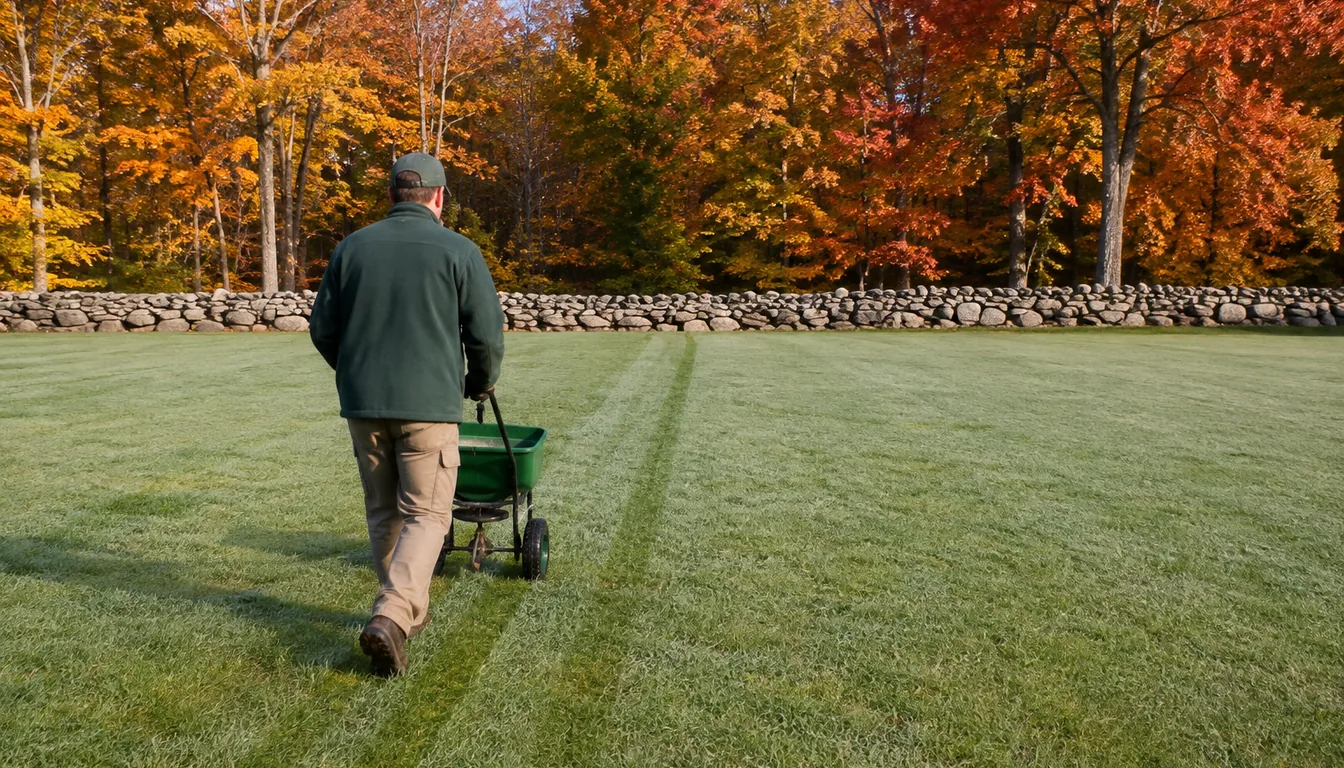
Cool-season seed does best in late summer because the soil is still warm, so the seed germinates quickly, and the seedlings get two to three months of favorable growing weather before winter stress. Fewer weed seeds germinate in late summer and fall, so the new grass has less competition. Extension in Iowa and in Massachusetts both give mid-August to mid-September, and Pennsylvania's calls late summer the best time for most of the state.
Spring is the second choice, because a spring seeding has to get through more weed competition, a long stretch of open soil while the ground warms, and summer stress on young seedlings. Early summer and summer plantings are best avoided altogether.
Dates move with climate, so use the ones your own state Extension publishes when they exist. The lawn care calendar shows how seeding fits with the rest of the year's lawn work.
Does a warm-season lawn follow the same plan?
Clemson Extension does not generally recommend overseeding a home lawn, and says it belongs only on bermudagrass if it is done at all, because the extra water, fertilizer and shade from the new seedlings can severely retard or damage centipedegrass, zoysiagrass and St. Augustinegrass in spring and early summer. A warm-season lawn therefore follows a different plan from the cool-season one.
On a bermudagrass lawn, ryegrass sown into the dormant grass gives green cover during the winter. In South Carolina, the timing below is generally a good fit. The light rate on an established lawn gives green cover without a thick ryegrass stand that causes transition problems in the spring.
- Timing
- About 30 days before the first frost
- Weather at that time
- Daytime highs near 70°F, nighttime lows usually above 50°F
- Upstate dates
- Early October
- Rate on an established lawn
- 5 pounds per 1,000 square feet
Ryegrass normally dies out in late spring. Seed that did not sprout can come up as big clumps the next year, so a lawn that has been overseeded once usually needs it again, or a fall pre-emergent herbicide to stop the leftover seed.
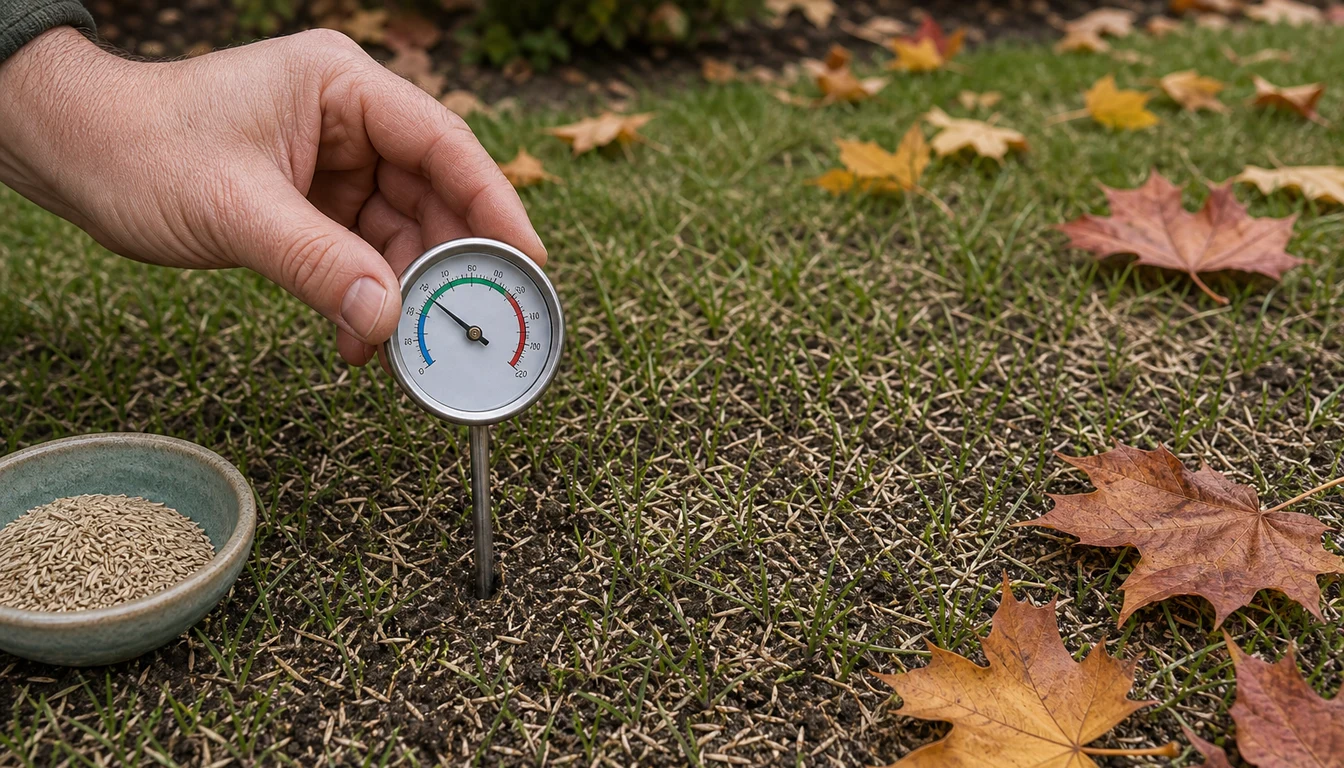
To thicken the bermudagrass itself with seed, wait for warm soil. Bermudagrass seed will not germinate until the soil reaches about 65°F, which makes May 1 through June 15 the best planting window in Oklahoma.
Is overseeding the right fix for this lawn?
Seed only helps once you know why the grass thinned, because seedlings meet the same problem the old grass did, and renovation gives only temporary improvement unless the original cause is fixed. Check the lawn against this list of common causes of turf decline.
- Drought
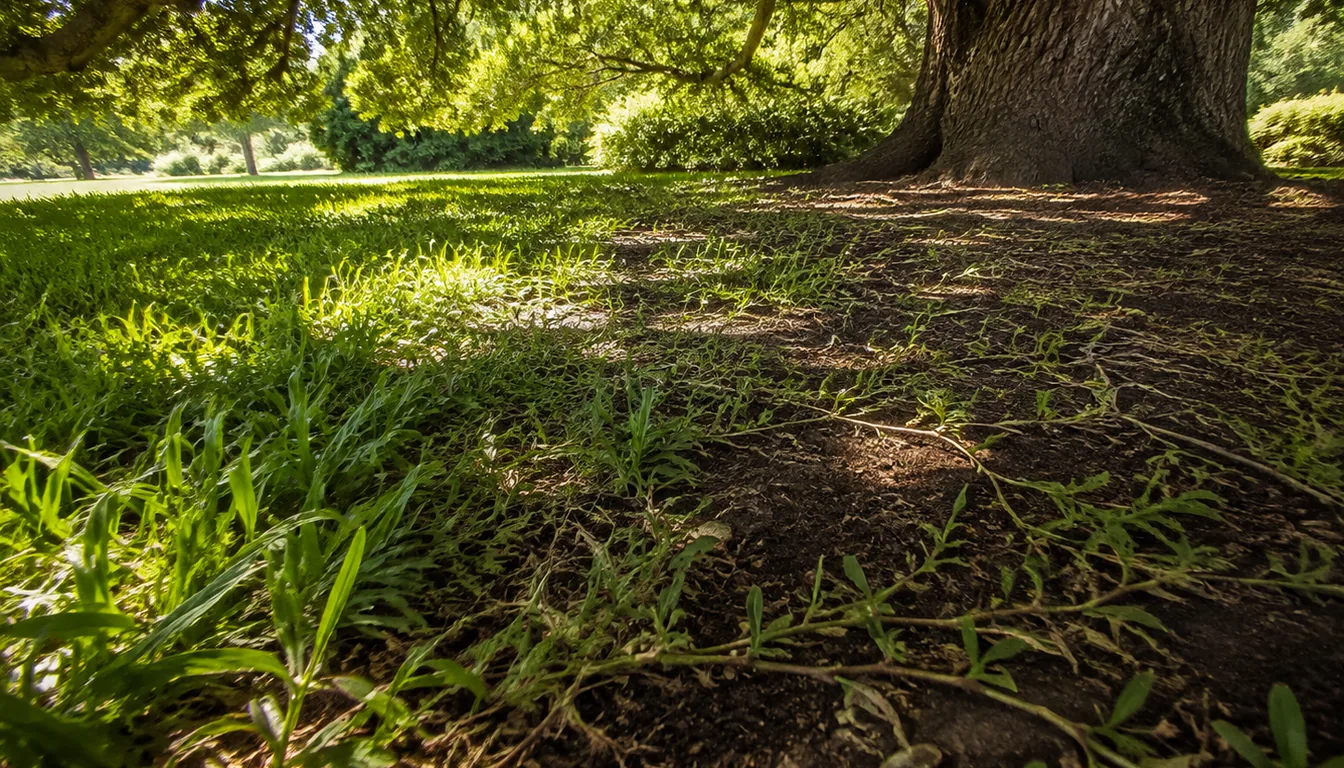
- Excessive shade and tree-root competition
- Poor drainage and soil compaction
- Low fertility or acid soil, which a soil test shows
- Weeds, insects or disease
- Thatch buildup
- Improper mowing
- Grass species that are poorly adapted to the site
How much good grass is left decides whether seed is enough. A lawn with more than 50% desirable grass can be renovated by overseeding its bare patches, while one with more than 50% weeds or bare ground needs a complete renovation. That job means killing all the vegetation with a nonselective herbicide and reseeding the whole lawn. The guide on whether overseeding is worth it covers a thin lawn that can still be saved.
Which seed should you buy, and how much?
Use seed of a species similar to the one already in the lawn, unless a poorly chosen species caused the decline in the first place. Where the choice is open, the mix follows the light.
- Sunny areas get Kentucky bluegrass, with at least two or three bluegrass cultivars in the mix.
- Partial shade gets Kentucky bluegrass with perennial ryegrass and fine-leaf fescues.
- Shady locations do best with the fine fescues, the best grasses for shade.
Perennial ryegrass sprouts in 5 to 7 days, while Kentucky bluegrass can take up to two weeks to emerge, which matters when a bare area has to fill in quickly. Ryegrass is the best species for renovating lawns because it germinates and establishes quickly and its roots can push into slightly compacted soil. Because of its aggressive nature, it is generally not used above 20 percent of a mixture.
On the seed tag, multiply the purity by the germination percentage and divide by 100 to get the pure live seed. A bag that is 85% pure with 60% germination holds only 51% pure live seed, so it takes about 2 pounds to supply 1 pound of pure live seed, while a bag that is 99% pure with 90% germination takes about 1.1 pounds. The cheaper bag can therefore cost more per pound of live seed.
The amount depends on the mix. UMass Amherst's seeding rates differ by mix, with a goal of 15 to 25 seeds per square inch when renovating.
| Mix | Pounds per 1,000 sq ft |
|---|---|
| Sun, medium to high maintenance (65-75% Kentucky bluegrass, 10-20% perennial ryegrass, 15% fine fescue) | 3 to 4 |
| Sun, low maintenance (65% fine fescue, 10-20% perennial ryegrass, rest Kentucky bluegrass) | 4 to 6 |
| Well-drained shade (80-90% fine fescue, 10-20% perennial ryegrass) | 4 to 6 |
| Shade (80% shade-tolerant Kentucky bluegrass, 20% perennial ryegrass) | 3 to 4 |
Poor conditions for germination call for about 50% more seed. Otherwise, extra seed does not help, because a stand seeded above the table's rates fills with small immature plants that are slow to mature, and an excessively dense stand raises disease problems and mower scalping.
To apply the rate, multiply length by width for each rectangular piece of the lawn and add the pieces up, which gives the number of thousands of square feet to seed.
How do you prepare the lawn so seed reaches soil?
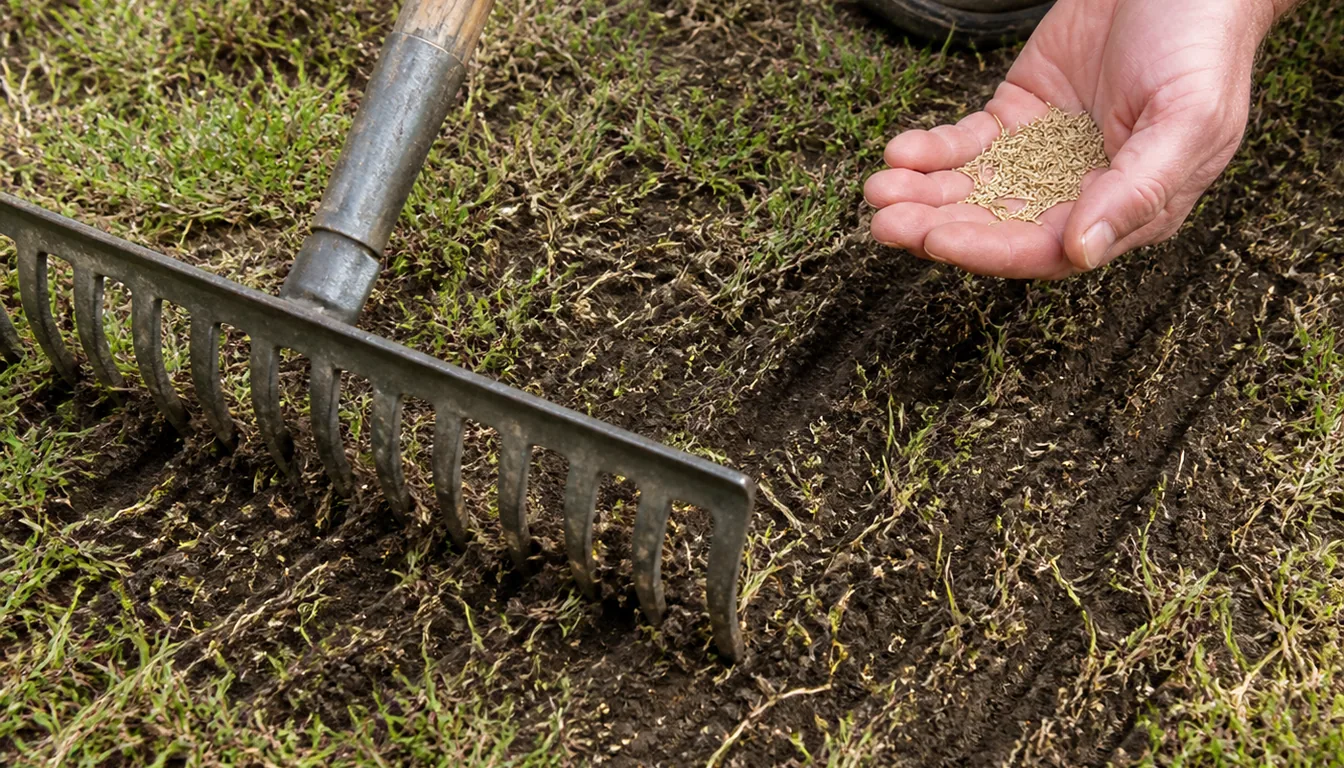
Seed that lands on grass blades or thatch never reaches the soil, and seed broadcast onto a lawn without cultivation will not survive. Preparation therefore has one aim, which is bare soil for the seed to touch, and it runs in a set order.
A soil test comes first, taken three to four weeks before the work, so you know what fertilizer and lime the lawn needs. Broadleaf weeds are treated next and well ahead of the seeding date, because a broadleaf herbicide mix used in lawn renovation needs a wait of about four weeks before seed can go down. The label gives the real interval for any product.
Then mow the lawn low for this one cut and take the clippings and debris off. Heights differ by source, from 1½ to 2 inches in Iowa State's overseeding guide, which aims to reduce competition from the established grass, down to about ¾ inch in Penn State's renovation program.
Check the thatch, the layer of partly decomposed stems and roots above the soil. A dethatcher removes it once it is more than ⅓ inch thick, and a layer over ½ inch calls for a full renovation that strips the sod. A lawn with less than that still needs the surface opened, and three tools do it.
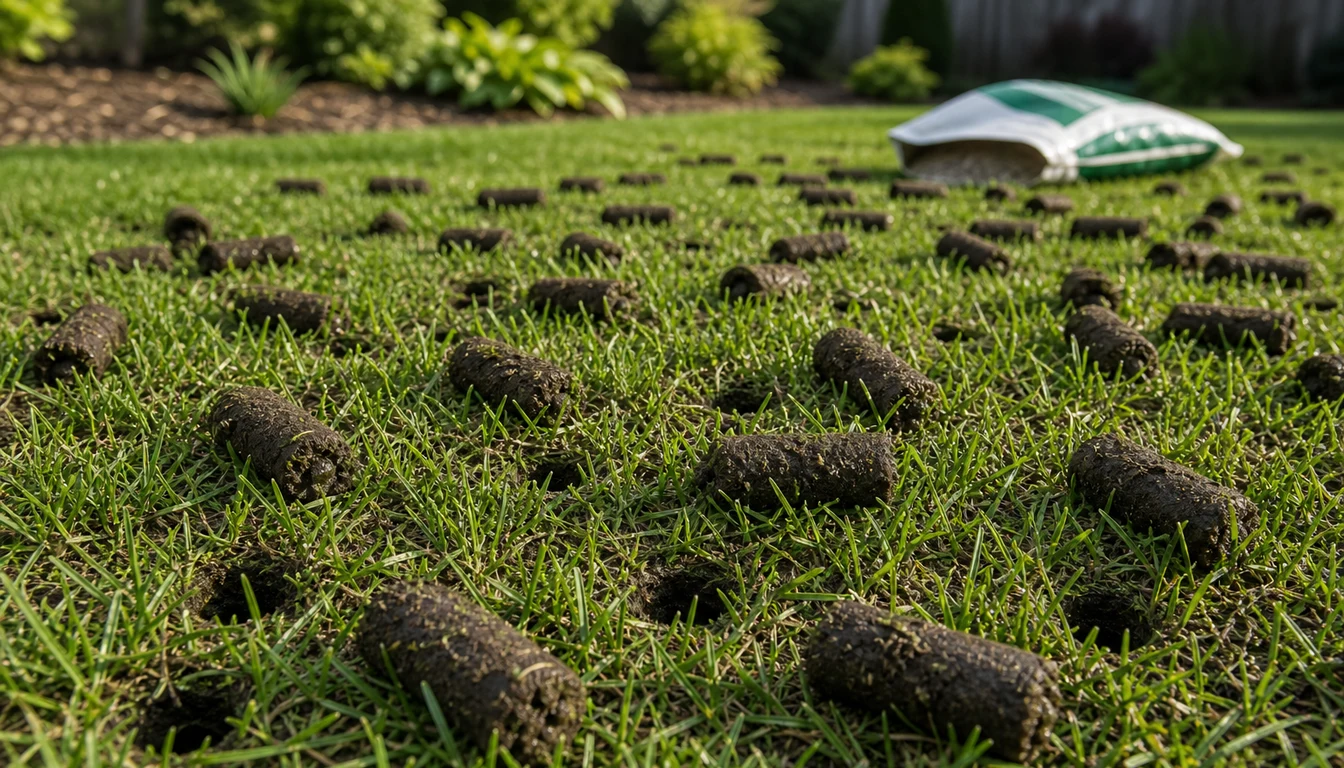
- A core aerator removes plugs of soil. Iowa State makes 3 or 4 passes until there are 20 to 40 holes per square foot, then drags the area with a mat or a piece of chain link fence to break up the cores and mix in the seed. Penn State calls for eight to ten passes in its renovation program.
- A vertical mower slices through the thatch and into the upper ¼ to ½ inch of soil. One or two passes are enough, and the loosened debris has to be raked off.
- A slit seeder cuts small grooves and drops the seed into them, which suits large areas.
On small areas a garden rake can loosen the soil to the depth needed, and the guide to overseeding without aerating covers that route.
How do you spread the seed and cover it?
A drop spreader suits a small lawn, and seeding in two directions leaves fewer skips and a more uniform application. That is why the steps below split the seed into two halves.
Starter fertilizer is applied just before or just after seeding, at 0.5 to 1 pound of nitrogen per 1,000 square feet. More than 1.5 pounds of nitrogen can burn the young turf, and the starter does not replace the phosphate and potash a soil test calls for.
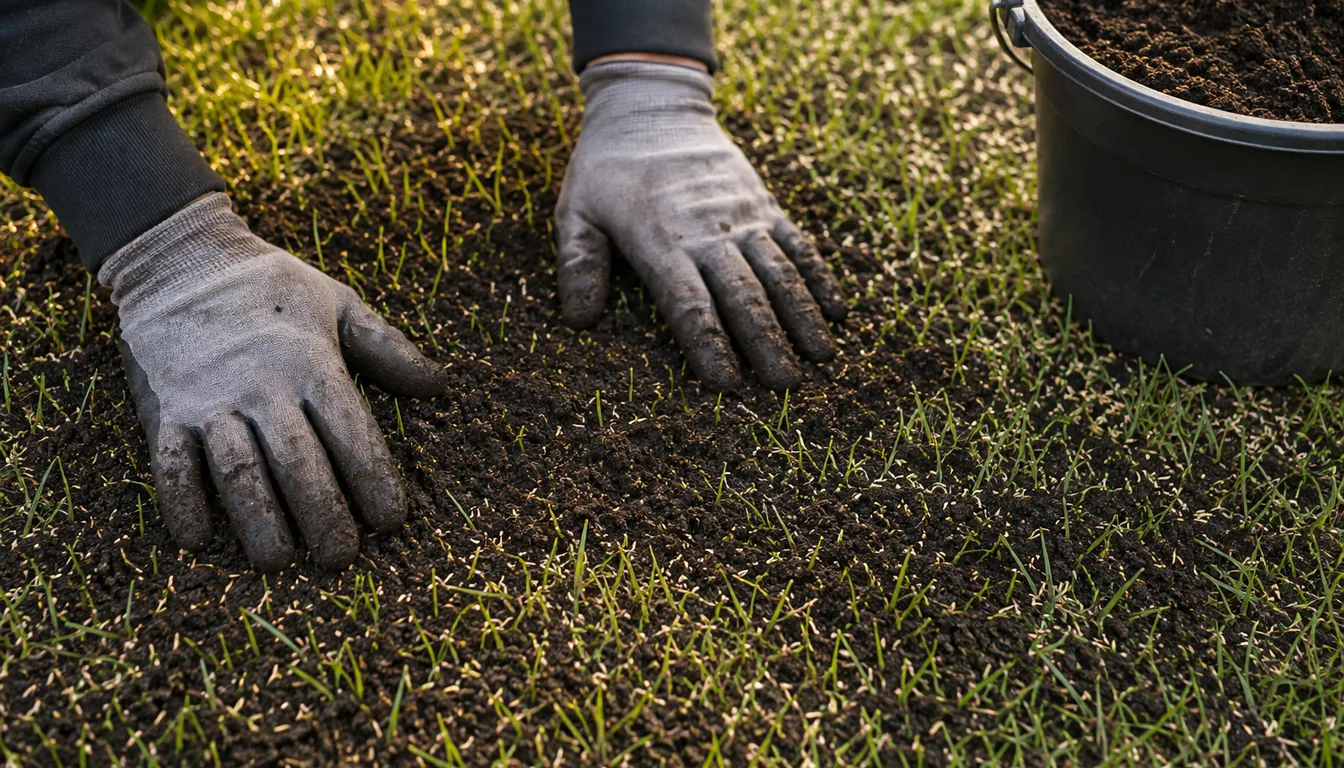
After seeding, the seed needs a little soil over it and firm contact beneath it, which the last three steps below provide. Straw mulch is for places where little grass remains, since a very light layer holds moisture but too much smothers the seedlings and brings disease problems.
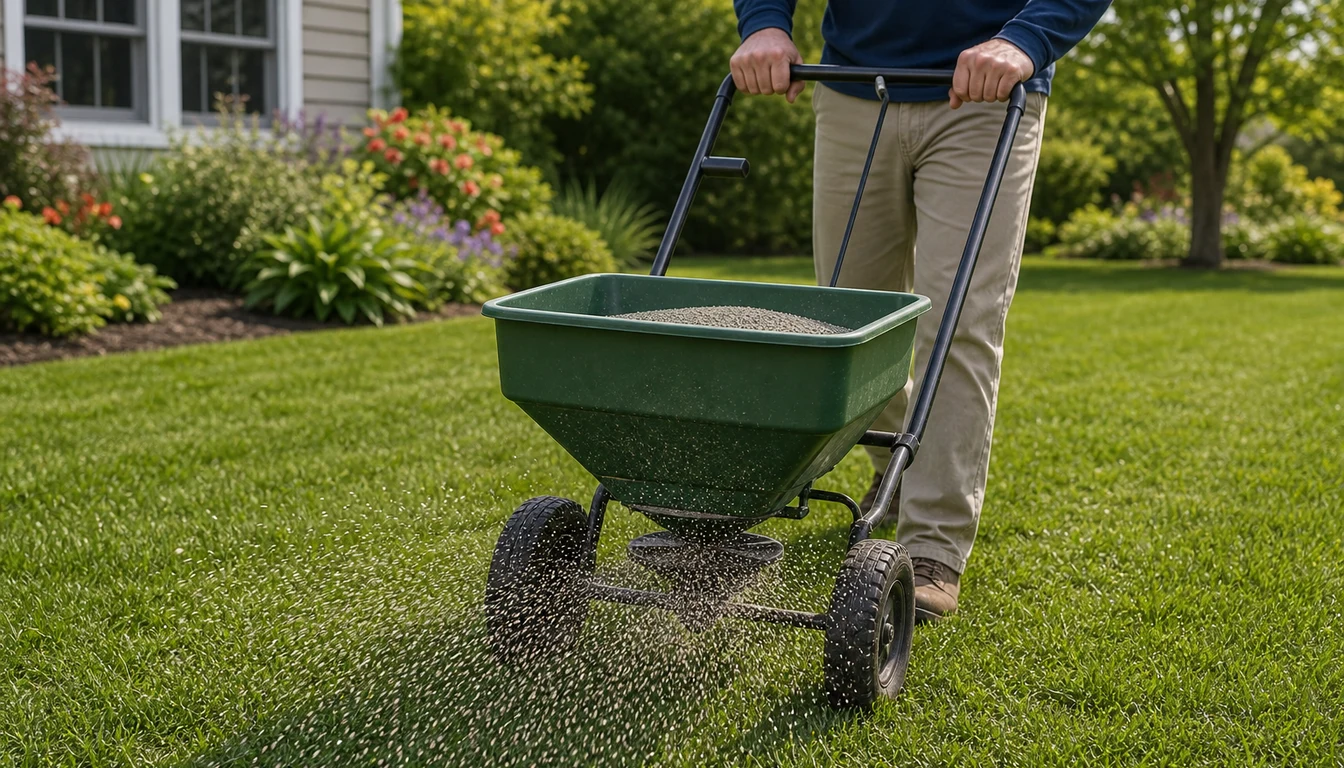
- Spread half the seedWalk the lawn in one direction with the spreader set to half the total amount.
- Spread the other halfCover the lawn again in a second direction, at right angles to the first, so any skips get filled.
- Rake it in lightlyDrag a leaf rake without pressing, until most seed is covered with 1/8 to ¼ inch of soil and some seed is still visible.
- Roll the area lightlyA lightweight roller on dry soil presses the seed into the soil, though this step is not necessary.
- Mulch only where grass is sparseSpread clean straw thinly, until about half the soil still shows through.
How often should you water new seed?
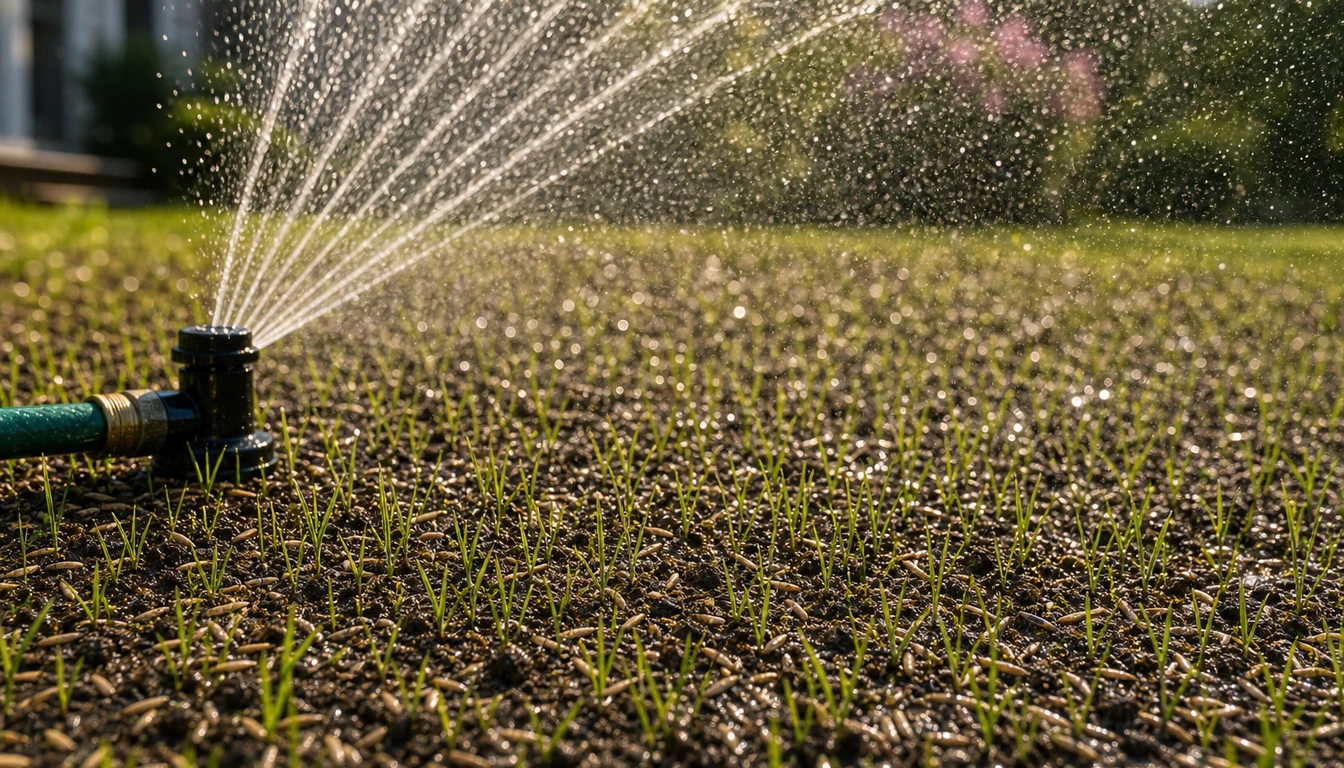
The seedbed has to stay moist from sowing until the seedlings are up. Their roots are delicate and shallow, and the seedlings cannot withstand severe moisture stress, so the soil should stay moist but never soggy. Light, frequent irrigation does this.
Extension pages give different counts, from once a day to three or four times, and the count can drop in rainy, cool or overcast weather or when the seedbed is mulched.
| Source | Before germination | Afterward |
|---|---|---|
| Minnesota | Soak the soil 4 to 6 inches deep once, then light irrigation up to 3 to 4 times a day | Reduce the frequency as roots grow into the soil |
| Iowa | Keep the upper 1 inch of soil moist, at least once a day | When seedlings reach 1 to 2 inches, water less often but more deeply |
| Massachusetts | Water two to three times a day if needed to keep the bed damp | Not stated |
| South Carolina (ryegrass) | Water lightly two or three times a day | Once mowed several times, water only as needed to prevent wilt |
Too much water also washes seed away and encourages disease. The new grass seed watering guide goes further into the schedule. The deep versus frequent watering comparison covers the later switch to deeper watering.
When can you mow, feed and walk on the new grass?
The first cut with a lightweight mower comes before the grass is more than one-third above the height you want, so a lawn kept at 3 inches gets mowed just before it reaches 4. Wisconsin Extension starts when seedlings reach 3 inches, which takes about 3 to 6 weeks.
A quick test is to walk onto the new turf. If the plants spring back upright where you stepped, mowing is probably safe, and if not, you risk pressing the seedlings into the soil.
While the seedlings come up, the established grass keeps being mowed often at 1½ to 2 inches to reduce its competition, and the height then rises gradually toward a final 3 inches. The first mow after overseeding guide covers the first cut in detail.
When the starter fertilizer is not enough to sustain rapid growth, a second feeding thickens the new turf, and the timing differs between sources.
- Penn State adds ½ pound of nitrogen per 1,000 square feet 4 to 8 weeks after the starter.
- Iowa State applies 1 pound about 6 weeks after germination.
- UMass Amherst applies ½ to 1 pound when the seedlings are about 2 inches high.
The new grass fertilizing guide sorts out the timing.
New turf is very sensitive to most herbicides, so they are best avoided unless the weed infestation is severe, and many broadleaf herbicides should wait until 4 to 6 weeks after establishment. The label gives the exact interval.
Seedlings are bruised or uprooted when trampled, so foot and vehicle traffic stays off until the grass is well rooted and has been mowed several times. The 4 to 8 weeks after seeding are the critical period for the new lawn. The walking on new grass seed guide gives the details.
What should you do if parts of the lawn stay thin?
Judge the result once the three to four weeks that germination and establishment probably take have passed, with perennial ryegrass fastest and Kentucky bluegrass slowest. A patch that is still thin after that time can be checked against the conditions linked to poor germination and seedling survival.
- Poor drainage, soil compaction or acid soil
- Low phosphorus or potassium
- Poor contact between seed and soil, or too little or too much mulch
- A steep slope where soil and seed erode
- Seeding at the wrong time of year
- Poor care after planting, such as a seedbed that dried out
Once the condition the patch points to is fixed, the patch can be reseeded. On a dead patch about the size of a basketball, loosen the soil, sprinkle the seed by hand and rake it in gently to ¼ to ⅜ inch deep. A bare patch only the size of a baseball may call for lawn fertilizer at 1 pound of nitrogen per 1,000 square feet, to push the surrounding grass to fill the gap.
A shady corner that keeps failing may need a different mix instead of more seed, and a mix that is 50% or more fine fescue suits dry shaded sites.
Pro Tips
- Find out why the grass thinned before you buy seed, because seedlings meet the same problem the old grass did.
- Mow low, take the clippings off and loosen the surface with a core aerator, vertical mower or slit seeder so seed touches soil.
- Spread half the seed in one direction and half at right angles, then rake lightly so some seed still shows.
- Skip crabgrass preventers when you seed, since they stop grass seed from sprouting too.
- Keep the seedbed moist but not soggy until the seedlings are up, then water less often and more deeply.
- Start mowing when the grass springs back upright after you walk on it, and keep traffic off until it has been mowed several times.
Frequently Asked Questions
How soon can I walk on my lawn after overseeding?
Keep foot and vehicle traffic off new turf until it is well rooted and has been mowed several times. Seedlings can be bruised or uprooted if trampled early, and the 4 to 8 weeks after seeding are the critical period for the new lawn.
Should I aerate every time I overseed?
Aeration is one of three ways to get seed into contact with soil, along with a vertical mower and a slit seeder, and on small areas a garden rake can loosen the soil. Core aeration also relieves compaction, which is one of the causes that can thin a lawn.
Can I overseed a lawn full of weeds?
Not when weeds or bare ground cover more than half of it. That lawn needs a complete renovation, which starts with killing all the vegetation. With less weed cover, treat broadleaf weeds well ahead of seeding, since one common broadleaf mix needs about four weeks before seed can go down, and follow the label for the interval.
Can I use weed-and-feed on new seedlings?
A weed-and-feed product contains a herbicide, and new turf is very sensitive to most herbicides, so they are best avoided unless the weed infestation is severe. Many broadleaf herbicides should wait until 4 to 6 weeks after establishment, and the product label gives the exact interval.
How long before an overseeded lawn looks full?
Perennial ryegrass sprouts in 5 to 7 days and Kentucky bluegrass can take up to two weeks to emerge. Germination and establishment probably take three to four weeks overall, and the first 4 to 8 weeks are the critical period for the new lawn.
Sources & References
- Iowa State University Extension, Overseeding a Lawn
- Iowa State University Extension, Late Summer and Fall Lawn Care
- Iowa State University Extension, Spring Lawn Care
- UMass Amherst, Lawn Renovation and Overseeding
- Penn State Extension, Lawn Establishment
- Penn State Extension, Renovation of Lawns
- Penn State Extension, Turfgrass Species for Pennsylvania
- University of Minnesota Extension, Seeding and sodding home lawns
- University of Wisconsin Horticulture: Over-seeding Lawn in Autumn
- Clemson HGIC, Overseeding With Ryegrass
- University of Maryland Extension, Lawn Maintenance Calendar
- Oklahoma State University Extension, Choosing, Establishing, and Managing Bermudagrass Varieties in Oklahoma