
When Should You Fertilize New Grass From Seed or Sod?
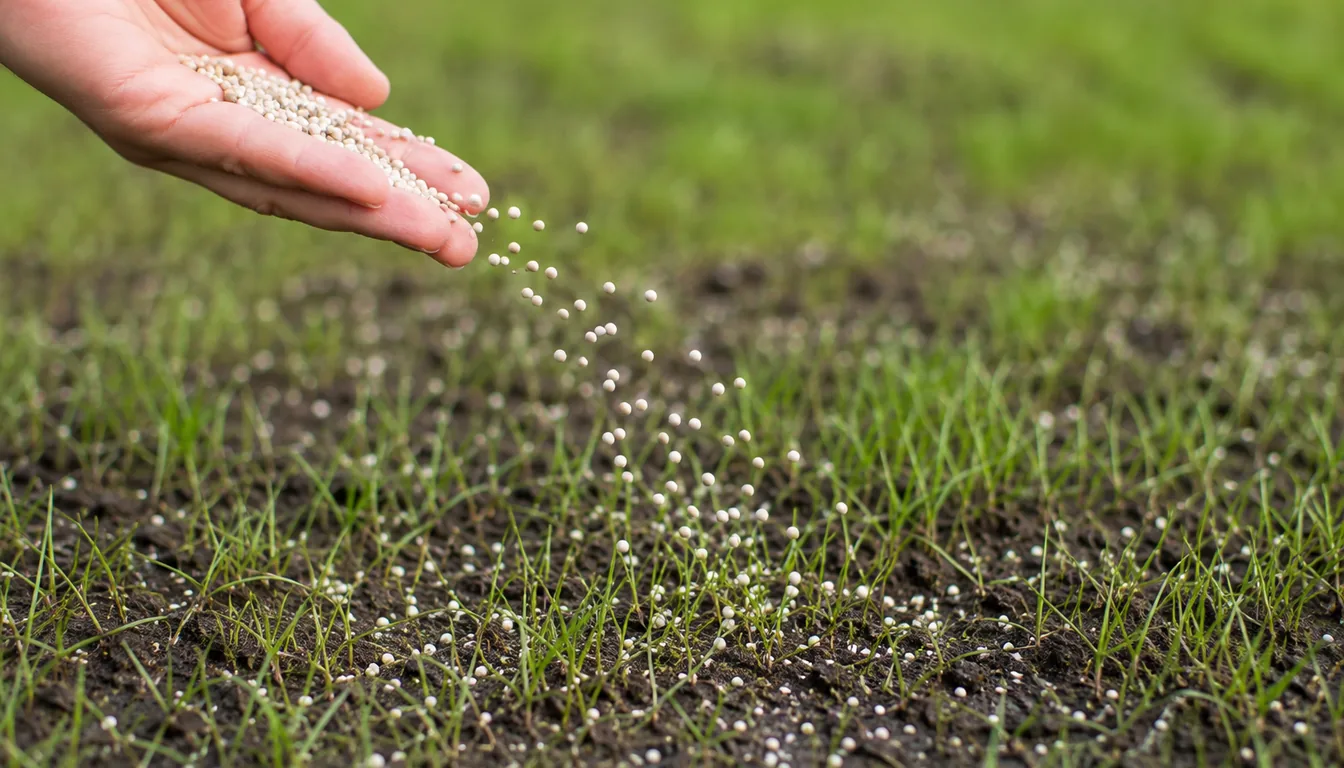
The timing depends on how the lawn was planted, and each method has its own rule. A seeded cool-season lawn gets starter fertilizer just before or just after seeding, then a light feeding of about 1/2 pound of nitrogen per 1,000 square feet 4 to 8 weeks later only if growth needs it. A seeded warm-season lawn gets its fertilizer worked into the soil before planting and a 1/2 pound feeding once seedlings are 1 1/2 to 2 inches tall. Sod usually arrives already fed. Cool-season sod in the northern Great Plains gets starter fertilizer under it and repeat feedings at 4 to 6 and 8 to 10 weeks, while University of Florida guidance holds warm-season sod for 30 to 60 days.
Those rules come from different extension services working in different climates, and they agree on one point. New grass has short roots, so fertilizer that arrives before the roots can use it either burns tender tissue or washes past the root zone.
At a glance
Which Fertilizer Rule Fits How Your Lawn Was Planted?
Find the row that matches your lawn. Each rule comes from one extension source, named in the last column, and the sections below explain each one.
| How it was planted | At planting | First feeding after planting | Source |
|---|---|---|---|
| Seed, cool-season grass | Starter fertilizer at 0.5 to 1 lb N per 1,000 sq ft, just before or after seeding | 1/2 lb N, 4 to 8 weeks after the starter, if growth needs it | Penn State Extension |
| Seed, warm-season grass | Soil-test fertilizer worked in before planting | About 1/2 lb N when seedlings are 1 1/2 to 2 inches tall | Clemson Extension |
| Sod, cool-season grass | Starter fertilizer raked into the finished grade before laying | Starter again at 4 to 6 weeks and 8 to 10 weeks | University of Nebraska |
| Sod, warm-season grass | Soil prepared by soil test, no extra feeding at laying | 30 to 60 days after laying, not before 30 | University of Florida |
| Overseeding an existing lawn | Starter fertilizer at about 1 lb N per 1,000 sq ft | The lawn's regular fall or spring program | Michigan State Extension |
A soil test sits under every row. Penn State notes that phosphorus and potassium move into soil too slowly from the surface, so the amounts a soil test calls for are tilled 4 to 6 inches into the seedbed before planting. Nitrogen is the opposite. It is not tilled in, because it can leach out of the topsoil before the grass can use it, so it goes on the surface as starter fertilizer.
Climate changes the dates more than the rules. Cool-season grasses such as Kentucky bluegrass and tall fescue are usually seeded in late summer or early fall, while warm-season grasses such as bermudagrass and zoysiagrass are planted in late spring.
How Do You Fertilize a Newly Seeded Cool-Season Lawn?
Penn State Extension's rule is to apply starter fertilizer just before or just after seeding at 0.5 to 1 pound of nitrogen per 1,000 square feet. It warns that more than 1.5 pounds of nitrogen can burn the young turf and lead to poor establishment. Typical starter analyses it lists include 10-10-10, 16-8-8, and 20-10-10, and most starter products contain quick-release nitrogen.
The starter is not a replacement for the soil test. Penn State is explicit that a starter fertilizer does not supply the phosphate and potash a soil test recommends, which is why those go into the seedbed first.
The second feeding is conditional. Penn State says starter fertilizer is sometimes not enough to sustain rapid growth, and that an application of 1/2 pound of nitrogen per 1,000 square feet 4 to 8 weeks after the starter helps thicken the new turf. A lawn that is pale and slow at five or six weeks fits that description. A lawn that is already dense and dark green does not need it yet.
Season decides what comes next. Michigan State University Extension notes that fertilizer in the seedbed of a spring-seeded lawn normally lasts until fall, when the lawn is fertilized again, and that a fall-seeded lawn needs its next fertilizer the following spring. Read with Penn State's rule, a fall-seeded lawn may get the optional 1/2 pound follow-up in October or November if it is still growing and pale, and otherwise waits for spring.
When Does a Seeded Warm-Season Lawn Get Fertilizer?
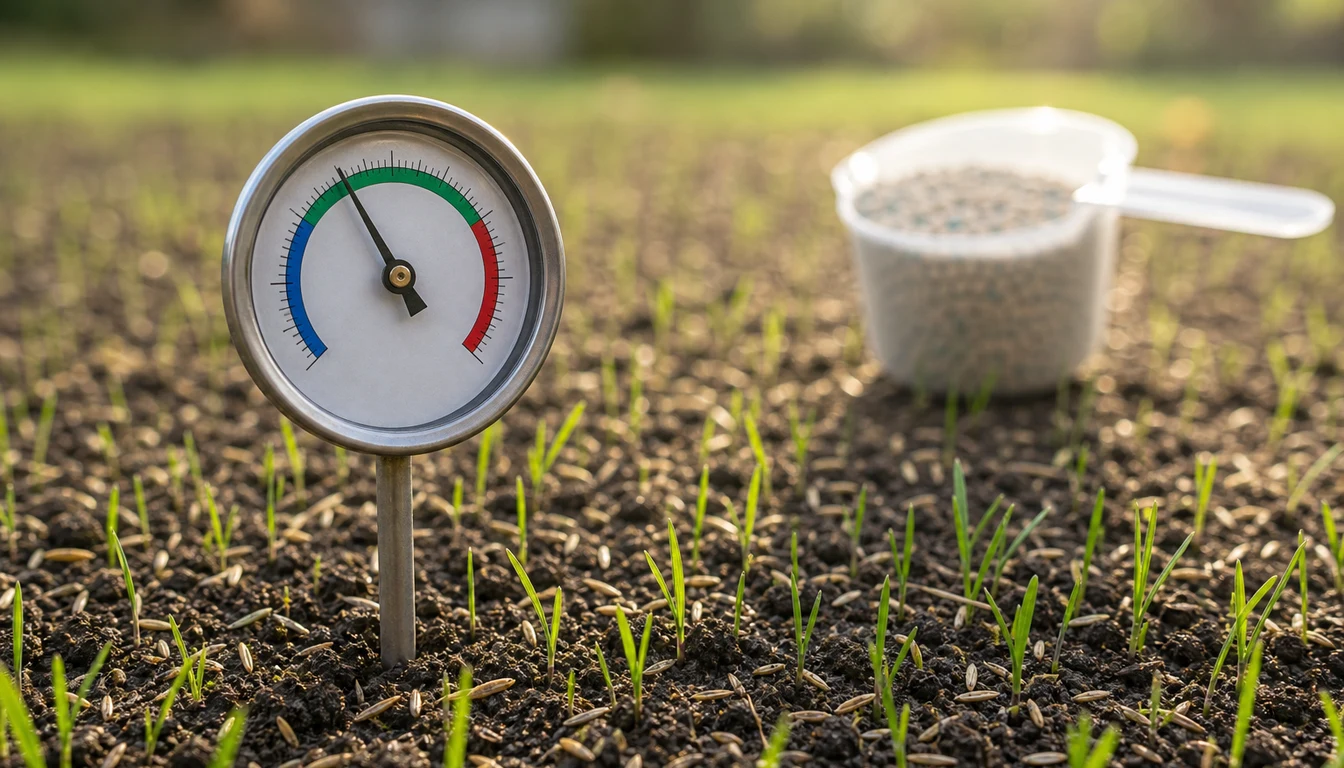
Clemson Extension handles warm-season seed differently. On soils low in phosphorus and potassium, it recommends a slow-release starter fertilizer worked in before planting at 1 1/2 to 2 pounds of nitrogen per 1,000 square feet, and notes that these products typically feed the lawn for about two months. On coastal soils that are naturally high in phosphorus, it substitutes a slow-release 15-0-15 centipede fertilizer.
The first feeding after planting is tied to seedling height, not to a date. Clemson's guidance is a light application of about 1/2 pound of nitrogen per 1,000 square feet, watered in, when the seedlings are 1 1/2 to 2 inches tall. It says that application substantially speeds establishment.
Planting date sets the rest. Clemson targets early May for warm-season seeding in South Carolina, which gives a bermudagrass or centipedegrass lawn the whole summer to root and spread before it goes dormant.
When Should New Sod Be Fertilized?
Sod needs less help than seed at first, and the timing depends on the grass and region.
Cool-season sod. A University of Nebraska fact sheet for Kentucky bluegrass and tall fescue sod applies a starter fertilizer to the finished grade before the sod goes down, at 1.0 to 1.5 pounds of phosphate (P2O5) per 1,000 square feet depending on the soil test. It repeats the same starter at about 1.0 pound of phosphate per 1,000 square feet 4 to 6 weeks after laying and again at 8 to 10 weeks, to head off the nitrogen shortage that shows up as thinning and yellowing older leaves. For sod laid in late summer on soil with enough phosphorus, it uses regular high-nitrogen fertilizer instead, at 1 pound of nitrogen in mid-September at least four weeks after laying, then in early October and mid-November.
Warm-season sod. University of Florida guidance is to not fertilize newly laid sod until 30 to 60 days after installation. Sod is generally fertilized at the farm before harvest, and feeding during establishment, combined with the frequent watering new sod needs, increases nutrient leaching past the short roots. If the sod turns yellow and spindly, UF allows fertilizer no sooner than 30 days after sodding, at no more than 1 pound of nitrogen per 1,000 square feet. Clemson Extension agrees that sod should not need fertilizer after transplanting and starts the regular program once the sod has rooted well.
Rooting can be checked by hand. The Nebraska sheet describes grasping the grass with both hands and lifting, and says sod that resists usually does so within 10 to 14 days in good weather. For St. Augustinegrass and other warm-season sod in Florida, UF expects the lawn to be on an established watering schedule about three to four weeks after sodding.
How Is Overseeding an Existing Lawn Different?
An overseeded lawn is mostly established grass with seedlings in the gaps, so it gets one starter application with the seed and then rejoins its normal program. Michigan State University Extension recommends a starter fertilizer at 1 pound of nitrogen per 1,000 square feet at seeding, with a nitrogen-to-phosphate ratio near 1 to 1 or 1 to 1.5.
Phosphorus rules can apply. MSU notes that Michigan restricts lawn phosphorus but still allows starter fertilizer for establishing turf, up to 1.5 pounds of phosphate per 1,000 square feet per application and 2.5 pounds per year. Ohio State Extension makes the same point for water quality reasons, calling seeding one of the few times supplemental phosphorus is warranted. Check local rules before buying a starter bag.
After the starter, the regular schedule takes over. For cool-season lawns overseeded in fall, that usually means the fall feedings in fall lawn fertilizing. The overseeding method and mowing after overseeding cover the rest of the job.
Why Does Too Much Fertilizer Hurt New Grass?
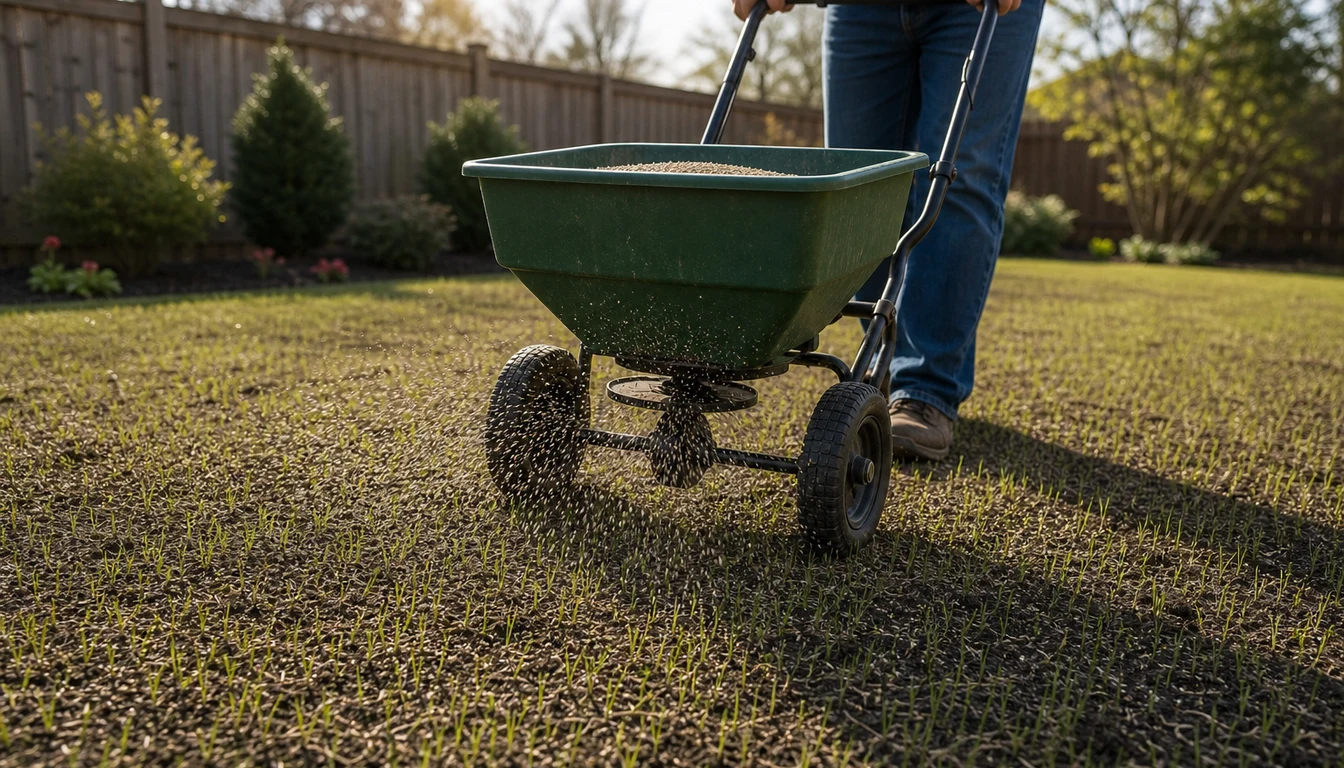
New grass is easy to overfeed because its roots are shallow and its leaves are tender. Penn State's burn threshold for starter fertilizer is more than 1.5 pounds of nitrogen per 1,000 square feet, and University of Florida research found that nutrient leaching is much more likely on newly planted sod than on established turf, because the short roots cannot catch what moves down.
Fast nitrogen also changes how the grass grows. MSU's Kevin Frank advises against all fast-release urea for fall feeding of lawns because it forces top growth, which means more mowing and less rooting. A new lawn needs the opposite, so slow-release nitrogen is the gentler choice after the starter.
Rain right after feeding is another way nutrients leave the lawn. Fertilizing before or after rain covers how to time an application around the forecast, and sweeping stray granules off pavement keeps them out of storm drains.
How Can You Tell a New Lawn Needs the Next Feeding?
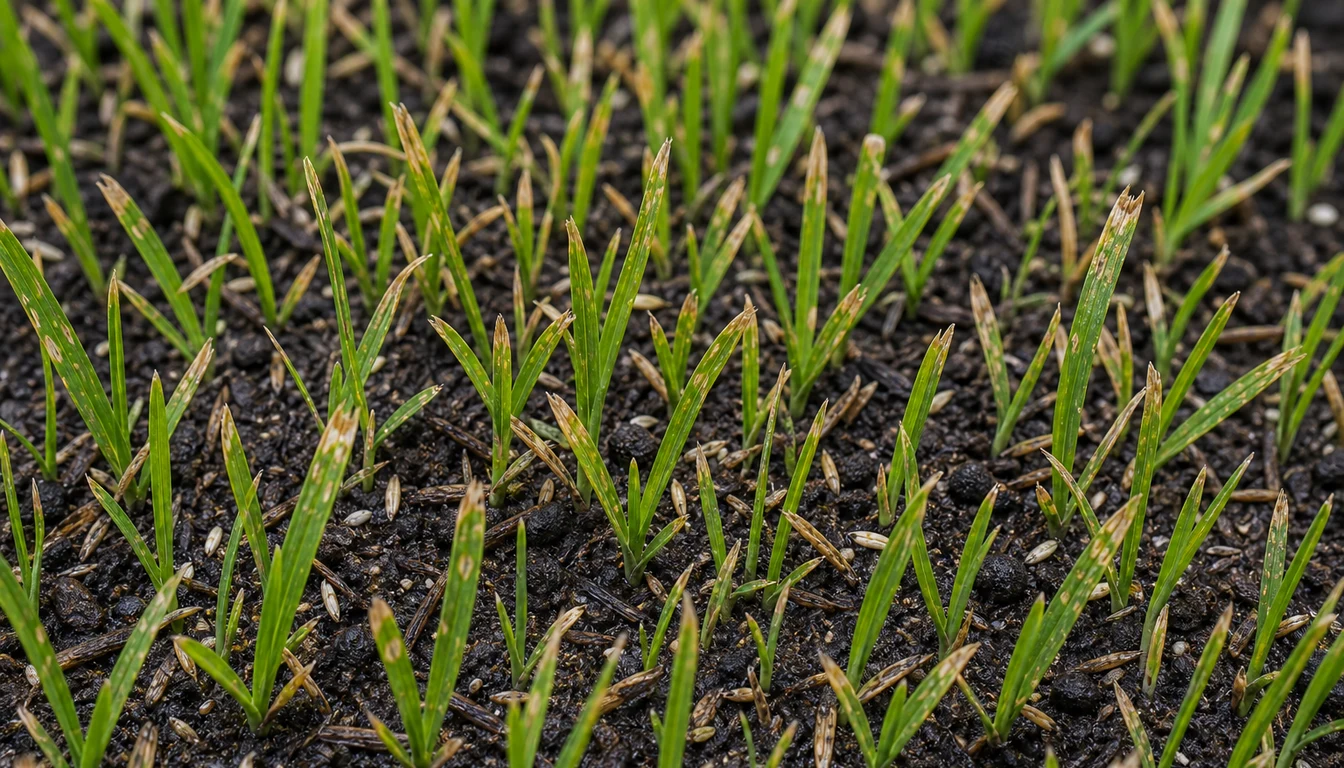
The sources describe the same warning signs. University of Florida points to yellow color and spindly growth in new sod, and the Nebraska sod sheet describes nitrogen shortage as thinning with older leaves turning yellow. Penn State's conditional follow-up feeding is meant for seeded lawns whose growth has slowed after the starter.
A lawn that is dense, evenly green, and growing well does not need the next feeding yet, even if a calendar says it is due. Extra nitrogen at that point mostly adds mowing.
Rule out the other causes first. Patches that stay pale and soft may be too wet, and patches that wilt may be too dry, and neither is fixed by fertilizer. Once the lawn has been mowed several times and is rooted, it moves onto a regular program, and lawn fertilizing covers the schedule for established grass.
Pro Tips
- Have the soil tested before planting so phosphorus and potassium can be worked into the seedbed.
- Keep starter fertilizer between 0.5 and 1 pound of nitrogen per 1,000 square feet on new seed.
- Give a seeded cool-season lawn its follow-up 1/2 pound of nitrogen only if it is pale or slow 4 to 8 weeks after the starter.
- Feed seeded warm-season grass once seedlings reach 1 1/2 to 2 inches tall.
- Wait at least 30 days before fertilizing new warm-season sod, and up to 60.
- Skip weed-and-feed products on new seedings and new sod.
- Check local phosphorus rules before buying a starter fertilizer.
Frequently Asked Questions
How soon after seeding can I fertilize new grass again?
For cool-season seed, Penn State's follow-up is 1/2 pound of nitrogen per 1,000 square feet 4 to 8 weeks after the starter, and only when the new turf needs help thickening. For warm-season seed, Clemson times it to seedlings 1 1/2 to 2 inches tall.
Should I put fertilizer down before or after laying sod?
Before, as part of soil preparation. The Nebraska sod guide rakes starter fertilizer into the finished grade before laying cool-season sod, while Florida and Clemson guidance for warm-season sod adds no fertilizer at laying and waits for the roots.
Can I use regular weed-and-feed on a brand new lawn?
No. Penn State warns that new turf is very sensitive to most herbicides, that many broadleaf herbicides should wait 4 to 6 weeks after establishment, and that no herbicide should go on new sod. The label gives the exact interval.
Do I need fertilizer if my new lawn already looks dark green?
Not yet. The follow-up feedings in extension guidance are meant for lawns that turn pale, yellow, thin, or slow, and a dense, evenly green new lawn is still using what the starter supplied.
How much starter fertilizer is too much?
Penn State recommends 0.5 to 1 pound of nitrogen per 1,000 square feet in a starter and warns that more than 1.5 pounds can burn young turf. Read the nitrogen percentage on the bag to convert that into pounds of product.
Sources & References
- Penn State Extension, Lawn Establishment
- Clemson Cooperative Extension, Lawn Establishment (HGIC 1203)
- University of Nebraska-Lincoln Turfgrass Science Program, Establishing Lawns From Sod
- University of Florida IFAS Extension, Fertilization and Irrigation Needs for Florida Lawns and Landscapes (ENH860)
- University of Florida IFAS Extension, Homeowner Best Management Practices for the Home Lawn (ENH979)
- Michigan State University Extension, Establishing a New Lawn Using Seed (E2910)
- Michigan State University Extension, Tips for seeding lawns in September
- Michigan State University Extension, Timing for fall fertilization and rust on turf
- Ohio State University Extension, Efficient Lawn Care Practices to Help Protect Ohio's Waterways (HYG-5812)
Related Guides
Best Time to Aerate and Overseed for a Thicker Lawn
Most lawns never reach their potential because aeration and overseeding happen at the wrong time.
11 min read
Best Time to Overseed a Northeast Lawn for Thick Turf
Overseeding in the Northeast is all about catching that short window when soil is warm, air is…
11 min read
Can You Overseed a Lawn Without Aerating It First?
Thin turf and bare patches do not always mean you need to rent an aerator.
11 min read
Dethatching vs Aerating: Which Does Your Lawn Need?
Choose dethatching when a measured layer of thatch has become excessive.
16 min read
How Long After Planting Grass Seed Can You Walk On It Safely
Most new lawns fail not from bad seed, but from feet, paws, and mower wheels showing up too soon…
11 min read
How to Fertilize a Lawn Without Burning It
Those yellow stripes and crispy patches after fertilizing are almost always user error, not bad…
14 min read