
Why Majesty Palm Leaves Turn Yellow and Which Frond to Check
Yellow leaves on a Majesty Palm mean more when you know which frond changed first.
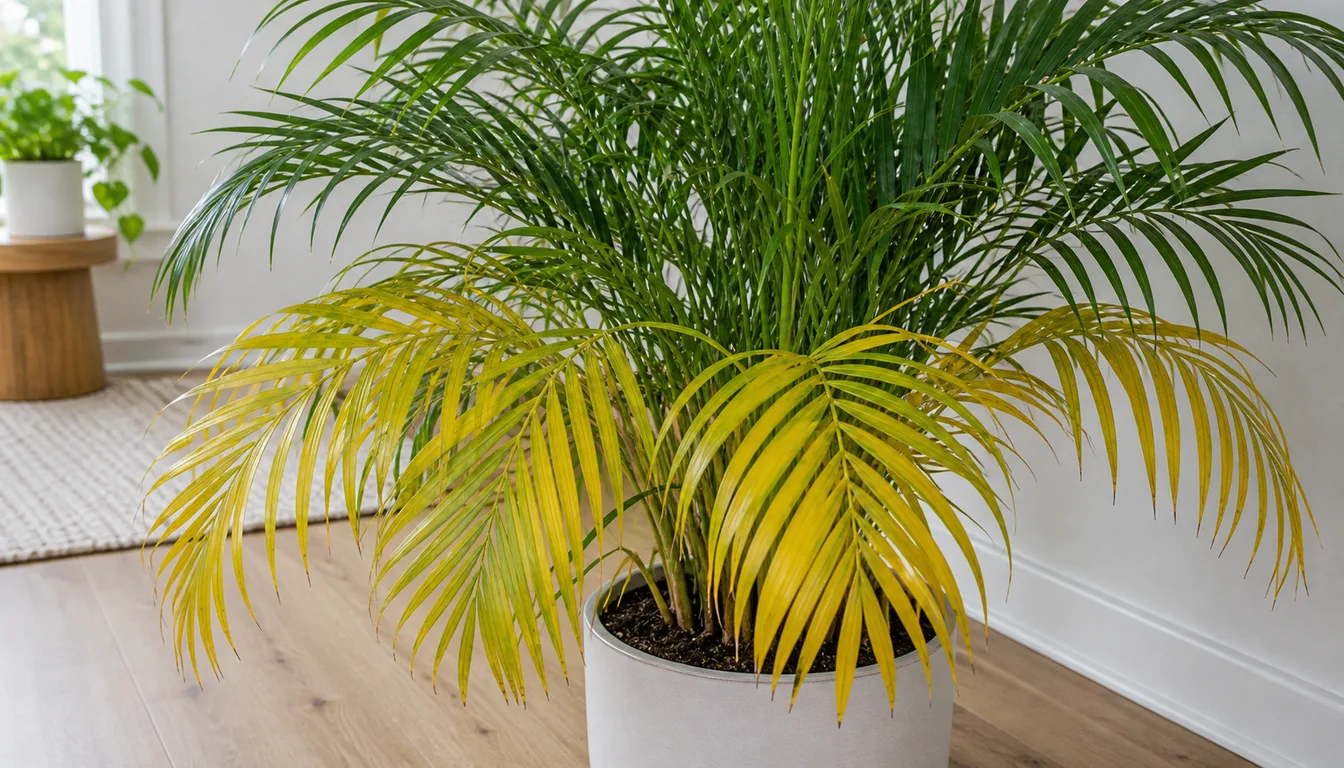
One slowly yellowing bottom frond may be normal turnover, while several lower fronds, a pale central spear, or yellowing across the canopy points to a specific root, light, pest, salt, nutrient, or temperature problem.
Quick diagnosis
The frond position separates normal aging from active stress
Start at the center spear and work downward.
One oldest bottom frond yellowing slowly can retire normally, several soft lower fronds above wet soil point toward oxygen-starved roots, a light dry pot supports drought stress, and pale or distorted new growth needs a light, root, or nutrient check. Narrow crisp tips on otherwise green leaflets belong to the brown-tip diagnosis.
Open the full diagnosisWhat You Are Seeing
Mark the first yellow frond before changing care. A Majesty Palm moves resources out of an aging bottom frond, but a problem spreads to several fronds, reaches younger tissue, or arrives with droop, spots, residue, webbing, or weak growth.
Next, check texture and pot weight. Soft yellow fronds above a heavy wet pot tell a different story from folded or crisping leaflets above a light pot whose mix has pulled from the sides.
Look at the newest spear last because it is the strongest warning point. A firm green spear suggests the growing center is still functioning, while a pale, distorted, soft, or loose spear moves the diagnosis toward roots, nutrient availability, chilling, or crown damage.
Keep yellowing separate from tip-first necrosis. A frond can have both symptoms, but broad loss of green color and a narrow dead leaflet end do not have to share the same cause or correction.
Common Causes
01 Common when limited to one frond
One oldest lower frond is retiring
Palms produce new leaves from the center and eventually shed their oldest foliage from below. A single bottom frond may fade from green to yellow while the central spear opens normally and every higher frond keeps its color.
Position and pace settle this diagnosis. Normal turnover stays at the lowest level, advances slowly through one old frond, and does not come with a sour pot, collapsed leaflets, mite stippling, or a pale central spear.
Tag the fading frond and count how many healthy fronds sit above it.
If the same lowest frond continues its slow decline while the next spear advances, care does not need changing. A second or third frond yellowing before new growth replaces them changes the balance and calls for a root-zone, light, and pest check.
How to identify it
- Only the lowest and oldest frond is yellowing.
- The yellowing advances gradually rather than appearing across several fronds at once.
- The central spear is firm and green, and a recently opened frond looks normal.
- The root ball is neither saturated for days nor extremely dry and shrunken.
- There is no fine stippling, webbing, white salt crust, cold-side pattern, or sudden loss of firmness.
What to do
- Leave the frond while a useful amount of green tissue remains.
- Remove it near the base with clean pruners only after it is fully yellow or brown and no longer supports the palm.
- Protect the trunk and nearby green petioles while cutting.
- Keep routine moisture and light steady instead of repotting or feeding in response to one old frond.
- Restart the diagnosis if a second frond begins yellowing before the first has finished declining.
02 High likelihood
The root zone stays saturated and short of oxygen
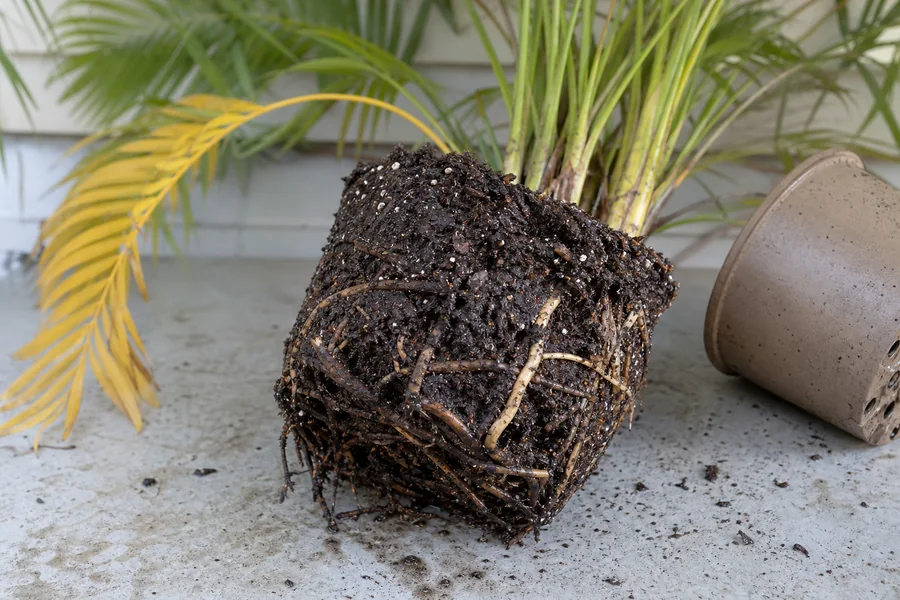
Moisture-loving does not mean airless. When water fills the pore spaces for too long, Majesty Palm roots cannot function normally, and several lower fronds may soften, droop, and turn yellow while the container still feels heavy.
The leaf color alone cannot prove overwatering. A persistently wet root ball, water trapped in a cachepot, blocked drainage, sour-smelling mix, dark soft roots, or a weakening central spear provides the evidence.
Probe the center and lower part of the root ball rather than judging the dry-looking surface.
A nursery pot can stand in runoff inside a decorative cover, or dense mix can stay wet below while the top inch lightens. Empty standing water and restore drainage first; repot only when decaying roots or a failed mix give a concrete reason to disturb the plant.
How to identify it
- Several lower fronds yellow together and feel soft rather than dry or crisp.
- The pot remains heavy and the mix stays wet well below the surface for many days.
- Water collects in the saucer or cachepot, or the container has no usable drainage hole.
- Potting mix smells sour or stale, and visible roots are dark and soft instead of firm.
- New growth slows, the palm droops in wet soil, or the central spear loses firmness.
What to do
- Stop watering until the upper mix begins to dry and the pot loses some weight.
- Empty standing water and confirm that every drainage opening is clear.
- Keep the palm warm in bright filtered light so the root ball can use water, but do not aim a drying vent at the leaves.
- Follow an overwatered-plant root check when the pot remains wet despite open drainage or when odor, soft roots, or a weak spear appears.
- Remove decayed roots and replace collapsed mix only when the root inspection shows that repair is needed.
03 High likelihood in warm bright rooms
The root ball dries out or sheds water around its edges
A dry root ball can also yellow a whole frond. Peat-rich mix may shrink away from the pot wall, allowing a quick watering to run down the gap and out while the center stays dry.
This cause becomes likely when the container feels unusually light, the mix is dry several inches down, and leaflets fold or lose firmness before watering. Repeated cycles of severe drying followed by a large drink can damage fine roots and make the pattern spread beyond the oldest frond.
Check the mix again soon after watering.
If water escaped immediately but a skewer from the center remains nearly dry, rewet the ball slowly in stages and let excess drain. If the center is already moist and the pot is heavy, the same yellow leaves cannot justify another soak.
How to identify it
- The pot feels much lighter than it did after a complete watering.
- Mix has pulled from the container wall or a wooden skewer comes out dry from the center.
- Water exits immediately along one side instead of wetting the root ball evenly.
- Leaflets fold or droop while the mix is dry, then regain some firmness after thorough watering.
- Yellowing accelerated during hot bright weather, a missed watering, or after roots filled most of the pot.
What to do
- Apply water slowly across the entire surface until the root ball is evenly moist and excess drains from below.
- Briefly soak the nursery pot in shallow water when dry shrunken mix refuses to absorb from above, then lift it out and drain it completely.
- Use moisture at depth and pot weight before the next watering instead of following a weekday schedule.
- Water before the whole root ball becomes dry and very light, but keep runoff out of the outer pot.
- Inspect for crowding when the palm needs water far more often than it used to, then repot only if root condition and growth justify it.
04 Medium likelihood
Low light weakens growth and slows water use
A Majesty Palm in dim light cannot support the same leaf area or use water at the same rate as one near a bright window. The canopy may become broadly pale, new fronds can open weak or undersized, and the pot may remain wet longer after each watering.
Light and moisture therefore interact. If a palm was moved deeper into a room and then began yellowing in a pot that now dries slowly, adding water on the old schedule compounds the original placement problem.
Measure the room from the plant's position, not from the window.
A palm several feet back, behind a curtain, or shaded by an overhang can receive far less useful light than it appears to. Move it gradually toward bright filtered light, then let the changed drying rate determine the next watering rather than keeping the old calendar.
How to identify it
- Several fronds look pale rather than one bottom frond turning a clear yellow.
- New growth is narrow, weak, stretched, or leaning strongly toward the nearest window.
- The palm sits far from a bright window or behind heavy curtains for most of the day.
- The root ball takes much longer to dry than it did in the previous position or season.
- There is no mite stippling, salt crust, sudden cold event, or root odor to explain the change.
What to do
- Move the palm closer to bright filtered light in stages so the foliage can adjust.
- Avoid placing a shade-grown palm directly in hot afternoon sun because bleached scorch patches are a separate injury.
- Rotate the pot periodically after placement is stable so new growth does not lean in one direction.
- Recheck the root ball before every watering because a brighter or dimmer position changes how quickly it dries.
- Judge the move by stronger new growth and a stable spread pattern, not by expecting old yellow tissue to turn green.
05 Medium likelihood in warm dry rooms
Spider mites are removing color in fine speckles
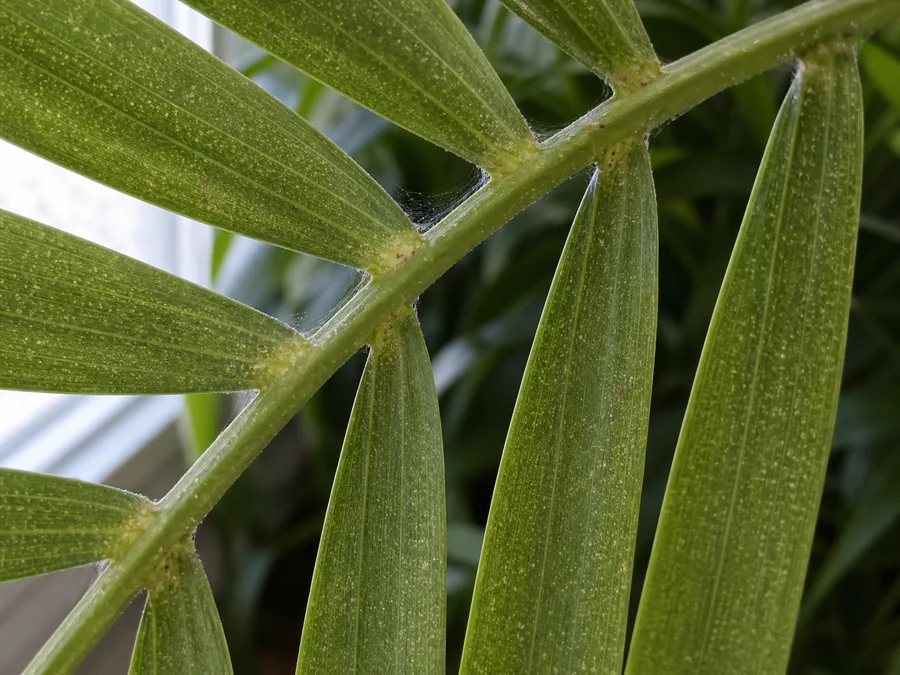
Spider mites cause thousands of tiny feeding marks that merge into a dull yellow or gray-green cast. This differs from a clean uniform fade because close inspection shows pale stippling across leaflets and sometimes delicate webbing near the rachis or leaflet bases.
A dry heated room can produce both mites and ordinary brown tips, so leaf color alone is not permission to spray. Confirm moving specks, shed skins, stippling, or fine webbing before choosing pest treatment.
How to identify it
- Yellowing resolves into many tiny pale dots when the leaflet is viewed in bright light.
- Fine web strands appear along the underside, rachis, or sheltered leaflet bases.
- A frond tapped over white paper drops tiny moving specks.
- The dull pattern spreads through sheltered interior foliage and may affect nearby houseplants.
- The root ball and drainage do not explain the speed or surface pattern of the damage.
What to do
- Separate the palm from other plants while inspecting both sides of each frond.
- Rinse the canopy thoroughly, especially the undersides, while keeping excess water out of the root ball.
- Use a product labeled for spider mites and indoor plants exactly as directed after mites are confirmed.
- Repeat inspection at the label interval because eggs and sheltered mites can survive one treatment.
- Keep new foliage clean and monitor nearby plants rather than using old yellow fronds as the success test.
06 Medium likelihood with visible residue
Soluble salts or a recent fertilizer dose injured the roots
Fertilizer and mineral-heavy water leave dissolved salts behind as moisture exits the pot. A high salt concentration makes water harder for roots to take up, so older fronds may yellow and develop brown margins even though the pot contains nutrients.
Look for a white or tan crust on the mix, rim, drainage holes, or saucer. The timing is especially useful when yellowing began after a strong feeding, feeding dry soil, or a long period of small waterings that never drained through the pot.
Do not answer suspected salt injury with another nutrient dose.
Pause fertilizer, confirm that water can pass freely through the pot, and flush only when the root ball is not saturated or rotten. Cleaner new growth after the residue and feeding pattern are corrected is stronger evidence than any change in an old yellow frond.
How to identify it
- Chalky residue coats the soil surface, rim, saucer, or drainage openings.
- Yellowing and edge injury are strongest on older fronds.
- The change followed a concentrated fertilizer dose or repeated feeding.
- Tap water leaves obvious scale on fixtures, kettles, or the humidifier.
- The pot drains, but normal watering rarely sends any water through the bottom.
What to do
- Stop fertilizer while the palm is stressed instead of trying to feed away the yellow color.
- Flush a freely draining pot with a generous volume of lower-mineral water, then let it drain completely.
- Do not flush saturated or poorly drained mix because extra water would worsen oxygen loss.
- Use rainwater, distilled water, or another suitable lower-mineral source when residue returns quickly.
- Resume light feeding only during active growth and follow the product rate for indoor foliage plants.
07 Lower after moisture and light checks
The yellow pattern points to nutrient availability
A palm can contain fertilizer and still fail to use a nutrient when damaged roots or an unsuitable root-zone reaction limits uptake. Palm nutrient disorders also affect different leaf ages and tissues, so a general yellow color is not enough to identify one.
Older fronds with patterned edge yellowing, broad pale growth across the plant, or a newest frond that opens pale, striped, or distorted are different clues. Confirm moisture, root health, light, salt history, and the age pattern before adding anything.
Record whether symptoms begin on the oldest, middle, or newest growth and whether the tissue between veins differs from the veins.
That pattern can guide a local diagnostic test, but it is not a reason to guess a single nutrient from photographs. A damaged root system must be corrected before it can respond predictably to feeding.
How to identify it
- Yellowing follows a repeatable pattern on old fronds, new fronds, or tissue between greener veins.
- The newest frond is unusually pale, narrow, striped, or distorted rather than merely lighter while it unfolds.
- Moisture, drainage, usable light, mites, and salt residue have been checked without finding a stronger cause.
- The potting mix is old, compacted, or known to be outside the suitable range for the plant.
- The palm has received either no nutrients through prolonged active growth or repeated unbalanced feeding.
What to do
- Do not diagnose one nutrient from a photograph or add several products at once.
- Check the fertilizer label, feeding record, water source, and root condition before choosing an amendment.
- Choose replacement mix that matches the roots when the old mix has collapsed, roots are salvageable, and the container can drain freely.
- Use a complete fertilizer labeled for palms or indoor foliage only after the root zone is functioning and active growth resumes.
- Ask a local extension or plant diagnostic service for help when the newest spear stays pale or distorted.
08 Seasonal or event-linked
Cold exposure or a sudden move shocked the canopy
A tropical Majesty Palm may yellow after touching cold glass, sitting in a cold draft, traveling through cold weather, or moving abruptly between light levels. The change often follows a dated event and affects the exposed side or recently handled fronds first.
A rapid move into stronger sun can add bleached tan patches, while chilling may progress from dull yellow-green to brown tissue. Neither pattern should be corrected with immediate fertilizer or repeated watering.
How to identify it
- Yellowing began soon after transport, a cold night, an open exterior door, or a major relocation.
- Damage is strongest on the side that touched glass or faced the draft.
- Several handled or exposed fronds changed together while sheltered growth stayed greener.
- The root ball, salt level, and leaflet surfaces do not show stronger evidence for another cause.
- New damage stops after the palm is returned to stable warmth and filtered light.
What to do
- Move fronds away from cold glass and exterior-door airflow while preserving similar light.
- Keep temperature and placement stable instead of moving the palm repeatedly in response to each marked frond.
- Acclimate a palm gradually when moving it closer to a brighter window.
- Water from the condition of the root ball because stressed foliage does not prove the roots are dry.
- Leave partly green fronds in place and use the next spear to judge recovery.
Remove a frond only after it has finished feeding the palm
Yellow tissue has lost chlorophyll and may not regain a useful green color, but the remaining green area still photosynthesizes. Removing every marked frond can leave an already stressed palm with too little working foliage.
Wait until a frond is fully yellow or brown unless it is soft, rotten, or heavily infested. Cut near the base with clean pruners without slicing the trunk or neighboring green petioles.
Separate the diagnosis by leaf age before removing anything.
One oldest frond fading slowly fits turnover. Several lower fronds above a heavy pot implicate root function.
Broad pallor with weak new growth and slow drying raises low light, while stippled individual leaflets require a mite inspection.
The central spear is the better recovery measure.
A firm green spear that opens into stronger leaflets, along with no spread to additional fronds, shows that the current correction is working. Marking the next higher green frond makes spread easier to judge than relying on memory.
Give a stable palm time to respond before stacking changes.
Light, root moisture, and temperature affect how quickly the container dries, so a move can require a new watering rhythm. Repotting, fertilizing, heavy pruning, and relocating on the same day add stress and conceal which condition mattered.
A soft or loose spear, spreading yellowing in wet mix, progressive root odor, or repeated pale distorted new growth needs prompt root inspection or local diagnostic help. Treat rapid center decline as a crown or root emergency rather than waiting for an old frond to finish yellowing.
Check Four Clues Before You Treat Yellow Fronds
Follow the checks in order so one symptom does not trigger conflicting treatments. The frond level tells you whether normal aging is plausible, then the root ball, central spear, and leaflet surface identify problems that need action.
Stop when a step supplies strong evidence. A dry center needs a different correction from saturated roots, while a firm green spear keeps the diagnosis outside the crown and visible stippling justifies a focused pest check.
- Locate the yellow frond. One oldest lower frond can retire normally, while several ages changing together need a whole-plant check.
- Check pot weight and moisture inside the root ball. Separate a heavy wet center from a light dry center or a gap beside the pot wall.
- Test the central spear gently. Firm upright new growth supports observation, while a loose or soft spear makes crown and root decay urgent.
- Inspect both sides of several leaflets under bright light. Fine stippling, webbing, shed skins, or moving specks support spider mites.
Recovery Plan
Map the yellow fronds and check the root ball
Photograph the canopy, mark which frond changed first, feel the pot weight, probe moisture at depth, and inspect leaflet undersides. Make the one correction supported by the strongest physical evidence.
Watch whether the pattern spreads
Old yellow tissue may continue declining, so watch the next higher frond and the central spear. Stable green tissue, improving pot behavior, and no new stippling are better signs than color on the original leaf.
Use new growth as the recovery test
A firm spear that opens greener and stronger shows that roots, light, or pest control improved. A pale distorted spear or fresh yellowing sends the diagnosis back to root health, nutrient availability, or a stressor that remains active.
Escalate decline that reaches the center
Seek experienced local help when the center softens, roots continue decaying, several new fronds remain abnormal, or confirmed mites persist after label-directed treatment. Those signs exceed normal lower-frond turnover.
Prevent spreading yellow fronds by learning the normal weight of the pot after watering and checking moisture below the surface before watering again.
Wet the full root ball, let excess water drain, and keep runoff out of the cachepot.
Keep Majesty Palm in bright filtered light with stable warmth, then adjust watering when season or placement changes its water use.
Inspect leaflet undersides and the central spear during routine watering so mites and weak new growth are noticed early.
Watch for white residue and keep a simple feeding record. Light nutrition during active growth supports the palm, but fertilizer cannot repair airless roots, a dry center, mite feeding, or cold injury.