
Thin, Patchy Buffalo Grass Often Has a Site Problem
Thin or bare areas in a buffalograss lawn usually follow shade, concentrated wear, uneven moisture, or a repair that never established. Decide whether the turf is dormant, stressed, or dead, then match the patch boundary to the site before adding water, fertilizer, seed, or pesticide.
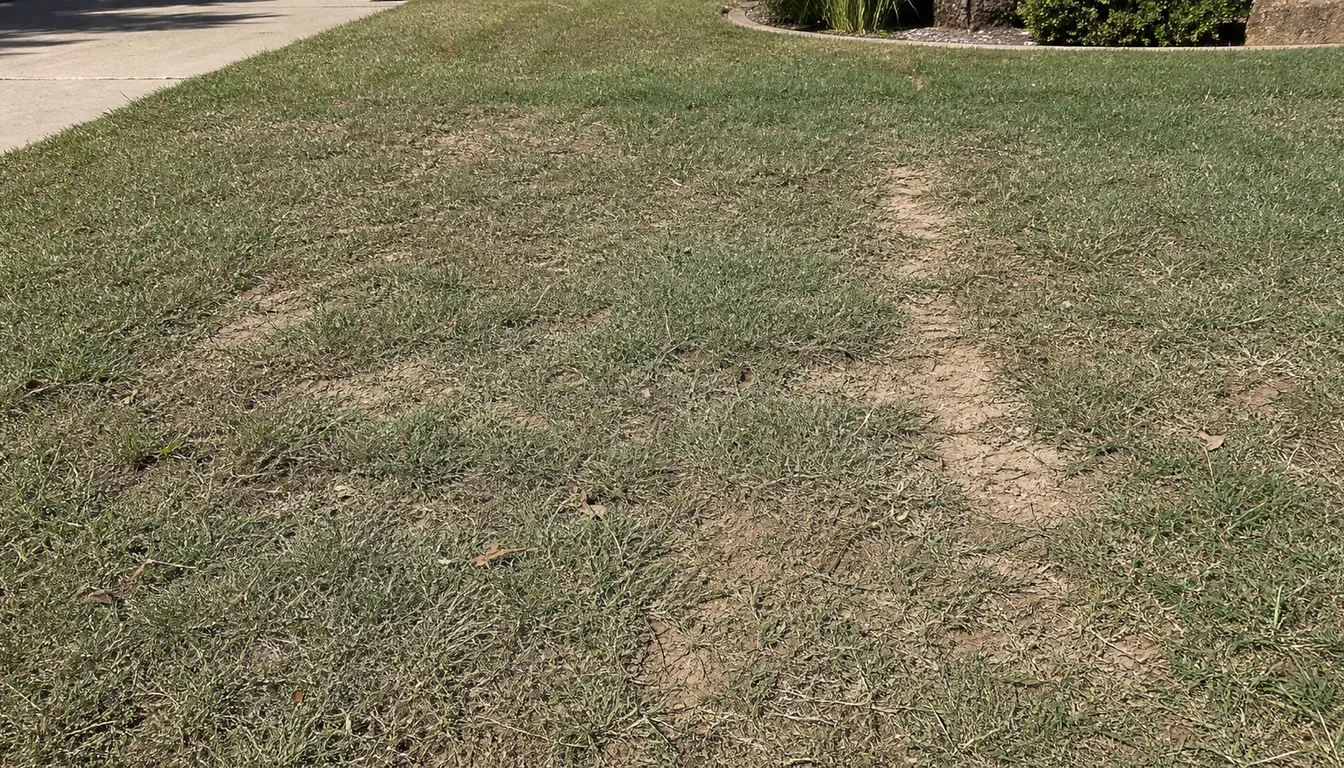
Quick diagnosis
A site pattern, seasonal dormancy, or concentrated wear
Check the calendar and the runners before repairing anything.
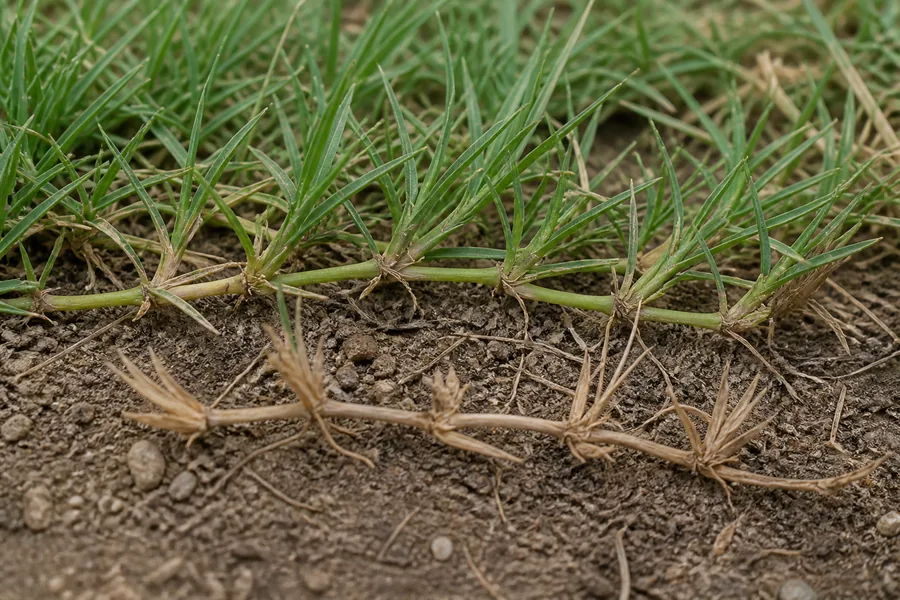
Cool-weather straw color with flexible rooted runners suggests dormancy, while loose brittle crowns suggest death.
In summer, the boundaries drawn by shade, sprinkler coverage, slopes, paths, and mower passes tell you more than color does.
Open the full diagnosisWhat You Are Seeing
Buffalograss is a native warm-season turf that spreads through above-ground runners called stolons. The buffalograss lawn profile covers both its low-input value and its limits in persistent shade, cool soil, and concentrated traffic.
Map each patch before you change the care routine.
Match a straight worn lane to traffic, a density change at a tree shadow to insufficient sun, or a dry arc to a sprinkler miss, then compare the soil and runners against healthy turf nearby.
Repair only while buffalograss is actively growing and the nights are warm. Living stolons close small gaps once the cause is corrected, while broad areas with dead crowns need matching plugs, sod, or seed plus temporary establishment watering.
Common Causes
01 Medium likelihood
Water stress and drought
Buffalograss goes dormant during drought and recovers when moisture returns, but prolonged dry soil kills crowns outright.
Uneven irrigation makes active-growth patches that follow sprinkler misses, slopes, or fast-draining soil rather than the even tan of seasonal dormancy.
How to identify it
- The patch expanded during hot, windy weather while irrigated turf nearby stayed green.
- Thin areas align with exposed slopes, sprinkler gaps, or sandy pockets.
- Soil below the root zone is much drier than soil under adjacent dense turf.
- Flexible runners remain rooted at nodes in a dormant patch, while dead runners are brittle and lift free.
What to do
- Measure sprinkler output with identical containers and correct blocked heads or gaps before increasing the whole system run time.
- When growth is desired, wet the root zone and then wait until it begins to dry rather than repeating shallow daily watering. Use deep-watering principles as a method, not a fixed calendar.
- Accept uniform drought dormancy where a green summer lawn is not required. Avoid alternating dormancy and rapid green-up with frequent light irrigation.
- Delay plugs or seed until moisture can be kept even during establishment, then reduce watering as roots take hold.
02 High likelihood
Incorrect mowing height or scalping
A low or uneven mower deck strips most of the green leaf from raised ground and clips stolons along the ridges. The damage follows repeated passes, wheel tracks, or high spots instead of the fixed boundary that shade draws.
How to identify it
- Thin areas follow mower lines or are concentrated along fence lines and edges.
- Blades look pinched, frayed, or shredded-sign of dull blades or high-speed reel mowers.
- New growth is sparse after a recent overly short mow (under recommended height).
- Stressed areas recover slowly after mowing events compared with adjacent turf.
What to do
- Raise the deck within the range recommended for the cultivar and never remove more than one-third of the green blade in one mowing.
- Sharpen mower blades at least once per season and check cutting deck for proper settings.
- If scalped in spring, reduce traffic on those areas, water lightly to encourage stolon spread, and repair with plugs if crowns have died.
- Adjust mowing frequency so you never cut too short during peak summer stress.
- Compare growth and habits with upright grasses when choosing mowing strategy using a turfgrass comparison.
03 Low likelihood
Soil compaction and poor drainage
Repeated traffic compresses pore space, crushes runners, and leaves roots with less air and water.
The resulting strip matches a gate, a play route, a parked wheel, or a mower turn, while a drainage failure collects water in a low spot instead.
How to identify it
- Thin strips in high-traffic zones, play areas, or mower paths.
- Water pools or runs off quickly rather than soaking in, despite thin turf.
- Resistance when probing the soil with a screwdriver or probe indicates compaction.
- Roots are short and concentrated in the top inch of soil when dug up.
What to do
- Core-aerate compacted areas while buffalograss is actively growing. Choose an aeration window that gives runners warm weather to recover.
- Topdress with a thin layer of screened compost or sandy loam to improve porosity and encourage stolon rooting.
- If high traffic is unavoidable, install stepping stones or hardscape to reduce wear, and rotate play areas.
- Follow aeration with plugs only where living runners cannot bridge the gap. Keep new roots evenly moist without soaking the surrounding established turf.
- For drainage issues, correct grading or install simple outlets to prevent standing water that kills buffalo crowns.
04 High likelihood
Normal dormancy or delayed spring green-up
Buffalograss turns straw-colored after frost and can stay dormant well after neighboring cool-season grass has greened up. A whole sunny lawn changing together fits the season far better than a spreading injury.
How to identify it
- Color changed broadly after cold weather or extended drought.
- Runners at several sample points remain flexible and firmly rooted.
- Small green shoots appear at nodes as soil warms.
- There is no matching shade line, traffic lane, loose turf, or feeding debris.
What to do
- Wait for sustained warm growing conditions before judging the stand or adding seed.
- Mark two small sample areas and watch the nodes for new shoots instead of repeatedly pulling runners.
- Do not force early green-up with heavy nitrogen or frequent spring irrigation, which can favor weeds before buffalograss is active.
- Repair only the areas whose crowns remain brittle and rootless after the rest of the lawn resumes growth.
05 High likelihood
Too much daily shade
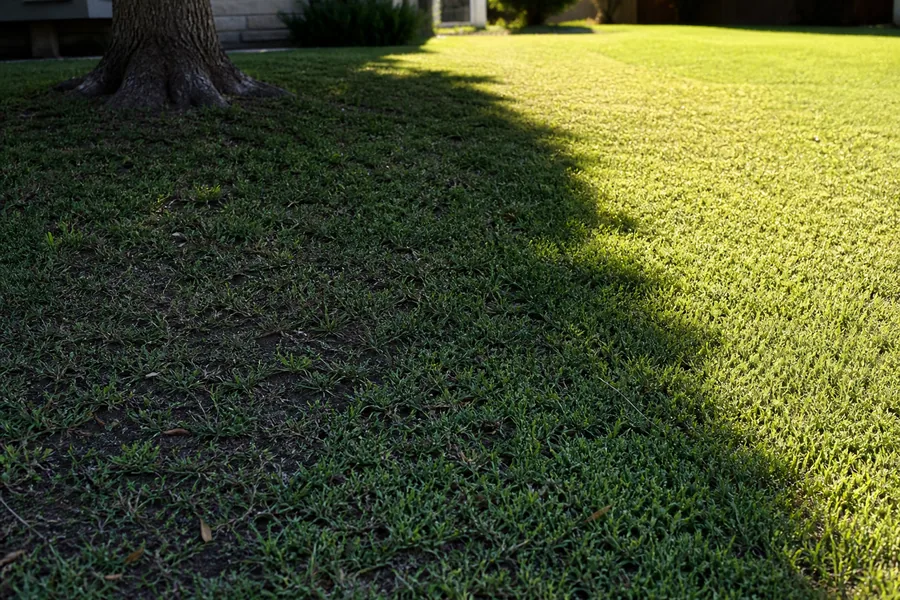
Buffalograss needs abundant direct sun.
Turf under a tree canopy, beside a wall, or north of a fence may survive and still stay open, because its stolons cannot make enough growth to close the soil.
How to identify it
- The edge between thin and dense turf follows the daily shadow boundary.
- Blades in the shaded area are longer and weaker rather than scorched or chewed.
- The same area stays sparse after irrigation coverage and soil moisture are corrected.
- Nearby turf on the same soil becomes dense where it receives more direct sun.
What to do
- Record direct sun across one clear day before pruning or replacing turf.
- Thin only appropriate small branches and preserve the tree's health and structure.
- Reduce traffic through marginal shade so the weakened runners are not also worn away.
- Where shade cannot change, replace the lawn strip with mulch, a path, or a plant suited to that light rather than repeatedly reseeding buffalograss.
06 Medium likelihood
Excess water, nitrogen, weeds, or thatch
This is a low-input grass, and it does not get denser simply because it receives more fertilizer and water. Excess inputs encourage weeds and organic buildup, while a thick thatch layer keeps runner nodes from touching moist soil.
How to identify it
- Weeds are vigorous while buffalograss remains open or weak.
- A cut plug shows a spongy brown layer between green tissue and mineral soil.
- The soil stays wet long after irrigation or has a sour smell in low areas.
- Rapid soft growth followed a fertilizer application but did not close the bare soil.
What to do
- Measure the thatch layer on several plugs and manage it when it is thick enough to keep stolons off the soil surface.
- Reduce irrigation when the root zone remains wet and compare symptoms with overwatered lawn signs.
- Use a soil test and local buffalograss guidance before applying more nitrogen.
- Correct the input pattern first, then help living runners contact soil with light topdressing where appropriate.
07 Medium likelihood
Seed, plug, or sod establishment gaps
A new lawn stays patchy where seed dried out, plugs lost soil contact, or sod seams never rooted.
Seeded and vegetative cultivars also need different repair material, so leftover seed may not match an installed vegetative lawn.
How to identify it
- Bare areas repeat the original plug spacing, sod seams, or runoff channels.
- Healthy young plants stop abruptly where the seedbed crusted or dried.
- A sod corner lifts without new white roots entering the prepared soil.
- Established runners are healthy at the edge but the gap is too wide for quick closure.
What to do
- Identify whether the lawn came from seed, plugs, or sod before buying repair material.
- Loosen and level the bare surface so plugs or seed have direct soil contact.
- Keep a new seedbed evenly moist during germination, then use new-grass watering stages to transition toward deeper watering.
- Use living edge growth for small gaps, plugs for larger isolated gaps, and broader renovation only where most crowns are dead.
08 Low likelihood
Confirmed webworm, chinch bug, or grub feeding
Insects sit below site and care problems in this diagnosis. Buffalograss webworm clips leaves and stems, chinch bugs feed around the crowns, and white grubs prune roots, but color or a dry patch alone confirms none of them.
How to identify it
- Webworm inspection finds larvae, silk, green pellets, or clipped blades near the soil surface.
- Small moving chinch bugs appear at the active edge when the canopy is parted or sampled.
- Grub-damaged turf lifts like loose carpet and curved larvae are present in the root zone.
- The damaged edge continues expanding after water coverage, shade, and traffic patterns are ruled out.
What to do
- Inspect several points at the active margin, including one healthy comparison point.
- Use the root and turf-lift checks for grubs before considering a grub treatment.
- Identify the insect and life stage, then follow current local extension advice and the product label for a targeted treatment.
- Repair dead areas only after feeding stops because pesticide cannot reconnect dead runners or correct a shaded site.
Recognize stress, pests, and disease
Buffalograss regrows from nearby living stolons unless the crowns and roots are dead.
Inspect a small square for attached runners, roots, lesions, and feeding evidence before deciding that seed or sod is required.
Insects and disease do thin warm-season turf, but they rank below site failures here. Treat only after finding direct evidence such as loose rootless turf with grubs, clipped stems with feeding debris, or lesions at an active margin.
A soil test can expose a pH or nutrient imbalance behind diffuse, uniformly pale thinning.
Test before adding fertilizer, and use the result instead of guessing.
Is the grass dormant, stressed, or actually dead?
Start with season and distribution. Frost turns this warm-season grass tan and cool soil delays growth, so broad color change across sunny areas can be normal while an isolated patch enlarging in warm weather needs a site check.
Inspect several runners at the border instead of tugging the center once. Living stolons bend and remain rooted, while dead crowns feel brittle and lift without resistance, and healthy turf nearby supplies a moisture and soil reference.
Give living dormant turf time to respond to warm conditions. Mark the border and photograph it weekly rather than forcing color with seed, heavy fertilizer, or pesticide, because an advancing edge shows stress while shoots at rooted nodes show recovery.
The patch shape points to the site problem
Walk the boundary at two times of day and match it with permanent features. A tree shadow can explain a sharp density change, a fan-shaped dry area suggests poor sprinkler overlap, and a narrow strip through a gate or mower turn points toward wear.
Buffalograss survives occasional use but cannot replace runners crushed by constant traffic. Push a screwdriver into moist soil inside and outside the lane, then redirect feet before aerating because unchanged traffic will compact the strip again.
Mower injury follows passes or high spots. Measure the deck on a level surface, inspect blades for frayed tips, and look for clipped crowns along ridges because a disease patch does not normally reproduce the entire mowing route.
More water and fertilizer can make the stand worse
Buffalograss stays useful with fewer inputs than many lawn grasses. Frequent spring irrigation can wake weeds early, and excess nitrogen creates soft growth without correcting shade, traffic, or dead crowns, so weather, root-zone moisture, and a soil test should guide each input.
Check irrigation with equal straight-sided containers across thin and healthy turf. Correct coverage differences, then wet the active roots and allow the soil to begin drying because clay, sand, slope, temperature, and wind make a fixed weekly number unreliable.
Cut a small plug to measure the brown organic layer above mineral soil. A thick springy layer keeps nodes from rooting and can shed water, so reduce the inputs that produced it and time physical thatch removal for active growth.
Wait for runners, add plugs, or rebuild the patch?
Use the smallest repair that can close the gap. If rooted green runners surround a small opening, remove the stress, loosen the surface, and pin a few living nodes against soil so they can spread inward during warm growth.
Use plugs when the opening is too broad for edge growth but the site still suits buffalograss. Match the existing cultivar when possible and keep new root balls moist without continuing daily irrigation after they establish.
Seed fits a seeded cultivar and a properly prepared broad area. It needs direct soil contact and light establishment water before the schedule shifts deeper, while sod closes soil faster but will still thin if shade or traffic remains.
Treat insects only after finding insect evidence
Put insects below season, light, moisture, traffic, and mowing unless the patch contains direct evidence. Webworms leave clipped tissue or feeding debris, chinch bugs must be found at the active edge, and grub injury loosens roots so turf lifts unusually easily.
Sample the active edge, damaged center, and healthy turf. A soap flush can expose surface-feeding larvae, while a small soil cut reveals the root zone, so identify what is present instead of blaming every insect found in soil.
Use current local extension thresholds and the product label after identification. Treatment timing depends on pest and life stage, and repair begins only after feeding stops because pesticide cannot reconnect dead runners.
Recovery Plan
Immediate actions and stabilization
Stop the damaging practices by raising the mowing height, sharpening the blades, and correcting the watering pattern.
Keep traffic off the worst patches and prepare only the confirmed dead areas for repair.
Establishment and visible regrowth
Plugs and small sod pieces root and spread only during active warm growth. Seeded repairs take longer to knit and need an evenly moist seedbed before the watering shifts deeper.
Thatch reduction and filling in
Stoloniferous growth and the adjoining healthy turf should fill moderate patches within two to three months once the cultural problems are fixed.
Large dead patches or root death may need sod, which recovers fastest and costs the most.
Prevent another thin stand by mowing for the cultivar, watering from measured soil need, relieving confirmed compaction, and basing fertilizer on a soil test. Inspect shade lines, traffic routes, blade condition, and pest evidence each season so one primary cause is corrected before repairs begin.
Sources
- Buffalograss home lawns, Colorado State University Extension
- Sod webworms, Oklahoma State University Extension
- Managing thatch in lawns, Oklahoma State University Extension
- Buffalograss lawns, Kansas State University Extension
- Buffalograss, Texas A&M AgriLife Turfgrass Science
- Buffalograss, Missouri Botanical Garden Plant Finder