
Sparse Bahia Grass Needs Warmth Before More Fertilizer
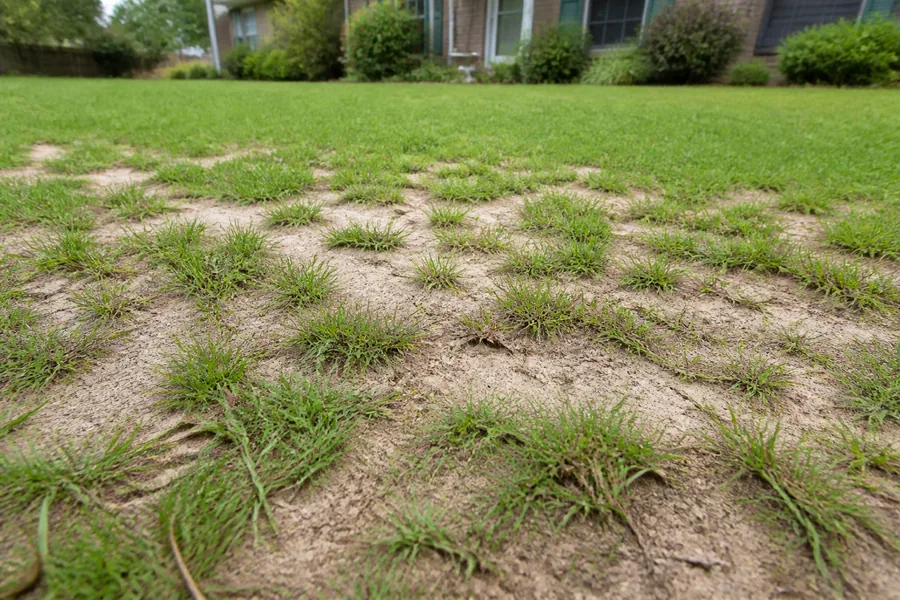
A thin bahiagrass lawn is sometimes a failing lawn and sometimes just bahiagrass, which grows in a coarse open habit by design. This page separates the two.
Then it works through the causes worth acting on.
A mower set too low, shade the grass cannot tolerate, mole crickets, compaction, and a soil pH that turns the lawn pale no matter how much nitrogen goes down.
Quick diagnosis
The lawn is cut too short, or it has not warmed up enough to be growing yet.
Start with where the thinning sits, because the pattern names the cause faster than anything else.
Thin under and around trees is shade, thin along the routes people walk is compaction, and thin in patches with raised soil ridges is insects working underneath. Thin evenly across the whole lawn points at the season, the mowing height, or the soil pH.
If the grass is brown everywhere in spring, tug a handful before doing anything, since dormant turf holds firm and dead turf pulls away.
Open the full diagnosisWhat You Are Seeing
Bahiagrass does not grow like the lawns in seed catalogs. It has wide coarse blades and an open habit, and it was selected for tough sandy low-fertility ground rather than for looking like a putting green.
That matters before any repair, because a good bahiagrass lawn still shows some soil between the plants. Chasing a density this grass cannot reach leads to overfeeding, which brings weeds and thatch rather than thickness.
The second question is timing. This is a warm-season grass that stays brown until the soil warms and greens up through early to mid spring, so a lawn judged in March is often being judged before it has woken up.
Common Causes
01 High likelihood
Still dormant, or greening up late
Warm-season grasses run on soil temperature rather than on the calendar. Bahiagrass greens up through early to mid spring, and a cool or wet spring pushes that later, so a lawn that looks dead in early spring is frequently just asleep.
Feeding it at that point achieves nothing useful. The grass is not taking up nutrients yet, so the nitrogen feeds whatever weeds are already growing and washes out of sandy soil before the lawn can reach it.
How to identify it
- It is early spring and the whole lawn is uniformly brown or straw-colored.
- A tugged handful of grass holds firm rather than lifting away.
- Green is starting to appear in the warmest, sunniest parts first.
- Neighboring warm-season lawns look the same.
What to do
- Tug a handful of turf before concluding anything, since dormant grass resists and dead grass comes away.
- Wait for the lawn to be actively growing before feeding, which is usually mid spring rather than early.
- Hold off on seeding too, because bahiagrass seed needs warm soil to germinate.
- Mow only once there is green growth to remove.
02 High likelihood
Mown too short
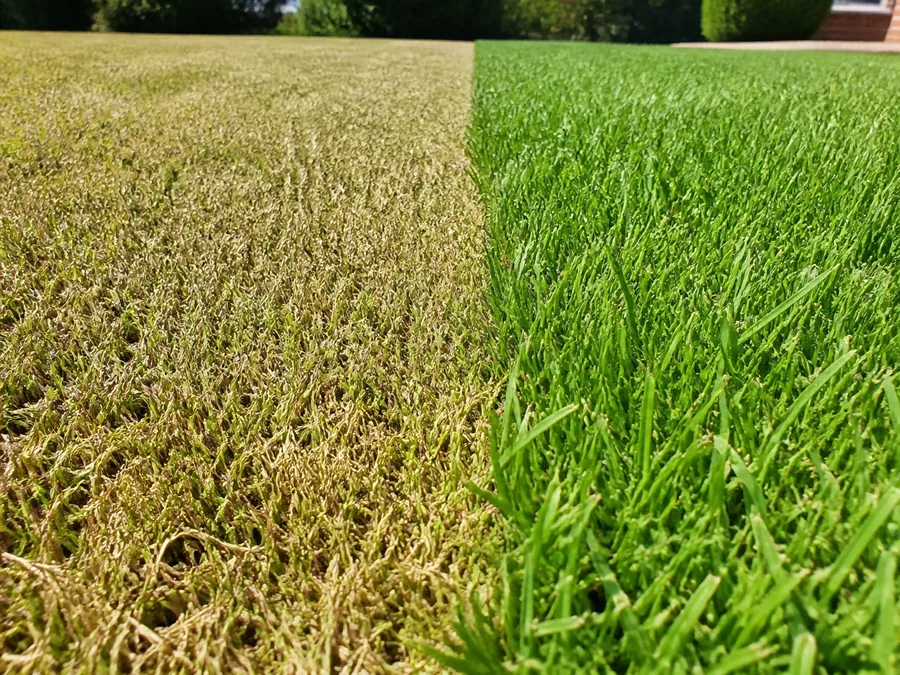
Bahiagrass wants two and a half to four inches, which is taller than most people set a mower. Cut below that and you remove the leaf area the plant needs to feed itself, and it responds by shrinking its root system.
That is the mechanism behind the thinning. Shorter roots reach less water, so the lawn struggles in summer and opens up further, and each low cut makes the next summer harder.
There is also a rule about how much to take at once. Removing more than a third of the blade in a single pass shocks the plant, so a lawn that has grown long needs two cuts a few days apart rather than one hard one.
How to identify it
- The lawn looks yellow-brown immediately after mowing and greens up over the following week.
- You can see stems and stubble rather than leaf blades.
- High spots and slopes are worst, since the mower sits lower there.
- The mower deck is set at two inches or below.
What to do
- Raise the deck to at least two and a half inches, and to four in any shaded area.
- Mow often enough that you never remove more than a third of the height at once.
- Cut a long lawn down in two passes several days apart rather than one.
- Keep the blade sharp, because a torn cut browns the leaf tips and adds to the pale look.
- Leave the clippings, which return nitrogen and cost nothing.
03 High likelihood
Too much shade
Bahiagrass is among the least shade tolerant lawn grasses in common use. Under trees and along the north side of buildings it thins out and stays thin, and no fertilizer, seed or watering program changes that.
Raising the cut helps a shaded area cope, since more leaf means more light captured, but it manages the decline rather than reversing it.
How to identify it
- Thinning follows the tree canopy and the shadow line of buildings.
- Open sunny parts of the same lawn are thick and healthy.
- The grass in shade is stretched and leggy rather than compact.
- The problem has worsened over years as trees have grown.
What to do
- Leave shaded areas at the full four inches all season.
- Thin the tree canopy to let more light through, which helps more than anything applied to the ground.
- Accept a different ground cover or mulched bed under dense shade rather than reseeding every year.
- Stop feeding shaded areas at the same rate as sunny ones, since the grass cannot use it.
04 Medium likelihood
Compaction and traffic
Compacted ground squeezes the air out of the soil, and roots need air as much as they need water. The thinning shows up as lines and patches that match exactly where people, mowers or vehicles actually go.
The test takes a second. Push a screwdriver into moist soil in a thick part of the lawn and then in a thin part, and the difference in resistance is usually obvious.
How to identify it
- Thin strips run along the routes people walk between doors, gates and parking.
- A screwdriver pushes into the good areas easily and meets resistance in the bad ones.
- Water pools or runs off rather than soaking in.
- The soil surface is hard and smooth rather than crumbly.
What to do
- Core aerate during active growth in late spring or summer, never while the lawn is dormant.
- Reroute the traffic with a path, stepping stones or a planted edge, since the wear will otherwise return.
- Top dress lightly with compost after aerating to keep the holes open.
- Avoid driving or parking on the lawn, which compacts deeper than foot traffic can.
05 Medium likelihood
Mole crickets and other turf insects
Mole crickets do their damage out of sight. They tunnel just below the surface and sever the grass from its roots, so the lawn dries out and thins while the blades themselves look undamaged, which sends people looking for a disease.
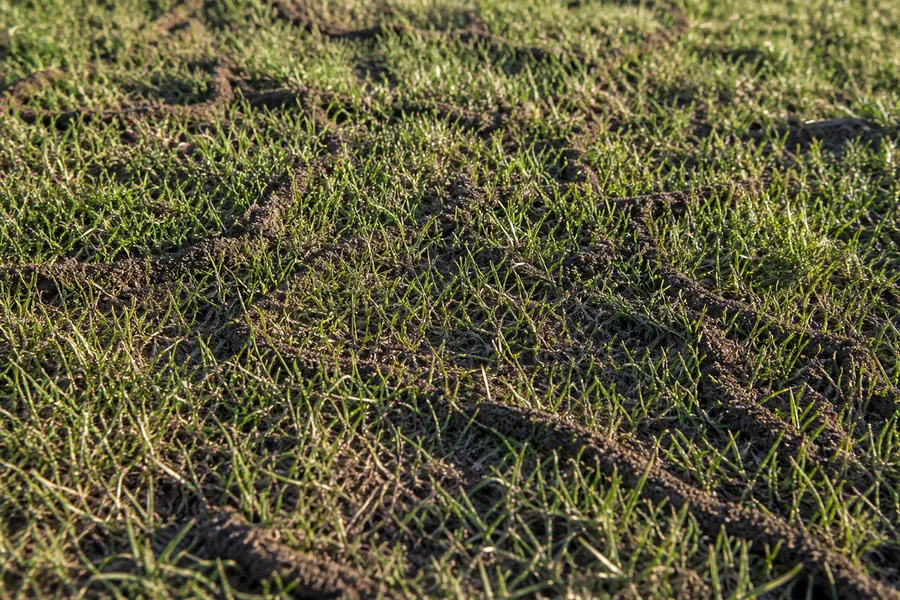
What gives them away is the ground rather than the grass. Raised soft ridges wander across the surface and small mounds of loose granular soil appear, especially visible in low morning light.
A soap flush settles it in minutes. Drench a square yard with soapy water and anything living below comes to the surface, which is worth doing before spending money on a treatment.
How to identify it
- Soft raised ridges wander across the surface and give underfoot.
- Small mounds of loose granular soil appear overnight.
- The turf lifts easily because it has been cut from its roots.
- Damage spreads through late spring and summer rather than appearing at once.
What to do
- Flush a square yard with soapy water and watch for a few minutes before treating anything.
- Treat while the insects are small in early summer, since large adults are far harder to control.
- Water the lawn before and after any soil-applied product so it reaches the tunnelling depth.
- Check for bahiagrass billbugs and fall armyworms too, which thin the same lawn on different timing.
- Keep the lawn growing well, since vigorous turf outruns light insect pressure.
06 Medium likelihood
Soil pH above the range
Bahiagrass wants acidic ground, somewhere around 5.5 to 6.5. Above a pH of 7.0 the iron in the soil turns into a form the roots cannot take up, and the lawn fades to a pale yellow-green.
This one is worth catching because it misleads. A pale lawn looks underfed, so the natural response is more nitrogen, and nitrogen cannot solve a problem caused by iron being locked away.
How to identify it
- The lawn is pale yellow-green rather than genuinely thin.
- Color does not improve after feeding.
- The soil is limestone-derived, or the lawn sits near concrete, mortar or a shell drive.
- A soil test reads above 7.0.
What to do
- Test the soil pH rather than guessing, since the fix depends on the number.
- Apply elemental sulfur at the labeled rate to bring pH down gradually over seasons.
- Use a liquid iron application for a short-term color response while the pH correction works.
- Stop adding lime, and check whether irrigation water is hard enough to be raising pH over time.
07 Medium likelihood
Genuinely underfed
Sometimes the lawn really is short of nitrogen, but the correct rate for bahiagrass is much lower than for most lawns. Never put down more than one pound of nitrogen per thousand square feet in a single application, and annual totals run from around one pound in the cooler parts of its range to four in the deep south.
This grass was chosen for poor ground, and it responds to overfeeding by producing thatch and inviting weeds rather than by thickening up. Restraint genuinely works better here than generosity.
How to identify it
- The lawn is uniformly pale and growing slowly during warm weather.
- It has not been fed for a year or more.
- Clippings are sparse and the lawn barely needs mowing in midsummer.
- The soil is sandy and rain has been heavy.
What to do
- Feed from mid spring once the lawn is actively growing, and continue through summer.
- Keep every application at or below one pound of nitrogen per thousand square feet.
- Use a slow-release product on sandy soil, which otherwise loses nitrogen to the first heavy rain.
- Leave clippings on the lawn, which supplies a useful share of the annual requirement for free.
Will It Fill Back In?
Partly, and more slowly than you might expect. Bahiagrass spreads by short thick stems that creep along the surface, and those advance a little each season rather than sending long runners across a gap the way some warm-season grasses do.
A bare patch a foot across will close over a warm season if the conditions causing it have been fixed, while a larger one is usually faster to plug or seed than to wait out.
The ceiling is worth naming.
Even a thriving bahiagrass lawn stays more open than a fine-textured one, so the honest target is a healthy lawn of this species rather than the appearance of a different one.
Is It Thin, or Is It Bahiagrass?
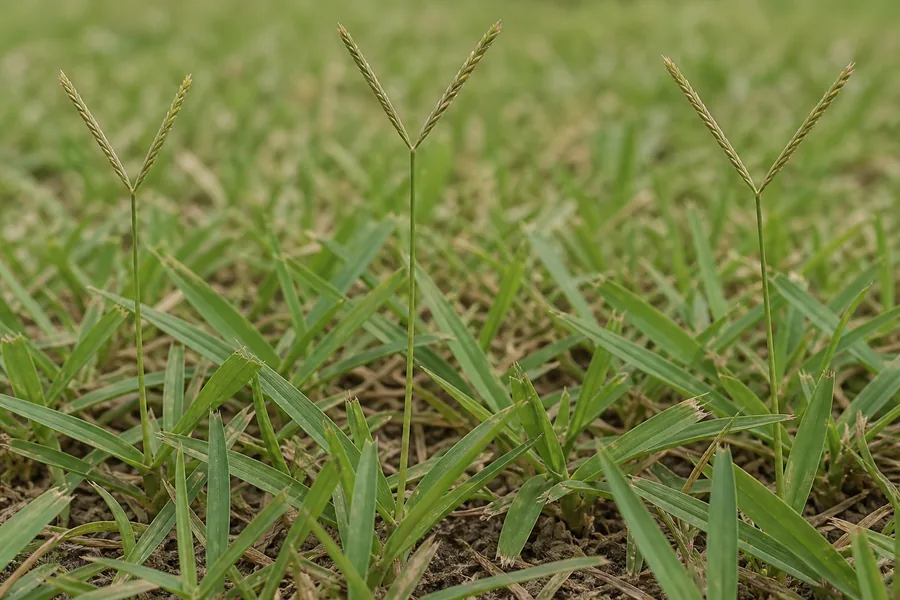
Confirm the species first, because the whole standard depends on it. Bahiagrass has wide coarse flat blades, and its seedhead is unmistakable once you know it, rising on a tall bare stem that splits at the top into a narrow V of two slender spikes.
Those seedheads are also why the lawn can look untidy days after mowing. They shoot up quickly and stand well above the leaf, which is a habit of the grass rather than a sign of neglect.
The open growth is built in. Bahiagrass puts its energy into a deep root system that lets it survive drought and poor sandy soil, and the trade for that toughness is a coarser, thinner-looking surface than a pampered lawn grass produces.
So judge it against itself. If the blades are green, the growth is steady and the gaps are consistent across the sunny parts of the lawn, the grass is doing what it does, and the causes on this page are not what you are looking at.
Recovery Plan
Change the settings
Raise the mower and confirm what you are dealing with by tugging turf, pushing a screwdriver into the soil, and flushing a patch with soapy water. A higher cut shows within two or three mowings.
Where the thickening happens
Bahiagrass only closes gaps while it is actively growing in warm weather. Aeration, feeding and any seeding all belong in this window rather than at the edges of the year.
Where a pH correction lands
Sulfur shifts soil pH over months, so a correction made this season is judged the following summer. Shade problems will also have moved on by then, usually in the wrong direction.
Set the mower high and leave it there, because the cutting height does more for this grass than anything else you can buy.
Two and a half to four inches, and the full four in any shade.
Then feed sparingly and only during active growth.
Bahiagrass was selected for poor ground, so the failure mode of a well-meaning owner is too much nitrogen rather than too little, and that produces thatch and weeds instead of density.