
Is My Kentucky Bluegrass Dormant or Dead in Summer Heat?
Kentucky Bluegrass often survives hot, dry weather by letting its leaves turn straw-brown while the crowns and roots remain alive. Check the browning pattern, moisture below the thatch, and an intact turf plug before you water heavily, apply a pesticide, or reseed.
Quick diagnosis
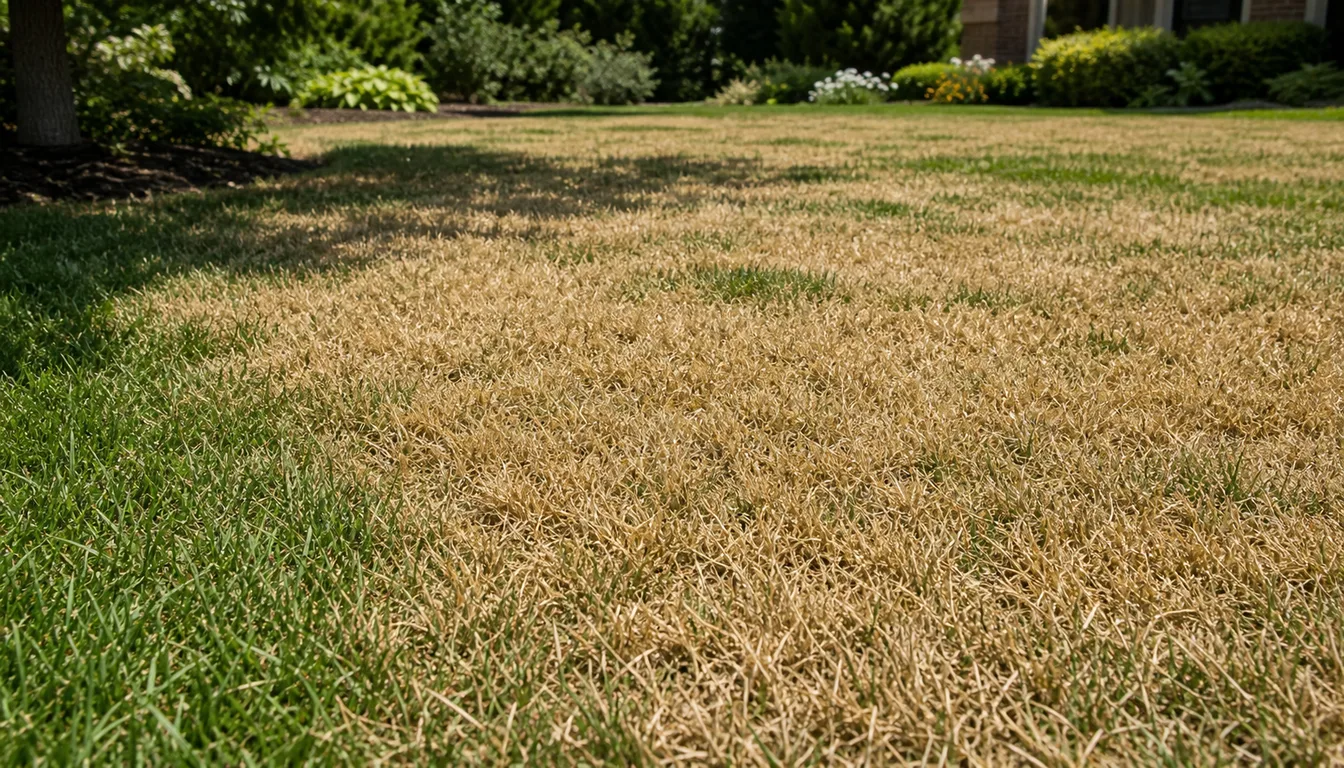
Drought dormancy when browning is broad and crowns remain firm
Broad browning after sustained heat and dry soil usually fits summer dormancy, as long as the turf stays rooted and the crowns at soil level feel firm.
Brown patches that lift loose, spread as rings, smell rotten, or show no new basal growth once cooler weather and moisture return need another diagnosis.
Open the full diagnosisWhat You Are Seeing
Kentucky Bluegrass is a cool-season, rhizome-forming grass. During drought its blades stop growing and die back while buds in the crown and rhizomes hold on to the lawn's ability to recover.
Start with the pattern across the whole lawn.
Dormancy follows the hottest, driest exposure, a missed sprinkler zone draws arcs or strips, and a root disease makes separate patches, rings, or crescents.
Compare a brown area with a greener one carrying similar foot traffic. Probe below the thatch in both, because a damp surface hides dry soil and runoff can leave a slope dry even after a full sprinkler cycle.
Summer dormancy is not the same problem as a persistently thin Kentucky bluegrass lawn.
Dormancy explains a seasonal change in color and growth, while chronic thinning means the stand has already lost density to shade, traffic, compaction, disease, or weak establishment.
Common Causes
01 High likelihood
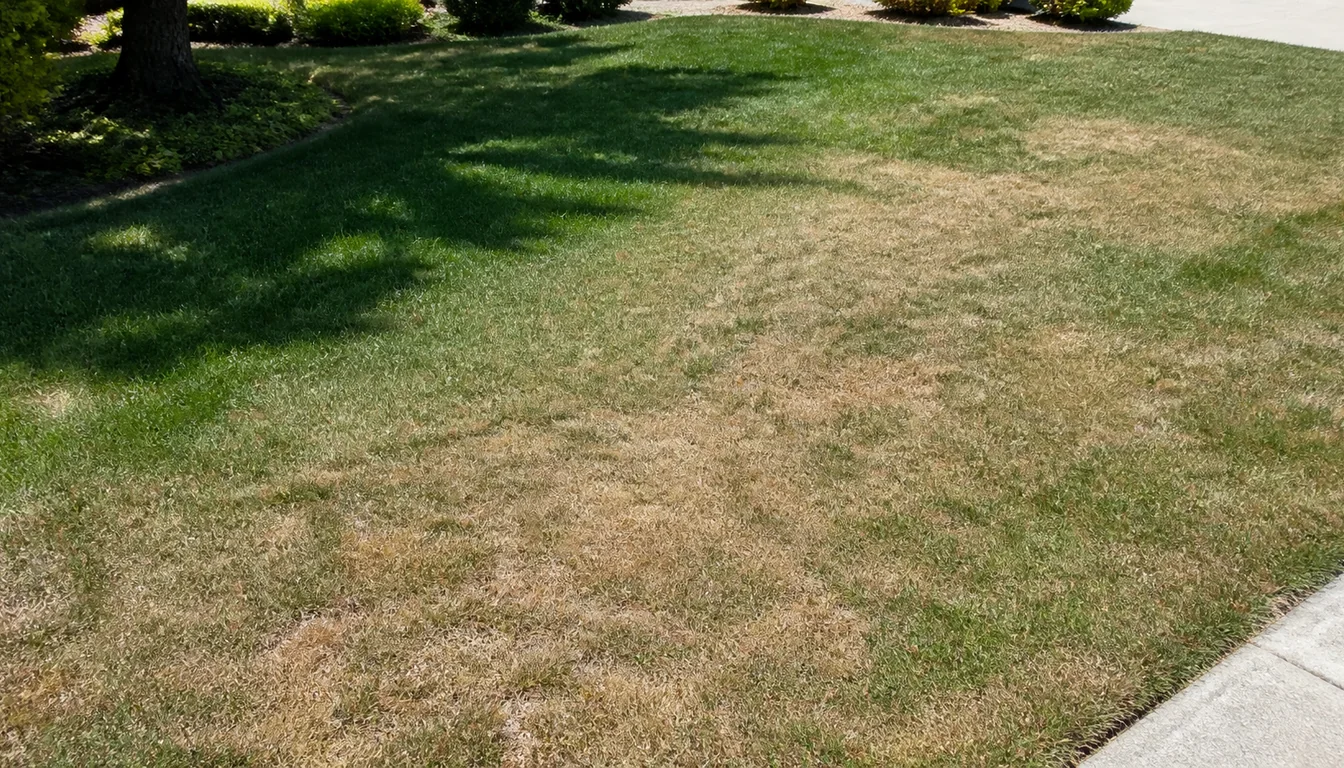
Heat and drought dormancy
Kentucky bluegrass slows leaf growth as the soil dries and summer heat drives water loss.
The visible blades turn tan or straw-brown, and established crowns and roots can stay alive for several weeks underneath.
The pattern is broad across open sunny turf and often shows first beside south- or west-facing pavement. A shaded margin or a low spot stays greener because it loses water more slowly or collects runoff.
Dormancy is a reasonable water-saving choice on an established, low-traffic lawn when brown color is acceptable for a season.
It is not permission to ignore the turf through an exceptionally long drought, because crowns do eventually die.
How to identify it
- Browning spread widely during hot weather with little rain.
- Growth slowed enough that the lawn needs little mowing.
- Crowns at the soil line remain firm and attached to flexible roots.
- Green shoots begin at the base after moisture returns and temperatures ease.
What to do
- Choose either survival dormancy or an actively green lawn before changing irrigation.
- Keep people, pets, and vehicles off brittle dormant turf as much as possible.
- Supply survival moisture during a prolonged dry period instead of repeatedly waking and re-drying the lawn.
- Wait for new basal growth before deciding that brown foliage means the plants are dead.
02 High likelihood
Shallow or uneven irrigation
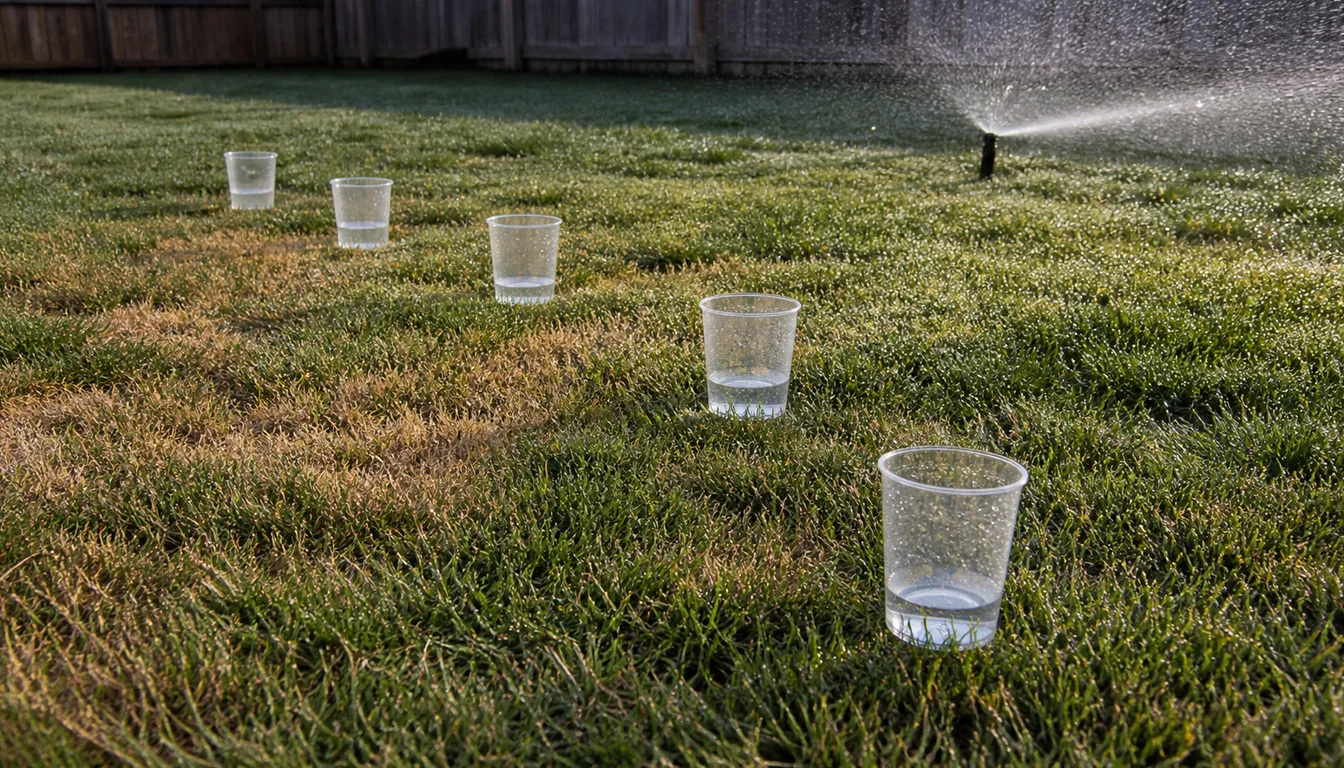
A sprinkler system can run exactly on schedule and still leave part of the root zone dry. Blocked spray, mixed nozzle types, low pressure, wind, slopes, and narrow strips all create different application rates inside one zone.
Look for straight edges, repeated arcs, dry corners, and brown turf beside pavement.
Green overlap bands between heads are the most useful sign of all, because they show that water distribution rather than the grass is drawing the pattern.
Put identical straight-sided catch cups across the zone and run one normal cycle. Compare the collected depth, then correct the coverage or split the cycle if water runs off, rather than assuming the whole lawn needs more water.
How to identify it
- Brown areas follow sprinkler arcs, zone boundaries, slopes, or hardscape.
- Catch cups collect noticeably different depths during the same cycle.
- The surface becomes wet while soil below the thatch remains dry.
- The same locations brown again soon after a short watering.
What to do
- Straighten tilted heads and clear grass that blocks the spray.
- Replace clogged or mismatched nozzles with parts intended for that zone.
- Use repeated short soak cycles on slopes when one long cycle creates runoff.
- Measure the result again before increasing every zone's runtime.
03 Medium likelihood
Weak crowns and shallow roots
Low mowing, compacted soil, heavy traffic, and a hard nitrogen push before the heat all leave Kentucky bluegrass badly prepared for drought.
Such a lawn enters dormancy sooner and loses more crowns than neighboring turf under identical weather.
Scalped high spots brown along the exact mower path, while compacted routes feel hard to probe and shed water. Lush growth from late spring nitrogen also demands water just as root growth is slowing in summer heat.
Take the current stress off before planning any renovation.
Raise the mowing height, keep traffic off dormant areas, hold back heavy nitrogen, and book core aeration for a season when cool-season turf can actually recover.
How to identify it
- The worst damage follows mower-scalped rises or repeated walking routes.
- A probe enters healthy soil more easily than the brown area.
- Water runs from compacted ground before soaking below the thatch.
- The lawn was pushed with fast nitrogen shortly before hot weather.
What to do
- Mow Kentucky bluegrass near 3 to 3.5 inches during summer when local guidance supports that range.
- Never remove more than one-third of the living blade in one mowing.
- Delay strong nitrogen feeding until the cool-season growth period.
- Aerate compacted soil when the turf is actively growing, not while crowns are heat-stressed.
04 Medium likelihood
New sod or seedlings drying out
Recently laid sod and young seedlings have none of the deep roots, rhizomes, or stored reserves an established lawn carries.
Letting them go dormant on purpose can kill the plants before they have anchored into the soil at all.
Lift one corner of sod, or inspect the seedbed without tearing the new roots. Moist soil beneath a brown strip points to poor soil contact, while dry soil beneath it points to too little establishment water.
Keep the new root zone evenly moist for its establishment stage, and avoid standing water.
Once the sod resists a gentle lift and new growth needs mowing, start lengthening the interval between waterings rather than stopping abruptly.
How to identify it
- The brown turf was installed or seeded during the current or previous growing season.
- Sod seams and exposed edges dry before the center of each piece.
- A sod corner lifts easily because roots have not entered the soil.
- Seedlings wilt or disappear instead of leaving firmly rooted dormant crowns.
What to do
- Do not manage young turf as an intentionally dormant established lawn.
- Keep the full sod and seedbed depth moist while roots establish.
- Correct poor contact between sod and soil where seams stay dry.
- Shift toward deeper, less frequent irrigation only as roots develop.
05 Lower
Summer patch disease
Summer patch damages Kentucky bluegrass roots well before the symptoms show in hot weather. The weakened plants then collapse under heat and drought, which is exactly why the disease gets mistaken for ordinary dormancy.
Instead of one broad fade tied to exposure, look for separate orange-brown patches that grow into rings, arcs, or frog-eye shapes.
Several patches may merge, but green turf usually survives between the early lesions.
Do not confirm summer patch from color alone. Record the geometry and the timing, inspect the roots, and use a turf diagnostic service when the pattern keeps returning, because long-term management depends on a reliable diagnosis.
How to identify it
- Damage starts as separate circular or oval orange-brown patches.
- Patches enlarge into arcs or rings rather than following a sprinkler edge.
- The same locations return during summer heat in successive years.
- Adequate moisture does not produce the broad green-up expected from dormancy.
What to do
- Photograph the pattern before it merges or the lawn changes color.
- Submit a fresh edge sample to a turf diagnostic lab when disease is plausible.
- Avoid shallow daily watering and excessive nitrogen that can worsen root stress.
- Base any fungicide program on confirmed disease and local timing advice.
06 Lower
Root-feeding insects or dead turf
White grubs and other root feeders can sever enough root that a brown patch detaches from the soil completely.
Drought-killed turf also goes brittle and loose once the crowns and roots have died.
Cut three sides of a small flap at the border between damaged and healthy grass, then fold it back. Loose turf with shortened roots, C-shaped grubs, or animal digging calls for a different response than a firmly attached dormant stand.
One grub found by chance does not prove damaging numbers, and a dry brown leaf does not prove death.
Count insects in a measured area, check several patch edges, and judge the crown tissue before choosing treatment or seed.
How to identify it
- A brown patch lifts like loose carpet because roots have been lost.
- C-shaped larvae appear in the upper soil near the expanding edge.
- Skunks, raccoons, or birds dig repeatedly in the damaged turf.
- Crowns are hollow or brittle and produce no basal shoots after moisture returns.
What to do
- Inspect several measured samples before deciding that grubs caused the injury.
- Use local extension thresholds and timing if treatment is justified.
- Reseed only areas whose crowns and roots are dead.
- Prepare seed-to-soil contact during the preferred cool-season establishment window.
Brown blades can sit above living crowns
A brown grass blade is dead tissue and will never turn green again.
Kentucky bluegrass survives dormancy through the living crown and the buds on its underground rhizomes.
That distinction is why color on its own is unreliable. A lawn can look uniformly straw-colored while every plant stays anchored and ready to push new basal shoots once cooler temperatures and moisture return.
Dormancy still spends stored reserves, and it does not protect turf indefinitely.
Long drought, hot soil, heavy traffic, shallow roots, or a young root system can turn a reversible pause into permanent crown loss.
Check representative plugs rather than pulling the driest surface blades. The crown, the root attachment, the soil moisture, and the response over time all carry more diagnostic weight than old foliage.
Check the crown, roots, and soil together
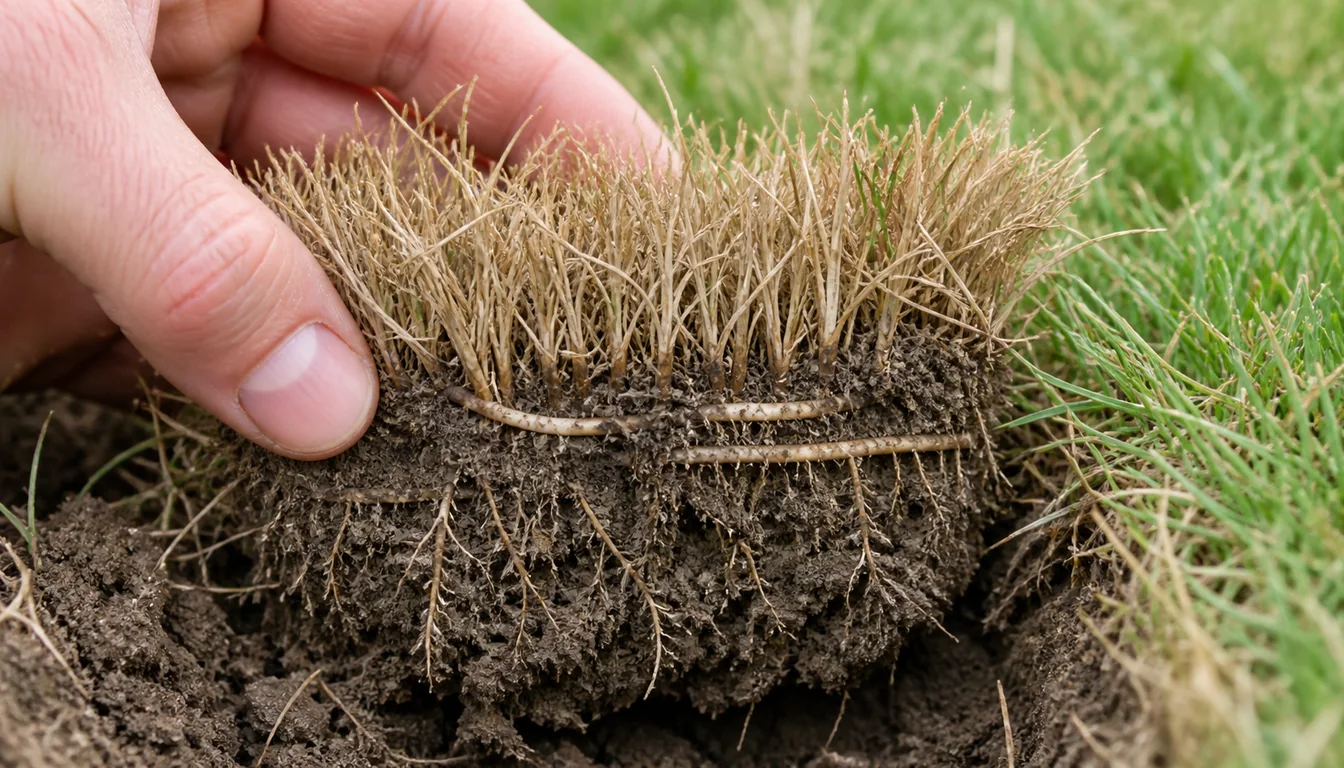
Choose a brown area that represents the main pattern and a greener comparison area. Use a knife or soil sampler to remove a small plug deep enough to keep the crown, upper roots, and surrounding soil together.
Firm pale or light-brown crowns that resist a gentle pull support dormancy, especially when fine roots and rhizomes remain attached. Hollow crowns, a rotten odor, brittle roots, or turf that separates from the soil support death, root disease, or insect feeding.
Feel the soil below the thatch and compare both plugs. Dry soil in the brown area supports moisture stress, while equally moist soil beneath a sharply localized patch makes simple drought less convincing.
- Cut an intact plug from the boundary between brown and greener turf.
- Locate the crown at the base of the blades and test whether it is firm and rooted.
- Compare soil moisture, root length, odor, insects, and attachment with a healthy plug.
Compare dormancy with summer patch and grub injury
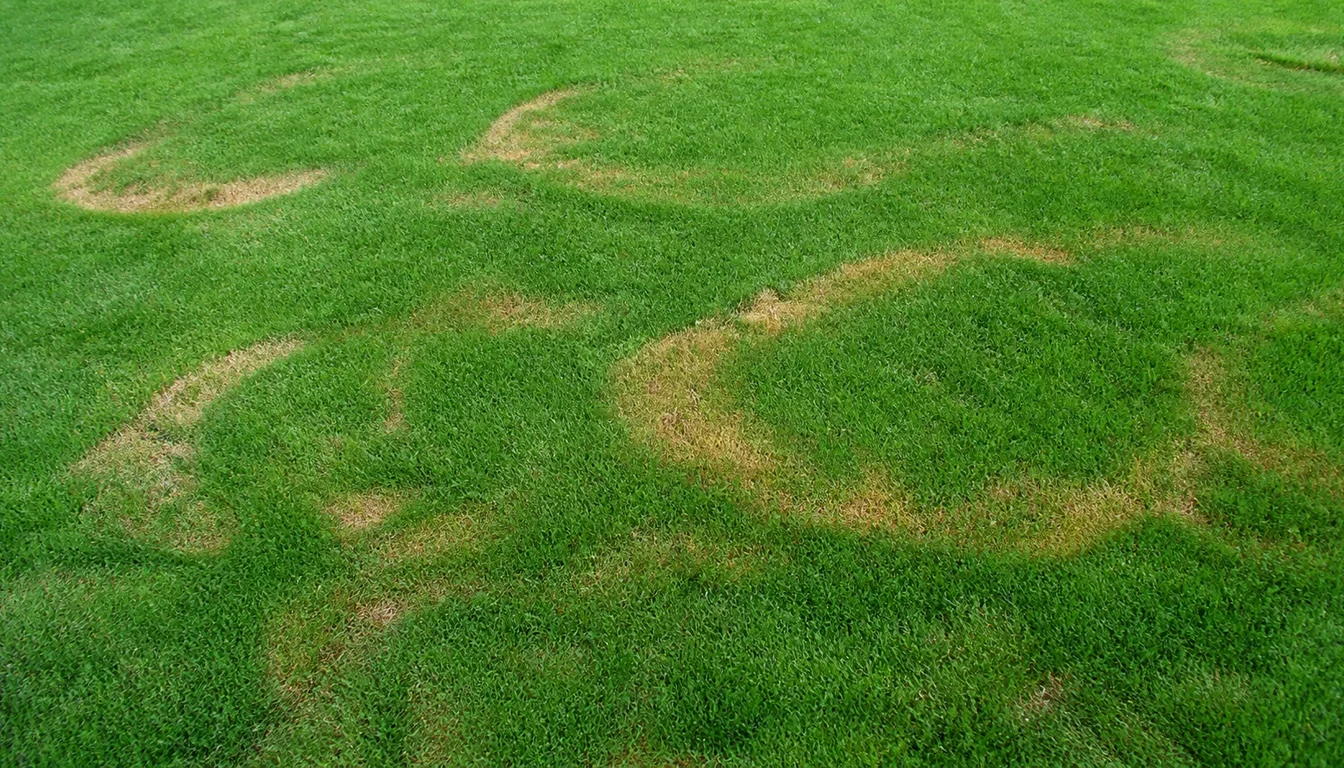
Physiological dormancy usually tracks heat, sun, dry soil, or irrigation coverage across a broad area. It should not begin as several small orange-brown circles that expand outward while green turf remains between them.
Summer patch can form rings, arcs, or frog-eye patterns during heat because damaged roots cannot support the leaves. White grub injury is more likely when roots are shortened, turf lifts easily, and animals dig at the patch edge.
Water response is supporting evidence rather than a stand-alone test. Broad new basal growth after measured irrigation and cooler weather supports dormancy, while recurring rings or loose rootless sod need a more specific diagnosis.
Summer Dormancy
- Broad exposure-linked browning
- Firm crowns stay rooted
- New basal growth follows moisture and cooler weather
Summer Patch
- Orange-brown circles, rings, or arcs
- Pattern can return in the same places
- Lab diagnosis may be needed
Root-Feeding Insects
- Turf may lift like loose carpet
- Roots are shortened or missing
- Larvae or animal digging support the diagnosis
Recovery Plan
Choose one water strategy
If the established crowns are alive, decide now whether the lawn stays dormant or comes back to active green growth.
Do not apply a token daily sprinkle, because it wets the thatch without reliably reaching roots.
Protect crowns during extended drought
Iowa State advises about 1 to 1.5 inches in a single application after four to six weeks of dormancy, repeated roughly every four weeks while severe dryness continues.
Where that is impractical, about a quarter inch weekly hydrates crowns without pulling the lawn fully out of dormancy.
Commit to regular moisture
A dormant lawn can be brought back with 1 to 1.5 inches of water followed by another application seven days later, but the schedule has to continue afterwards. Waking the grass repeatedly and letting it dry back down spends reserves and adds injury.
Repair only confirmed dead areas
Wait for cooler weather and adequate moisture, then look for new shoots at the crown.
Rake out the loose dead material and reseed patches that stay rootless or show dead crowns, inside the cool-season establishment window your area recommends.
Reduce severe summer loss by mowing established Kentucky bluegrass high enough to shade crowns, measuring sprinkler output, correcting runoff and compaction, and avoiding a heavy nitrogen push before heat. Keep recently seeded or sodded turf consistently moist until roots establish, and decide before drought whether an older lawn will be managed for green color or safe dormancy.
Sources
- Summer Dormancy in Cool-Season Lawns, Iowa State University Extension
- Conserving Water on Drought-Affected Lawns, University of Minnesota Extension
- Watering Efficiently, Colorado State University Extension
- Methods to Schedule Home Lawn Irrigation, Colorado State University Extension
- Turfgrass Species Selection Guidelines, Colorado State University Extension
- What Are White Grubs?, Purdue University Extension
- Summer Patch, Purdue University Extension