
Why Is Kentucky Bluegrass Growing Thin in Shade or Traffic?
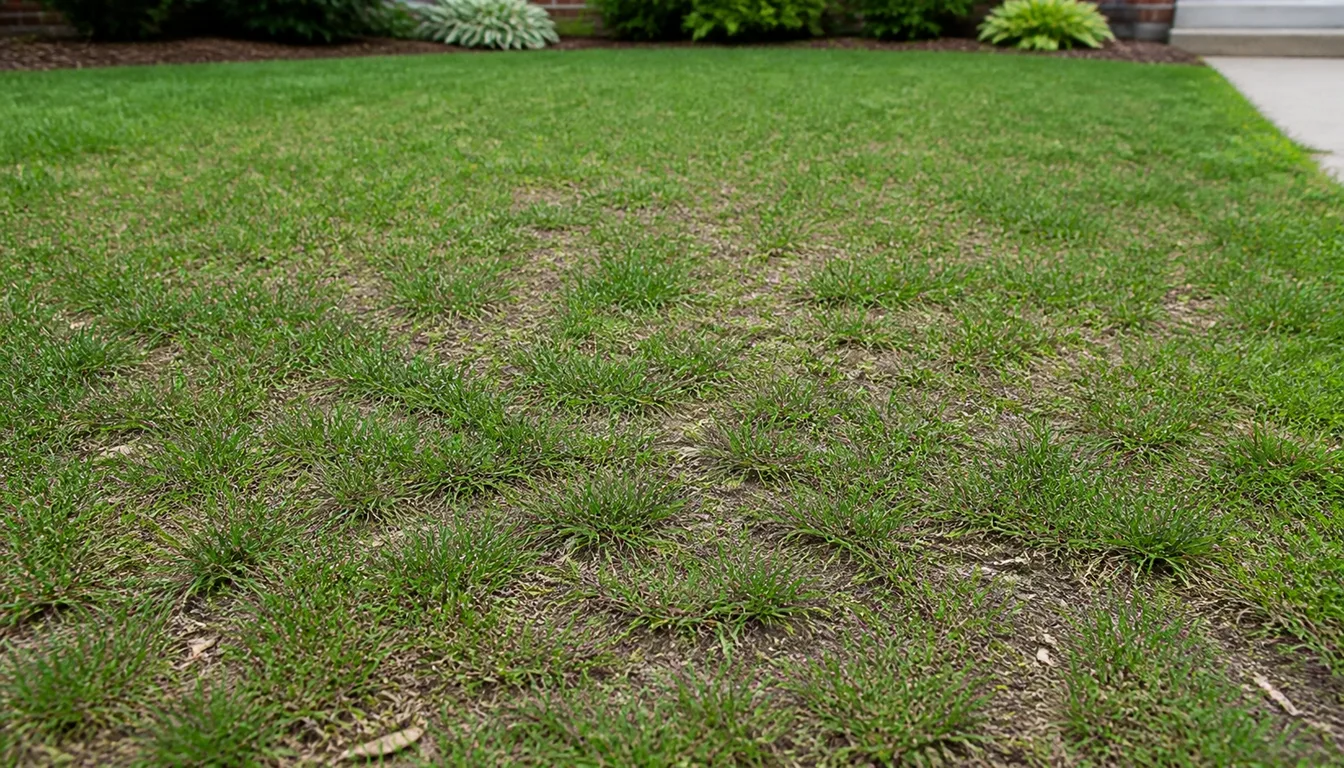
A Kentucky Bluegrass lawn is truly thin when it has fewer living crowns, visible soil, and gaps that remain after favorable growing weather returns. Map those openings to light, traffic, soil resistance, moisture, thatch, or a repeating pest pattern before adding seed.
Quick diagnosis
A site condition is removing crowns faster than rhizomes can replace them
Start with the soil rather than the color. Open ground with missing crowns is a thin lawn, while intact straw-colored turf over firm crowns is usually dormancy.
Gaps that follow shade, a footpath, hard soil, or a repeating ring are telling you where to look.
Open the full diagnosisWhat You Are Seeing
Kentucky Bluegrass spreads by underground rhizomes, so a healthy stand closes small openings on its own. Bare soil that persists means crowns are dying, shoots are wearing away, or nothing new can establish.
Judge density only when the lawn should be growing, because dormant blades may be brown while the sod underneath stays continuous.
A thin lawn stays open long enough for weed seedlings to take the exposed soil.
Draw the boundary of each weak zone. A tree dripline, a walking route, a mower-scalped ridge, a sprinkler edge, or a recurring ring tells you more than the overall green color.
Compare one weak plug against one dense plug cut from the same lawn.
Dig both and look at how deep the roots run, how thick the springy layer above the soil is, and whether the crowns are still firmly attached.
Common Causes
01 High likelihood
Shade and tree competition
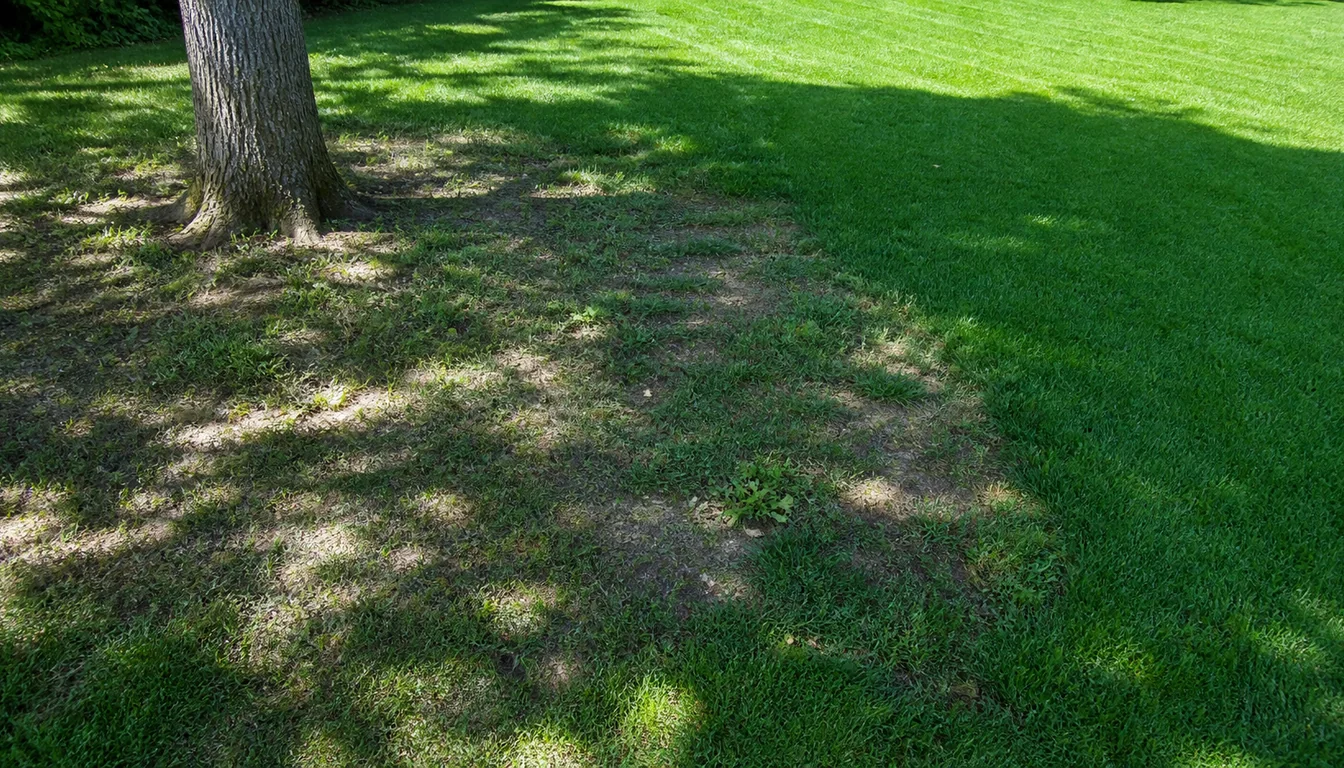
Most Kentucky bluegrass cultivars want open sun and lose density in heavy shade.
Under a tree it is also competing with woody roots for water, while damp leaves that dry slowly raise disease pressure at the same time.
A stable boundary near the dripline is stronger evidence than a few random gaps. Blades in shade grow longer, softer, and more horizontal as the plant reaches for light, while the same soil out in the sun carries dense turf.
Estimate direct sun several times across the season, because a leafless spring canopy hides the summer limit.
Light pruning can rescue a marginal site. Repeated overseeding cannot make bluegrass persist where the canopy and the roots have already won.
How to identify it
- Thin turf follows the canopy or the north side of a building.
- Blades are long and weak while crowns remain widely spaced.
- The same grass becomes denser beyond the shade boundary.
- Tree roots occupy the shallow soil and the area dries unevenly.
What to do
- Remove fallen leaves promptly so they do not smother the remaining shoots.
- Prune only suitable branches and protect the tree's structure and root zone.
- Use a shade-adapted fine fescue mix where the site has enough light for turf.
- Replace turf with mulch or another suitable groundcover where heavy shade persists.
02 High likelihood
Traffic and compacted soil
Feet, pets, play, mower turns, and parked equipment wear the leaves off and crush the pore spaces roots need.
Worn soil then takes water slowly and grows shallow roots, so it loses crowns faster than rhizomes can replace them.
Traffic injury forms a route between two destinations, or a broad use area. It is rarely a random patch.
Push a screwdriver into moist soil and compare the resistance with a protected part of the same lawn.
Move the traffic before you renovate. Core aeration relieves compaction while the grass is actively growing, but fresh holes cannot outrun people walking the same line every day.
How to identify it
- Open turf forms a path to a gate, play area, or patio.
- The soil is difficult to probe even when it is moist.
- Water puddles or runs away from the worn route.
- Roots in a plug are shorter than roots from protected turf.
What to do
- Redirect repeated movement with stepping stones or a wider path.
- Keep traffic off wet soil and drought-stressed turf.
- Core-aerate during a cool-season recovery period when compaction is confirmed.
- Overseed after the use pattern changes and seed can contact loosened soil.
03 High likelihood
Shallow roots and uneven moisture
Frequent light sprinkling keeps the thatch damp while the mineral soil below it stays dry.
Hot pavement edges, slopes, sprinkler gaps, and sandy pockets lose their crowns first under stress, then stay thin after the rest of the lawn has recovered.
Probe below the thatch immediately before watering, then again after a measured cycle. If water never reaches the main root zone, longer soak cycles or corrected coverage matter far more than more seed.
Wet soil thins a stand too.
Poor drainage shuts oxygen out of the roots, and dry and saturated soil both end in the same short roots and sparse shoots, so match the repair to what the probe actually found.
How to identify it
- Thin strips align with pavement, slopes, or sprinkler boundaries.
- Soil below damp thatch remains dry after irrigation.
- Water stands for hours in the weak area after rain.
- Roots are short and concentrated near the surface.
What to do
- Measure sprinkler output across the weak and dense zones.
- Correct clogged heads, runoff, or drainage before renovation.
- Water deeply enough to wet the active root zone without leaving it saturated.
- Allow the surface to dry between established-lawn irrigation cycles.
04 Medium likelihood
Excess thatch, fertility, or unsuitable pH
Kentucky bluegrass makes rhizomes, and it can build a thick layer of living and dead stems above the soil.
Once that layer passes about one inch, crowns sit high in it, roots dry quickly, and water or pest treatments may never reach mineral soil.
Cut a wedge that takes in leaves, thatch, and soil, then measure the springy brown band. Clippings are usually not the main material, because they break down faster than crowns, stems, and roots.
Fertility fails in two directions.
Too little nutrition slows replacement growth, while aggressive nitrogen pushes excess shoots and more thatch. A soil test and a seasonal program beat guessing from color.
How to identify it
- A spongy brown layer separates green blades from mineral soil.
- Mower wheels sink and scalp elevated crowns.
- Water beads or remains in the thatch while soil below is dry.
- Growth stays weak or excessively soft despite routine care.
What to do
- Use core aeration as a gradual thatch and compaction tool.
- Consider vertical mowing only when thatch depth and turf condition justify it.
- Test soil before changing lime, pH, phosphorus, or potassium.
- Apply nitrogen for steady density during cool-season growth rather than rapid color.
05 Medium likelihood
The seed mix does not fit the site
Pure Kentucky bluegrass can stay sparse in shade, or on a dry low-input site, even when the seed itself is good.
A seed label cannot overrule the light, drainage, traffic, and maintenance that decide which grasses persist.
Fine fescues generally take shade better, and turf-type tall fescue suits some moderate-shade or traffic situations. Local climate and site moisture still apply, so pick a regional mix rather than treating one alternative as universal.
Technique creates the other mismatch.
Seed caught in thatch, left without soil contact, or allowed to dry during germination simply disappears, and the gaps stay exactly where they were.
How to identify it
- Bare areas return after several rounds of the same seed.
- The stand fails mainly where light or moisture differs from the seed's needs.
- Seedlings emerge but disappear before producing a rooted crown.
- The existing mix is unknown or contains only one poorly adapted cultivar.
What to do
- Match species and cultivars to sun, shade, moisture, traffic, and maintenance.
- Expose enough soil for seed contact without destroying healthy crowns.
- Protect germinating seed with consistent surface moisture.
- Use several compatible cultivars or a site-appropriate mix for resilience.
06 Lower
Summer patch or root-feeding insects
Summer patch strips crowns in sunken straw-colored circles, rings, or frog-eye shapes during hot weather. In severe cases the roots, crowns, and rhizomes darken, and the dead space later fills with weeds or other grasses.
Root-feeding insects leave a different physical clue.
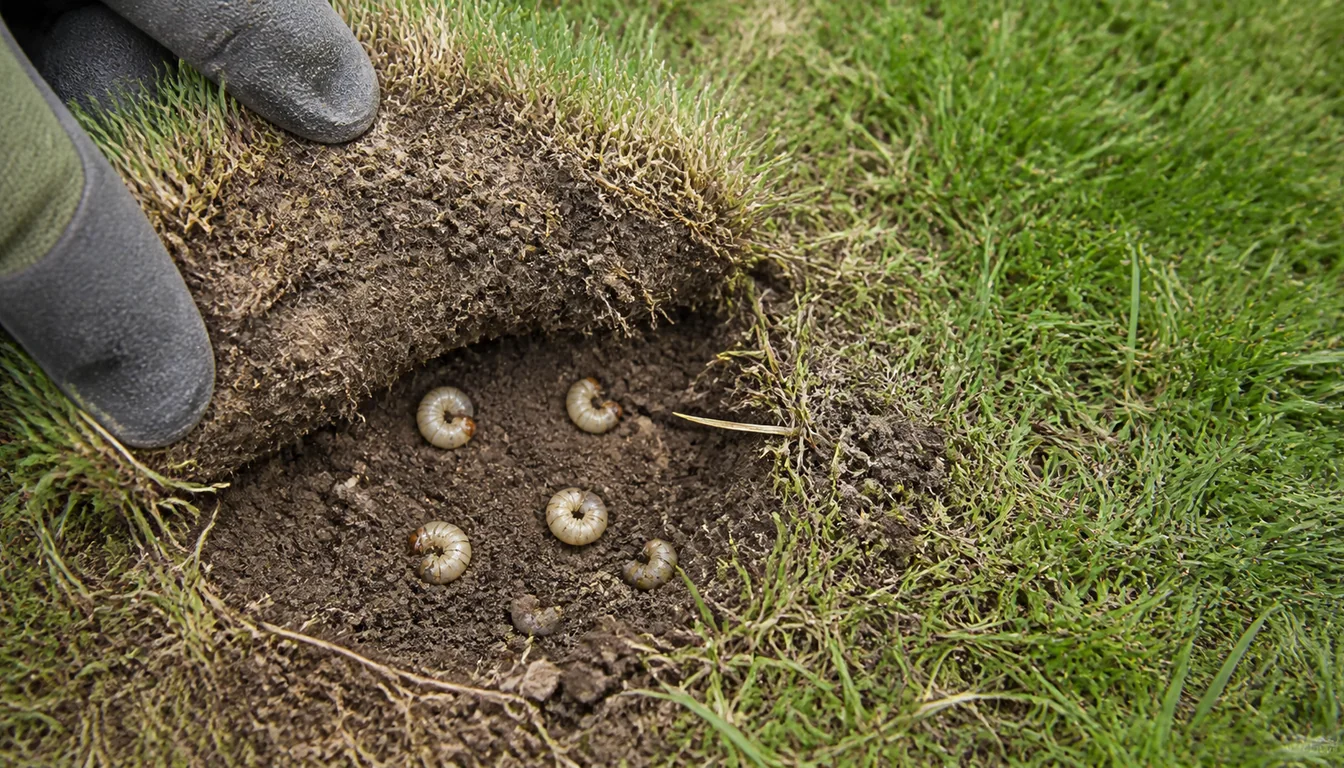
Turf that has lost enough root lifts like loose carpet, and skunks, raccoons, or birds dig where the larvae are concentrated.
Neither one should be diagnosed from thinness alone. Sample the edge of an active patch, inspect roots and crowns, count insects in a measured area, and use a diagnostic lab when a repeating disease pattern looks plausible.
How to identify it
- Separate patches enlarge into rings or arcs during summer.
- Dark damaged crowns or rhizomes occur at a recurring patch edge.
- Sparse turf lifts easily because roots have been eaten.
- Larvae or repeated animal digging occur near the expanding damage.
What to do
- Photograph the early pattern before separate patches merge.
- Submit a fresh edge sample when summer patch is suspected.
- Use local treatment thresholds and timing for confirmed root-feeding insects.
- Repair dead areas only after the active cause is controlled.
Seed cannot outgrow an unchanged site
Kentucky bluegrass has real recuperative power, because rhizomes keep producing new shoots.
A stand that stays open is telling you the losses are stronger than that repair.
Adding seed hides the evidence for a while without changing it. New plants fail again if heavy shade, daily traffic, compacted soil, poor seed contact, or a root disease still runs the site.
Weeds are usually the result of the open canopy rather than its first cause.
Killing them without rebuilding cover leaves the same light and soil space free for the next flush.
A repair lasts when it matches the plant to the site and changes the limiting condition first. Some ground is better served by a mixed stand, a path, mulch, or a groundcover that is not turf at all.
Measure what the roots are growing through
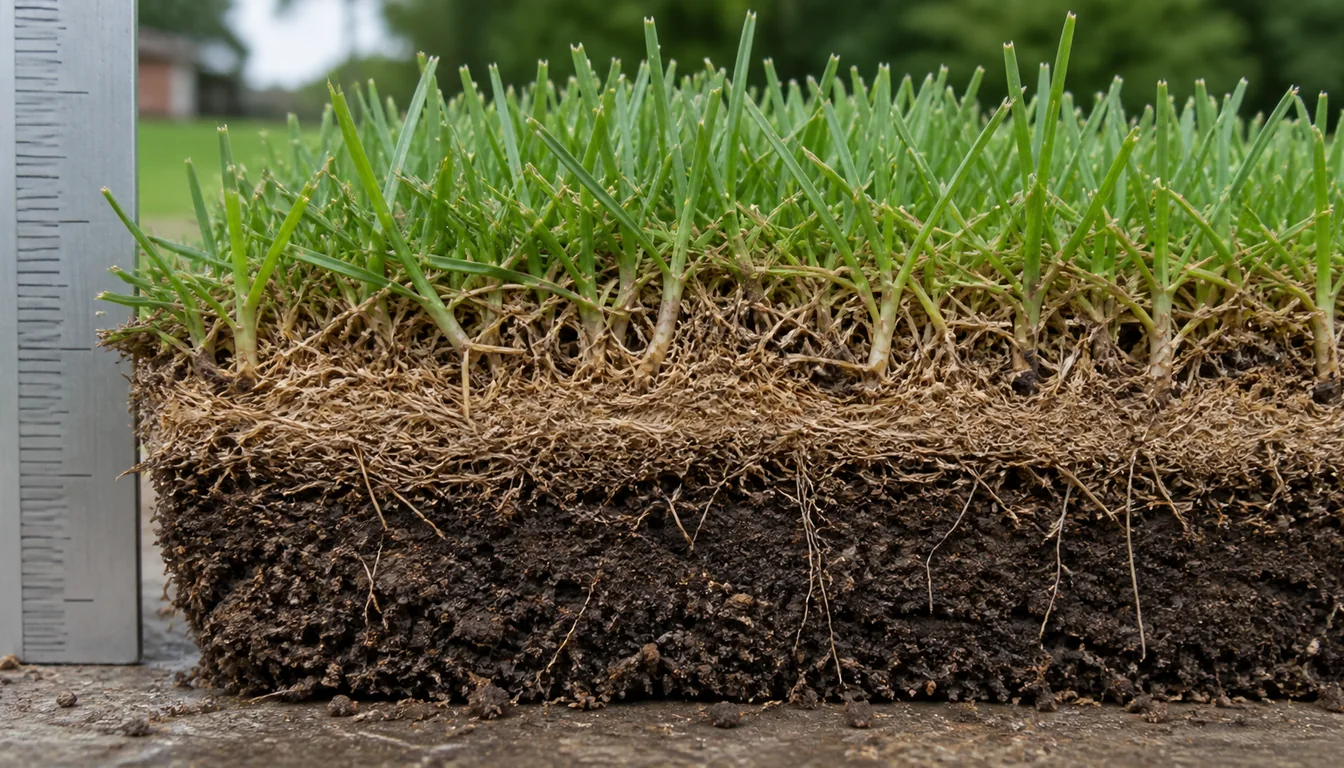
Audit one weak area and one dense comparison area on the same day. Record direct light, traffic, soil resistance, moisture below thatch, thatch depth, root length, and whether crowns remain attached.
Cut a clean wedge rather than judging the surface alone. The useful boundary is where the loose brown thatch ends and mineral soil begins, and a layer over about one inch deserves attention when it coincides with shallow roots or scalping.
Interpret combinations rather than one reading. Shade plus dry tree-root soil needs a different repair from full sun plus compacted wet clay, even though both areas look sparse from standing height.
- Map hours of direct light and the exact edge of the thin zone.
- Probe moist soil in weak and dense turf to compare resistance.
- Cut a wedge to inspect thatch, crowns, roots, moisture, and odor.
- Match the strongest difference to the first repair before buying seed.
Decide whether Kentucky bluegrass still fits the site
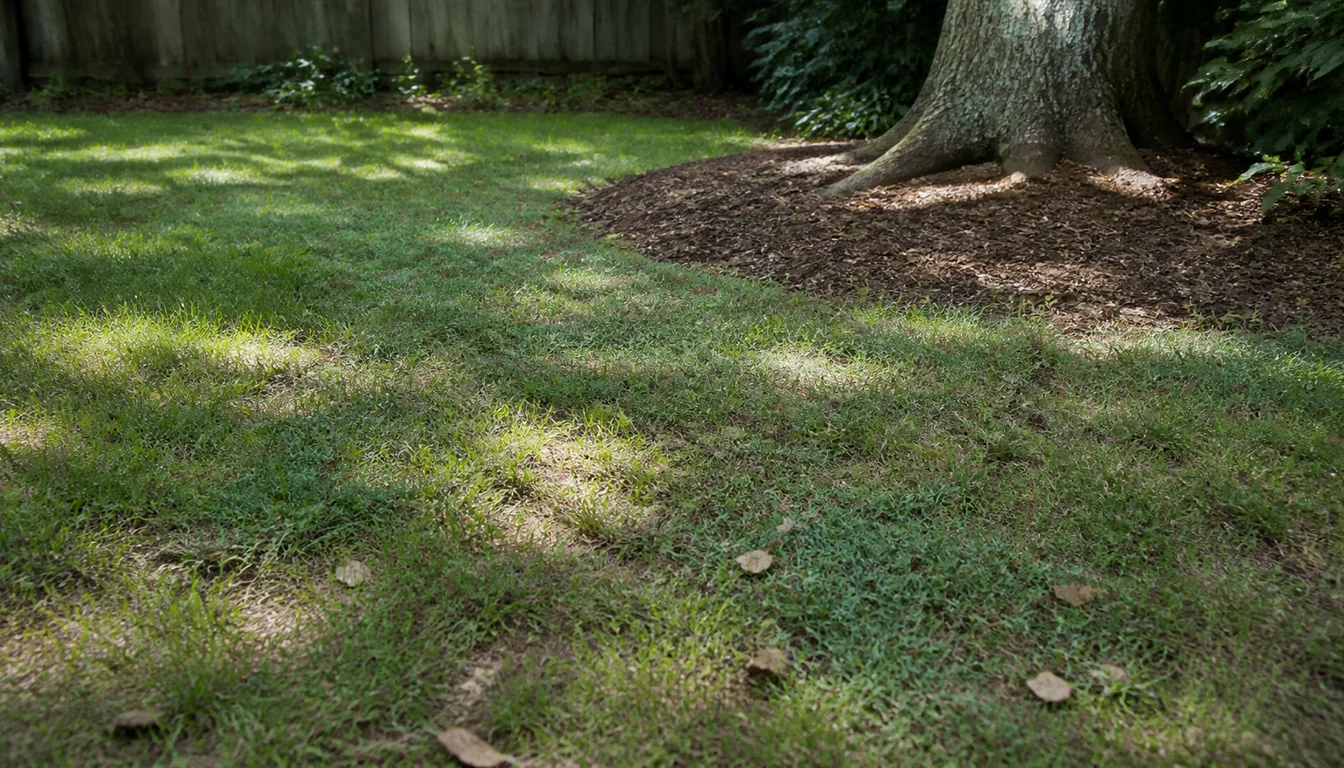
Keep Kentucky bluegrass where the site provides adequate light, drainage, rooting depth, and summer management. Correcting coverage or compaction can let established rhizomes close modest gaps without replacing the whole stand.
Partial shade may favor a regional mixture with fine fescues or another locally suitable cool-season grass. Heavy shade under mature trees may not support durable turf at all, especially when roots also compete for moisture.
Protect the chosen seed from the same failure. Create soil contact, seed during the locally preferred cool-season window, maintain germination moisture, and keep traffic away until seedlings are anchored.
Open Sun
- Repair water and soil limits
- Retain suitable bluegrass cultivars
- Use rhizome recovery where crowns remain
Partial Shade
- Choose a regional shade mix
- Reduce leaf litter and avoid scalping
- Expect a less aggressive bluegrass share
Heavy Shade or Traffic
- Consider non-turf cover or a path
- Protect tree roots and soil structure
- Stop repeating seed that cannot persist
Escalate rings, rotten crowns, or loose turf
Cultural thinning follows a stable site pressure such as shade, wear, or hard soil. Summer patch is more suspicious when separate six-inch to three-foot areas become sunken rings or frog-eye shapes and return during heat.
Root-feeding insect injury changes attachment. Cut a small flap at the boundary and look for shortened roots, C-shaped larvae, and soil disturbance rather than relying on birds or brown color alone.
Keep the sample representative and fresh if a lab will examine it. A piece taken only from the dead center may no longer contain the active transition that distinguishes disease from drought or secondary decay.
Site Pressure
- Matches shade, traffic, or hard soil
- Crowns fail where the constraint remains
- Repair starts with the site
Summer Patch
- Sunken rings or frog-eye shapes
- Dark crowns, roots, or rhizomes
- Use a diagnostic sample
Root Feeders
- Turf loses attachment
- Larvae occur near the active edge
- Use local thresholds before treatment
Recovery Plan
Map and measure the limiting condition
Mark the shade boundaries, traffic routes, recurring rings, irrigation gaps, and bare zones. Compare plugs before you apply seed, fertilizer, insecticide, or fungicide.
Correct the site that removed density
Redirect the traffic, fix irrigation coverage, relieve confirmed compaction, deal with excess thatch, or choose a grass mix that matches the light you actually have.
Delay seeding if the same constraint will kill the new crowns.
Create seed-to-soil contact
Use the cool-season renovation window your region recommends, expose soil without destroying healthy turf, and keep the surface steadily moist through germination.
Protect the seedlings from traffic and mowing damage.
Judge cover and crown density
Look for fewer openings, stronger attachment, and visible rhizome spread rather than color alone.
If the same pattern returns, go back to the site diagnosis or get pest and disease testing before renovating again.
Keep Kentucky bluegrass dense by matching it to open, well-drained sites, mowing without scalping, measuring irrigation, limiting repeated traffic, and aerating confirmed compaction during active growth. Monitor thatch and soil fertility instead of pushing color with excess nitrogen, and use a shade-adapted mix or non-turf surface where bluegrass cannot persist.
Sources
- Developing an Integrated Turfgrass Pest Management Program, Penn State Extension
- Managing Thatch in Lawns, Penn State Extension
- Growing Turf Under Shaded Conditions, Penn State Extension
- Renovating a Lawn for Quality and Sustainability, University of Minnesota Extension
- Lawn Establishment, Penn State Extension
- Common Diseases on Cool-Season Lawns, Purdue University Extension
- Summer Patch, Purdue University Extension