Sod vs Seed
Choose sod when the site needs immediate cover and you can install a suitable local turf quickly. Choose seed when the planting window is right, the surface can stay protected, and wider grass selection or lower material cost matters more than instant green.
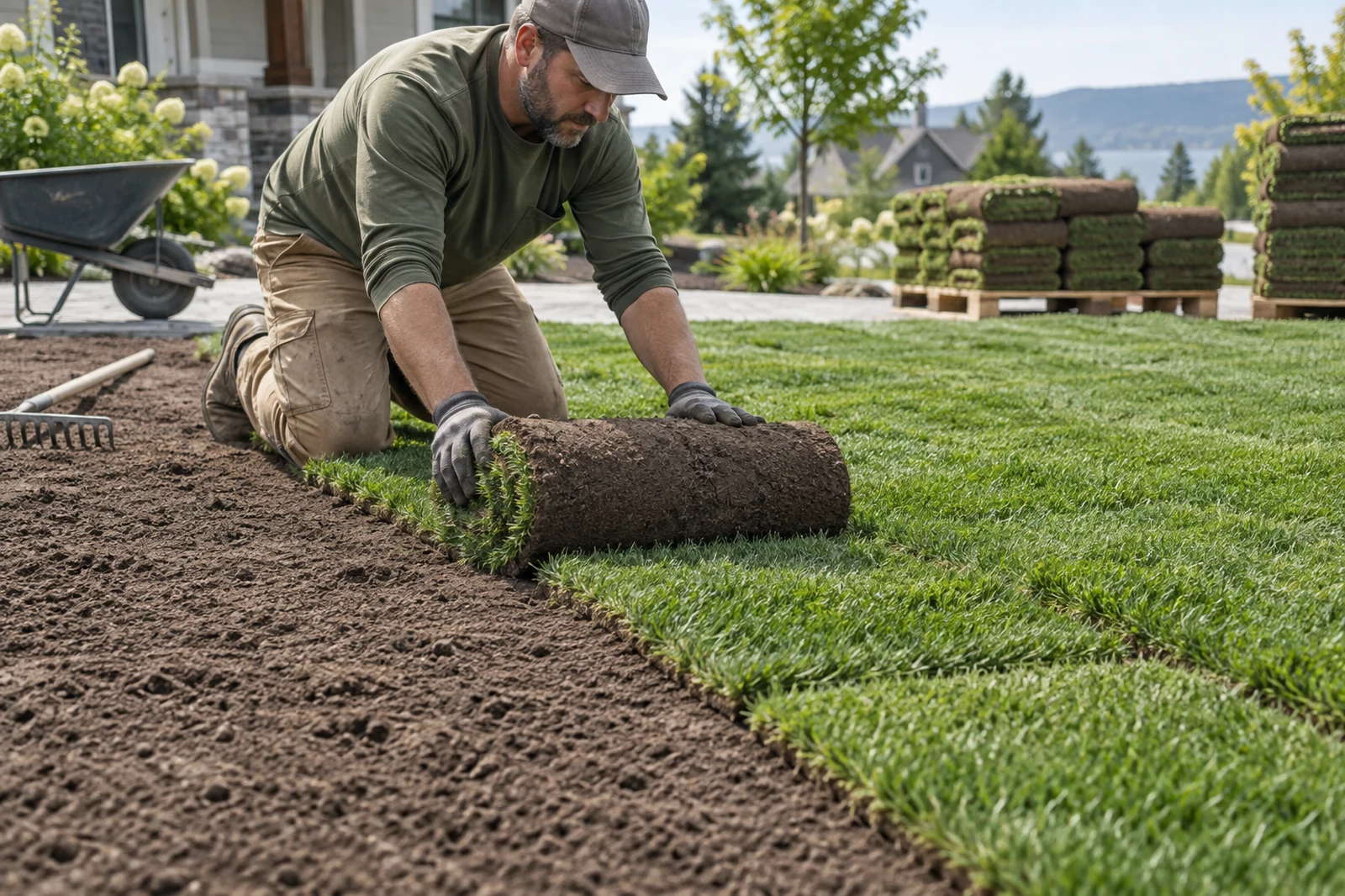
Sod
Mature turf transplanted with roots and soil
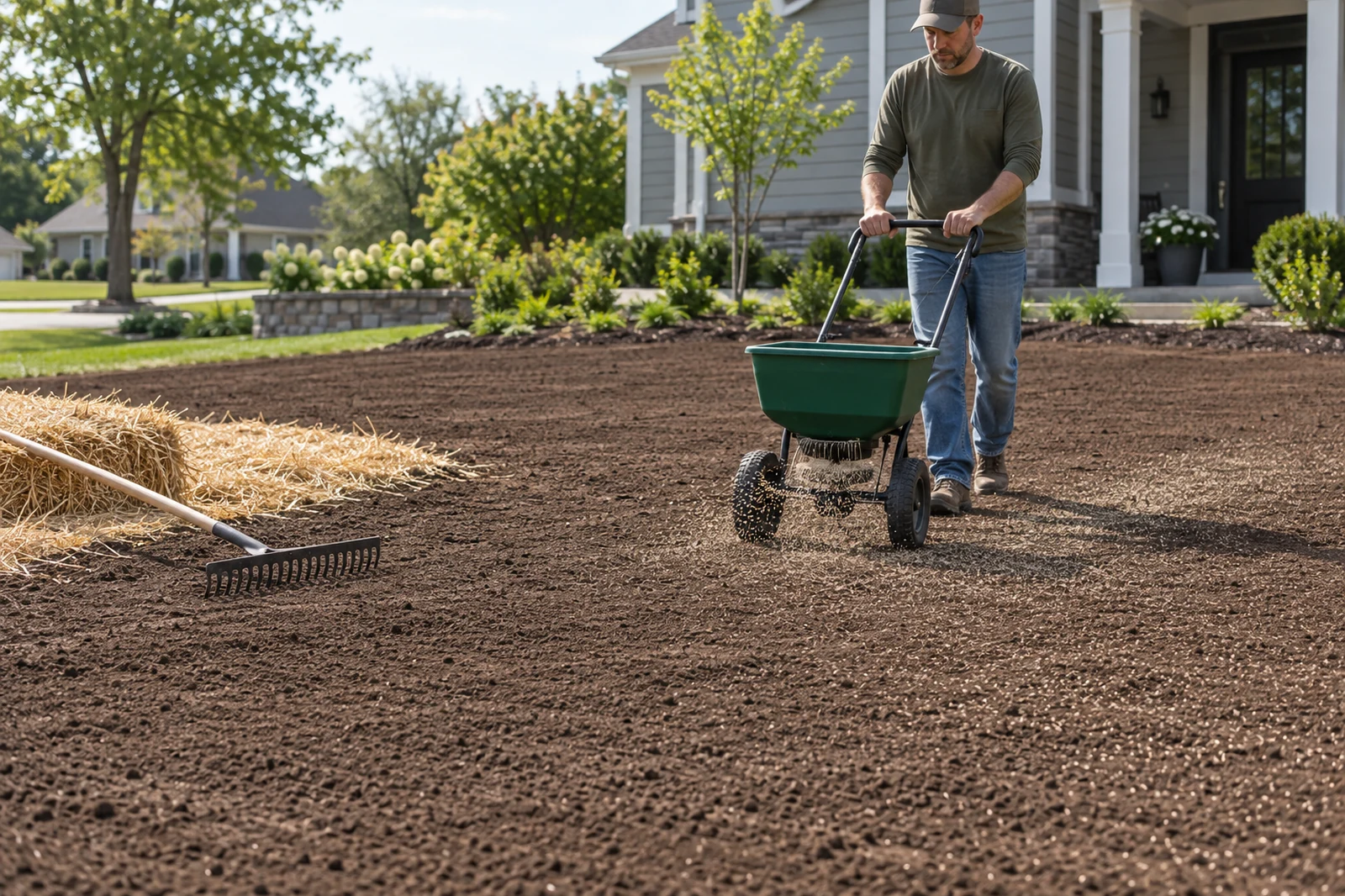
Seed
Turfgrass established where it will grow
Sod and seed are establishment methods, not grass types. Either can produce a durable lawn when the species fits the climate and site, the soil is prepared, and the young turf receives careful water and traffic control.
Sod arrives as mature cover, but harvest removes much of its root system. It still has to connect with the soil below before the lawn can handle normal use.
Seed starts with no cover and a shallow moisture-sensitive stage. Its strengths are species choice, lower material cost, easier transport, and the ability to sow a grass or blend that sod farms may not carry.
Specifications
Compare what each method costs you in time, money, and risk.
| Feature | Sod | Seed |
|---|---|---|
| What reaches the site | Mature turf, roots, and a thin soil layer | Labeled seed that germinates in place |
| Visible cover | Immediate | Develops after germination and tillering |
| Normal use | Only after roots resist a gentle lift | Only after enough growth and mowing |
| Grass selection | Limited to local sod production | Broader species, cultivar, and blend choice |
| Soil preparation | Smooth, firm, moist, and uncompacted | Smooth, firm, and suitable for seed contact |
| Critical water check | Moisture through sod into soil below | Moist surface without puddling or runoff |
| Timing flexibility | Broader, but active rooting and water still matter | Narrower and tied to grass and climate |
| Early erosion protection | High after correct installation | Needs mulch or an erosion-control system |
| Main logistics risk | Delivery dries or heats before installation | Weather interrupts germination and care |
Immediate green is not the same as an established lawn. Sod needs root contact and recovery from harvest, while seeded turf needs germination, leaf growth, tillering, and enough rooting to tolerate traffic.
Both methods inherit every site defect left underneath them. Poor grade, compaction, unsuitable grass, weak irrigation coverage, and buried debris remain after the surface turns green.
Best Use Cases
Choose by the timeline and budget the job has.
Bare soil must be covered now
Active erosion or a firm deadline
Mature turf shields soil as soon as it is laid and watered.
The site still needs correct grading, tight seams, slope anchoring, and time for roots to knit.
Large area in the best season
Budget matters and time is available
Seed covers more area with less material cost when temperature and weather support the chosen grass.
The surface must remain moist and protected through uneven germination and early mowing.
A specific cultivar or blend is needed
Shade, traffic, heat, or lower input
Seed labels let you select named species and varieties for the measured site.
Choose sod when a suitable certified local product is available and its narrower selection still fits.
Existing lawn has thin areas
Repair rather than full replacement
Overseeding can fill broad thin turf without removing every living plant.
Sod is useful for completely bare patches when matching material is available and the old damaged layer is removed.
Should you choose the grass before sod or seed?
Yes. Start with climate, sun, summer heat, winter cold, water availability, soil, traffic, mowing expectations, disease pressure, and the quality you are willing to maintain.
Cool-season grasses and warm-season grasses grow most actively in different weather. Local planting calendars matter more than a national month printed on a generic project list.
Seed usually offers the wider selection. Read the label for species and cultivar names, germination percentage, purity, weed seed, other crop seed, inert matter, lot number, and the date of the test.
Sod selection depends on what nearby farms can grow, harvest, and deliver as a stable roll. Turf species that spread with rhizomes or stolons are easier to handle as sod, so the available mix may not match every low-input, shade, or regional goal.
Use Bermuda and fescue differences as an example of why method comes second. One may fit the climate and exposure while the other fails there, regardless of whether it arrives as seed or sod.
Do sod and seed need different soil preparation?
The important preparation is nearly the same. Sod cannot hide a compacted, uneven, nutrient-deficient, or poorly drained root zone, and seed will expose those defects even sooner.
Finish the disruptive work before materials arrive.
- Remove construction debris, persistent weeds, old thatch, and turf that the plan replaces.
- Confirm drainage and set the final grade away from buildings without blocking required swales.
- Test soil early enough to correct pH or nutrients according to local recommendations.
- Relieve severe compaction and incorporate only justified screened amendment into a consistent root zone.
- Set irrigation heads, valves, and utility access at the final elevation.
- Rake the surface smooth and firm enough that footsteps leave shallow marks rather than deep sinks.
- Water a test cycle and repair dry zones, runoff, leaks, and low spots before planting.
Leave the finished surface slightly below pavement when sod thickness must meet that edge. A seeded surface can meet the final grade directly because no harvested soil layer will be added.
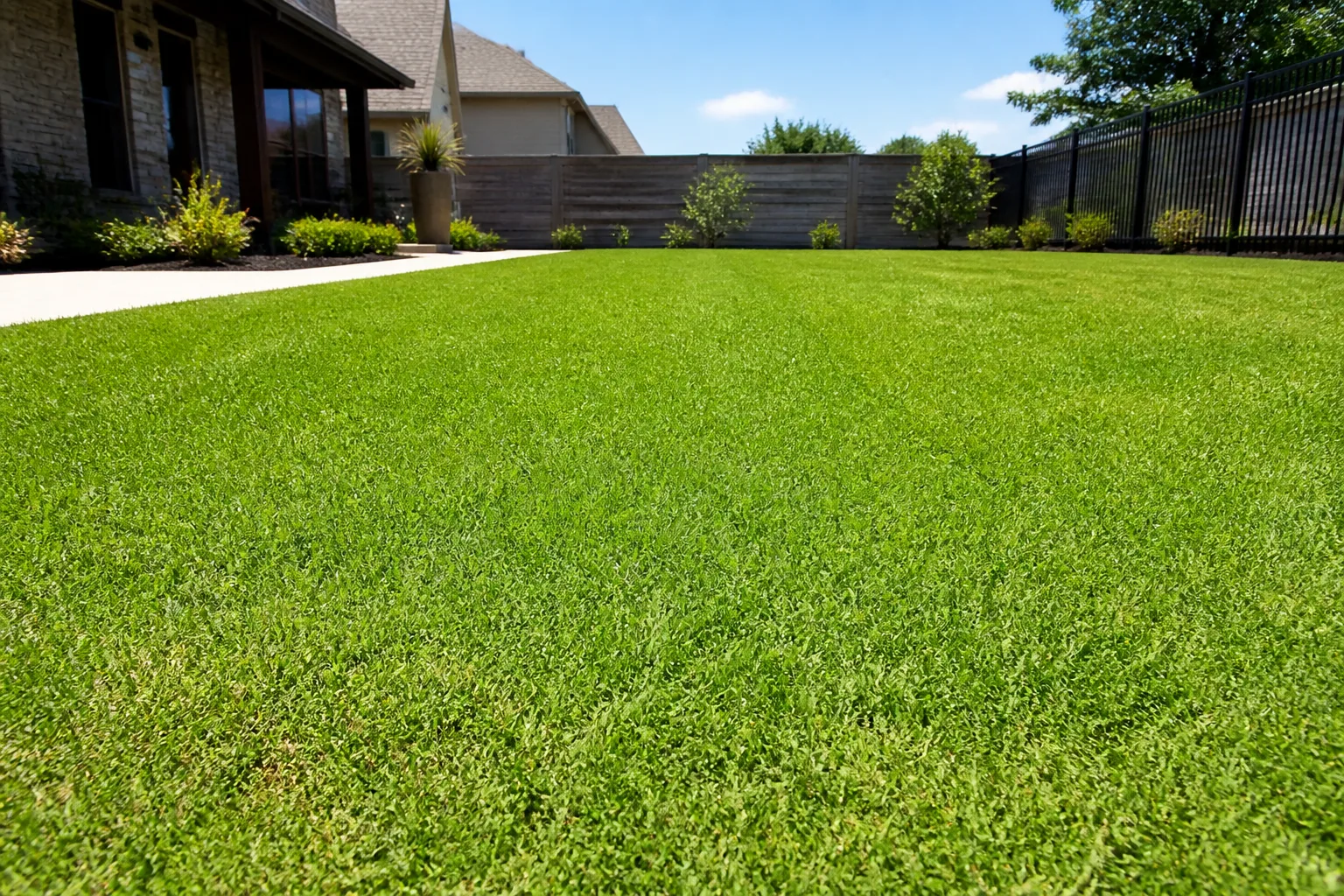
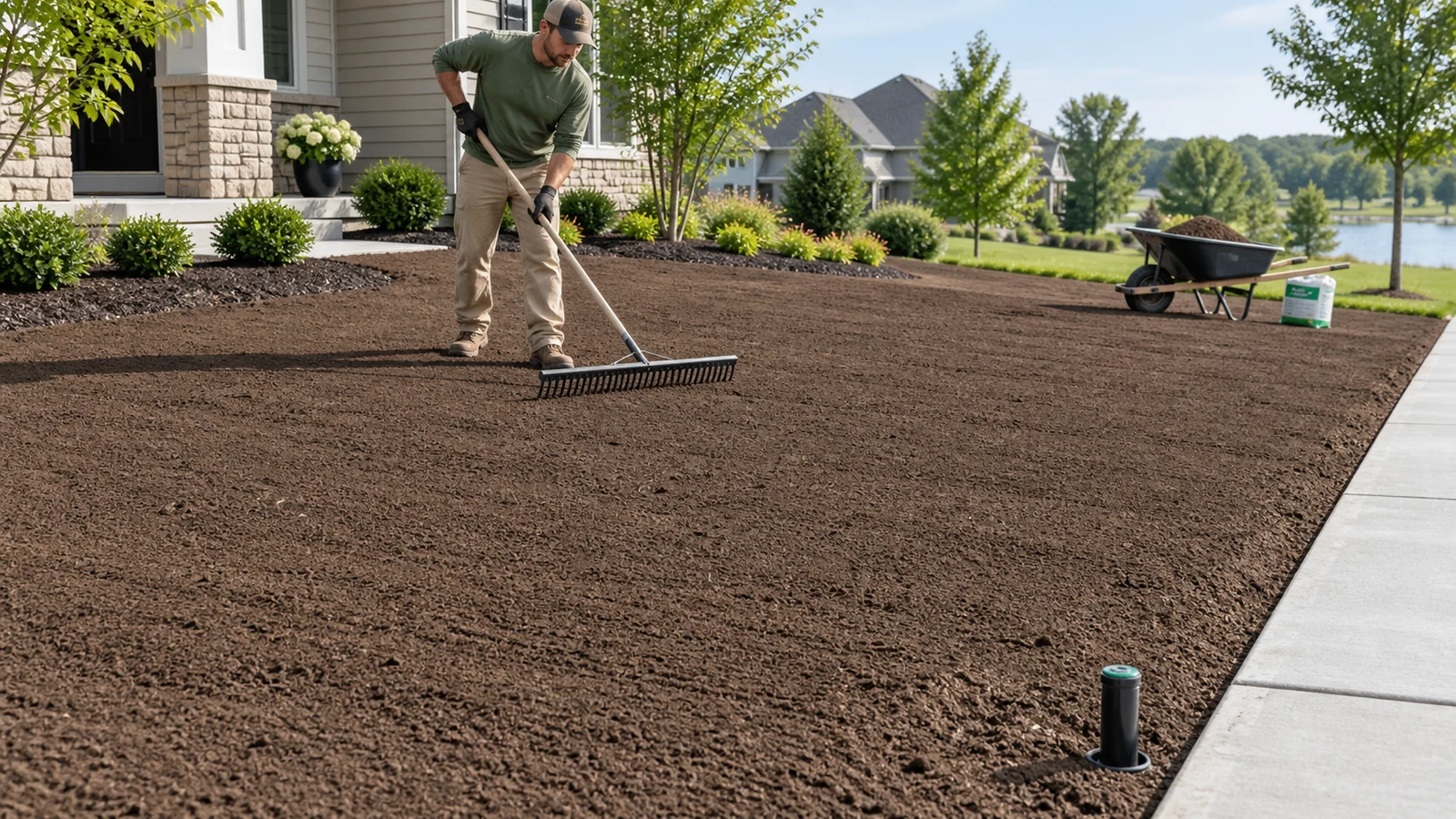
The prepared yard in the image has a smooth firm surface, working drainage, and protected irrigation heads. Those details serve either method.
How do you establish a lawn from seed?
Plant inside the best establishment window for the selected grass. Cool-season seed commonly performs best as late-summer heat eases and soil remains warm, while warm-season species need a spring or early-summer window with sustained active growth ahead.
Use the label or current local Extension rate for that exact species or blend. Applying extra seed can create crowded weak seedlings and disease-prone humidity rather than a faster mature lawn.
Divide the measured seed into two portions and spread in perpendicular directions for more even coverage. Lightly rake only as the species requires, then firm the surface so seed has contact without being buried too deeply.
Use clean straw, a suitable fiber mulch, or a specified erosion blanket where the site needs protection. A thick layer can block light and seedlings, while hay or contaminated material can add weeds.
The germination stage needs a moist surface, not standing water. Short careful irrigation may be needed more than once on drying days, but weather, soil, equipment output, mulch, and species prevent one universal schedule.
- [ ] Seed species and cultivars fit the site and region
- [ ] The bag label shows acceptable germination and weed-seed values
- [ ] The application rate follows that product and species
- [ ] Seed is distributed in crossing passes
- [ ] Seed contacts firm soil at the correct shallow depth
- [ ] Mulch protects without smothering the surface
- [ ] Irrigation keeps the seed zone moist without runoff
Keep the seed zone moist until the slowest intended species has emerged, then reduce watering frequency gradually and wet a deeper root zone. Continue protecting the area because green shoots are still too weak for ordinary play or pet traffic.
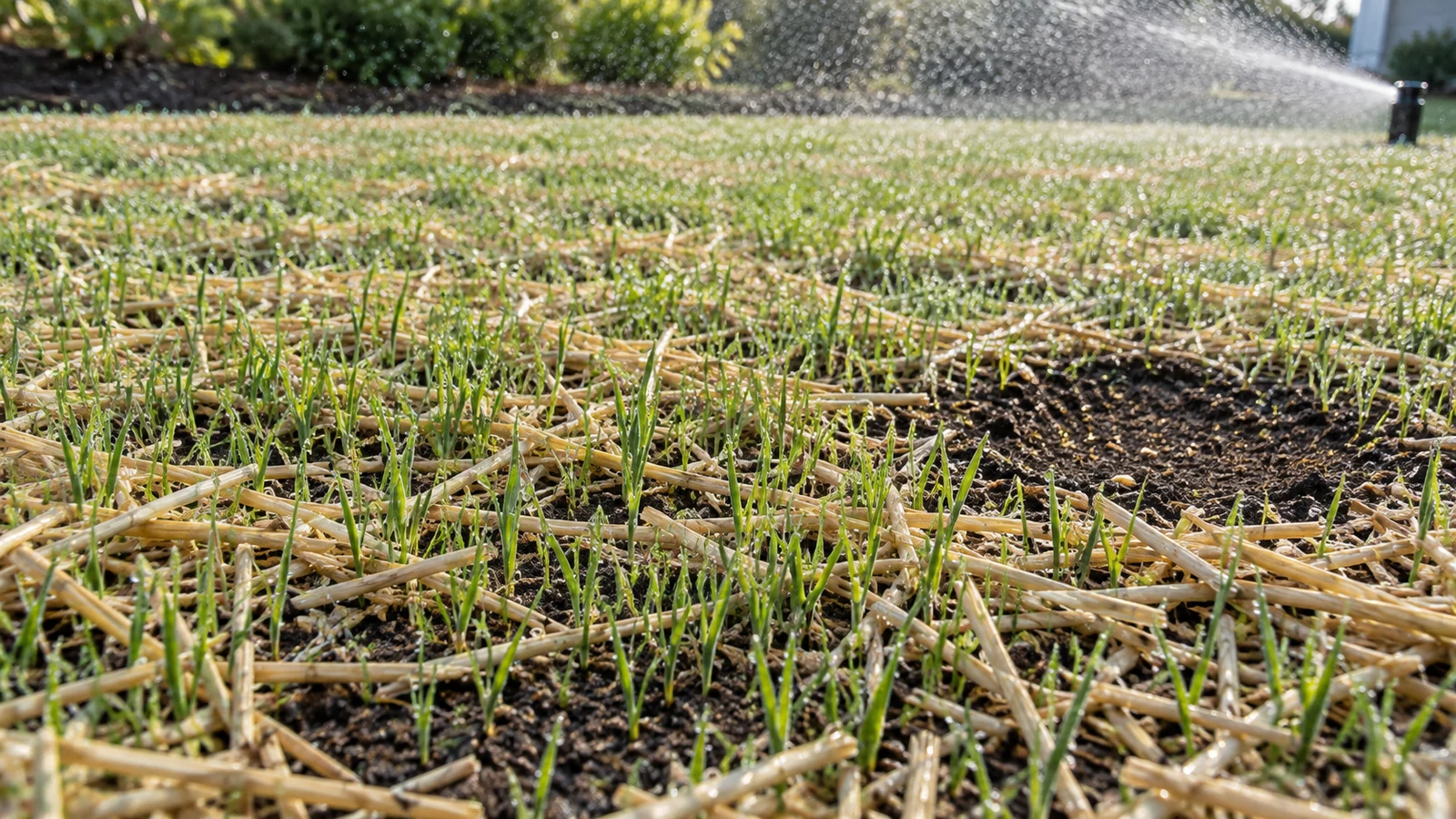
The image shows an appropriate early surface with emerging seedlings, light straw, and fine irrigation. The small bare patch is a reason to inspect moisture and seed contact, not to flood the entire lawn.
How do you install sod without dry seams or weak roots?
Schedule delivery only when the prepared site, irrigation, tools, and crew are ready. Rolled turf can heat and dry rapidly, so same-day installation is safer than treating a pallet as stored landscape material.
Inspect delivered sod for uniform thickness, active healthy grass, moist soil, weeds, disease, insects, heat damage, and torn pieces before the crew spreads rolls across the yard.
- Moisten the prepared soil without turning it muddy.
- Begin at a straight edge and stagger joints like brickwork.
- Butt pieces tightly and cut clean patches instead of stretching rolls across gaps.
- Lay strips across slopes and secure them when local guidance calls for stakes.
- Roll or tamp lightly to create sod-to-soil contact without heavy compaction.
- Water promptly enough to wet the sod and the soil immediately beneath it.
Edges beside pavement, corners, small pieces, and the outer row dry fastest. Check those places separately instead of increasing water across the whole lawn.
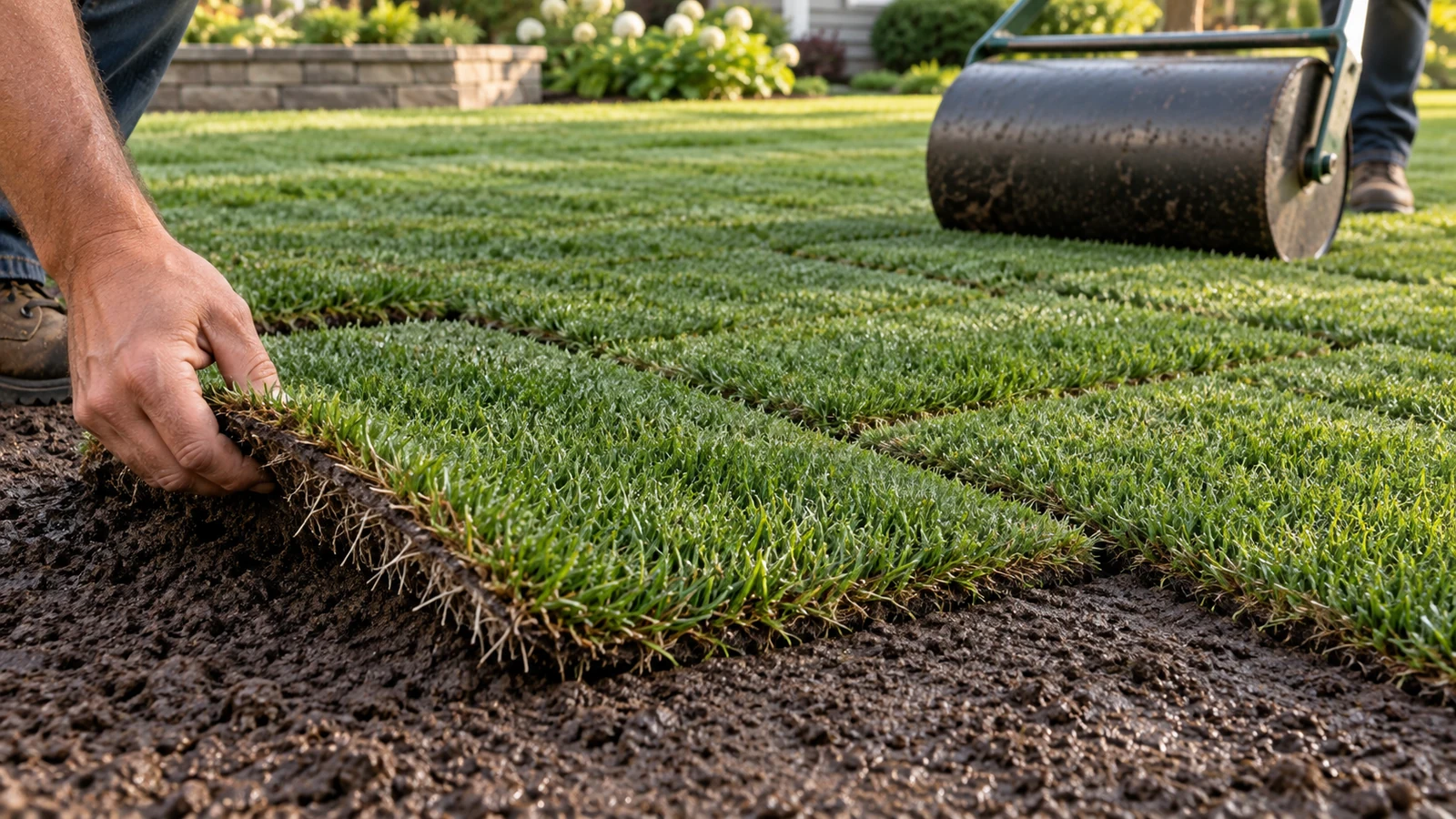
The close view shows tight staggered seams and a lifted edge where contact and moisture can be inspected. Once roots resist a gentle lift in several places, the lawn is beginning to knit into the site.
When can you reduce water and use the new lawn?
Use plant and soil evidence instead of one countdown. Heat, wind, shade, soil texture, grass species, irrigation output, rooting activity, and installation quality can change the transition by days or weeks.
For seed, keep the upper layer evenly moist through germination, then reduce frequency in stages as roots deepen. Continue the moist-surface phase until the slowest intended species has emerged rather than stopping when a fast companion first turns green.
For sod, check beneath different pieces. Water must pass through the harvested layer into the prepared soil, while constant saturation can deprive new roots of oxygen.
| Observation | What it means | Next action |
|---|---|---|
| Seed surface dries before emergence | Germination is at risk | Shorten the interval without creating runoff |
| Seedbed glistens or puddles | Application exceeds need or intake | Shorten the cycle and inspect grade |
| Sod edge curls or gaps open | Edge is drying or piece has shifted | Refit, fill narrow seams, and correct coverage |
| Sod lifts easily after several checks | Roots have not connected | Protect traffic and inspect contact and moisture |
| Sod resists a gentle lift | New roots are entering soil | Begin a gradual watering transition |
| Young turf shows footprints | Leaves and soil are not ready for use | Keep traffic off and let the surface recover |
Mow seeded turf when enough plants reach the normal mowing height for that grass and the soil is firm enough for equipment. Use a sharp blade and avoid removing an excessive share of the leaf at once.
Mow sod after it has rooted enough that the mower will not shift strips and the surface can carry the machine without rutting. Immediate green never authorizes immediate traffic.
Is sod always better for slopes and bad weather?
Sod provides immediate surface cover and usually controls early erosion better than loose seed. That advantage matters on active slopes, around drainage structures, and where a bare surface could send sediment off site.
It is not a substitute for correct drainage. Concentrated runoff can travel beneath sod, lift strips, erode seams, or saturate the slope if the grade and outlet remain wrong.
Seed can work on gentle slopes when planted in the right season with an erosion-control blanket, mulch, tackifier, or other locally specified protection. Ordinary loose straw and extra seed do not reliably stabilize a severe slope.
Weather affects both methods. Summer heat can cook stacked sod and raise irrigation demand, while a seeded surface can dry between cycles or wash in a thunderstorm.
Cold soil slows both germination and sod rooting. Warm-season sod laid dormant may remain unattached and exposed to freeze or drying risk even though it looks like a complete surface.
How should you compare the real cost of sod and seed?
Seed usually costs less as a material, while sod purchases mature turf plus farm, harvest, pallet, delivery, handling, and installation work. The total project difference narrows or widens according to area, access, labor, erosion controls, water, and failure risk.
Measure the plantable square footage rather than the lot size. Subtract buildings, pavement, beds, utilities, and areas that will use another groundcover, then have suppliers quote the same measured plan.
Compare complete line items.
| Line item | Sod project | Seed project |
|---|---|---|
| Grass material | Sod by measured area and product | Seed by labeled rate and species |
| Delivery and storage | Pallet delivery and immediate handling | Bags stored cool and dry until planting |
| Installation | Cutting, fitting, rolling, and disposal | Spreading, raking, firming, and mulch |
| Erosion protection | Stakes or specialty work on slopes | Mulch, blanket, staples, or tackifier |
| Water and monitoring | Intensive checks until rooting | Longer germination and seedling checks |
| Repair allowance | Dry edges, gaps, or mismatched pieces | Washouts, misses, weeds, or thin areas |
Include soil preparation in both bids. A cheap sod quote that skips grading and compaction repair is not comparable with a seed quote that includes a finished root zone.
Put a value on schedule and risk without inventing a national price. Sod may justify its premium when one storm could erode exposed soil, while seed may be the sensible use of money across a large stable area planted in its ideal season.
Get current local prices and product details because freight, pallet deposits, minimum deliveries, cultivar, season, access, and crew availability change the result. Keep the numbers outside the article rather than treating an old per-square-foot range as a lasting rule.
Can you combine sod and seed or repair only part of a lawn?
Yes, when the grasses are compatible and the visual transition is acceptable. Sod can protect a drainage edge or urgent high-erosion strip while seed establishes across a stable flat area.
Confirm that color, blade width, growth habit, mowing height, and seasonal behavior will blend. Installing one sod cultivar beside an unrelated seed mix can leave a permanent patchwork after both are healthy.
For an existing thin lawn, first decide whether enough desirable turf remains to recover. The overseeding process fits broad thinning when seed can reach soil and the existing grass still suits the site.
Small completely dead areas can be stripped, prepared, and patched with matching sod or seed. Do not lay sod over dead turf or a thick thatch layer because the new roots need direct soil contact.
Severe compaction, poor grade, chronic shade, wrong grass, buried debris, and irrigation gaps will defeat either repair. Address compacted soil or change the planting before buying another surface.
Use the final decision in order.
- Choose a grass that fits climate, light, traffic, and maintenance.
- Identify the local establishment window and erosion risk.
- Confirm water coverage, site preparation, access, and labor.
- Compare complete current quotes for the measured area.
- Pick sod for immediate protected cover or seed for selection and lower material cost.
- Delay either method when the root cause beneath the future lawn remains unresolved.
Review the result after the establishment season. Density, rooting, weeds, runoff, water use, repair area, and actual traffic tolerance show whether the project succeeded more clearly than its first green photograph.
Sources & References
- Practical Lawn Establishment and Renovation — Oregon State University Extension
- Lawn Establishment — Penn State Extension
- Lawns — NC State Extension Gardener Handbook
- Water Quality and Home Lawn Care — NC State Extension
- Seeding and Sodding Home Lawns — University of Minnesota Extension
- Buying Turfgrass Seed for Minnesota Lawns — University of Minnesota Extension
- Renovating the Home Lawn — Colorado State University Extension