
What's a Weeping Willow? How to Give One Enough Room
Salix babylonica Salicaceae
Weeping Willow (Salix babylonica) grows quickly to 30 to 40 ft tall and as wide, which is why it looks like a bargain and so often turns into a problem. Roots range far past the canopy hunting water, the weak wood sheds limbs in storms and under ice, and the tree is relatively short-lived.

Care snapshot
What Is a Weeping Willow, and How Fast Does It Really Grow?
Weeping Willow (Salix babylonica) is a fast, relatively short-lived deciduous tree in the willow family, Salicaceae. Linnaeus named it for Babylon by mistake, and NC State Extension notes that it is actually native to eastern Asia. Almost everything difficult about it follows from the speed.
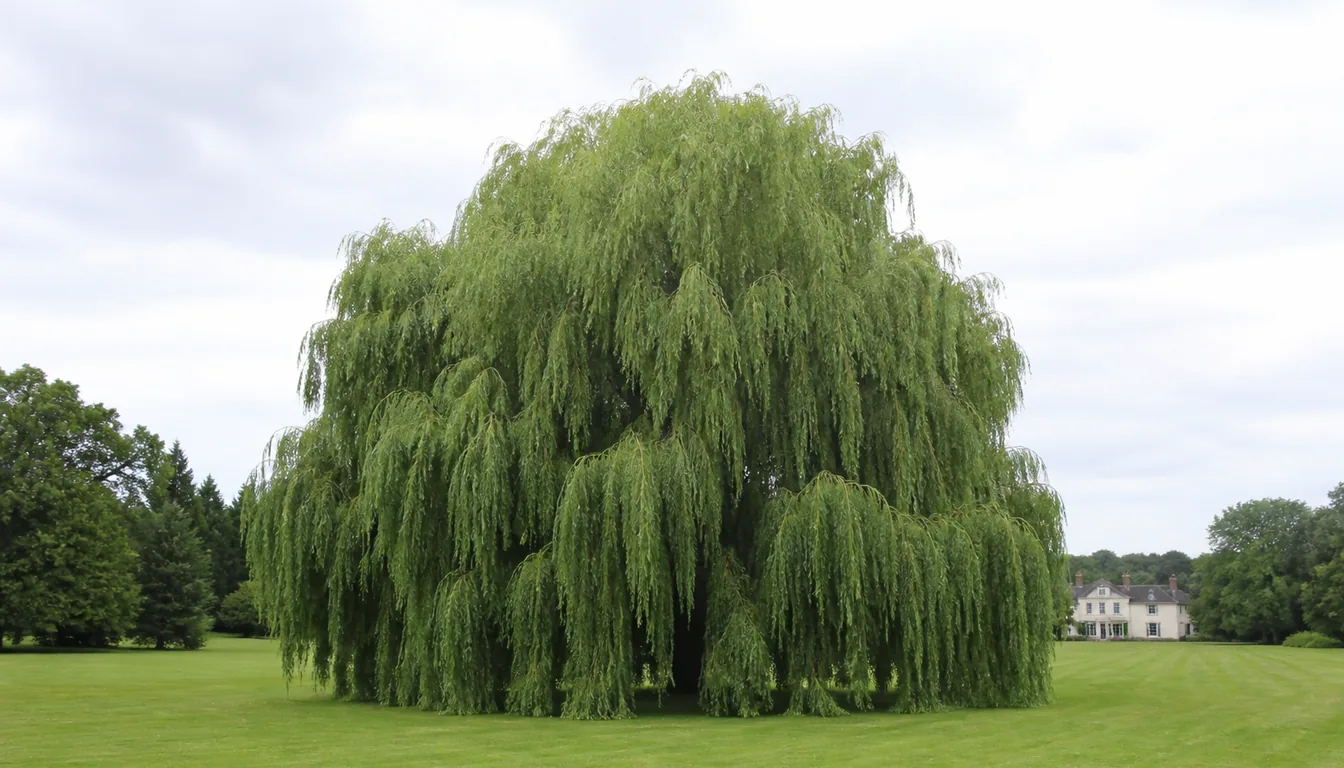
The shape is a broad dome with branch tips hanging almost to the ground, and nothing else in a yard produces that outline. It is the entire reason people plant one.

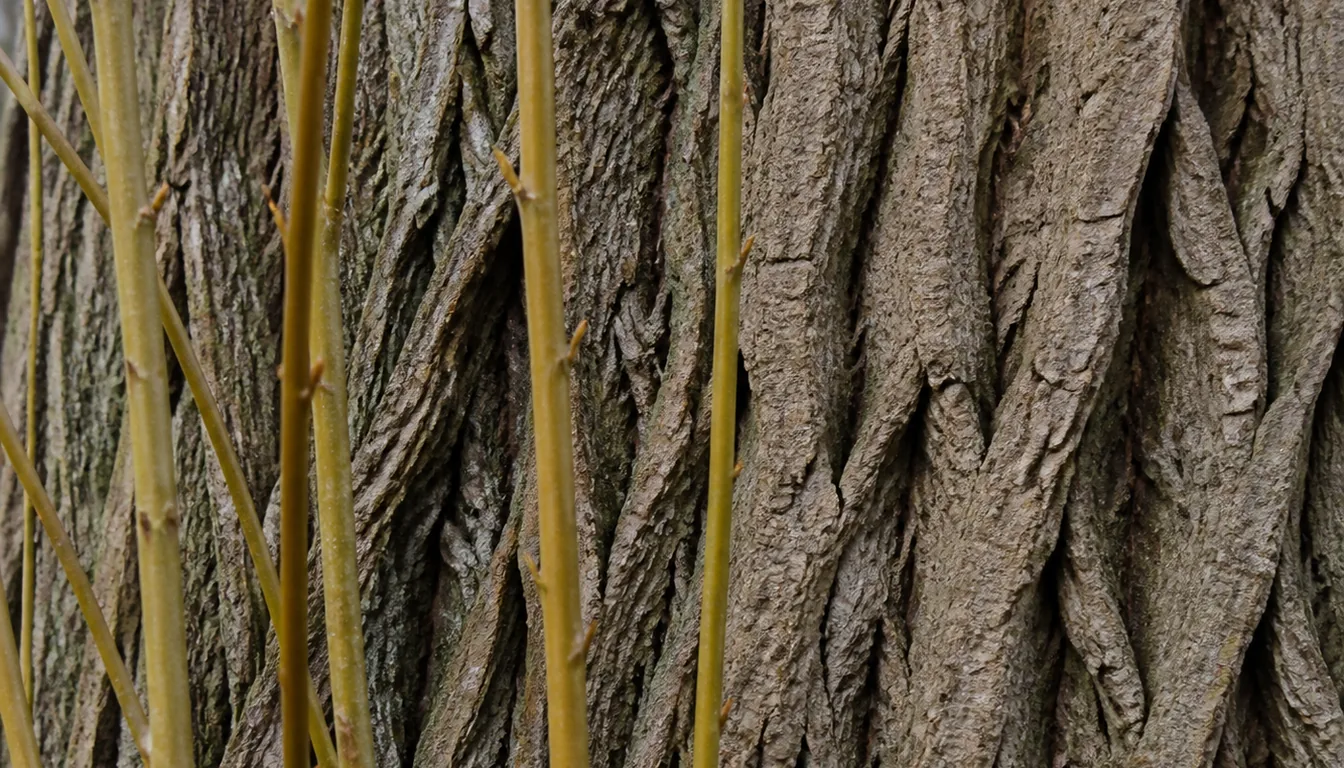
Bark on an old trunk is deeply furrowed gray-brown. Young shoots are thin, flexible, and often olive or yellow, which is the quality willows have always been cut for in basketry.
The cost of the speed is wood that is soft, light, and weak.
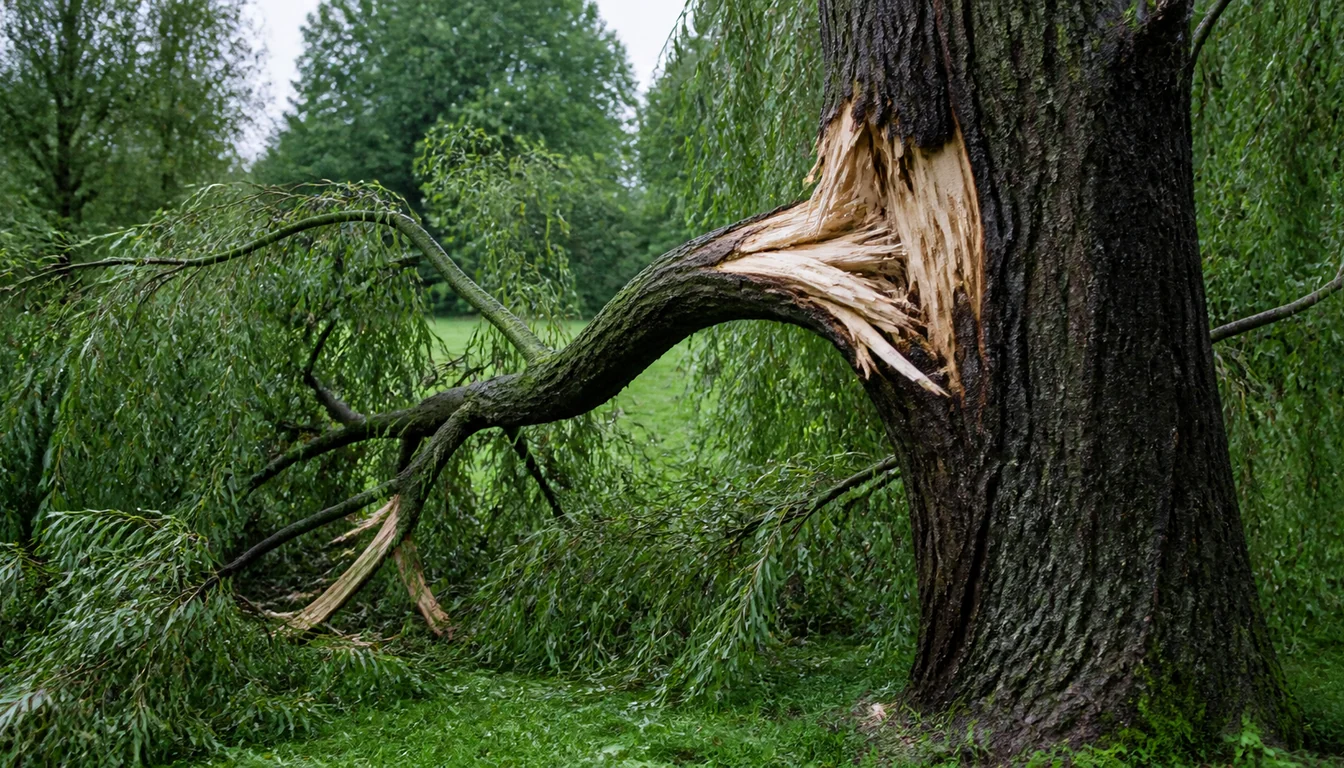
NC State notes that the rapid growth comes with weak wood that cracks or breaks easily, especially under snow or ice, which is why limbs tear off in storms. An oak grows far more slowly and builds much harder wood.
- Growth rate
- Fast. NC State describes it as growing quickly to full size on a moist site.
- Mature size
- 30 to 40 ft tall and about as wide, according to NC State. Roots spread well beyond the crown.
- Lifespan
- Relatively short. Litter, breakage, and pest and disease problems are why NC State does not usually recommend it for home landscapes.
- Leaf and season
- Narrow, finely toothed leaves, light green above and bluish beneath. One of the first trees to leaf out in spring and the last to drop its leaves in fall.
- Wood
- Weak and easily cracked. This is the price of the fast growth and the reason limbs fail.
How Far Do the Roots Reach, and Will They Break Pipes?
Willow roots are the reason this tree has its reputation. NC State Extension warns that its invasive roots can damage water and sewer pipes, and the root system spreads well past the edge of a 30 to 40 ft crown.
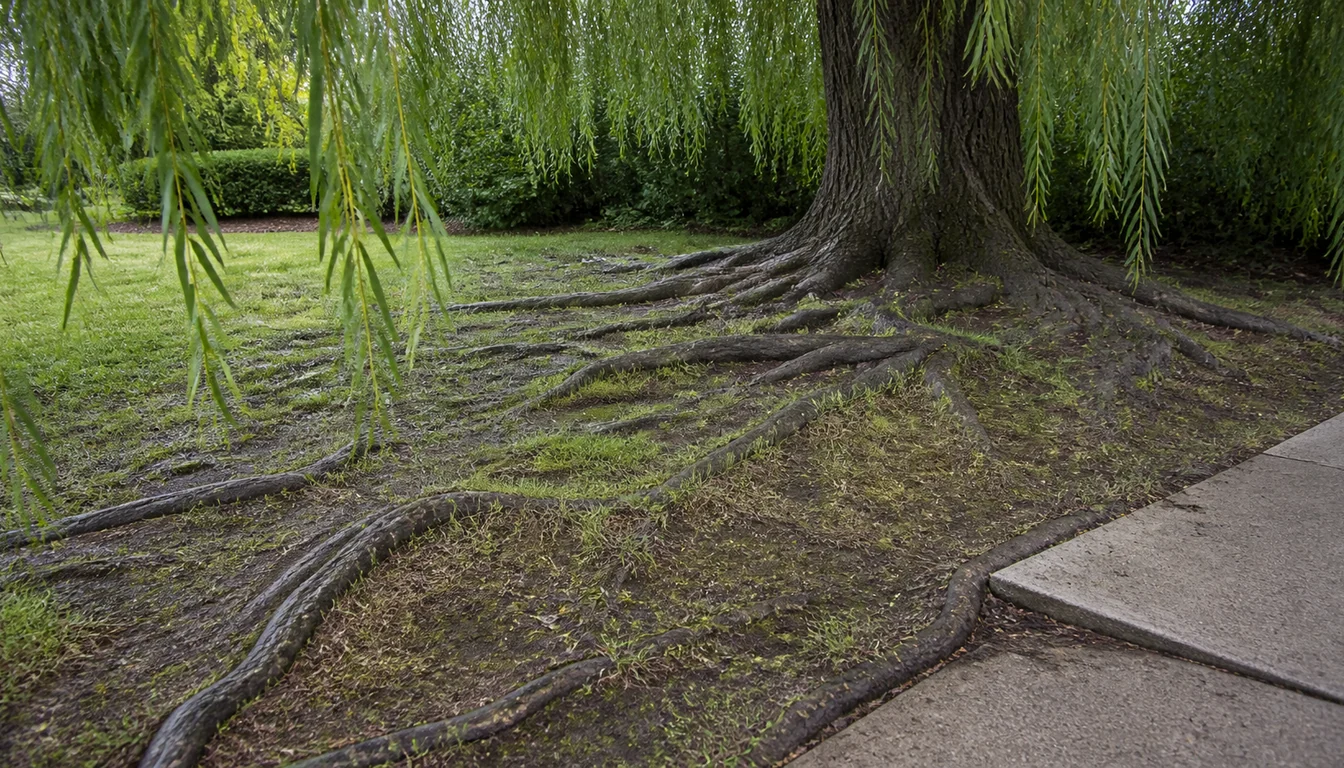
They stay shallow while they do it, mostly within the top 18 inches, which is why they ridge up through lawn and lift the edges of paths.
The pipe question needs a precise answer, because the popular version is wrong in a way that matters. Willow roots do not drill through sound pipe.
What they do is find the small leak or the loose joint an old clay or cast-iron drain already has, push fine roots in through the gap, and then thicken inside the pipe until it blocks completely.
That distinction separates a tree that is safe near a modern sealed run from one that will destroy an old drain within a decade. If you do not know what your laterals are made of, assume the worst.
Every clearance below assumes level ground. Add to them wherever the land slopes toward the thing you are protecting, because that is the direction the roots will travel first.
The roots also go looking for water rather than waiting for it. A willow on a dry site sends roots toward the wettest thing within reach, which in a suburban yard is very often the leach field or a leaking irrigation line.
Turf under a mature willow is a lost argument, so plan a mulched bed or leave the ridged roots exposed rather than scalping them with a mower every week.
- House or foundation
- 50 ft. The soil-moisture swing under a shrinking root plate matters more here than the roots themselves.
- Septic field or leach line
- 50 ft and more. Constantly moist, loose, and nutrient-rich, which is exactly what the roots hunt for.
- Drain or sewer lateral
- 50 ft if the line is old clay or cast iron. A modern sealed run is far less at risk.
- Well head
- 50 ft minimum, and check the local separation rule, which is often stricter.
- Pool or paving
- 50 ft. Shallow roots lift slabs and liner beds long before the canopy reaches full size.
Does a Weeping Willow Have to Be Near Water?
No, and the pond in every photograph misleads people in both directions. A willow grows perfectly well on ordinary garden soil that stays reasonably moist, and it needs no water feature to survive.
What it does need is steady moisture. NC State says it grows best in very moist soil, and its roots will take water from wherever they can reach.
The site does not decide whether the tree lives. It decides what kind of tree you end up with.
That makes it genuinely useful on a wet corner where few other trees thrive, as long as the corner is big. NC State recommends it for pond and lake edges and low spots that hold water.
Soil chemistry barely matters, since the tree takes acid through alkaline ground.
Water a new tree deeply every 5 to 7 days through its first two summers. After that a willow on a moist site needs nothing from you, and a willow on a dry site needs watering forever, which is itself a reason not to plant one there.
- On a moist site: Fast growth, a full crown, and no watering needed at all once the tree is established.
- On a dry or sandy site: Slower growth, summer leaf shed, a thinning crown, and far more borer attack. This is how most dry-site willows die.
- On saturated ground: Handles it better than most trees, which is why NC State lists it for rain gardens and planting at the water's edge.
Why Does It Keep Dropping Twigs and Whole Branches?
Constant small litter is normal and permanent. A weeping willow sheds thin twigs and branchlets all year, more after wind, and there is no version of this tree that does not do it.
That is worth knowing before you put one over a lawn you like to keep tidy or a pool somebody has to skim.
Whole limbs are a different matter. Willow wood is low density and the tree carries long, heavily loaded horizontal branches, so a limb four or five inches thick can tear out of the trunk in a summer thunderstorm rather than snapping cleanly.
The failure almost always happens at a narrow branch union, where bark got squeezed between two stems instead of wood knitting them together.
Those unions are visible years before they fail. Look for a tight V-shaped fork with a raised ridge of ingrown bark running down into it, rather than the open U-shape and smooth collar a sound union shows.
NC State notes that pruning to remove heavy branches helps avoid breakage. Shorten long heavy limbs rather than removing them outright, and take out competing leaders while the tree is young enough that the cuts stay small.
Ice and wet snow are the other trigger, and NC State singles out snow and ice as the conditions under which the weak wood breaks most easily. A willow also holds its leaves late, so an early winter storm can load a canopy that has not dropped yet.
Why Are the Leaves Spotted, Skeletonized, or Falling Early?
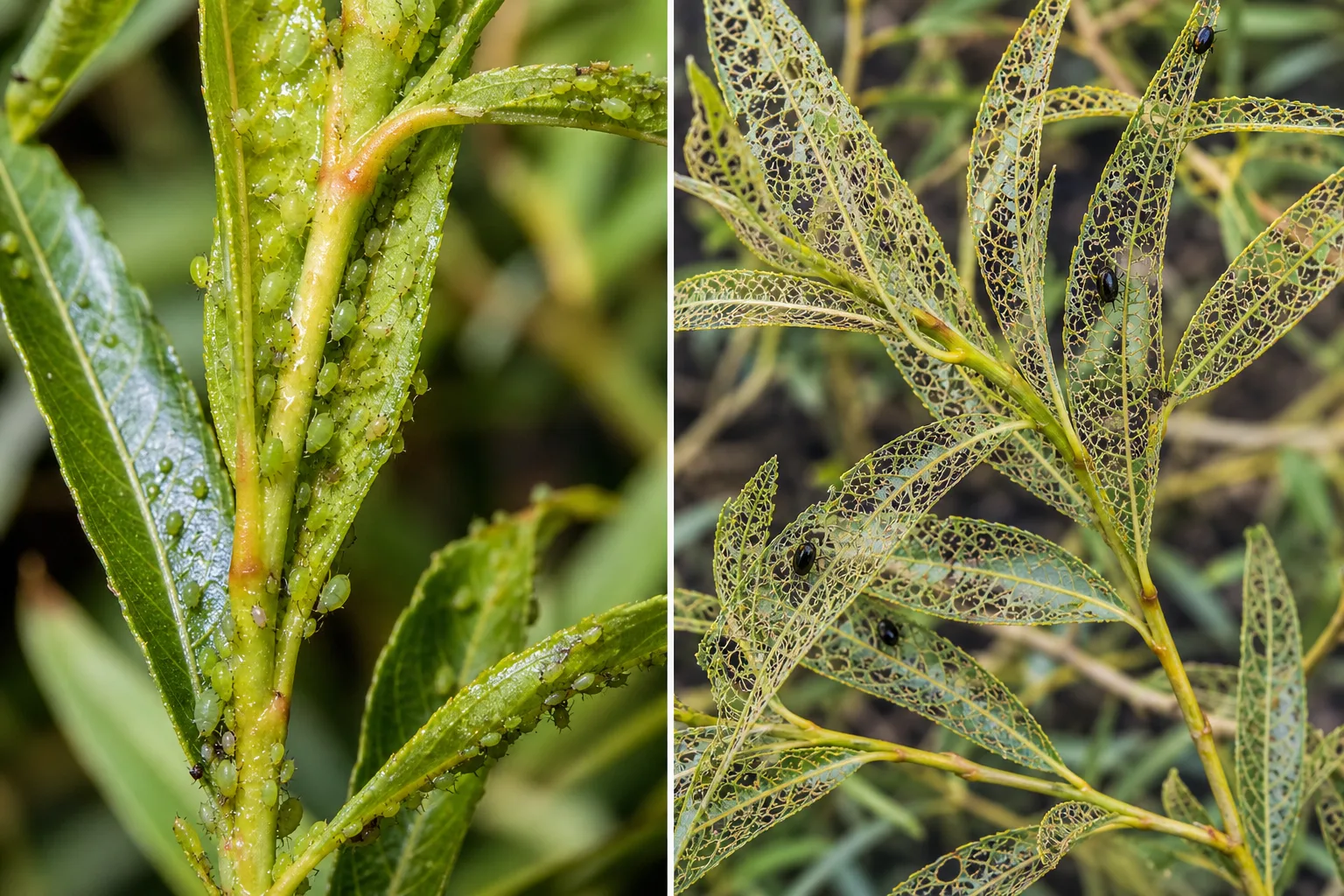
NC State lists aphids, mites, beetles, scale, borers, lace bugs, and caterpillars among willow pests, along with blights, powdery mildew, leaf spots, and cankers. Three problems account for most of what an owner notices. The first is willow scab and black canker, which arrive in wet springs and kill new shoots from the tip backward.
A healthy tree throws it off and releafs. A tree that catches it several years running thins badly, and the only useful responses are cutting out dead wood in dry weather, raking fallen leaves, and thinning the canopy so it dries faster after rain.
The second is the giant willow aphid, which builds dense colonies of large gray-brown insects along the stems rather than on the leaves.
A hose blast knocks the colonies back and predators finish the job, so spraying a tree this size is neither practical nor necessary.
The third is the willow leaf beetle, a small metallic blue-black beetle whose larvae graze leaves down to a lace of veins.
Only a young tree that cannot spare the loss is worth treating.
Borers are the one to take seriously, and they follow drought stress rather than causing it, so a willow with sawdust at the base and dying upper limbs is telling you about its water supply.
Willow scab and black canker. Cut out dead wood in dry weather, rake fallen leaves, and thin the canopy so it dries faster, after which a healthy tree releafs.
Giant willow aphid colonies on the stems, where the honeydew is the complaint rather than the insects. Hose them off and let predators finish.
Willow leaf beetle larvae. Looks alarming, arrives late in the season, and rarely matters on an established tree.
Borers, and the one to take seriously. They follow drought stress, so this is a message about the water supply.
How Do You Prune a Weeping Willow, and When?
Prune in late winter while the tree is bare and the structure is readable. Willows bleed sap from cuts made as spring growth starts, which is messy rather than dangerous, and summer cuts on a tree this vigorous simply provoke a flush of water sprouts.
There are three jobs, and none of them is the same as pruning an ornamental.
- Structure, in the first ten years. Take out competing leaders and tight V-shaped forks early so the tree builds one dominant trunk with wide-angled branches.
- Clearance, once a year. Shorten the lowest hanging tips to a height you can walk and mow under, cutting back to a side shoot rather than shearing level.
- Thinning, as needed. Remove crossing, rubbing, and dead wood so air moves through the canopy and the leaf diseases dry out faster.
Should You Plant One at All?
For most suburban lots the honest answer is no, and NC State says the same, noting that weeping willow is not typically recommended for home landscapes because of litter, breakage, disease, and insect problems. The tree wants 50 ft of clearance in every direction and its roots can damage water and sewer pipes.
The people it does suit have a very specific site.
An acre or more of open ground, a pond or stream bank that needs holding, no drains or septic anywhere within reach, and a real wish for that outline within a few years rather than decades. On that site a weeping willow does a job few other trees can match.
If the site is smaller, the useful move is to name what you actually wanted from the willow and buy that instead.
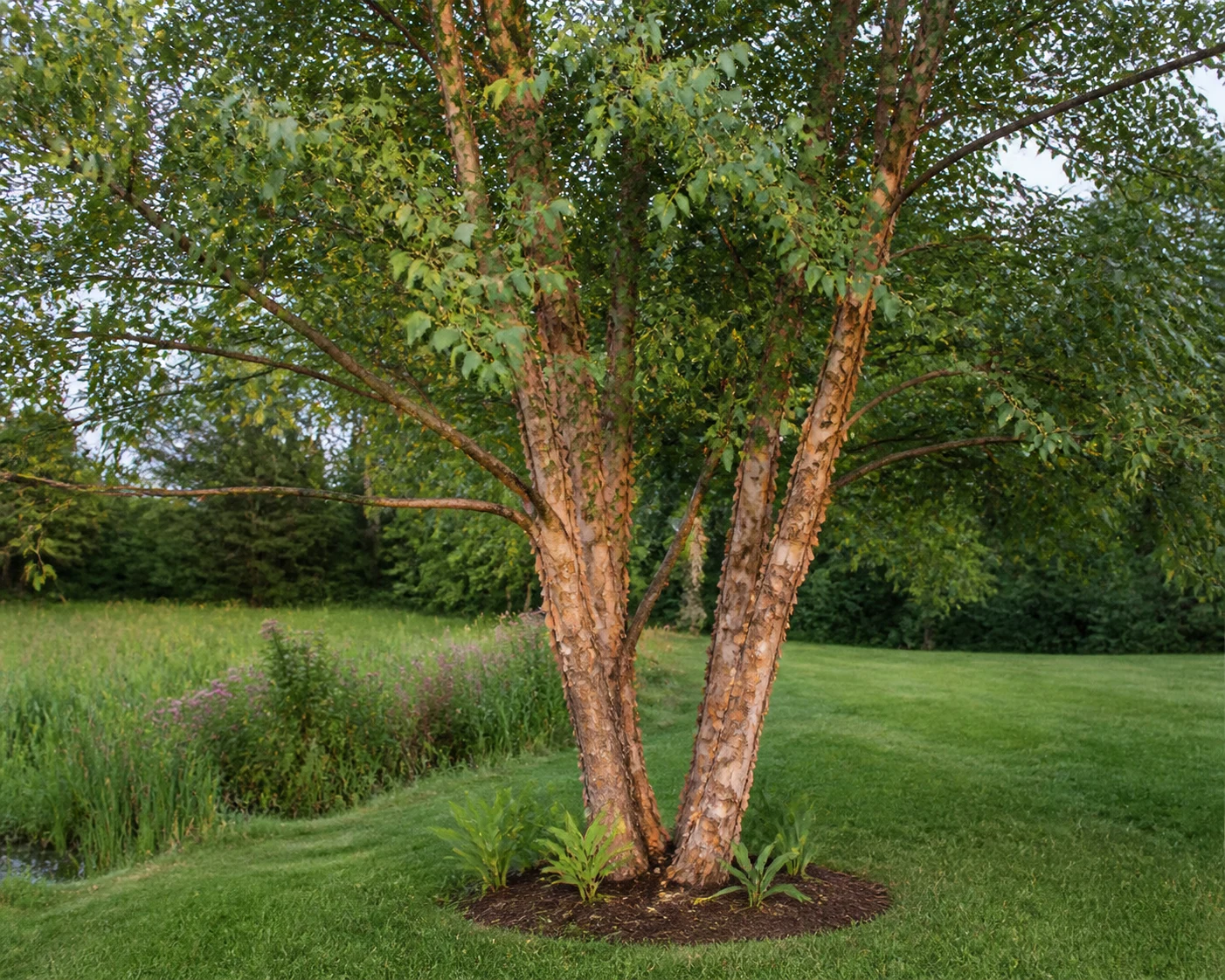
For fast shade on damp ground, a river birch gives much of the speed with far less root reach. For the weeping outline at a manageable scale, a weeping cherry or a weeping crabapple stays far smaller.
For bank stabilization on a small pond edge, shrub willows such as pussy willow do similar root work at shrub size and can be cut back hard whenever they outgrow the spot.
One last thing is worth knowing before you commit. Willow cuttings root so readily that a branch pushed into damp ground often grows, and NC State notes that weeping willow has naturalized throughout North Carolina.
- Weeping Willow
- Only on an acre or more, well away from drains. Unmatched outline, relatively short life, endless litter.
- River Birch
- Fast shade on damp ground with a far smaller root reach.
- Weeping cherry or weeping crabapple
- The weeping outline at a size an ordinary suburban lot can actually hold.
- Pussy willow and other shrub willows
- Bank holding at shrub size. Cut them back hard whenever they outgrow the spot.
Frequently Asked Questions
Can you grow a weeping willow from a cutting?
Yes, and it is the standard way to propagate one. NC State lists stem cuttings as the recommended method, and a pencil-thick dormant cutting pushed into damp ground in late winter usually roots readily.
Are weeping willows toxic to dogs, cats, or horses?
The records do not settle it for this species. The ASPCA lists purple osier willow (Salix purpurea) as non-toxic to dogs, cats, and horses, but weeping willow itself does not appear on its lists, so whether its bark or leaves harm a pet or horse is unknown.
When do weeping willows leaf out and drop their leaves?
NC State notes that it is one of the first trees to leaf out in spring and the last to drop its leaves in fall. That long season is pleasant, and it is also why an early winter storm can catch a fully loaded canopy.
Why is my weeping willow leaning?
A slight lean toward open light or toward water is normal and structurally fine on a tree that grew that way from the start. A lean that appeared suddenly, with cracked or heaved soil on the opposite side of the trunk, means root failure and needs an arborist rather than a stake.
Is a corkscrew willow the same as a weeping willow?
No. Corkscrew willow, 'Tortuosa', is grown for twisted stems rather than a hanging curtain. It is often sold as Salix matsudana, and NC State lists it among the cultivars of Salix babylonica, so it shares the same weak wood and the same siting rules apply.
Sources & References
- Willow Trees, University of Minnesota Extension
- Trees and Storm Damage, University of Minnesota Extension
- Salix babylonica, Missouri Botanical Garden Plant Finder
- Salix babylonica, North Carolina State Extension Gardener Plant Toolbox
- Salix babylonica, Royal Horticultural Society
- Pupleosier Willow, ASPCA Toxic and Non-Toxic Plants
- Toxic and Non-Toxic Plant List: Dogs, ASPCA Animal Poison Control
Related Plants
River Birch
The realistic substitute for damp ground, with far less root reach and a longer life.

Red Maple
Fast shade that tolerates wet feet without the brittle wood or the drain problem.

Sweetgum
Another bottomland native for a big lot, with stronger wood and better fall color.
Cherry Blossom Tree
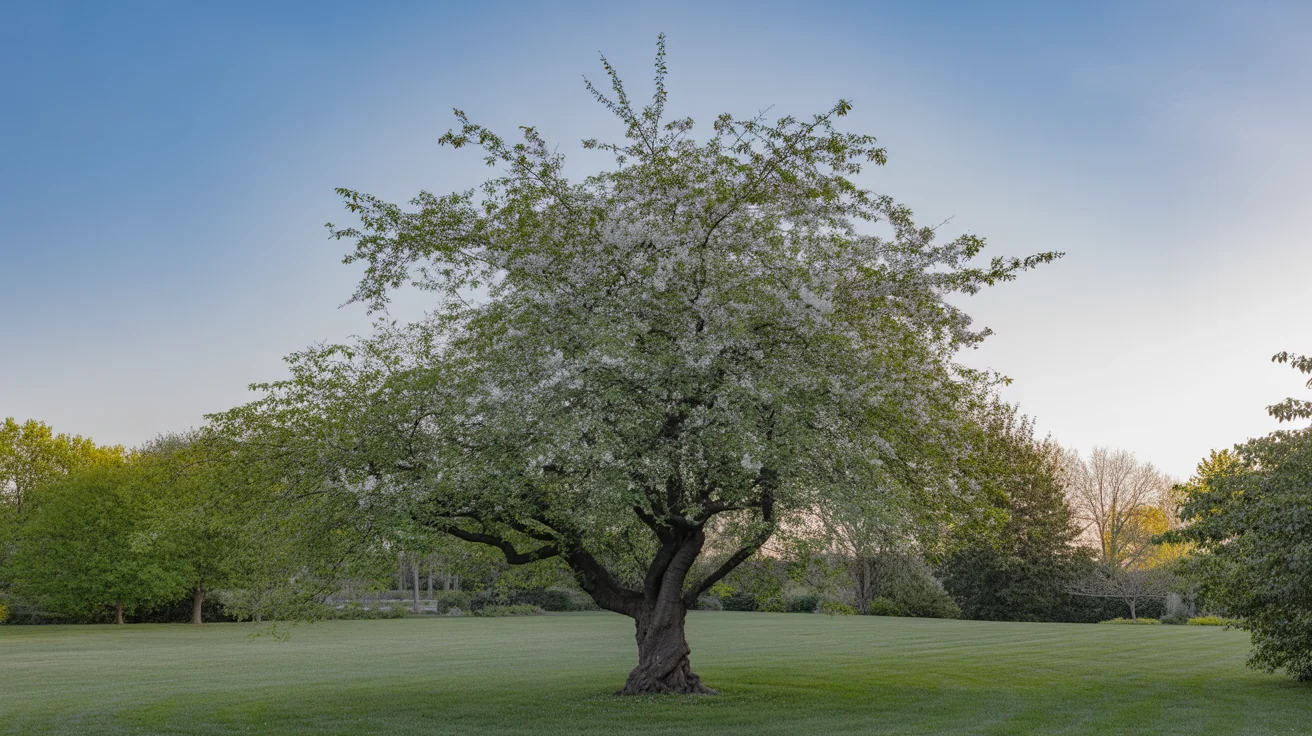
Cherry blossom tree is a common name for ornamental cherries grown for spring flowers rather than a useful fruit crop.

Eastern Redbud
Eastern redbud is a small North American tree with pea-like flowers that open on bare twigs and older wood.

Flowering Dogwood
Flowering Dogwood is easiest to grow when you copy the place it wants to live.