
When a Weeping Willow Canker Means More Than a Dead Twig
A canker becomes likely when a dead weeping willow shoot traces back to sunken, discolored, cracked, or oozing bark. Inspect from the dead tip toward the trunk, limit DIY pruning to small reachable branches with a sound union, and treat trunk or overhead scaffold defects as an arborist decision.
Start diagnosis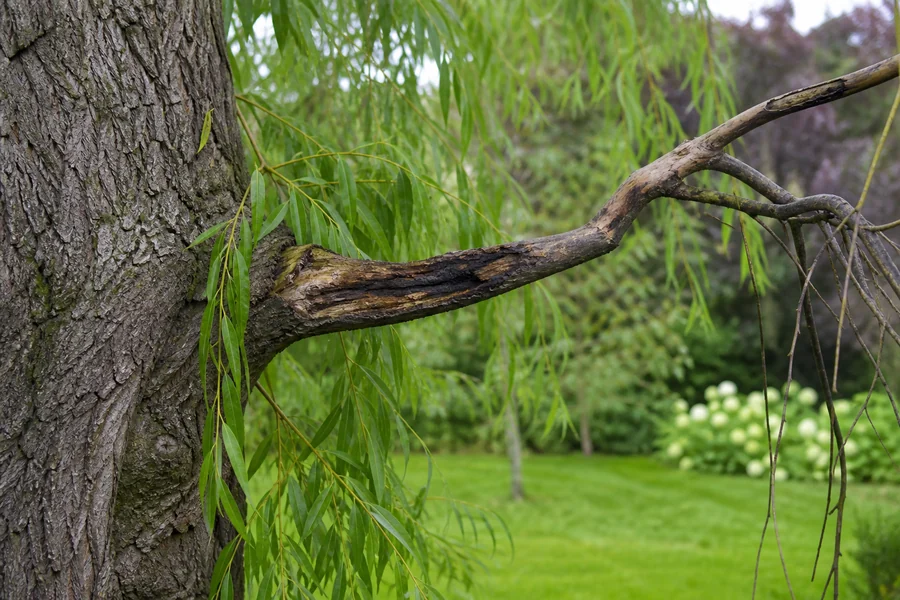
What You Are Seeing
Canker names describe dead areas in bark and cambium rather than one universal pathogen. Cytospora species can infect stressed willow wood, while willow blight can combine shoot cankers with leaf and twig symptoms.
A photograph alone may not identify the organism to species.
The position and extent of dead tissue matter more than sap or ooze by itself. Willows can leak from wounds, insects, cracks, and infections, so diagnosis needs the lesion boundary and the canopy response beyond it.
Cankered bark cannot be sprayed back to living tissue. Management removes limited affected branches when safe, reduces drought and root stress, prevents new wounds, and monitors whether dieback continues into larger structural wood.
Common Causes
A canker pathogen entered stressed or wounded wood
Cytospora and other canker fungi exploit weakened bark and wounds, then kill cambium along a branch. When the dead zone narrows or encircles conducting tissue, leaves and twigs beyond it decline because water movement is interrupted.
- A dead shoot traces back to an elongated sunken or discolored bark area.
- The lesion has a defined transition from normal bark to dead, cracked, or loose bark.
- Buds and leaves beyond the lesion fail while branches below it remain alive.
- Small dark fruiting structures or stained tissue may appear on older cankers.
- Several lesions begin near old pruning cuts, broken twigs, rubbing branches, or winter injury.
- Map each dead branch to its lesion before choosing any cut.
- Remove a small affected branch at a healthy branch union when the entire job is reachable from the ground.
- Keep the branch collar intact and avoid flush cuts, long stubs, or wound paint.
- Clean cutting tools before moving to another tree and remove diseased debris from the site.
- Reinspect during leaf-out and dormancy for dieback that crosses into larger wood.
Willow blight involves leaves and young shoots
Willow blight can involve leaf spots or blackening along with shoot dieback and cankers. A pattern that moves through leaves and young twigs across the canopy is broader than one isolated Cytospora-like branch lesion.
- Young shoots blacken or die while nearby leaves develop spotting or blighted areas.
- Multiple current-season twigs decline rather than one branch beyond one old wound.
- Symptoms increase during a wet disease-favorable period.
- Dead leaves remain associated with affected twigs in parts of the canopy.
- The exact cause remains uncertain without local diagnostic examination.
- Collect clear photographs and a fresh sample that includes living-to-dead transition tissue.
- Ask a local plant diagnostic service or qualified arborist to separate willow blight from other cankers.
- Remove limited dead twigs when conditions are dry and the work is safely reachable.
- Avoid overhead or crown injury while improving airflow around crowded young trees.
- Base any fungicide decision on a confirmed diagnosis and a current label for willow and the disease.
Drought, root, or site stress lowered the tree's defense
Weeping willow grows rapidly where roots can obtain reliable moisture, but drought, compacted soil, root disturbance, flooding without oxygen, or construction damage can weaken cambium. Stress does not prove a canker pathogen, yet it explains repeated infections across otherwise minor wounds.
- Cankers followed a dry season, trenching, grade change, soil compaction, or root-zone disturbance.
- Several branches decline at different locations rather than behind one lesion.
- Soil is dry below the surface or remains saturated and sour-smelling near roots.
- Growth slowed and leaves became smaller before branch dieback appeared.
- Mulch, turf, paving, or traffic changed across the root area.
- Check soil moisture in multiple parts of the root zone before adding water.
- Use deep-watering principles to wet active roots without keeping them saturated.
- Maintain an organic mulch layer while leaving the trunk flare uncovered.
- Keep vehicles, excavation, and stored materials away from the root zone.
- Do not add fertilizer automatically because it cannot replace damaged roots or remove infected bark.
Mechanical wounds created entry points
Torn stubs, flush cuts, mower strikes, rubbing branches, and storm breaks expose cambium and slow closure. A wound is not automatically a canker, but an expanding discolored margin and distal dieback show that the problem has moved beyond the original injury.
- The lesion begins at a pruning stub, split crotch, abrasion, or broken branch.
- Bark discoloration expands beyond the shape of the original wound.
- A branch dies outward from the injured area after initially surviving.
- Repeated cuts have left flush wounds or long decaying stubs.
- Fresh damage lacks the advancing margin seen on older infected tissue.
- Correct only cuts that can be brought back to a sound branch union without enlarging the injury unnecessarily.
- Protect the trunk from mower and string-trimmer contact.
- Reduce crossing or rubbing branches while they are still small.
- Do not carve cankers out of trunks or coat them with wound sealer.
- Have storm-torn scaffold limbs assessed under the willow storm-damage safety boundary.
Match the bark lesion to the dieback beyond it
Follow a dead or thinning branch toward its base until the bark changes. A canker sits between living wood and the dead shoot beyond it, often as a sunken or sharply discolored zone. A fresh tear from storm damage can become infected later, but a new mechanical split without an advancing dead margin is a different starting problem.
Open full diagnosisA Fungicide Cannot Rebuild Dead Bark
Once cambium has died, the tree can only grow new tissue around the injury if enough sound circumference and vigor remain. No spray converts a sunken canker back into conducting bark.
Fungicides may have preventive roles for particular diagnosed diseases and timings, but they do not replace removal of a small cankered branch or professional assessment of structural wood. A generic canker label is not permission to spray a willow.
The tree's response depends on lesion position. Loss of one twig can be compartmentalized, while a trunk or major scaffold canker may interrupt a large share of the crown and weaken the wood that supports it.
Willow grows fast and can produce vigorous shoots after damage, but new shoots do not prove the old structural defect is safe. Monitor the lesion boundary and branch attachment rather than canopy greenness alone.
Trace the Dead Wood Back to Its Boundary
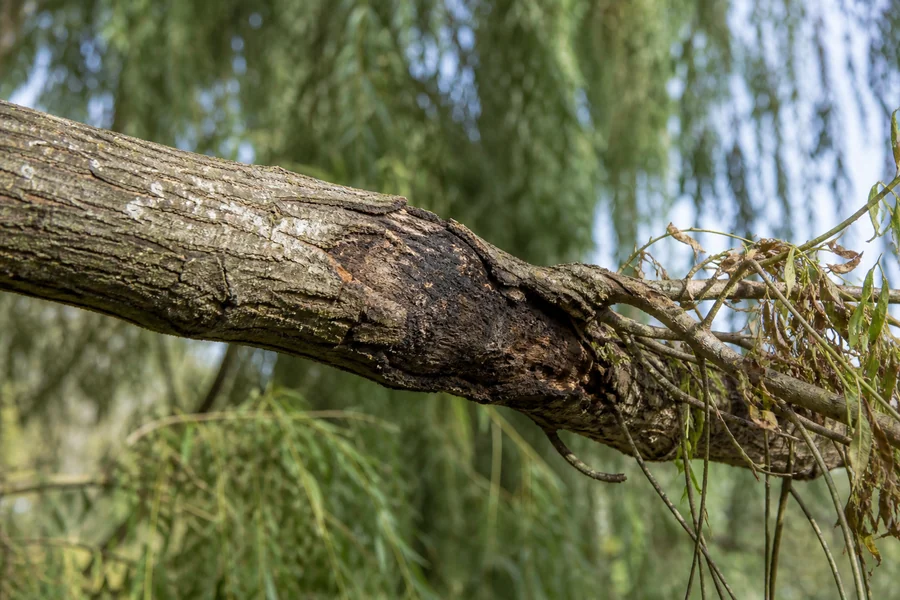
Begin at a shoot that failed to leaf out or died during the season. Move toward the trunk and compare bark color, firmness, contour, buds, and side shoots until you find the transition back to living growth.
A canker diagnosis strengthens when that transition includes sunken or dead bark and the shoot beyond it is failing. Ooze, peeling bark, or one crack without the same canopy relationship is incomplete evidence.
- Canker pattern
- Defined dead bark lies between healthy wood and distal dieback.
- Fresh storm split
- Fibers are newly torn or cracked without an established expanding dead margin.
- Normal mature bark
- Fissures repeat across healthy trunk tissue with no matching branch death.
- Borer evidence
- Holes, frass, galleries, or insect activity accompany decline.
- Root-zone decline
- Multiple crown areas weaken without one branch lesion explaining the pattern.
Photograph the whole branch and a close view of the transition, then note when symptoms began. Those views are more useful to an arborist or diagnostic lab than a macro image of ooze alone.
Prune the Branch, Not the Visible Stain
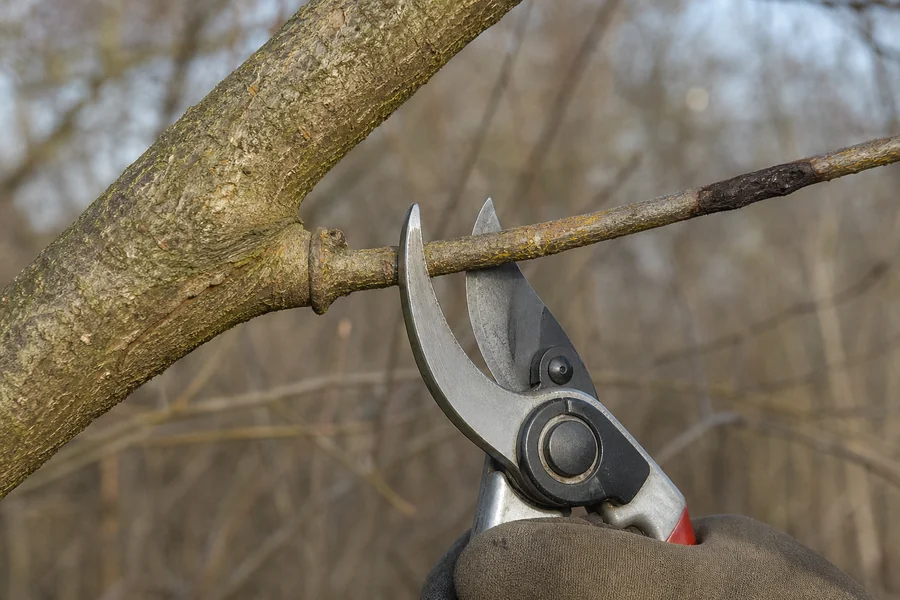
A fixed number of inches below visible bark cannot guarantee clean wood because infection may extend internally or the next suitable union may lie closer or farther away. For a small reachable branch, remove the branch at a healthy lateral union or its collar rather than chasing the stain along the stem.
Limit DIY work to branches you can reach from the ground with ordinary hand tools and that cannot strike a person, building, line, or vehicle. A pole saw, ladder, chainsaw, hung branch, or large limb changes the risk and belongs to trained tree care.
- Confirm that the affected branch is small, reachable, and nonstructural.
- Choose a sound union below the lesion where bark and attached growth remain normal.
- Plan the cut just outside the branch collar without cutting into trunk or parent-branch tissue.
- Support the branch or use a staged removal so its weight does not tear bark.
- Make the final collar cut with a sharp tool and leave no long stub.
- Clean the tool before working on another tree and move diseased debris out of the area.
- Photograph the cut and inspect the parent wood for continued discoloration or dieback.
Do not carve a lesion from the trunk or apply paint, tar, or homemade disinfectant to the wound. The collar and surrounding living tissue need to form their own closure response.
Stop When the Defect Belongs to the Trunk
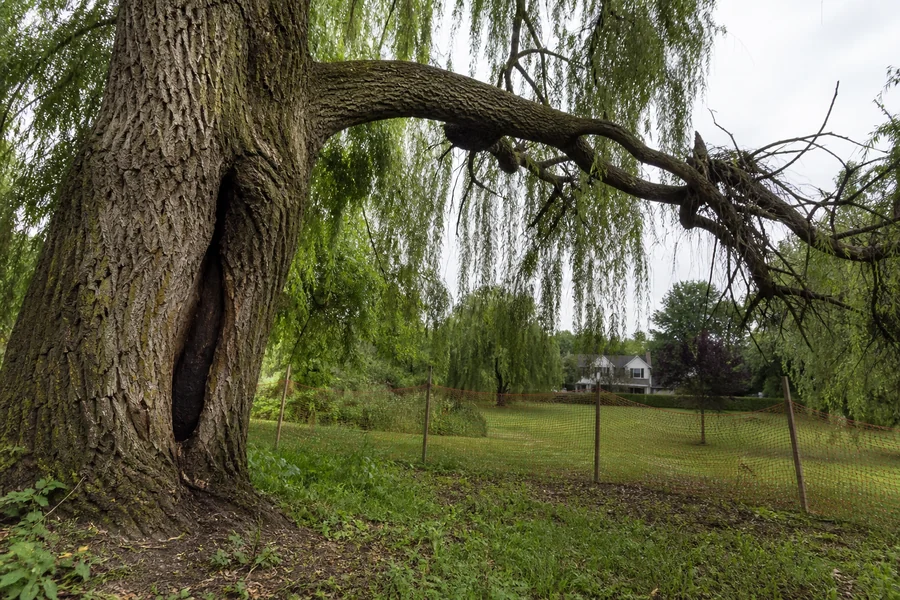
A canker on the trunk, a major scaffold, or a union carrying heavy overhanging wood cannot be solved by pruning a few twigs. Willows can shed weak wood, and a lesion that reduces the sound circumference may also reduce load-bearing capacity.
Seek prompt assessment when bark damage spans a large part of the trunk, a crack opens at a loaded union, roots lift, the trunk leans or moves, dead wood hangs overhead, or dieback continues into successive scaffold branches.
Ask the arborist to separate biological diagnosis from risk assessment. The fungus name informs management, while defect size, remaining sound wood, targets, and branch loading determine whether pruning, monitoring, or removal is appropriate.
Recovery Plan
Map lesions and remove immediate targets
Keep people away from questionable overhead wood, photograph each lesion with its dead branch beyond, and arrange arborist review for trunk or scaffold defects. Prune only small safe branches at sound unions.
Watch the boundary and distal growth
Healthy buds below a removed branch and no new dieback support containment. Expanding bark discoloration, new ooze, or failure across larger branches means the problem remains active or the tree is under continuing stress.
Reassess structure and site stress
Inspect old lesion margins, branch attachments, root-zone changes, and new dead wood. Continued recurrence despite corrected water and wound pressure warrants diagnostic sampling and another professional risk review.
Reduce new entry points by pruning small branches at sound collars, preventing trunk strikes, and correcting rubbing limbs early. Protect the broad root zone from drought, saturation, compaction, excavation, and grade changes, then inspect after storms so torn wood receives the right structural response before decay and canker margins become harder to separate.