
Is a Storm-Damaged Weeping Willow Safe to Keep?
A weeping willow can remain dangerous after the wind stops. First separate a lodged branch from a split load-bearing union or a rotating root plate, then keep people outside the fall zone until the utility or an arborist has cleared the hazard.
Start diagnosis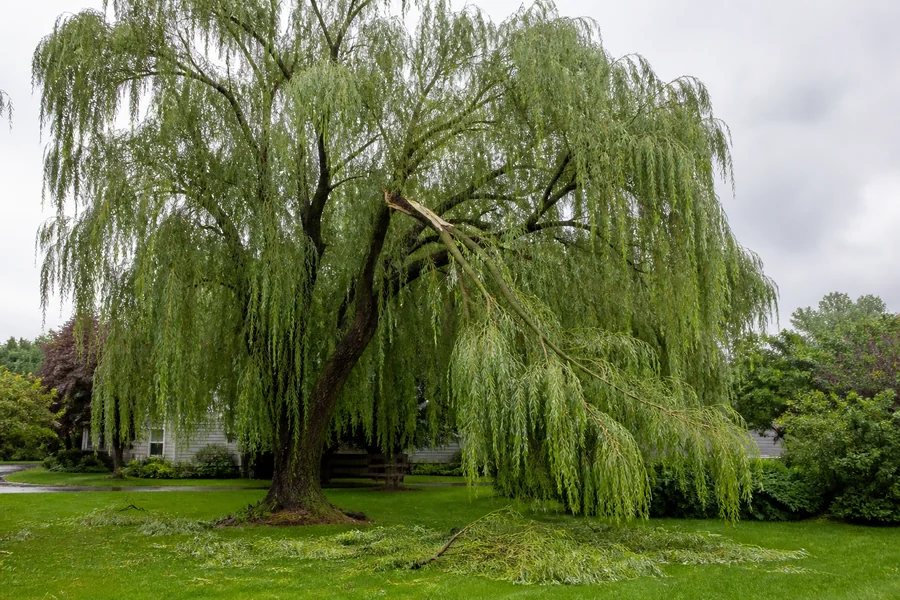
What You Are Seeing
A storm can break the crown, split the trunk, rotate the roots, or expose decay that existed before the weather arrived. Those failures do not share one repair, so the location of lost support matters more than the amount of foliage still green.
Keep people, pets, vehicles, and portable furniture away from the possible fall path. Never assume a service line is harmless because neighborhood power appears to be off, and never pull a limb away from a conductor.
Photograph the whole tree, both sides of the trunk base, the broken attachment, and the ground around the root flare from a safe position. Include a fixed object for scale and note whether the lean, crack, or soil movement is new.
Common Causes
A broken limb is suspended in the crown
A scaffold limb can break without reaching the ground. It may hang by torn fibers, rest across other branches, or remain bent under stored force, then shift as the crown dries or wind returns.
- Fresh pale wood or shredded fibers show where the limb separated.
- The branch angle changed or its foliage hangs lower than the surrounding crown.
- One end is lodged in another branch, on a roof, or against another tree.
- Debris continues to fall even though the main limb has not moved.
- The branch or tree is near a utility conductor.
- Close the ground beneath and beyond the limb's likely drop path.
- Call the utility when any branch or tree part touches or could move into a line.
- Use a qualified tree-care company for climbing, rigging, or a cut that needs a ladder or chainsaw overhead.
- Move only loose debris that can be reached from open ground outside the fall zone.
- Have the remaining attachment and nearby branches inspected after removal.
A load-bearing trunk or union has split
Two similar stems can separate where bark was trapped between them, or a major limb can tear into the trunk. The split changes how the remaining crown transfers weight into the trunk.
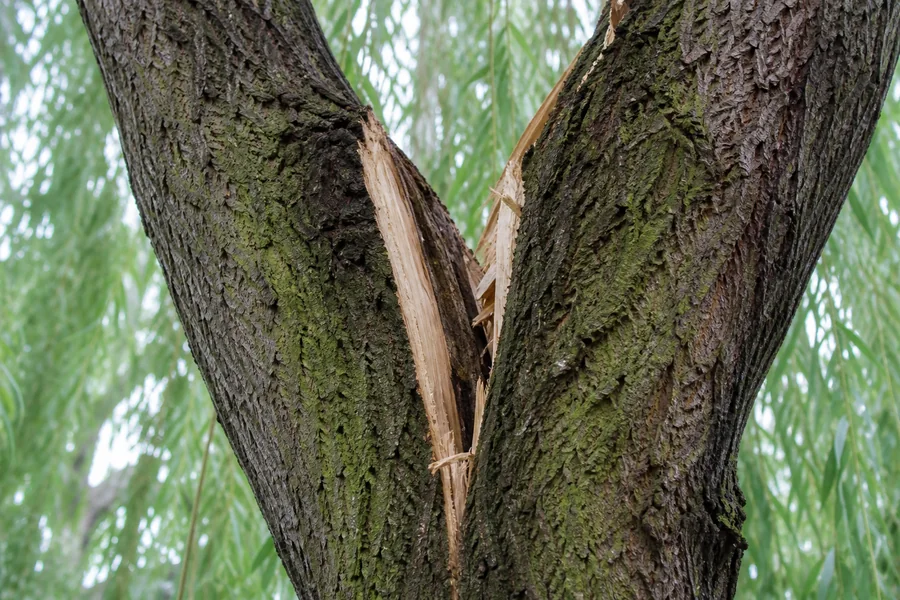
- A fresh gap opens between two stems or continues down the trunk.
- Pale torn wood borders a darker seam of old included bark or decay.
- One stem has dropped, twisted, or begun carrying weight through a narrow strip of wood.
- The crack changes width with wind or under the weight of wet foliage.
- Targets such as a house, road, play area, or neighbor's yard sit within reach.
- Keep the potential fall area empty and do not strap the stems together as a temporary experiment.
- Ask an arborist to inspect the union, remaining sound wood, crown load, decay, and targets.
- Discuss selective removal only when the remaining structure can carry the changed load.
- Treat cabling or bracing as an engineered support that needs sound anchors and later inspection.
- Choose removal when the remaining load path cannot be made acceptably safe.
The root plate rotated in wet soil
Wind loading can lever the trunk while saturated soil loses holding strength. The root-and-soil plate may tilt without the tree falling completely, leaving anchoring roots torn or the soil detached around them.
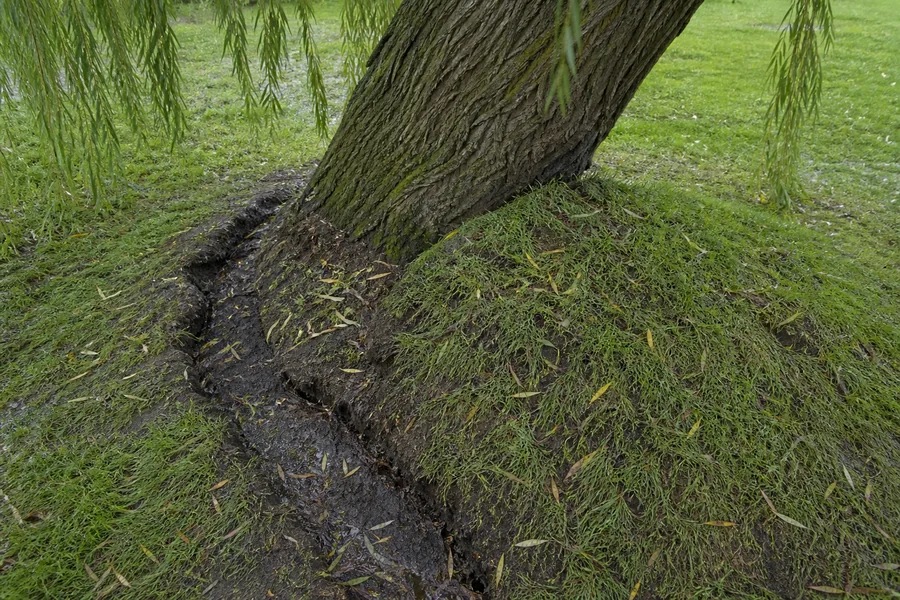
- The trunk has a new lean that was absent before the storm.
- A crescent-shaped crack opens in the soil near one side of the base.
- Soil or turf is mounded on the side opposite the lean.
- The root flare shifted relative to a fence, path, or previous photograph.
- Rain-saturated ground moves or opens further during gusts.
- Exclude the full direction of fall and an additional margin for crown spread.
- Do not pull a mature willow upright with a vehicle, rope, or improvised anchor.
- Have an arborist assess root breakage, soil failure, lean, targets, and whether retention is realistic.
- Keep vehicles and excavation away from the disturbed root plate.
- If removal is required, coordinate access so saturated soil is not compacted across retained trees.
The crown broke but the trunk and base stayed stable
A tree may lose branches while the trunk, major attachments, and root plate remain unchanged. Retention depends on where the branches tore, how much balanced live crown remains, and whether the new wounds expose serious defects.
- The trunk lean and soil around the flare match their pre-storm condition.
- Breaks are confined to branches rather than continuing into the trunk.
- Remaining scaffold attachments have no fresh cracks or movement.
- The surviving crown is distributed around the trunk rather than concentrated on one side.
- The break surfaces do not reveal extensive hollow, soft, or dark decayed wood.
- Let a professional remove large or loaded branches and finish torn attachments correctly.
- Make ground-level cuts only on small, fully detached material that is clear of all tension and overhead hazards.
- Retain adequate live crown instead of trying to make the outline symmetrical in one visit.
- Avoid topping and wound paint because neither restores the original attachment.
- Schedule follow-up structural pruning only after the first response and tree condition are known.
The storm exposed an older weakness
Dark, soft, hollow, callused, or fungal-colonized tissue at a fresh break shows that some weakness predated the storm. The weather may be the final load rather than the only cause.
- Fresh pale splinters surround older dark or softened wood.
- A hollow extends beyond the branch that failed.
- Old woundwood curls around a seam, cavity, or dead stub.
- Fungal fruiting bodies, loose bark, or repeated dieback occur near the break.
- The remaining trunk or union shares the same defect.
- Photograph the break before cleanup hides the internal condition.
- Ask the arborist to evaluate the extent and location of remaining sound wood.
- Use the willow canker signs only when bark lesions or branch dieback extend beyond the mechanical break.
- Do not scrape, fill, or seal a cavity to make it look sound.
- Change the retention decision when decay compromises the remaining load path.
Look for a changed lean, lifted soil, a trunk split, or a suspended limb
View the tree from more than one side without walking beneath the canopy. Fresh crescent cracks or mounded soil beside the trunk point to anchorage loss; a widening split points to a failing union; a heavy broken limb held aloft by other branches remains a falling hazard. Any line contact goes to the utility, and any of these structural signs needs an arborist before cleanup.
Open full diagnosisThe Storm Reveals the Load Path
The crown transfers wind and gravity loads through branch unions, the trunk, and the root plate into soil. Damage low in that path affects everything above it, which is why one split trunk or rotating base can matter more than several broken outer branches.
Normal willow shoots hang in an even curtain and flex in wind. Storm damage creates a discontinuity: a changed angle, a torn attachment, a fresh gap, a lodged mass, or a new lean that was not part of the tree's previous form.
Old included bark, cavities, decay, previous topping, or one-sided crown growth can concentrate stress. If the break exposes diseased bark rather than only mechanical tearing, that separate diagnosis belongs with canker and dieback evidence.
When the trunk and soil have not moved and the concern is instead a pipe, path, or foundation, use the root-conflict evidence checks. That separate diagnosis needs proof of contact rather than storm-failure signs.
Set the Boundary Before Cleanup
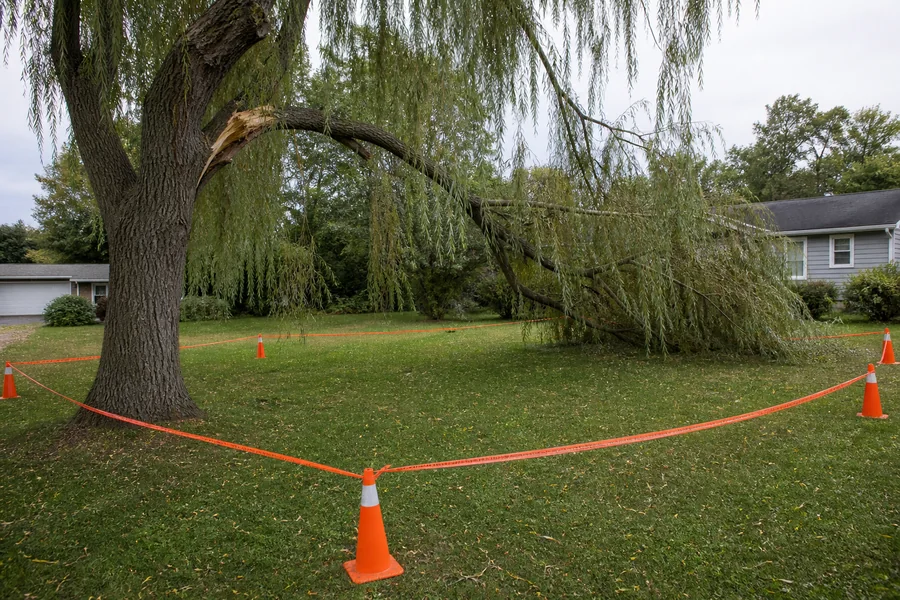
Begin where the tree could reach, not where debris has already landed. A heavy limb may swing, roll, or fall beyond the canopy edge, and a partially uprooted tree may continue moving after the rain stops.
Take photographs from open ground and use the camera zoom instead of stepping under the crown. Compare the trunk with a roofline or fence post and record fresh soil cracks, because those references help establish whether the lean changed.
- Tree or branch near a conductor
- Stay away and call the utility, even when power appears to be off.
- Large limb hanging or under tension
- Close the drop zone and hire a qualified tree-care crew with rigging equipment.
- New lean, lifted soil, or trunk split
- Keep the full fall direction clear and request an arborist assessment.
- Small loose twigs on open ground
- Collect them only when no overhead, line, or whole-tree hazard remains.
- Damage over a road or public space
- Notify the responsible utility, municipality, or property authority.
A ladder, an overhead chainsaw, or a cut into bent wood moves the task outside homeowner cleanup. Wood fibers can release stored force before the operator sees which direction the piece will travel.
Read Where the Tree Lost Support
Trace the failure from the soil upward. Soil movement groups the problem with anchorage loss; a trunk or codominant seam groups it with a load-bearing split; damage confined to branch attachments may leave a stable base.
Green leaves only show that some tissues still receive water. They do not prove that a cracked union can carry wind load or that torn roots can hold the tree upright.
Share old photographs when possible. A longstanding phototropic lean with stable soil differs from a new lean accompanied by heaving, though either can still require assessment when a target lies beneath it.
Decide With Load Path, Not Leaf Color
Retention is more plausible when the root plate and trunk remain stable, breakage is confined to repairable branches, sound attachments remain, and the crown can be managed without topping. The tree's value and the consequence of another failure also belong in that judgment.
Removal becomes more likely when the root plate rotated, the trunk split through a major load path, decay extends into what must remain, or the altered crown would leave unacceptable risk over a target. Ask the arborist to explain which evidence drives the recommendation.
If removal creates a new planting decision, choose a tree for the available rooting volume and mature crown space. A fast-growing replacement still needs structural training and enough room rather than speed alone.
Recovery Plan
Document change and control access
Photograph the tree from safe positions, note line contact and targets, mark the exclusion zone, and wait for utility clearance or an arborist when structural hazards remain.
Record what remains
Keep the assessment, photographs, pruning or support details, and inspection schedule. Protect the root zone from vehicles and avoid fertilizer intended to force rapid replacement growth.
Watch structure as well as foliage
Check for widening cracks, renewed lean, soil lifting, hanging branches, crown thinning, and decay at exposed wounds. Water during genuine dry periods without keeping already wet soil saturated.
Recheck the altered load path
Inspect the same unions, support hardware, root plate, and targets after strong wind or saturated-soil events. Request another professional review when anything has moved or the target use has changed.
Structural pruning while a willow is young can reduce competing stems and poorly attached branches before they carry a mature crown. Preserve generous rooting space, avoid construction injury and topping, and inspect major unions before storm season rather than discovering every defect after failure.