
Leggy Wandering Jew: Light, Stem Age and Renewal
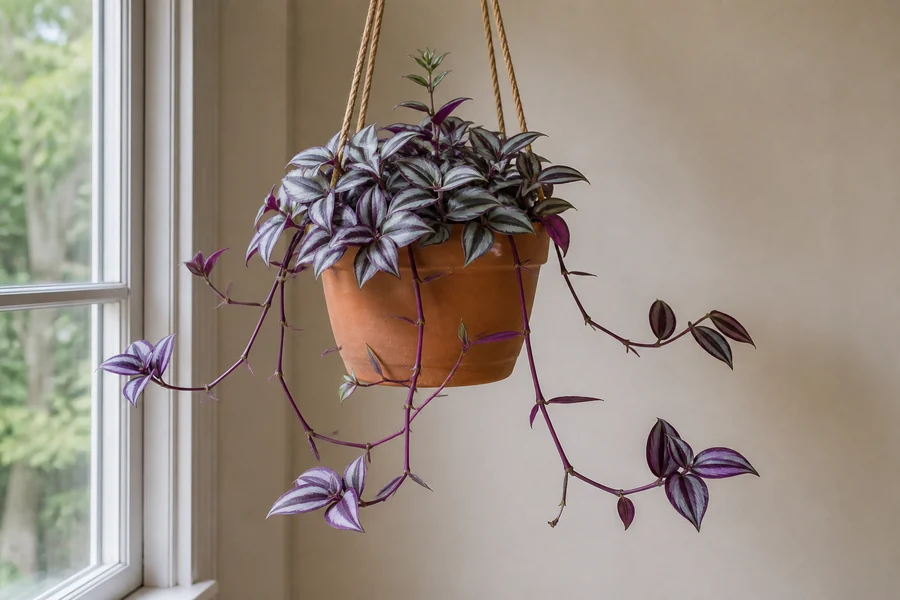
A leggy Tradescantia zebrina may have long new internodes, old bare vines or a thinning crown. Comparing when those changes developed helps separate inadequate light from aging growth and root or stem decline before choosing pruning or renewal.
Quick diagnosis
Compare new internodes with older compact growth
Longer new gaps after a darker move support a light-related explanation. Compact tips on old bare vines can favor renewal, but neither spacing nor firm stems rules out root trouble. Persistent wetness, wilting or soft bases need attention before shaping the plant.
Open the full diagnosisWhat You Are Seeing
Vine length alone does not make Tradescantia zebrina leggy. This species naturally trails, so the useful evidence is the distance from one leaf node to the next and whether leaves still cover the stem.
Use one healthy compact shoot as the plant's reference.
Compare new internodes with earlier growth and the timing of a room move, changing seasonal light or increased shading. A comparison within the same plant is more useful than a universal spacing cutoff.
Old bare internodes will not shorten or grow their dropped leaves back. Recovery appears as tighter new spacing, branches below a cut, and rooted tips filling the empty crown.
Smoothly faded stripes on leaves that remain closely spaced answer a different question. Diagnose that pattern on the faded Tradescantia leaves page instead of pruning for color alone.
Common Causes
01 Check light history
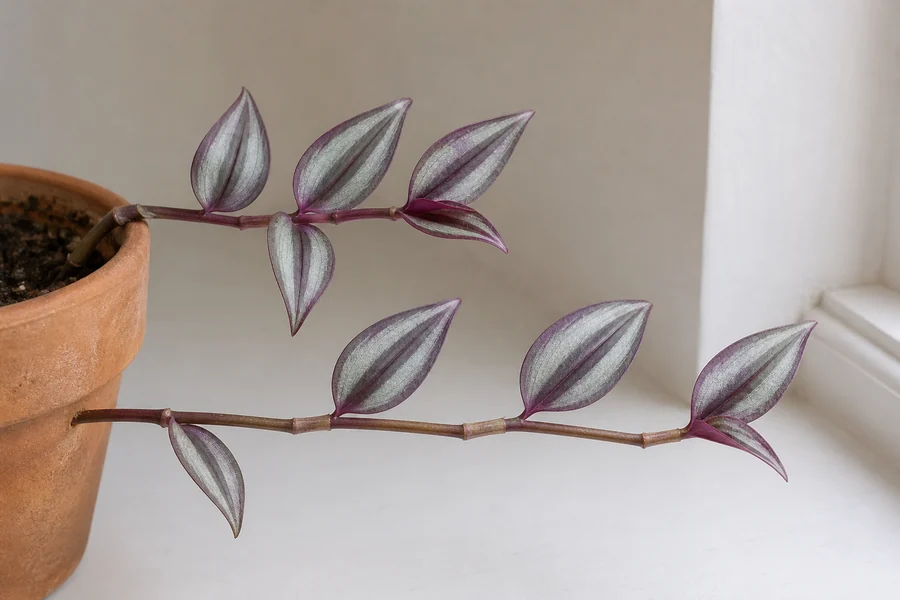
Low light can accompany longer new internodes
NC State associates low light with lower-leaf loss and reduced foliage color, while Wisconsin describes a naturally spreading plant that can become straggly. Longer gaps that develop after a darker move support checking light, but vine length or spacing alone cannot establish the cause.
How to identify it
- New gaps between leaves are longer than gaps on the plant's earlier compact shoot.
- Leaves become smaller toward the extending tip and the stem leans toward the useful light.
- The crown sits above or behind the window even when the hanging ends reach brighter space.
- The change began after a darker season, room move, or increase in shading.
What to do
- Move the crown and newest nodes into brighter filtered light rather than lighting only the hanging ends.
- Rotate the pot only after each side has enough light, since rotation cannot repair an exposure that is weak everywhere.
- Use a grow light when the room lacks a workable window, following the fixture maker's distance and duration guidance.
- Mark the first node made after the move and judge later internodes from that point.
02 Check older vines
An old trailing stem can be sparse without current etiolation
An older trailing vine can lose lower leaves while its tips continue growing. A bare crown with compact new tips can benefit from renewal when light and root conditions are suitable; that pattern does not prove that the roots are healthy.
How to identify it
- The bare section is old while the newest leaves remain full size and closely spaced.
- Several long vines hang from only a few crowded starting points in the pot.
- Firm stem bases and an appropriate drying pattern are useful observations, but cannot exclude every root problem.
- The plant looked full when young but thinned gradually as vines lengthened.
What to do
- Retain a suitable bright, filtered exposure while checking the history of leaf loss and the root zone.
- Select healthy tip sections to root back into empty areas of the crown.
- Remove an old bare stem after replacement cuttings are secured rather than stripping the whole basket at once.
03 Check branching
Pruning and rooted tips can refill sparse growth
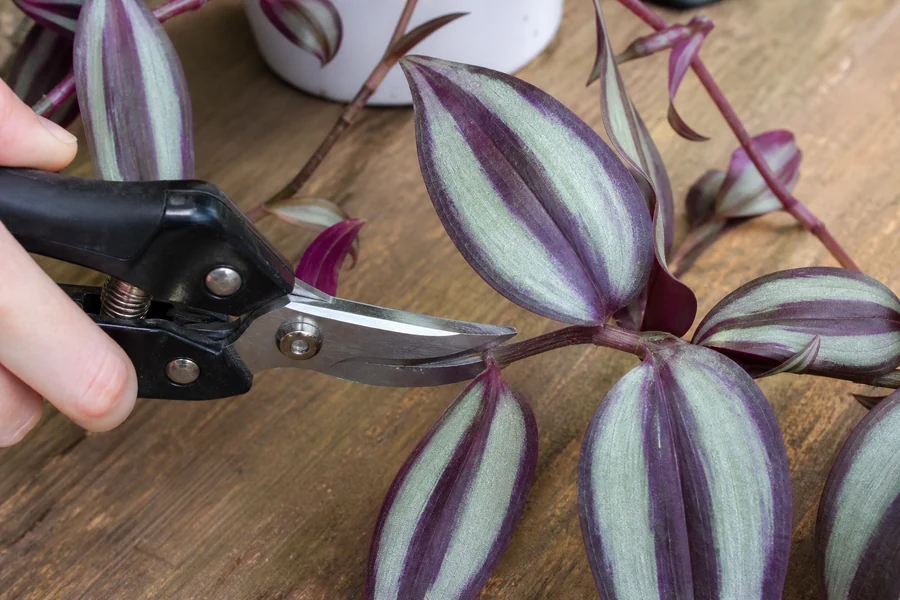
Wisconsin recommends pinching or pruning zebrina to encourage branching, or renewing a straggly plant from cuttings. A healthy stem with viable nodes can contribute new growth after a cut, while its removed tip can root separately. A sparse center may need several rooted stems distributed around the pot rather than longer trails at its edge.
How to identify it
- Only a few stems emerge from the pot and most side growth sits near their tips.
- Healthy nodes remain on firm purple stems below the foliage.
- The pot has not been pinched, cut back, or renewed with cuttings during active growth.
What to do
- Choose cut locations from node health and the shape you want, not from a fixed percentage of vine length.
- Make each cut with clean blades just above a healthy node retained on the parent stem.
- Keep firm colorful tips with several nodes for propagation and discard soft or pest-damaged pieces.
- Use the houseplant pruning method when cleaning tools and choosing viable stem tissue.
04 Contributing factor
Feeding history can reveal an additional stress
Extra fertilizer cannot compensate for inadequate light. A recent application, an excessive dose or visible salt buildup belongs in the assessment, but soft growth alone does not prove a feeding problem.
How to identify it
- A flush of soft rapid growth followed feeding while the plant remained in weak light.
- White mineral crust appears on the rim or mix, or the label rate was exceeded.
- Internodes were already widening before extra fertilizer was added.
What to do
- Pause feeding while correcting light and checking whether salts or roots need attention.
- Resume only during active compact growth using the labeled rate from a suitable indoor-plant fertilizer.
- Extra fertilizer is not needed simply because a plant has been pruned. Feeding depends on active growth, plant condition and the product’s directions.
05 Rule out before cutting
Root or stem decline changes the renewal decision
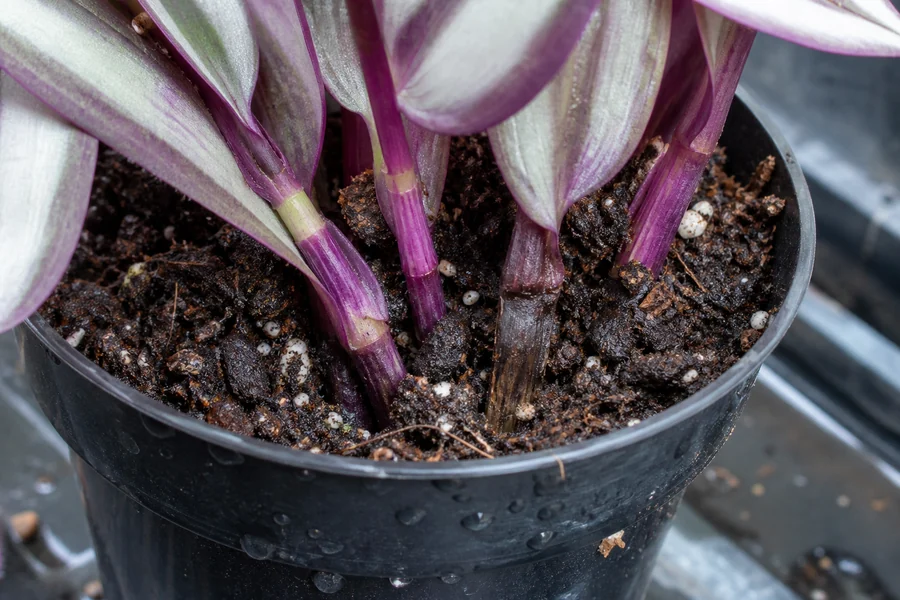
Saturated mix reduces oxygen around roots and can cause wilting or lower-leaf loss. Infection can produce overlapping symptoms. A plant with collapsing bases needs that problem assessed before a cosmetic cutback; apparently firm tips are not automatically safe propagation material.
How to identify it
- The pot stays wet and heavy while lower leaves yellow or fall.
- One or more bases are dark, soft, translucent, or easy to pull free.
- New tips wilt despite wet mix instead of simply leaning toward light.
- Some tissue above the damaged area may look intact, but appearance cannot certify that it is free of infection.
What to do
- Empty standing water and check drainage, stem bases and moisture below the surface before disturbing the roots.
- If the plant continues declining in wet mix, an overwatered-plant root check can help assess damage. Avoid repeatedly tugging stems or pulling the root ball apart.
- Keep a plant with suspected disease apart from healthy plants. UMD recommends discarding severely infected plants and taking cuttings only from healthy tissue; a firm cut surface alone cannot establish that condition.
- When viable healthy material remains, use clean tools and a separate clean pot with suitable fresh mix. Do not return cuttings to a wet, decaying parent pot.
Separate Stem Spacing, Stem Age, and Stem Strength
Stem spacing records growth under earlier conditions. Longer new gaps after a darker move support a light-related explanation, while compact tips beyond an old bare section suggest that repeated moves into stronger sun may miss the problem.
Age helps distinguish a naturally lengthening vine from a declining crown. Pruning can encourage branching and cuttings can refill gaps, but dropped leaves will not return at the same old positions.
Stem decline changes the order of work. Root-zone assessment comes before reshaping when bases collapse, while an otherwise healthy trailing vine can be renewed without disturbing its entire root ball.
Light, aging growth, moisture and pests can overlap. Correct an immediate damaging condition while keeping observations clear enough to assess what new growth does afterward.
Cut the Vine Where New Growth Can Start
A healthy stretched vine and a plant with a collapsing base need different decisions. Pruning or renewal can improve the shape of a healthy plant. A declining plant first needs its root environment and possible disease assessed so the problem is not carried into new pots.
For a shaping cut on a healthy parent, leave a viable node below the cut. A removed tip needs nodes of its own, with lower leaves removed where the node will contact water or moist mix. Clean tools reduce avoidable transfer between plants. Gloves help if zebrina sap irritates your skin, and cut pieces belong out of reach of pets or children who may chew them.
- Long stem, healthy nodes
- Cut above a retained node at the point where branching will improve coverage.
- Bare old base, compact tip
- Keep the tip as a cutting and remove the obsolete length after renewal begins.
- Soft or dark base
- Assess the root zone and possible disease before choosing salvage material; firmness alone does not prove healthy tissue.
- Compact healthy shoot
- Leave it as the reference for future internode spacing.
Rebuild the Bare Crown With Its Own Cuttings
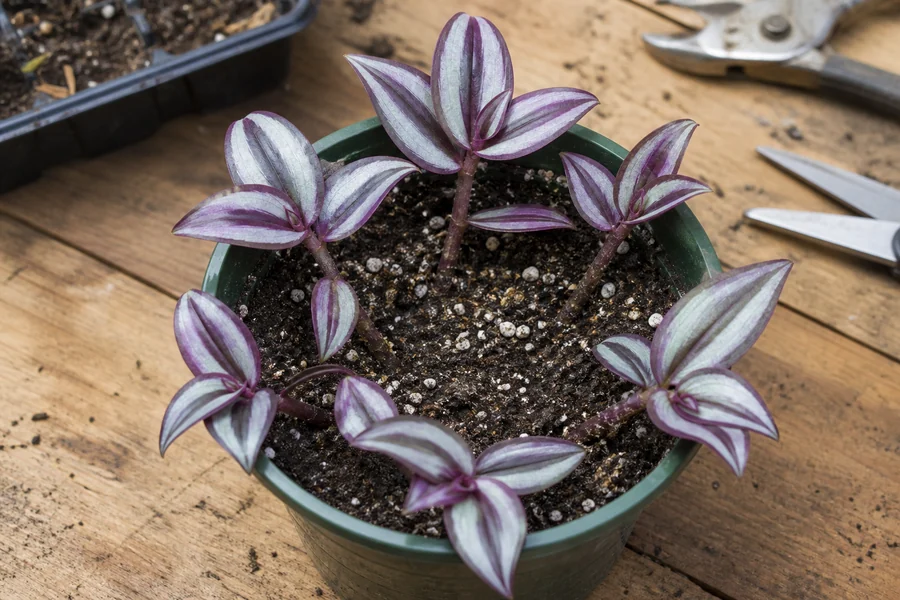
Tradescantia nodes root readily, which makes the removed tips part of the repair rather than waste.
Direct rooting places nodes where replacement stems are needed, while water rooting makes developing roots visible before potting. Neither method makes a sick cutting healthy.
Iowa State recommends propagation from healthy, vigorously growing plants rather than diseased or pest-infested stock. UMD allows cuttings from healthy tissue when dealing with root disease but recommends discarding severely infected plants. Uncertain material warrants diagnosis instead of using a clean-looking cut as proof.
A general houseplant cutting workflow can help with clean preparation, but the zebrina-specific goal here is crown coverage. Space several nodes around the empty surface rather than making a second trailing cluster at one point.
- Choose healthy, vigorous tips with viable nodes from suitable propagation material. Exclude pest-infested or deteriorating pieces.
- Remove the lowest leaves without stripping the node itself.
- Insert at least one bare node into moist airy mix, or submerge that node in clean water.
- Distribute direct-rooted tips around the bare crown and keep each node in contact with the mix.
- Keep the pot in bright filtered light and lightly moist during establishment without leaving it saturated.
Judge the Fix From Internodes Made After the Move
Mark the first node that forms after the light correction. Old gaps remain long, so only the spacing beyond that marker can show whether the new exposure supports compact growth.
Shorter successive internodes, full-size leaves and branches below cuts support improved growth. Continued stretching warrants another look at exposure and care history; yellowing, wilting or softness also requires checking moisture, pests and roots.
Hold conditions steady when the new pattern improves. Repeatedly moving the pot makes each short piece of stem a record of a different exposure and prevents a clean comparison.
Recovery Plan
Address the condition before choosing cuts
Check exposure, moisture and damaged tissue first. Healthy sparse vines can be renewed; a soft base or suspected infection needs assessment before propagation. Old bare lengths will still look unchanged.
Watch retained nodes and cuttings
Healthy nodes below cuts may produce branches while inserted tips establish roots. Keep direct-rooted nodes in contact with lightly moist mix and remove any cutting that turns soft.
Compare the new internodes
Compare growth formed after the change with the earlier stem. Tighter spacing and fuller leaves support improvement, while continued widening calls for reassessing light and other growing conditions.
Light reaching the top of the pot and occasional renewal can help maintain a fuller zebrina basket. Watering follows the mix’s condition, while fertilizer supports active growth when nutrients are needed. Comparing new spacing with earlier growth helps catch a change without treating every long vine as a problem.
Sources
- Tradescantia zebrina — NC State Extension Plant Toolbox
- Tradescantia zebrina, Zebra Plant — Wisconsin Horticulture
- Propagating Houseplants — Iowa State University Extension
- Overwatered Indoor Plants — University of Maryland Extension
- Root Rots of Indoor Plants — University of Maryland Extension
- Indoor Plant Care — Purdue Extension HO-39-W