
Bromeliad Center Rot and the Test for a Living Crown
A soft dark center on a bromeliad means the newest leaf bases or growth point may be decaying. Check whether inner leaves are still firmly attached, then inspect the root zone and any offsets before deciding whether the mother rosette can be kept.
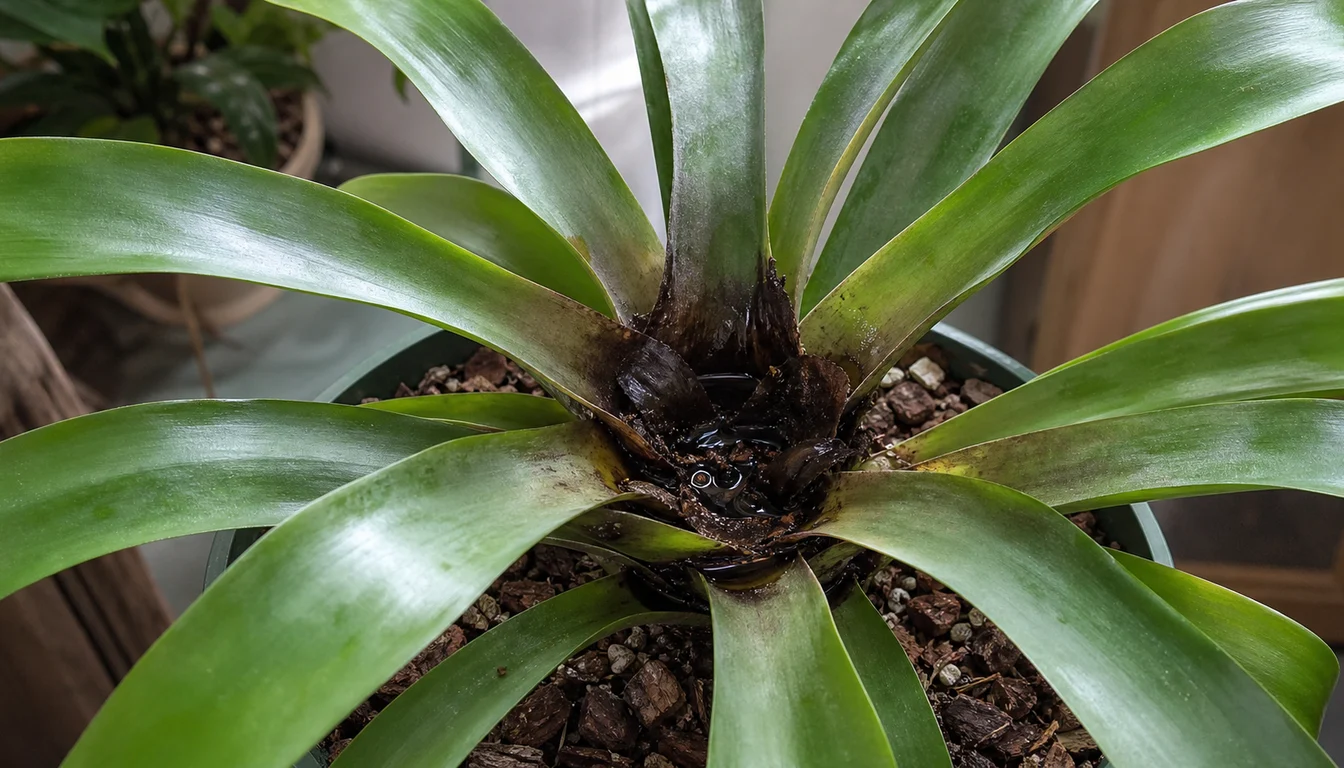
Quick diagnosis
Crown decay when the inner leaves are soft and pull loose
Smell the center and touch only the visible edge of the damaged tissue. A sour odor, water-soaked dark leaf bases, and an inner leaf that releases with almost no resistance mean the growing point is failing.
If the newest leaves remain firmly attached, tip the old water out of a tank-forming rosette and inspect for a decaying flower stalk or trapped debris before assuming the crown is lost.
Dry firm damage at the far ends of leaves belongs to brown tip diagnosis, not center rot.
Open the full diagnosisWhat You Are Seeing
Many bromeliads naturally hold water in a central tank, so water in the rosette is not automatically overwatering. Trouble begins when living tissue becomes injured or decay reaches the leaf bases, while a saturated airless root zone can start a separate path upward from below.
The crown contains the growth point that produces new leaves. Once that point and all inner leaf bases have turned soft, the mother rosette cannot rebuild a new center, although firm offsets attached beyond the damaged tissue may still be worth saving.
Stop pouring treatments into an unidentified soft center. The same visible collapse can follow several organisms or an earlier cold injury, and a pesticide chosen without a diagnosis may miss the cause while delaying disposal of unsalvageable tissue.
Isolate the plant from other bromeliads and avoid splashing its tank water into neighboring rosettes. Inspect first with clean hands and reserve cutting for tissue that is clearly dead or for separating a healthy offset from a failing mother.
Common Causes
01 High likelihood when inner leaves pull free
Soft decay has reached the growing point
The most serious pattern begins inside the rosette. New leaf bases turn brown or black, lose their structure, and release from the center because the tissue that held them has decayed.
A sour or fermenting odor and wet slippery tissue support active soft decay. The appearance alone cannot name a bacterial or fungal organism, but it can show that the mother rosette's only growing point is no longer intact.
How to identify it
- The newest inner leaf moves independently or pulls free with almost no resistance.
- Its hidden base is dark, translucent, or soft rather than pale and firm.
- The center smells sour, fermented, or foul.
- Wet decay expands outward from the inner leaf bases rather than inward from dry leaf tips.
- The center fails to produce a firm new spear after damaged leaves collapse.
What to do
- Isolate the pot and stop splashing water from its center onto other plants.
- Tip out standing liquid and keep the damaged crown from being refilled while you assess how far the softness extends.
- Do not dig into firm green tissue in search of a clean center because the growing point is compact and easy to injure.
- If all inner bases are soft and the center has collapsed, treat the mother rosette as lost and inspect its offsets before disposal.
- Ask a diagnostic clinic to identify the cause before using a fungicide or bactericide on other valuable plants.
02 High likelihood when the pot stays heavy
A wet root zone allowed rot to move into the base
A tank bromeliad can hold water above while its compact roots sit in an airy mix below, but dense wet media removes the air roots need. Root tips die first, then the plant loosens and dark soft tissue can move into the basal stem beneath the rosette.
This pattern may yellow or soften outer leaves before the innermost spear releases. A wet heavy pot and damaged roots make below-ground failure more likely than stale cup water alone.
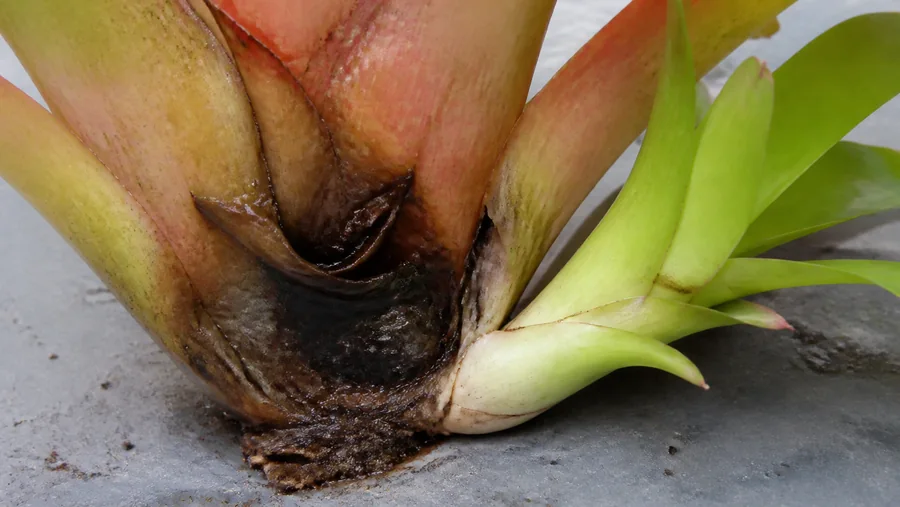
How to identify it
- The container has no open drainage hole or stands in collected runoff.
- The mix remains wet and heavy long after watering.
- Roots are dark and soft with few firm pale tips.
- The whole rosette rocks at the base or separates easily from the mix.
- Softness begins low around the basal stem as well as in the center.
What to do
- Remove the nursery pot from standing water and confirm that its drainage holes are open.
- Slide out the root ball and inspect it without pulling apart firm living roots.
- Trim only roots that are fully soft and dead with a clean tool, disinfecting the tool before it touches another plant.
- Repot surviving firm tissue at its original depth in fresh free-draining bromeliad mix and a clean container.
- Discard the mother rosette when decay has entered the shared basal stem and no clean firm tissue separates it from the roots or offsets.
03 Medium likelihood after chilling
Cold injured tissue around a water-filled rosette
A cold event can kill bromeliad leaf tissue, especially where chilled water sits against the rosette. The first sign may be a brown band at the former water line or translucent patches, and damaged tissue may then become a place where decay begins.
The timing is usually clear. Symptoms follow cold transport, an unheated room, a draft, or contact with cold glass rather than months of ordinary tank care in stable warmth.
How to identify it
- Damage appeared shortly after a cold night, cold shipment, or exposure beside an exterior door.
- Several leaves have a brown or translucent band at a similar height.
- Leaves touching cold glass are worse than protected leaves.
- The tissue was first water-soaked or translucent before it darkened.
- Soft decay is limited to injured areas or begins there before reaching the crown.
What to do
- Move the plant to stable warmth with bright filtered light and no direct draft.
- Drain water from the rosette before another unavoidable cold period.
- Leave firm green tissue in place and watch whether the boundary stops moving.
- If the center becomes soft or inner leaves release, follow the crown assessment rather than treating the remaining injury as cosmetic.
- Protect healthy offsets from cold while the mother rosette is evaluated.
04 Medium likelihood after flowering
A spent flower or trapped debris is decaying in the cup
A dead flower stalk, fallen bract, or other organic debris can break down in old tank water and create discoloration or odor. The mess can look alarming even while the tightly attached inner leaves and living crown remain firm.
This is the salvageable lookalike when odor and dark water clear after gentle rinsing and no softness advances into living leaf bases.
How to identify it
- A loose spent flower part or dead debris sits in the central well.
- The water is discolored but the newest leaf remains firm and attached.
- Dark material wipes or rinses away without revealing soft living tissue below.
- The odor decreases after the tank is emptied and rinsed.
- No expanding water-soaked boundary appears over the next several days.
What to do
- Tip out the old water without pouring it through neighboring plants.
- Remove only loose dead flower material that lifts away without pulling on live leaf bases.
- Rinse a true tank rosette gently with fresh rainwater or distilled water and drain it again.
- Watch the inner leaf attachment and tissue firmness before returning to normal tank care.
- Escalate to the crown-decay branch if odor returns with spreading softness or a loose center spear.
05 Medium likelihood when firm offsets are growing
The flowered mother rosette is aging normally
Most rosette-forming bromeliads flower once from each mature rosette and then decline slowly. Outer leaves yellow and dry while offsets grow around the base, but the process should not begin as sudden wet black collapse with a foul odor.
Normal decline can coincide with a spent flower in the tank, which makes the center look untidy. Firm tissue, slow change, and healthy pups keep this in the life-cycle branch rather than the active-rot branch.
How to identify it
- The mother rosette has finished flowering and has declined gradually rather than overnight.
- Older outer leaves fade before the newest inner leaves.
- Leaf bases remain firm and do not release with a gentle touch.
- One or more offsets are green, firm, and actively growing.
- There is no spreading wet boundary or persistent foul smell after loose flower debris is removed.
What to do
- Continue species-appropriate water and light while the mother supports its offsets.
- Remove only fully dead leaves and spent flower tissue that can be cut without entering the crown.
- Allow healthy offsets to grow before deciding whether to separate them.
- Use the offset propagation guide when a pup is large enough and has a clean attachment.
- Reassess immediately if normal dry decline changes to soft dark tissue or odor.
A destroyed growth point does not grow a new center
The mother rosette can keep making leaves only while its compact central growth point remains firm.
Cleaning old water or nearby dead flower tissue may help when that point is still sound, but a fully soft collapsed center cannot rebuild from the middle.
Offsets change the outcome for the pot even when the mother is lost. A pup with firm leaves and a clean attachment beyond the soft boundary can continue as a separate rosette, while a pup attached through dark soft basal tissue is not a safe salvage candidate.
Do not confuse slow postflower aging with recovery from rot. A mother rosette may keep declining naturally while its pups thrive, and the proof is firm tissue without a spreading wet margin or recurring odor.
Recovery Plan
Isolate and map the soft boundary
Stop shared watering, tip out contaminated liquid, and check the attachment of the newest leaves. Inspect roots and offsets before cutting so you know whether any firm tissue lies beyond the decay.
Watch firmness rather than surface color
A salvageable rosette keeps its inner leaves attached and the soft boundary stops moving. Renewed odor, a loosening center spear, or new water-soaked tissue means decay remains active.
Protect only clean firm offsets
Keep an offset only when its base and attachment are firm and clearly separated from the damaged tissue. Use a disinfected tool for each cut and discard any pup whose base is already soft or discolored.
Confirm recovery with a new attached leaf
A surviving rosette or offset should hold its center leaves firmly and continue making intact growth. Stable outer scars are acceptable, but recurring center collapse requires disposal or laboratory diagnosis for valuable collections.
Identify whether the plant forms a central tank.
For Aechmea, Guzmania, and other tank bromeliads, use fresh rainwater or distilled water, empty and refill the well periodically, and remove loose flower debris before it decays.
Non-tank bromeliads should not have water forced into a center that is not built to hold it. Their roots or leaves supply moisture according to the species.
Keep the root zone airy in every case.
Use a free-draining bromeliad mix, keep the rosette at its original planting depth, let runoff leave the pot, and never allow a nursery pot to stand in water inside a cachepot.
Adjust before cold weather or a low-light season. Drain a tank before a serious chill, keep leaves away from cold glass, and reduce root-zone watering when the mix dries slowly without abandoning the fresh-water needs of a warm actively growing tank plant.
Remove spent flowers and loose dead leaves with clean tools, and disinfect tools before moving to another plant. Inspect new purchases and isolate any plant with loose inner leaves, wet dark bases, or a persistent odor until the source of the damage is clear.