
Is It Rhododendron Root Rot, and Can the Plant Be Saved?
A wilting rhododendron in wet soil may have damaged roots, but symptoms alone do not identify the cause. Drainage, fine roots, crown tissue, and signs of pests help distinguish the possibilities before treatment or replanting.
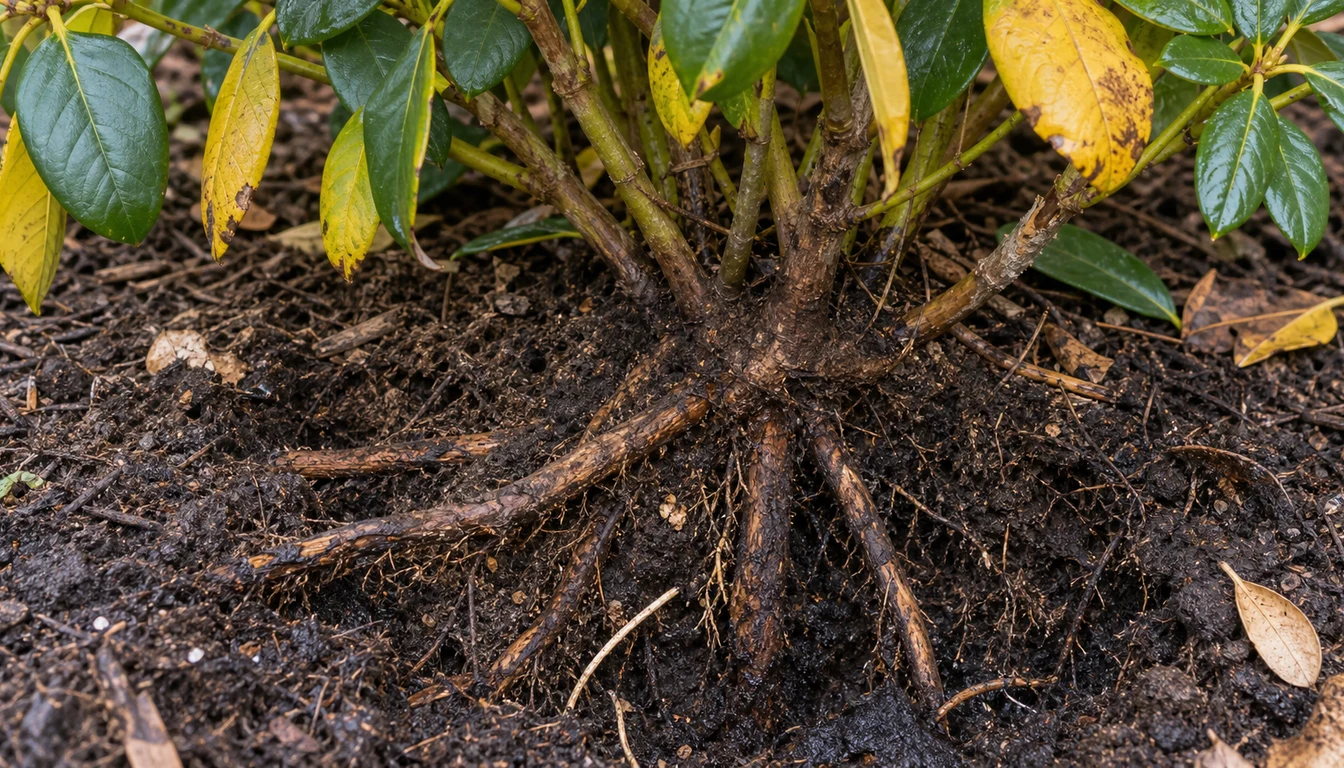
Quick diagnosis
Root trouble is possible when wilting persists in wet soil; a clean crown does not rule it out.
The first checks are soil moisture, recent watering or flooding, planting depth, and visible stem damage. These observations help narrow the problem without cutting healthy bark.
If the crown has no symptoms, fine roots still need assessment. UC IPM explicitly warns that feeder-root rot can cause similar wilting even when the root crown appears intact.
Discolored crown tissue can support suspicion of Phytophthora, while a white fungal sheet suggests another disease such as Armillaria. Neither a single cut nor the absence of a stain settles every case; an extension diagnostic service can advise on sampling before an irreversible treatment or removal.
Rhododendron leaf scorch overlaps in visible symptoms, so leaf-edge browning alone is not an exclusion test.
Open the full diagnosisWhat You Are Seeing
Fine feeder roots absorb water, and their loss can leave a rhododendron wilting even when the surrounding soil is wet. Larger roots that look intact do not establish that the absorbing root system is healthy.
A plant may decline from oxygen-starved soil, infection, feeding damage, or several stresses together. Timing and the distribution of symptoms help guide inspection, but whole-plant versus single-branch decline is not a reliable way to rule out root disease.
Photographs of the whole shrub, its base, and the wet area are useful starting evidence. If root inspection is needed, a small accessible area or the outside of a container root ball is less disruptive than lifting and breaking apart an established shrub.
Common Causes
01 Assess wet-soil and root symptoms
Phytophthora root and crown rot
Phytophthora is a group of water molds favored by wet conditions. Root and crown symptoms vary with the host, pathogen, and conditions; a conspicuous crown lesion is not present in every root infection.
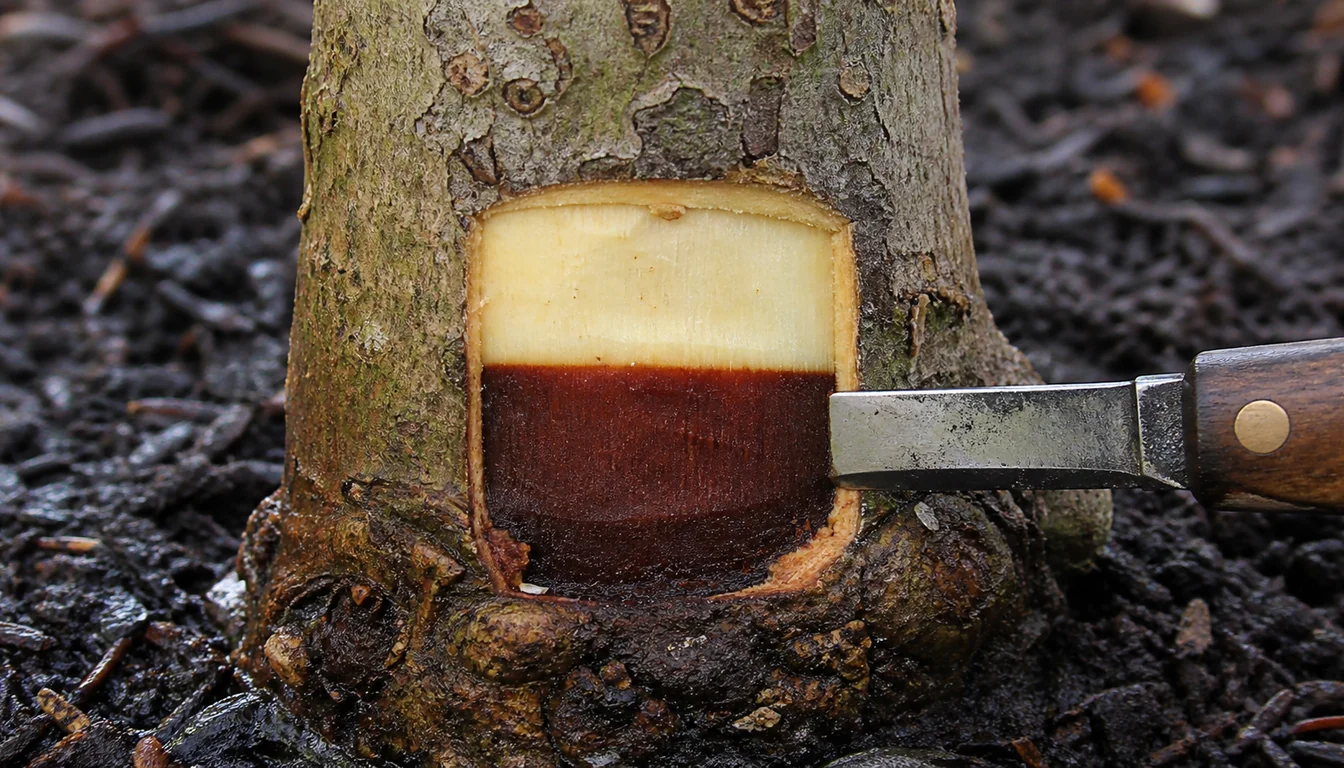
How to identify it
- Persistent wilting despite adequate moisture
- Discolored or decaying fine roots, which may occur without crown staining
- Reddish-brown tissue under affected crown bark
- Prolonged saturation or decline concentrated in poorly drained areas
What to do
- Pause irrigation while the root zone remains saturated, then reassess moisture rather than leaving a recovering shrub dry indefinitely.
- Avoid repeated exploratory bark cuts; a local extension service can recommend a suitable sample if identification will change management.
- Correct runoff and drainage without directing contaminated water or soil toward healthy plants.
- Treatment and retention depend on the diagnosis and extent of injury; a fungicide cannot restore dead roots.
02 Check drainage and irrigation
Roots drowned in soil that never drains
Water fills the pore spaces that normally supply roots with air. Prolonged saturation can damage roots directly and also favor infection, so an apparent drainage problem does not establish that no pathogen is involved.
How to identify it
- Standing water or slowly draining soil after rain
- Compaction or runoff collecting at the root zone
- Decline concentrated in low ground
- Fine-root damage despite an apparently clean crown, which still needs assessment for rot
What to do
- Observe where water collects and how long it remains after rain or irrigation. A test hole supplies drainage evidence, not a disease diagnosis.
- Address incoming runoff and soil compaction without tearing through an established root system.
- A mound or raised planting area can help when designed to drain; simply filling the original wet hole does not resolve the surrounding site.
03 Check the original planting level
A crown buried by deep planting or piled mulch
Soil or mulch against the stem can keep the crown damp. The visible planting level is worth checking early, but exposing a buried crown does not reverse existing decay or show whether infection is present.
How to identify it
- The original root-ball surface lies below added soil or mulch.
- Mulch is heaped against the stem rather than pulled back from it.
- Bark at the soil line is soft or dark compared with bark a hand's width higher.
- The plant was set low in its hole, or soil has been added over the bed since it went in.
What to do
- Move loose mulch away from the stem and locate the original root-ball surface gently.
- Avoid excavating structural roots or leaving a water-catching basin at the base.
- A shrub planted deeply may need professional assessment before lifting; the timing and disturbance matter for a stressed plant.
04 Look for larvae as well as leaf notches
Vine weevil larvae eating the roots
Vine weevil larvae feed on roots, while adults notch leaf margins. Leaf notches justify looking for larvae, especially in containers, but adult feeding alone does not prove that enough roots have been lost to cause wilting.
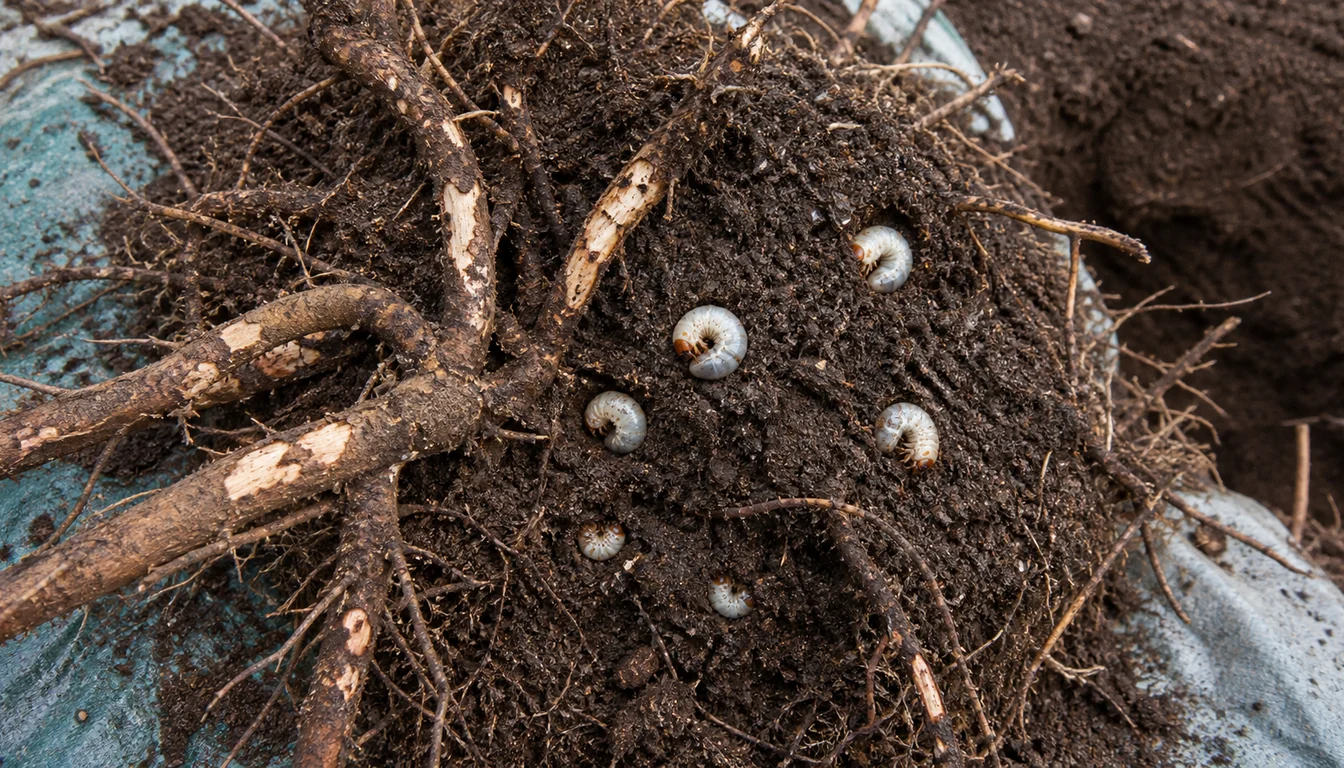
How to identify it
- The root ball opened up holds white legless grubs curled in a C shape with tan brown heads.
- Root bark is stripped in patches, leaving bare pale wood on roots that are otherwise firm.
- Leaf margins carry crescent notches bitten out of the edge, often on several plants nearby.
What to do
- Check accessible roots or a container root ball for legless grubs with brown heads before choosing a treatment.
- Larvae can be removed during necessary repotting. Biological controls depend on the nematode product, soil temperature, moisture, and pest stage; the product instructions determine suitable conditions.
- Nearby containers may warrant inspection. Further treatment depends on what is found, rather than an automatic spring repeat.
05 Assess fungal signs and buried wood
Honey fungus at the base of the plant
Armillaria can persist in infected roots and buried wood. A white fungal sheet beneath affected bark is a significant clue, but professional confirmation is useful before removing a shrub or choosing its replacement.
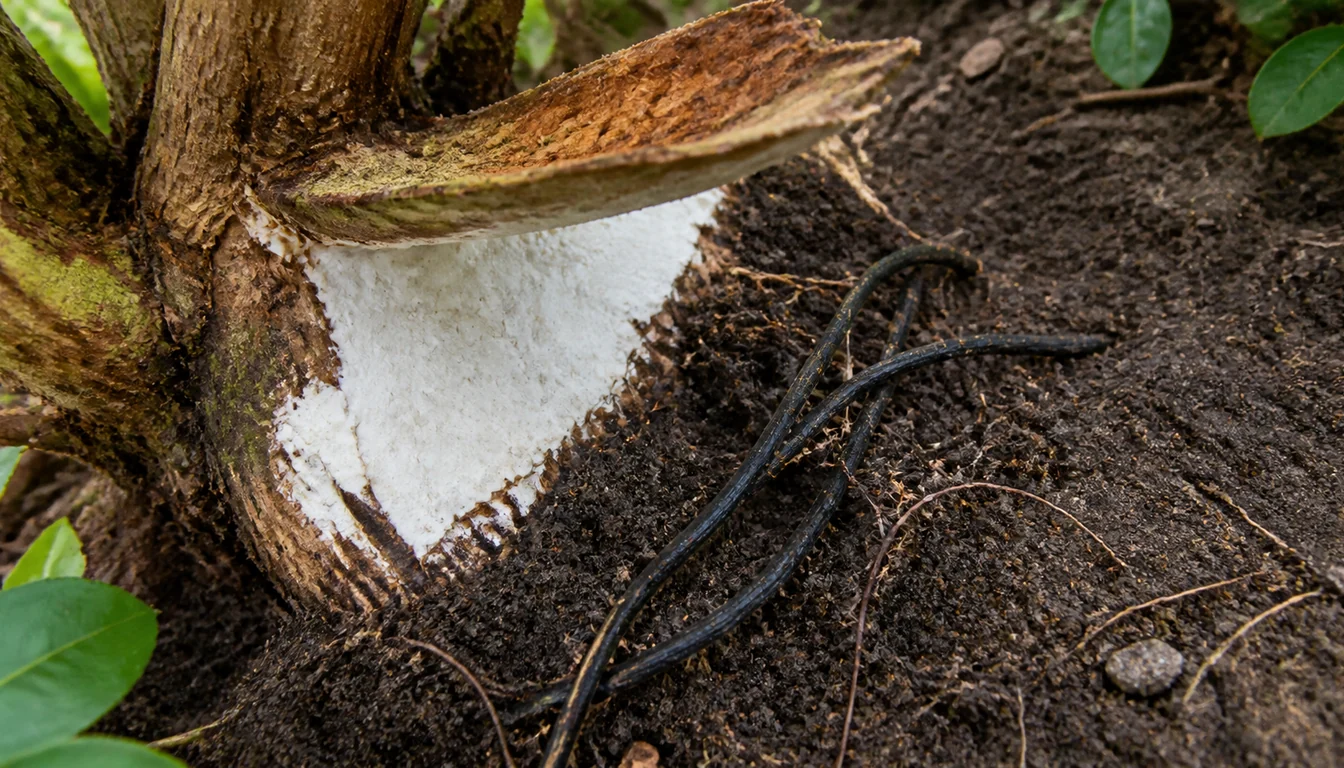
How to identify it
- Bark lifted at the base peels away over a flat white sheet of growth lying against the wood.
- A mushroom odor may accompany the fungal sheet; odor alone does not identify the disease.
- Black strands like bootlaces run through the soil around the roots and across nearby buried wood.
- There is an old stump, a buried root, or a removed tree within a few yards.
What to do
- A confirmed infection calls for attention to infected roots and woody material, not just the visible stem.
- A local extension service can advise on removal and disposal without spreading affected material.
- Replanting decisions need the disease context as well as drainage. Less susceptible plants are not immune.
06 Inspect visible bark and ties
A stem chewed or cut through at ground level
Chewed bark, trimmer wounds, or a constricting tie can interrupt movement through a stem. Visible damage is useful evidence, but white tissue at one point on the crown does not show that the roots elsewhere are healthy.
How to identify it
- Bark is missing in a band at or just below ground level, exposing pale wood underneath.
- Vole damage shows narrow paired grooves from teeth, usually where mulch or snow gave cover.
- A trimmer leaves clean angled cuts, often several strikes on the same side.
- A tie or a label wire has cut into tissue that has swollen above and below it.
What to do
- Inspect the visible stem and any ties before disturbing roots.
- Remove a constricting tie where this can be done without further injury, and prevent additional chewing or equipment damage.
- A severely girdled stem needs an assessment of its remaining live tissue. Cutting below the injury does not guarantee replacement shoots.
07 Check for frost heaving
Roots injured over winter or lifted by frost
A recently planted shrub can move during freeze-thaw cycles, leaving exposed roots or a gap around the root ball. Those observations may support winter injury, but firm remaining roots and a pale crown do not exclude disease in finer roots.
How to identify it
- The plant went in within the last season or two.
- The root ball sits slightly proud of the soil, with a gap around its edge you can push a finger into.
- Decline appears after winter, but spring timing also overlaps with root disease.
What to do
- Check whether the root ball has actually lifted before adjusting the planting.
- Restore contact with surrounding soil carefully once the ground is workable, without burying the crown.
- Water according to soil moisture and keep mulch clear of the stem. Persistent decline warrants assessment rather than repeated pressing or digging.
Can This Plant Be Saved?
Recovery depends on how much functioning root and crown tissue remains, the cause of injury, and whether the growing conditions can be corrected. There is no reliable recovery deadline from one bark scrape.
Surviving foliage and new growth are useful observations over time, but neither alone proves the pathogen is gone. A shrub that continues to collapse needs reassessment before more water, fertilizer, or treatment is added.
Disease-specific products may help in appropriate cases, but they cannot rebuild dead tissue. Product labels and local extension advice matter because a treatment for one cause may do nothing for another.
Can You Plant Another Rhododendron in the Same Spot?
Replanting starts with the cause of failure and the corrected site. An unexplained death does not establish that the soil is either safe or permanently unusable.
- Poor drainage still needs correction before a replacement is planted, even when infection has not been confirmed.
- Confirmed Phytophthora may persist beyond removal of the shrub, so another susceptible plant can remain at risk.
- Confirmed honey fungus calls for assessment of infected woody roots and stumps as well as the replacement choice.
- Visible planting, pest, or stem injury needs its own correction; finding one problem does not automatically exclude another.
A related shrub such as azalea, pieris, or mountain laurel is not automatically a safe replacement. Species, cultivar, local disease advice, and the actual moisture conditions matter more than a shared garden label.
RHS lists common boxwood among plants less often affected by honey fungus, while emphasizing that no plant is completely immune. That distinction is useful only after the disease and the site requirements have been considered together.
Recovery Plan
Document the conditions
Check moisture, runoff, planting depth, and visible damage. Saturated soil calls for a pause in watering; dry soil calls for a different response, even when the foliage looks similar.
Correct the relevant problem
Drainage, pest management, and disease management are different jobs. A diagnostic service can help choose the next step when observations overlap or removal is being considered.
Reassess survival
Watch for sustained growth and further dieback. A declining shrub may need another assessment, but a calendar date alone does not decide whether it must be replaced.
Well-drained soil, appropriate planting depth, and watering based on moisture reduce avoidable root stress. Mulch belongs over the root zone rather than against the stems.
Those measures reduce risk; they do not prevent every pest, pathogen, or winter injury. Persistent wilting still deserves assessment even in a carefully maintained bed.
Sources
- Rhododendrons and azaleas, Clemson Cooperative Extension
- Growing rhododendrons and azaleas, University of Minnesota Extension
- Phytophthora root and crown rot in the garden, University of California IPM
- Honey fungus, Royal Horticultural Society
- Vine weevil, Royal Horticultural Society
- Rhododendron growing guide, Royal Horticultural Society