
Why Are My Dracaena Leaves Turning Yellow?
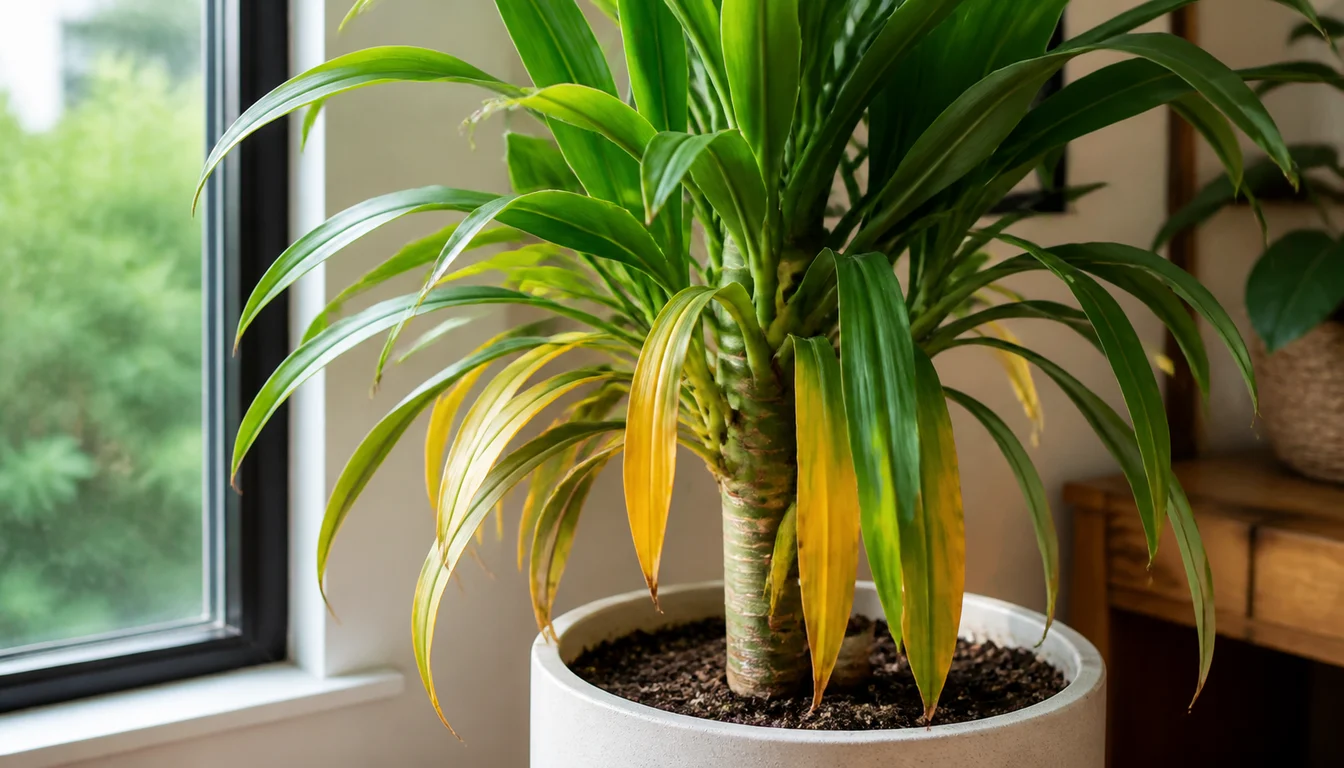
Yellow Dracaena leaves can reflect normal markings or aging, but new yellowing can also accompany water stress, exposure injury, pests, or disease. The useful distinction comes from what changed, where it changed, and the condition of the pot and plant together.
A firm cane or pale root does not rule out a root problem, and a yellow halo does not identify a pathogen.
Quick diagnosis
Compare the leaf pattern with the pot and recent changes
Stable cultivar markings and gradual loss of an older lower leaf can be normal. New yellowing at several levels, wilting, enlarging spots, or soft cane tissue calls for closer inspection.
Start with root-ball moisture, drainage, both leaf surfaces, and recent sun or cold exposure. Unpotting becomes useful when decline and root-zone evidence justify it, rather than whenever a leaf changes color.
Open the full diagnosisWhat You Are Seeing
An indoor cane-form Dracaena carries younger foliage toward the crown and older leaves below. A yellow lower leaf therefore has a different history from a new leaf that opens pale or spotted, although position alone cannot tell you the cause.
Some cultivars have yellow stripes, margins, or spots throughout their lives. An older photograph or the named cultivar's description helps separate those markings from a change in previously green tissue.
Water shortage and injured roots can both leave foliage short of water. That overlap explains why adding water to every yellow or limp plant can make a wet-root problem worse.
Common Causes
01 Possible
Normal markings or gradual leaf aging
The Dracaena group includes markedly different foliage patterns. Comparing leaves on the same plant is more useful than expecting every cultivar to remain uniformly green.
Older lower leaves can yellow and fall as a cane grows. That is a reasonable explanation for limited, gradual turnover on an otherwise stable plant, but there is no universal allowance of one or two yellow leaves that proves health. Rapid change, damaged young growth, or a declining cane needs another explanation.
How to identify it
- Yellow markings resemble earlier photographs or the named cultivar rather than a new patch of damage.
- An older lower leaf changes gradually while the remaining crown appears stable.
- A new texture change, spreading lesions, or accelerating loss makes simple aging less convincing.
What to do
- Observe the pattern and pot conditions before changing watering or fertilizer.
- Leave useful green tissue in place. A fully dry leaf can be removed without tearing the cane.
02 Possible
Persistently wet mix and damaged roots
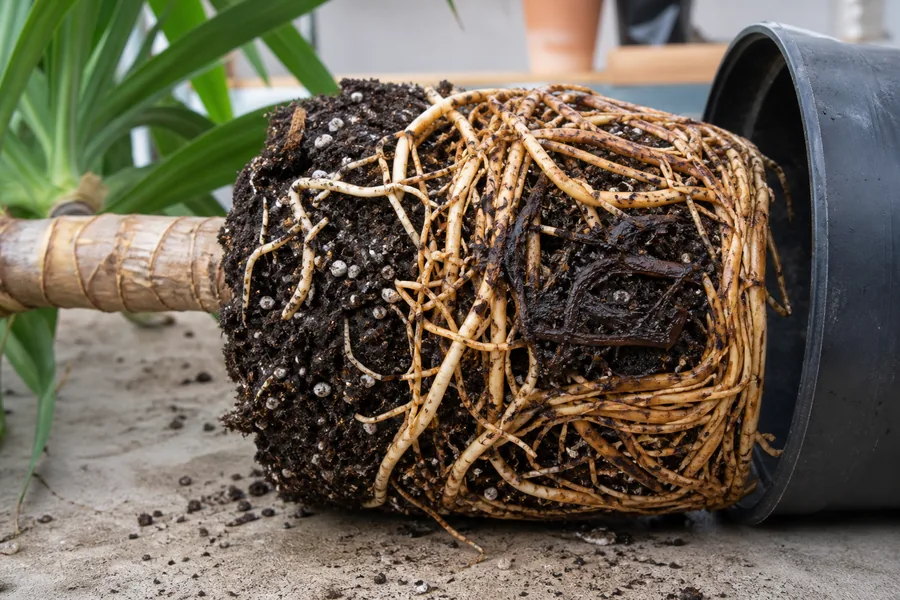
Water occupies spaces that would otherwise contain air in a saturated potting mix. Poor aeration can injure roots, and root disease may also be involved, so persistently wet mix is a risk condition rather than proof of a particular infection.
Several yellow leaves, wilting, and a wet root ball together justify investigating drainage. If decline continues or the base starts collapsing, a careful root inspection provides information that pot weight cannot. Healthy-looking roots in one part of the pot do not clear the entire root system.
How to identify it
- The root ball remains wet below the surface while foliage continues declining.
- Runoff remains in the saucer or outer pot, or a drainage opening is blocked.
- During a justified inspection, roots that collapse, lose their outer tissue, or have extensive decay are concerning. Color alone is insufficient.
What to do
- Empty standing water and clear blocked drainage. Let the mix lose excess moisture before watering again.
- If the mix has broken down or roots are extensively damaged, assess whether repotting can help. Avoid repeatedly disturbing a stable root ball.
- When repotting is justified, remove clearly dead tissue with clean tools and use fresh suitable mix in a draining container matched to the remaining roots.
- Pause fertilizer while the cause of decline remains unresolved.
03 Possible
A dry root ball or water bypass
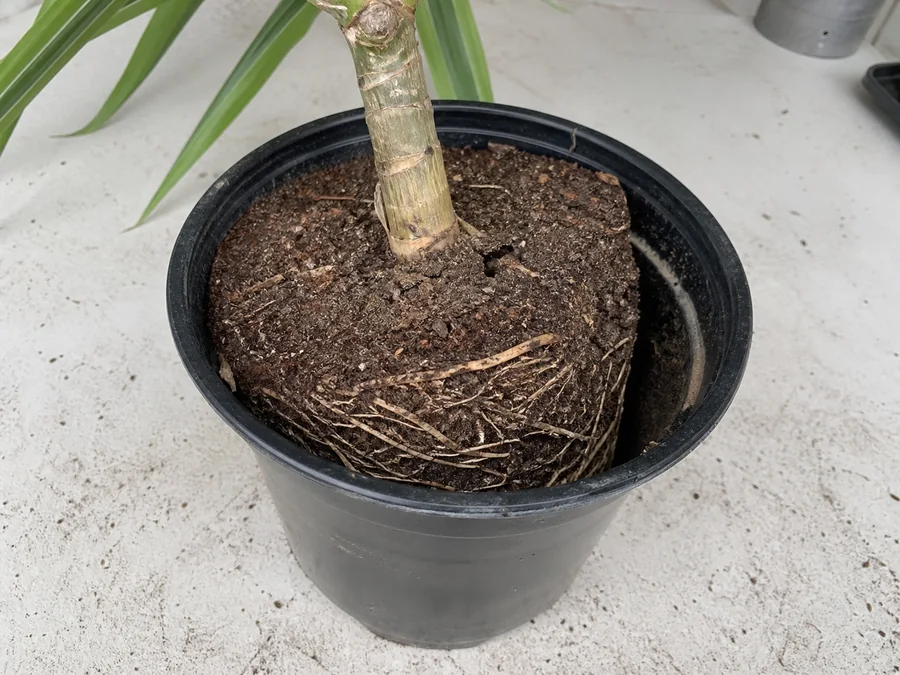
A root ball that remains dry can leave older foliage yellow with dry margins. Peat-based mixes sometimes become difficult to rewet, so water may run beside the root ball while its center remains dry.
Runoff alone does not establish that the roots received water. Comparing moisture in the center with moisture near the pot wall helps distinguish bypass from a thoroughly wetted pot. Present moisture also cannot reconstruct an earlier dry spell, and drought and root damage may occur together.
How to identify it
- The container is light compared with its own freshly watered weight, and the root ball is dry below the surface.
- Water exits rapidly while the center remains dry, or mix has pulled away from the pot wall.
- Dry leaf margins support water stress but also occur with other injuries.
What to do
- Water slowly across the surface, then inspect whether moisture reached the center.
- If the mix resists wetting, shallow bottom watering can help. Remove the pot once the root ball has rewetted and let it drain, rather than leaving it standing in water.
- Base the next watering on root-ball moisture and the growing conditions. No fixed soaking time suits every pot.
04 Possible
Insufficient light and slower water use
Dracaena can survive conditions that support little new growth. In a dim position, slow growth and slow drying may occur together, so keeping the old watering schedule after a move can expose the roots to longer wet periods.
Color response varies by species and cultivar. Weak variegation or a pale leaf alone is not a light meter, and adding light does not repair existing root injury.
How to identify it
- The plant has moved away from usable window light or is shaded for much of the day.
- New growth is weak or sparse compared with its earlier growth in a brighter position.
- The root ball now takes longer to dry under otherwise similar conditions.
What to do
- Increase usable indirect light gradually, avoiding a sudden move into strong direct sun.
- Continue checking moisture rather than watering on the old schedule.
- Assess new growth and whether leaf loss stabilizes alongside the light change.
05 Possible
Scorch after stronger sun
Abruptly stronger sunlight can damage foliage grown in shade. Pale, dry patches on exposed leaves are consistent with scorch, especially after a move or a seasonal change in the angle of sunlight.
The exposure history matters because cold contact, physical injury, and leaf disease can also leave patches. Window-side damage supports an exposure problem but does not exclude a simultaneous root problem.
How to identify it
- Damage occurs on exposed surfaces after stronger light reached them.
- Protected leaves are less affected, although a mixed pattern is possible.
- Injured patches become dry or papery rather than returning to normal tissue.
What to do
- Filter intense direct light or move the plant out of the strongest rays while retaining useful indirect light.
- Keep green portions of damaged leaves when practical.
- Reassess if new lesions appear after the exposure has ended.
06 Possible
Chilling or contact with cold glass
Cold transport, an open winter door, and chilled window glass can injure tropical Dracaena foliage. UF/IFAS describes pale cross-bands in chilled D. marginata, but that species-specific symptom does not diagnose every striped Dracaena leaf.
The timing and position of injury need to fit an actual exposure. Cold can also slow water use or affect roots, so evidence of leaf chilling does not justify ignoring the pot.
How to identify it
- A cold event preceded the damage, with affected foliage near the source of exposure.
- Leaves that touched cold glass are injured more than protected leaves.
- Severe injury may include darkened or collapsing tissue, which also warrants checking for decay.
What to do
- Move the plant to stable indoor warmth away from cold glass and exterior drafts.
- Avoid placing injured foliage against a heater or in abrupt strong sun.
- Adjust watering to measured moisture as growth and water use change. Remove dead or decaying tissue with clean tools.
07 Possible
Fluoride sensitivity or excess soluble salts
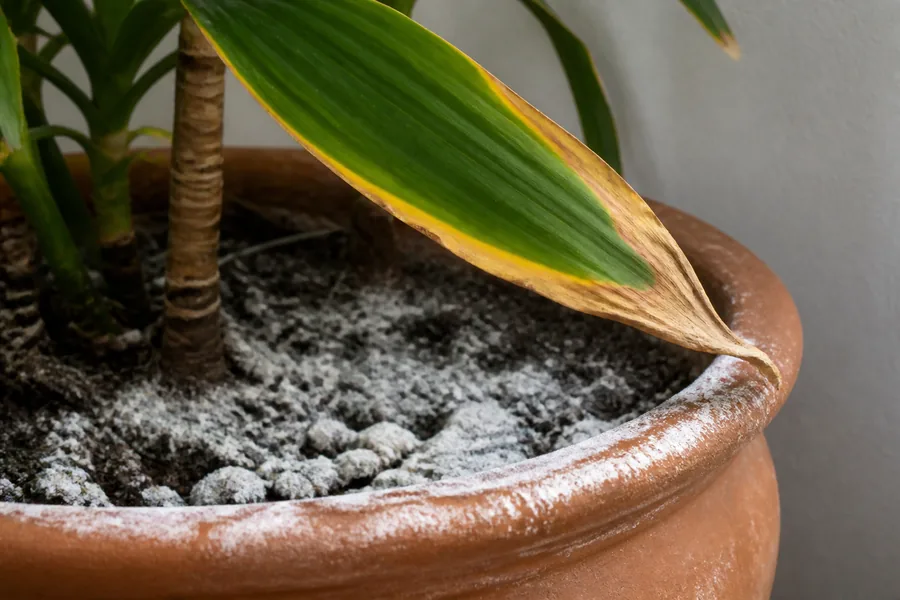
UF/IFAS identifies fluoride sensitivity in Dracaena and describes related tip or margin injury. Excess fertilizer salts can also harm roots and leaf edges, but the two problems cannot be separated by a photograph or a white deposit on the pot.
A feeding history, irrigation-water information, and, where persistent problems justify it, water or growing-media testing provide stronger evidence. Clean-looking mix does not exclude dissolved salts, and visible residue does not measure fluoride.
How to identify it
- Tips or margins deteriorate while other parts of the leaf remain greener.
- Damage follows a fertilizer application or persists with a particular water supply.
- Deposits are visible on the rim or mix, but their composition is unknown.
What to do
- Pause feeding while checking the product dose and water source.
- Where salt accumulation is supported and the pot drains freely, leaching with suitable low-mineral water may help. Repeatedly flushing a saturated, failing root ball is not a substitute for correcting drainage.
- A known low-fluoride water source can address confirmed or well-supported fluoride exposure. Persistent unexplained injury merits testing rather than repeated product changes.
08 Possible
Nutrient availability or crowded roots
A long-used mix can supply too little nutrition, while unsuitable pH or damaged roots can limit uptake even when nutrients are present. Yellowing between greener veins helps identify a question to investigate, not a fertilizer to prescribe from leaf color.
Crowded roots may leave little mix to hold water and allow uneven wetting. A few roots at the drainage holes alone do not establish that crowding caused yellowing. Pot history, growth, wetting behavior, and a justified inspection together guide the decision.
How to identify it
- Growth is persistently pale or weak without a clear new exposure event.
- The pot has a long feeding or repotting history that may explain changing nutrient supply.
- A dense root mass and little remaining mix coincide with difficult wetting or restricted growth.
What to do
- Resolve wet-root, dry-core, and salt concerns before adding fertilizer.
- Consider repotting a crowded root ball when its condition supports the need, using a pot matched to the roots.
- Persistent interveinal yellowing may justify a media or water test. Feed an established, actively growing plant according to an appropriate product label.
09 Possible
Spider mites, scale, or mealybugs
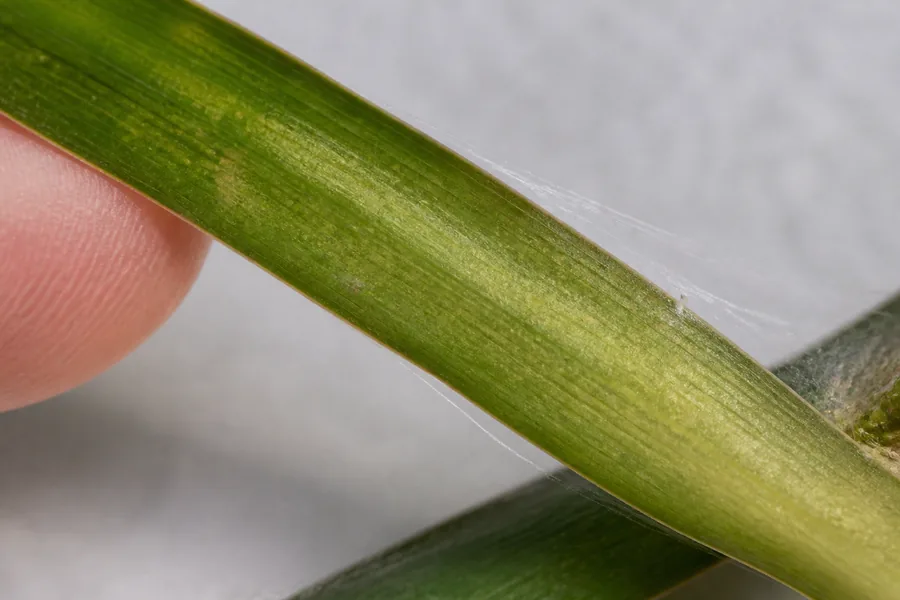
Mites can produce pale stippling and webbing, while scale and mealybugs may leave raised covers, cottony material, or sticky honeydew. Actual pests or their characteristic signs are more useful than yellow color alone.
Leaf undersides and sheltered leaf bases deserve attention. An initial inspection can miss a small population, and finding pests does not establish that every damaged leaf has the same cause.
How to identify it
- Fine stippling or webbing is present, with moving mites visible under magnification or after tapping foliage over white paper.
- Raised covers, cottony clusters, or sticky residue accompany visible insects.
- New damage develops near infested tissue.
What to do
- Separate an infested plant and inspect nearby plants.
- Gentle rinsing or wiping can remove some pests without scraping healthy tissue.
- For confirmed spider mites, choose a treatment labeled for the pest, indoor use, and the plant. Follow label testing and repeat-treatment directions.
- Continue observation because sheltered pests may survive the initial treatment.
10 Possible
Leaf spots, including possible Fusarium
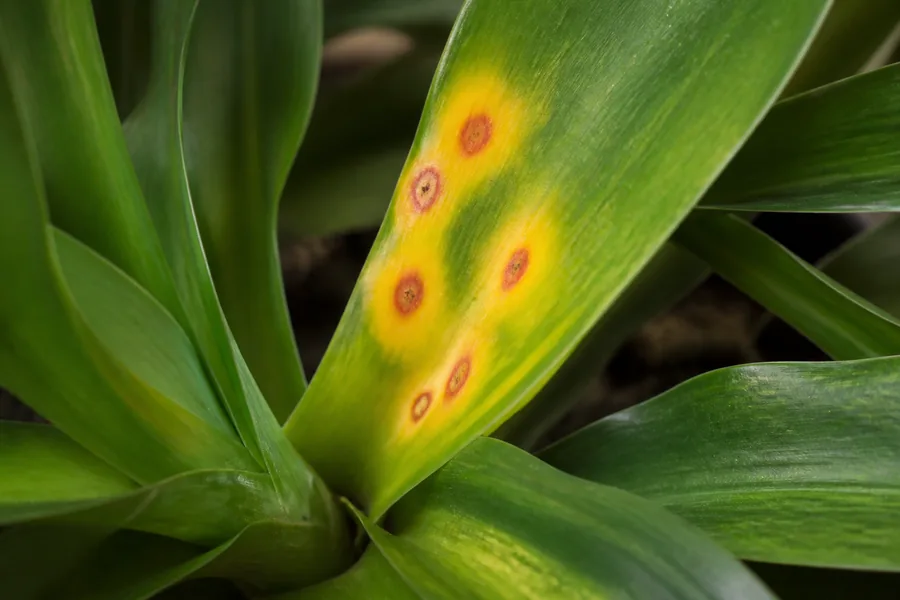
Florida's plant pathology circular describes reddish-brown spots with yellow halos on Dracaena and explains how splashed water can carry Fusarium into the leaf whorl. That makes wet young foliage relevant history when this pattern appears.
A matching lesion is still a symptom rather than a confirmed pathogen identification. Other leaf-spot diseases and physical injuries can overlap, and roots cannot be cleared by the appearance of the leaf spots.
How to identify it
- Defined reddish or brown lesions have yellow surrounding tissue.
- Young leaves or tissue near the whorl are affected, particularly after repeated wetting.
- Lesions enlarge or new lesions appear, rather than remaining as stable old scars.
What to do
- Keep irrigation water out of the crown and avoid splashing between plants.
- Separate an actively declining plant and remove badly damaged leaves with clean tools when practical.
- Seek plant-diagnostic advice before selecting a fungicide. Historic chemical recommendations in older publications do not establish a current household treatment.
11 Possible
Soft or collapsing cane tissue
A soft, collapsing section of cane is a more urgent finding than leaf color alone. Decay may involve microbes and environmental injury, but texture and odor do not identify bacteria or a particular disease.
A firm area elsewhere on the cane cannot guarantee that the base or roots are sound. If damage is extensive, replacement may be more practical than repeatedly cutting a deteriorating plant, and apparently firm pieces are not automatically disease-free propagation stock.
How to identify it
- Cane tissue collapses, becomes wet or discolored, or no longer supports the crown.
- Decline progresses into previously unaffected tissue.
- An unpleasant odor may accompany decay but is not a pathogen test.
What to do
- Separate the affected plant and avoid moving splash water or dirty tools to healthy plants.
- Inspect the extent of damage before deciding whether limited removal is realistic. Extensive collapse may justify discarding the plant and mix.
- Clean tools and containers before reuse. Obtain diagnostic advice if valuable plants or several plants are affected.
Why one clue cannot settle the diagnosis
Leaves show the consequence of stress, not necessarily its origin. A root ball can be wet because the mix drains poorly, because water use has fallen, or because injured roots take up less water. Those possibilities can reinforce each other.
Comparing affected and unaffected canes helps locate a problem, but canes in one pot may have different root conditions. A firm crown and some pale roots therefore provide limited reassurance rather than proof that the whole plant is healthy.
A short record of moisture, exposure changes, and where new damage appears makes progress easier to judge. Fully dead tissue will not recover, while the behavior of remaining foliage and new growth provides a more useful picture than the color of one old leaf.
Which observation changes the next step?
The least disruptive checks come first. The combination below helps decide whether observation is reasonable or the plant needs closer inspection.
- Stable older-leaf loss
- Compare earlier photographs and cultivar markings. Continued loss or affected young growth needs a broader check.
- Dry center despite runoff
- Assess whether the root ball actually rewets. A moist edge alone does not establish even watering.
- Wet mix with progressive decline
- Correct standing water and drainage. Root inspection becomes useful when decline persists or the base collapses.
- Spots, webbing, or deposits
- Inspect the actual mark and relevant exposure history. Obtain identification or testing before choosing a disease treatment.
- Soft cane or spreading collapse
- Separate the plant and assess the extent of damage. A firm neighboring cane does not clear the affected tissue.
Recovery Plan
Watch for continuing damage
A corrected exposure does not erase old injury. Newly affected leaves, spreading lesions, or further collapse deserve reassessment rather than another automatic watering or fertilizer dose.
Compare new and existing foliage
New leaves appropriate to the cultivar, stable remaining foliage, and improved root-zone conditions together are encouraging. No fixed number of days or one green leaf establishes recovery.
Revisit the evidence
Persistent wetness, newly soft tissue, or a spreading lesion pattern may require closer inspection or diagnostic help. Repeated repotting without new evidence can add injury while leaving the original problem unresolved.
Stable warmth, suitable light, and an unobstructed drainage path reduce avoidable stress. A suitable houseplant mix still needs watering based on its actual moisture.
Cleaning leaves provides an opportunity to notice pests and changing marks. Keeping irrigation water out of the crown limits prolonged wetting there, while fertilizer dose and water quality deserve review if margin injury returns.
Sources
- ENH892/EP149: Cultural Guidelines for Commercial Production of Interiorscape Dracaena
- Royal Horticultural Society - How to Grow Dracaena
- University of Minnesota Extension: Insects on Indoor Plants
- University of Georgia Extension, Growing Indoor Plants with Success, Bulletin 1318
- Leaf damage on houseplants, Royal Horticultural Society
- Properly Watering Container Houseplants, Virginia Cooperative Extension, SPES-804P
- Fusarium Leaf Spot of Dracaena, Florida Plant Pathology Circular 63 (1967, revised 1980)
- Houseplant Diseases & Disorders, Clemson Cooperative Extension, HGIC 2251