
Boston Fern Brown Tips: Check Roots, Exposure, and Salt Buildup
Brown tips on a Boston fern are dead tissue with several possible causes. A dry root ball, persistently wet roots, drying air, concentrated salts, or direct exposure can produce overlapping damage. The useful first check is the condition of the pot and the pattern of new injury, before another watering or treatment.
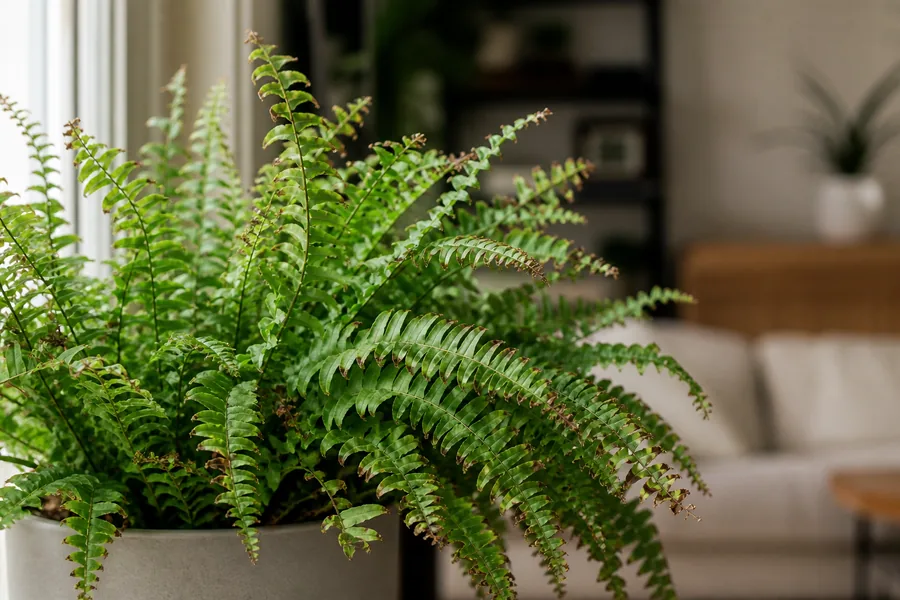
Quick diagnosis
Brown tips alone do not identify the cause. Compare moisture inside the root ball, exposure, and where fresh damage appears.
A light pot with a dry center supports rewetting. A heavy pot with wet mix needs drainage and root-zone assessment before more water. Runoff can pass around a dry core, so water leaving the pot does not prove that the center became moist.
Damage facing a heater, window, or draft makes that exposure worth checking, but it does not exclude root stress or pests. Slow loss of older fronds can accompany normal turnover; spreading injury, a soft crown, or damage to new growth needs closer investigation.
Open the full diagnosisWhat You Are Seeing
A crisp brown leaflet tip will not become green again. Its position records injury, but neither its color nor its size tells you when the problem began or whether the cause is still present.
The fine foliage of a Boston fern can lose water faster than the roots supply it. Dry mix can restrict that supply, while saturated, poorly aerated mix can impair roots even when water is abundant.
A damaged margin and a yellowing whole frond can share the same underlying problem. The distribution helps choose the next observation, not assign a different disease to every color.
Common Causes
01 Check the evidence
Dry mix is difficult to rewet
Some peat-rich mixes shrink and resist wetting after becoming very dry. Water may follow a gap beside the pot instead of spreading through the root ball. That leaves visible runoff and a still-dry center at the same time.
A dense root system can make even watering harder, but fast runoff alone is not proof of bypass. An already moist, freely draining pot can also release water quickly.
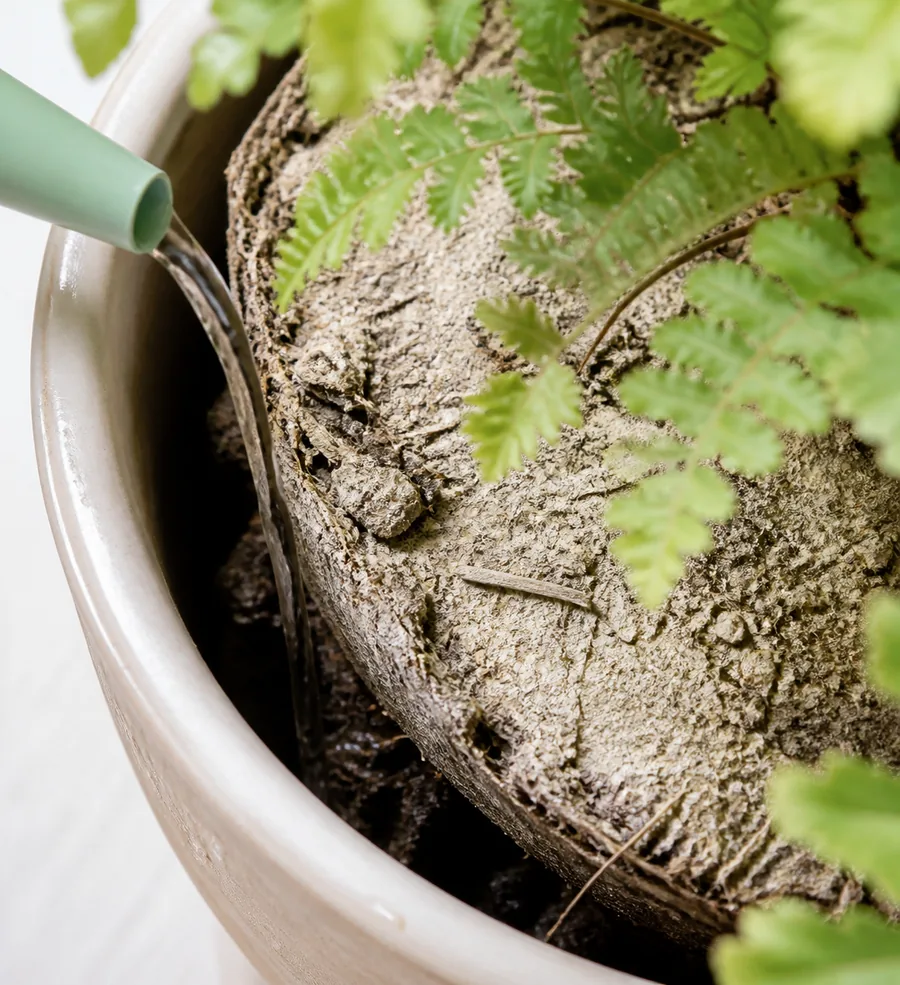
How to identify it
- The pot is lighter than its usual weight after watering and drainage.
- Moisture checked gently in more than one accessible place remains low below the surface.
- A gap has opened beside the root ball, or water follows an obvious channel.
- The center remains dry after a slow watering, despite runoff.
What to do
- Water slowly over the surface when the root ball is dry, then confirm that moisture reaches below the top layer.
- If surface watering does not rewet it, brief bottom watering in a draining pot can help. Remove the pot and drain it once the mix has taken up water.
- Assess crowding or deteriorated mix if uneven wetting continues. A fixed soaking time or a fast-drying day does not by itself establish that repotting is needed.
02 Check the evidence
Drying air around the fronds
Heating and moving air can increase moisture loss from delicate foliage. A high hanging basket may experience warmer, drier conditions than a nearby tabletop. The root ball and surrounding air therefore need separate attention.
A room humidity reading is useful context, but there is no single reading that diagnoses the brown tips. Misting provides only a brief change, and the presence of a pebble tray does not prove that the air around the fern stays humid.
How to identify it
- Damage followed a heating change, move, or exposure to a vent.
- The air near the actual fronds is drier than elsewhere in the room.
- The root ball is moist while exposed foliage continues to dry.
What to do
- Move the plant away from direct hot airflow while retaining usable indirect light.
- Where room air is persistently dry, a humidifier can provide a more sustained change than occasional misting.
- Keep assessing the pot separately. Extra watering of already wet mix cannot compensate for dry air.
03 Check the evidence
Concentrated salts in the root zone
Dissolved salts can accumulate when fertilizer and irrigation inputs exceed what drains from the pot. A high concentration interferes with root water uptake and can injure roots, so a plant in damp mix can still develop dry-looking margins.
A crust prompts a review of water and fertilizer history. Its appearance cannot identify the salt, measure the concentration around roots, or prove that fertilizer caused the damage.
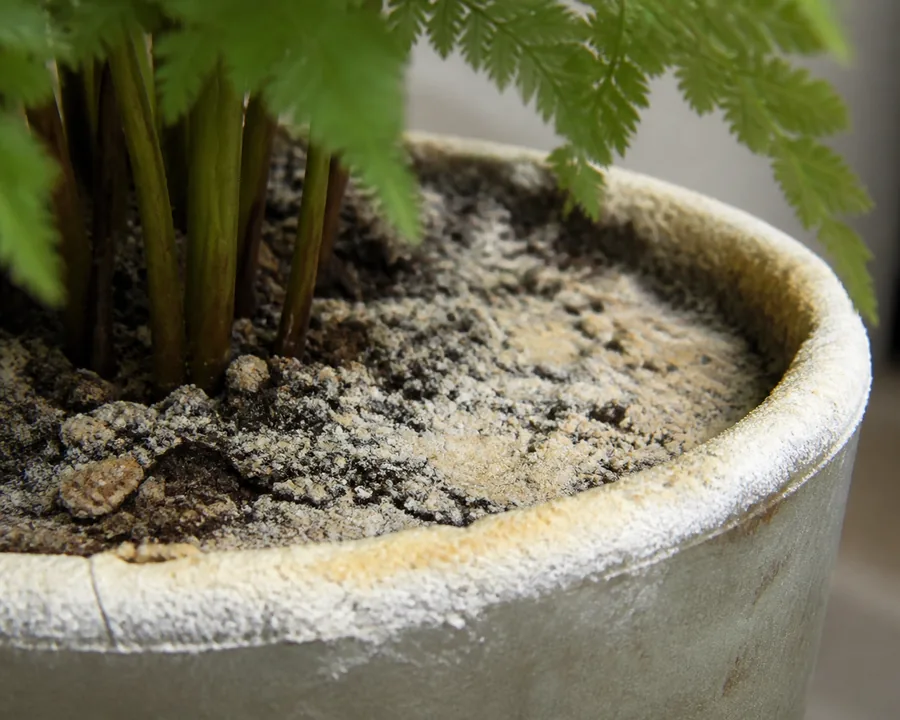
How to identify it
- Fertilizer was applied more often or at a higher concentration than intended.
- Mineral deposits are visible on the pot or mix.
- The pot has rarely received drainage, or has stood in collected runoff.
- Fresh tip damage followed feeding or a change in water supply.
What to do
- Pause extra feeding while checking the product, dilution and watering history.
- Where excess salts are suspected and drainage works, leaching with suitable low-salt water can carry some dissolved salts out. Discard the runoff.
- Do not keep flushing a saturated, failing root ball. Damaged roots or deteriorated mix may need repotting instead.
- Resume appropriate light feeding during active growth according to a label suitable for the plant, rather than making every product one fixed fraction of its rate.
04 Check the evidence
Water treatment and mineral content
UMN Extension cautions against repeated use of softened water for tropical ferns because salts can accumulate. That is a more specific concern than assuming that all tap water damages Boston ferns.
A water report or a relevant test can clarify what the supply contains. Brown tips cannot identify fluoride, chlorine, hardness, or sodium, and the word filtered does not establish which substances a filter removes.
How to identify it
- The water passes through a household softener before reaching the plant.
- The supply changed before fresh injury appeared.
- Deposits recur despite a suitable feeding rate and working drainage.
What to do
- Check the water source and treatment method before buying an additive or changing several care practices.
- Where the supply contributes unwanted salts, a suitable unsoftened or low-mineral source may help. The choice follows the actual water issue.
- Judge any change by whether new damage slows, while continuing to assess roots and exposure. Existing dead margins remain visible.
05 Check the evidence
Crowding makes even watering difficult
Roots can occupy much of a mature fern basket, leaving less mix to hold a water reserve. That matters when watering becomes difficult or growth is restricted, not merely because a root appears at a drainage hole.
Wind, warmth and light can also shorten the interval between waterings. A thirsty day alone does not prove the pot is too small.
How to identify it
- Watering has become difficult despite checking that the mix wets throughout.
- Visible crowding accompanies restricted growth or an inadequate moisture reserve.
- The mix has deteriorated or no longer wets and drains evenly.
What to do
- Assess the root ball gently when repotting is justified by these conditions.
- Use a moisture-retentive, aerated mix and a container matched to the roots, rather than a large volume of unused wet mix.
- For an established healthy clump, division is an alternative to an increasingly large container. Each piece needs a crown and attached roots.
- Routine work fits active growth; serious drainage failure needs attention even when the calendar is inconvenient.
06 Check the evidence
Sun, heat, cold, or moving air
A side facing strong sun, a heater or a draft may receive more injury than protected foliage. That spatial relationship is a useful clue, but uneven root moisture and physical damage can also create an uneven pattern.
A move or a recent change in heating strengthens the exposure explanation. It still needs to agree with the pot conditions and what you can actually see on the fronds.
How to identify it
- Fresh damage is concentrated near an identifiable exposure.
- The plant recently moved into stronger sun, cold air or a heating stream.
- Fronds touch cold glass or are repeatedly brushed by people or pets.
What to do
- Provide filtered light and shelter from the damaging exposure.
- Avoid repeatedly turning fresh foliage into a known harmful position. Moving or screening the source is more useful than distributing the injury.
- Reassess water use after a move, since shelter and light can change how quickly the pot dries.
07 Check the evidence
Older fronds are declining
Older fronds eventually deteriorate as the clump produces new growth. Limited old-frond loss can fit that process, especially when the rest of the plant remains stable.
An old frond can also be the first to show stress. New growth is encouraging, but it does not prove that the watering, roots and foliage are free of problems.
How to identify it
- Decline remains limited to older, outer fronds.
- New growth continues without fresh injury.
- The pot and growing conditions remain suitable and the pattern is not accelerating.
What to do
- Remove fully dead fronds with clean scissors without pulling at the crown.
- Keep useful green tissue unless there is a separate reason to remove it.
- Escalate the inspection if younger fronds develop damage, several fronds decline quickly, or the crown softens.
What Old Tips and New Damage Can Tell You
Trimming a dead margin changes its appearance without treating the cause. A clean cut that stays within the dead edge avoids removing useful green tissue or creating a new wound in it.
New fronds provide another observation point. Healthy-looking growth and less fresh damage suggest improvement, while continued injury means the original explanation needs reassessment. Neither result identifies a pathogen on its own.
How to Check Whether Water Reaches the Root Ball
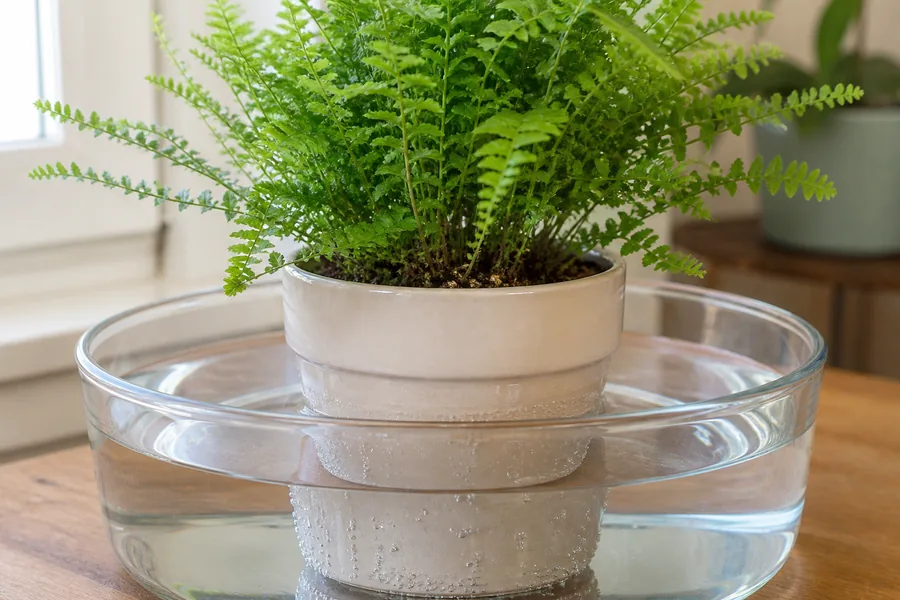
A pot’s usual weight after watering and full drainage provides a useful comparison. Weight becomes less informative after repotting or changing containers, so it belongs beside a moisture check rather than replacing one.
- Check for standing water and a blocked drainage path before adding water.
- If the root ball is dry, water slowly across the surface. Check accessible mix below the surface rather than judging only the runoff.
- If the core stays dry, a short period of bottom watering may help the mix absorb water. A draining inner pot is necessary.
- Lift the pot out, allow full drainage, and confirm that the root ball rewetted. Persistent dry pockets call for a mix or crowding assessment.
When Spots or Pest Signs Need a Closer Look
Orderly brown dots under mature pinnae may be normal sori, the fern’s spore-bearing structures. Raised irregular covers, cottony clusters, or fine stippling require a different inspection. The overall brown color is not enough to choose a treatment.
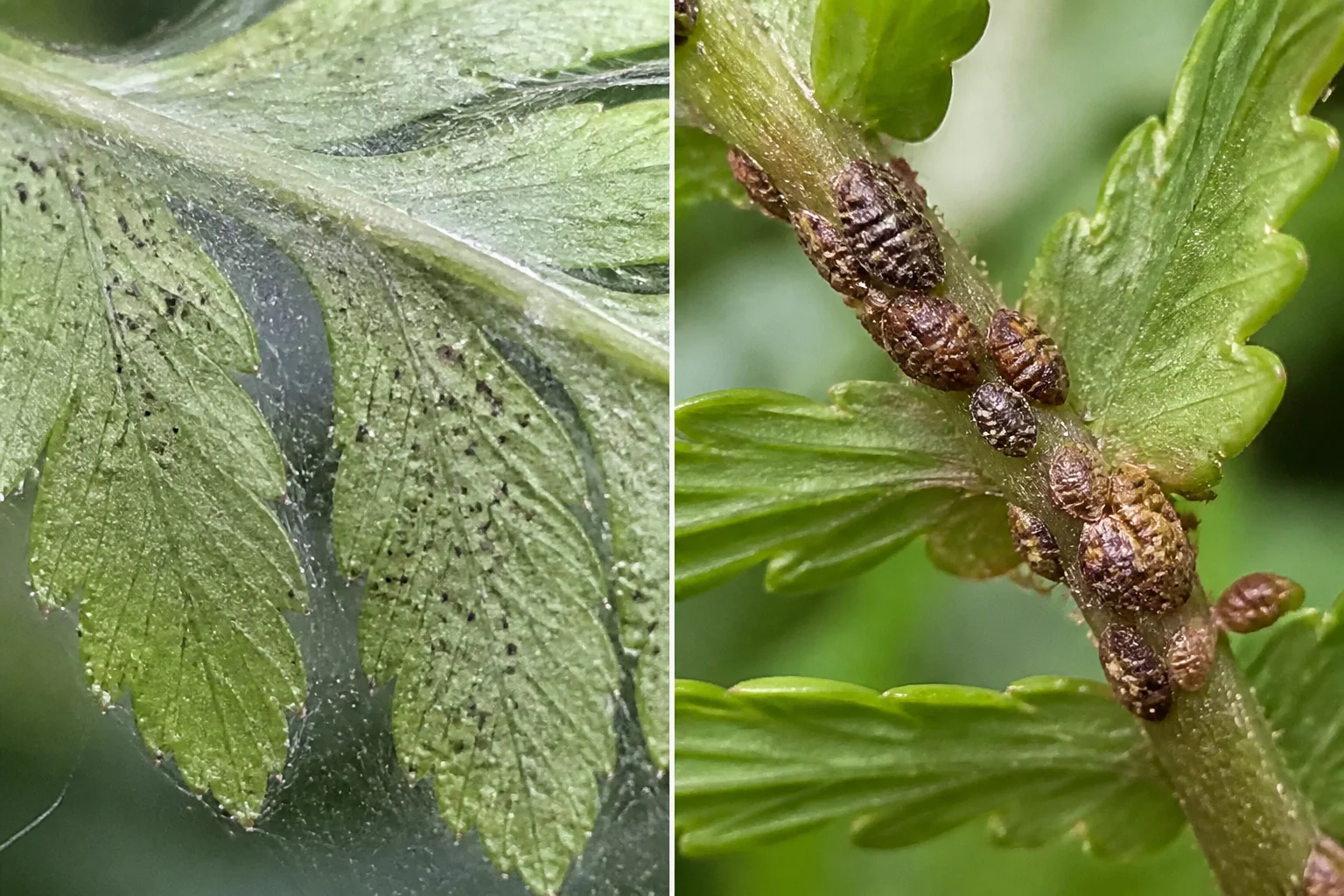
Magnification can help reveal actual insects or mites. Dense webbing with rapidly expanding brown lesions may have another explanation, including the fungal blight described in Penn State’s fern guidance. A local extension or plant diagnostic service can help when a pattern remains uncertain.
A known infestation warrants separation from nearby plants. Fern foliage may be sensitive to sprays, so any treatment needs an identified target and a label suitable for indoor ferns. A symptom photograph is not a reason to apply an arbitrary insecticide or fungicide.
Recovery Plan
Correct the observed condition
Rewet confirmed dry mix, drain standing water, or remove a harmful exposure as the observations warrant. A brown margin cannot show whether that correction has worked immediately.
Track fresh injury
Compare the same fronds and new growth over time. Old dead tissue remains brown, while spreading damage or a weakening crown calls for reassessment.
Reconsider roots and pest signs
A fern may have more than one problem. Persistent decline despite suitable moisture and exposure deserves closer root or foliage inspection, without waiting for a fixed recovery deadline.
Even wetting, free drainage and sheltered indirect light give the root system and fronds more stable conditions. Watering follows the actual mix, while feeding follows active growth and the product’s directions.
Changes in heating, location or potting mix are useful to record when new damage appears. This history is more informative than assuming every recurrence needs another soak or more fertilizer.
Sources
- Nephrolepis exaltata, NC State Extension Plant Toolbox
- Growing tropical ferns indoors, University of Minnesota Extension
- Fern Diseases, Penn State Extension
- Leaf damage on houseplants, Royal Horticultural Society
- Indoor Ferns, Clemson Cooperative Extension, HGIC 1505
- University of Minnesota Extension: Insects on Indoor Plants
- University of Georgia Extension, Growing Indoor Plants with Success, Bulletin 1318