
Which Aloe Vera Leaves Turn Yellow Tells You Why
A yellow Aloe Vera leaf means the green has been taken out of it, and there are only three ways that happens. Which leaves changed, and whether they still feel firm, narrows seven possible causes down to one.
Quick diagnosis
Read which leaves, then squeeze one
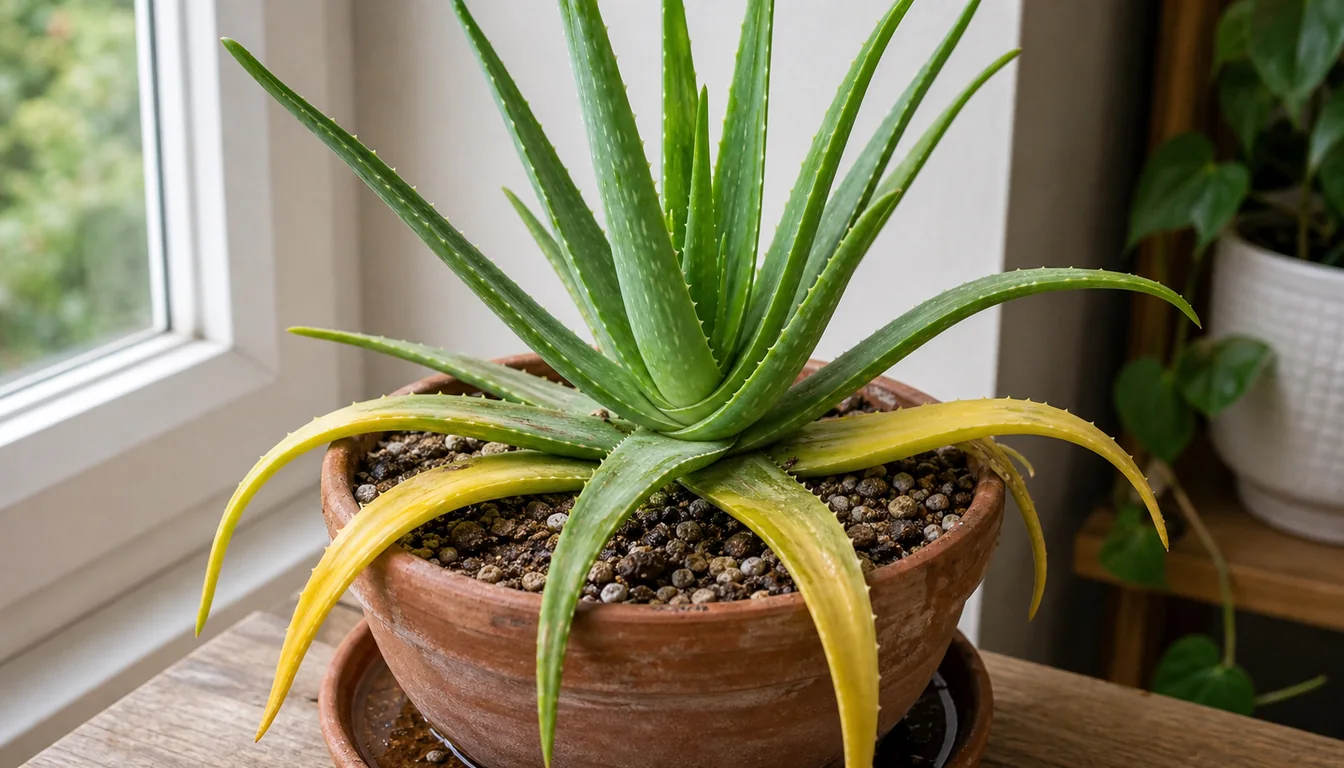
Yellow starting at the lowest outer leaves means the plant is pulling resources back, while an even color across every leaf at once is a light story.
Open the full diagnosisWhat You Are Seeing
Green is chlorophyll, so a yellow Aloe Vera leaf has had its chlorophyll withdrawn or destroyed. Those are different events with different causes, and the plant tells you which one by choosing where the yellow appears.
When supply drops, an Aloe Vera empties its oldest leaves first and moves what it recovers into the center. That is why yellowing which starts at the bottom and works inward points at the roots, the soil, or simple age.
Color that shifts evenly across every leaf at once is light acting on the whole plant instead.
Common Causes
01 High likelihood
Roots that can no longer supply the leaves
Roots standing in wet mix die, and dead roots deliver nothing. The plant answers by emptying its oldest leaves to keep the center alive, which is why the yellow climbs inward from the bottom.
How to identify it
- Yellow leaves feel soft and look slightly translucent held up to the light.
- The mix is still damp a week after watering and the pot is heavy for its size.
- Yellowing moves inward leaf by leaf rather than staying on one or two.
- Roots pull up brown and limp instead of pale and firm.
What to do
- Take the plant out of the pot and judge the roots before deciding anything else.
- Cut back to firm pale tissue, then leave the plant dry and shaded for a day so the cuts seal.
- Replant into a gritty mix in a pot barely wider than the roots that are left.
- Wait a week before watering, then water only once the mix is dry all the way down.
- Expect the already-yellow leaves to stay yellow, since the plant has taken what it needed from them.
02 High likelihood
The oldest leaf finishing its life
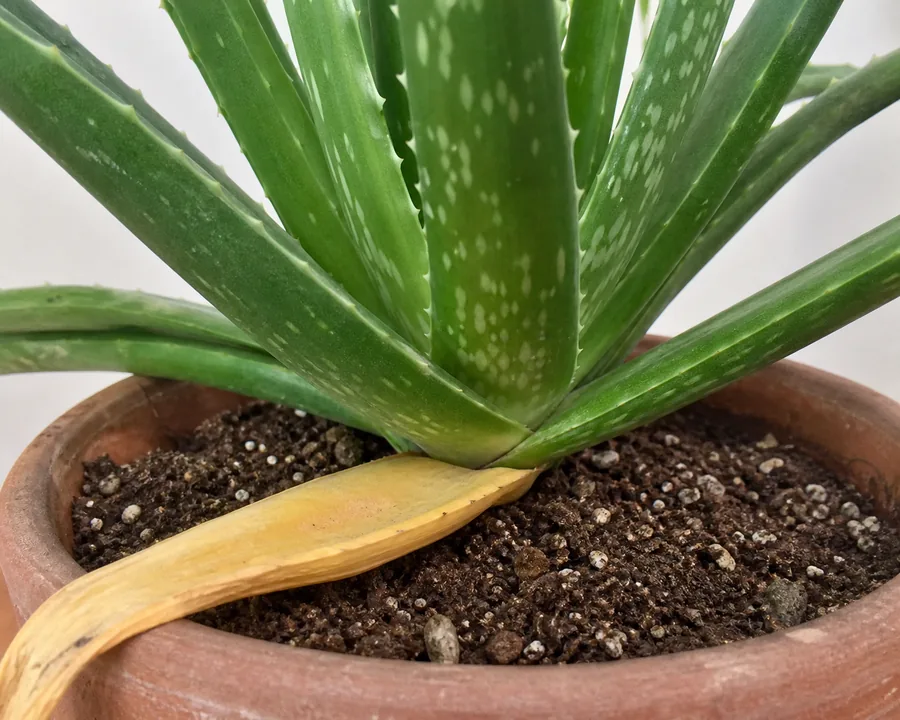
An Aloe Vera grows from the center and retires from the outside, so its lowest leaf is also its oldest. Losing one every so often is the plant working normally.
How to identify it
- Only the single lowest leaf is yellow, and the ones above it are firm and green.
- It dries down and thins rather than going soft or smelling sour.
- The center of the rosette is still producing new leaves.
- Nothing about the watering, the light, or the pot changed recently.
What to do
- Leave it attached until it has dried out, because it still holds water the plant can use.
- Pull it away with a gentle sideways tug once it turns papery, or cut it flush if it resists.
- Do not change watering or light on account of one spent leaf.
- Start looking for another cause only if a second and a third follow within weeks.
03 Medium likelihood
Strong light bleaching the whole plant
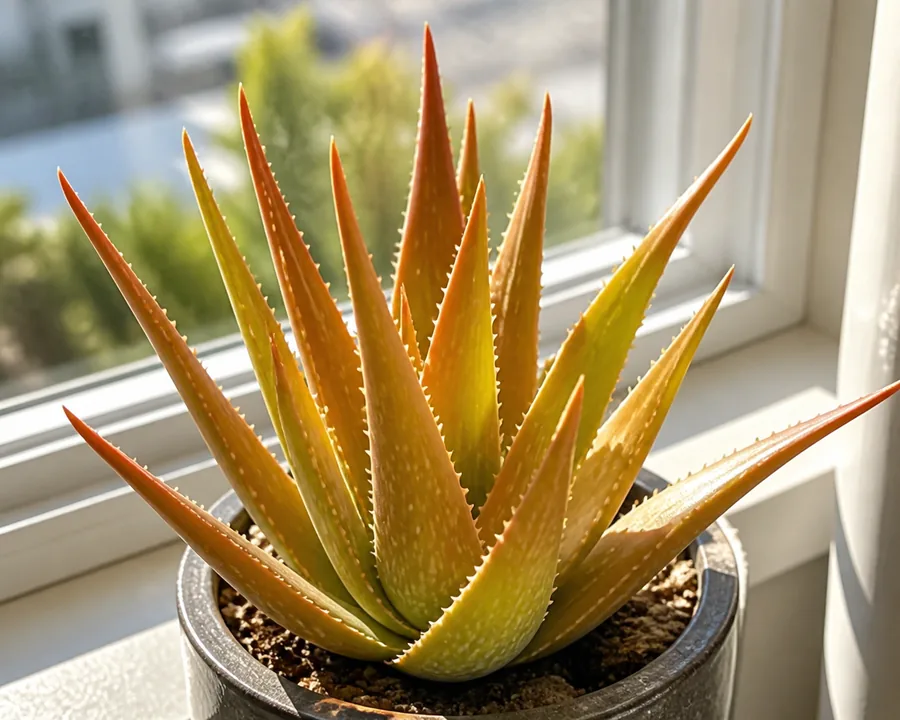
Hard direct sun breaks chlorophyll down faster than the leaf can rebuild it, so the green fades while the leaf stays thick and firm.
An Aloe Vera does this on purpose, and it usually adds a red or bronze edge as it goes.
How to identify it
- Every exposed leaf shifted color at once rather than one at a time.
- The leaves are still plump and firm when squeezed.
- Edges and tips carry a red, bronze, or purple tint.
- The plant was recently moved into stronger light, or the season turned.
What to do
- Decide whether the color bothers you, because the plant is not in danger.
- Move it back from the glass or behind a sheer curtain to bring the green back over a few months.
- Introduce stronger light across about two weeks rather than in one move.
- Leave every leaf attached, since none of this tissue has died.
04 Medium likelihood
Not enough light to build the green
Weak light gives the plant too little energy to fill new leaves with chlorophyll, so they come out pale from the start. This is the mirror image of sun stress and it needs the opposite move.
How to identify it
- The newest leaves at the center are the palest on the plant.
- Older outer leaves are still a deeper green than the young ones.
- The plant sits well back from a window, or the window faces north.
- New leaves are also longer and narrower than the older ones.
What to do
- Compare the center against the outside before moving anything, because that is what separates this from sun stress.
- Move the plant to the brightest window you have, adding direct sun across about two weeks.
- Add a grow light through winter if no window carries it.
- Accept that the pale leaves stay pale, and judge the change on the ones that follow.
05 Medium likelihood
Soil that has nothing left to give
An Aloe Vera left three or more years in the same mix runs its nitrogen down. The plant then takes what it needs from older leaves, which pale evenly while the watering and the roots look perfectly normal.
How to identify it
- Several older leaves have paled together, without going soft.
- The roots come up firm and pale, and the mix still drains.
- It has been years since the plant was last repotted.
- Feeding produced a brief improvement that did not hold.
What to do
- Repot into fresh gritty mix rather than reaching for fertilizer first.
- Move up one pot size at most, since a wide pot of damp mix creates a different problem.
- Tease the spent mix off the roots instead of dropping the whole root ball into a bigger pot.
- Feed lightly through the growing season afterward, at half the strength on the label.
06 Low likelihood
Mineral crust from tap water and feed
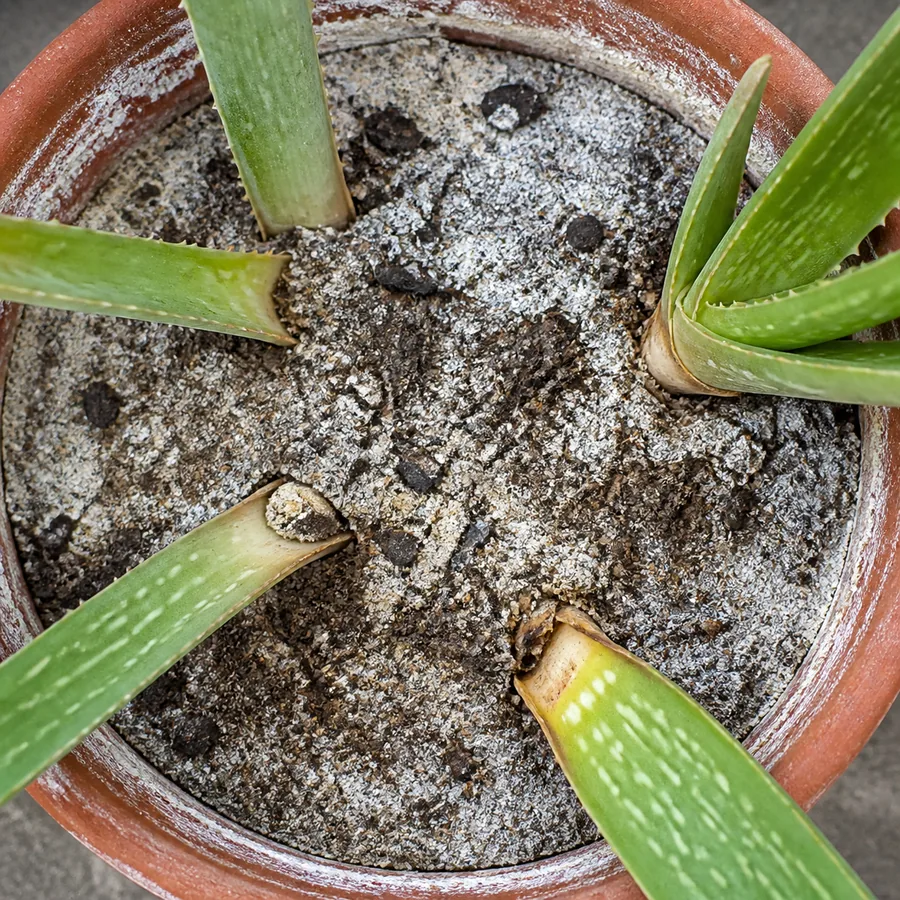
Hard tap water and regular feeding leave salts behind that burn the fine root tips doing the actual absorbing. Supply drops without the plant ever being overwatered, and the older leaves go first.
How to identify it
- A white or pale crust sits on the soil surface and inside the pot rim.
- The mix drains normally and does not smell sour.
- Yellowing arrived gradually on a plant whose care has not changed.
- The plant is fed regularly, or the tap water here is hard.
What to do
- Flush the pot by running water through it for a minute or two, letting it drain freely.
- Scrape the crust off and replace that top layer with fresh mix.
- Switch to filtered or collected rainwater if the crust comes back quickly.
- Cut feeding back to the growing season only, at half the labeled strength.
07 Low likelihood
Left dry for far too long
An Aloe Vera held dry long enough eventually draws on its oldest leaves as well, so drought arrives here as color before it ever looks like shrivelling. It is the least likely cause on this page and the fastest to eliminate.
How to identify it
- Older leaves have gone a flat straw-yellow while the center stays green.
- Creases run the length of each emptied leaf instead of across it.
- The pot lifts far lighter than it did in the days after watering.
- Water poured on now runs straight through and out of the holes.
What to do
- Lift the pot before anything else, because that one check rules this in or out.
- Stand the whole pot in a few inches of water for half an hour so the mix rewets from below.
- Repeat in three days if the first soak ran straight past a shrunken root ball.
- Leave the straw-yellow leaves alone, since they hold moisture the plant can still use.
Yellow Leaves Do Not Turn Green Again
Once an Aloe Vera has pulled the nitrogen out of a leaf it does not put it back, so that leaf stays yellow whatever you fix.
It is still worth leaving attached for a while. A spent leaf holds water the plant can draw on, and removing it early takes that away for the sake of appearance.
Judge recovery at the center instead, where a new leaf coming through at full color is the only thing that proves the cause is gone.
Is the Plant Still Savable?
The question behind a mostly yellow Aloe Vera is usually not which cause it was, but whether anything is left to save.
Look at the center first. Small firm green leaves coming from the middle mean the plant still has a working core, and every cause on this page is recoverable from there.
Then squeeze the base of the stem. Soft or dark tissue there means the crown has gone, and no correction to light or water reaches back past that point.
Offsets around the base are the way out when the parent is finished, and they root readily once separated and left to callus for a few days.
Recovery Plan
The spread stops
The honest first sign is that no further leaf begins yellowing, and it arrives well before any new growth does.
Roots take over again
A repotted or flushed plant needs this long before its roots can supply the whole rosette. Existing yellow leaves dry down across this window and can be removed as they turn papery.
Full-color growth returns
New leaves from the center arrive at a proper depth of green once supply is steady. A plant moved out of hard sun re-greens over roughly the same period.
An Aloe Vera only strips its older leaves when supply drops, so the habit that matters is the one protecting the roots doing the supplying.
Then set a repotting interval and hold it. Fresh mix every two or three years clears exhausted soil and salt build-up together, and those are the two causes that arrive so slowly nobody notices them.