
An Overwatered Tree Hides It for a Year, Then Thins
A tree gives you almost no warning. Colorado State says the symptoms of root problems may appear one to several years after the damage, so a tree that looked well last summer proves nothing about last summer's watering.
The second problem is location. Most tree roots sit in the top 6 to 24 inches of soil and spread across an area two to four times the width of the crown, which means the hose at the trunk is watering almost none of them.
This page moves both the diagnosis and the watering out to where the roots are. What the canopy can honestly tell you, how to take a soil reading that means something, and what to change once you have one.
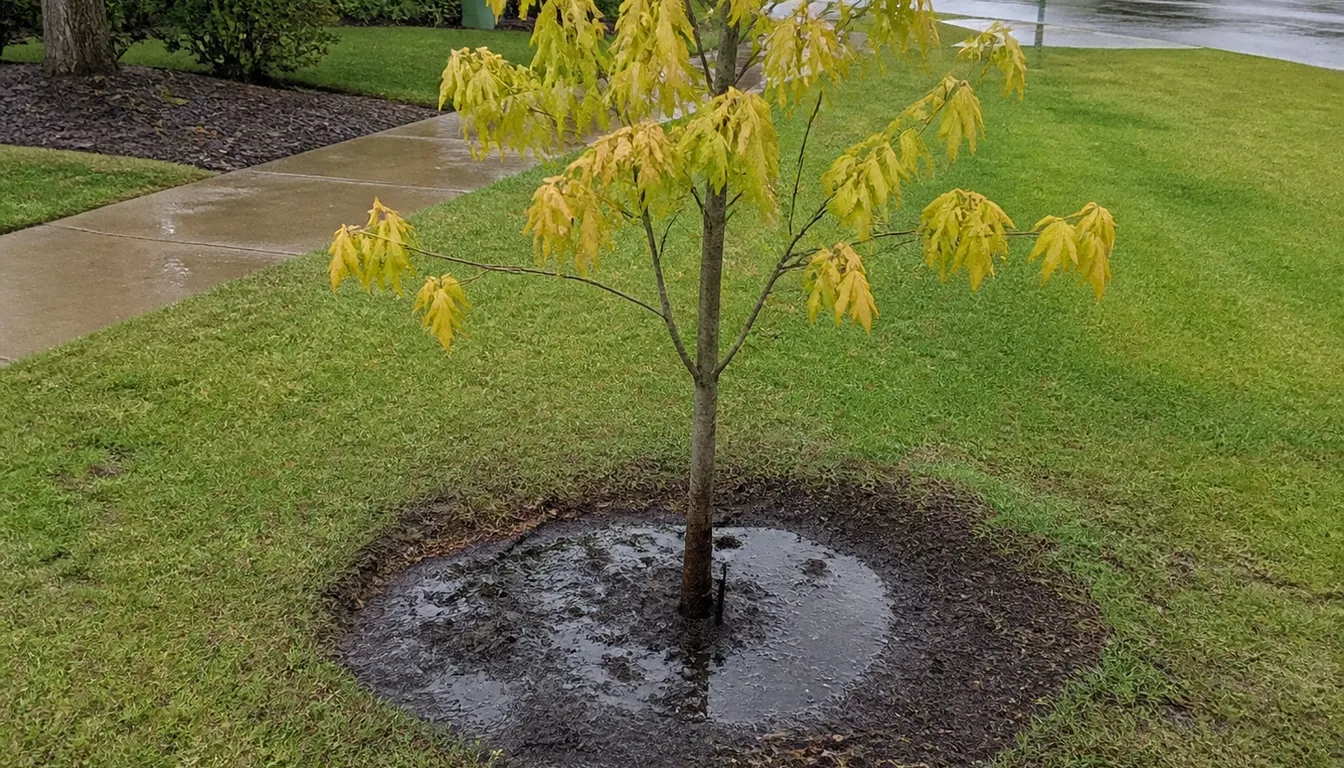
At a glance
Why Can an Overwatered Tree Look Fine for a Year?
A tree is slow in a way that hides the mistake.
Colorado State puts it in a single line. Symptoms of root problems may appear one to several years after the damage occurred, which means the canopy you are looking at is reporting on a season you have probably forgotten.
Underground the mechanism is oxygen rather than water. Roots need both, and when the soil is saturated the pore spaces fill with water and restrict oxygen uptake, so most roots die.
A mature tree absorbs that loss for a while. It carries reserves in its trunk and large roots and draws on them quietly, so the crown stays full while the fine roots that do the absorbing disappear underneath it.
Nothing above ground changes for a season or two.
By the time the canopy thins, the irrigation that caused it has usually been running for years on the same setting. Nobody changed anything, which is exactly why nobody suspects anything.
That delay also sets what recovery looks like. A tree that stops getting worse is doing well, and expecting visible improvement within a season is asking the wrong thing of an organism that took three years to mention the problem.
Can the Leaves Tell You It Is Too Much Water?
Not on their own, and this is the part most pages get wrong.
Yellowing older leaves, autumn color arriving in August, leaf drop through summer and a canopy that has gone see-through are all real symptoms of too much water. They are also real symptoms of drought, compaction, girdling roots and construction damage.
Every one of those ends the same way underground, which is a root system that can no longer supply the crown. The canopy reports the shortage without reporting its cause.
One combination does point one way. A tree thinning or wilting while the ground beneath it is wet several days after the last rain has a root problem rather than a thirst.
Dieback is a severity reading rather than a diagnosis.
When branch tips die and the death works back along the branch, root loss is already substantial.
The tree has been declining for years by then, whatever started it.
Treat the canopy as the thing that sends you outside with a probe. It is the last place the problem appears and the worst place to settle it.
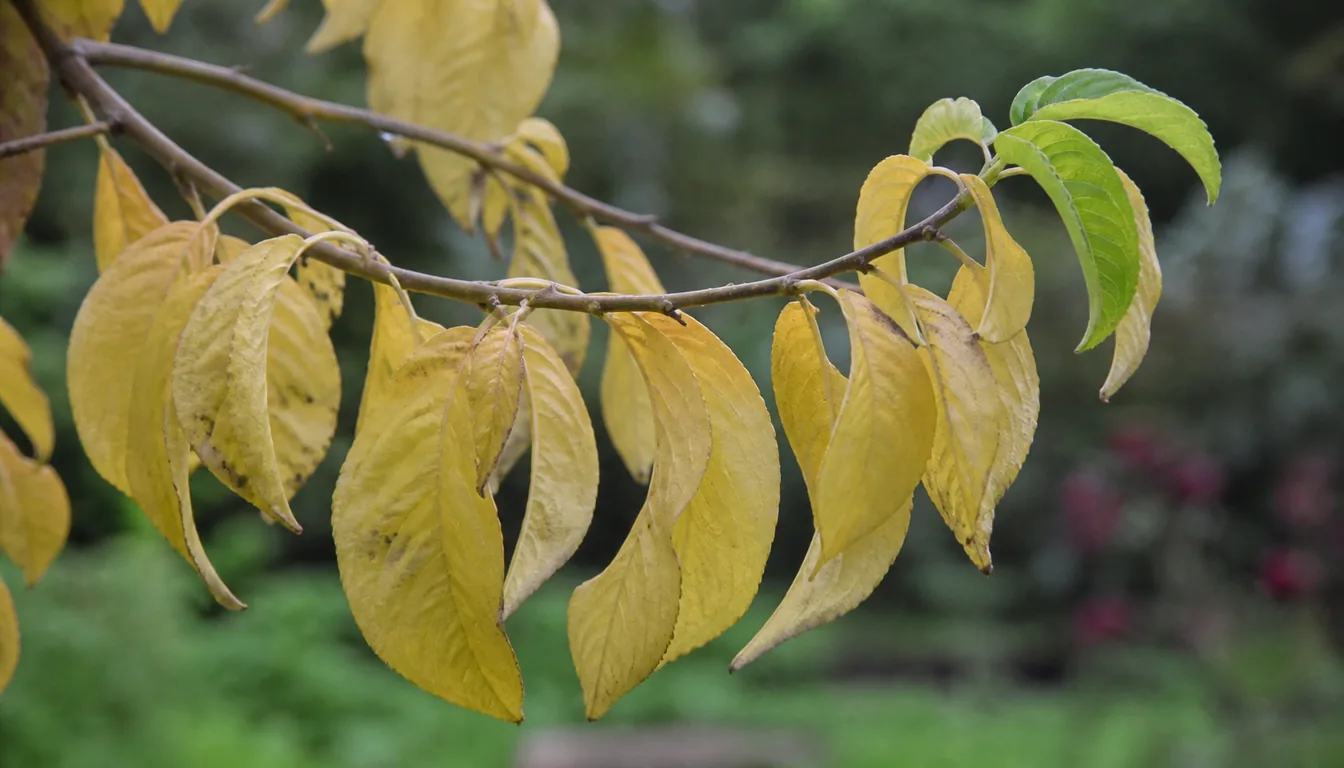
Where Are a Tree's Roots, and Where Should You Be Checking?
Most people picture a taproot going straight down. That picture is why the watering goes in at the trunk.
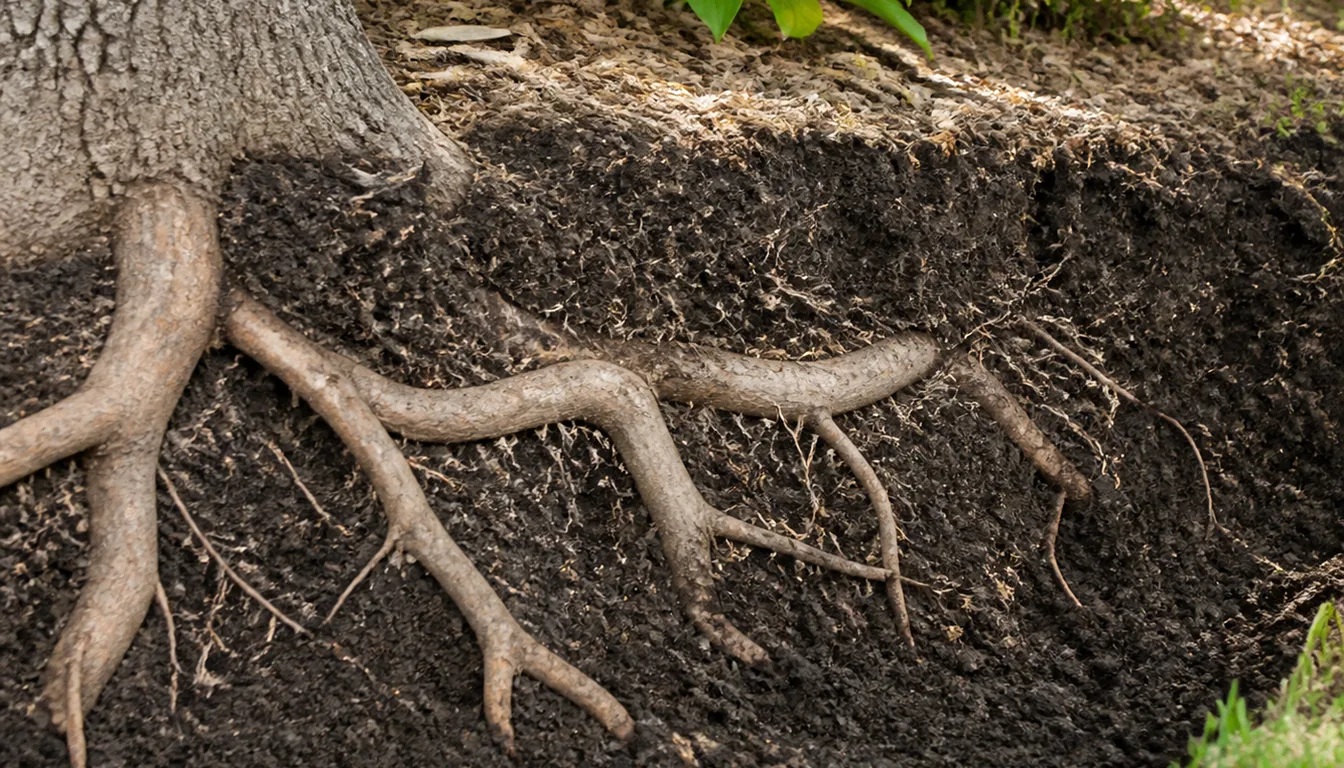
Colorado State puts most tree roots in the top 6 to 24 inches of soil. Large roots occasionally reach 3 to 7 feet where conditions allow, and those are structural rather than absorbing.
The spread is the bigger surprise.
The root system occupies an area 2 to 4 times the diameter of the crown. It reaches past the dripline as well, and the total spread runs to two to five times the crown diameter, which on a mature shade tree is most of a small garden.
The roots doing the work are tiny.
Feeder roots are about one sixteenth of an inch across, they live in the top layer, and they are the first thing saturated soil kills.
Losing them costs a tree its water supply while every visible root stays intact.
That geometry decides everything else on this page. Water applied at the trunk soaks a small circle of structural roots, and a soil check taken against the trunk reads the one spot least representative of the root zone.
It also explains why raising a bed over roots is a serious act. Adding only 4 to 6 inches of soil over an existing root system drastically reduces the oxygen and water available to it.
- Root depth
- Most roots in the top 6 to 24 in
- Root spread
- 2 to 4 times the crown diameter
- Feeder root size
- About 1/16 in across
- Fill over roots
- 4 to 6 in is enough to starve them
How Do You Check the Soil Around a Tree?
The reading is only worth taking where the roots are, which is out under the canopy and past it.
A long screwdriver works as well as a soil probe.
Push it in and note where it stops moving easily. It slides through wet soil and stalls in dry or compacted ground, so the depth where it stops is the reading, and the feel on the way down tells you as much as the number.
Depth is the number that matters.
A proper watering soaks in slowly to about 12 inches and leaves the top 6 to 9 inches moist across the root zone, so those are the depths worth reading.
Anything wetter than that at 12 inches, days later, is the answer.
Timing turns the reading into a diagnosis. Soil that is still saturated at that depth several days after the last watering or rain is the confirmation the leaves could not give you.
Take two or three readings around the tree. A single probe by the tap tells you about the tap.
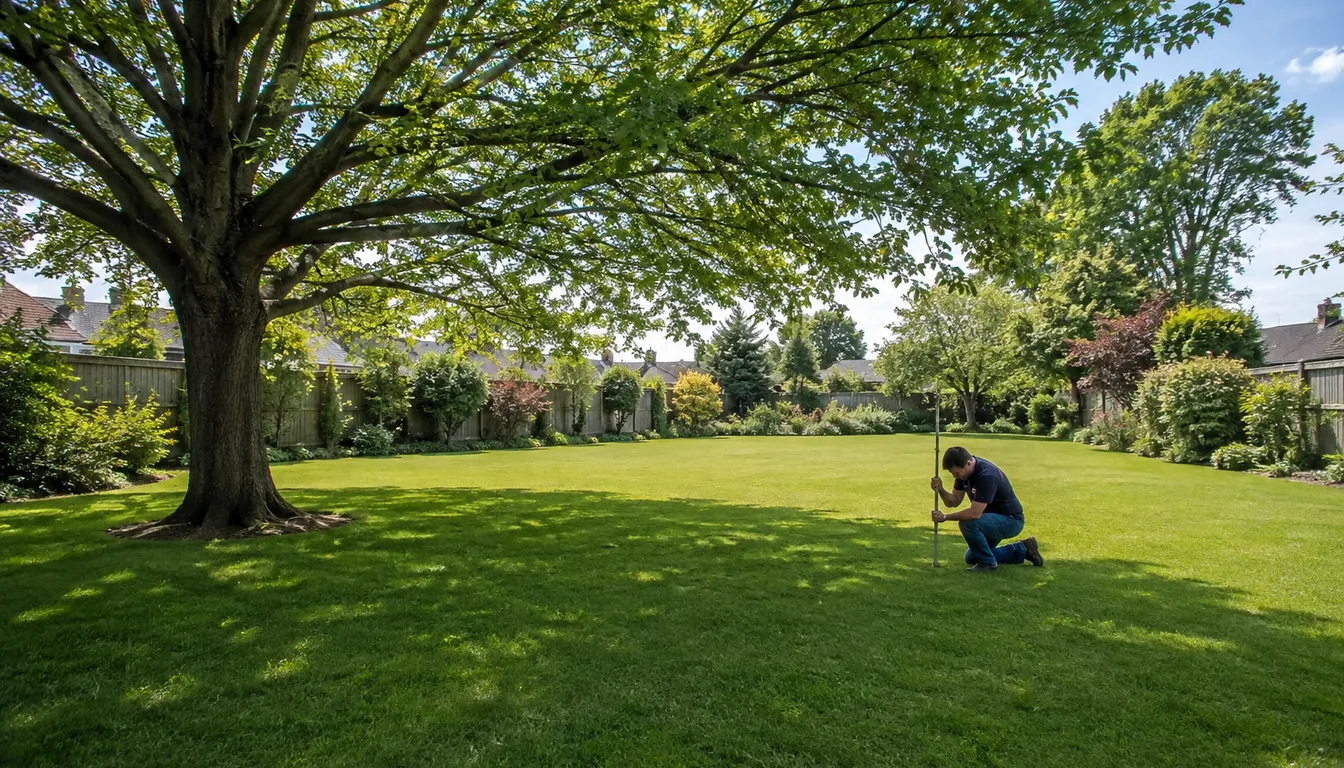
- Take the reading out under the canopy and beyond it, never against the trunk
- Push a probe or a long screwdriver to 12 inches and note where it meets resistance
- Check three or four days after the last watering or rain rather than the same day
- Repeat at two or three points around the tree before drawing a conclusion
What Around the Trunk Is Keeping It Wet?
Most of the water reaching a struggling tree is not being applied on purpose.
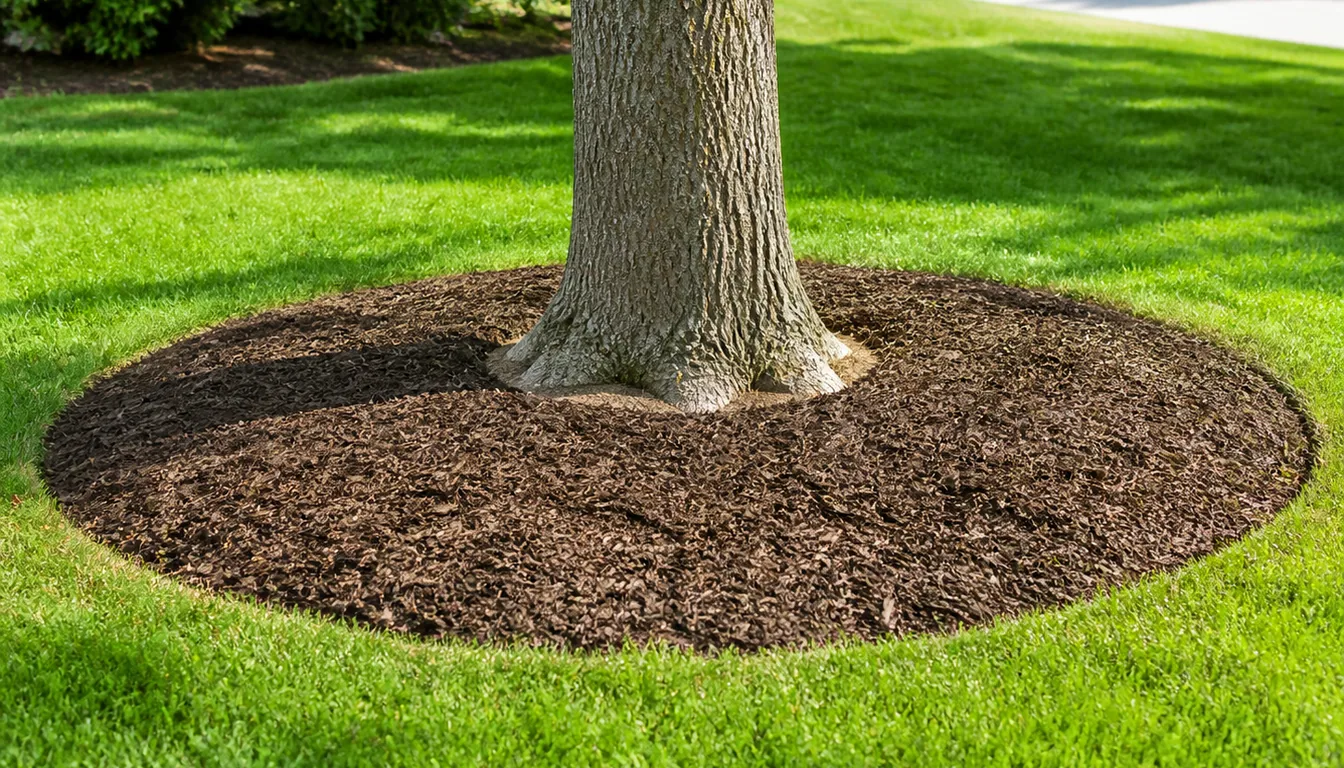
Mulch is the common one.
It goes on at 2 to 3 inches deep, stays 3 inches clear of the trunk, and never runs deeper than 6 inches. Heaped against the bark it holds the root collar permanently damp, which is exactly where rot begins.
The lawn program is the next. Sprinklers run little and often because that suits grass, and little and often is exactly the pattern that keeps the shallow layer where tree roots live from ever draining.
Light frequent watering has a second cost. It encourages shallow rooting, so the tree ends up less able to handle the first dry spell as well as waterlogged in the wet ones.
Then there is the water nobody counted at all. Downspouts, driveway run-off and a low spot in the lawn each deliver to the root zone without anybody turning a tap, and between them they often outweigh the irrigation.
| What is around your tree | What it does | The fix |
|---|---|---|
| Mulch heaped against the trunk | Keeps the root collar wet, where rot starts | Pull it back 3 in from the bark and level it to 2 to 3 in |
| Lawn sprinklers on a grass schedule | Little and often keeps the shallow root layer saturated | Run a separate deep soak for the tree and skip it on the lawn cycle |
| A downspout draining near the tree | Delivers a roof's worth of water into the root zone | Extend the outlet well past the canopy edge |
| The tree sitting in a low spot | Collects run-off from the whole lawn | Regrade the surface away, without adding soil over the roots |
| A raised bed built over the roots | 4 to 6 in of fill alone starves roots of oxygen | Remove the added soil rather than planting into it |
How Do You Water a Tree Without Drowning It?
Deep and rare, out where the roots are, and only when the probe says so.
Apply the water over the root zone within the dripline and beyond it rather than at the trunk. That is where the feeder roots are, and it is a far larger area than most people think they are watering.
Let it soak in slowly to about 12 inches, leaving the top 6 to 9 inches moist across that area. A soaker hose left running and moved around beats a sprinkler pass, which wets the grass and little else.
Light watering is the pattern to avoid. It promotes a shallow root system that suffers in summer heat and drought, so a tree watered lightly and often is being made more fragile rather than less.
What decides the next watering is the probe rather than the calendar or the irrigation controller. How much water a plant needs is a separate question from how often it needs any.
- Where
- Over the root zone, dripline and beyond, not the trunk
- How deep
- Soak slowly to about 12 in, top 6 to 9 in moist
- Avoid
- Light frequent watering, which shallows the roots
- Next watering decided by
- A probe reading, not a schedule
When Is It Past a Change of Watering?
Some findings end the do-it-yourself stage.
Mushrooms or bracket fungi at the base of the trunk or over the roots mean decay is already established inside wood that was alive. They are the fruiting body of something that has been working through the tree for a long time, so removing them changes nothing at all.
Soft or sunken bark at the root collar is the more serious version. That is the point where a tree fails structurally rather than merely declining, and it is not visible until somebody clears the soil and mulch away from it.
Dieback across a large share of the canopy means the root loss has gone past what any watering change can rebuild. An arborist excavates the root collar, looks for girdling roots, and assesses how much sound wood is left before recommending anything.
Size turns this into a safety question rather than a gardening one. A large tree with root decay standing over a house, a path or a road gets assessed by somebody qualified to judge whether it stays, and that is not a judgment to make from the kitchen window.
- Bracket fungi or mushrooms at the trunk base or over the roots
- Bark at the root collar that is soft, sunken or peeling away
- Dieback across a large share of the canopy rather than a branch or two
- Any of the above on a tree big enough to reach a building, a path or a road
Pro Tips
- Take the soil reading out under the edge of the canopy, since the soil against the trunk is the least representative in the garden.
- A thin canopy over wet ground points at the roots, and the same canopy over dry ground points somewhere else.
- Pull mulch back three inches from the bark so the flare of the trunk stays visible all year.
- Run a tree's watering separately from the lawn program, because little and often suits grass and drowns roots.
- Expect a corrected tree to stop getting worse rather than to recover visibly within a season.
Frequently Asked Questions
How can I tell if my tree is overwatered or just dry?
Take a soil reading out under the canopy rather than at the trunk.
A thinning or wilting tree over soil that is still saturated at 12 inches several days after rain has a root problem. The same canopy over dry soil is a different question.
How long does it take for overwatering damage to show in a tree?
Colorado State says symptoms of root problems may appear one to several years after the damage occurred. A tree that looked well last summer is not proof that the watering was right.
How deep are tree roots?
Most roots sit in the top 6 to 24 inches of soil, spread over an area two to four times the diameter of the crown. Some large roots reach 3 to 7 feet where the soil allows, but they are structural rather than absorbing.
Should I water at the trunk?
No. The feeder roots are out under the canopy and past the dripline, so water applied at the trunk soaks the one part of the root system that does not take it up.
How deep should tree watering soak?
About 12 inches, applied slowly, leaving the top 6 to 9 inches of soil moist across the root zone. Light frequent watering promotes a shallow root system that copes badly with heat.
Can an overwatered tree recover?
If the watering is corrected before decay sets in, yes, slowly. Mushrooms or bracket fungi at the base, soft bark at the root collar, or dieback across a large share of the canopy all mean it is time to have the tree assessed instead.
Sources & References
- Healthy Roots and Healthy Trees, Colorado State University Extension
- Watering Established Trees and Shrubs, University of Minnesota Extension
- Watering a Home Landscape During Drought, Colorado State University Extension
- Fall and Winter Watering of Plants and Trees, Colorado State University Extension
- Meeting the Watering Needs of a Newly Planted Tree, Penn State Extension
Related Guides
A Drought Tolerant Plant Is Not Drought Tolerant Yet
Colorado State puts it in one sentence. Drought tolerant plants are not drought tolerant until…
11 min read
Best Time to Water Flowers for Stronger Blooms
Watering flowers at the wrong time does more damage than skipping a day.
10 min read
Best Time to Water Indoor Plants: Morning or Evening?
Morning is the better default for watering indoor plants.
6 min read
Best Time to Water Plants for Healthier Roots
Watering at the wrong time wastes water and stresses plants, even if you are generous with the…
11 min read
Deep Watering vs Frequent Watering: What Roots Need
Deep watering usually serves established lawns, vegetables, trees, and shrubs better than repeated…
17 min read
How Much Water Do Plants Need? Wet the Root Zone, Then Wait
Plants need enough water to moisten the soil where their roots take it up, and then no more until…
8 min read