
Why Pomegranate Flowers Drop Before Setting Fruit
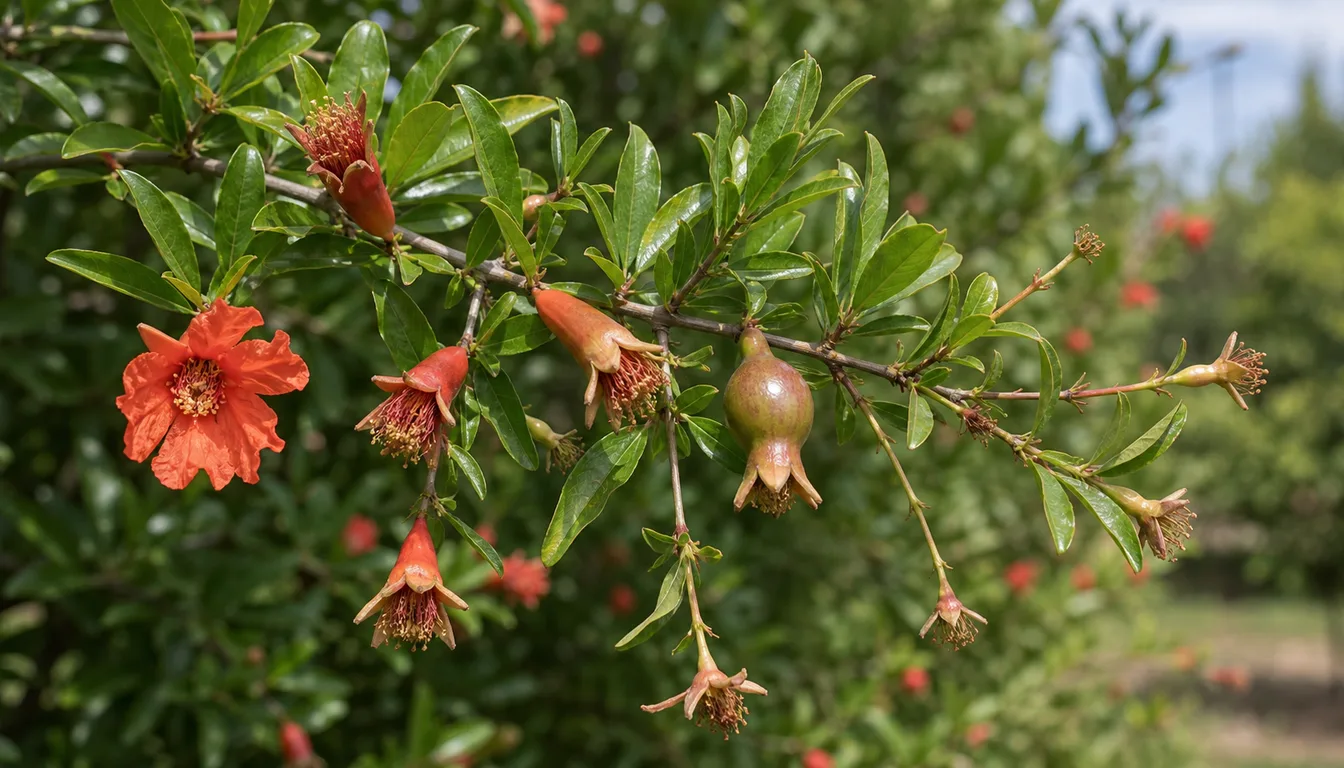
Start with the base of a newly opened Pomegranate flower.
A narrow vase-shaped bloom is functionally male and normally falls after releasing pollen, while a flower with a fuller rounded base has the ovary that can swell into fruit.
If those rounded flowers also drop, trace pollination, bloom weather, root moisture, plant age, light, pruning, and cultivar before changing care.
Quick diagnosis
Check the flower base before treating the plant
Collect one freshly fallen flower and compare it with flowers still open.
A narrow base that never looked like a tiny fruit marks normal male-flower shedding.
A rounded or peanut-shaped base that yellows, shrivels, or detaches deserves the rest of the diagnosis because that flower had the structure needed to set fruit.
Open the full diagnosisWhat You Are Seeing
A branch on a pomegranate shrub can be covered in orange-red petals while carrying relatively few flowers capable of becoming fruit. The useful count is not every bloom, but the rounded-base flowers that remain attached after their petals age.
Watch what happens next. A successful fruit-bearing flower keeps its fleshy calyx and begins enlarging behind the crown, while a failed flower dries at the stem or a pea-sized fruitlet stops growing and drops.
This diagnosis ends before harvest. Fruit that reached full size and later opened through the rind belongs to pomegranate fruit cracking, not to poor set.
Common Causes
01 Check first
The fallen flowers were functionally male
Pomegranate shrubs produce fruit-bearing flowers and functionally male flowers on the same plant. The male flower has a relatively narrow, straight-sided base because its ovary is not developed, so it releases pollen and then falls without making fruit.
This is normal shedding rather than failed care. Concern begins when the shrub produces almost no rounded-base flowers, or when clearly rounded flowers and newly swelling fruitlets also detach.
How to identify it
- The fallen bloom has a narrow vase-shaped base instead of a rounded swelling.
- There was never a tiny fruit shape behind the petals.
- Open flowers and healthy leaves remain on the same shoot.
- Some rounded-base flowers or young fruitlets are still holding elsewhere.
- The detached flower is clean rather than blackened, spotted, or soft.
What to do
- Leave narrow flowers in place so insects can collect and move their pollen.
- Count rounded-base flowers on several branches before judging the crop.
- Photograph the same marked branch every few days through one bloom flush.
- Avoid spraying, feeding, or changing irrigation because male flowers fell normally.
- Continue the diagnosis only when fruit-bearing flowers also fail to hold.
02 Likely when blooms stay clean
Rounded flowers received too little useful pollen
Pomegranates are self-fruitful, so one compatible plant can set a crop, but pollen still has to reach the receptive center of a fruit-bearing flower. Insects and hummingbirds do much of that transfer, and another compatible pomegranate can improve the number of flowers that set without being strictly required.
Suspect this cause when rounded-base flowers look healthy, bloom weather is mild, and very few visitors move among them. A small hand-pollinated test is more useful than assuming every flower needs a second tree.
How to identify it
- Rounded-base flowers open normally but detach without visible injury.
- Few bees, beetles, or hummingbirds visit during the active bloom period.
- Nearby flowers were removed, sprayed, or absent during the same weeks.
- An enclosed patio, screen, or indoor position limits insect access.
- Marked hand-pollinated flowers hold more often than untouched flowers nearby.
What to do
- Avoid broad insecticide sprays while pomegranate flowers are open.
- Let insect visitors reach the canopy during dry daylight hours.
- Grow pesticide-free pollinator plants that overlap the pomegranate bloom period nearby.
- Transfer pollen to a few rounded flowers with a clean soft brush as a test.
- Consider a second compatible fruiting cultivar only after the one-branch test supports a pollen-transfer limit.
03 Weather dependent
Bloom stayed humid or repeatedly wet
Pomegranate flowers set best with air movement and a dry bloom surface. Extended humid weather, repeated rain, or overhead irrigation can leave petals and reproductive parts wet long enough for flowers to abort even while the root zone has adequate moisture.
This pattern differs from drought because the soil is not dry and the flowers may look water-soaked or collapse after wet periods. Dense interior growth that stays damp after the outer canopy dries makes the pattern more convincing.
How to identify it
- Rounded flowers abort during a rainy or persistently humid bloom period.
- Overhead sprinklers wet flowers during their run.
- Interior blooms remain damp after outer leaves have dried.
- The root zone is moist rather than hard and dry.
- Later flowers set better during a drier spell on the same plant.
What to do
- Use drip irrigation instead of a sprinkler when the current system repeatedly wets the canopy.
- Water early enough that accidental leaf wetness can dry promptly.
- Remove dead twigs and crowded inward growth during the proper pruning season.
- Keep weeds and dense growth from blocking air around the lower canopy.
- Judge the next drier flower flush before making a fertilizer change.
04 Common in heat and containers
The root zone dried while fruitlets were trying to hold
A drought-tolerant pomegranate can survive dry soil while still sacrificing flowers and young fruit. The critical evidence is a rounded flower that begins to swell, followed by a fruitlet that stops enlarging as the soil dries and tender leaves lose firmness.
Container-grown fruit plants can cross that threshold quickly because the whole root ball heats and dries in a day. Watering only after fruitlets have yellowed cannot reconnect them, but steadier moisture can protect later flowers in the same bloom season.
How to identify it
- Rounded flowers formed small fruitlets before the drop began.
- Soil several inches down is dry rather than merely dry at the surface.
- Tender leaves curl or lose firmness during the hottest part of the day.
- Container mix pulls from the pot edge or water runs through dry channels.
- Later fruitlets hold better after the root zone stops cycling between dry and soaked.
What to do
- Use soil depth, pot size, and weather to guide each irrigation decision.
- Apply water slowly across the active root area instead of dumping it at the trunk.
- Use an organic mulch layer over the root zone while keeping the trunk flare clear.
- Shade the container itself from hot pavement without moving the foliage into deep shade.
- Adjust the interval from soil drying and weather rather than from a fixed calendar.
05 Regional and seasonal
A late cold night injured open flowers
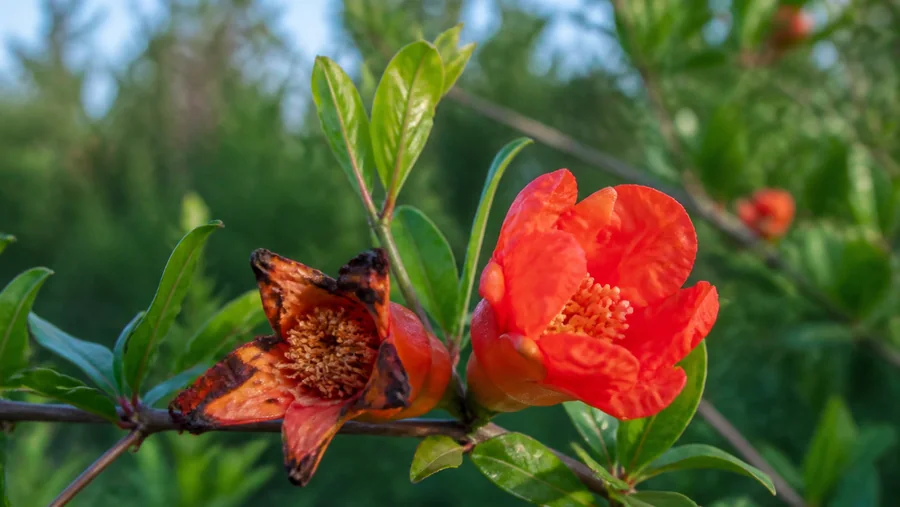
Tender pomegranate growth is more vulnerable around bud break than dormant wood. A late cold event can kill a pistil or young shoot even when the older branch survives and later produces another flush.
Cold injury leaves damaged tissue rather than a clean flower-base fork. Look for browned or blackened flower centers, collapsed petal edges, and injured new leaves appearing together after the same night.
How to identify it
- Damage appeared immediately after an unusually cold night.
- Flower centers or petal margins turned brown to black.
- Tender shoot tips and new leaves on exposed branches were injured too.
- Sheltered flowers lower in the canopy survived better.
- Fallen flowers show dead tissue instead of a clean healthy narrow base.
What to do
- Wait until the extent of injury is clear before cutting live wood.
- Remove only tissue that fails to resume growth after the cold period passes.
- Use a breathable frost cover over a manageable shrub when another cold night is forecast.
- Keep the cover from resting directly on open flowers and remove it after temperatures recover.
- Protect later bloom flushes rather than trying to restore flowers already killed.
06 Common in the first years
A young plant is favoring shoots over fruitlets
Young pomegranates may flower before they can hold a dependable crop. Fruit drop is common during the juvenile period, and excessive fertilizer or irrigation can make it worse by pushing long soft shoots while newly set fruit remains weak.
Age alone fits best when the plant has been established only a few seasons and still gains framework rapidly. On an older shrub, the same lush shoot pattern points more strongly to recent feeding, constant wet soil, or repeated hard pruning.
How to identify it
- The plant is within roughly its first three to five years of establishment.
- Long soft shoots and large leaves dominate the canopy.
- Small fruitlets form but many shed before meaningful enlargement.
- Growth accelerated after heavy fertilizer or frequent irrigation.
- The shrub otherwise lacks cold injury, dry soil, or diseased tissue.
What to do
- Let a young plant build roots and permanent framework without forcing a full crop.
- Stop adding fertilizer until a soil test or measured growth shows a need.
- Allow the upper root zone to begin drying between thorough irrigations.
- Remove vigorous basal suckers that compete with the trained framework.
- Judge improvement over the next bloom cycle as the plant matures.
07 Site or pruning pattern
Shade or hard pruning reduced productive flowering wood
Pomegranates need full sun for strong flowering and fruiting, and productive spurs occur mainly on two- and three-year-old wood. Deep shade limits set, while aggressive pruning removes the older wood and branch tips that would have carried productive blooms.
This cause usually changes the whole canopy pattern rather than making one healthy flower fall. Use where the crop forms on fruiting wood to protect productive branches, then compare sparse rounded-base flowers with set on the sunniest uncut branches.
How to identify it
- The canopy receives less than about six hours of direct sun during the growing season.
- Rounded-base flowers cluster on the outer sunlit side while shaded branches set little.
- A hard winter cut removed many branch tips and older lateral shoots.
- Long replacement growth followed pruning but fruiting spurs are scarce.
- An unpruned or sunnier branch on the same plant performs better.
What to do
- Remove or thin an external shade source when that can be done without harming the site.
- Move a container gradually into stronger direct sun.
- Use light annual thinning instead of repeatedly shortening every branch.
- Keep healthy two- and three-year-old fruiting wood when shaping the canopy.
- Expect pruning and light corrections to show mainly in a future bloom cycle.
08 Persistent cultivar clue
The plant was selected for flowers rather than fruit
Some pomegranates are sold as ornamentals for compact growth, unusual flower color, or double blooms. Double-flowered cultivars may make a dramatic display yet rarely form edible fruit, so perfect care cannot turn their bloom structure into that of a productive fruit cultivar.
Use this diagnosis only after checking the label, nursery record, or reliable cultivar description. An unknown plant with single flowers and rounded ovaries still deserves the pollination and stress checks before it is declared ornamental.
How to identify it
- The original tag or nursery listing describes an ornamental selection.
- Flowers have many extra petals or a double-flowered form.
- The mature plant blooms heavily year after year but never develops rounded fruitlets.
- The shrub is a compact dwarf sold mainly for display.
- Care changes do not alter the absence of fruit-bearing flower forms.
What to do
- Confirm the cultivar name before changing fertilizer or irrigation.
- Keep an ornamental pomegranate for its flowers if that display still suits the garden.
- Add a named fruiting cultivar when edible fruit is the goal.
- Choose a locally adapted cultivar with documented fruit production.
- Do not rely on hand pollination when the plant produces no developed fruit-bearing flowers.
Judge the next bloom flush, not the flowers already gone
A detached flower cannot be made to set again.
The useful work is protecting rounded-base flowers that are still open and watching whether their calyx base stays green and begins to enlarge.
Pomegranates can bloom in several flushes, so a failed early group does not always end the season. A later flush may respond to steadier root moisture, drier bloom surfaces, restored pollinator access, or protection from another cold night.
Some corrections need a longer test.
A young plant must mature, productive wood must regrow after hard pruning, and an ornamental cultivar will not change its inherited flower type because care improved.
Read the flower base before diagnosing poor fruit set
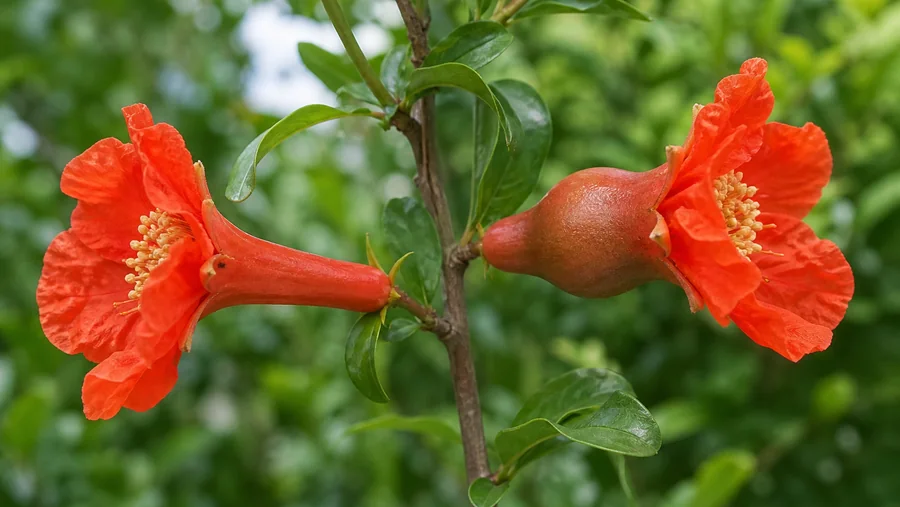
Inspect flowers from the side while they are freshly open. Petal color does not settle the question because both flower types can be orange-red, and a spent bloom can lose the silhouette that was clear a day earlier.
A functionally male flower narrows into its stem like a vase. Its stamens produce pollen, but the undeveloped ovary means the entire flower can drop cleanly after bloom without showing that the shrub is thirsty or unfertilized.
A fruit-bearing flower is wider behind the petals, often with a rounded or peanut-shaped base. That swollen part is the ovary, and its fleshy calyx becomes the crown that remains visible on a young pomegranate.
Mark several rounded flowers with loose colored ties on nearby twigs and leave the narrow flowers alone. Recheck the marked group after petals fade, because the proportion that begins swelling tells you more about fruit set than a pile of naturally fallen male blooms.
Test pollination on one branch while the flowers are open
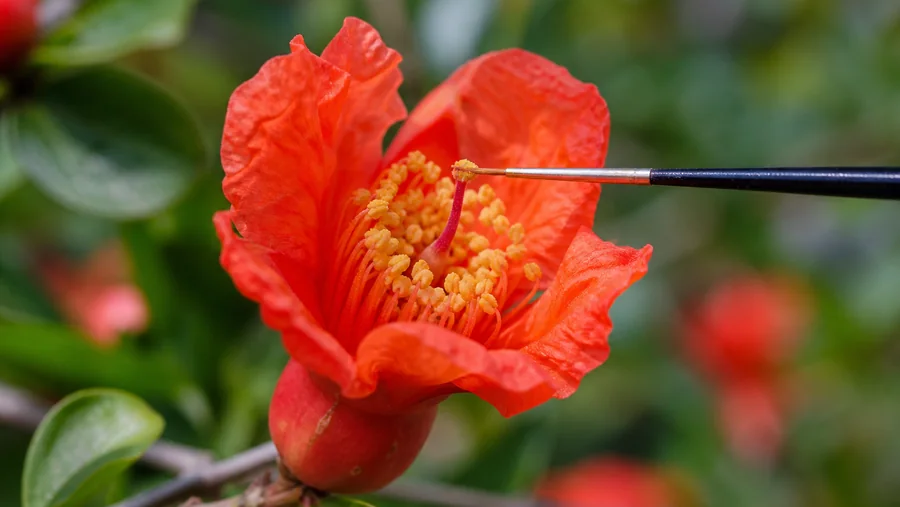
Self-fruitful means one compatible pomegranate can supply both pollen and fruit-bearing flowers. It does not mean pollen reaches every receptive flower without wind, insects, hummingbirds, or deliberate contact.
Choose a dry morning and collect pollen from a freshly open flower with a clean soft artist brush. Touch the pollen lightly to the central receptive structure of several open rounded-base flowers, then mark that twig without tying anything tightly around it.
Leave a similar group nearby untreated and keep water, light, and all other care the same. If markedly more test flowers begin swelling, pollen transfer was probably limiting set and the next response is better pollinator access rather than more fertilizer.
A test that fails on both groups points back to flower type, wet bloom weather, dry roots, cold damage, plant age, or cultivar. It also prevents one poor bloom week from becoming a reason to buy a second tree before the evidence supports it.
Recovery Plan
Sort the fallen flowers by base shape
Compare narrow clean blooms with rounded-base flowers and mark several rounded flowers that are still attached. Check soil moisture and recent weather before changing water or fertilizer.
Test pollen transfer on one branch
Hand-pollinate a small marked group and leave a similar group untreated. Keep sprays away from open flowers and water the soil without wetting the canopy.
Watch which rounded bases enlarge
Successful set stays green and swells behind the crown. Record whether retained fruitlets follow the hand-pollinated group, the drier bloom period, steadier soil moisture, or the more sheltered branch.
Correct the condition that cannot change now
Improve sun exposure, replace overhead irrigation, preserve productive older wood, moderate fertilizer, or confirm the cultivar. Let a juvenile plant mature instead of forcing shoot growth with extra feeding.
Protect fruit set by preserving several kinds of evidence during bloom. Keep the root zone evenly moist but not constantly saturated, deliver irrigation below the flowers, avoid broad insecticide sprays, maintain an open sunlit canopy with light annual pruning, and feed from measured need rather than from flower drop alone.
Keep the plant label and a simple bloom record.
Flower-base shape, cold nights, wet weather, pollinator visits, pruning dates, and the branch where fruitlets held will make next season's diagnosis faster than another general treatment.
Sources
- Pomegranate Production, University of Georgia Cooperative Extension
- The Pomegranate, University of Florida IFAS Extension
- Pomegranates, Clemson Cooperative Extension
- Pomegranate, Punica granatum, Clemson Cooperative Extension
- Pomegranate, Fruit of the Desert, Utah State University Extension
- Floral Characterization of Pomegranate Genotypes to Improve Hybridization Efficiency