
Read an Apple Leaf Spot Before You Reach for a Spray
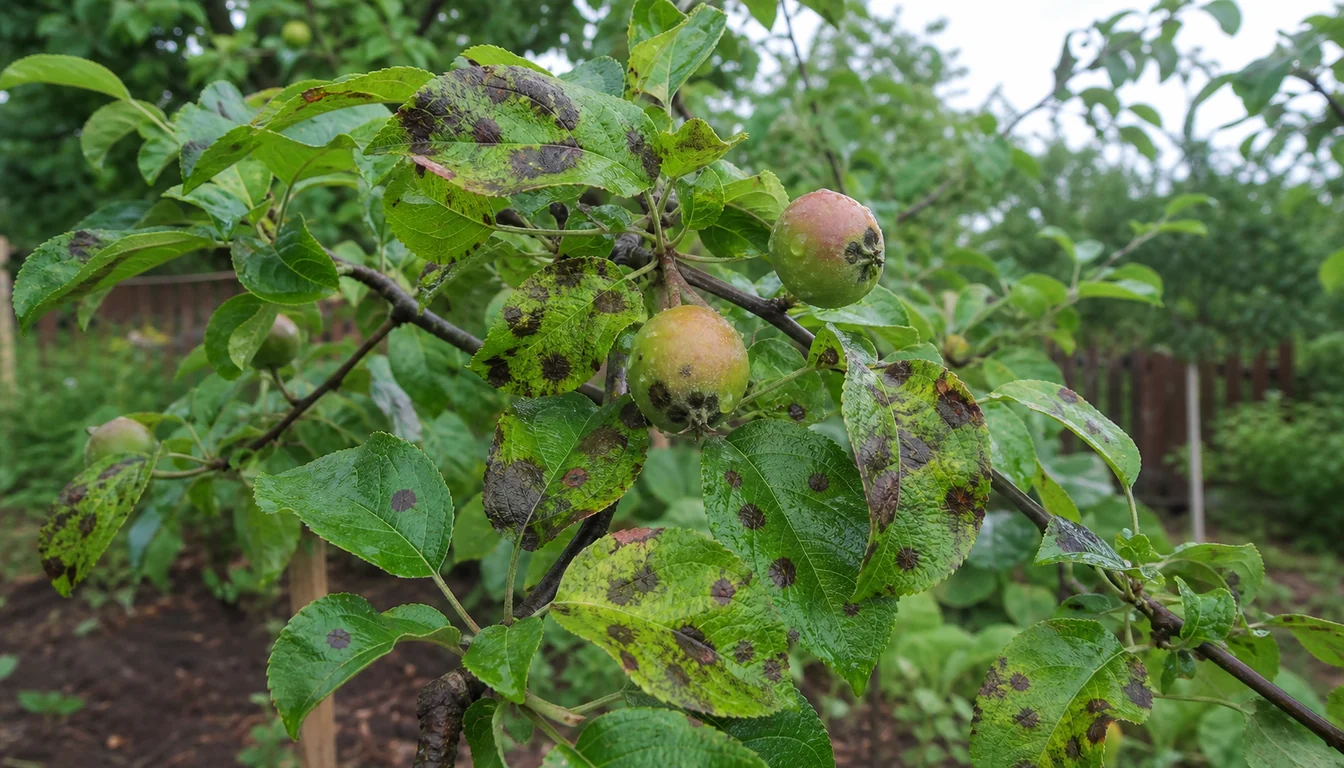
Several unrelated fungi mark apple leaves, and they do not share a treatment. Two of the six common causes are not spray problems at all, so the mark has to be read before anything is applied.
Quick diagnosis
Read the color and the edge, then turn a leaf over
Velvety and olive-brown with a soft edge points to scab, a hard dark ring around a tan center points to black rot, and anything orange means checking the underside of the leaf.
Open the full diagnosisWhat You Are Seeing
Apple leaves carry marks from several unrelated fungi, and the distinction matters because the treatments have almost nothing in common. One is answered by raking, one by pruning wood, and one by dealing with a juniper somewhere else in the garden.
Color and edge do most of the sorting. A velvety olive-brown blotch that feathers into the green is a different organism from a small tan circle with a hard dark ring around it.
Then turn a leaf over, because only one of these puts its spore structures on the underside.
Common Causes
01 High likelihood
Apple scab
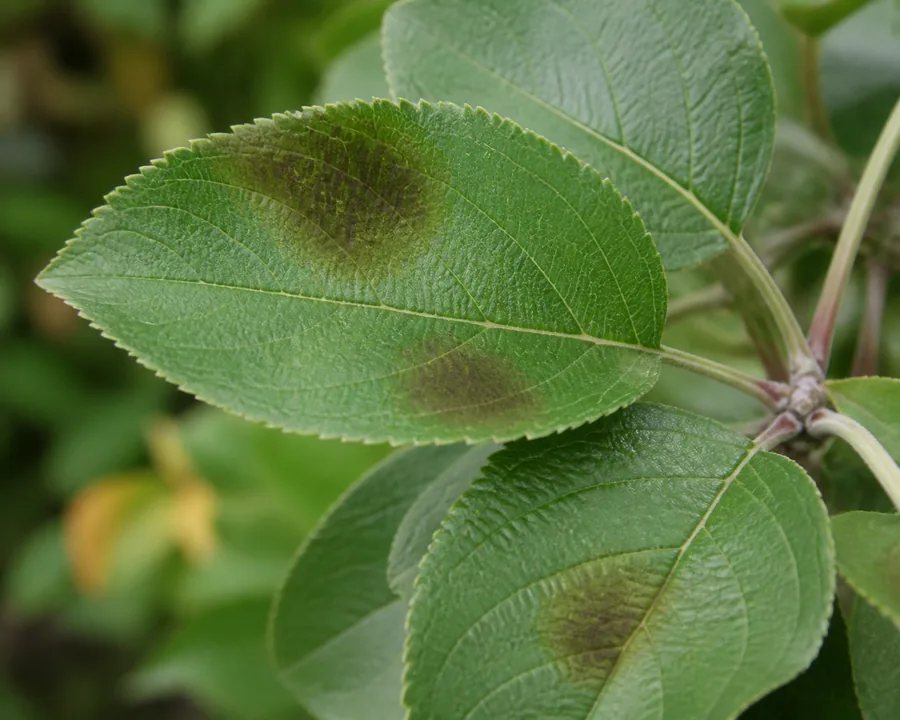
Round velvety spots, olive-green fading to brown and usually under half an inch across, appear on the upper leaf surface after bud break.
The fungus spends winter in last year's fallen leaves, which is why the same tree is hit again every spring the litter is left down.
How to identify it
- Blotches look velvety rather than glossy, and their edges feather into the green.
- Color runs olive-green to brown, never orange and never sharply ringed.
- They appear in spring after bud break, during cool wet spells.
- A hard year turns the leaves yellow and strips the tree by midsummer.
- Fruit carries corky scabbed patches that may crack open.
What to do
- Rake and remove every fallen leaf in autumn, since that litter is where next spring's spores come from.
- Prune in late winter to open the canopy so leaves dry faster after rain.
- Time any protective spray to bud stages, green tip through petal fall, rather than to a date on the calendar.
- Expect the existing spots to stay, because a protective spray guards leaves that are not yet infected.
- Plant a resistant cultivar when replanting, since Liberty resists scab, rust, mildew and fire blight together, while GoldRush is immune to scab yet still takes rust.
02 High likelihood
Cedar-apple rust
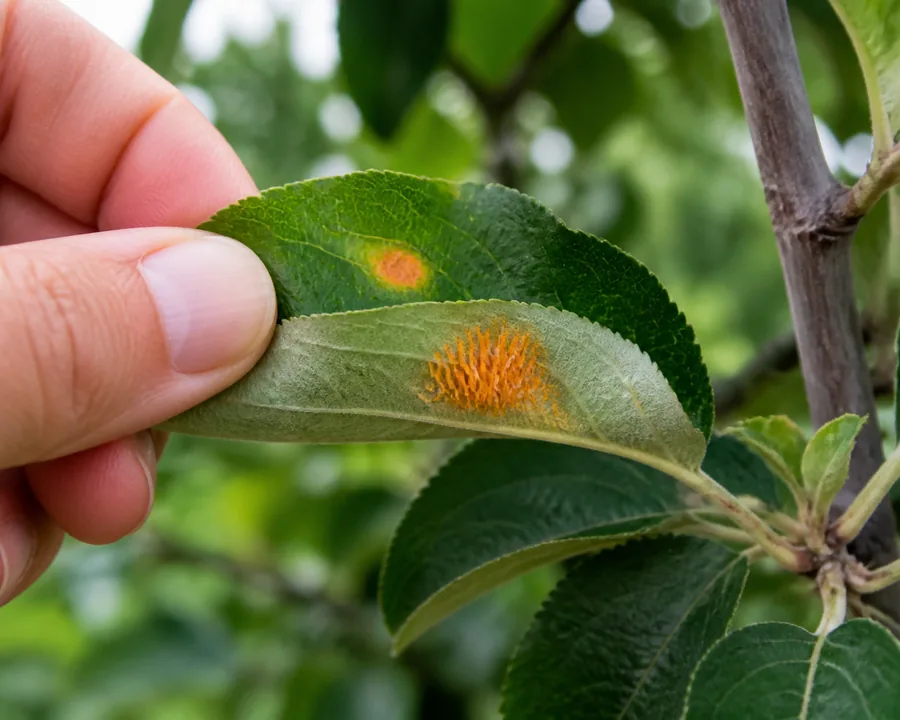
Rust prints a yellow-orange lesion that stays smooth on the upper surface, then raises its spore structures on the underside of the same leaf. It cannot complete its cycle without a juniper or cedar nearby, so half the fix is on a different plant.
How to identify it
- Lesions are yellow to orange rather than brown.
- The upper surface stays smooth while the underside carries raised tube-like structures.
- There is a juniper or cedar growing within sight of the tree.
- Orange gelatinous horns appear on those junipers during spring rain.
What to do
- Turn a leaf over before anything else, because the underside settles this in seconds.
- Prune visible galls out of nearby junipers before spring, which is when they release.
- Keep junipers and apples apart when a new planting gives you the choice.
- Treat removal as a partial answer, because spores carry from junipers well beyond your own boundary, which is why cultivar choice matters more here than it does for scab.
- Pick a resistant apple cultivar if the junipers are not yours to remove.
03 High likelihood
Black rot, showing as frogeye leaf spot
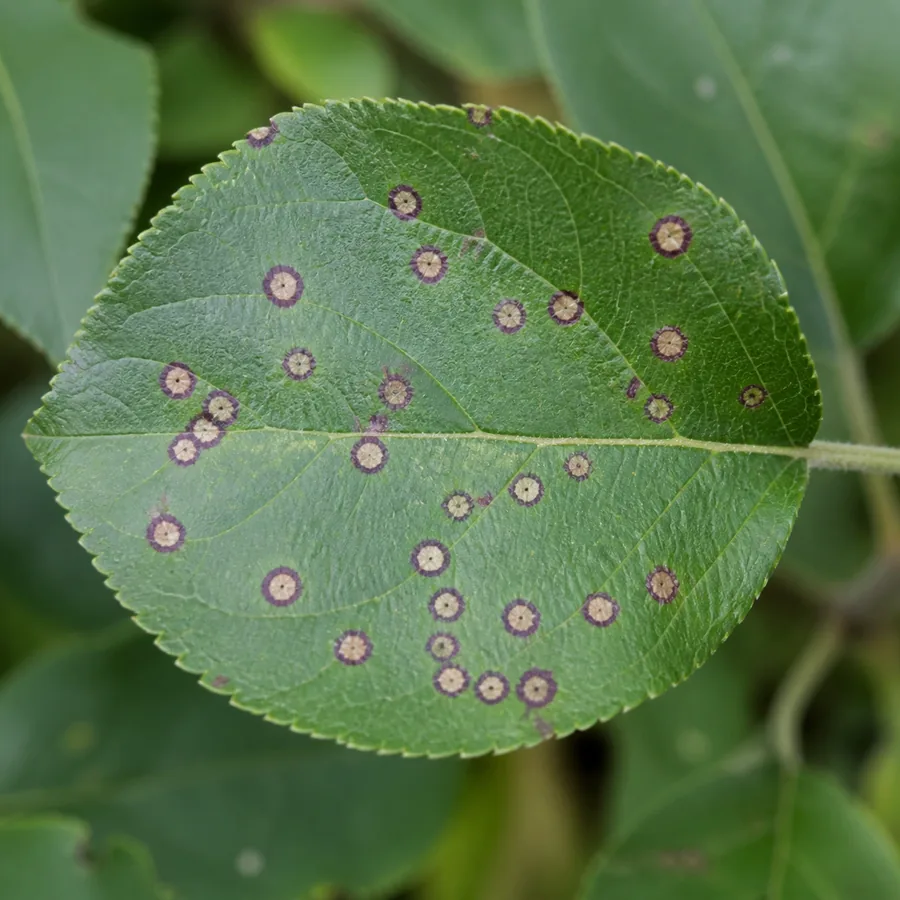
The leaf sign is a small, nearly circular tan spot with a distinctly darker margin, which is where the name frogeye comes from.
Those spots are the visible half of a fungus that also makes sunken cankers on branches, and the wood is what actually needs attention.
How to identify it
- Spots are small, round, and tan with a hard darker ring.
- Edges are sharp rather than feathered into the green.
- Branches carry dark sunken cankers, and leaves above one turn bright yellow and die.
- Fruit lesions start as reddish flecks, often at the blossom end, then spread in alternating brown and black rings.
What to do
- Look at the wood, because the leaf spots are a symptom of what is happening in the branches.
- Prune out cankered and dead wood during dormancy, cutting well back into healthy tissue.
- Remove every mummified fruit left hanging on the tree or lying underneath it.
- Skip a fungicide for the leaf spots, because NDSU Extension does not recommend fungicides for black rot on home trees and Penn State names sanitation as the primary control. A protectant spray guards only fruit and leaves not yet infected and does nothing for a canker already in the wood.
04 Medium likelihood
Powdery mildew
This one coats the surface instead of printing into it.
A white powdery layer spreads over young leaves and shoots, and the growth beneath it comes out narrow and distorted.
How to identify it
- The mark is a white coating that rubs off, not a lesion set into the leaf.
- New shoot tips are stunted and the leaves on them come out narrow.
- It favors warm humid weather rather than the cool wet springs scab needs.
What to do
- Prune out infected shoot tips in late winter, since the fungus overwinters inside the buds.
- Open the canopy to cut the humidity sitting inside it.
- Use sulfur where treatment is justified, put onto new growth rather than onto the leaves already coated.
05 Medium likelihood
Marssonina leaf blotch
This blotch arrives late in summer rather than at bud break, and that timing is what separates it from scab. It strips a tree faster and more completely than scab manages at the same point in the season.
How to identify it
- Dark blotches appear from midsummer onward on a tree that was clean in spring.
- Leaf drop is heavy and quick once the blotches spread.
- A spring spray program made no difference, because the infection had not begun yet.
What to do
- Clear fallen leaves, which this fungus overwinters in as well.
- Extend canopy pruning rather than adding spring sprays that finish before this starts.
- Watch late summer on any tree that has had it before, rather than early spring.
- Accept that nothing applied now clears existing blotches, so this season's work is the autumn rake and next summer's watchfulness.
06 Low likelihood
Spray burn and heat scorch
Not every mark on an apple leaf is a fungus. Damage from a spray or a hot day appears all at once on the leaves that were exposed, and it never spreads afterward.
How to identify it
- Every affected leaf was hit on the same day, and nothing new appears later.
- Marks sit where droplets pooled or where the sun struck hardest.
- The damage does not enlarge over the following weeks.
- Something was applied, or the weather turned suddenly hot, just before it showed.
What to do
- Work out what was applied and when before treating anything.
- Spray in the cool of early morning or evening rather than in full sun.
- Follow the dilution on the label, because a strong mix burns more than it protects.
Whether Spraying Is Even the Answer
A protective fungicide does one thing. It guards tissue that has not been infected yet, so it changes what the next leaves look like and nothing about the spots already there.
Protective means before, not after. A spray put on once the spots are visible has arrived too late for those leaves and only defends whatever opens next.
Two of the six causes here are not spray problems at all. Black rot is answered with a saw, and rust is answered on the juniper.
That is why the diagnosis comes first, since timing to bud stages matters far more than how many applications go on.
Those stages are things you look at rather than dates. Green tip is the first sliver of leaf breaking the bud, tight cluster is the flower buds bunched and still closed, and petal fall is the week the blossom drops.
Can You Still Eat the Apples?
Scab damages the skin first. Its spots turn brown and corky, and fruit infected while very young grows deformed and cracked, which is why Minnesota Extension calls scabby fruit often unfit for eating fresh. The same guidance treats trees whose fruit goes to cider as a case where scab does not justify spraying.
Black rot is the more serious case for the crop, because it rots the fruit itself in alternating brown and black rings and can leave shriveled fruit hanging on the tree.
Clearing the fruit matters beyond this season. Mummified apples left hanging on the branch or lying under the tree carry the fungus straight into next spring.
How Serious Is This for the Tree?
Most of what marks an apple leaf costs a season of fruit quality and vigor rather than the tree itself.
Black rot is the one to take seriously, because its cankers girdle wood. A girdled branch dies, and the leaf spots are only how the tree tells you the wood is involved.
Scab earns attention for a different reason. A tree stripped bare several summers running spends its reserves regrowing leaves instead of setting next year's crop, so the cost arrives late and compounds.
That is the whole calibration. Cankered wood is this week's job, spotted leaves are this season's, and a coating on the shoot tips can wait for winter pruning.
Recovery Plan
Only the new leaves change
Existing lesions never clear, so everything done now protects the leaves that have not been marked yet.
The litter decides next spring
Clearing fallen leaves is the action that lowers pressure for the following year. It does more than any single spray in the season just finished.
The difference shows up
A tree whose litter was cleared and canopy opened carries far fewer early lesions. If it does not, the diagnosis is worth revisiting before the spray schedule is.
Two habits do most of the work on an apple tree, and neither one involves a sprayer. Clear the fallen leaves every autumn, because that litter is where the spores wait out the winter.
Then prune to keep the canopy open. These fungi need hours of wet leaf surface, and a canopy that dries quickly after rain simply gives them less of it.
Sources
- Diagnosing Apple Tree Leaf Spots, North Dakota State University Extension
- Scab-Resistant Apple Cultivars Revisited, University of Missouri Integrated Pest Management
- Growing apples in the home garden, University of Minnesota Extension
- Apple trees in the home garden, Oregon State University Extension
- Apple scab of apples and crabapples, University of Minnesota Extension
- Pome Fruit Disease - Black Rot and Frogeye Leaf Spot, Penn State Extension
- Frog-eye / Black Rot of apples and pears, Iowa State University Extension and Outreach