
Pear Tree Fire Blight: How Far Back Do You Cut?
Fire blight blackens Pear Tree blossoms and shoots and leaves the dead foliage hanging on the branch instead of dropping. The bacteria are already in clean-looking wood beyond the blackening, so where you make the cut matters more than how quickly you make it.
Quick diagnosis
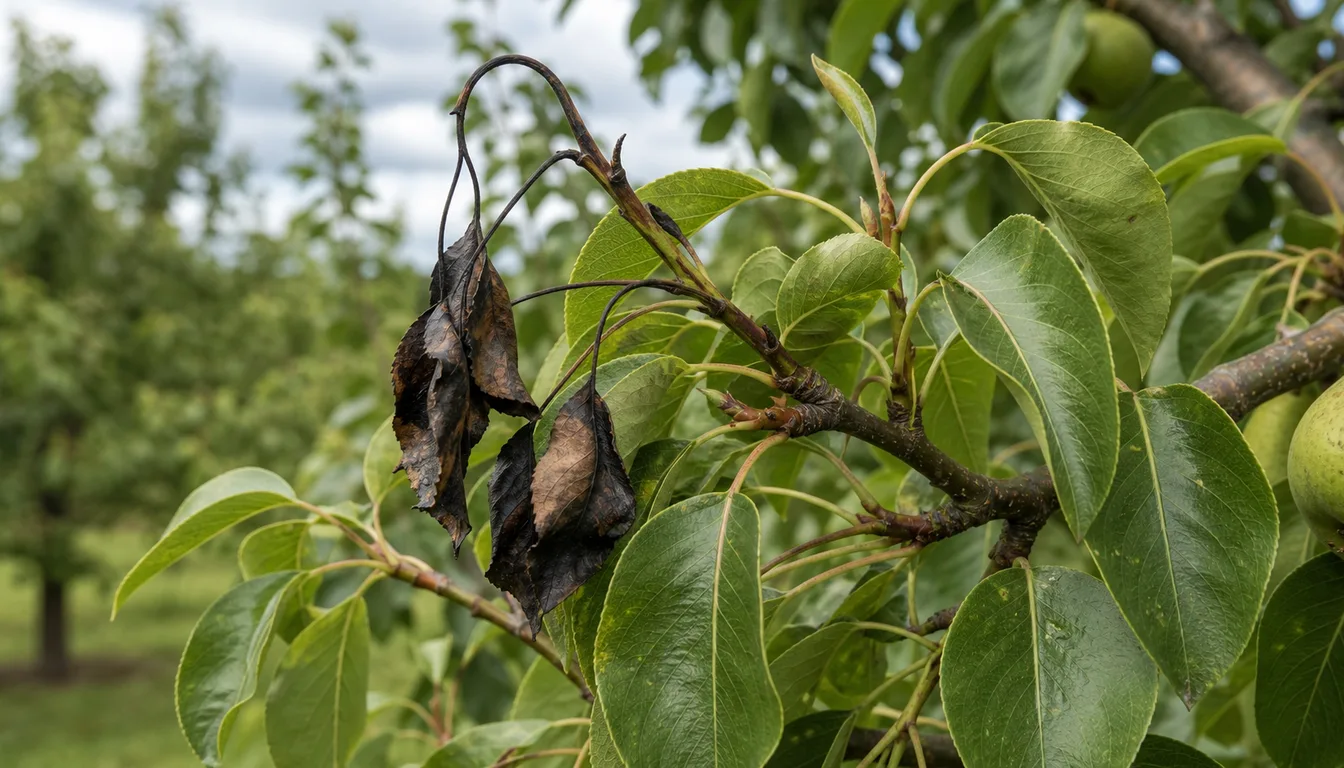
Dead leaves still firmly attached, on a shoot tip bent into a hook
Those two signs together are close to conclusive. Almost nothing else kills leaves and leaves them clinging to the branch, and the hook forms because the shoot tip is still soft when the tissue behind it dies.
Frost is the lookalike people reach for first.
Frost blackens every flower at one height on one night and then stops, while a bacterial strike keeps traveling down the spur and into the wood over the following days.
Blackening that rubs off between finger and thumb is not this.
That is sooty mold growing on insect honeydew, and the tissue underneath is still green.
If the leaves are spotted and falling rather than dead and hanging, look at leaf spot diseases instead. Blight kills tissue in a continuous run from the tip backward rather than in separate spots.
Blossoms that opened normally and then simply dropped without ever blackening are a different question again, and pear tree poor fruit set covers that one.
Open the full diagnosisWhat You Are Seeing
Fire blight is a bacterial disease, which rules out most of what sits on a garden center shelf. Fungicides do nothing to it, and there is no spray that clears an infection already inside the wood.
What makes it urgent is speed. In warm humid weather above roughly 65F a strike can travel several inches a day down a shoot, so a Pear Tree that looked fine on Sunday can have a blackened limb by the weekend.
The part that catches people out is invisible. Bacteria are already established in clear, healthy-looking wood well beyond the point where the tissue has darkened, which is why a tidy cut at the edge of the black leaves the infection in the tree.
Before you cut anything, note when it started and what the weather was doing. Damage that appeared during bloom in warm wet weather, after a hailstorm, or on soft summer growth all point to different entry routes and slightly different responses.
Common Causes
01 High likelihood
Infection that started in the blossoms
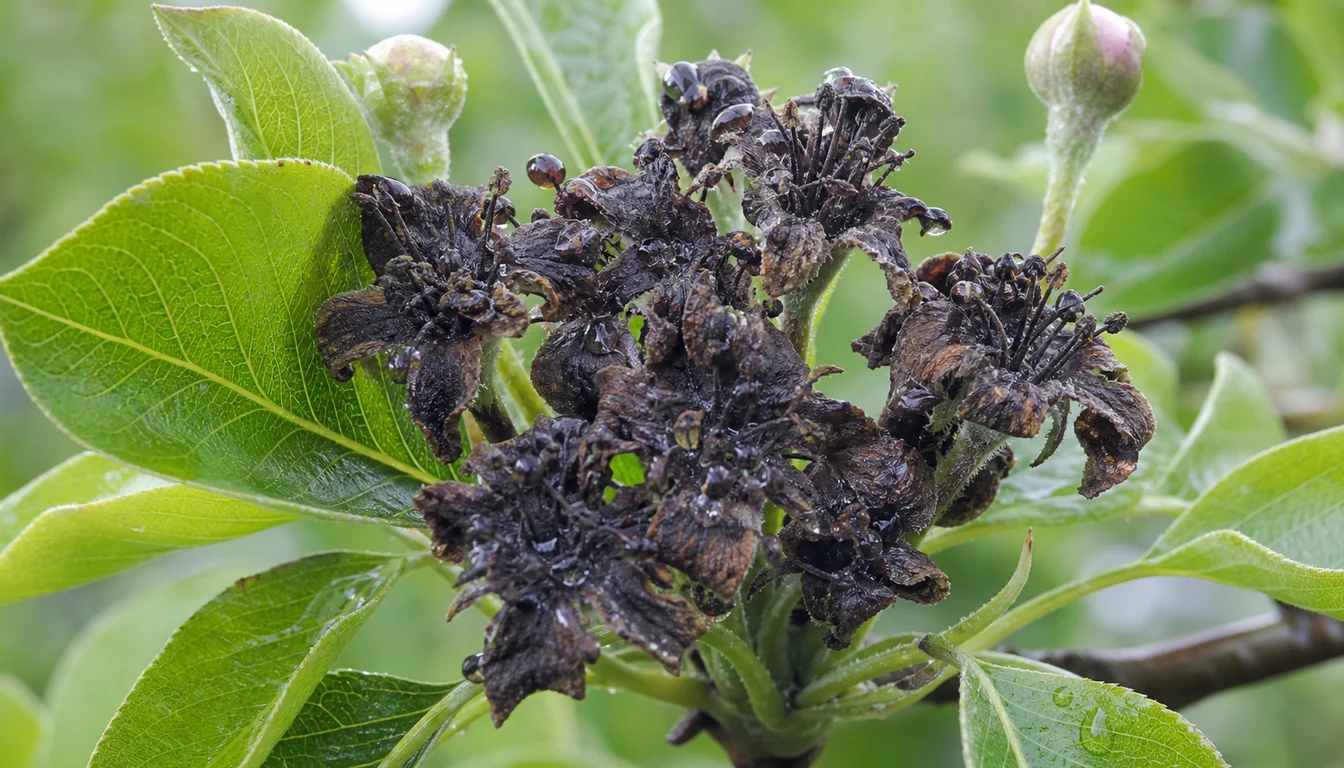
Most home orchard outbreaks begin on an open flower. Bacteria build up on the surfaces inside the bloom during warm humid weather, then move through the flower into the spur and onward into the wood behind it.
Catching it at this stage is worth a great deal. A spur strike removed in the first days is a small cut, and the same infection two weeks later is a scaffold limb.
How to identify it
- The blackening appeared during or just after bloom, in warm wet weather rather than cold.
- A whole flower cluster collapsed together while the spur leaves around it stayed green at first.
- Affected clusters are scattered through the tree rather than confined to one height or one side.
- The darkening has continued to advance down the spur since you first noticed it.
What to do
- Cut the affected spur out well below the darkening, following the cutting method in the section below.
- Work through the tree in one pass rather than returning day after day, since each entry spreads bacteria.
- Remove and burn or bin the prunings rather than leaving them in the orchard or composting them.
- Watch bloom weather next spring, because warm humid days with open flowers are the risk window.
- Avoid overhead watering and anything else that wets open blossom.
02 High likelihood
Strikes running into soft new shoots
Tender shoots carry the infection faster than any other tissue on the tree. Water sprouts and vigorous tips are the worst, which is why the strikes often show up on the growth a gardener was most pleased with.
The shoot bends into its hook while the tip is still soft, and then the whole thing blackens and stays where it is. That hook is the sign most people arrive already having seen.
How to identify it
- Shoot tips have wilted and curled downward into a hook shape.
- The blackening runs continuously from the tip backward rather than appearing in separate patches.
- Dead leaves stay firmly attached and do not pull off easily.
- New strikes keep appearing on the same limb after you have already cut some out.
What to do
- Trace each strike back to where the wood is a year or more old before deciding where to cut.
- Check the same limb again a week later, because new strikes there mean the previous cut was too short.
- Leave nothing partly cut, since a stub with infection in it feeds the next round.
- Stop any feeding that is pushing soft growth while the outbreak is active.
03 High likelihood
Cankers carrying it through the winter
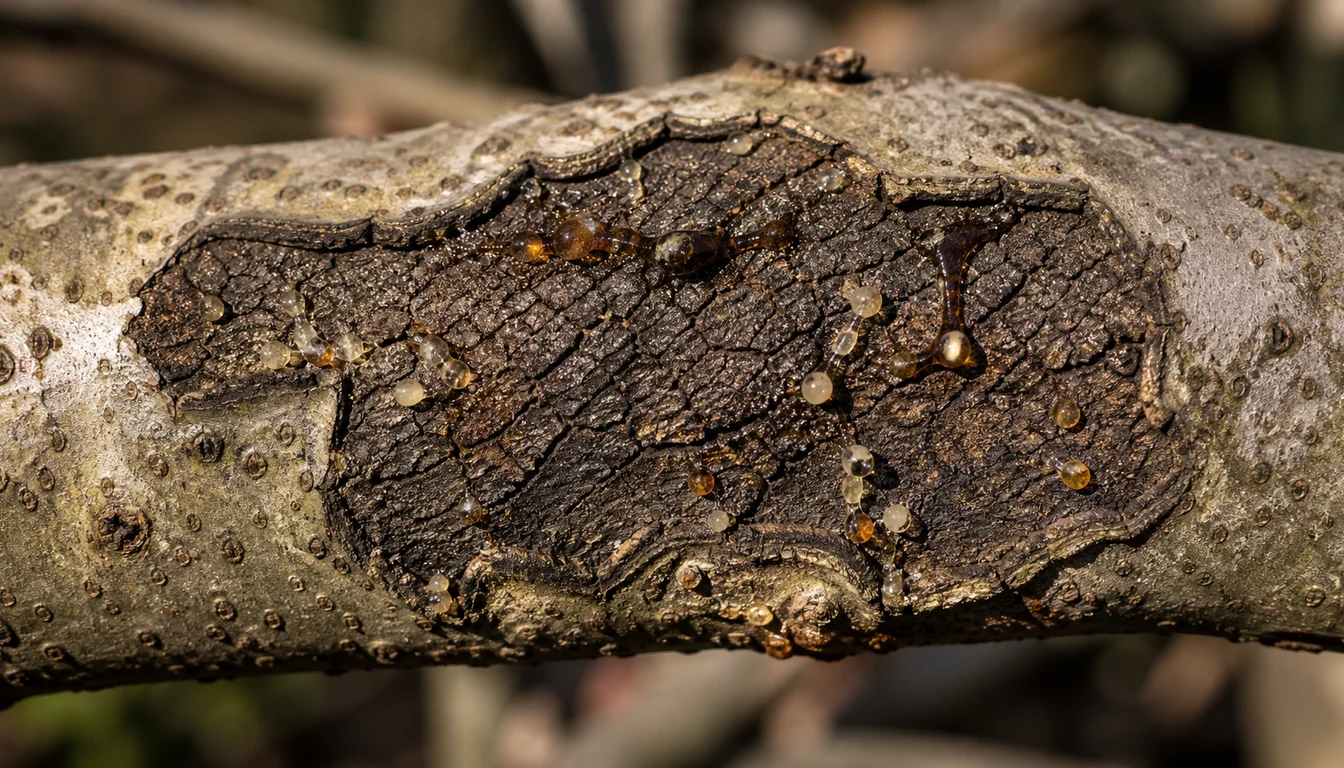
The bacteria do not survive the winter in the soil or on fallen leaves. They survive at the edge of cankers on the tree itself, in the living tissue just outside the dead sunken area.
That is why an orchard fights the same outbreak year after year. Cutting the visible strikes each summer while leaving the canker in place removes the symptom and keeps the source.
How to identify it
- Bark shows a sunken, cracked, or discolored patch with a distinct edge against healthy bark.
- Amber to milky droplets appear on that patch during warm humid weather.
- Several strikes radiate from the same limb rather than being scattered across the tree.
- The same section of the tree flares up again after every winter.
What to do
- Hunt for cankers in the dormant season, when they are visible and the infection is barely moving.
- Cut small cankered twigs and limbs well below the discolored margin, in dry weather.
- Mark any canker on a scaffold limb or the trunk rather than cutting into it immediately.
- Get local advice before making a large structural cut, since removing a scaffold may cost more than the canker.
- Keep prunings out of the compost heap and away from other trees.
04 Medium likelihood
Storm, hail, and pruning wounds
Bloom is not the only way in. Any fresh wound during warm wet weather gives the bacteria a route, which is why a hailstorm in June is followed by strikes that have nothing to do with flowers.
Pruning belongs on the same list. Cutting a tree during wet weather while an outbreak is active moves bacteria on the blade from one limb to the next.
How to identify it
- Strikes are scattered across the canopy rather than concentrated at flowering spurs.
- They appeared one to two weeks after hail, a storm, or heavy pruning.
- Damaged bark, torn shoots, or old cut surfaces sit at the start of each affected shoot.
- The outbreak began well after bloom had finished.
What to do
- Prune only in dry weather, and preferably when the tree is dormant.
- Expect trouble after summer hail and check the tree closely for a fortnight afterwards.
- Avoid large wounds during the growing season on a tree with any blight history.
- Use clean cuts rather than tearing, since a ragged wound stays open longer.
05 Medium likelihood
Blight that has reached the rootstock
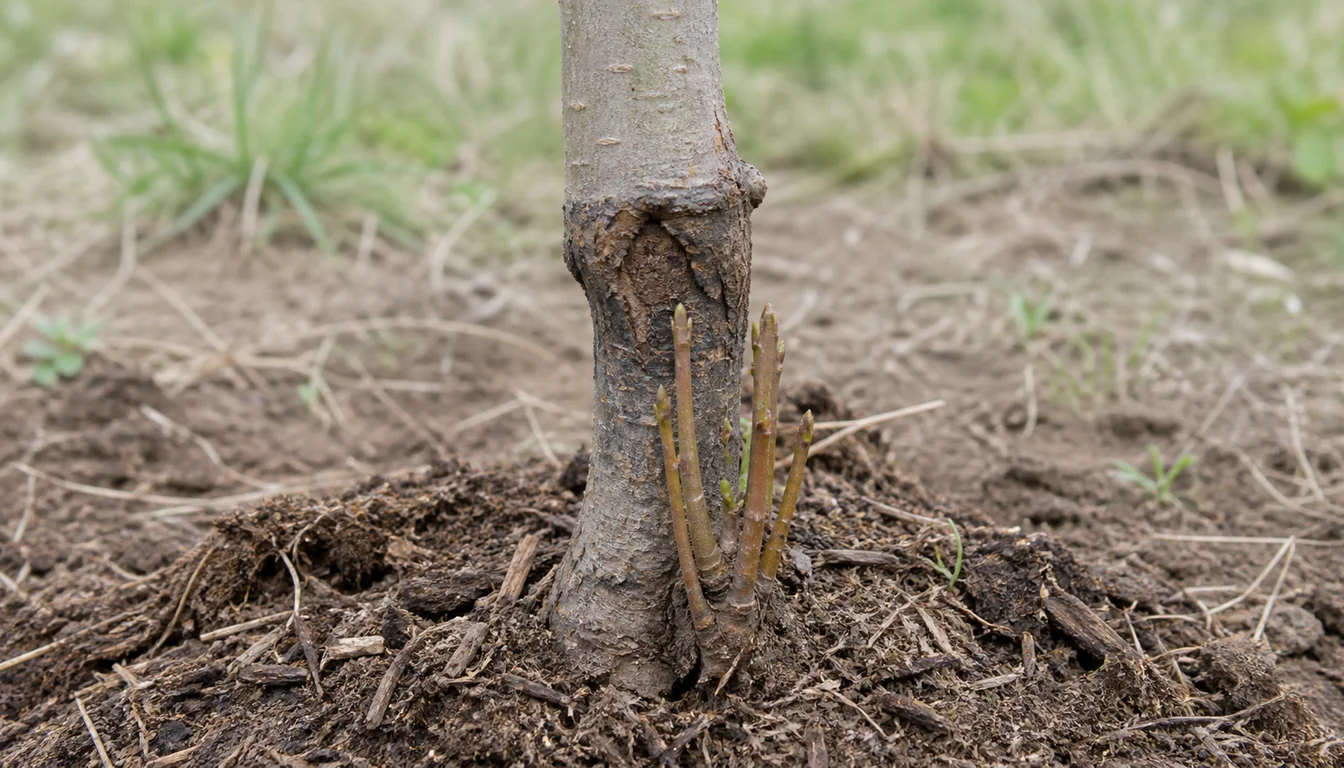
The infection can travel all the way down the trunk and settle at the graft union. Some dwarfing rootstocks are considerably more susceptible than the variety grafted onto them, so the tree can be lost from below while the canopy still looks worth saving.
Check the base before you spend a morning in the canopy. Once the union is girdled, nothing you cut above it changes the outcome.
How to identify it
- There is a dark sunken area at or just below the graft union on the trunk.
- Vigorous suckers are pushing from the rootstock while the top of the tree declines.
- The whole canopy is thinning rather than losing scattered individual shoots.
- The tree is on a dwarfing rootstock, which several susceptible types are.
What to do
- Scrape a little bark at the union with a knife to see whether the tissue underneath is brown rather than green.
- Stop investing work in the canopy if the discolored area runs right around the trunk.
- Remove and replace a girdled tree rather than waiting out another season.
- Choose a resistant variety on a resistant rootstock when you replant, which is the single most effective decision available.
06 Medium likelihood
Soft growth from heavy feeding or a hard prune
Succulent tissue is far more susceptible than hardened wood, so anything that pushes a flush of soft growth raises the risk for the whole season. A generous winter prune is answered with exactly that flush the following spring.
Feeding counts even when it was not aimed at the tree. Lawn fertilizer spread within the root zone reaches the pear just as effectively as anything applied to the trunk.
How to identify it
- The tree carries a lot of long soft water sprouts, especially near old pruning cuts.
- It was pruned hard the previous dormant season, or fed generously in spring.
- The strikes are concentrated on that vigorous growth rather than on older wood.
- There is lawn within the root zone that gets a regular feeding program.
What to do
- Skip nitrogen feeding entirely on a tree with a blight history.
- Spread heavy pruning across several seasons rather than taking a lot in one winter.
- Rub out water sprouts while they are small and soft rather than cutting them later.
- Keep lawn feed out of the root zone, which extends well past the branch tips.
Will the Tree Survive?
That depends entirely on which part of the tree is infected. A tree losing scattered shoot tips in the canopy usually comes through it, and one girdled at the graft union does not, which is why the check at the base comes before the work above.
A limb is the middle case. If a strike has reached a scaffold and you have to take that whole limb to get below the infection, the tree survives but its shape does not, and that is often the moment people decide to replace it.
Sprays are worth understanding rather than hunting for. Antibiotic treatments exist, they are timed to protect open blossom rather than to cure anything, they are restricted or unavailable to home gardeners in many places, and none of them touch an infection already inside the wood.
Nearby trees are a fair worry. The same bacteria move through pear, apple, quince, and several ornamental relatives, so a neighboring tree in the same family is worth checking whenever you find a strike on this one.
How to Cut It Out Without Spreading It
Cut further back than looks necessary. On young shoots that means at least 8 to 12 inches below the lowest visible blackening, and on older or larger wood it means considerably more, because the bacteria are established in tissue that still looks perfectly healthy.
Make the cut somewhere sensible on the tree rather than mid-shoot. Take the whole shoot back to a junction with older wood so you are not leaving a stub, and accept losing more growth than the damage alone would suggest.
- Wait for dry weather, and work in the dormant season instead if the strikes are not actively advancing.
- Walk the whole tree first and mark every strike, so you cut in one pass rather than entering repeatedly.
- Trace each strike back until you reach wood at least a year old, then measure your 8 to 12 inches from the lowest blackening beyond that.
- Cut at a junction with older wood rather than partway along a shoot, leaving no stub behind.
- Disinfect the blade between cuts when you are working through tissue that is actively oozing, using rubbing alcohol or a household disinfectant.
- Carry the prunings straight out and burn or bin them, keeping them off the compost heap and away from other trees.
Then check the same limbs again about a week later. Fresh blackening below where you cut means the infection was already past your cut, and the next one has to go further back still.
Recovery Plan
One pass, in dry weather
Check the graft union first, then walk the tree and mark every strike before cutting anything. Do the whole job in one dry session rather than returning to the tree each evening.
Stop any feeding immediately. Nitrogen while an outbreak is running produces exactly the soft tissue the bacteria move through fastest.
Watch for what you missed
Check the cut limbs weekly through warm humid weather. Fresh blackening below a previous cut means the infection had already traveled past it, and that limb needs taking back further.
New strikes elsewhere on the tree usually mean a canker is still feeding the outbreak from somewhere you have not found yet.
Find the source
This is the important part and the one most people skip. With the leaves gone and the infection barely moving, walk the tree slowly and look for sunken cracked bark on every limb.
Remove what you can reach safely, mark anything on a scaffold or the trunk, and take advice on those before making a large cut.
The bloom window
Warm humid days while the flowers are open are the risk period, so watch the tree through bloom and for a fortnight afterwards.
A spur strike caught in its first days is a small cut. The same infection found in July is a limb.
The choice that matters most is made at the garden center rather than in the orchard.
Resistant pear varieties on resistant rootstocks exist, they are widely sold, and they remove most of this risk before a tree is even planted.
On a tree you already have, the cycle breaks in winter.
Find and remove the cankers, keep nitrogen off it, spread pruning across seasons rather than taking a lot at once, and prune only when the wood is dry.
Sources
- Pear, fire blight, Hortsense, Washington State University
- Fire blight, Erwinia amylovora, Utah State University Extension
- Apple, pear and related trees disorder, fire blight, Wisconsin Horticulture
- Growing pears in the home garden, University of Minnesota Extension
- Fire blight, Royal Horticultural Society