
Why a Norfolk Island Pine Gets Leggy and What Can Still Fill Out
A leggy Norfolk Island Pine shows a changed growth pattern through wider new branch tiers, sparse side growth, or a leader that leans toward one light source.
Better light can make future growth more compact, but pruning cannot pull old tiers closer together or replace a branch that is gone.
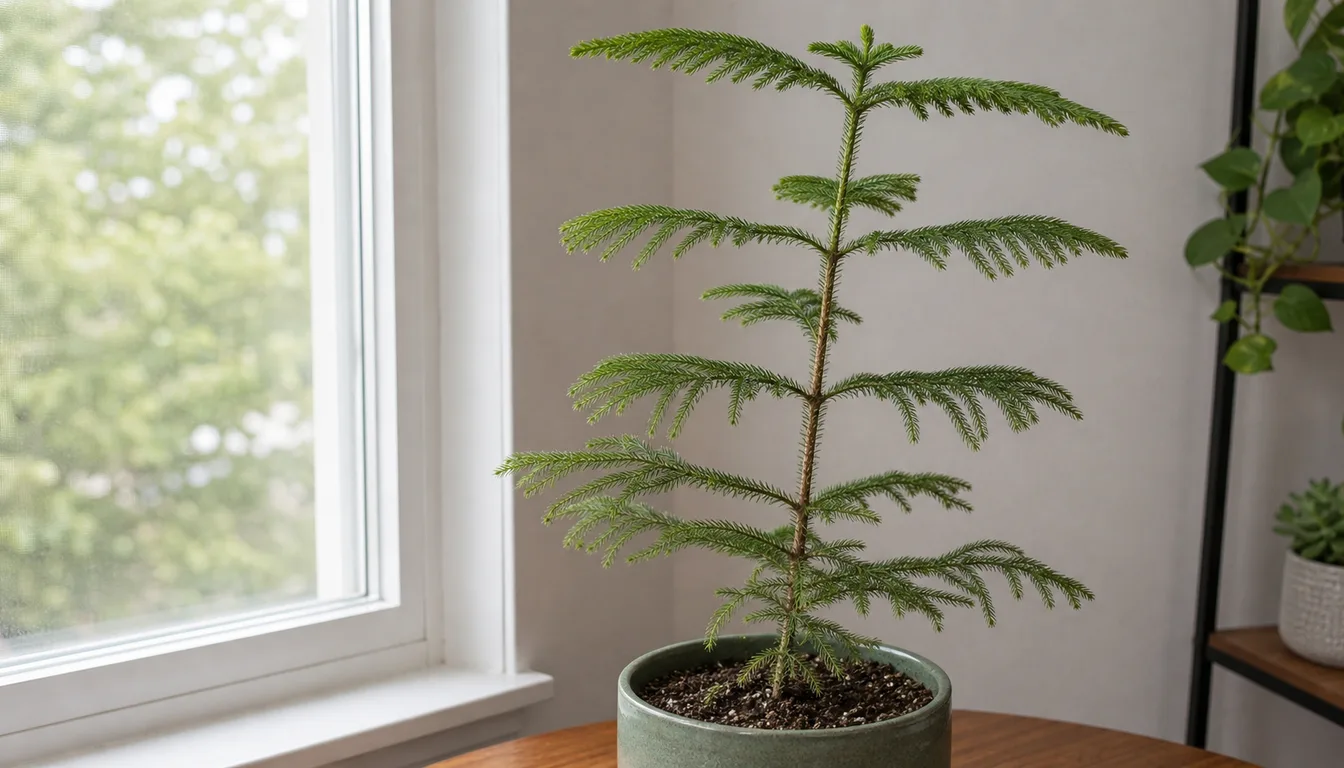
Quick diagnosis
The newest growth is stretching for more usable light
Compare the newest trunk gaps with the older gaps below them, then inspect whether long green branch tips droop while their bases stay horizontal. Either pattern can point to weak light, so keep the central leader intact while you improve the plant's position.
Open the full diagnosisWhat You Are Seeing
A Norfolk Island Pine naturally grows in horizontal whorls around one upright trunk, so some open space between tiers is part of its normal architecture. The useful question is whether the newest spaces are longer than the older ones on the same tree.
Green stretched growth and brown tissue are separate reader problems. If the branch spacing still looks normal but needle ends are turning dry and brown, use the Norfolk Island Pine brown-tip diagnosis instead.
Old stretched sections will remain visible. Your repair succeeds when the central leader stays straight and the next branch tier forms with denser branchlets and a shorter interval above the last one.
Common Causes
01 High likelihood indoors
The canopy receives too little usable light
A Norfolk Island Pine can remain alive in a dim room long after its shape begins to change. Some trees make longer gaps between whorls, while others slow at the top as side branches lengthen and their green tips begin to droop.
This cause fits best when the change is strongest in recent growth.
Older lower tiers may still look compact because they formed at a nursery or in a brighter former position, while the upper canopy records the darker months in your home.
Judge the canopy rather than the brightness of the room to your eyes. A position across the room from a window can feel pleasant to a person while providing much less light to a tree than the area close to the glass.
How to identify it
- The newest gaps on the central trunk are longer than the older gaps below them.
- Upper branchlets are smaller, paler, or more widely spaced while the needles remain mostly green.
- Long side branches stay green but bend downward mainly at their outer tips.
- A newly formed node carries fewer branches than the older five- or six-branch whorls below it.
- The plant sits far from a window, behind a heavy curtain, or where another plant blocks the light.
- Growth became looser after the tree moved indoors or after seasonal indoor conditions changed.
- There is no broad browning, soft root tissue, sticky residue, or fine webbing to explain the weak appearance.
What to do
- Move the plant gradually toward the brightest suitable window and keep harsh afternoon sun filtered if the foliage is not accustomed to it.
- Clear objects that shade the lower and middle branch tiers rather than exposing only the top.
- Add a full-spectrum grow light above the leader when the window cannot support compact new growth.
- Follow the lamp maker's distance guidance and check that the upper needles do not bleach or feel warm.
- Do not add extra fertilizer as a substitute for light because feeding does not shorten growth that is already stretched.
02 High likelihood when the tree leans
One-sided window light is pulling the leader off center
A tree can receive enough light to keep growing yet receive almost all of it from one direction. The leader bends toward the window, the window-facing branches stay fuller, and the room-facing side becomes sparse.
Look from directly above the pot and then from the side. A clean lean toward the brightest opening supports this diagnosis more strongly than an old bend near the base, which may have formed before you owned the plant.
Rotation can distribute exposure, but it works best as prevention or a gradual correction. Repeatedly turning a severely leaning tree by half a turn makes the leader change direction again rather than giving it a steady path upward.
How to identify it
- The central leader and newest branch tips point toward the same window.
- Branches facing the glass are denser than branches facing the room or wall.
- The pot has stayed in one orientation for many weeks or months.
- A wall, piece of furniture, curtain, or neighboring plant crowds the thinner side.
- The needles are still flexible and green rather than crisp at the ends.
What to do
- Move the pot into open space where light can reach more than the top and one outer face.
- Turn the pot a small amount each week so the leader does not have to reverse a sharp bend.
- Center a supplemental lamp over the top when window light remains strongly directional.
- Keep the plant in one improved location long enough to judge a new tier instead of moving it every few days.
- Use a loose support only when the trunk cannot remain upright, and remove it once the stem can hold itself.
03 Medium likelihood in holiday pots
Several seedlings are competing inside one nursery pot
Many small retail pots contain more than one Norfolk Island Pine seedling.
The cluster looks full at first, but each trunk has its own leader and its own branch tiers. As the plants grow, inner branches receive less light and the separate trees can lean away from one another.
Count trunks where they enter the mix instead of counting green tops.
Two or more stems emerging from separate points indicate a group planting, while several leaders arising from one damaged trunk indicate a different structural problem.
Crowding does not automatically require immediate separation. Disturbing a weak plant's roots while it is adjusting to better light adds a second stress, and a mature root mass may be difficult to divide without sacrificing fine roots.
How to identify it
- Two or more distinct trunks enter the potting mix at separate points.
- Each trunk carries its own tier pattern and narrow upright leader.
- Inner branches are sparse where the seedlings shade one another.
- The cluster spreads outward even though each stem bends toward the available light.
- The pot appeared dense when purchased but developed empty spaces as the individual trees gained height.
What to do
- Improve light and stabilize watering before deciding whether the group needs to be divided.
- Keep all leaders unobstructed and rotate the entire pot gradually.
- Wait for active growth before separating seedlings that have healthy roots and enough room for individual pots.
- Accept a grouped form when the roots are tightly interwoven and division would cause extensive damage.
- Do not cut the shorter leaders merely to make one trunk look dominant because those stems are separate trees.
04 Lower unless the pot gives evidence
Root stress is weakening growth while feeding hides the real limit
Light remains the first check for a green leggy tree, but damaged roots can make new branchlets weak and sparse. Persistently wet mix limits air around the roots, while a compacted or badly root-bound mass may accept water unevenly.
The pot must support this diagnosis. A sour smell, soft dark roots, water that lingers for many days, or a root ball that sheds water down the sides matters more than stretch alone.
Fertilizer can deepen the confusion. A plant in weak light uses water and nutrients slowly, so frequent feeding may leave soluble salts in the mix without giving the canopy the energy it needs to form compact growth.
How to identify it
- The mix remains wet for an unusually long time or water bypasses a shrunken root ball.
- Roots at the drainage holes are black and soft, or the pot contains a dense circling mass with little usable mix.
- New branchlets are weak along with yellowing, wilt, needle loss, or brown root-related damage.
- A pale crust has formed on the mix or pot after repeated fertilizer applications.
- The plant was fed during a dark season even though it produced little healthy growth.
What to do
- Check moisture below the surface and inspect visible roots before changing the pot.
- Let excess water drain fully and never leave the inner pot standing in collected runoff.
- Repot the houseplant in a well-drained mix only when root condition or severe crowding gives a reason to disturb it.
- Pause fertilizer until the tree has sound roots, brighter placement, and visible active growth.
- Resume light indoor-plant feeding during active growth rather than trying to force rapid replacement of old gaps.
Future tiers can improve even though old gaps stay open
A stretched section of trunk is permanent. Better conditions change the branch tiers that form afterward, so the upper plant can become more compact while the old open interval remains below it.
Lower branches that are still green may hold their foliage and support the shape for years. A branch that has been removed or has died completely should not be expected to reappear from the bare trunk.
Do not judge success by height or by a quick flush of soft growth. Look for a firm upright leader, a shorter new interval, and a fuller fan of green branchlets at the next whorl.
A mature leggy specimen may never regain the balanced silhouette of a compact young tree. Keeping the leader and living tiers intact usually preserves more of its natural form than cutting it back.
Read the spacing on the trunk before calling it leggy
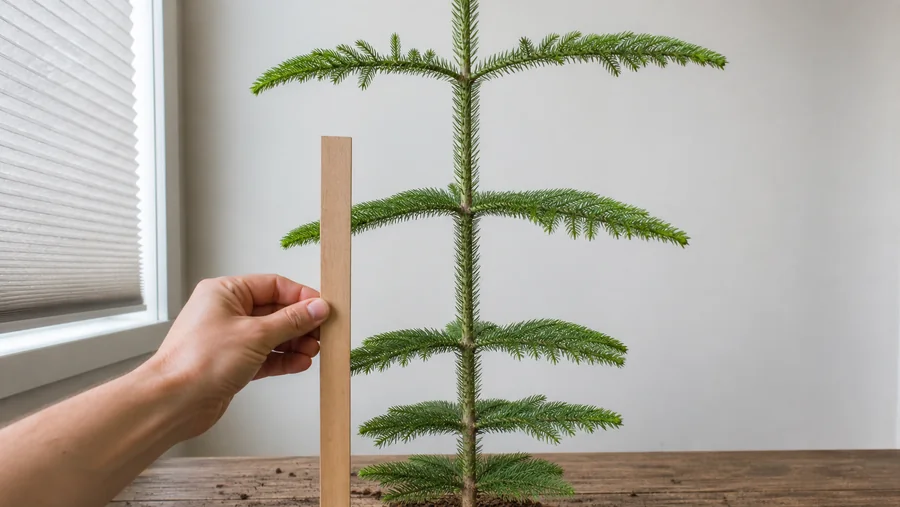
Start at the pot and follow the central trunk upward. A healthy Norfolk Island Pine has visible spaces between horizontal whorls, often with several branches radiating from each level.
Find the point where spacing changes. When the lower half has compact green tiers but the last two or three intervals suddenly lengthen, the trunk is preserving a timeline of reduced light.
Next compare the branchlets on those tiers.
True light-related stretch usually combines a longer trunk interval with smaller fans of foliage, a paler green, or a lean toward the brightest side.
Count the branches that leave a newly formed node. A well-lit Norfolk Island Pine commonly develops five or six around a whorl, so fewer branches on recent nodes support the light diagnosis when older nodes are fuller.
One wide gap by itself can be normal, especially when the tiers above and below remain balanced and the newest leader is sturdy. Record the current top gap with a ruler or a dated photo, then compare it with the interval that forms next.
Old internodes cannot shorten and a bare trunk does not produce a replacement whorl on demand. This makes new spacing the honest recovery signal.
Needle tips that turn brown while the spacing stays unchanged belong to the brown-tip problem. A whole branch that dies also needs moisture, root, temperature, and pest checks rather than a simple legginess fix.
Long green branch tips can be leggy without a stretched trunk
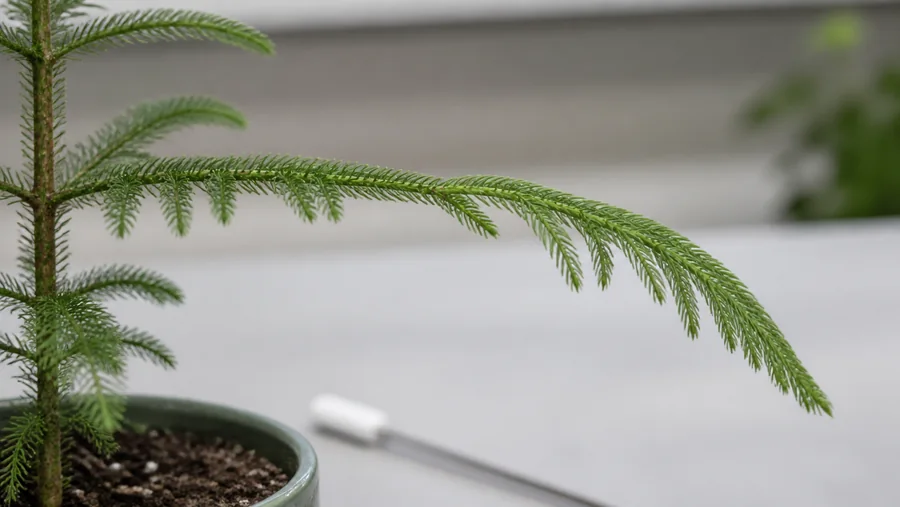
A low-light tree does not always stretch upward. The central leader may slow while side branches keep extending, leaving a broad sparse plant with long soft tips that hang below their original horizontal line.
Follow one branch from the trunk outward. Low-light droop is most convincing when the inner section remains firm and horizontal but the long green outer portion curves down.
Moisture stress usually changes more of the branch.
A dry root ball can make whole lower tiers sag from near their attachment points, then turn brown and fall if the shortage continues.
Keep this pattern separate from dead or diseased tissue. Flexible green needles without black spots, residue, webbing, or a sharp brown boundary support a form problem rather than a damaged branch.
Correct the light and leave the living branch attached. The old tip may remain low, but the useful response is firmer, denser growth near its end and better-supported branchlets on the next whorl.
Build a light zone around the whole canopy
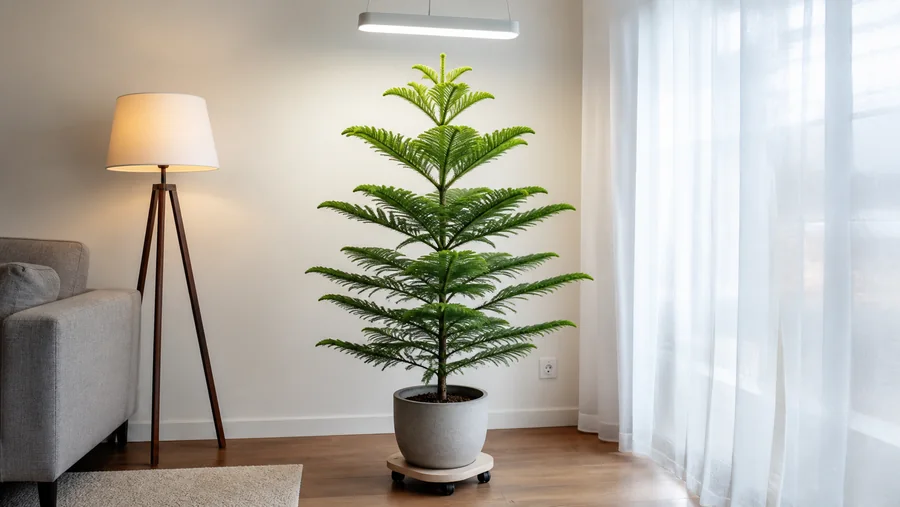
Choose the position from the tree's point of view. The central leader, middle tiers, and lower side branches all need an open path to bright light, not just a bright patch on the ceiling or wall.
Move a plant that has lived in shade closer to the window in stages. Filter strong afternoon sun at first and watch for pale bleached patches, which show that the change was too abrupt.
A small weekly turn helps distribute directional window light. Use modest turns and keep the plant in the same useful location so the leader can make a gradual correction instead of bending back and forth.
When the best window still produces long new intervals, place a full-spectrum grow light above the leader. Set its distance according to the fixture instructions because lamp output varies too much for one universal measurement.
Recheck the setup as the tree gains height.
A plant can stay beside the same bright window while its leader grows above the glass and into the darker wall area, making the newest tier the least-lit part of the canopy.
Raise a supplemental lamp with the leader and keep it centered over the top. Moving the pot onto a tall stand can help only when that change still leaves enough side light for the lower tiers.
Take one photo from the same position whenever a new whorl begins. The comparison shows whether the leader remains straight, the tip droop is easing, and the newest node is carrying a fuller set of branches.
Leave open air around the branches and keep furniture, curtains, and neighboring plants from pressing into the thinner side. A pale wall can reflect some light, but it cannot replace a useful window or lamp.
Hold watering and feeding steady while you test the new setup. If you change every input at once, you will not know whether compact new growth came from better light or whether fresh damage came from the pot.
Protect the leader instead of trying to prune the gaps away
Do not top the central leader to make the tree bushier. The natural pyramidal form depends on that upright growing point, and a cut cannot make old trunk intervals contract.
Avoid shearing branch tiers into a cone.
A branch that is removed or broken does not reliably grow back, so a cosmetic cut can turn temporary legginess into a permanent hole.
You can remove a branch that is fully dead by cutting close to its attachment without gouging the trunk. Leave every flexible green branch in place while the tree adjusts to better light.
If several trunks enter the soil, confirm that they are separate seedlings before touching them. Dividing a crowded pot may improve long-term spacing, but it should wait until the plants are stable and actively growing.
A tree approaching the ceiling has a space problem rather than a legginess problem. Restricting pot size and fertilizer can slow growth, but neither action makes the plant shorter, so plan a taller location before the leader reaches the ceiling.
An upright shoot tip can sometimes be rooted under propagation conditions, while a cutting from a horizontal side branch keeps its sideways habit and will not recreate an upright tree. Commercial sources also describe cutting propagation as impractical for most indoor growers.
That makes top propagation an exceptional salvage choice, not a routine fullness fix. Cutting the leader still permanently changes the original tree, and successful rooting of the removed tip is not guaranteed.
A stake can hold a weak trunk upright for a limited period, but it cannot correct the cause. Tie it loosely below a branch tier, check the tie often, and remove the support when the trunk can carry its own new growth.
Recovery Plan
Stabilize the light path
Move the plant gradually, clear the canopy, and begin small regular turns.
Existing gaps will look the same, so watch for bleaching, new leaning, or moisture changes while the plant adjusts.
Judge the leader and newest branchlets
The next visible extension should stay straighter, and long green branch tips should produce firmer growth. A dated photo also reveals whether a new node is carrying a fuller set of branches.
Compare the new interval with the old record
A shorter interval and fuller branch fan show that the light correction worked. Continued stretch means the canopy still needs more usable light or the roots need the evidence-based checks described above.
Keep a Norfolk Island Pine in an open bright position where light reaches the whole canopy. Turn the pot a small amount each week, keep the central leader uncut, and inspect the newest interval whenever a branch whorl forms.
Water according to the root ball rather than a calendar, and feed lightly only while the tree is making healthy active growth.
Sources
- University of Connecticut Home Garden Education Office: Norfolk Island Pine
- Texas A&M AgriLife Ornamental Production: Norfolk Island Pine
- NC State Extension Plant Toolbox: Norfolk Pine
- Royal Horticultural Society: Araucaria heterophylla
- UF IFAS Gardening Solutions: Norfolk Island Pine
- University of Missouri Extension: A Holiday Tree from the South Pacific
- University of Illinois Extension: Norfolk Island Pine
- Ask Extension: Multiple Trees in a Single Pot
- Kansas State Research and Extension: Norfolk Island Pine