
Brown Spots on Aloe Vera Start Firm or Start Soft
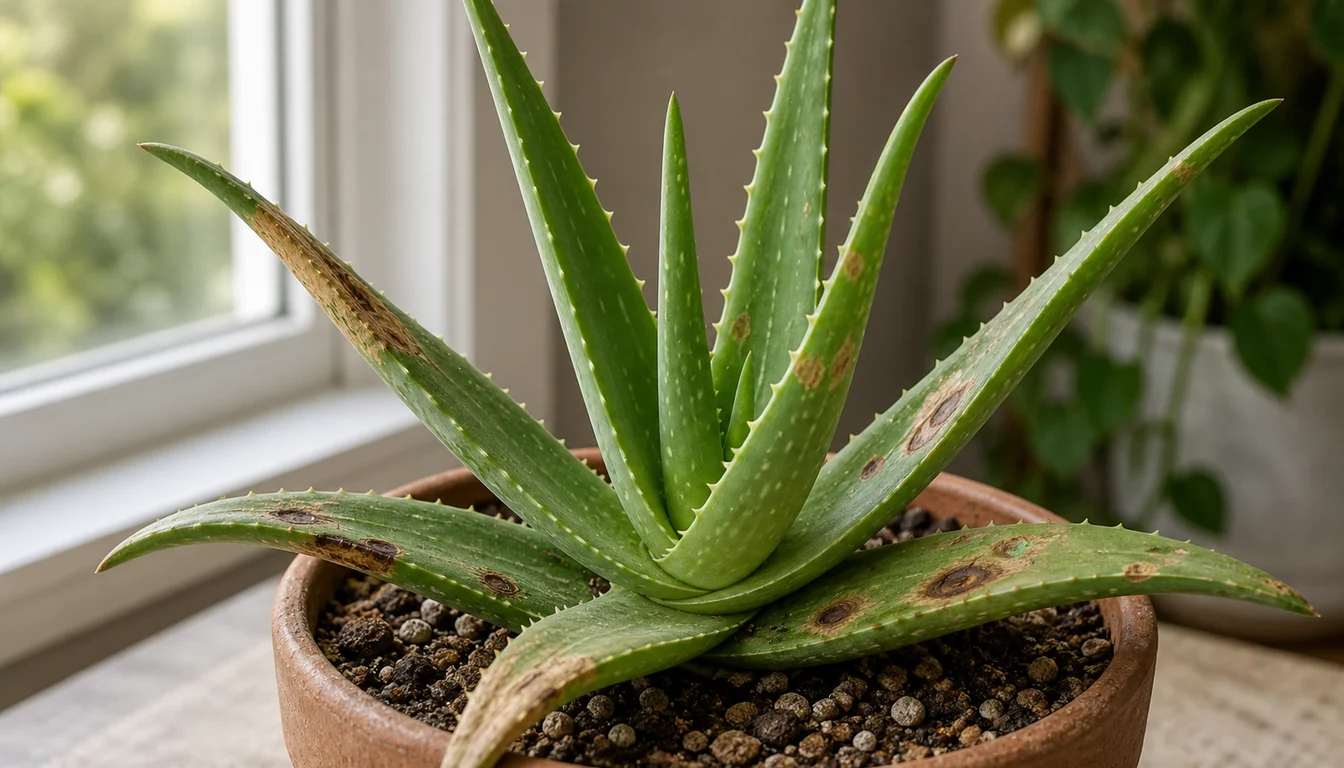
Brown spots on Aloe Vera come from opposite causes that print the same color, so the mark on its own is not enough to act on. Sunscald, rot climbing up from the leaf base, and cold winter glass account for nearly every spot on an indoor plant.
Quick diagnosis
Sunscald or rot, separated by touch
Press the brown mark with a fingertip, because firm and dry sends you to the light while soft or water-soaked sends you to the roots.
Open the full diagnosisWhat You Are Seeing
Every Aloe Vera leaf is a water tank, so a brown mark reports what happened to the gel underneath it. Skin that browned while the gel survived stays plump and hard, and tissue that lost its gel sinks into a wet-looking patch.
Where the mark sits matters as much as how it feels, because trouble arriving through the roots shows up first at the leaf base while sun, cold, and handling damage land on the exposed face and the outer half of the leaf.
Not every color change is damage. Strong light turns Aloe Vera leaves bronze, rust-red, or purple across the whole surface, and that even flush is a sun response the plant can carry for months without any tissue dying.
Common Causes
01 High likelihood
Sunscald after a sudden light move
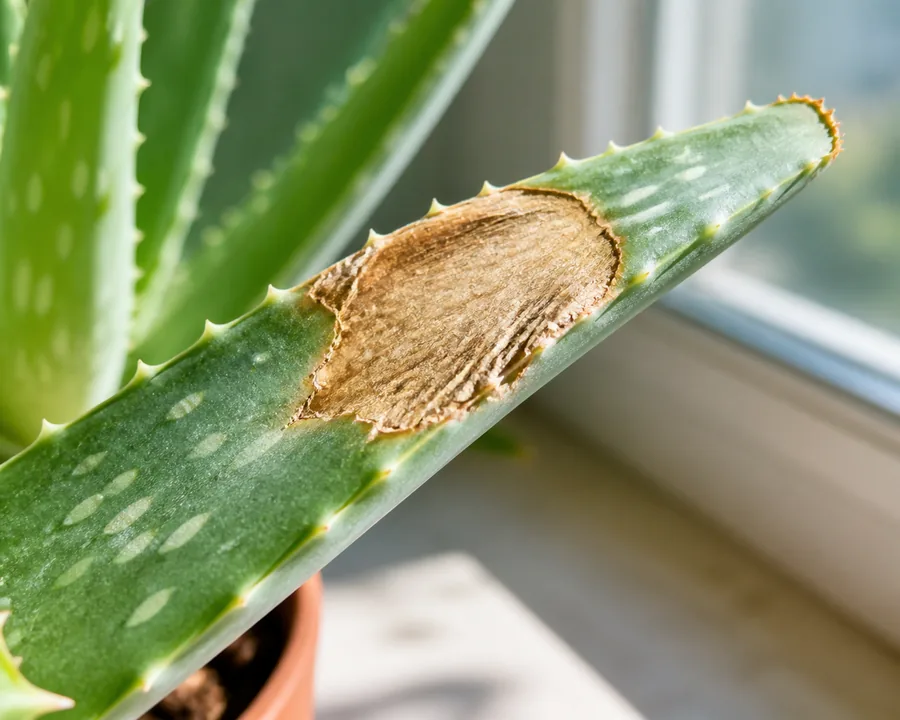
Aloe Vera builds its sun protection slowly, so a plant carried from a dim corner to a south window or set outdoors in spring can burn within a few bright afternoons.
The burned skin dies while the gel beneath it survives, which is why these patches stay hard.
How to identify it
- Patches are dry and straw-tan to red-brown, with a crisp papery skin.
- Damage sits on the side of the plant that faces the window or the open sky.
- Pressed with a fingertip, the spot feels as firm as undamaged leaf.
- The plant was moved, repotted nearer a bright window, or taken outside in the past two weeks.
What to do
- Pull the pot back from the glass or behind a sheer curtain the same day.
- Reintroduce brighter light over about two weeks, adding roughly an hour of direct sun every few days.
- Leave scorched leaves attached while they stay firm, because they still feed the rosette.
- Cut a leaf off flush at the base only once it goes limp or more than half of it has died.
- Give a plant that summers outdoors morning sun and afternoon shade rather than all-day exposure.
02 High likelihood
Rot moving up from the leaf base
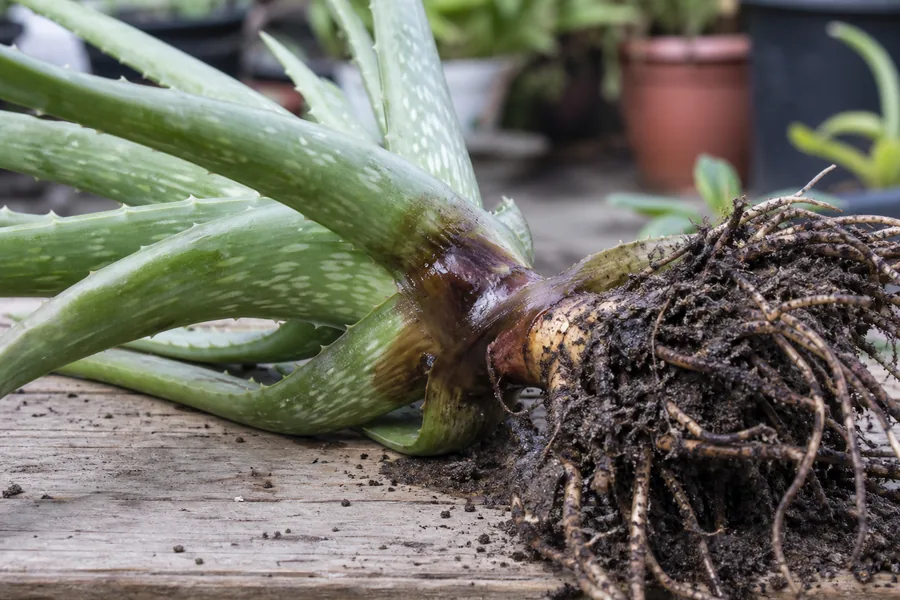
Soggy mix and a pot that drains slowly let root rot reach the crown, and from the crown the damage climbs into the leaves from below. The brown looks wet rather than dry because the gel inside the leaf has broken down.
How to identify it
- Brown is dark, translucent, and water-soaked, often with a yellow zone just above it.
- The damage starts where the leaf joins the crown, not at the tip or on the outer face.
- The leaf feels soft or squashy and may pull free with a wet snap.
- Soil is still damp more than a week after watering and the pot feels heavy for its size.
- A sour smell rises from the crown or from the drainage holes.
What to do
- Slide the plant out of its pot and look at the roots before changing anything else.
- Cut away every brown slimy root and every leaf that has gone soft at its base, wiping the blade with alcohol between cuts.
- Leave the cut surfaces open to dry air for one to two days so they callus before replanting.
- Replant into a gritty mix of roughly half potting soil and half coarse sand or pumice, in a pot with open drainage holes.
- Wait a week before the first watering, then water only once the mix is dry the whole way through.
03 Medium likelihood
Cold damage from winter glass or a draft
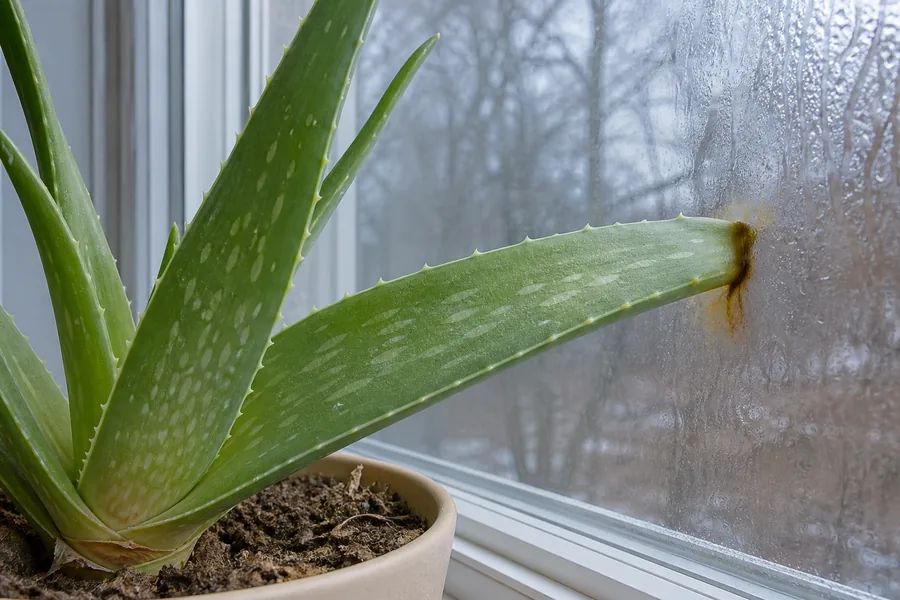
Aloe Vera tissue starts to fail below roughly 50°F, and a leaf resting against a winter window or sitting under a door draft chills well below room temperature.
The result is a mushy brown patch on a plant whose soil is bone dry, which sends most people to the watering can for the wrong reason.
How to identify it
- Damage appears on the leaf face or edge that touched the glass or met the draft.
- The patch is soft and darkened, yet the mix is dry and the roots are firm.
- Spots showed up after a cold night, a frost, or the heating cycling on and off.
- Leaves deeper inside the rosette, away from the cold surface, are untouched.
What to do
- Move the pot several inches clear of the glass and away from doors and vents.
- Keep the plant above 55°F at night through winter.
- Leave chilled leaves in place until they dry out, because cutting into cold-damaged tissue invites rot.
- Hold off watering while the plant is cold, since a chilled root ball dries very slowly.
- Bring a plant that summers outdoors back inside before the first night in the low 40s.
04 Low likelihood
Bruises, pests, and leaf disease
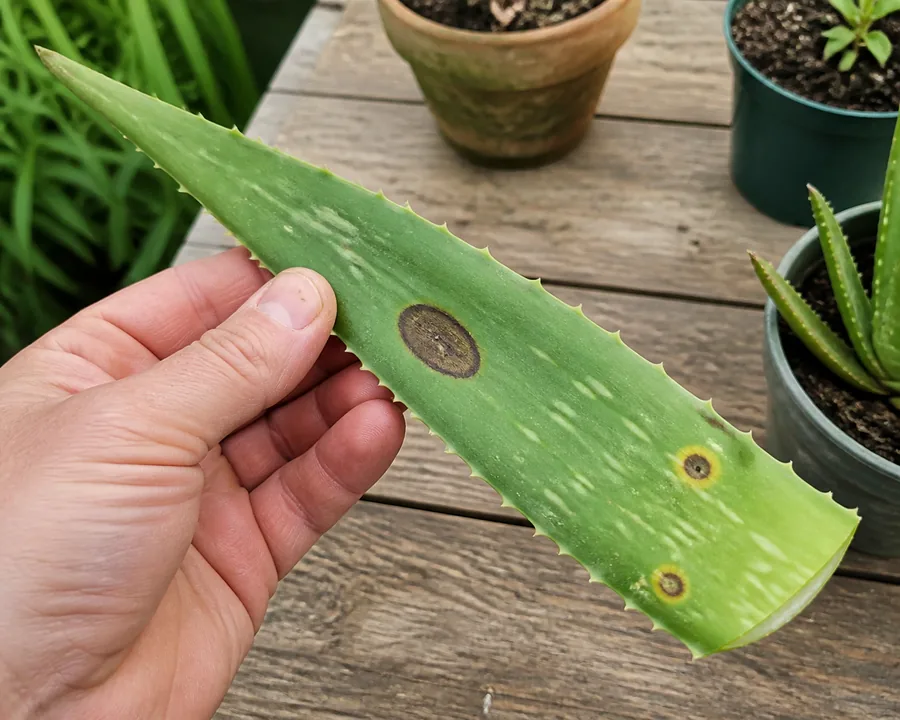
Thick gel leaves bruise like fruit, so a knock during repotting or a pet brushing past leaves a sunken brown dent that never grows. Genuine leaf disease is uncommon indoors, and the pattern worth recognizing is a rust or bacterial spot that prints dark circles ringed in yellow.
How to identify it
- A bruise is a single sunken mark with a sharp outline that stays exactly the same size.
- Disease spots are round and dark, often ringed in yellow, and more of them appear over weeks.
- Scale insects sit as small brown bumps that scrape off and leave a pale mark behind.
- Mealybugs leave white cottony patches in the leaf joints before any browning shows.
What to do
- Leave a bruise alone, because sealed Aloe Vera tissue does not spread the damage.
- Remove spotted leaves at the base and throw them away rather than composting them.
- Water the soil instead of the rosette and keep air moving so leaves never sit wet.
- Wipe scale and mealybugs off with an alcohol-dipped cotton bud, then check again weekly for a month.
- Keep a newly bought plant apart from the rest of the collection for two weeks.
A Spot That Grows Is a Different Problem From One That Stays
No brown mark on an Aloe Vera leaf turns green again, so every fix is aimed at keeping the next leaf clean rather than at rescuing the damaged one.
That makes the size of the spot the honest test. Trace its edge in your mind and look again a week later, because sunscald and bruises hold their shape while rot keeps eating outward.
One outer leaf is expendable and can be cut flush at the base without setting the plant back. Softness in the center of the rosette is a different situation, because the crown feeds every leaf and the plant will not come back once it collapses.
Can You Still Use Gel From a Spotted Leaf?
Most people keep Aloe Vera for the gel, so a damaged leaf raises a harvest question the other spotted houseplants never do.
A firm sunscalded leaf still gives usable gel. The burn killed the outer skin while the flesh underneath stayed sealed, so you can cut past the dry patch and rinse off the yellow latex under the skin as you would with an undamaged leaf.
A soft, water-soaked leaf is waste.
Once rot reaches the flesh the gel goes cloudy or stringy, and rinsing does not undo what is already breaking down inside.
Recovery Plan
The spot stops growing
Once the cause is removed, the existing mark should hold its outline within a few days. A patch still widening after a week means the roots are still wet or the plant is still too cold.
New leaves in the center
Small clean leaves pushing up from the center of the rosette, rather than any change in the damaged leaf, are the first honest sign that the cause is gone.
Scarred leaves move outward
As new growth stacks up, marked leaves are pushed to the outside of the rosette, where they dry off and can be taken away. A plant cut back for rot needs the long end of that window, because it is rebuilding roots first.
Two habits prevent almost every brown spot on an indoor Aloe Vera. Introduce stronger light in stages across about two weeks, and keep the pot clear of cold glass from late autumn onward.
A gritty mix in a pot with open holes, watered only when the soil is dry the whole way through, stops the roots from sending trouble up into the leaves.