
Where Do Lawn Grubs Come From? The Beetle Cycle Behind Them
Lawn grubs come from eggs that adult scarab beetles lay in the soil under turf. Rutgers Cooperative Extension describes the adults emerging between June and August, mating, and the females going back into the soil to lay 20 to 60 eggs in several batches over 2 to 4 weeks, typically 1 to 4 inches deep. The grubs that hatch feed on grass roots through late summer and fall.
That cycle explains most of what a homeowner sees. Grubs do not crawl in from far away. They are the offspring of beetles that flew in and chose that patch of grass, so the questions that matter are which beetle it was, when it laid eggs, and why it picked this lawn.
At a glance
What Are Lawn Grubs, Exactly?
White grubs are the larvae of scarab beetles. UC Statewide IPM describes a whitish to yellow, wrinkled, C-shaped grub with six legs and a reddish head, and University of Maryland Extension notes that it holds the C shape at rest and straightens out when it crawls.
Several beetles produce nearly identical grubs. Rutgers lists the oriental beetle, Asiatic garden beetle, northern masked chafer, Japanese beetle, green June beetle, European chafer, and May or June beetles as the white grub species in New Jersey turf. Maryland notes that telling them apart takes a look at the raster, the pattern of bristles on the underside of the last body segment, under 10x magnification.
The species is worth knowing because it changes the answer to where the grubs came from and how long they stay. Most of these beetles complete one generation a year. Maryland reports that May and June beetles take 2 to 3 years to mature, so their grubs can sit in the same soil through more than one season. The sampling method and the raster check are laid out in how to identify lawn grubs.
How Does the Beetle Life Cycle Put Grubs in a Lawn?
For the annual species, the cycle runs on a calendar that Rutgers and Maryland describe in close agreement. The dates below are mid-Atlantic timing and shift earlier or later with local climate.
| Season | Stage | What is happening in the soil |
|---|---|---|
| June to August | Adult beetles | Adults emerge, mate, and females lay eggs in batches over 2 to 4 weeks, 1 to 4 inches deep |
| Mid to late summer | Eggs and young grubs | Eggs and the first two larval stages each last 2 to 3 weeks |
| September | Third-stage grubs | Most grubs molt to their third and largest stage and keep feeding on roots |
| October | Overwintering | Grubs move deeper as the soil cools, 6 to 18 inches down in Maryland |
| April and May | Spring feeding | Grubs return to the root zone and feed for another 4 to 6 weeks (from late May in Maryland) |
| Late spring | Pupae | Grubs pupate 2 to 8 inches deep and new beetles emerge 1 to 2 weeks later |
Two feeding periods follow from that table. Late summer and early fall is when the grubs grow from newly hatched larvae to their largest stage while eating roots. Spring brings a second, shorter round from the same grubs before they turn into beetles, which is why damage found in April usually traces back to eggs laid the previous summer.
The small grubs of August are also the ones a treatment can reach most easily. Rutgers calls spring applications against the larger grubs, from late April through May, generally the least effective and rarely justified, because the grass can outgrow most grub populations once it is growing again.
Why Do Beetles Lay More Eggs in Some Lawns?
Moisture is the clearest factor extension research documents. Rutgers reports that watering during peak beetle activity in summer tends to attract egg-laying females, especially when the soil in surrounding areas is dry, and that it increases the survival of eggs and young larvae. A lawn kept green with sprinklers through a dry July can become the most attractive egg site on the block.
The same fact sheet flips that advice for late summer and fall. Once the grubs have hatched, irrigation makes the grass more grub tolerant, because well-watered turf can keep replacing the roots being eaten. The timing of the water decides whether it helps the beetles or the lawn.
Grass type changes how much damage a given number of grubs causes, even when it does not change how many eggs arrive. Rutgers notes that good management produces turf with a deep, extensive root system that tolerates higher grub densities, that tall fescue is the most tolerant cool-season grass, and that perennial ryegrass is the least. Two neighboring lawns with similar counts can therefore look very different by September.
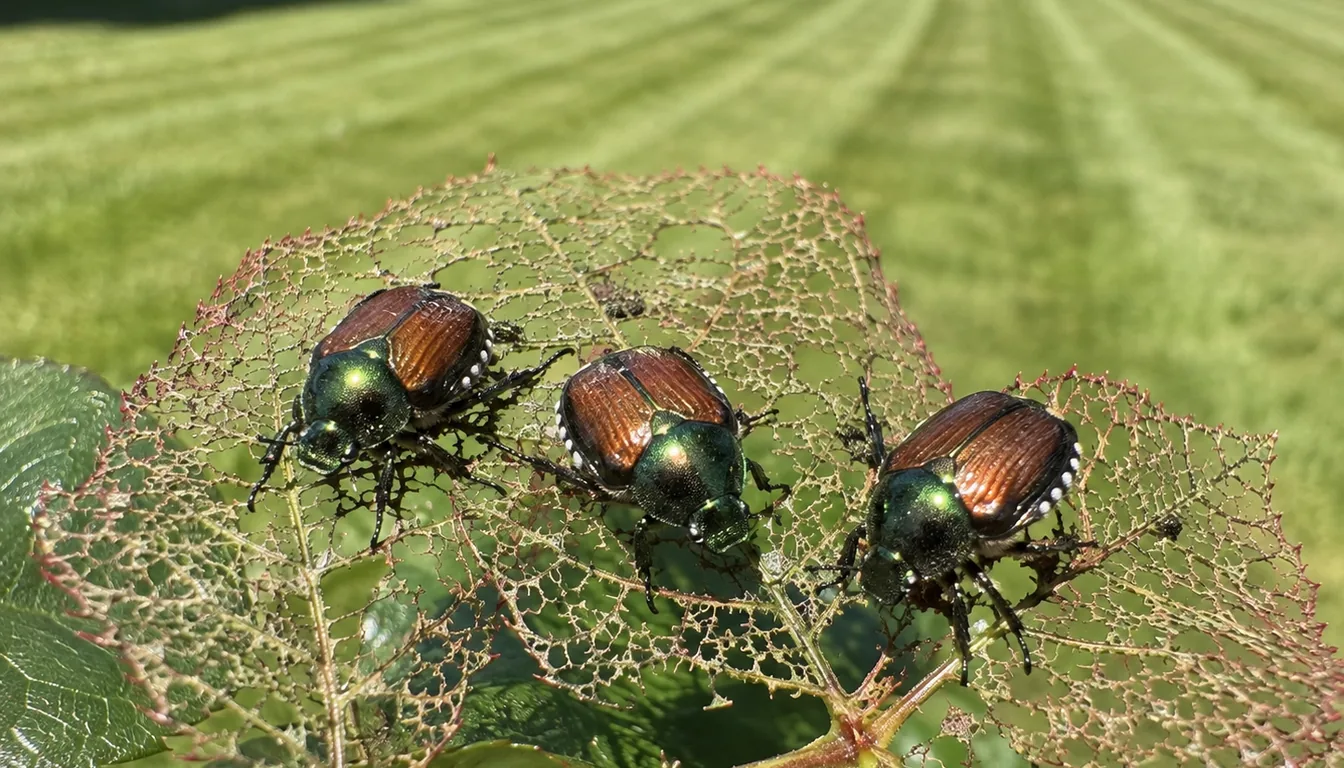
Adult beetles are visible evidence of the same cycle. Japanese beetles feeding on garden plants in July are the generation that lays eggs in nearby turf that summer. Because the adults fly, those eggs can end up in any suitable lawn within their range, not only the one under the plant they fed on.
Can Grubs Come From Garden Soil, Mulch, or a Neighbor's Yard?
Grubs appear wherever beetles laid eggs, and turf is the usual choice. Maryland Extension notes that scarab grubs can eat the roots of a variety of plants, in the ground and in containers, but that they are primarily a lawn pest. A few grubs in a vegetable bed or a pot are possible, and a heavy population in garden soil is the exception.
A larva found in compost or mulch is not automatically a lawn grub. Many soil insects are pale and soft, and only the C-shaped body, the legs behind the head, and the raster pattern confirm a scarab and its species.
Grubs themselves do not travel between properties in any meaningful way. The movement happens at the adult stage, when beetles fly in, feed, and lay eggs. A neighbor's yard matters as a source of adults, and the conditions in your own turf during the egg-laying weeks decide how many of those eggs survive.
How Can You Break the Grub Cycle in Your Yard?
The cycle has two weak points, the egg-laying weeks and the young grubs of late summer. Working with those dates is more effective than reacting to brown grass months later.
- Hold back extra summer wateringRutgers links irrigation during peak beetle activity to more egg-laying females and better egg survival, especially when nearby soil is dry, so trim extra watering only as far as the grass type tolerates.
- Water through late summer and fallOnce grubs have hatched, irrigation makes the grass more grub tolerant by keeping new roots coming.
- Count before treatingLift a one-square-foot flap of sod in several places and compare the count with the 6 to 10 grubs per square foot Rutgers gives for Japanese beetle, oriental beetle, and European chafer.
- Match any product to the stagePreventive products go on in June or July while females are laying eggs, and curative products target small grubs in late summer.
- Choose biological controls by speciesRutgers reports milky spore works only on the Japanese beetle and Heterorhabditis bacteriophora nematodes control it well but other species less.
A grub count below threshold in turf with firm roots usually means the lawn can carry them, and University of Wisconsin-Madison Extension notes that a strong, robust lawn tolerates some grubs without issue. When counts are high, the label of a product registered for grubs in home lawns sets the rate, timing, and watering-in, which Wisconsin puts at about half an inch of water. Household remedies do not substitute for that step, and dish soap does not reach or kill grubs in the root zone.
Pro Tips
- Note when adult beetles appear on garden plants, because their egg-laying weeks follow in nearby turf.
- Avoid heavy watering of an otherwise dry lawn during the summer beetle flight if the yard has a history of grubs.
- Keep turf watered from late summer into fall so the grass can replace roots the young grubs eat.
- Count grubs under several lifted squares of sod in August or September before deciding on any treatment.
- Have a grub identified before buying milky spore, since it works only on Japanese beetle grubs.
Frequently Asked Questions
Do grubs come from my compost or mulch pile?
Lawn grubs come from beetles laying eggs in turf soil. Other pale larvae can live in compost or mulch, and a C-shaped body with legs behind the head and a raster check under magnification are what confirm a scarab grub.
Can grubs travel from my neighbor's yard into mine?
The grubs themselves stay close to where they hatched. Adult beetles fly, so a neighborhood beetle population can lay eggs in several lawns in the same summer, and watered turf during that period draws more of them.
Why do I have grubs if I never saw any beetles?
Egg laying happens below the surface over a few weeks in summer, so the adults are easy to miss. Grubs in the soil are proof that beetles laid eggs there, whether or not anyone saw them.
Do grubs only live in lawns with sprinklers?
No, but Rutgers reports that summer watering during peak beetle activity attracts egg-laying females, especially when surrounding soil is dry, and improves egg survival. By the same finding, an unwatered lawn in a dry summer is the less attractive place to lay eggs.
Will replacing my lawn get rid of grubs?
Removing turf takes away their main food, since Maryland Extension describes white grubs as primarily a lawn pest. They can still feed on the roots of other plants in the ground and in containers, so a few may persist in planted beds.
Sources & References
- Rutgers NJAES Fact Sheet FS1009, An Integrated Approach to Insect Management in Turfgrass: White Grubs
- University of Maryland Extension, White Grubs in Lawn and Garden Soil
- University of Wisconsin-Madison Extension, White Grub Control in Turfgrass
- UC Statewide IPM Program, Turfgrass Pest Management Guidelines: Monitoring and Treating Insects and Mites
Related Guides
Do Marigolds Keep Squirrels Away From Your Garden?
Squirrels can strip a bed of seedlings or freshly planted bulbs in a single morning.
11 min read
Do Squash Bugs Bite People?
No. A squash bug cannot bite you. Its mouthparts are a slender stylet built to pierce plant tissue…
9 min read
Does Dawn Dish Soap Kill Grubs? Why It Fails and What Works Instead
No. Dawn and other dish detergents do not bring white grubs to the surface, and they do not kill…
9 min read
How Do You Get Rid of Spider Mites on Houseplants?
Spider mites on houseplants often can be reduced by repeatedly washing the leaf undersides.
11 min read
How Much Neem Oil Per Gallon? Read and Scale the Label Rate
There is no universal amount of neem oil per gallon. The rate belongs to the exact product and its…
11 min read
How to Control Fungus Gnats in Houseplant Soil
Fungus gnat control works best when it addresses the larvae in potting mix as well as the adults…
15 min read