
How Much Neem Oil Per Gallon? Read and Scale the Label Rate
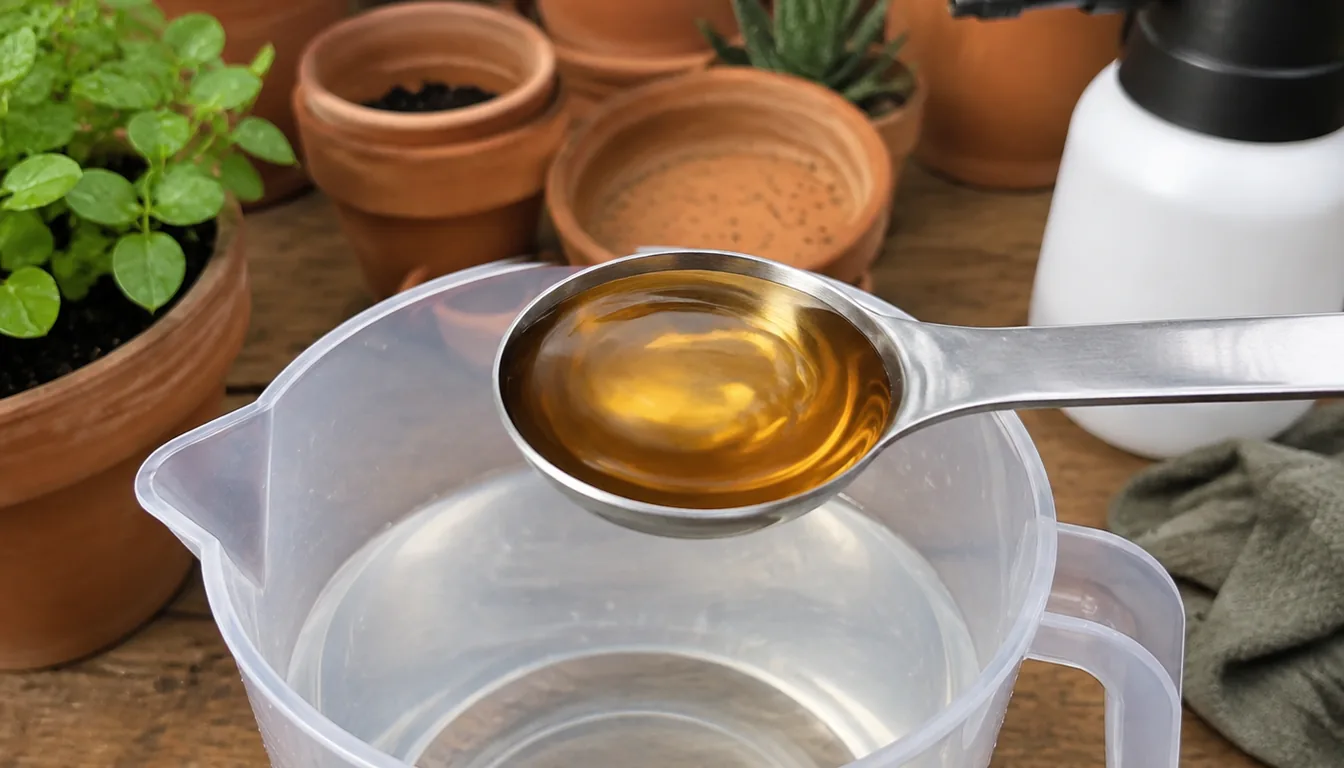
There is no universal amount of neem oil per gallon. The rate belongs to the exact product and its labeled use. A ready-to-use spray needs no dilution, while a concentrate may have different instructions for insects, mites, and diseases.
As one concrete example, the Captain Jack’s Neem Oil Concentrate label linked by Bonide lists 2–4 tablespoons per gallon of water for insect and mite use. Its general fungicide mixing instructions list 2 tablespoons per gallon, with separate rates for turf diseases. Those are instructions for that 70% clarified-neem product, not for every bottle sold as neem.
Once the applicable rate is known, a smaller batch uses the same proportion. A quart takes one-quarter of a per-gallon dose, and a pint takes one-eighth. All gallon, quart, pint, and spoon measures below are US liquid measures.
At a glance
Which Neem Product Are You Holding?
Neem describes several ingredients and formulations. Cold-pressed oil may contain azadirachtin, while clarified hydrophobic neem extract acts mainly as a contact oil. Other products list azadirachtin separately, sometimes with additional active ingredients. Ready-to-use and concentrate describe how the product is supplied, not a separate pest-control ingredient.
| Package information | What it establishes | What it does not establish |
|---|---|---|
| Ready to use | The product is supplied at its intended dilution | A dose to add to a gallon of water |
| Concentrate | Directions must specify dilution before the intended use | One mixing rate shared by all concentrates |
| Clarified hydrophobic extract of neem oil | An oil-based active ingredient | The same action or dilution as an azadirachtin product |
| Cold-pressed neem oil or azadirachtin | A different ingredient/formulation to identify | Permission to copy another neem product’s spoon rate |
| Active ingredient percentage | Concentration in the packaged product | The finished spray percentage or the allowed application rate |
The product name, active ingredients, and registration number help distinguish similar bottles. The directions must also fit the plant or crop, target problem, and application site. Cosmetic neem oil without plant-pesticide directions does not supply enough information to build a treatment recipe.
How Much Neem Oil Goes in One Gallon?
The answer comes from the mixing directions for the intended use, not the largest percentage on the front of the bottle. A product can contain 70% clarified neem extract while requiring only a small measured amount in water. That ingredient percentage does not mean a 70% spray.
The Bonide label in Sources illustrates why the treatment heading matters. Its general fungicide direction and insect/miticide direction give different rates, and a separate turf table has its own instructions. The label attached to your container governs if it differs from the online example. An unclear range needs clarification from the manufacturer, not a guessed middle dose.
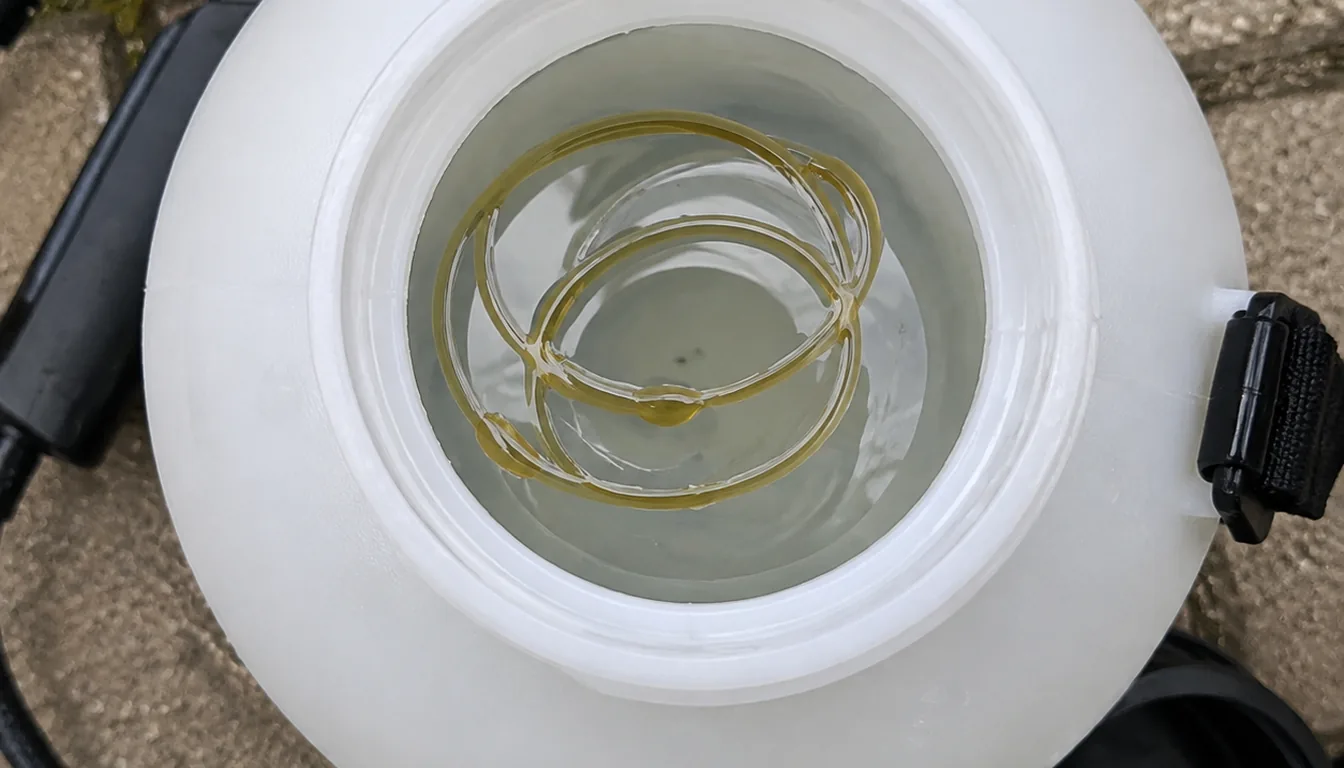
One US tablespoon is about 14.79 mL, and a US gallon is about 3,785 mL. One tablespoon per gallon of water is therefore only about 0.39% product relative to that water volume. It is not a 1% or 2% mix. This arithmetic explains the units, not a recommended pesticide concentration.
Directions saying “per gallon of water” and directions saying “make one gallon of finished spray” also describe different measuring steps. Follow the wording on the product rather than switching between them.
Does This Product Need Added Soap?
A separate soap dose is not a normal addition to every neem concentrate. Many formulations already contain ingredients that let the oil disperse in water. The cited Bonide label specifically prohibits added adjuvants, including spreaders and stickers.
A product that calls for an added surfactant must name or describe the permitted material and amount. Dish detergent is not automatically an equivalent. More soap can change how the mixture wets foliage and can contribute to injury.
The mixing order and agitation instructions determine how to keep a formulated spray uniform. An oil layer calls for checking those directions, the water, and the condition of the product. It does not prove that the pesticide dose was too low.
Do Sensitive Plants Need a Different Rate?
There is no dependable chart that assigns one teaspoon to tender herbs and a tablespoon to thick-leaved shrubs. Plant species, growth stage, health, weather, and formulation all affect tolerance. A waxy leaf is not evidence that a stronger dose is safe.
A sensitive plant may be excluded by the label or require a small-area trial. Where a label provides a permitted range, its conditions govern the choice within that range. Reducing an unsuitable product to an invented “gentle” rate does not make the use appropriate.
The test uses the intended labeled concentration on a small, representative area. The observation period comes from product-specific instructions or manufacturer guidance if no period is supplied. An undamaged test leaf does not cancel restrictions on stressed plants, flowers, weather, or other pesticides.
How Do You Scale the Rate to a Smaller Batch?
The scaling rule is straightforward once the label rate and units are clear. Product needed equals the per-gallon product dose multiplied by the fraction of a gallon of water. A US gallon contains 4 quarts or 8 pints.
For the cited Bonide insect/miticide directions, the columns below scale the low and high ends of that product’s labeled range. They are arithmetic examples for that formulation and use, not low- and high-strength recommendations for other bottles.
| Water amount | At 2 tablespoons per gallon | At 4 tablespoons per gallon |
|---|---|---|
| 1 US gallon | 2 tablespoons | 4 tablespoons |
| Half a US gallon | 1 tablespoon | 2 tablespoons |
| 1 US quart | 1½ teaspoons | 1 tablespoon |
| 1 US pint | ¾ teaspoon | 1½ teaspoons |
One US tablespoon equals 3 teaspoons, and 2 tablespoons equal 1 US fluid ounce. A fluid ounce measures volume. It is not an ounce weighed on a scale. A liter is also larger than a US quart, so swapping those containers changes the proportion.
For a different labeled rate, keep that rate throughout the calculation. If a label gives milliliters per liter, using graduated metric equipment avoids an unnecessary chain of spoon conversions. Very small batches can require amounts that ordinary measuring spoons cannot resolve accurately. Suitable dedicated measuring equipment or a ready-to-use product can avoid estimating tiny fractions.
Does the Pest or Disease Change the Directions?
The target problem determines which part of a multipurpose label applies. An insect rate does not establish a powdery-mildew schedule, and an outdoor crop direction does not establish indoor-use permission.
Clarified neem oil can affect susceptible insects, mites, and exposed eggs by contact. Azadirachtin-containing products can interfere with feeding and development. Efficacy differs by pest, life stage, coverage, and formulation, so neither “all eggs are unaffected” nor “all adult beetles are immune” is a useful universal rule.
A living pest or a supported disease diagnosis gives the treatment a target. Yellowing, curling, or a brown patch alone may reflect watering, roots, temperature, or another problem that more pesticide will not resolve.
How Much Spray Goes on the Plant?
The mixing rate sets concentration. The application directions set where and how much diluted spray reaches the plant. A gallon of mix is not a dose for one plant, and a small houseplant does not need an entire gallon simply because the rate is written that way.
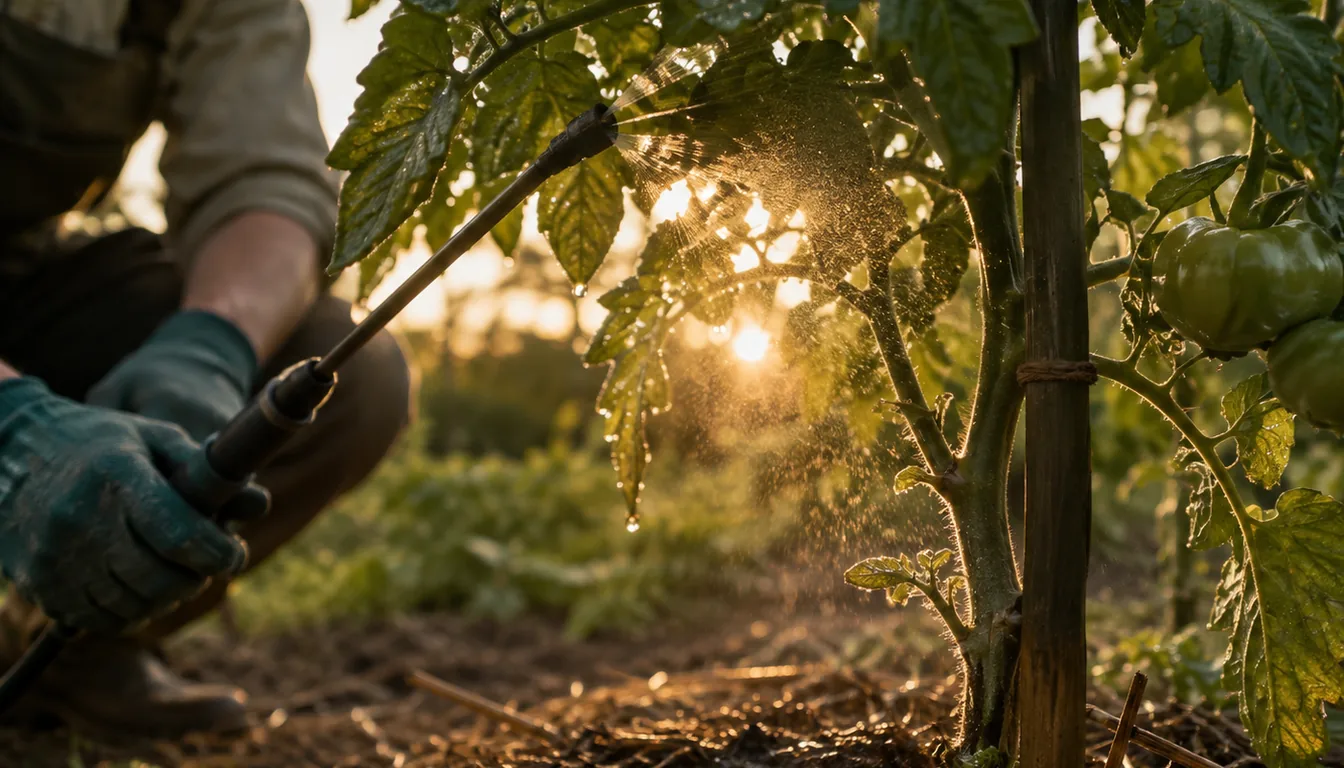
The cited Bonide directions call for thoroughly wetting plant surfaces, including leaf undersides, with frequent mixing during spraying. Other products can differ. Spray stays on the labeled target and site, with drift and runoff controlled as directed.
A foliar rate does not authorize a soil drench or establish how deeply to wet potting mix. Indoor application also requires attention to ventilation, household surfaces, access by people and pets, and disposal.
How Can You Tell Whether Treatment Is Working?
A correct dilution is only one part of effective treatment. Contact oils must reach susceptible stages, while growth-disrupting ingredients do not act like an instant knockdown on every pest. Some surviving or newly hatched pests after an application can reflect life stage and coverage rather than too little concentrate.
Follow-up compares live pest activity and new damage, not whether old scars become green. Continued activity calls for checking identification, accessible stages, coverage, and the allowed treatment interval. It does not by itself authorize a stronger batch or an earlier spray.
Repeat timing belongs to the exact product and purpose. There is no general weekly neem schedule for every houseplant, no calendar dose required for healthy plants, and no universal number of applications that proves control.
What If the Leaves React or the Mix Looks Wrong?
Injury after spraying needs an exposure history. Product, rate, additives, weather, plant condition, and other recent treatments all matter. New pale or brown areas can fit spray injury, but appearance alone does not prove it.
Injury after treatment
Stop further applications and compare the actual mixture and conditions with the label. Seek product-specific advice before trying to remove residues.
Oil separates in the tank
Recheck formulation, mixing order, water and agitation. Do not automatically add soap or more concentrate.
Pests persist
Check identity, coverage, life stage and permitted repeat timing before selecting the next treatment.
Accidental measuring error
Set the mixture aside safely and contact the manufacturer for correction or disposal advice. Do not apply an uncertain batch to use it up.
Adding fertilizer to force recovery or soaking an already wet pot creates another variable. Suitable light and moisture for the plant remain necessary while the cause is assessed. Personal exposure takes priority over the plant and follows the first-aid directions on the container.
Do Weather and Season Change the Dose?
Weather can change whether a treatment is suitable, but it does not create a new spoon-per-gallon recipe. Heat, freezing conditions, drought stress, prolonged wetness, and incompatible recent sprays can increase injury risk. Temperature limits and any required interval from sulfur belong to the specific product directions.
USDA hardiness zones describe winter cold. They cannot supply today’s spray temperature, a neem season, or a safe treatment interval. A cool evening can still be unsuitable if the plant is stressed or a label restriction applies.
Pollinator precautions matter even for a plant-derived pesticide. The cited Bonide label warns about direct treatment of bees and prohibits application while bees visit the treatment area. Choosing dusk does not replace checking those conditions.
How Much Should You Mix and Store?
A batch sized to the plants actually being treated reduces leftovers. Storage life of diluted product varies with formulation and conditions, so a blanket 24-hour allowance is unreliable. The concentrate and mixed spray can have different storage instructions.
- Measure with equipment reserved for pesticides, never utensils returned to food use
- Keep the original product label and note the amount of water and concentrate used
- Prepare only the amount needed and maintain the labeled agitation
- Follow the product directions for sprayer cleaning and disposal of rinsate
- Keep unused pesticide out of household drains and surface water
- Store concentrate in its original container under its stated conditions, out of children’s and animals’ reach
If the amount in a partly used sprayer is unknown, there is no reliable basis for topping it up. A fresh calculation needs a known water volume and a known product dose. The bottle’s storage guidance and manufacturer can address separation, age, or freezing damage without an invented shelf-life date.
Frequently Asked Questions
Can I use a four-liter bottle as a US gallon?
No. A US gallon is about 3.785 liters, so a four-liter water volume is larger. Use matching units from the product directions and scale the dose to the measured water volume. An Imperial gallon is different again, at about 4.546 liters.
Sources & References
- Bonide, Captain Jack’s Neem Oil Concentrate label, EPA registration 70051-2-4
- NIST, Guide to the SI Appendix B.9, Volume Conversion Factors
- NIST, Metric Household Capacity Equivalents
- Colorado State University Extension, Insect Control: Horticultural Oils
- University of New Hampshire Extension, What Should Neem Be Used for on Plants?
Related Guides
Do Marigolds Keep Squirrels Away From Your Garden?
Squirrels can strip a bed of seedlings or freshly planted bulbs in a single morning.
11 min read
Do Squash Bugs Bite People?
No. A squash bug cannot bite you. Its mouthparts are a slender stylet built to pierce plant tissue…
9 min read
Does Dawn Dish Soap Kill Grubs? Why It Fails and What Works Instead
No. Dawn and other dish detergents do not bring white grubs to the surface, and they do not kill…
9 min read
How Do You Get Rid of Spider Mites on Houseplants?
Spider mites on houseplants often can be reduced by repeatedly washing the leaf undersides.
11 min read
How to Control Fungus Gnats in Houseplant Soil
Fungus gnat control works best when it addresses the larvae in potting mix as well as the adults…
15 min read
How to Identify Lawn Grubs Before You Treat the Grass
Brown grass, birds, or skunk damage can suggest white grubs, but none proves the diagnosis.
16 min read