Arborvitae vs Juniper
Choose a named arborvitae cultivar when its mature width, moisture needs, and deer risk fit the site. Choose a named juniper cultivar when drainage, sun, form, and regional disease fit are better, because neither genus is one universal screen plant.
Arborvitae
Thuja spp.
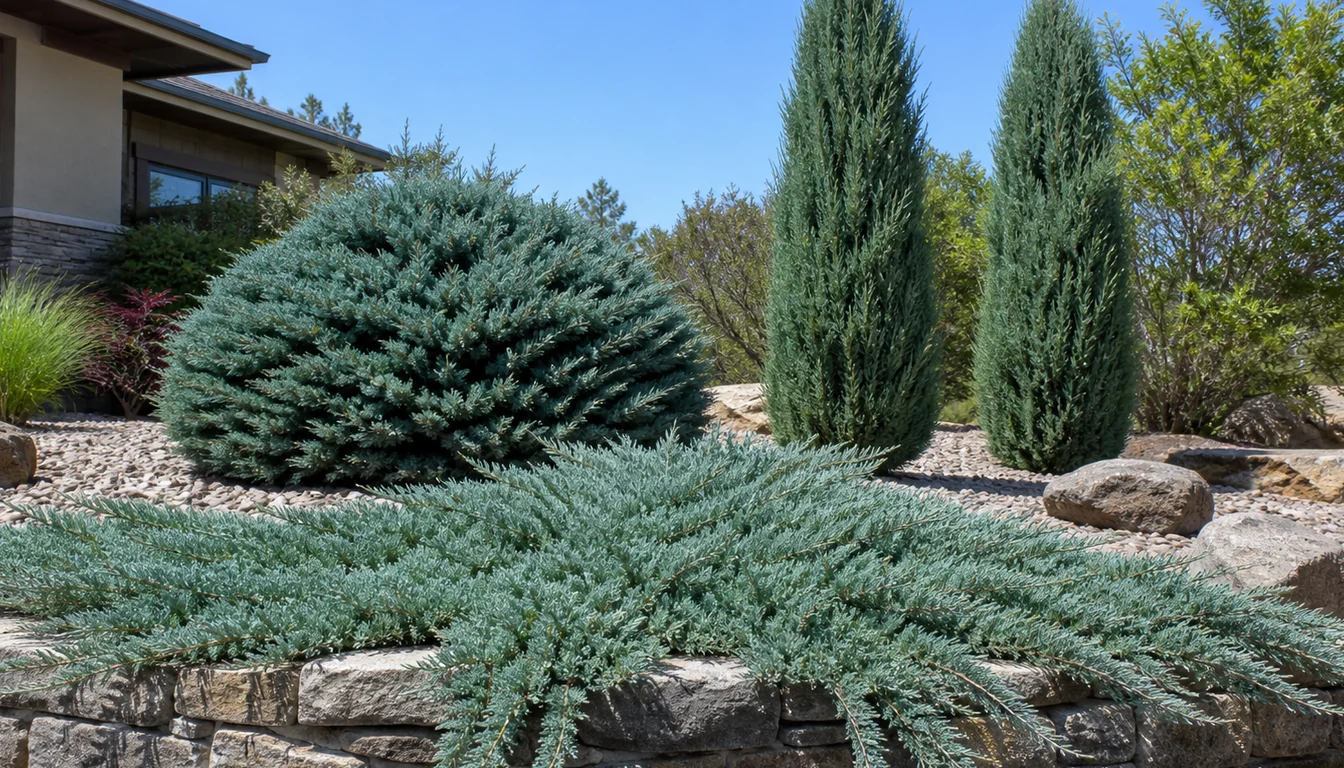
Juniper
Juniperus spp.
Arborvitae and juniper can both provide evergreen privacy, but their labels cover very different plants.
A narrow arborvitae, a spreading juniper, and an eastern red cedar may all sit in the same nursery row while demanding completely different amounts of ground space.
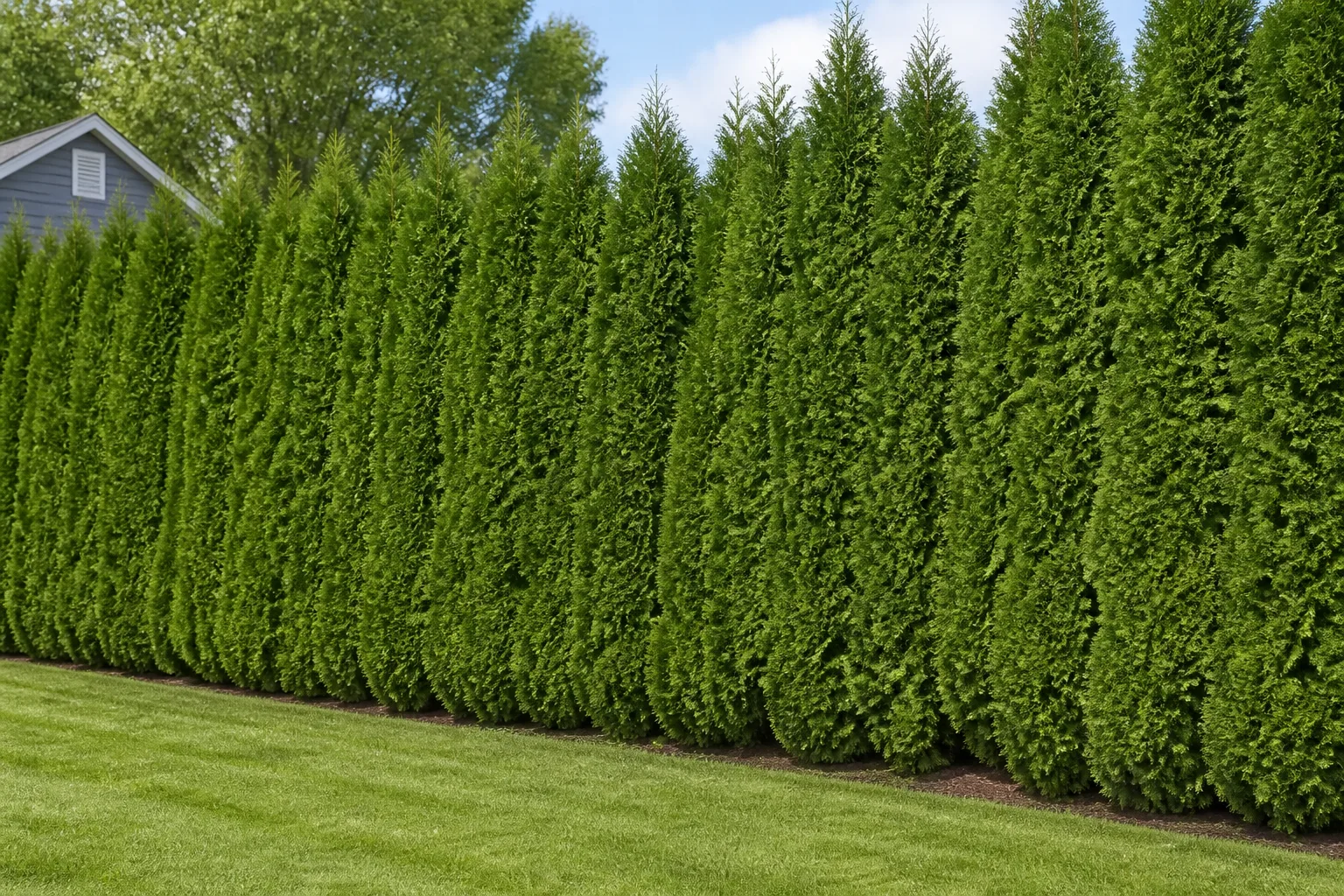
Arborvitae is often the easier route to a soft, uniform wall in a cool or moderate site with dependable soil moisture.
Juniper offers more foliage colors and landscape forms, and some species handle heat, drought, road salt, or exposed ground better after establishment.
Wet roots, shade, or a humid-climate mismatch can still make the wrong juniper fail.
Start with the mature dimensions and tolerances of the exact cultivar.
Then compare the screen you want with the water, winter exposure, deer, salt, drainage, and nearby fruit trees already present.
Specifications
Compare the traits that change the growing decision.
| Feature | Arborvitae | Juniper |
|---|---|---|
| Common screen form | Many dense columnar and pyramidal cultivars | Columnar, pyramidal, mounded, spreading, or tree forms |
| Foliage feel | Usually soft, flattened sprays | Soft scales, prickly juvenile needles, or both |
| Best soil pattern | Moisture-retentive but suitably drained for the cultivar | Well drained, often drier after establishment |
| Dry exposed sites | Higher winter-burn and thinning risk | Some species and cultivars are well adapted |
| Deer pressure | Serious risk for American arborvitae | Often lower, but not deer-proof |
| Hard renovation | Old bare wood may not refill reliably | Old bare wood may not refill reliably |
| Distinctive reproductive feature | Small woody cones | Fleshy berry-like seed cones on female plants |
| Nearby orchard concern | Not the main alternate host for cedar-apple rust | Some junipers host Gymnosporangium rusts |
The useful comparison is cultivar against cultivar.
Habit, mature width, cold hardiness, humidity response, deer pressure, salt tolerance, and disease susceptibility can change within each genus.
Use the paired rows as a nursery checklist.
Replace every broad description with the figures and tolerances printed for the exact plant you can buy.
Best Use Cases
Choose by the job the planting needs to do.
Narrow formal screen
A consistent vertical wall
Columnar arborvitae cultivars make a predictable, soft-surfaced wall when their mature width fits the strip.
An upright juniper can also screen, but some cultivars become broad, irregular, or tree-sized.
Hot dry slope
Full sun and fast drainage
American arborvitae is a poor default where wind, reflected heat, and dry soil repeatedly pull water from evergreen foliage.
Several landscape junipers tolerate heat and drought after establishment but still need compatible climate, open sun, and drainage.
Heavy deer browsing
Winter food pressure
White-tailed deer can strip reachable arborvitae foliage, leaving a permanent browse line that may require costly fencing.
Some Chinese juniper selections resist deer damage better, although no plant is deer-proof when food is scarce.
Moist but drained garden soil
Steadier root-zone moisture
American arborvitae can suit soil that holds useful moisture without suffocating roots, including sites too consistently moist for drought-adapted junipers.
A low spot or irrigated bed that stays wet can damage juniper roots even when the foliage initially looks drought-tough.
Why is the cultivar name more important than the genus?
Arborvitae and juniper are not single shapes. Nurseries sell globe arborvitae, narrow columns, broad pyramids, creeping junipers, mounded shrubs, upright accents, and full-sized juniper trees.
A genus-level winner therefore creates a bad planting plan. The exact cultivar owns the mature height, width, foliage color, growth habit, hardiness, and many tolerance differences.
The species behind the cultivar matters too. American arborvitae, western red cedar hybrids, Chinese juniper, Rocky Mountain juniper, and eastern red cedar do not share one climate envelope.
| Read on the tag | Why it matters |
|---|---|
| Full botanical name | Separates species with different climate and disease fit |
| Cultivar name | Identifies the selected form and foliage traits |
| Mature height and width | Sets spacing and long-term access |
| Hardiness range | Screens out winter mismatch |
| Sun and drainage needs | Screens out site mismatch |
| Named pest or disease resistance | Narrows regional risk |
Marketing words such as compact, fast, hardy, and low maintenance need numbers or conditions beside them. Compact compared with the wild species can still be much too wide for a three-foot bed.
Take a photo of the full tag and keep it with the planting record. If the seller cannot identify the cultivar, you cannot confidently design a permanent screen around it.
How can you tell arborvitae and juniper apart?
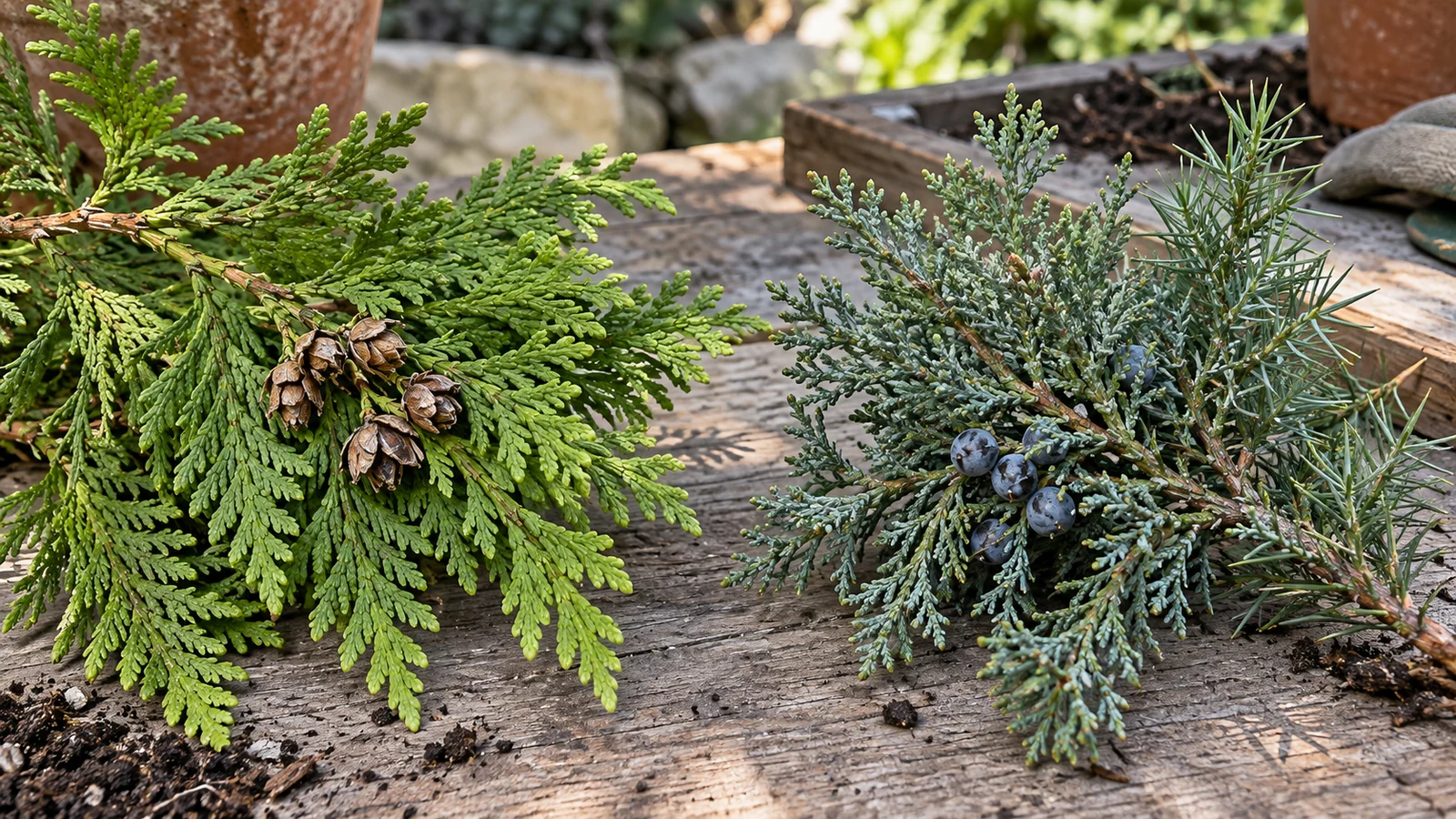
Mature arborvitae usually carries tiny scale-like leaves in flat, fan-shaped sprays. The sprays often feel softer and lie in distinct planes, creating a layered surface.
Juniper foliage is more variable. A plant may carry sharp juvenile needles, overlapping adult scales, or both at once, and its branches may look rope-like, feathery, coarse, or tightly upright.
Female junipers can form fleshy seed cones that resemble blue or blue-gray berries. Arborvitae forms smaller dry woody cones instead.
| Feature | Arborvitae | Juniper |
|---|---|---|
| Branchlet pattern | Flattened fan-like sprays | Rounder, angular, or irregular sprays |
| Foliage texture | Usually soft scales | Scales, prickly needles, or both |
| Common color range | Green, gold, bronze in winter | Green, blue-green, gray, or gold |
| Seed structure | Small dry cone | Fleshy berry-like cone on female plants |
| Habit range | Globe to column or broad pyramid | Groundcover to shrub or tree |
Foliage texture matters beside a path or play space. A prickly juniper placed where people brush past it can be unpleasant even when its mature width technically fits.
The comparison image shows the useful field marks at the same scale. Color alone is unreliable because both groups include green, gold, and winter-bronzing selections.
Which plant makes the better privacy screen?
Arborvitae often wins when the design calls for repeated narrow columns and a consistent green wall. That answer holds only if the chosen cultivar fits the soil, winter exposure, and mature width.
An upright juniper can form an effective screen in full sun, especially where a compatible species handles drier soil or urban exposure. Its color and branch texture may create a less formal result.
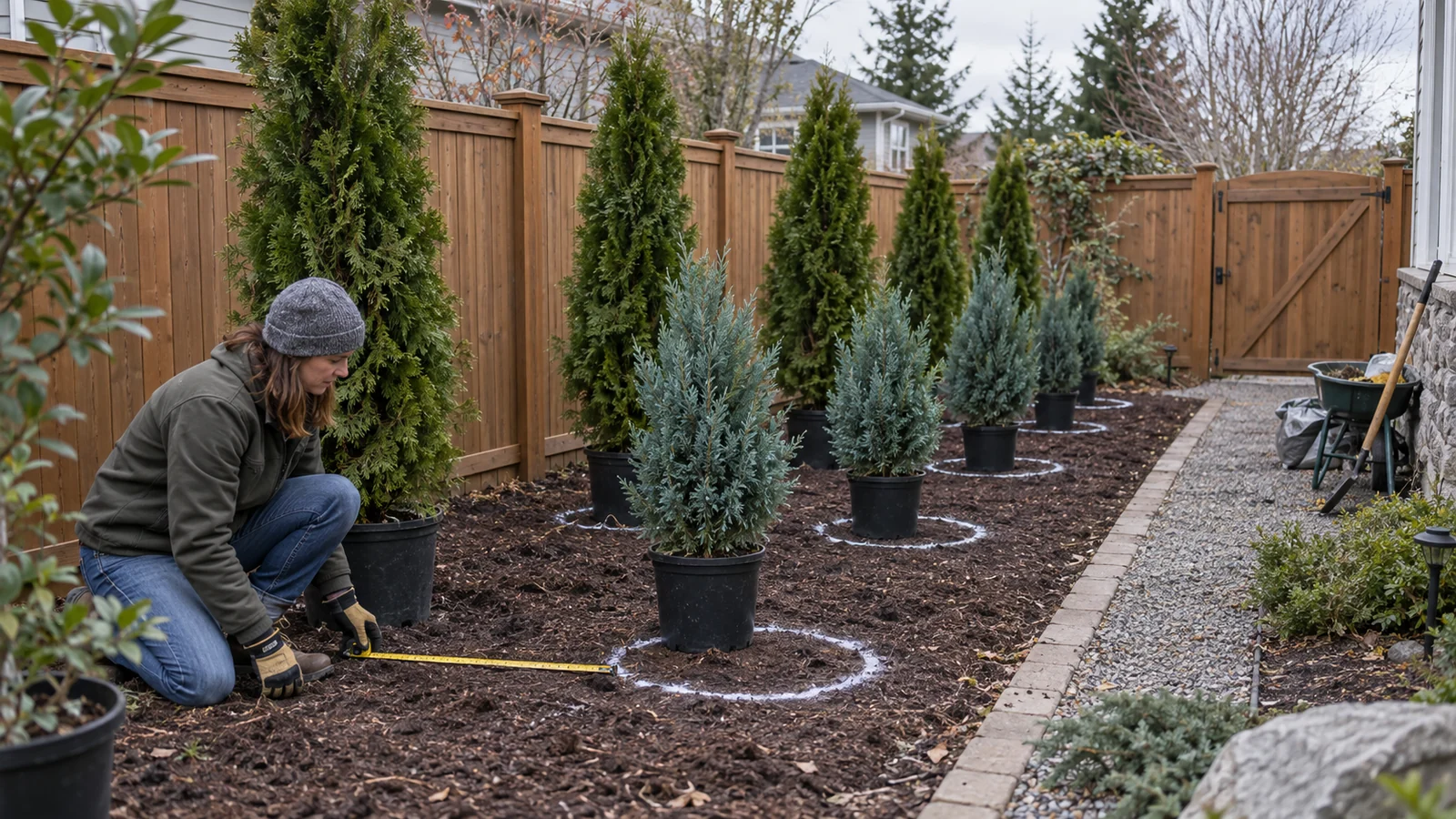
Do not calculate spacing from the width of the nursery pot. Use the expected mature spread, then decide how much overlap is needed without forcing trunks and roots into permanent competition.
- 1. Mark the view: Stand at the window, patio, or property area where privacy matters and mark the actual sight line.
- 2. Measure the planting strip: Include utilities, easements, fences, eaves, gates, paths, and access for future pruning.
- 3. Choose the mature form: Compare named cultivars that fit the available width without repeated hard cutting.
- 4. Lay out full-size circles: Mark each mature spread on the ground before digging.
- 5. Check failure resilience: Consider a staggered or mixed screen where one pest, disease, or weather event could open an entire row.
A single-species row looks orderly, but one shared weakness can remove privacy along the whole boundary. University Extension guidance for mixed screens and windbreaks recommends plant diversity so a failure does not erase the entire function.
The living-screen planning guide covers the broader choice among tree species. Use an arborvitae or juniper only when a suitable cultivar fills one of those roles.
Design for the mature screen width, not the first summer. Crowding can close gaps quickly, yet it also reduces airflow, increases competition, and makes replacement difficult when lower branches die.
Which one handles dry soil, wet soil, heat, and wind?
American arborvitae favors a root zone that supplies steady moisture, and it can tolerate more soil moisture than many landscape junipers. It still needs oxygen around the roots and should not be reduced to a plant for standing water.
Dry winter wind creates a separate problem. Evergreen foliage continues losing water when frozen or dry soil cannot replace it, which can leave arborvitae brown on the windward or sunny side.
Many junipers handle drought after establishment, but that strength does not excuse poor planting or a dry root ball in the first season. Full sun and drainage remain the safer shared starting points.
Juniper species also differ by climate. A Rocky Mountain selection that thrives in dry air may perform poorly in high humidity, while an eastern red cedar or Chinese juniper selection may fit a different region.
| Site condition | Better starting candidate | What still needs checking |
|---|---|---|
| Moist, drained loam | American arborvitae cultivar | Mature size, deer, winter exposure |
| Dry sunny slope | Adapted juniper cultivar | Establishment water, erosion, humidity |
| Low wet pocket | Neither by default | Drainage cause and locally suited alternatives |
| Reflected heat by pavement | Heat-adapted juniper cultivar | Root volume and road salt |
| Open winter wind | Site-specific juniper or protected arborvitae | Cold hardiness and foliage injury history |
| Partial shade | Some arborvitae cultivars | Expected loss of density |
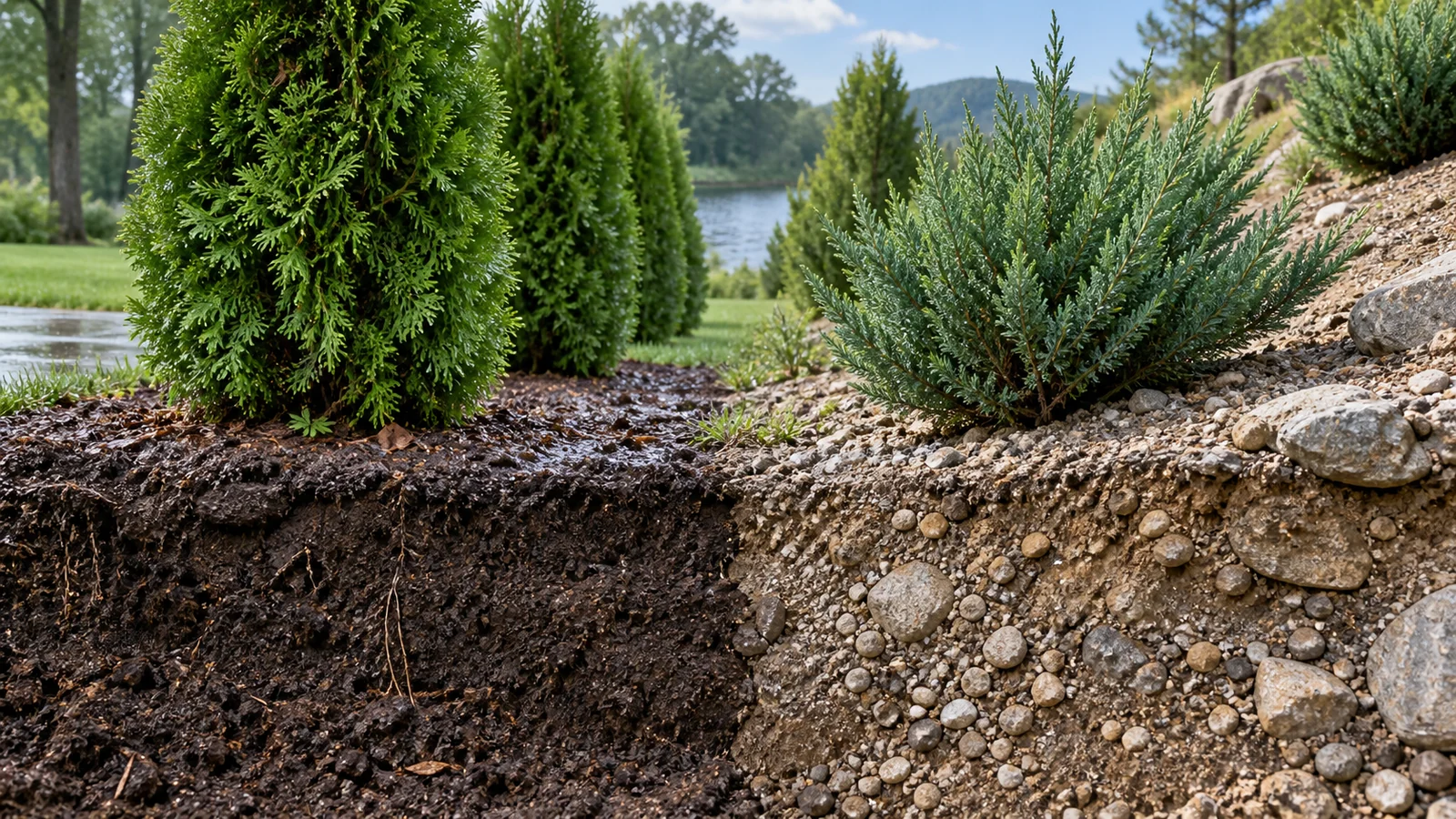
The root-zone image compares moisture-holding soil with a fast-draining slope without pretending that one soil texture determines the answer. Compaction, grade, irrigation runoff, and buried construction debris can overturn a surface impression.
Watch the site through heavy rain and a dry spell before buying a row of plants. A few minutes with a shovel can prevent years of replacement watering.
How do deer, road salt, and winter burn change the choice?
Deer pressure can decide the comparison before appearance does. American arborvitae is heavily browsed in many regions, and repeated feeding can create a bare lower edge at the exact height where privacy is needed.
A fence around each plant may work during establishment, but the final barrier must protect the full reachable canopy through deep snow. Repellents require correct timing and repeated application, and they may be unreliable under heavy feeding pressure.
Some junipers are less attractive to deer, but resistance is not universal immunity. Use local deer-resistant plant guidance and look at what survives unprotected in nearby yards.
Road salt is also cultivar- and species-dependent. Penn State Extension identifies eastern red cedar as a more salt-tolerant alternative where arborvitae suffers beside salted roads, but that does not make every juniper safe beside every pavement.
- [ ] Look for a consistent deer browse line on neighboring evergreens
- [ ] Map snow piled from drives and walks
- [ ] Mark the side exposed to winter sun and prevailing wind
- [ ] Trace salty runoff and tire spray from the road
- [ ] Check whether roof runoff floods or buries one end of the planting
- [ ] Confirm that fencing or a wind screen can remain clear of foliage
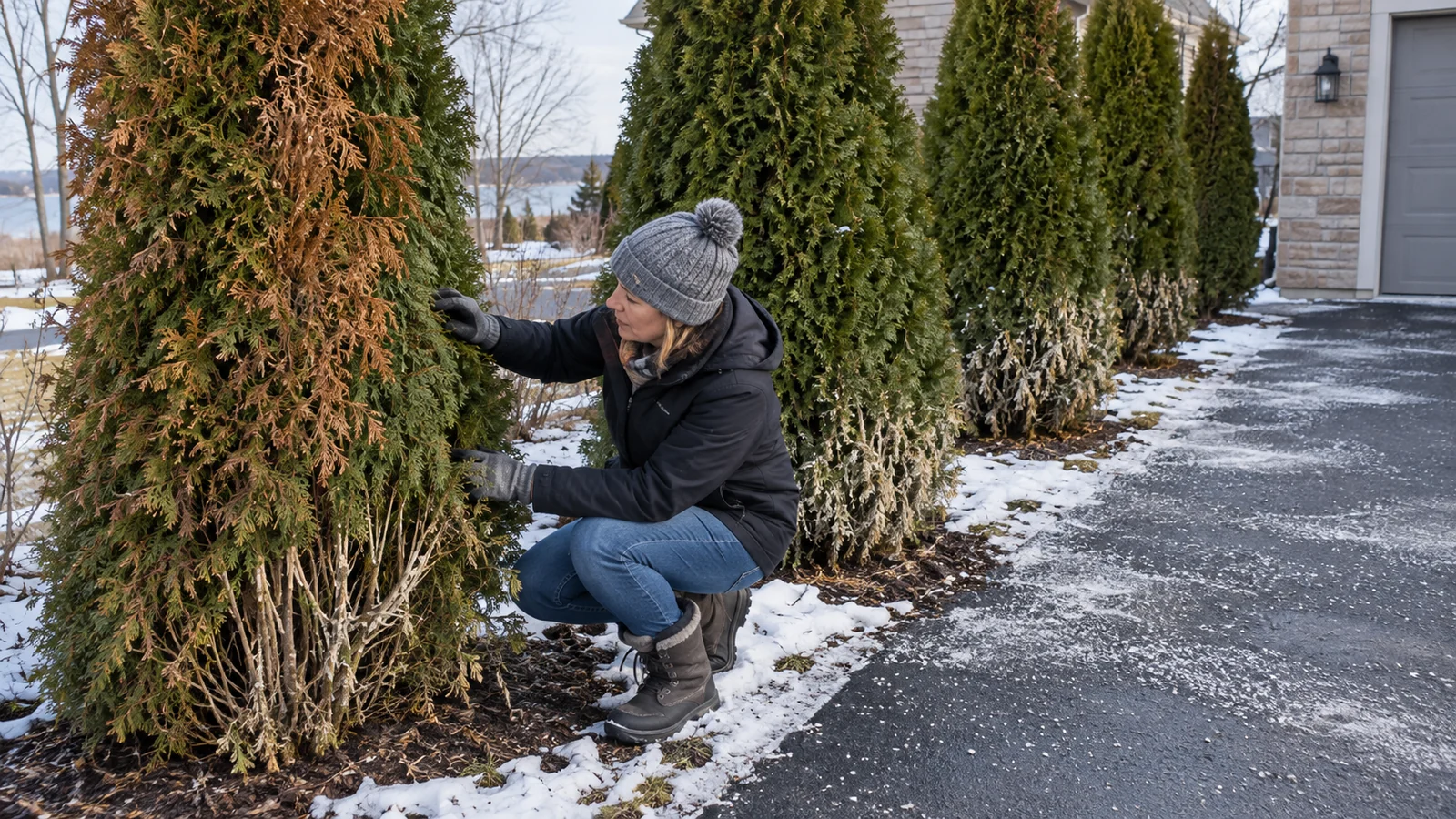
Brown arborvitae foliage after winter can reflect desiccation, broken branches, deer feeding, or another problem. The arborvitae winter-burn guide helps separate the pattern before you prune or replace a plant.
The image contrasts winter desiccation with browsing and salt spray. These injuries can overlap on one hedge, so the position and height of damage matter as much as the color.
Can you keep either evergreen narrow with pruning?
Light pruning can hold a suitable cultivar near its intended outline. It cannot turn a plant that wants twelve feet of width into a healthy three-foot column for decades.
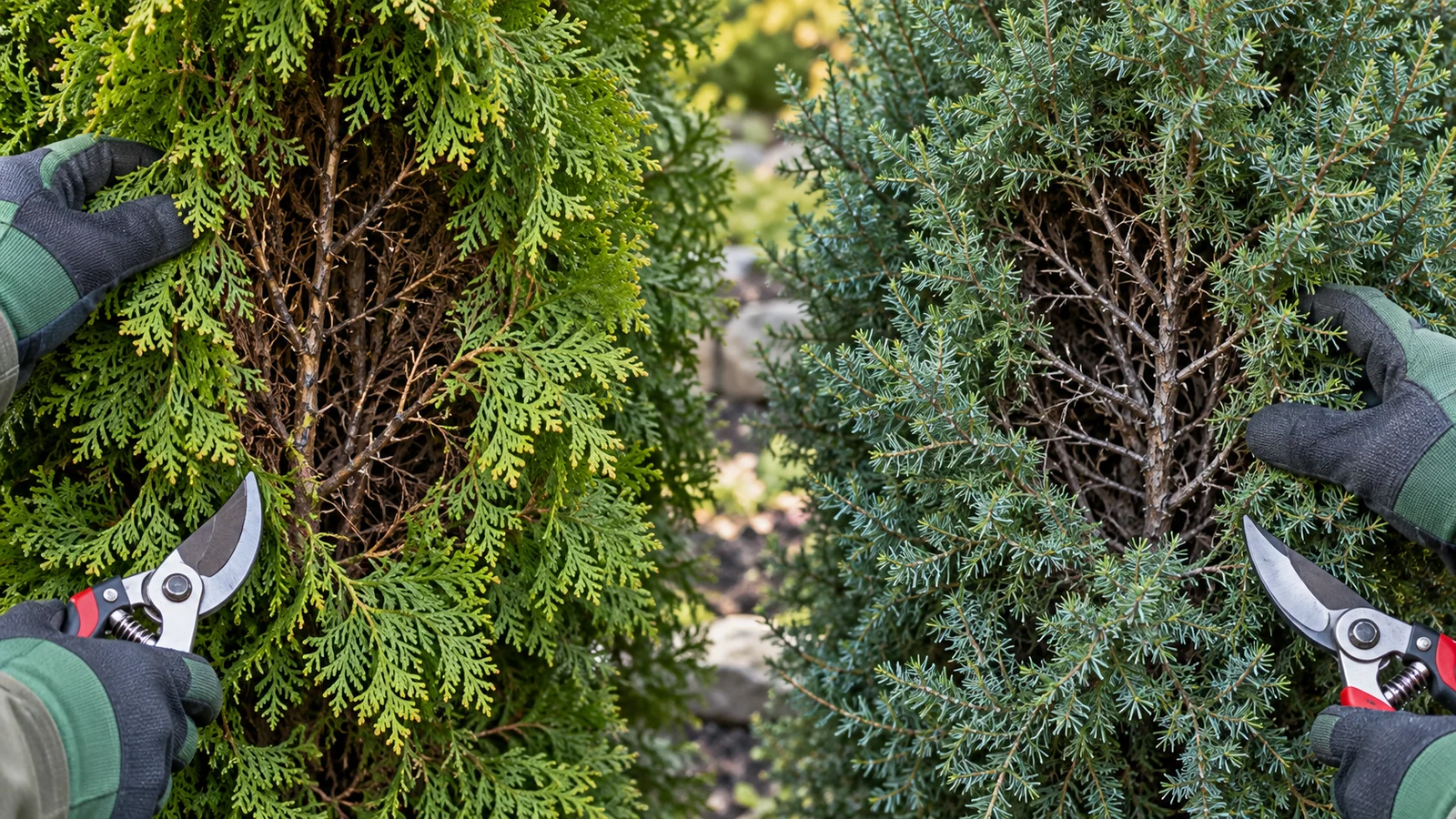
Both groups can develop shaded, leafless interior wood. A cut that removes the green shell may expose a hole that does not refill on the schedule you expect.
Arborvitae can be lightly sheared or selectively thinned while green growth remains. Multiple leaders or branches bent by snow need selective structural work rather than flat-topping the whole row.
Junipers vary in their response, but severe cuts into old bare wood are a common failure. Follow pruning timing and plant-response guidance instead of using the same hedge trimmer routine on every evergreen.
Pruning also has an access cost. Leave enough room to move behind the row, inspect trunks, clear weeds, and remove branches without standing in traffic or leaning across a fence.
The image shows the green outer shell and the bare interior on both plants. That boundary is the practical limit a label such as pruning tolerant does not explain.
Which pest and disease problems should you compare?
Bagworms can feed on arborvitae and juniper, so choosing one genus does not remove that scouting job. Spider mites, scale insects, tip blights, root rots, and environmental browning also enter the comparison.
Juniper needs one extra landscape check near apples, crabapples, hawthorns, serviceberries, and related plants. Some juniper species host Gymnosporangium rust fungi that use a juniper host and a rose-family host to complete their life cycle.
Orange gelatinous horns on juniper galls during wet spring weather are distinctive. They do not mean the juniper is dying, but they can release spores that affect susceptible fruit or ornamental plants.
Distance reduces exposure without creating a perfect barrier because wind carries spores. Resistant apple or crabapple cultivars and correct diagnosis may matter more than removing one nearby juniper.
| What you see | Possible issue | First useful check |
|---|---|---|
| Moving bags made of foliage | Bagworms | Open a bag and confirm larvae or eggs |
| Fine stippling or bronzing | Spider mites or stress | Inspect foliage and webbing closely |
| Dead shoot tips | Blight, insects, or injury | Check pattern, weather, and live tissue boundary |
| Roots in saturated soil | Root decline | Correct drainage before treatment |
| Orange horns on juniper galls | Gymnosporangium rust | Identify nearby susceptible rose-family hosts |
| One exposed brown face | Winter or salt injury | Match damage to wind, sun, and pavement |
Do not respond to every brown patch with fertilizer or a pesticide. Confirm whether the damage comes from roots, weather, animals, insects, or a pathogen, because the wrong treatment adds stress without restoring dead foliage.
A cultivar's local disease resistance is more valuable than a genus-wide promise. County Extension records, nearby plant performance, and nursery disease notes should narrow the final list.
Which evergreen should you plant?
Choose arborvitae when a named cultivar gives the form and mature width you need, the root zone can supply steady moisture, and winter exposure and deer can be managed. This is often the cleanest route to a formal columnar screen.
Choose juniper when a named cultivar fits the exact height and width, the site is sunny and well drained, and its regional heat, humidity, salt, and disease performance is documented. This route is especially useful for dry slopes, blue-gray foliage, informal forms, or deer-prone boundaries.
Choose neither when the strip remains waterlogged, receives too little light for a dense evergreen screen, or is too narrow for the mature plants and working access. The evergreen shrub guide can widen the candidate list without forcing either genus into the wrong job.
- [ ] Exact species and cultivar recorded
- [ ] Mature height and width fit the measured space
- [ ] Hardiness and summer climate fit the location
- [ ] Soil drainage observed after heavy rain
- [ ] Establishment watering is practical
- [ ] Deer, salt, wind, and snow exposure reviewed
- [ ] Pruning access remains outside the mature canopy
- [ ] Nearby apple-family plants considered for juniper rust hosts
- [ ] Replacement access and screen resilience planned
Price the whole installation. Plants, soil correction, irrigation parts, mulch, deer barriers, utility locating, replacement access, and years of trimming can outweigh a small difference in nursery price.
Buy the plant whose full name and requirements you can verify. A healthy screen comes from matching several named plants to one measured site, not from choosing the tougher-sounding genus.
Sources & References
- Thuja occidentalis, North Carolina Extension Gardener Plant Toolbox
- Growing and Using Juniper, Clemson Cooperative Extension
- Juniper Diseases and Insect Pests, Clemson Cooperative Extension
- Protecting Trees and Shrubs in Winter, University of Minnesota Extension
- Cedar-Apple Rust and Related Rust Diseases, University of Minnesota Extension
- Plants for Mixed Privacy Screens, University of Maryland Extension
- Pruning Shrubs, Clemson Cooperative Extension
- Minimize Deicer Damage with Salt-Tolerant Plants, Penn State Extension