
Will Winter-Burned Arborvitae Turn Green Again?
Brown arborvitae foliage after winter can reflect drying wind, sun, salt, or other damage. The pattern and surviving growth help guide care, while anti-desiccant suitability depends on the product label.
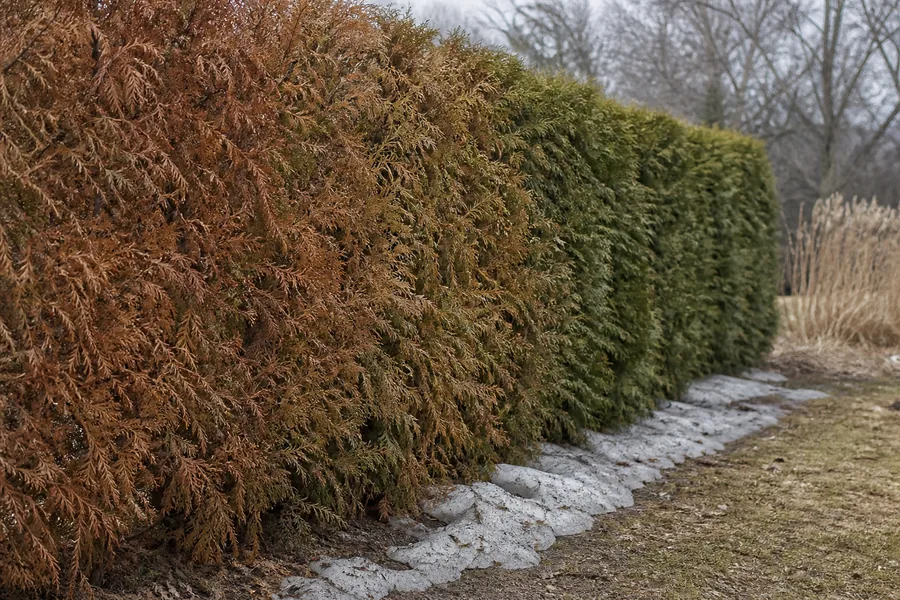
Quick diagnosis
Winter burn, meaning foliage that dried out while the roots were in cold or frozen soil.
Browning concentrated on an exposed face, especially beyond the snow line, is consistent with winter injury. That pattern is a clue rather than proof, so the soil, road-salt exposure, and timing matter too.
Ragged browsed twigs suggest deer damage. Silk cases warrant a closer look for arborvitae bagworms, while unusual twig lesions or spreading dieback may need a diagnostic assessment; more than one problem can affect a hedge.
Open the full diagnosisWhat You Are Seeing
Arborvitae foliage continues losing moisture in winter. When cold or frozen soil restricts water uptake, exposed sprays can dry faster than the roots can replace the loss.
Wind and winter sun can concentrate injury on one face or one end of a hedge. Salt spray and other site stresses may overlap that pattern, so uneven browning is not proof of a single cause.
Discoloration can become clearer in late winter or spring, after the damaging weather. The timing of visible browning and the timing of injury are not always the same.
Common Causes
01 Consider exposure and soil moisture
Cold wind and winter sun with the roots locked up
Cold or frozen soil can limit water replacement while evergreen foliage continues losing moisture. Wind and sun increase that imbalance, so exposed foliage may brown while sheltered sprays stay green.
A south- or west-facing pattern can support the investigation, but a tip-to-base color gradient does not rule out root or twig problems. Screens reduce exposure; irrigation helps only when the soil is thawed, dry, and able to absorb water.
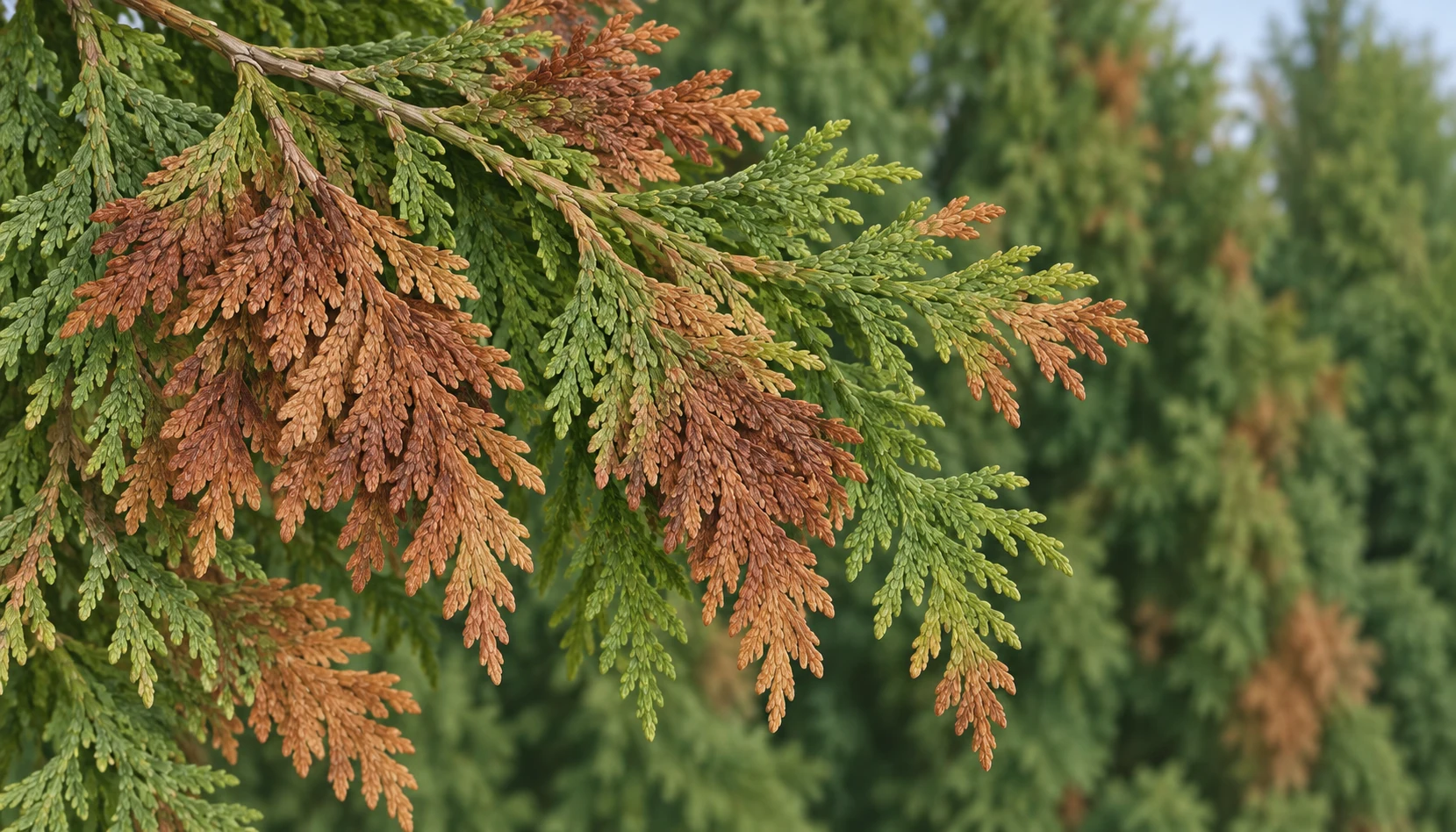
How to identify it
- Exposed sprays are brown or bleached while some sheltered foliage remains green.
- The damage sits on one side of the plant or one end of the hedge.
- The worst of it faces south, west, or open ground.
- Other exposed evergreens nearby show the same pattern.
What to do
- Put a burlap screen on the exposed face rather than wrapping the whole plant, which traps moisture against the foliage.
- Water during a thaw only if the root-zone soil is dry and can absorb water; do not soak frozen or saturated ground.
- Leave the brown foliage in place for now, because it shades the live tissue behind it.
- Wait for new growth before cutting anything, since brown foliage often hangs on wood that is still alive.
- Plan a permanent windbreak if the same face burns every year.
02 Check moisture below the mulch
Dry soil going into winter
Dry soil before freezing can leave an evergreen more vulnerable to winter injury. Moisture varies across a hedge, so the root zone needs checking rather than assuming every plant received the same rain or irrigation.
How to identify it
- The soil under the mulch is dry when you dig a hand into it during a thaw.
- Autumn was dry and the hedge was not watered before the ground froze.
- Plants in fast-draining or sandy soil are worse than neighbors in heavier ground.
- Irrigation reaches the front of the hedge but not the root zone behind it.
What to do
- If autumn soil is dry, water the root zone before it freezes; an already wet site does not need an extra soaking.
- Keep two to four inches of mulch over the root zone, held back from the trunk itself.
- Water the whole root spread rather than a strip along the front face.
- Apply water slowly enough to soak into the root zone rather than wetting only the mulch surface.
03 Check road spray and runoff
De-icing salt from a drive or road
Salt spray or salty meltwater can injure foliage, buds, or roots beside roads and walks. Browning near pavement warrants checking snow-storage locations and drainage, but wind exposure can produce an overlapping pattern.
Reducing repeated exposure matters more than treating the foliage after each winter. A soil or diagnostic assessment can help when salt injury is uncertain.
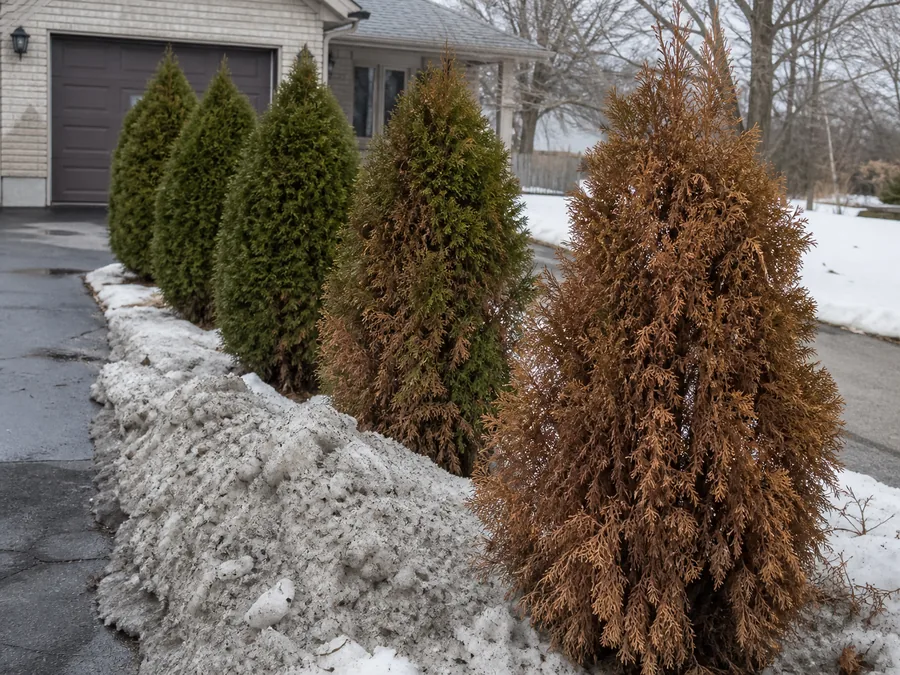
How to identify it
- The worst damage is nearest a road, drive, or path and eases with distance.
- Plowed or shoveled snow is piled against the affected plants.
- Buds fail to open in spring rather than just foliage browning.
- Foliage drops early instead of hanging on through the season.
What to do
- Keep snow cleared from salted pavement away from the hedge to reduce one source of exposure.
- Where salt contamination is supported and the soil drains freely, follow local extension guidance for leaching; extra water on poorly drained soil can add root stress.
- Put a temporary barrier along the pavement edge to catch spray before it reaches the foliage.
- Clear snow promptly and limit de-icer to the amount and locations its label specifies. Alternative products can still injure plants.
- If exposure cannot be reduced, consider a different planting location or a more suitable replacement after assessing the cause of repeated damage.
04 Review growth and fertilizer timing
Tender growth entering cold weather
Growth that has not hardened before cold arrives is vulnerable to injury. Fertilizer history is one clue, but a late application alone does not establish why a hedge browned.
How to identify it
- Tender new growth was present when freezing weather arrived.
- Recent pruning or feeding may have encouraged that growth.
- Outer shoot injury overlaps with the pattern from drying wind and sun.
What to do
- Avoid fertilizing simply to force recovery. Timing and need depend on the soil, growth, and local guidance; avoid stimulating tender growth before cold weather.
- Skip feeding altogether on an established hedge that is growing well.
- Check whether lawn fertilizer is reaching the hedge root zone by accident.
05 Check the root ball separately
A young hedge with roots that have not spread
A recently planted hedge depends heavily on its original root balls until roots spread into the surrounding ground. Establishment varies with plant size, site, and care, so age alone does not show that watering or exposure protection is no longer needed.
How to identify it
- The plants were put in within the last two or three years.
- New plants burn while older ones a few feet away do not.
- The root ball is still distinguishable from the surrounding soil when you dig beside it.
- The hedge was planted in autumn with little time to root before winter.
What to do
- Use a wind screen where young plants are exposed, and reassess the need as roots establish; a fixed three-year deadline does not fit every site.
- Check the root ball and neighboring soil separately in dry weather, including autumn. Water where moisture is lacking while the ground can absorb it.
- Spread mulch over the root area without piling it against the stems; deeper heaps do not provide better care.
06 Check the actual product label
An unsuitable anti-desiccant product
Rutgers cautions that some anti-transpirants are unsuitable for scale-leaved evergreens, including arborvitae. That warning does not establish a ban on every product, or prove that a past application caused the browning.
How to identify it
- The product label excludes arborvitae or scale-leaved evergreens
- Browning followed an application, a timing clue to discuss with an extension service rather than a diagnosis
What to do
- The product label determines whether that use is allowed. An unknown or unsuitable product is not a reason to spray again; appropriate soil moisture and a wind or salt screen address exposure without relying on a coating.
Will the Brown Turn Green Again?
Dead foliage does not turn green again. Improvement comes from surviving buds and shoots, so the amount of live growth matters more than the first impression of a brown hedge.
Some injured plants recover as new growth fills around the damage; severely damaged branches may not. Arborvitae generally fills poorly from bare old wood, which limits how much a stripped section can recover.
How to Tell What Is Actually Dead
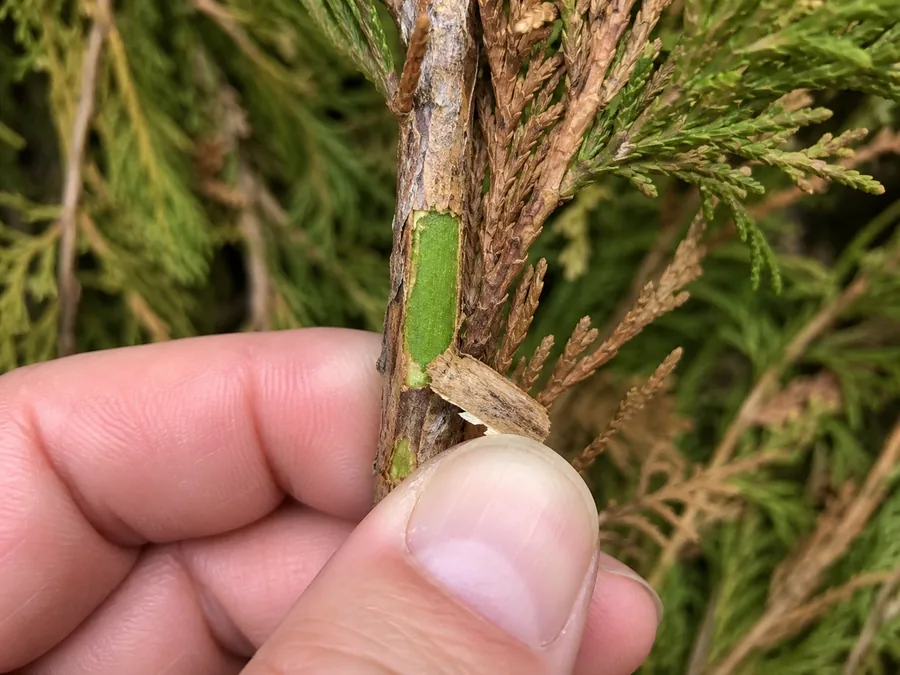
The least damaging first check is to watch the buds and compare affected branches with healthy growth as spring progresses. A small bark scrape can help assess an uncertain twig, but repeated scraping creates wounds and a green spot does not certify the entire branch.
Clearly dead or broken branches can be removed. For uncertain winter damage, waiting for the plant’s normal spring growth makes the boundary easier to judge, without imposing a March date or a fixed six-week recovery deadline.
Recovery Plan
Nothing visible changes
Soil moisture and exposure still need attention. Water is useful when the soil is thawed and dry enough to need it; saturated ground does not benefit from more irrigation.
The plant tells you what survived
New shoots help reveal surviving growth. A branch without new growth needs closer assessment before pruning, especially when the rest of the hedge has only just begun growing.
Growing out over the damage
Surviving shoots may gradually fill some damaged areas. Large gaps or branches stripped back to bare old wood may remain, so improvement depends on what is alive rather than a fixed number of seasons.
Autumn care begins with soil moisture, mulch kept clear of the stems, and protection where drying wind or road spray repeatedly damages the same face.
Recurring injury warrants a look at the site as well as the care. A permanent windbreak or a better-suited planting may help, but a replacement such as juniper still needs the right drainage, space, and exposure.
Sources
- Arborvitae foliage turns brown, University of Minnesota Extension
- Primer on anti-transpirant applications, Rutgers Plant and Pest Advisory
- Arborvitae for landscape plantings, University of Minnesota Extension
- Thuja occidentalis profile, NC State Extension Plant Toolbox
- Protecting trees and shrubs in winter, University of Minnesota Extension