Care snapshot
- Light
- Full sun to part shade
- Water
- Drought tolerant (UF/IFAS)
- Height
- 40 to 80 ft (NC State); 60 to 80 ft (UF/IFAS)
- Zone
- Zones 8 to 10 (UF lists 7b to 10b)
- Spread
- 40 to 100 ft (NC State); 60 to 120 ft (UF/IFAS)
- Temperature
- Wind and salt tolerant
What Is a Southern Live Oak, and How Big Does It Get?
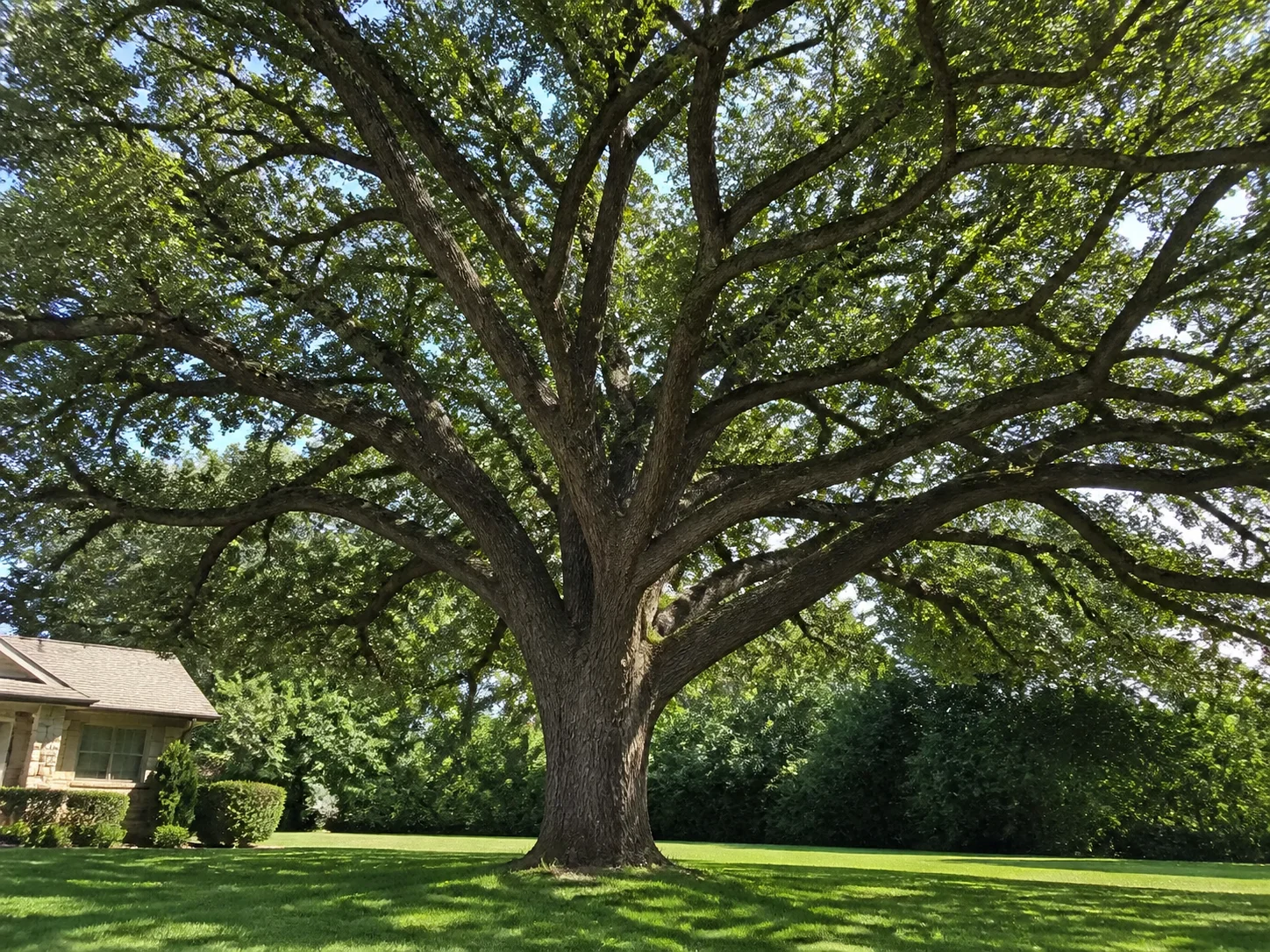
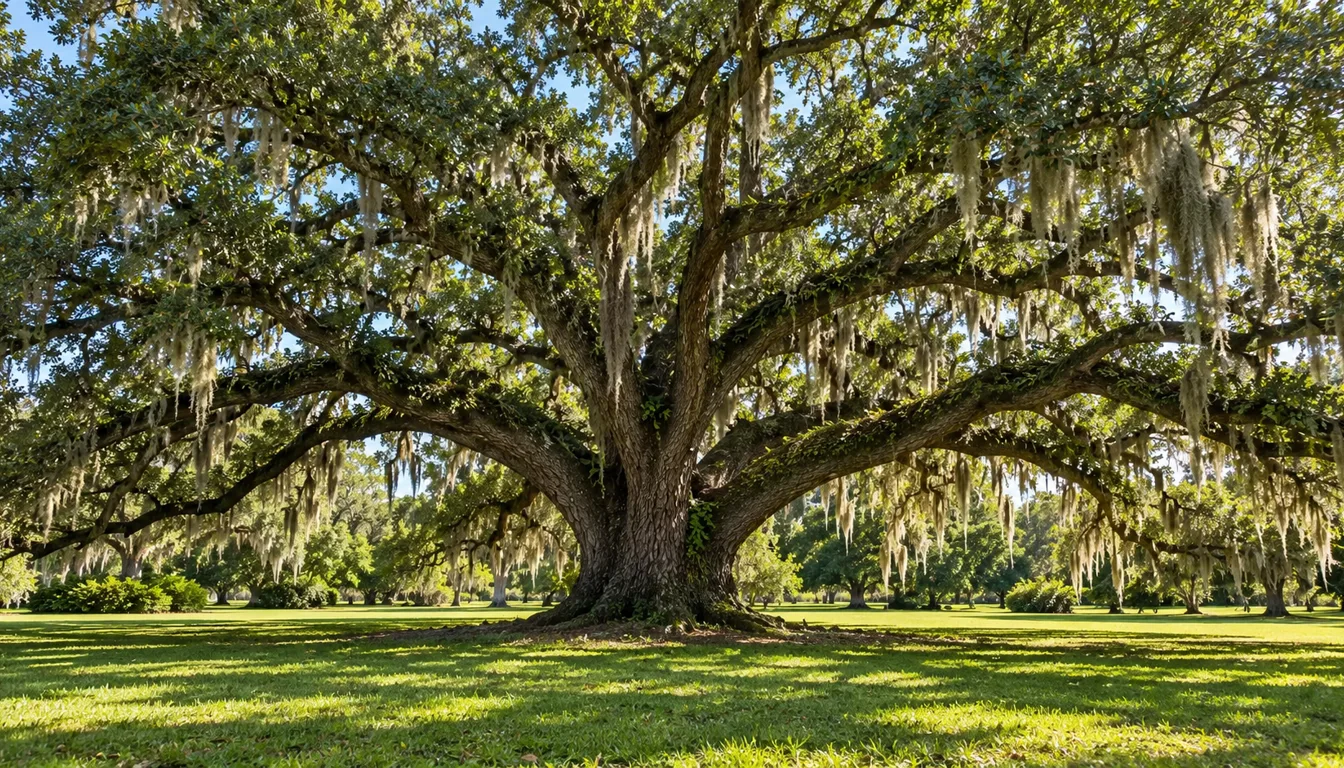
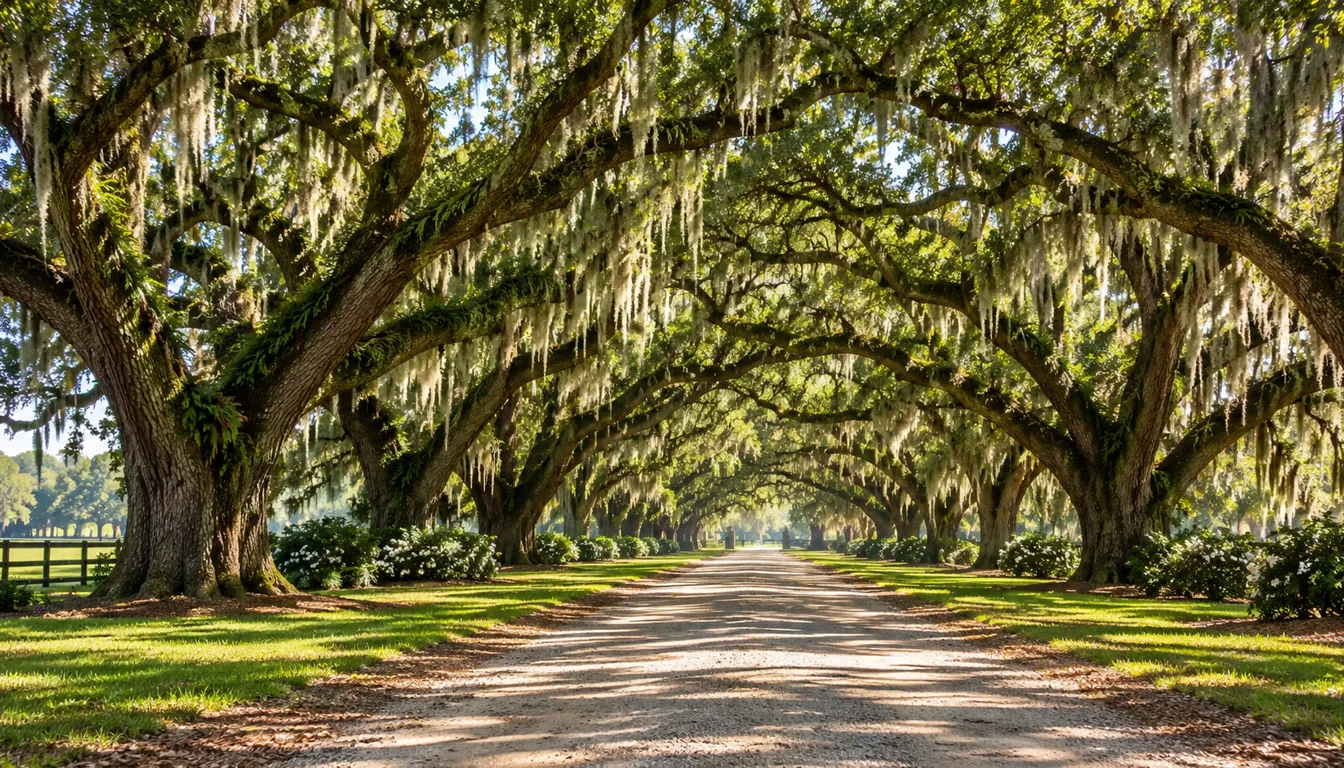
Southern live oak (Quercus virginiana) grows on the coastal plains from southeastern Virginia south through Florida and west to eastern Texas, and the extension sources disagree on its size. NC State gives 40 to 80 feet tall and says the tree rarely grows over 50 feet, with gnarled branches that reach 40 to 100 feet wide.
UF/IFAS reads larger, at 60 to 80 feet tall with a 60 to 120 foot spread for a tree grown under the right conditions, and says it can survive for centuries. The EDIS sheet lists the leaves as semi-evergreen, and NC State says the tree keeps its old leaves until the new ones begin to leaf out.
Texas A&M's plant clinic calls the spring drop of old leaves normal and no disease, and notes that the tree can look sickly in late January and February, when the old leaves yellow and often spot brown or black. Check for new buds before you worry, as the oak wilt section below explains.
- Height
- 40 to 80 ft (NC State), rarely over 50 ft; 60 to 80 ft (UF/IFAS)
- Spread
- 40 to 100 ft (NC State); 60 to 120 ft (UF/IFAS)
- Leaves
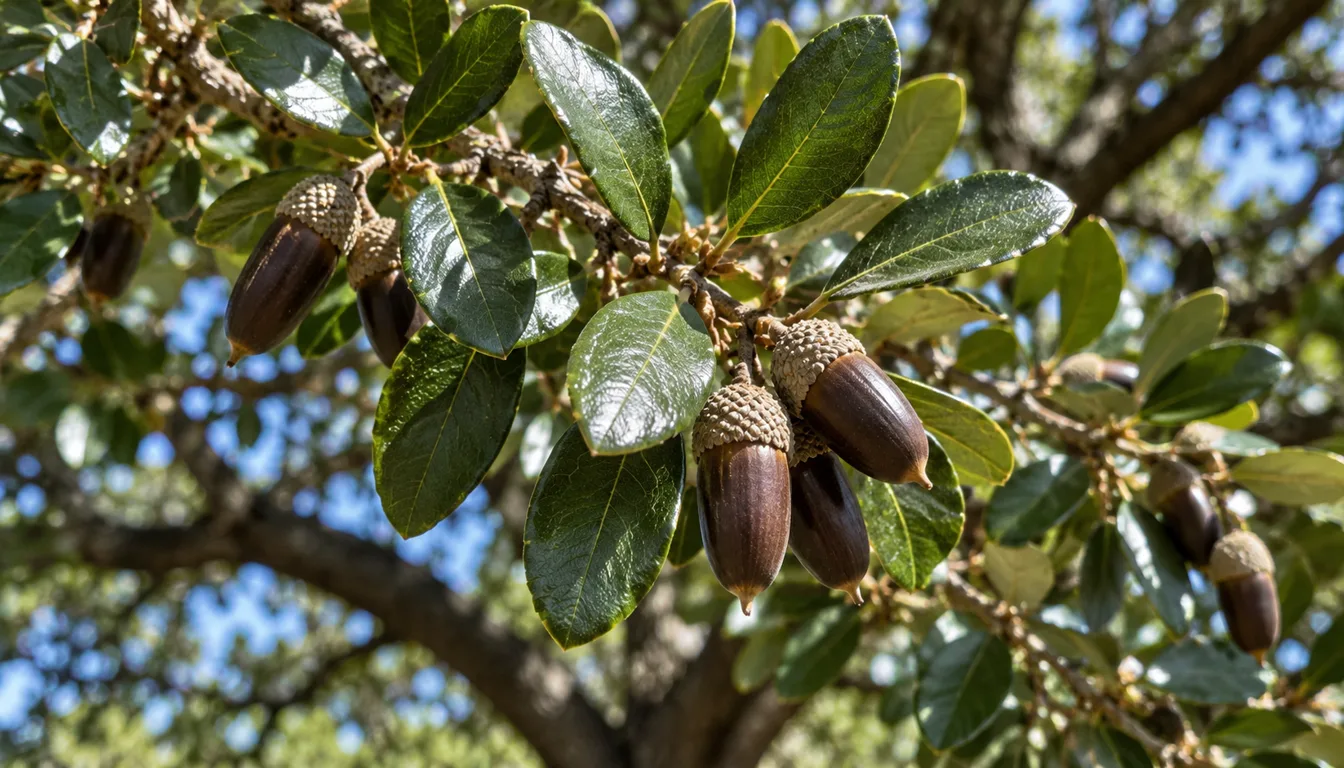
- Held until new leaves open in spring (NC State); 2 to 5 in long, dark green and glossy above, paler beneath (UF/IFAS)
- Acorns
- About 3/4 in, mature in one growing season (NC State, UF/IFAS)
- Lifespan
- Can survive for centuries (UF/IFAS)
- Tolerates
- Wind, salt spray, periodic flooding (NC State); drought and alkaline soil (UF/IFAS)
How Much Room and What Site Does a Live Oak Need?
Roots and crown are what outgrow a home lot. UF/IFAS warns that roots planted too close to curbs, sidewalks or driveways may eventually grow large enough to lift and crack them, and that a live oak should not go near or under utility lines or light posts.
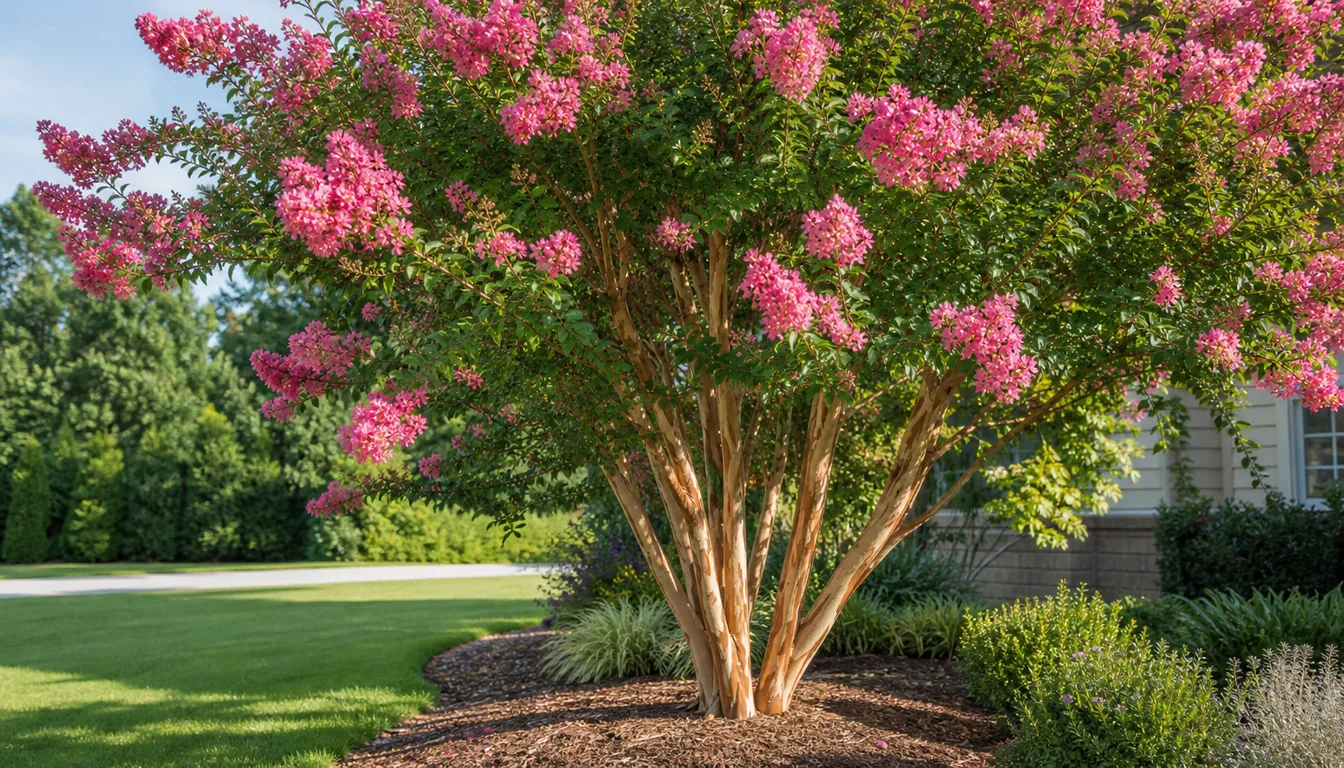
NC State lists more than 60 feet of planting space, so a small front yard is the wrong place for one. On a small lot, a crepe myrtle is the better fit, since NC State sizes it at 6 to 30 feet high and wide depending on the variety.
Inside that space the tree asks little of the soil and the weather, according to UF/IFAS and NC State.
- Light. Full sun to partial shade.
- Soil. It grows best in moist, acidic sand, loam or clay and also tolerates alkaline soil (UF/IFAS).
- Water and weather. It tolerates drought and salt (UF/IFAS), periodic flooding and salt spray (NC State), and NC State rates it resistant to wind, salt and storm damage.
- Hardiness. Zones 7b through 10b (UF/IFAS) or 8a through 10b (NC State).
UF/IFAS says an established tree has very good wind resistance, and NC State lists it for coastal landscapes. In fire-prone areas, NC State rates the tree highly flammable and says to keep it out of the defensible space around your house. For any oak, the oak guide covers how to plan crown and root space.
How Do You Plant and Prune a Young Live Oak?
Clemson, writing for South Carolina, says a container-grown tree can go in at any time of year but is best planted in fall, because roots in the Southeast keep growing through the warm fall and winter months. That extra root growth may lessen how much the tree depends on watering the following summers.
Planting and the first two years follow this order.
- Set the root ball so its topmost roots are level with the soil surface, and check that no extra soil or potting mix covers them, since as little as half an inch of excess soil can keep water from entering the root ball (Clemson).
- Spread 2 to 4 inches of organic mulch over the planted area, and keep it from touching the trunk (Clemson).
- For the first 2 weeks, check the soil daily and water deeply if the top 6 inches feel dry, then check at least once a week for two years (University of Maryland Extension).
Maryland also warns that many people have drowned newly planted trees by watering them too often, so learn the signs of overwatering trees while you water through those first two years.
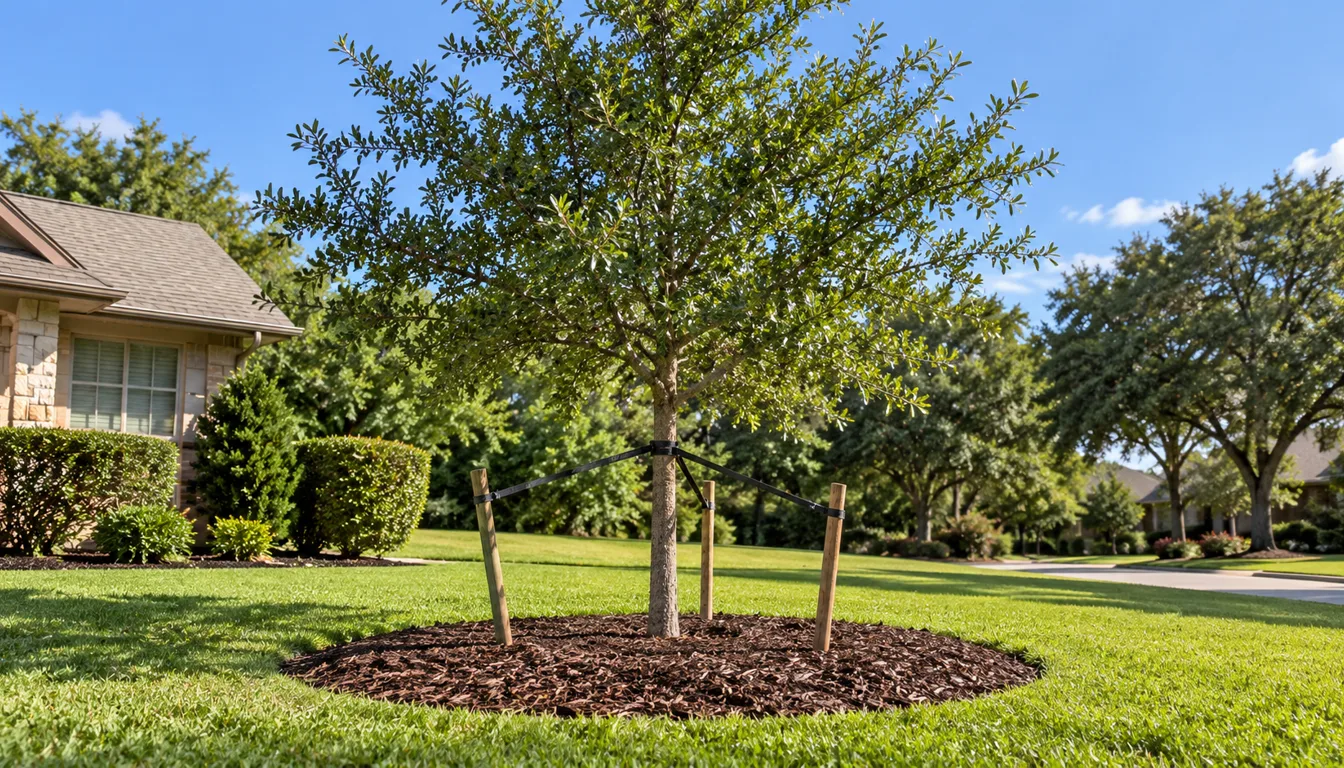
Left alone, live oak becomes multi-trunked with many winding branches. UF/IFAS says to remove the extra trunks that compete with the leader and the branches that form a narrow angle with the trunk, because those are likely to split from the tree as it ages. A dominant central leader gives the tree strong branch attachments, which UF/IFAS says helps minimize wind damage.
UF/IFAS gives two pruning schedules, and EDIS adds that one of the biggest problems with live oak in cities is the lack of pruning.
- Gardening Solutions. Every year for the first five years, then every three years until the tree is 30.
- EDIS fact sheet. Every year for the first three years, then every five years to age 30.
Make each cut just outside the branch collar, the swollen area where branch and trunk wood meet, and do not remove more than 25% of the crown at one time (Texas A&M Forest Service). Pick the dates with when to prune trees in mind, because both Texas A&M and UF/IFAS tell you to avoid cutting oaks in the oak wilt season described below.
Does Oak Wilt or Spanish Moss Threaten a Live Oak?
UF/IFAS describes live oak as usually free of serious pests, with occasional galls, scales, aphids or boring insects, and young or weakened trees are more susceptible to pests. The disease to know is oak wilt, a fatal fungal disease that UF/IFAS says is found primarily in Texas.
The fungus invades the water-carrying vessels of the tree, the tree responds by plugging them, and live oaks show intermediate susceptibility (Texas A&M Forest Service). Underground, it moves through connected roots at an average of 75 feet per year, mostly among live oaks, and that route causes most of the spread and tree deaths in Central Texas. Above ground, sap beetles carry spores to fresh wounds, and they are very active in late winter and early spring.
Oak wilt shows in live oaks as yellow and brown veins on the leaves, but spring is a hard time to read them because the tree is shedding old leaves while it grows new ones. Texas A&M's plant clinic says oak wilt symptoms are most often seen in summer, and gives a way to sort normal leaf drop from a real problem.
- Normal leaf drop. Tiny new buds sit at the base of each dying leaf's stalk, and new leaves appear shortly after the old leaf drops.
- A dead branch. No buds, and the branch snaps brittle and is brown inside instead of greenish-white.
- More than 10% of the branches dead. Talk to a certified arborist or your county Extension office.
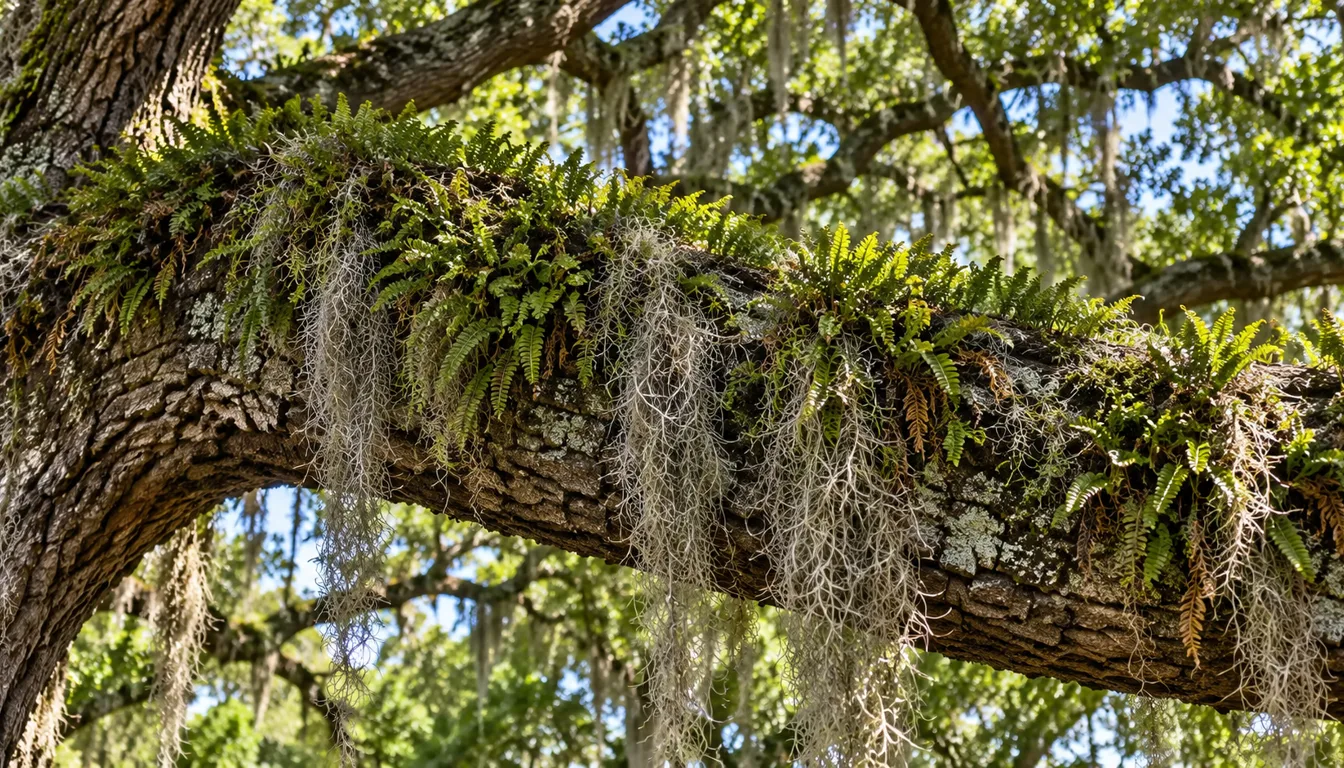
Spanish moss and resurrection fern on the limbs are a separate matter. UF/IFAS calls Spanish moss a flowering epiphyte, a plant that grows on another plant for support and gets all of its nutrients from the air and rainwater, and says it does not kill trees.
A heavy covering can shade leaves, slow growth and break branches, but the impact on a healthy tree is minimal. A UF/IFAS Brevard County extension agent says the resurrection fern does not harm the tree either.
- Lifted pavement and cracked curbs point to roots planted too close (UF/IFAS).
- Limbs that split after storms can trace back to multiple trunks or narrow branch angles (UF/IFAS).
- Wilting, browning leaves in Texas call for an oak wilt check, and Texas A&M says to contact a certified arborist if you are unsure.
Which Wildlife Use Live Oak, and Is It Toxic to Horses?
NC State lists live oak as a host plant for imperial moth larvae and for the banded, Edward's, gray and white-M hairstreaks and the Horace's and Juvenal's duskywings. Its acorns are eaten by woodpeckers, blue jays, small mammals, wild turkeys and ducks, and NC State rates the tree resistant to damage by deer.
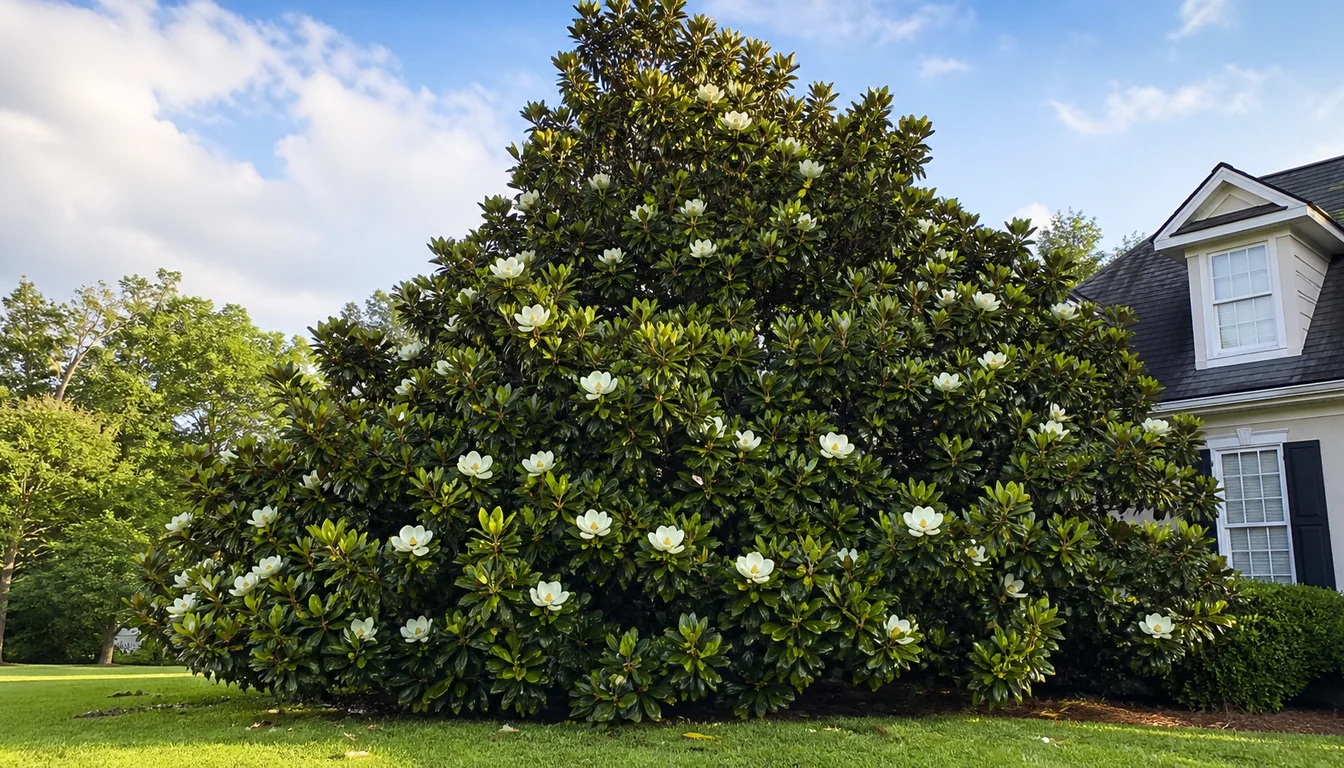
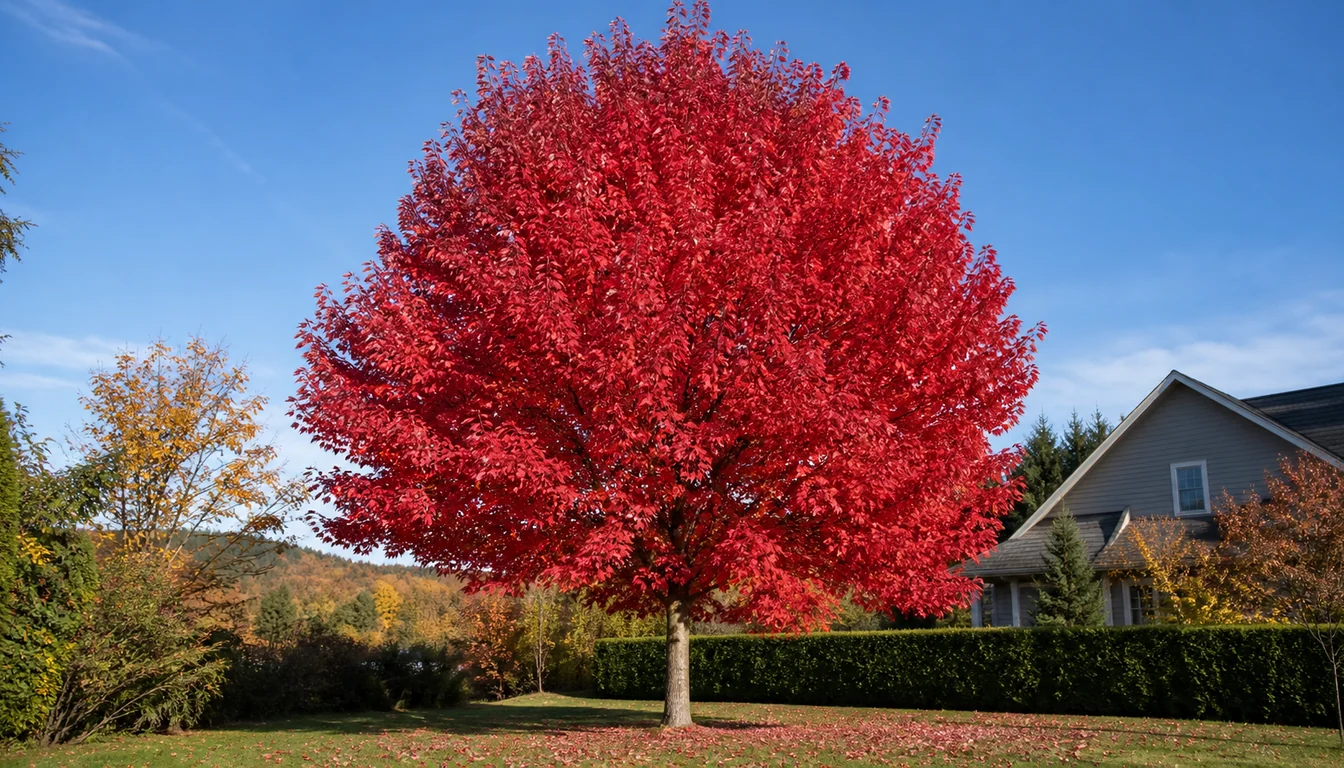
Southern magnolia is a large broadleaf evergreen for the same big Southern yards, growing 60 to 80 feet tall and 20 to 40 feet wide (NC State). The shade trees list covers other large options, including red maple, which NC State says grows fairly fast in medium to wet soil.
Frequently Asked Questions
How fast does a live oak grow?
UF/IFAS rates the growth rate as moderate, and says young trees grow about three feet a year with the trunk adding about an inch in diameter under nursery conditions. The tree can survive for centuries.
How far from a house should I plant a live oak?
Give it more than 60 feet of planting space (NC State), since UF/IFAS puts the spread at 60 to 120 feet. Its roots can lift curbs, sidewalks and driveways in time, and it should stay away from utility lines. NC State also says to keep it out of the defensible space around a house in fire-prone areas.
Does a live oak lose its leaves?
It drops its old leaves in spring as new ones emerge, so it is green almost all year. Texas A&M's plant clinic calls this leaf turnover normal and no disease problem.
Is Spanish moss bad for live oaks?
Not to a healthy tree. UF/IFAS says Spanish moss grows on trees without being a parasite and does not kill them, and that a heavy covering can shade leaves, slow growth and break branches but has minimal impact on healthy trees. A UF/IFAS Brevard County extension agent says resurrection fern does not harm the tree either.
Are live oak acorns poisonous to horses?
Yes. The ASPCA lists oaks as toxic to horses, and NC State says the poisoning comes from eating young leaves or raw acorns.
What zone does live oak grow in?
UF/IFAS lists Zones 7b through 10b, and NC State lists 8a through 10b. Both describe a tree of the Southeast and Gulf coasts.
Sources & References
- Live Oaks, UF/IFAS Gardening Solutions
- Quercus virginiana: Southern Live Oak, UF/IFAS EDIS ENH-722
- Quercus virginiana, North Carolina Extension Gardener Plant Toolbox
- Live oak dropping leaves in early spring, Texas A&M AgriLife Extension Plant Disease Diagnostic Lab
- Prevent the Spread of Oak Wilt in Texas, Texas A&M Forest Service
- Pruning Mature Trees, Texas A&M Forest Service
- Planting Trees Correctly, Clemson Cooperative Extension Home and Garden Information Center
- Watering Trees and Shrubs, University of Maryland Extension
- Spanish Moss, UF/IFAS Gardening Solutions
- The Oak, the Moss, and the Fern, UF/IFAS Extension Brevard County
- Oak, ASPCA Toxic and Non-Toxic Plants
- Magnolia grandiflora, North Carolina Extension Gardener Plant Toolbox
- Lagerstroemia indica, North Carolina Extension Gardener Plant Toolbox
- Acer rubrum, North Carolina Extension Gardener Plant Toolbox