
How to Stop Powdery Mildew From Taking a Watermelon Canopy
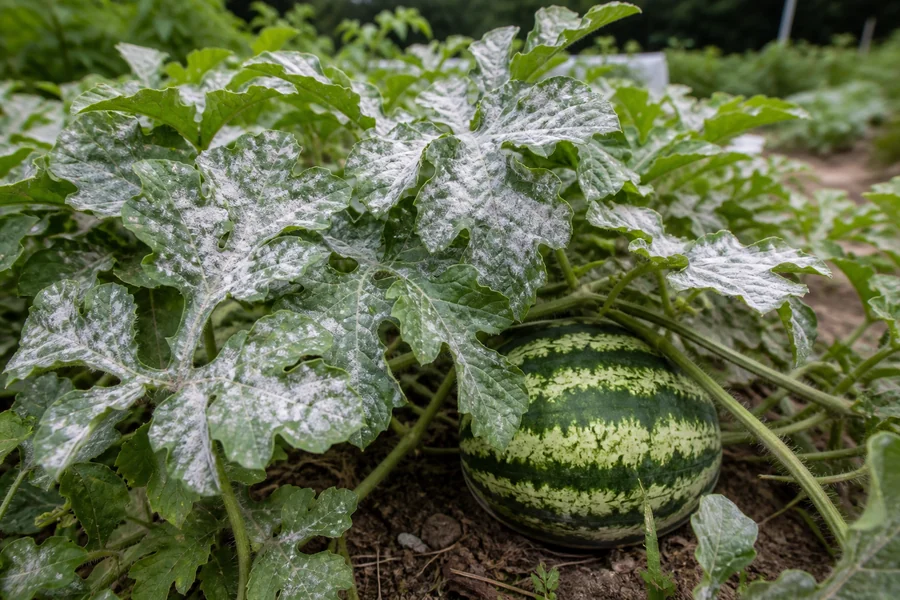
White floury colonies that expand across older watermelon leaves fit powdery mildew.
Confirm that the material sits on the surface, preserve enough green canopy to feed and shade fruit, then use cultural changes and a product specifically labeled for edible cucurbits when treatment is warranted.
Quick diagnosis
Look for expanding surface colonies on older leaves
Powdery mildew begins as separate white patches that merge into a dusty coating on upper and lower leaf surfaces and petioles. Normal rind or leaf pattern stays within the tissue, spray residue follows droplets, and downy mildew starts with angular yellow lesions bounded by veins rather than a uniform floury film.
Open the full diagnosisWhat You Are Seeing
The disease often becomes obvious after vines have filled their space and fruit are sizing.
At that stage, the goal is enough healthy leaf area to keep fruit growing and protected from direct sun, not a cosmetically perfect vine.
Powdery mildew fungi produce surface colonies and airborne spores. They can infect without free water on leaves, so switching irrigation methods supports a healthier root zone but does not replace disease scouting or a treatment decision.
Old infected tissue will not turn fully green after control improves. Slower expansion and cleaner new leaves are the useful evidence that management is working.
Common Causes
01 Most likely
Cucurbit powdery mildew is colonizing the leaf surface
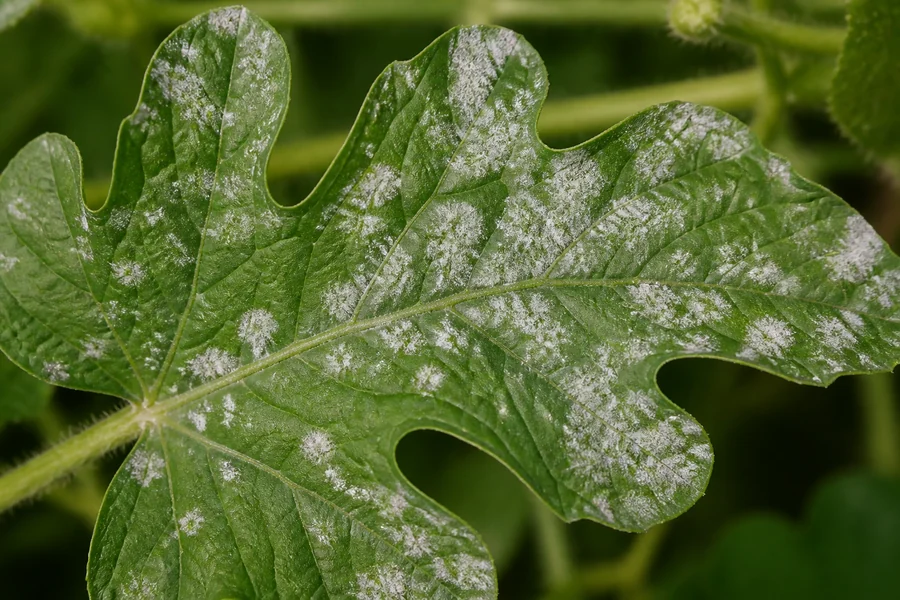
Several powdery mildew fungi infect cucurbits and produce white spore-bearing growth on living leaf surfaces. Wind moves spores through a patch, and visible colonies can expand quickly once susceptible foliage and favorable humidity coincide.
How to identify it
- Small round white colonies enlarge and merge instead of remaining fixed droplet marks.
- Growth appears on both leaf surfaces and may extend onto petioles or stems.
- Older shaded leaves are often affected before the youngest tips.
- Heavily covered leaves yellow, crisp, and lose function.
- Nearby squash, cucumber, or melon foliage may show a similar surface coating.
What to do
- Confirm the pattern on several leaves before treating the crop.
- Remove only leaves that are heavily covered or no longer functioning.
- Begin label-directed control while enough green canopy remains to protect fruit.
- Scout both leaf surfaces because missed colonies continue producing spores.
- Clean up infected cucurbit debris after the crop finishes.
02 Common contributor
A dense aging canopy hides the first colonies
Watermelon runners overlap as the crop matures, creating shaded interior leaves that are hard to inspect and spray. Density does not create the pathogen, but it delays detection and makes even coverage difficult.
How to identify it
- The oldest inner leaves carry more colonies than open runner tips.
- Vines cross in layers and inspection requires lifting healthy foliage.
- Powder is concentrated near the crown or beside a fence and tall crop.
- Spray reaches exposed tops but lower and interior surfaces remain untreated.
- Fruit is already present, so aggressive thinning would expose it to sun.
What to do
- Guide movable runners apart without repeatedly twisting their bases.
- Remove dead and heavily infected leaves first instead of opening the whole canopy at once.
- Keep healthy leaves over fruit as shade while creating access for inspection.
- Plan wider spacing next season using the variety's expected runner length.
- Inspect from the bed edge and crown so interior colonies are not missed.
03 Seasonal
Variety susceptibility and late-season pressure favor spread
Resistance varies among watermelon cultivars and may be partial rather than absolute. A susceptible planting can develop disease as nights lengthen and inoculum builds even when its spacing and irrigation are reasonable.
How to identify it
- One cultivar is consistently worse than another grown under the same conditions.
- Disease begins late after a long period of healthy growth.
- New leaves acquire colonies soon after older infected leaves are removed.
- Nearby cucurbit crops show increasing powdery mildew pressure.
- Seed descriptions list no powdery mildew resistance or name a different race.
What to do
- Record the cultivar and outbreak timing for the next seed choice.
- Choose resistance described for powdery mildew while recognizing that scouting is still required.
- Rotate fungicide modes of action when the label and local guidance call for rotation.
- Avoid saving heavily diseased debris in the production bed.
- Protect current healthy foliage according to harvest timing rather than trying to restore dead leaves.
04 Supporting factor
Vine stress reduces the canopy's buffer
Drought, saturated roots, nutrient imbalance, or heavy pest injury does not manufacture powdery mildew, but it leaves fewer functional leaves to lose. A stressed vine reaches the fruit-quality threshold sooner when disease removes additional leaf area.
How to identify it
- Wilting or root-zone trouble began before extensive white growth.
- Fruit load is high while the remaining green canopy is small.
- Leaves show chewing, nutrient symptoms, or drought injury alongside mildew.
- The bed has dry and saturated pockets under the same irrigation pattern.
- New growth remains weak even where powdery colonies are sparse.
What to do
- Check moisture below mulch and correct irrigation from soil evidence.
- Use the vegetable watering checks instead of frequent surface sprays.
- Address confirmed pests or root problems separately from the fungal treatment.
- Do not add heavy fertilizer to force replacement leaves without soil evidence.
- Prioritize healthy tissue and maturing fruit when deciding whether continued treatment is worthwhile.
Protect Function, Not the Appearance of Old Leaves
Powdery colonies reduce the light a leaf can use and eventually hasten yellowing and death. A vine can tolerate scattered infection, but extensive defoliation while melons are filling can reduce sugar production and leave rind exposed to sun injury.
Removing every marked leaf can cause the same practical loss as the disease. Keep leaves that remain mostly green and continue shading fruit unless their disease level makes them a strong source of spores or they are already collapsing.
Treatment protects uninfected or lightly infected tissue better than it restores heavily colonized leaves. Evaluate the boundary of each patch and the condition of new growth rather than rubbing old powder repeatedly to see whether it returns.
Fruit usually does not carry the conspicuous leaf coating, but canopy loss affects its environment. Reposition loose shade or retain healthy foliage over exposed melons instead of applying an unapproved product to fruit.
Test the White Patch Before Treating
Inspect a fresh patch in angled daylight and compare several leaves. Powdery mildew looks superficial and floury, but a rub test alone is not decisive because dust and dried sprays can also move under a finger.
Follow the patch over time.
Living colonies enlarge beyond their first boundary and appear on newly affected leaves, while one splash mark or mineral deposit stays tied to its original droplet pattern.
- Powdery mildew
- White surface colonies enlarge and merge on upper or lower leaf surfaces.
- Downy mildew
- Angular yellow to brown lesions stop at veins, with growth mainly beneath affected tissue.
- Spray residue
- Marks follow droplets or coverage and do not spread as independent colonies.
- Dust or soil splash
- Coating matches exposed surfaces and environmental dirt rather than expanding patches.
- Spider mites
- Fine pale stippling and webbing appear instead of a floury fungal layer.
When the evidence remains mixed, use the white-spots diagnostic guide to broaden the check before applying a fungicide.
Protect the Leaf Area Still Feeding Fruit
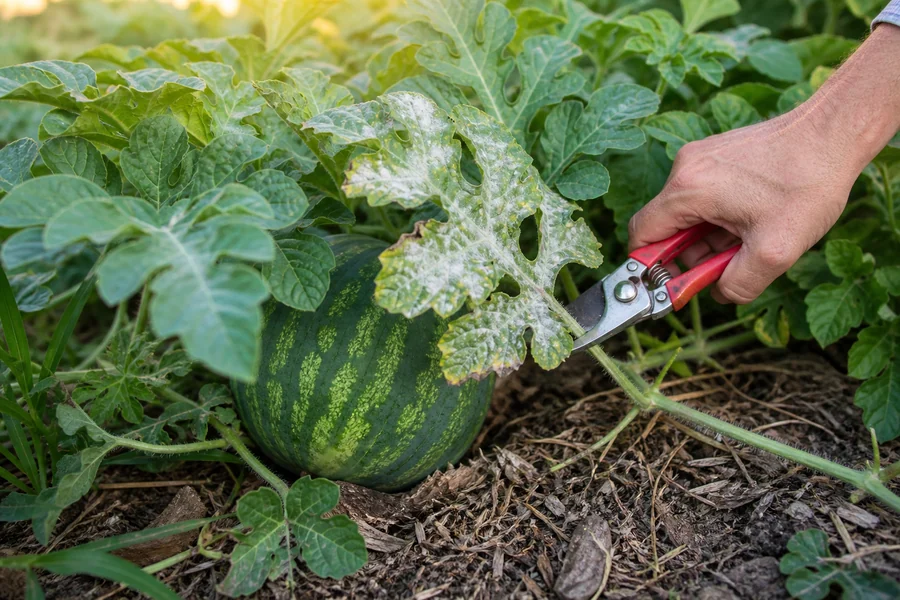
Rank leaves by function before cutting. A crisp leaf covered edge to edge contributes little, while a mostly green leaf with a few colonies may still feed and shade the crop.
- Locate fruit and identify which healthy leaves currently shade each one.
- Remove dead leaves and the most heavily colonized older leaves first.
- Cut at the petiole without tearing nearby runners or opening a large hole above fruit.
- Bag or move infected material out of the production row rather than shaking it through clean foliage.
- Reassess airflow and spray access before removing another layer.
- Mark the disease boundary and inspect new leaves after the next treatment interval on the label.
Sanitation has diminishing returns. Once removal would expose fruit or leave too little green area, stop cutting and protect the canopy that remains.
The drip-versus-sprinkler comparison can help redesign irrigation, but powdery mildew can develop on dry foliage. Choose the system for root-zone consistency and practical canopy access rather than treating leaf wetness as the sole cause.
Choose a Label, Not a Kitchen Recipe
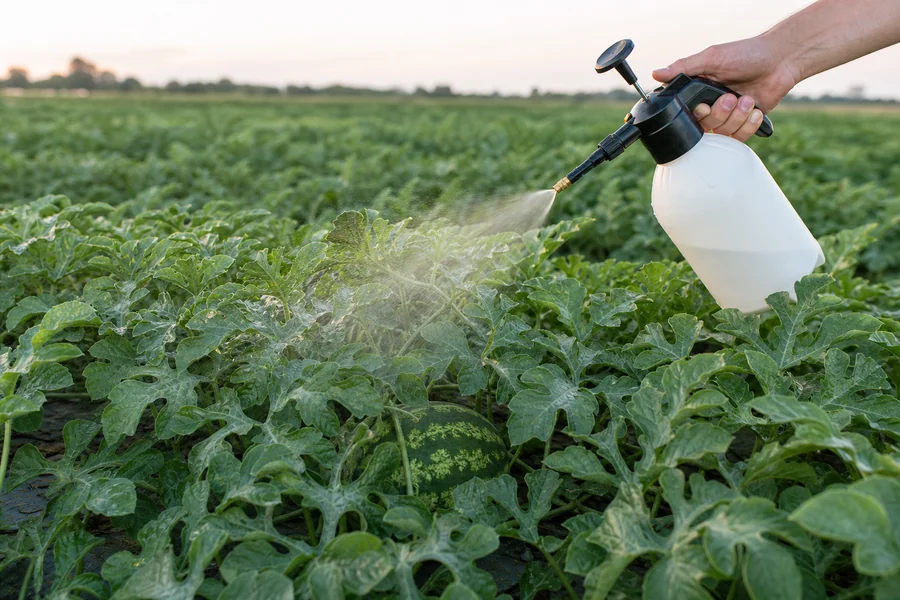
Use only a fungicide or biofungicide whose current label permits the crop, disease, site, and intended harvest use. The active ingredient name alone is not enough because formulations and legal uses differ.
Protectants work best before colonies cover most of the canopy. Rotate modes of action when directed to slow resistance, and do not substitute a homemade milk, soap, oil, or baking-soda recipe for a tested label.
Apply the coverage the label requires, including lower surfaces when specified, during suitable weather. Avoid drift, high heat, incompatible mixtures, and heavy runoff.
Treatment success means the disease advances more slowly and new foliage stays cleaner. Existing white patches and dead tissue can remain visible after spore production is suppressed.
Recovery Plan
Confirm and mark the disease edge
Compare surface colonies with residue and vein-bounded lesions, photograph or mark the outermost affected leaves, remove only nonfunctional tissue, and read the entire label before any application.
Judge spread on new tissue
Old patches may remain white.
Cleaner new leaves, fewer new colonies, and a stable disease boundary show useful control, while rapid expansion calls for a coverage, timing, resistance, or diagnosis review.
Keep enough canopy over fruit
Continue scouting and protect functional leaves according to the label and harvest timing. When the canopy is largely lost or fruit are nearly finished, weigh further treatment against remaining crop value and remove debris after harvest.
Select powdery-mildew-resistant watermelon cultivars when available, give runners their intended space, scout interior older leaves before fruit fill, and keep vines vigorous with measured root-zone care. Remove infected crop debris and rotate beds where practical, while recognizing that airborne spores can still arrive from outside the garden.