
Powdery Mildew on Zucchini: Can the Plant Still Produce?
A zucchini plant with a few powdery mildew colonies can keep flowering and producing if most of its canopy remains green.
Confirm the fungus first, protect clean leaves early, and judge whether treatment is still worthwhile from the amount of healthy foliage and warm growing time left.
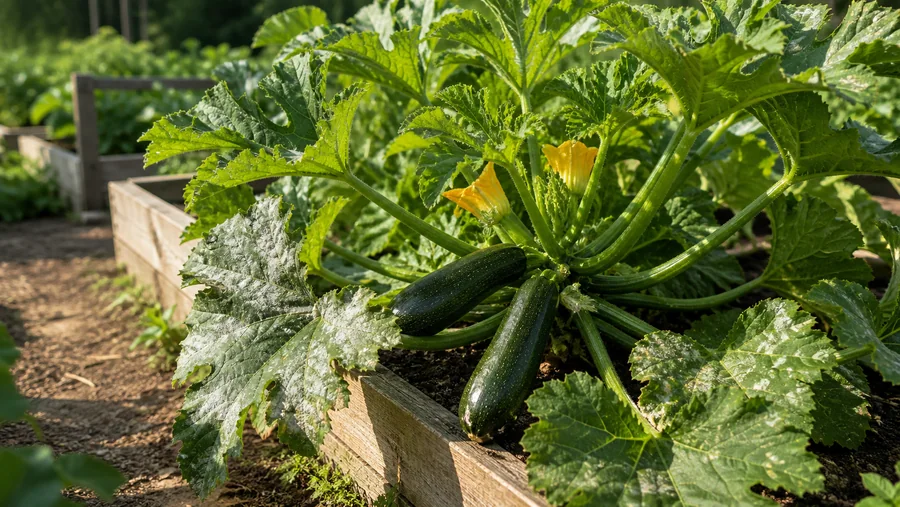
Quick diagnosis
Powdery mildew when raised white patches cross the leaf veins
Rub one small white patch with a damp dark cloth, then look at the leaf pattern around it.
Powdery mildew leaves a loose white or gray residue and forms irregular colonies that cross veins, while healthy Zucchini silvering is flat inside the leaf and repeats in sharp angles along the veins. Turn the leaf over as well because true colonies can occur on both surfaces and often begin on older shaded leaves.
Open the full diagnosisWhat You Are Seeing
Do not pull a productive Zucchini plant because one lower leaf looks dusted. A limited outbreak can be slowed enough to protect the clean canopy, but a plant with nearly every leaf covered has too little healthy tissue for a spray to restore.
Powdery mildew on cucurbits is caused mainly by Podosphaera xanthii, though another closely related fungus can produce the same visible disease. Wind carries spores into the bed, and colonies can expand during warm dry weather after humid nights even when rain and overhead watering are absent.
The practical goal is to keep new colonies off green leaves for the remaining harvest period. Existing white growth will not disappear from damaged tissue, so success means slower spread, firm new leaves, covered fruit, and continued flowering rather than a spotless old canopy.
Common Causes
01 High likelihood
True powdery mildew colonies
Early powdery mildew looks like scattered floury circles on mature zucchini leaves. The colonies enlarge, join across veins, and may reach lower leaf surfaces, petioles, and stems while the tissue beneath them turns pale yellow and eventually brittle.
Look first at older leaves inside the crown where shade and still humid air last longest.
A random raised coating that transfers to a damp cloth supports mildew, while a flat silver pattern that appears symmetrically in the leaf tissue does not.
How to identify it
- Loose white or gray material sits on the leaf surface rather than inside the tissue.
- Irregular colonies cross veins and expand beyond their first circular spots.
- Older shaded leaves usually show the first clear colonies.
- Heavy infection yellows and dries leaves and can spread onto petioles or stems.
What to do
- Mark two or three clean upper leaves and inspect them every few days so you can judge spread rather than stare at old damage.
- Remove only leaves that are heavily colonized or already brittle, using clean pruners and leaving enough green canopy to shade the fruit.
- Open the plant gently by controlling weeds and moving neighboring foliage rather than cutting a large group of useful leaves at once.
- Protect remaining green tissue with a product labeled for powdery mildew on squash or cucurbits when the infection is still limited.
02 High likelihood
Natural silver mottling in zucchini leaves
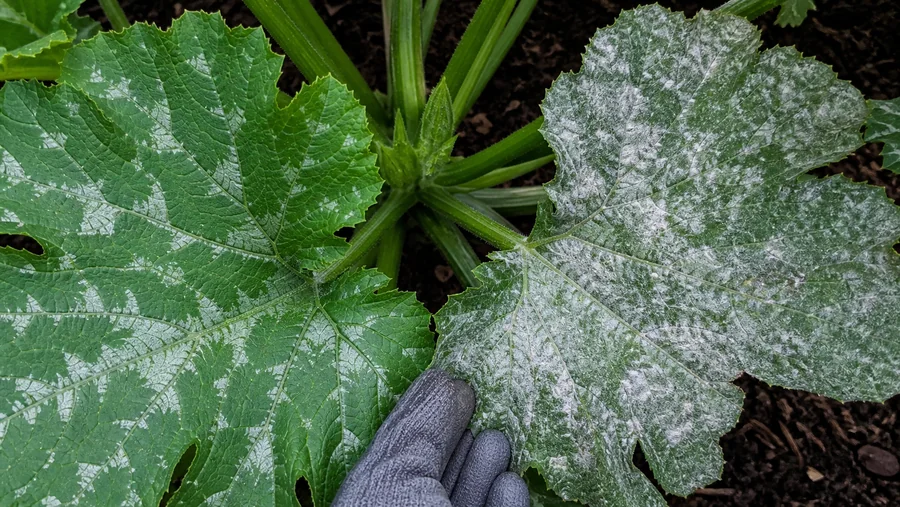
Many zucchini varieties produce pale silver areas as a normal leaf trait. The color lies flat within the blade, follows major veins or forms repeated angular patches, and stays in the same place as the leaf expands.
Healthy mottling does not rub onto a cloth, create fuzzy edges, or spread from one leaf to nearby petioles. A normally patterned leaf remains firm and productive, so spraying or removing it would reduce the canopy for no benefit.
How to identify it
- Silver areas have crisp boundaries that follow the vein network.
- The leaf surface feels like the surrounding green tissue and has no loose coating.
- Several leaves show a similar balanced pattern without yellowing or brittle edges.
- New marks do not appear as enlarging round colonies over several days.
What to do
- Leave the leaf attached and photograph its pattern for comparison later in the week.
- Check one older shaded leaf and one newer exposed leaf before deciding the whole plant is affected.
- Avoid preventive spraying based only on flat silver color because unnecessary products can injure foliage or useful insects.
- Return to the mildew branch only if raised material, spreading colonies, yellow tissue, or stem growth appears.
03 Medium likelihood
Downy mildew with angular lesions below the leaf
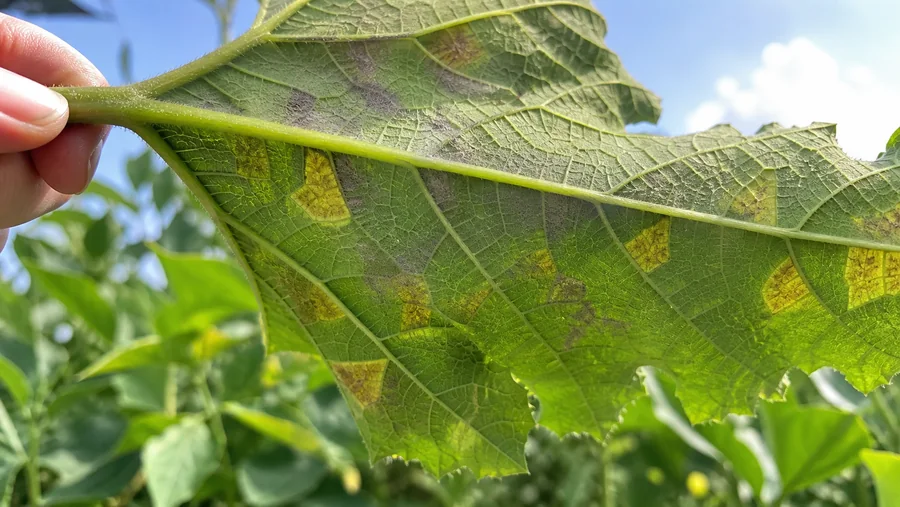
Cucurbit downy mildew shares part of the name but produces a different pattern. The upper surface develops pale yellow areas that are often trapped between veins, while the corresponding underside may carry gray, brown, or purple fuzzy growth during humid weather.
Powdery mildew presents visible white colonies on the surface and can occur on both sides without the same angular yellow map. If the leaf is collapsing quickly after wet weather and the strongest growth is underneath, use a local extension diagnostic source before choosing a product.
How to identify it
- Yellow or brown lesions form angular shapes bounded by leaf veins.
- Gray-purple fuzzy growth appears mainly on the underside opposite those lesions.
- Leaves may collapse quickly during cool humid or rainy conditions.
- A simple wipe does not reveal the loose floury colony expected from powdery mildew.
What to do
- Photograph both sides of a fresh affected leaf before it dries or collapses.
- Avoid treating from the shared word mildew because products and timing may differ.
- Remove severely collapsed tissue without carrying it through healthy cucurbit foliage.
- Seek a regional diagnosis when downy mildew is suspected because outbreaks and recommendations change by location.
04 Medium likelihood
Dried water, mineral, clay, or spray residue
Hard-water droplets, foliar products, and kaolin clay can dry into pale spots that resemble the first day of mildew.
Residue usually matches a splash or nozzle pattern, appears on many surfaces at once, and lacks the soft spreading edge of a living colony.
Wipe a small test area with plain water and watch the same leaf for several days. Residue that cleans away and does not return without another application needs no disease treatment, while fresh round colonies on nearby leaves support an active infection.
How to identify it
- Dots follow droplet outlines or cover fruit, mulch, stakes, and leaves in the same direction.
- The marks appeared soon after irrigation or a foliar application.
- Leaf tissue below the deposit remains firm and evenly green.
- The cleaned test area stays clear and no new colony edge develops.
What to do
- Rinse only the small test patch needed for diagnosis instead of washing spores across the full plant.
- Review what was sprayed and whether the product was mixed and applied according to its label.
- Move irrigation to the soil line when repeated mineral spotting makes inspection difficult.
- Treat for mildew only when new biological growth appears after residue has been ruled out.
05 Low likelihood
Spider mite or thrips feeding scars
Sap-feeding pests remove color from individual cells rather than laying powder on the leaf. Spider mites create many tiny pale dots and may leave fine webbing below the leaf, while thrips can produce narrow silver scars with small black waste spots.
Use a hand lens or tap the leaf over white paper before reaching for a fungicide. Feeding damage stays embedded in the blade and will not wipe away, and finding moving pests or webbing changes both the treatment and the inspection area.
How to identify it
- Pale stippling or narrow silver scars sit inside the leaf tissue.
- Fine webbing collects near veins, petioles, or protected leaf folds when mites are numerous.
- Tiny moving pests or black specks appear on the underside under magnification.
- No raised white colony spreads across veins or onto zucchini stems.
What to do
- Confirm the pest on several leaves before choosing any treatment.
- Remove a badly damaged leaf only when enough healthy canopy remains to shade the fruit.
- Use a product labeled for the identified pest and edible squash, then follow its coverage and harvest directions.
- Reinspect eggs, young pests, and nearby cucurbits because one application may not cover every life stage.
Dry weather after a humid night can speed the disease
Powdery mildew differs from many leaf diseases because it does not need a film of water to infect zucchini tissue.
A humid canopy can support infection, then warm dry air helps new spores form and travel from established colonies.
This is why changing from a sprinkler to drip irrigation does not cure an existing outbreak by itself. Soil-level watering still helps keep the bed predictable, but spacing, sunlight, weed control, moderate nitrogen, early scouting, and protection of clean tissue address the larger disease cycle.
Older leaves often show symptoms first because they sit inside the shaded crown after the plant has begun producing. Dense foliage, neighboring vines, weeds, shade, and lush nitrogen-fed growth create more sheltered leaf area where a small colony can escape notice.
Zucchini fruit is not directly infected by this powdery mildew, yet the canopy loss still matters. A weak plant may set fewer or smaller fruit, and exposed squash can suffer sunscald when too many leaves yellow, dry, or are removed.
Decide Whether to Keep Treating or Remove the Plant
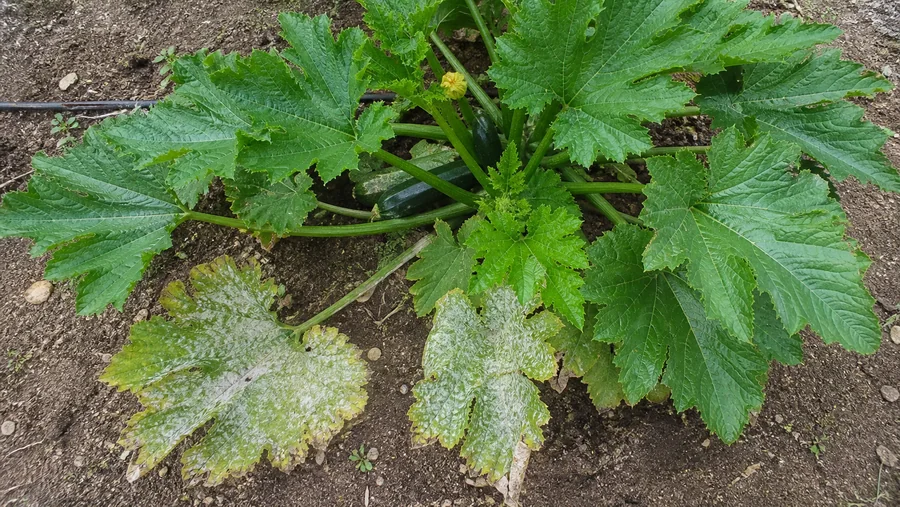
Keep an early outbreak in perspective. If only a few older leaves carry colonies and the crown is still pushing clean foliage around flowers and fruit, selective removal plus protection of healthy tissue can preserve useful harvests.
- A few older leaves affected
- Keep the plant. Remove the worst leaf or two, improve access through the bed, and protect clean tissue early.
- Colonies spreading through the middle canopy
- Keep treating only if a useful area of green foliage and developing fruit remains. Prune gradually and reassess new colonies within several days.
- Most leaves covered, yellow, or brittle
- A spray cannot rebuild the lost canopy. Harvest sound fruit, then remove the plant when little clean foliage or warm growing time remains.
Do not strip every spotted leaf in one session. Zucchini depends on broad leaves to power rapid fruit growth and shield tender squash, so removing a large part of the canopy can cause the damage that treatment was meant to prevent.
The end-of-season decision depends on time as well as appearance.
Protecting a partly healthy plant can be worthwhile with several warm harvesting weeks ahead, while repeated spraying offers little return when your first likely frost is near and the plant has already lost most of its green leaf area.
Choose and Apply a Spray for Edible Zucchini

Start with the product label because the crop is food. The label must list squash, zucchini, or cucurbits and state how much to use, how often it may be applied, what protective equipment is required, and how long to wait before harvest.
Sulfur, potassium bicarbonate, and some horticultural or neem oils are among the lower-impact active ingredients used against powdery mildew. Availability and crop labeling vary, and these products work best while enough green tissue remains to protect rather than after the canopy is fully covered.
A homemade spray is still a chemical mixture touching tender zucchini foliage and food. Kitchen baking soda, milk, soap, vinegar, and mixed recipes do not supply a crop label, tested rate, harvest interval, or reliable protection, so they should not replace a registered product and its directions.
- Read the complete label and confirm that edible squash is listed before mixing anything.
- Test the labeled mixture on a small leaf area when the product permits, then wait for signs of burn before treating the canopy.
- Spray in calm cool conditions and cover the surfaces named by the label without creating heavy runoff.
- Repeat only at the labeled interval because new zucchini leaves emerge quickly and old infected tissue will stay marked.
- Record the product, date, and required preharvest interval so every harvested fruit can be handled correctly.
Coverage matters because contact products protect only the surfaces they reach. Direct the application toward accessible leaf surfaces instead of flooding the center of the crown, and stop when the label says the crop, heat, wind, or harvest timing makes an application unsuitable.
Recovery Plan
Confirm the coating and protect the canopy
Compare texture and vein pattern, inspect both leaf surfaces, and mark clean upper leaves. Remove only heavily colonized or brittle foliage, open access around the crown, and start a labeled protectant only when enough healthy leaf area remains.
Watch for new colonies rather than old stains
Existing patches will remain visible, so use the marked leaves to judge whether fresh powder appears. Slower spread and firm clean growth support the first response, while rapidly expanding colonies call for a label review, better coverage, or a fresh diagnosis.
Protect fruit with useful green leaves
Continue picking zucchini at a tender usable size and leave enough healthy foliage to shade developing fruit.
Expect production to continue when the crown stays vigorous, though a heavily affected plant may make fewer or smaller squash.
Stop when healthy canopy or warm time runs out
Harvest sound fruit that meets every pesticide waiting period, then remove the plant when most leaves are dry or the season can no longer support new growth. Clean tools and clear diseased residue so the next crop does not begin inside an old infected canopy.
Powdery mildew on the leaves does not directly infect zucchini fruit. Sound squash can be harvested and eaten, but discard fruit with soft rot, deep damage, or another sign of decay and obey every pesticide preharvest interval before picking.
For the next planting, choose a zucchini variety advertised with powdery mildew resistance or tolerance, place it in full sun, and give the mature plant the spacing printed for that variety. Keep weeds and neighboring vines from sealing the crown, and use a vegetable fertilizer plan based on real plant or soil need because overly lush growth creates a dense susceptible canopy.
Begin checking older leaves before the usual late-season outbreak instead of waiting for the plant to look white from a distance. At the end of production, remove badly diseased vines and fallen leaves, clean cutting tools, and plan the next zucchini bed for open light and easy inspection.
Sources
- Powdery Mildew of Cucurbits, University of Minnesota Extension
- Powdery Mildew, Utah State University Vegetable Guide
- Powdery Mildew in the Flower Garden, University of Minnesota Extension
- Addressing Downy Mildew and Powdery Mildew in the Home Garden, Penn State Extension
- Insect Control and Horticultural Oils, Colorado State University Extension
- Zucchini Leaves, Ask Extension