
Why a Watermelon Gets a Black Patch at the Blossom End
A dry, dark, sunken patch centered on the end opposite the stem fits blossom-end rot on a developing watermelon.
The fruit lacked a steady calcium supply while that rind tissue was forming, usually because water movement through the roots changed, so the useful repair protects fruit that is still small rather than treating the old scar.
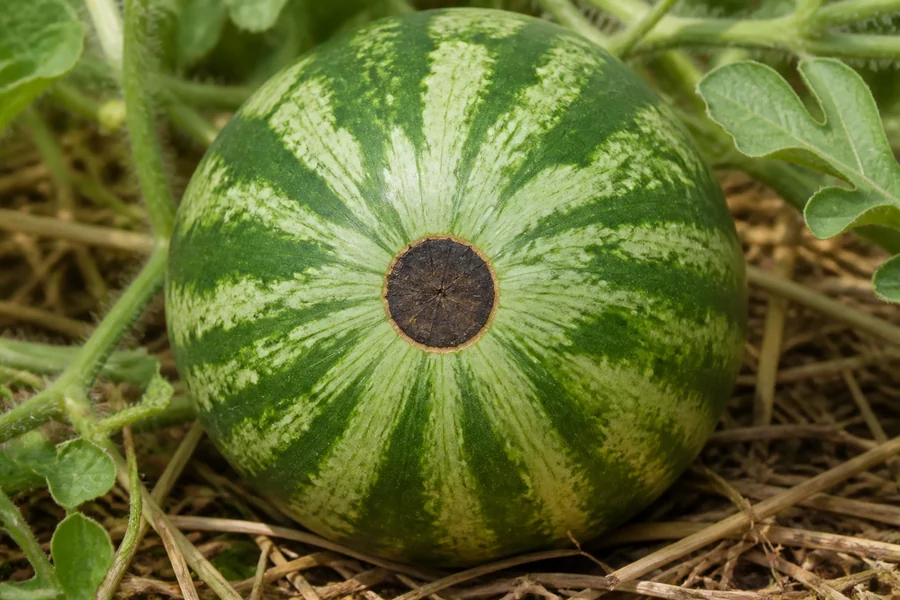
Quick diagnosis
Confirm the blossom scar, then inspect the root zone
Turn the melon without twisting its stem.
A leathery lesion centered on the blossom scar supports blossom-end rot, while damage on the belly where the rind touches wet soil points elsewhere. The symptom does not prove that garden soil lacks calcium, and an amendment is justified only when a soil test identifies the shortage or a pH problem.
Open the full diagnosisWhat You Are Seeing
Blossom-end rot is a physiological disorder rather than an infection moving from melon to melon. Calcium helps expanding cell walls hold together, but the developing fruit receives it only while roots are taking up water and the plant is moving that supply into new tissue.
A hot dry interval, a saturated bed after heavy rain, a narrow drip pattern, or injured feeder roots can interrupt that delivery even when calcium is already present in the soil. The dark patch often appears after the stressful interval, so today's moist surface does not describe the conditions under which the damaged rind formed.
Blossom end rot on watermelon shows up after a melon has set and started to swell. Flowers that close without producing a growing fruit, or tiny ovaries that abort before a leathery lesion forms, belong to the watermelon fruit-set diagnosis.
The first damaged fruit is evidence, not a forecast for the whole crop.
Clean blossom ends on younger melons can show that root-zone conditions improved even while the old fruit remains scarred.
Common Causes
01 Most likely
Water supply changed while the blossom end was forming
Calcium travels with water from the root zone. When soil dries substantially and is then soaked, or stays saturated long enough to reduce root oxygen, young fruit can miss calcium during a brief but critical period of cell expansion.
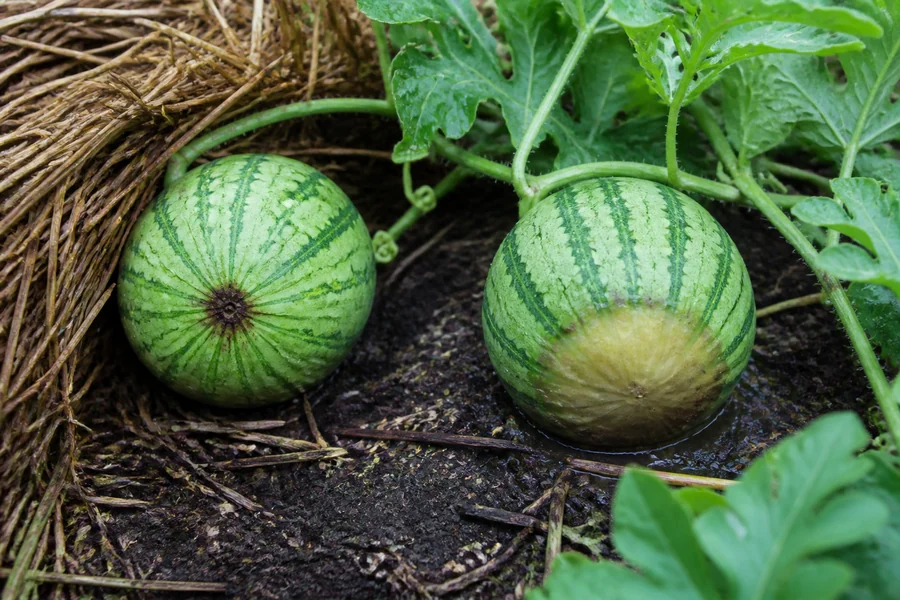
How to identify it
- The affected melons are similar in size and began expanding during the same hot, dry, or very wet interval.
- Soil is dry beneath the mulch in one part of the root area but wet near an emitter or low spot.
- Water has run off a crusted or sloping bed instead of soaking across the vine's root zone.
- Younger fruit that formed after irrigation became steadier has clean, firm blossom ends.
- Leaves may look normal now because the vine recovered before the fruit lesion became obvious.
What to do
- Check soil below the surface at more than one location before changing the watering schedule.
- Apply water slowly enough to wet a broad root area rather than one channel beside the crown.
- Use the season-and-soil watering checks to decide when the bed needs water instead of catching up with a large soak after visible wilt.
- Keep an organic mulch layer over the wetted area while leaving the crown itself uncovered.
- After a heavy rain, confirm that water drains and air returns to the root zone before irrigating again.
02 Common contributor
Roots cannot use the water that is present
A watermelon vine can sit beside damp soil yet receive an uneven supply when cultivation has cut feeder roots, compaction limits their spread, or prolonged saturation deprives them of oxygen. Local root trouble explains why one vine or one end of a row can be affected while neighboring plants stay clean.
How to identify it
- Damage is concentrated on vines beside a walkway, wheel track, recently hoed strip, or puddling area.
- One plant wilts longer than its neighbors even though the nearby soil feels wet.
- A soaker hose or drip line wets only a narrow strip while much of the mulched bed remains dry beneath the surface.
- The crown or older leaves decline along with repeated blossom-end lesions.
- Water ponds, runs away, or disappears down cracks without wetting the soil between them.
What to do
- Stop cultivating near established vines and pull small weeds without tearing through the root area.
- Redirect foot traffic and avoid lifting or repeatedly moving vines once fruit expansion begins.
- Split a long irrigation into slower passes when compacted or sloping soil sheds water.
- Repair compacted garden soil between crops rather than digging aggressively around a fruiting vine.
- Correct standing water and blocked drainage before treating the symptom as drought.
03 Possible
Rapid growth or excess salts raised the demand
A strong nitrogen push can produce a large thirsty canopy and rapid fruit growth just when roots are struggling to keep calcium moving. Accumulated fertilizer salts also make water harder for roots to take up, so another feed can worsen the transport problem rather than correct it.
How to identify it
- The vine turned unusually lush and dark green after a fertilizer or manure application.
- Fruit enlarged quickly during a heat spell while the bed dried faster than before.
- White mineral residue appears where irrigation evaporates, or a soil test reports elevated soluble salts.
- Several melons of the same age developed lesions after the same feeding and weather interval.
- Later fruit improves after unplanned feeding stops and moisture becomes steadier.
What to do
- Pause extra fertilizer and list every nutrient product recently applied to the bed.
- Do not use Epsom salt for this symptom because it supplies magnesium rather than calcium.
- Base future feeding on soil evidence and crop need instead of trying to force an affected melon to recover.
- Maintain steady moisture while the vine adjusts, without flushing a poorly drained bed into saturation.
- Use new growth and new fruit as the response signal rather than the old lesion.
04 Less common
A soil test shows a calcium or pH problem
Some beds truly contain too little available calcium or sit at a pH that needs correction. Repeated symptoms under demonstrably stable moisture make testing useful, but the fruit spot alone cannot choose between lime, gypsum, or no calcium amendment.
How to identify it
- A current laboratory soil test reports low calcium rather than merely an affected fruit.
- The test also shows whether raising soil pH is appropriate.
- Blossom-end rot recurs across susceptible crops despite broad, stable wetting and healthy roots.
- The bed's amendment history is known, so the result can be interpreted without guessing what was already added.
- New fruit continues to develop centered lesions after water distribution and root stress are corrected.
What to do
- Follow the soil laboratory's amendment and rate recommendation for the bed.
- Use lime when the test calls for calcium and a pH increase, not simply because a melon has a dark end.
- Consider gypsum only when calcium is needed without the same pH change and local guidance supports it.
- Work long-term amendments into soil before a future crop when practical because they cannot rebuild damaged rind.
- Keep irrigation steady after correction because calcium in soil still needs functioning roots and water movement to reach fruit.
Confirm the Mark Belongs to the Blossom End
Find the stem attachment first, then look directly opposite it for the small blossom scar. Blossom-end rot expands outward from that point as a pale or water-soaked area that becomes tan, brown, or black, with a dry leathery surface that may sink as the tissue collapses.
A watermelon lying on damp ground can develop a belly or contact rot where its underside touches soil. That lesion follows the contact patch rather than the blossom scar and may become soft, water-soaked, or patterned as decay advances.
Sun injury belongs on exposed upper or side rind, while poor pollination stops normal fruit development before a substantial melon carries this centered leathery patch. These positions matter more than color alone because several injuries eventually turn dark.
Blossom-end rot can later become soft, fuzzy, leaking, or foul when secondary organisms enter dead tissue. That later decay changes what to do with the fruit, but it does not turn the original calcium-transport failure into a contagious disease that fungicide will reverse.
Map Water Across the Vine's Root Zone
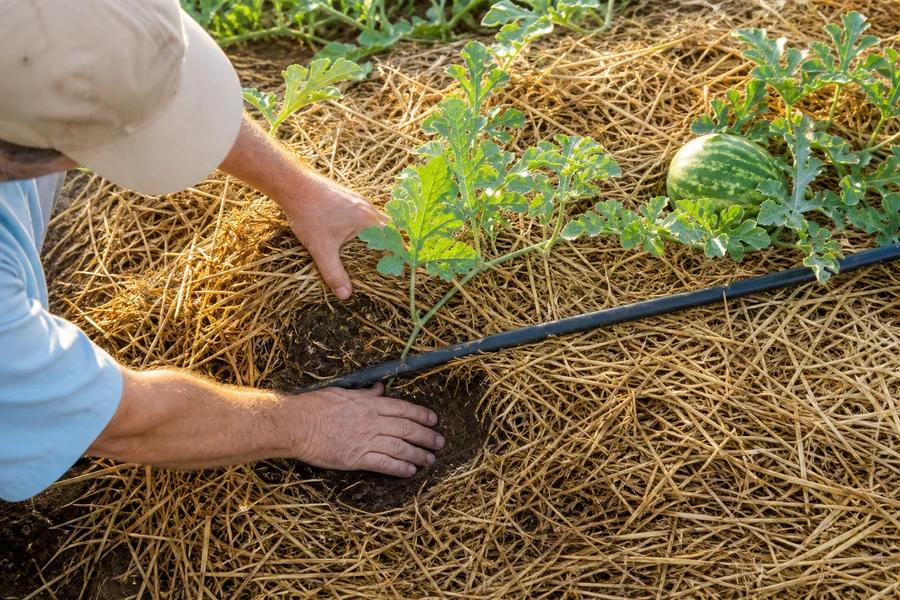
Watermelon roots occupy more of the bed than the visible crown, while hoses, slopes, crusts, and mulch can hide sharp differences in moisture.
A useful check samples the wetted area and a second point farther along the vine without digging through roots.
- Choose one point between the crown and the irrigation line, then a second point farther across the mulched root area.
- Lift only a small mulch patch and feel or probe below the dry surface without cutting roots.
- Compare whether both samples are beginning to dry, evenly damp, saturated, or dry beside a narrow wet channel.
- Run irrigation slowly and stop to see whether water entered those locations instead of flowing downhill or through cracks.
- Replace the mulch without piling it against the crown, then repeat the same check after the next hot day or heavy rain.
- Adjust timing or hose placement from the pattern you measured and watch the youngest enlarging fruit for clean blossom ends.
A soaker hose is useful only when its output reaches the needed width and depth. The soaker-hose setup guide explains pressure, spacing, and an after-run soil check when one line leaves dry pockets.
Stable moisture does not mean permanently wet soil. Sandy beds may need a different interval from clay beds, rain changes the next decision, and every root zone needs oxygen between irrigations.
If repeated checks show that water cannot enter compacted ground or drains into one channel, treat that physical limit as the cause. Adding more minutes to the same irrigation pattern can leave the wet part wetter without reaching the dry part.
Make Calcium a Test Result
Low calcium inside damaged rind is part of blossom-end rot, but it does not reveal the amount of calcium in the bed. Transport can fail in calcium-rich soil whenever dry, saturated, salty, compacted, or injured roots cannot maintain water uptake.
Foliar calcium cannot rebuild rind cells that have already collapsed, and fruit tissue receives little benefit from a spray after the critical growth period has passed.
Test a recurring bed so the laboratory result, pH, and amendment history guide the decision.
- Agricultural lime
- Use only when the soil test calls for calcium and raising pH.
- Gypsum
- Consider only when the test shows a calcium need without the same pH increase.
- Foliar calcium
- Do not expect it to heal the lesion or replace stable root-zone water.
- Epsom salt
- Skip it because it supplies magnesium, which does not correct a calcium shortage.
- More fertilizer
- Pause unless evidence shows a nutrient need, since salts and rapid growth can increase stress.
For the current crop, correct water distribution and protect roots first unless a recent result already documents a shortage. Apply any recommended amendment at the laboratory rate and keep the record for the next planting instead of stacking products after every affected melon.
Decide the Fruit's Fate
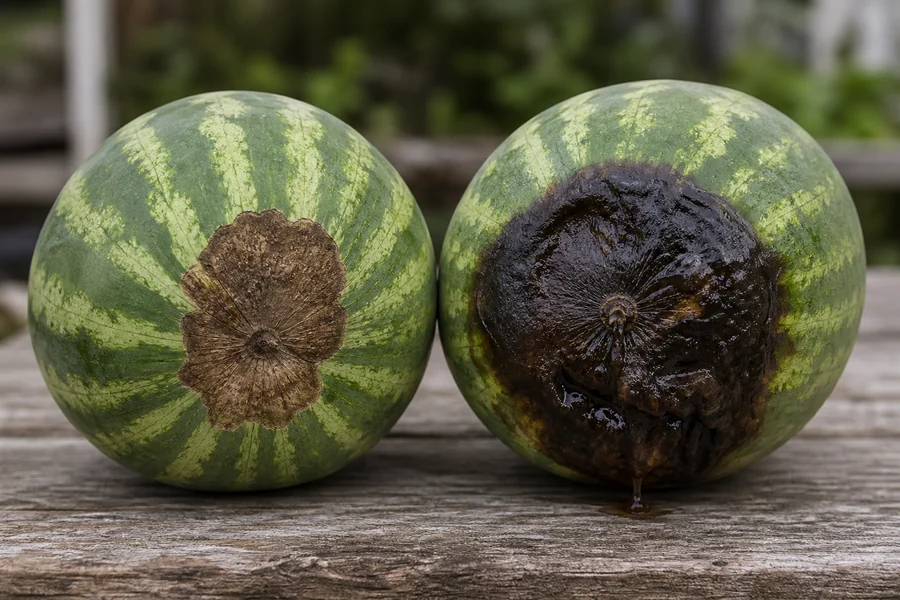
The affected rind will not turn green and fill in after irrigation improves. Mark a small dry lesion and watch whether it stays localized while the melon grows, but remove a severely damaged young fruit when collapse is advancing and there is little sound crop left to mature.
A ripe melon with a minor dry scar requires a quality judgment after harvest, while a deeply damaged immature melon usually declines before producing useful flesh. Do not treat a changed surface as proof that the interior is sound.
Judge the repair on the next fruit cohort. Firm, normally colored blossom ends on melons that expand after the root-zone correction are better evidence than any change in the original scar.
Recovery Plan
Confirm the lesion and reconstruct the water history
Locate the blossom scar, check whether the lesion is dry or secondarily decayed, and inspect two parts of the root zone. Review rain, irrigation, heat, feeding, cultivation, and runoff from the period when the fruit was smaller.
Watch fruit that is still small
Maintain broad, even moisture without saturating the bed.
Young melons should remain firm at the blossom end as they enlarge, while the original lesion stays visible even if the underlying stress has ended.
Escalate only when the pattern continues
Clean later fruit confirms that water delivery recovered. Repeated centered lesions after root and irrigation problems are corrected justify a laboratory soil test and a review of pH, calcium, salts, drainage, and amendment history.
Protect early fruit expansion by watering from below the mulch, checking more than one part of the root zone, keeping traffic and cultivation away from established vines, and avoiding unplanned fertilizer pushes. Follow the watermelon growing guide for spacing and season-long culture, then record which weather and irrigation interval produced each fruit cohort so a future lesion can be traced to conditions rather than treated by guesswork.