
Squash Vine Borer on Zucchini: Confirm Frass Before Cutting
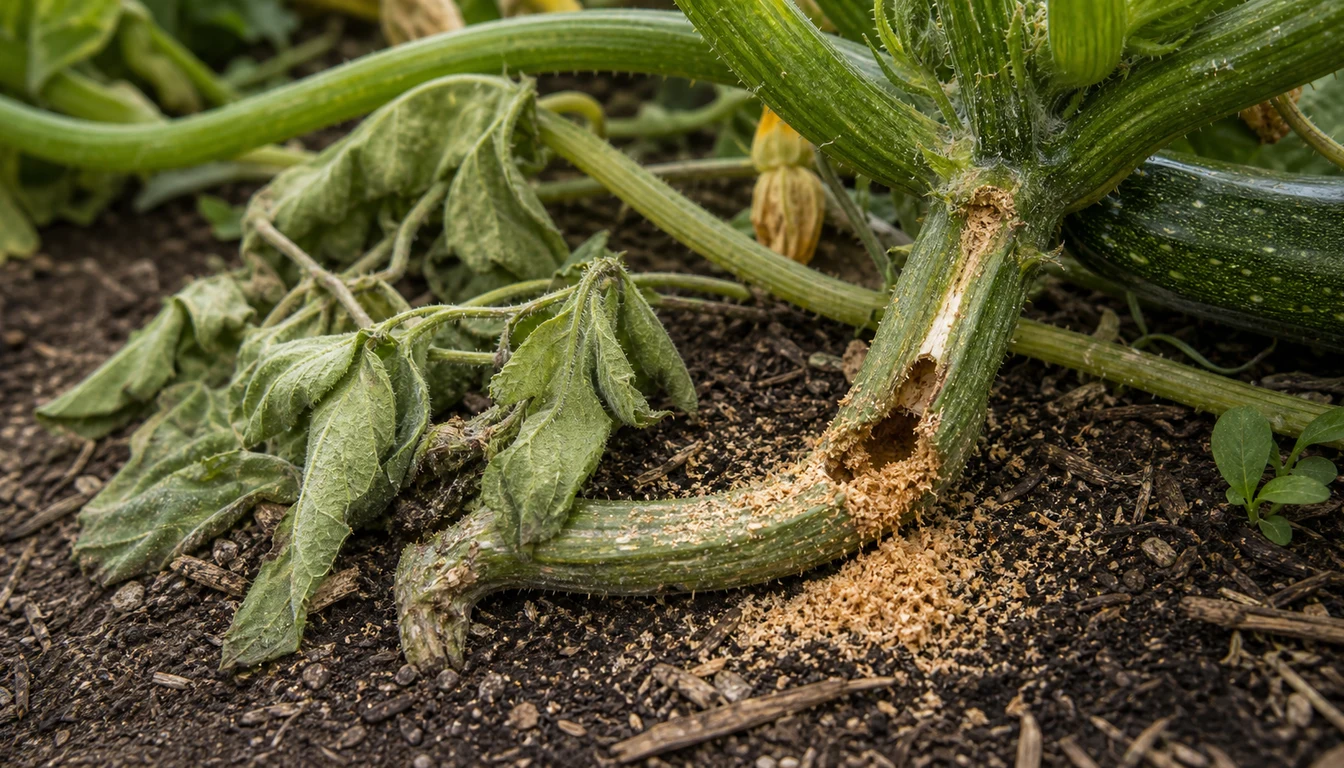
A zucchini vine that wilts in the morning and leaks moist greenish or orange sawdust-like frass from a lower stem may contain squash vine borer.
Confirm the entry point before cutting, then decide whether firm crown tissue can support surgery or the plant should be removed before larvae enter the soil.
Quick diagnosis
A cream-colored squash vine borer larva is feeding inside the crown or lower stem
Inspect a wilted plant early in the day.
Look for a hole or split near the soil line with moist coarse frass, then press the crown to find the length of firm tissue. Strong-sun wilt alone is not enough because drought, bacterial wilt, crown rot, and squash bugs can weaken zucchini without leaving a frass-filled tunnel.
Open the full diagnosisWhat You Are Seeing
The adult squash vine borer is an orange-and-black clearwing moth that flies during the day and resembles a wasp. It lays small flat brown eggs near susceptible stems, and the cream larvae enter soon after hatching, where ordinary contact sprays can no longer reach them.
A larva feeds through the center of the stem and blocks water movement. The first wilt may appear only during strong sun, but a plant that remains wilted in the morning deserves an immediate stem-base inspection because several larvae can occupy one plant and destroy the crown.
Diagnosis controls how much damage you do while trying to help because one accessible tunnel in an otherwise firm stem may be opened, while a soft crown with several entry points is a poor salvage candidate.
A dry bed with no frass needs water, and wilt paired with cucumber beetle feeding but no tunnel needs a different disease check.
Common Causes
01 High likelihood during local flight
Adult moths are laying eggs on lower stems
Adults emerge from soil near previous host plants and fly in daylight. Eggs hatch in about a week, so the useful prevention window begins when adults are first seen and closes rapidly after larvae enter stems.
How to identify it
- An orange abdomen with black dots and clear hind wings distinguish the day-flying moth from many wasps.
- Small flat brown eggs occur singly on lower stems or nearby plant surfaces.
- A yellow pan trap or direct garden observation detects adults but does not measure how much damage will occur.
- Local extension reports and last year's infestation provide better timing than one national calendar date.
What to do
- Begin daily stem checks when adults appear locally or susceptible vines begin running.
- Remove visible eggs without damaging the stem and inspect nearby plants for fresh frass.
- Use a securely edged floating row cover only when the bed did not hold susceptible cucurbits the previous year.
- Remove the cover when flowers open so bees can reach them, or provide deliberate hand pollination while exclusion remains in place.
02 High likelihood when frass is fresh
A larva is feeding inside one reachable stem
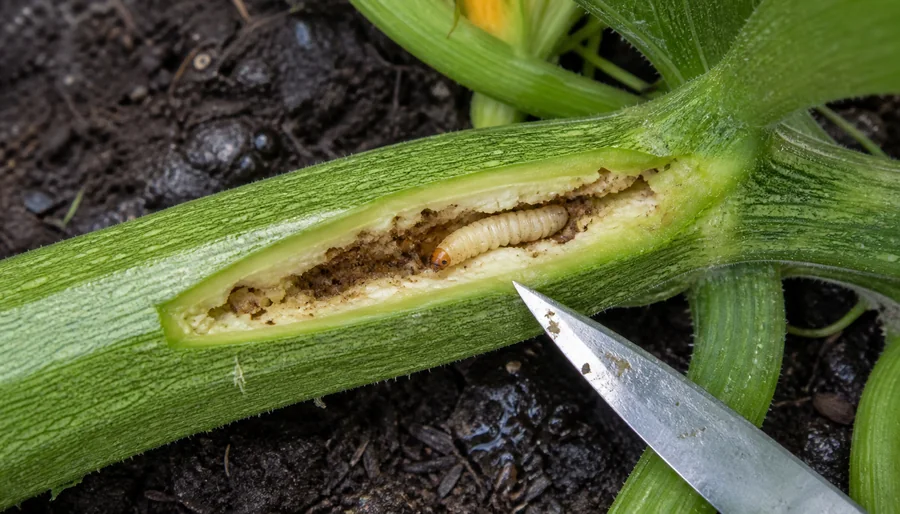
A cream larva with a brown head feeds inside a frass-lined tunnel. One early tunnel in firm tissue offers the best chance for surgery, although opening a stem never guarantees recovery.
How to identify it
- Moist greenish or orange sawdust-like material collects at an entry wound.
- Wilt begins beyond the injured stem while another branch may remain firm.
- Gentle pressure traces a hollow or weakened section without finding widespread crown softness.
- A careful lengthwise slit exposes a tunnel and sometimes the larva itself.
What to do
- Mark the frass point and support the vine before making one shallow lengthwise slit.
- Extend the slit only far enough to locate and kill every reachable larva in that tunnel.
- Keep the stem attached, close it gently, and mound moist soil over the wound so nodes can form supporting roots.
- Water the root zone normally and watch the repaired branch for renewed firmness rather than flooding the wound.
03 Urgent with several entry points
Several larvae have destroyed the crown
Multiple borers can attack one plant. When several soft tunnels meet in the crown, cutting farther often removes the structure needed to carry water or support new roots.
How to identify it
- Frass emerges from more than one side of the crown or from several lower stems.
- The crown feels soft, hollow, or rotten across most of its width.
- Most branches remain wilted in the morning despite adequate soil moisture.
- Opening one entry reveals connected tunnels or damage that continues below the soil line.
What to do
- Harvest usable fruit before the plant deteriorates further.
- Pull the entire plant with the damaged crown and inspect it for larvae.
- Kill larvae and bag or otherwise destroy infested tissue rather than composting an intact crown locally.
- Check remaining squash individually because removing one plant does not prove its neighbors are infested.
04 Possible in a repeated cucurbit bed
A row cover trapped emerging adults inside
Larvae leave stems, burrow into nearby soil, and remain there until adults emerge the following season. A cover placed over the same bed can confine those moths with the new crop instead of excluding them.
How to identify it
- Squash or pumpkins grew in this exact bed during the previous season.
- Adult moths appear beneath an intact cover whose edges remain sealed.
- Eggs or fresh frass occur even though outside moths could not enter.
- Old crowns or vine residue remained near the planting area.
What to do
- Remove trapped adults and inspect every lower stem before resealing or abandoning exclusion.
- Rotate susceptible cucurbits to a different bed when possible.
- Do not present a repeated-bed cover as complete protection.
- Destroy killed plants promptly and remove crop residue after harvest.
05 Common after wilt appears
Prevention began after larvae entered
Foliar Bt and contact sprays depend on exposed targets.
Once a larva is inside the stem, it is protected, so late spraying cannot repair the tunnel or reliably kill the hidden insect.
How to identify it
- Wilt and frass were already present before treatment began.
- Spray reached leaves but not the protected larva inside the stem.
- The damaged branch continues collapsing despite a recent application.
- New entry points may still appear if eggs are hatching elsewhere during adult flight.
What to do
- Use stem surgery or plant removal for confirmed internal larvae.
- Reserve any pesticide decision for unentered larvae during a locally verified flight window.
- Select only a product whose label names the crop and pest, and follow harvest intervals and pollinator precautions.
- Do not inject Bt or unlabelled mixtures into stems as a routine rescue method.
Treatment works only when it matches the life stage
Adults and eggs are exposed, but larvae become protected as soon as they bore into the plant. That boundary explains why exclusion and any labeled preventive treatment must be timed before entry, while a wilted frass-producing stem needs physical inspection rather than another foliar spray.
Bt must be eaten to work and is not effective against a larva already protected inside a zucchini stem. Broad-spectrum insecticides can also harm bees, so flowering crops require strict label use, pollinator timing, and a clear reason to treat rather than calendar spraying.
Larvae feed for several weeks, leave the stem, and pupate one to two inches into the soil.
Prompt removal of killed plants and rotation reduce the chance that the same bed supplies adults directly beneath next year's cover.
Prove the Borer Before Opening the Stem
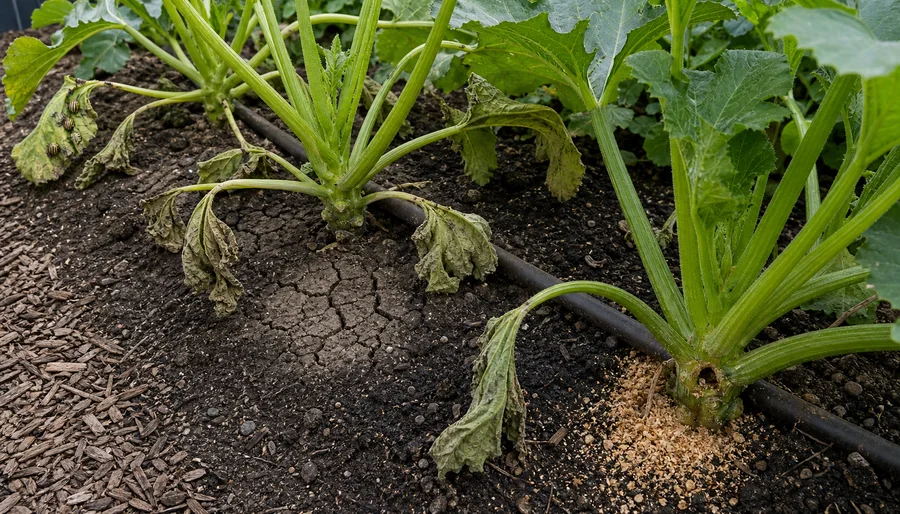
Inspect during the cool morning, when a healthy watered zucchini should have recovered from ordinary afternoon heat wilt. Follow each collapsed leaf stalk toward the crown and look underneath stems because the entry hole may face the soil.
Fresh borer frass is coarse, moist, and greenish or orange rather than a dry crack in the stem. Press gently above and below it to estimate how far the tunnel travels before deciding whether a slit is justified.
- Squash vine borer
- One plant or branch wilts and a lower stem carries an entry hole with moist sawdust-like frass. Open only the confirmed tunnel.
- Drought or heat wilt
- Several plants droop in uniformly dry soil, improve after the heat passes or the root zone is watered, and have no entry wound or frass.
- Bacterial wilt
- Wilt occurs with cucumber beetle feeding and no basal tunnel. Cutting for a borer will not correct the disease pathway.
- Squash bugs
- Egg clusters, gray nymphs, or adults occur on leaf undersides and stems, but no larva-filled tunnel or coarse frass leaves the crown.
- Crown rot
- The crown is wet and soft without sawdust-like material or a distinct feeding tunnel. Review soil drainage and disease conditions before surgery.
White powder on zucchini leaves and a dark sunken fruit end each need their own diagnosis. Neither symptom confirms the internal stem feeding that makes surgery relevant.
Open One Salvageable Stem or Remove the Plant
Attempt surgery only when the crown and most of the affected stem remain firm, the tunnel can be traced, and useful foliage lies beyond it. Remove the plant when several tunnels meet, the crown is broadly soft, or no intact pathway remains.
- Support the affected vine and mark every frass point before cutting.
- With a clean sharp knife, make a shallow slit along the stem rather than across it.
- Locate and kill each cream larva in the opened tunnel, then stop cutting once firm tissue resumes.
- Close the stem gently and mound moist soil over the wound and nearby nodes to encourage new roots.
- Monitor the branch each morning and remove the plant if wilt or crown softness continues to spread.
A repaired plant may survive but still yield less because lost vascular tissue does not regenerate instantly. Keep fruit load reasonable and judge recovery by morning firmness, intact new growth, and the absence of fresh frass.
Exclude Adults Without Blocking Pollination

Watch for the day-flying orange-and-black moth when susceptible vines begin running, and use local extension timing because adult flight changes by region. A yellow water trap can confirm presence, but it does not replace stem inspection or create a treatment threshold.
Cover a rotated bed securely so adults cannot walk beneath the edges. Do not cover zucchini planted where susceptible squash grew last year because overwintered borers may emerge inside the barrier.
Remove the cover when flowers open so bees can pollinate them, unless you are deliberately hand-pollinating and continuing short-term exclusion. A second planting timed after local egg laying ends can sometimes avoid the main flight, while the differences among summer and winter squash help explain why butternut is less often attacked than susceptible zucchini.
At season's end, pull dead crowns, destroy infested tissue, and rotate the next susceptible crop when space allows. These actions interrupt the local cycle more directly than companion planting or a heavy mulch layer whose protection has not been demonstrated.
Recovery Plan
A saved branch should regain firmness
After the larva is removed and the wound is covered, inspect before daytime heat. Continued morning wilt, new frass, or expanding crown softness means another larva remains or the stem cannot recover.
New roots may support the repaired stem
Nodes under the soil mound may root and help the vine carry water around the injury. Avoid repeatedly opening the wound, and remove a plant that keeps declining rather than letting larvae finish development unnoticed.
Monitor every plant separately
Adult flight may produce new entries on neighboring plants, but one infested plant does not prove all are damaged. Check stems for fresh frass and continue harvesting from firm healthy vines.
Use the normal zucchini growth and flowering stages to time protection. Rotate away from last year's bed, monitor before larvae enter, seal covers only before bloom, and remove them for pollination.
Pull killed plants promptly and destroy infested crowns. Follow every current pesticide label and pollinator restriction, and do not substitute companion planting, unlabeled stem injections or late Bt sprays for life-stage timing.