
String of Pearls Shriveled? Check Moisture and Root Function
Shriveled String of Pearls can reflect dry mix or roots that cannot supply the leaves, including roots damaged while the pot stayed wet. Pot weight, moisture within the root ball and the condition of attached stems help decide whether to rewet the mix or investigate the roots.
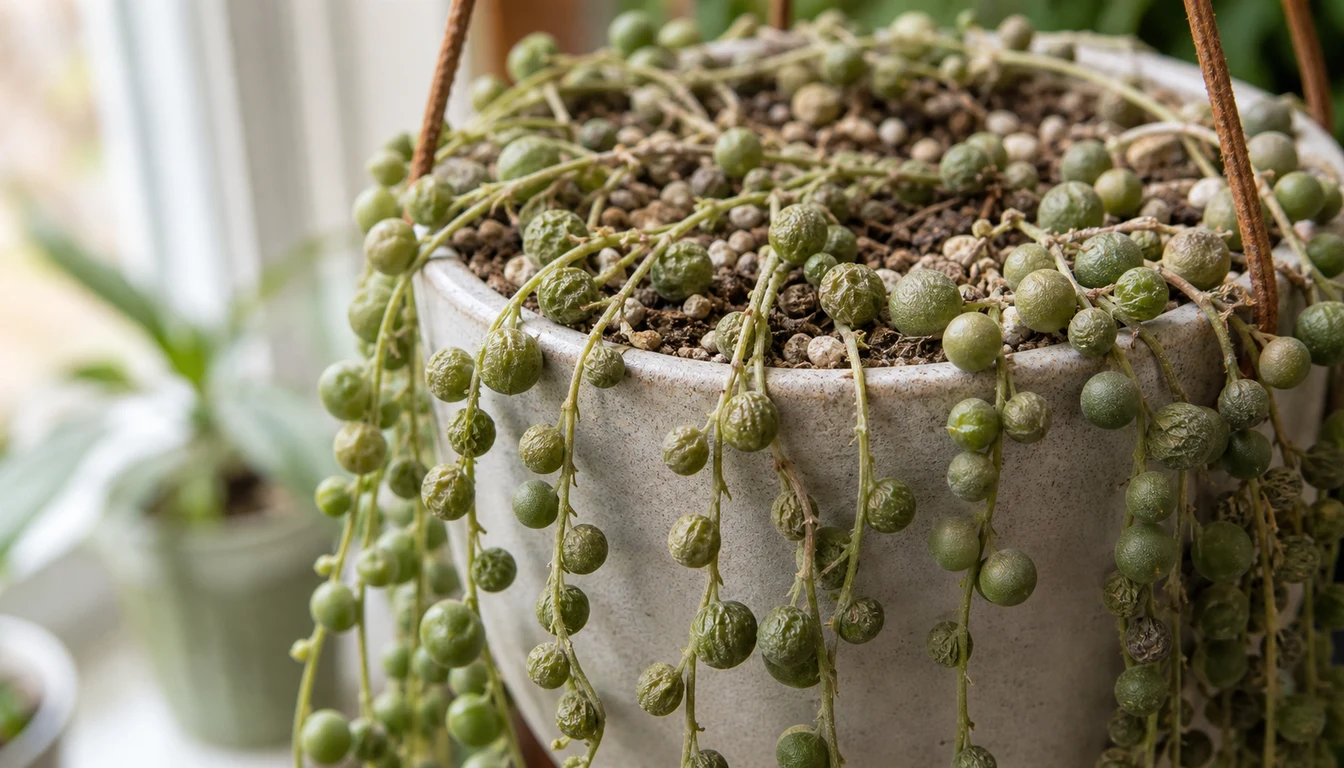
Quick diagnosis
A dry-looking vine does not always need more water
A light pot with a dry root zone supports careful rewetting. A damp, heavy pot with continuing shrivel calls for a root and stem check before more water. Green stems, firm pearls or a lack of odor cannot rule out root damage; soft or collapsing tissue needs the separate mushy-stem assessment.
Open the full diagnosisWhat You Are Seeing
The round leaves of String of Pearls store water. Their shape limits the surface exposed to dry air, and a narrow translucent window admits light into the leaf. That normal stripe is different from a whole leaf collapsing or becoming glassy.
As a leaf loses water it can become smaller and wrinkled. The useful next question is why its supply fell. Water may be absent from the mix, or present around roots that are damaged and cannot take it up.
The plant forms a relatively small surface-root system. A small pot can dry quickly, but deeper unused mix can also stay wet after its surface looks dry. Neither “shallow” nor “succulent” makes watering automatic.
Runoff is not proof of even wetting. Very dry mix can shrink from the pot wall or resist absorbing water, leaving a dry pocket even after water reaches the drainage hole. That possibility is worth checking before shortening the interval between waterings.
Common Causes
01 Possible
The shallow root mat has used its available water
When the root-bearing mix has dried, the leaves may lose more water than the roots can replace. A lighter pot and dry mix at more than one accessible point support a watering decision. The absence of visible stem damage does not certify healthy roots.
How to identify it
- Several attached pearls have become smaller or wrinkled.
- The pot feels lighter than after its last watering and drainage.
- Mix within the root zone feels dry, rather than only the exposed surface.
- Recent watering, heat or placement history offers a plausible reason for the dry-down.
What to do
- Water slowly across the root zone until the mix accepts water and runoff appears from the drainage hole.
- Let the container drain fully and empty its saucer or outer pot.
- Check an accessible part of the root-bearing mix after watering, using touch or a clean wooden skewer gently. A single probe can miss a dry pocket.
- Return the plant to suitable bright indirect light and watch its response while allowing normal drying between waterings.
- Recheck the pot sooner after a warmer, brighter, or windier placement change without adopting a fixed interval.
02 Possible
Water is bypassing contracted dry mix
Potting mix that has become extremely dry can pull inward or resist absorbing the first pass of water. The open channel beside the wall becomes an easy route to the drainage hole, leaving the root-bearing center almost untouched.
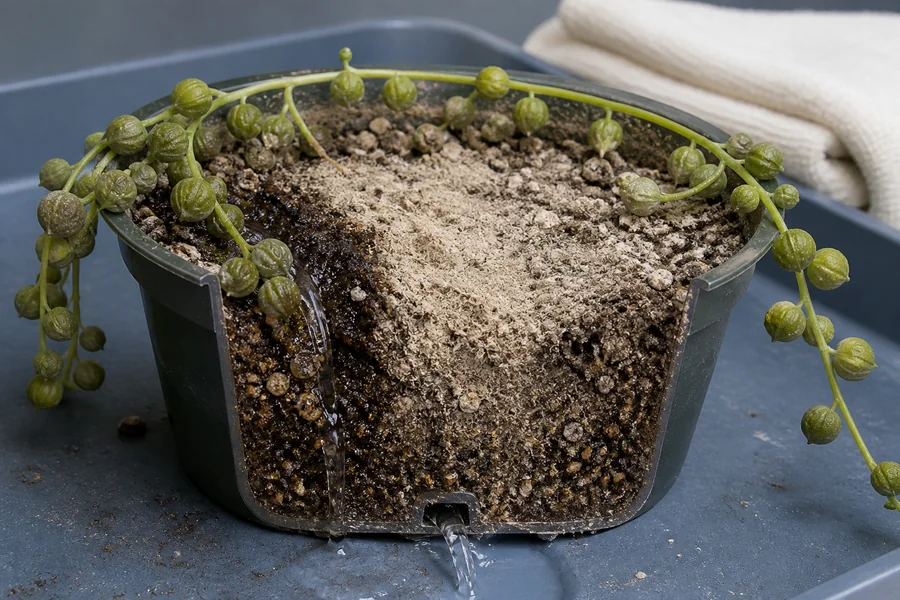
How to identify it
- A visible gap separates the root ball from part of the pot wall.
- Water exits seconds after pouring even though the pot still feels light.
- The surface darkens only in narrow paths while other areas remain pale and dusty.
- A skewer inserted into the center emerges dry after runoff has stopped.
What to do
- Rewet dry mix in slow passes, checking that water enters the root ball rather than escaping at the wall.
- If the mix still resists water, temporary bottom watering can help. The procedure below explains when to remove and drain the pot.
- Replace deteriorated mix when uneven wetting persists, while supporting the fine roots and stems.
03 Possible
Crowded roots or deteriorated mix make watering unreliable
A tightly filled root ball can leave little mix between the roots. Deteriorated media may also hold water unevenly or drain poorly. Inspection distinguishes those conditions from assuming that repeated shriveling always means the pot is too small.
How to identify it
- Roots crowd the drainage opening or form a tight mat around the outside of the mix.
- Very little loose mix remains when the plant is eased from its pot.
- Some parts become wet while dry pockets persist under the same crown.
- The plant needs rewetting much sooner than before even though its light and temperature have not changed.
- New vine growth slows while older attached pearls repeatedly lose firmness.
What to do
- Support the trailing stems while easing the root ball from the container if moisture checks and repeated poor wetting justify inspection.
- Look for crowded roots, persistent dry pockets or mix that stays saturated. Those conditions require different corrections.
- Keep intact roots where possible and replace deteriorated mix with a draining medium that accepts water.
- Match the replacement pot to the living root volume rather than automatically increasing its depth.
- If stems have lost their root supply, consider separate stem cuttings after assessing the tissue.
04 Possible
The pot is drying faster after a placement or weather change
More light, warmer air, a fan, an open window, outdoor wind, or a porous unglazed pot can shorten the time a shallow root mat holds water. The old routine then falls behind even though each individual watering is thorough.
How to identify it
- Shriveling began after the basket moved closer to glass, outdoors, or into stronger airflow.
- The whole pot becomes light sooner while the crown and stems remain firm.
- The exposed part of the pot dries sooner. Scorch or cold damage may coexist and needs its own exposure check.
- Mix in an unglazed clay pot loses moisture faster than the same mix did in plastic or glazed ceramic.
- The plant responds to complete watering, then wrinkles again as the changed setting dries the pot.
What to do
- Check pot weight and center moisture more often while the plant adjusts to the new setting.
- Move it out of direct fan, heater, or air-conditioner flow without removing the bright indirect light it needs.
- Acclimate outdoor plants gradually and protect the shallow pot from intense midday sun and drying wind.
- Choose a less porous shallow container when an unglazed pot dries faster than the household can monitor safely.
- Keep water reaching the whole root zone when it is needed, while adjusting the timing to the changed conditions.
05 Possible
Root damage limits uptake despite available moisture
Prolonged wetness reduces oxygen around fine roots, and root disease, severe drying or handling damage can also reduce uptake. A plant may therefore shrivel above damp mix. Continuing to add water cannot replace lost roots.
How to identify it
- Shriveling continues while the root-bearing mix is still damp.
- There is a history of prolonged wetness, severe drying or a recent disturbed root ball.
- Some stems have little attachment to the mix; do not pull them up simply to test resistance.
- When inspection is justified, roots may be sparse, decayed or easily broken. Appearance alone does not identify a pathogen.
What to do
- Avoid another watering while the root zone is damp and inspect the root ball if decline continues.
- Retain an original crown only if enough apparently sound, connected tissue remains for a realistic recovery attempt.
- Remove rotten portions with clean tools, using a clean container and fresh growing medium for retained material.
- Assess soft stems and collapsed leaves through the mushy-stem pathway before choosing cuttings.
- Discard severely decayed plants. If separate sound stem sections remain, root them apart from suspect material and watch for renewed decline.
Water Availability and Water Uptake Are Different
A leaf is the end of a supply route through stems and roots. Wrinkling shows a change in the leaf; it does not reveal every condition along that route. A firm green upper stem can remain attached to roots that are already damaged.
A dry root zone supports rewetting. Continued decline above damp mix instead calls for inspection of roots, connected stem tissue and recent exposure. Waterlogging and root pathogens can produce overlapping symptoms, so naming a disease requires more than matching a picture.
Cold exposure or sudden strong light may injure part of a plant while its watering is otherwise adequate. Recent contact with cold glass or a move into hot sun is useful history, but damage confined to one side does not automatically exclude root problems.
Softness, collapse or a spreading dark area changes the priority from rehydrating dry mix to assessing damaged tissue. The related mushy-stem article covers that decision in more detail.
Rewetting Mix That Has Actually Dried
Top watering works when the mix accepts a slow pour. If severely dried mix repeatedly channels water past the root ball, temporary bottom watering can help it absorb moisture. The pot must have drainage holes, and the crown and leaves remain above the water line.
- Lift the pot and inspect accessible root-zone moisture before adding water.
- Apply room-temperature water slowly across the surface, pausing to let it soak in.
- If water bypasses dry mix, set the lower pot in shallow water and monitor moisture wicking upward.
- Remove the pot when moisture reaches the upper mix, then allow drainage and empty any saucer or cover pot.
- Recheck an accessible central area gently. If it remains dry, address the uneven wetting rather than repeating whole-pot soaks after the mix is already damp.
This checks whether water entered the mix. It cannot prove that every root is alive or predict how quickly the pearls will regain volume. A misted leaf surface also tells you nothing about moisture in the root zone.
What the Response Can and Cannot Tell You
Less wrinkling or steadier growth after appropriate watering supports a moisture-related explanation. It does not prove that all roots are sound, and there is no single recovery deadline that separates living from failed roots.
An older, badly collapsed leaf may remain damaged while new growth develops. Changes across connected stems and new leaves provide more useful context than insisting that every old pearl become perfectly round.
Persistent decline over damp mix justifies a closer root check. Support the stems and ease the root ball out rather than tugging individual strands. Severely decayed material cannot be restored by fertilizer or another soak.
Where the original root system cannot be retained, apparently sound stem nodes may provide a propagation option. Wear gloves because the sap can irritate skin, and collect fragments away from children and animals. New softness during establishment needs reassessment.
Recovery Plan
Observe before adding more water
Watch the leaves and stems while following root-zone drying. Improved firmness is useful feedback, not proof that no root damage remains.
Protect developing attachments
New growth and rooted nodes suggest progress. Repeated lifting to inspect roots can disrupt them, so observe the plant without pulling on the strands.
Use the pot rather than a permanent interval
Light, warmth, airflow, pot material and root volume affect drying. A future watering decision still needs the actual moisture condition, even after this episode improves.
A draining pot matched to the roots and a mix that wets evenly reduce conflicting wet and dry pockets. Water reaches the root zone, then excess runoff leaves the container.
A warmer or windier location may need more frequent inspection; a slower-drying pot needs more time between waterings. Persistent shriveling over damp mix belongs to a root and stem assessment, not an automatic drought rescue.
Sources
- Curio rowleyanus - NC State Extension Plant Toolbox
- String of Pearls, Senecio rowleyanus - Wisconsin Horticulture
- How to grow string of beads - RHS Growing Guide
- Overwatered Indoor Plants - University of Maryland Extension
- Root Rots of Indoor Plants - University of Maryland Extension
- Watering - Illinois Extension Houseplants