
Zucchini Rotting at the Blossom End? Water Steadily First
Most zucchini that rot at the tip do not have blossom end rot, and one question sorts it out, which is whether the fruit is still getting bigger.
This page covers genuine blossom end rot and its watering cause, the pollination failure that looks just like it, and the wet-weather fungus that looks like neither.
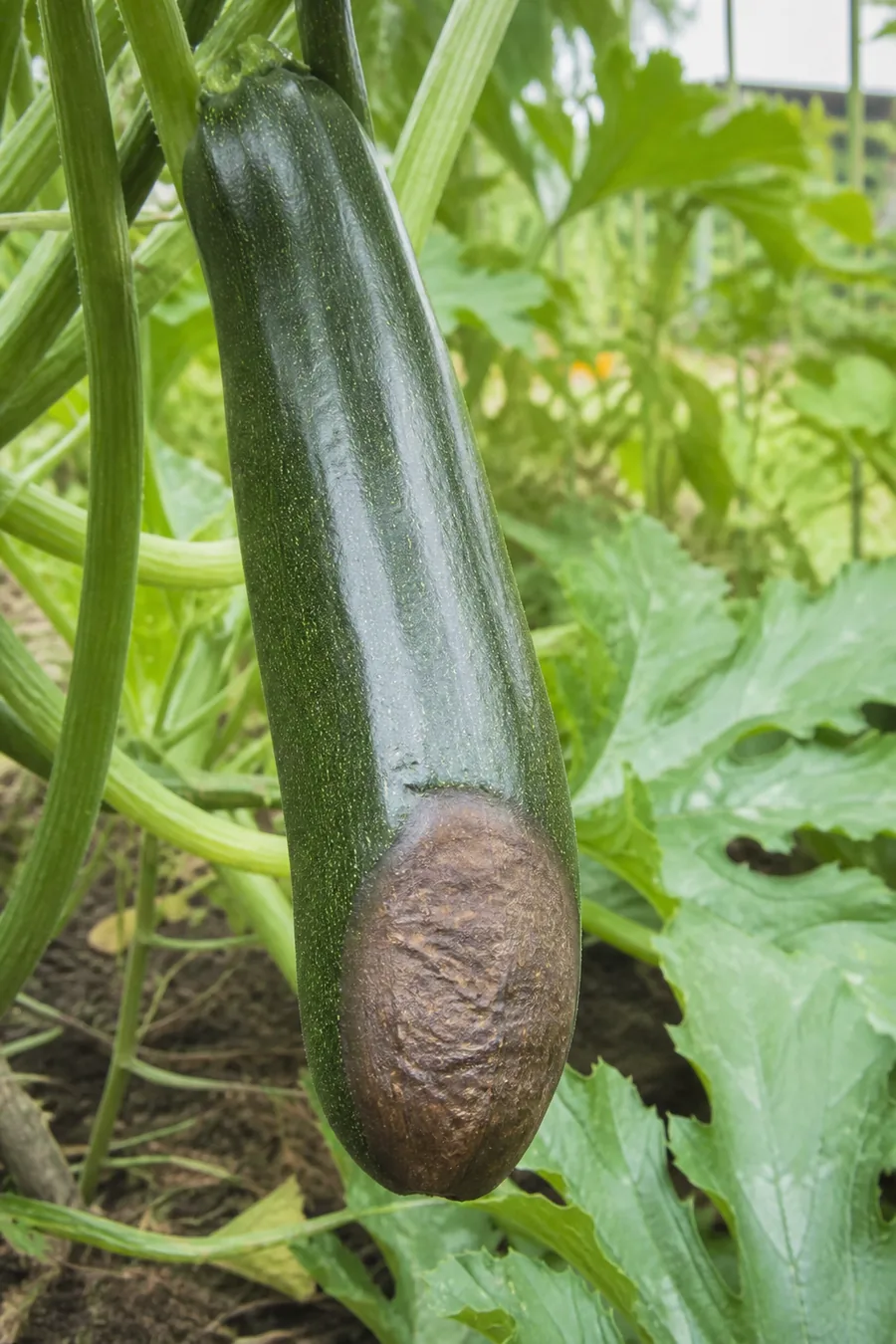
Quick diagnosis
The fruit stopped growing because the flower was never pollinated, which is not blossom end rot.
Watch whether the fruit is still enlarging, because that single observation splits three different problems apart.
A fruit that keeps growing while a dry sunken dark patch spreads at the tip has genuine blossom end rot, caused by water delivery rather than by soil calcium. A small fruit that stops growing, yellows along its whole length and shrivels was never pollinated.
A soft fruit carrying fine white whiskers tipped with black has a fungal wet rot instead.
Open the full diagnosisWhat You Are Seeing
Three unrelated things make a zucchini rot at the blossom end, and they get treated as one problem because they end in the same place on the same fruit. Only one of them is actually blossom end rot.
The reliable way to tell them apart is growth. A fruit with the true disorder carries on enlarging while the lesion develops, whereas a fruit that was never pollinated stops within a day or two and shrivels whole.
Genuine blossom end rot is a physiological disorder rather than a disease. It happens when calcium fails to reach the fastest-growing tissue at the tip of the fruit, and in almost every garden the calcium is present in the soil and simply is not getting there.
Common Causes
01 High likelihood
The flower was never pollinated
This is the commonest reason a zucchini rots at the tip, and it is not blossom end rot at all. An unpollinated fruit yellows along its whole length, softens at the tip, shrivels and drops within a few days, and crucially it never gets any bigger.
Zucchini make it easy for this to happen. Male and female flowers are separate, each female flower is receptive for a single morning, and it closes by midday whether or not a bee arrived.
Early in the season it can be unavoidable. A young plant often produces a run of male flowers before any females appear, and a run of females before enough males are open to pollinate them.
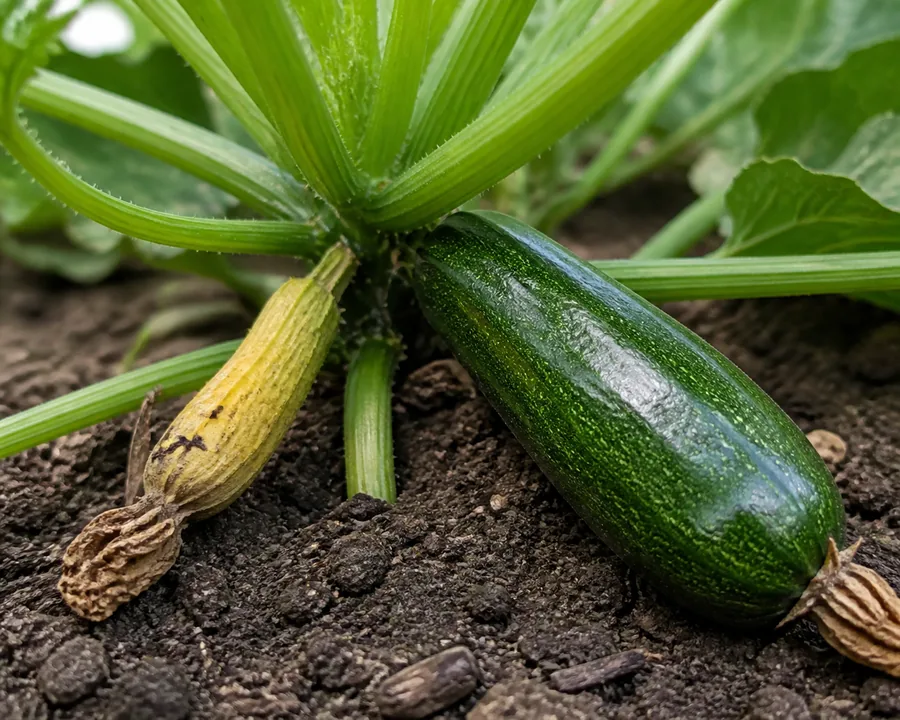
How to identify it
- The fruit is small and has not increased in size since you noticed it.
- Yellowing runs along the whole fruit rather than sitting at the tip.
- The fruit is soft and shrivelled rather than dry and leathery.
- The withered flower is often still attached.
- It is early in the season, or the weather has been cold, wet or very hot.
What to do
- Hand pollinate in the morning while the flowers are open, which takes under a minute per fruit.
- Remove the failed fruit so the plant stops spending on it.
- Plant flowers nearby to bring in more bees, which removes the need to do it yourself.
- Avoid spraying insecticides during flowering, and never in the morning when pollinators are working.
- Give it time early in the season, since the balance of male and female flowers evens out as the plant matures.
02 High likelihood
Irregular watering
This is genuine blossom end rot, and understanding the mechanism explains why the usual remedies fail. Calcium travels up the plant dissolved in the water the roots take in, so it only arrives where water arrives.
Once deposited, calcium does not move again. A fruit swelling during a dry spell cannot borrow from the leaves, so the tissue furthest from the stem, at the blossom end, is the first to run short and collapse.
Swings do more damage than steady dryness. A bed that goes bone dry and is then soaked produces this far more reliably than one kept evenly moist at a lower level, which is why the fix is a rhythm rather than a volume.
The timing also misleads people. The shortage happens days before the mark appears, so the lesion you are looking at reports on last week's watering rather than today's.
How to identify it
- The fruit is still enlarging while the patch spreads.
- The affected area is dry, sunken and leathery rather than soft.
- It starts as a small water-soaked spot and darkens to brown or black.
- The bed has swung between very dry and very wet.
- Other fruit on the same plant are unaffected.
What to do
- Water on a fixed rhythm rather than waiting for the plant to wilt.
- Soak deeply and less often instead of sprinkling daily, which trains roots downward.
- Mulch the bed to hold moisture steady between waterings, which does more than any product.
- Remove affected fruit so the plant redirects its resources.
- Skip calcium sprays, since fruit absorbs almost nothing through its skin and the soil is rarely short anyway.
03 Medium likelihood
Choanephora wet rot
This one is a genuine fungus and it looks unlike the others once you know what to look for. The fruit tip goes soft and water-soaked, then grows a dense coat of fine white hairs tipped with tiny purplish-black heads, which is where its common name of whiskery rot comes from.
It arrives with prolonged wet weather and usually enters through the fading flower still attached to the young fruit. Unlike the disorder, it spreads from fruit to fruit, so leaving affected ones on the plant makes the problem larger.
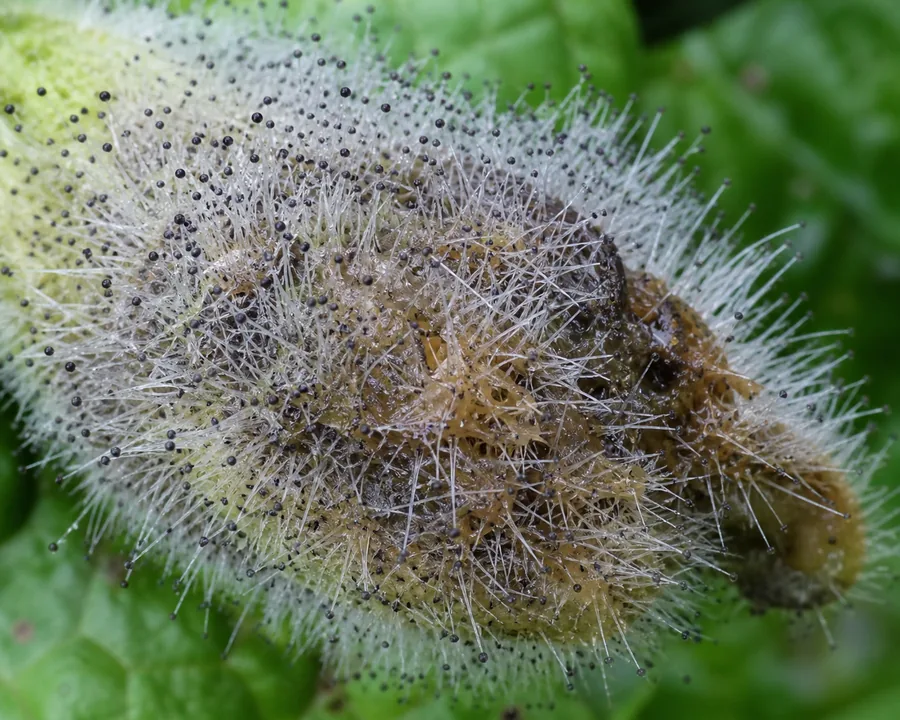
How to identify it
- Fine white hair-like growth with dark tips covers the affected area.
- The tissue is soft and wet rather than dry and sunken.
- The weather has been persistently wet or humid.
- More than one fruit is affected.
What to do
- Remove and bin affected fruit rather than composting them.
- Pick off the spent flowers clinging to young fruit, which is the usual entry point.
- Improve air movement by spacing plants properly and removing some of the oldest leaves.
- Water the soil rather than the plant so foliage and fruit dry quickly.
- Harvest young fruit promptly during wet spells rather than letting them sit.
04 Medium likelihood
Roots damaged by hoeing or transplanting
You can water perfectly and still see this if the roots cannot take the water up. Zucchini root shallowly and spread far wider than the plant looks, so a hoe worked in close severs exactly the roots doing the work.
A recently transplanted plant has the same limitation for a while, which is why the first fruits after planting out are the ones most often affected.
How to identify it
- The bed was hoed or cultivated close to the plants recently.
- The plants were set out shortly before the problem appeared.
- Watering has been consistent and the mulch is in place.
- Only the earliest fruit are affected.
What to do
- Mulch instead of hoeing, which suppresses weeds without cutting roots.
- Pull weeds by hand within a foot or two of the stems.
- Water generously after any disturbance until the plant recovers.
- Expect the next round of fruit to be clean once the roots regrow.
05 Medium likelihood
Containers and restricted roots
A pot can go from saturated to bone dry inside one hot day, and that swing is exactly the condition that produces the disorder. Zucchini are large plants with large appetites, and they outgrow the root volume most containers offer well before the season ends.
How to identify it
- The plant is in a pot or a raised bed with limited depth.
- The container dries out visibly between waterings in hot weather.
- The plant wilts by afternoon even when watered that morning.
- Ground-grown plants nearby are unaffected.
What to do
- Use the largest container you can, and treat anything under about fifteen gallons as marginal for zucchini.
- Water twice a day in hot weather rather than once.
- Mulch the surface of the container just as you would a bed.
- Group pots together so they shade each other and dry more slowly.
06 Medium likelihood
Too much nitrogen
A heavily fed plant grows leaves fast, and fast-growing leaves take up calcium ahead of the fruit. The result is a magnificent-looking plant producing poor fruit, which is a hard pattern to read as overfeeding.
The form of nitrogen matters too. Ammonium-based fertilizers directly hinder calcium uptake at the root, so the same amount of nitrogen from different products does not have the same effect.
How to identify it
- The plant is unusually large and leafy with dark green foliage.
- It has been fed repeatedly or planted in heavily manured ground.
- Fruit production is disappointing relative to the size of the plant.
- The fertilizer used lists ammonium forms of nitrogen.
What to do
- Stop feeding for a few weeks and let the plant balance itself.
- Choose a fertilizer formulated for fruiting vegetables rather than a general high-nitrogen feed.
- Avoid piling fresh manure into the bed before planting cucurbits.
- Feed lightly and often rather than heavily and occasionally.
07 Low likelihood
Soil pH low enough to limit calcium
Strongly acidic soil genuinely does reduce the calcium available to roots, so this cause is real. It is also uncommon, and it is worth saying that plainly, because assuming it leads people to lime beds that did not need it.
How to identify it
- A soil test reads strongly acidic.
- Other calcium-sensitive crops in the same bed show similar problems.
- Steady watering and mulching have not improved matters over several weeks.
- The soil has been heavily amended with acidic material such as pine needles or peat.
What to do
- Test the soil before adding anything, since this is the one cause you cannot diagnose by eye.
- Lime at the labeled rate for your soil type if the test calls for it.
- Expect the correction to take months, so treat it as next season's fix.
- Fix the watering rhythm regardless, because that helps this season and liming will not.
Can You Still Eat It, and Will the Next One Be the Same?
A fruit with the true disorder is perfectly safe to eat once you cut the affected end away, because nothing has infected it.
The rest of the fruit is unchanged.
The fungal version is different, and those fruits belong in the bin rather than the kitchen or the compost heap, since composting keeps the spores in your garden.
No affected fruit recovers, whichever cause it has, and leaving it on the plant costs energy that could go into the next one.
Pick it off and judge whether the fix worked by what sets afterwards.
Is It Really Blossom End Rot?
Run the growth test before anything else. Mark a suspect fruit with a loose loop of string, measure it, and look again the next day, because only one of these problems lets the fruit keep growing.
A fruit that grew has blossom end rot and needs a watering change. A fruit that did not grow, and has yellowed along its whole length, was never pollinated, and no amount of calcium or careful watering will change that.
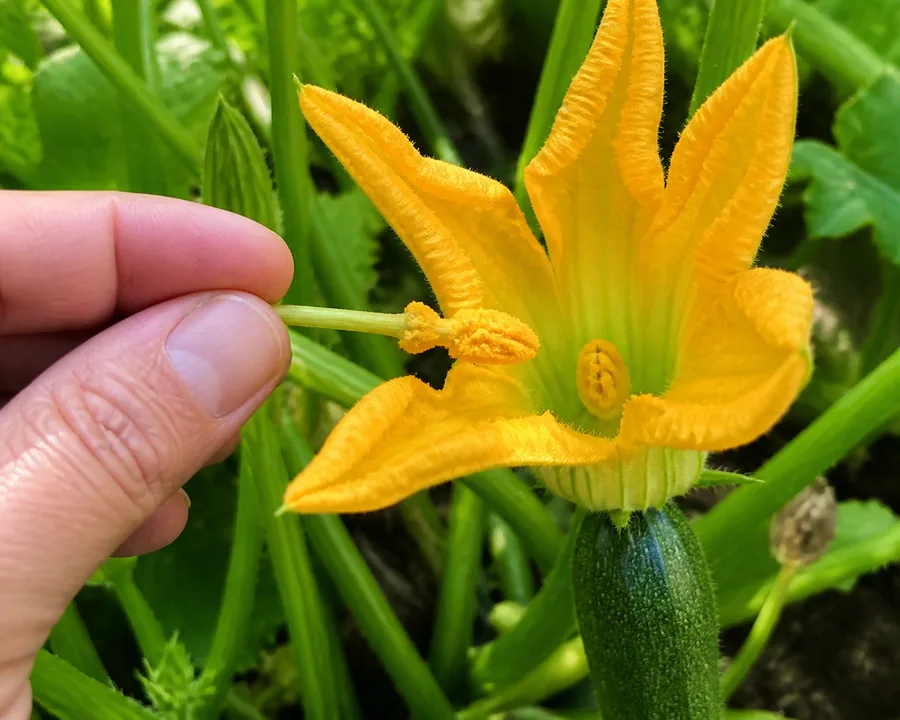
Telling the flowers apart takes one glance. A female flower sits on top of a tiny immature zucchini, while a male flower rises on a plain thin stem with nothing behind it, and a plant needs both open on the same morning.
Hand pollinating is simpler than it sounds. Pick a male flower, tear the petals away to leave the pollen-covered stamen exposed, and brush it against the center of an open female flower until the pollen transfers visibly.
Recovery Plan
Remove and diagnose
Pick off every affected fruit and run the growth test on the next one that sets.
Nothing you do rescues fruit that is already marked.
Where the answer shows
Fruit that sets after the watering is steadied should come through clean. If it does not, the cause was pollination or the fungus rather than water.
Usually it settles
Early-season cases often stop on their own as the plant matures, roots spread and pollinators find the flowers. Persistent cases point at containers, root damage or feeding.
Steady moisture prevents genuine blossom end rot, and mulch does more for that than any bottle. A mulched bed watered on a rhythm holds the even conditions that let calcium reach the fruit, which is the entire mechanism.
For the pollination half of the problem, grow flowers near the vegetable bed and leave the morning to the bees. Hand pollination is a useful rescue, but a garden with pollinators in it does not need one.